RAJA YOGA

          BY
    SRILOY MOHANTY
CONTENTS…


INTRODUCTION
RAJA YOGA
 BAHIRANGA YOGA   ANTARANGA YOGA
   YAMA
                    DHARANA
   NIYAMA
                    DHYANA
   ASANA
                    SAMADHI
   PRANAYAMA
   PRATYAHARA
INTRODUCTION…


Raja yoga is the path of will power

It is also known as patanjali’s yoga or astanga yoga

Astanga yoga = eight (asta) + limbs (anga)

It is mainly divided in to two parts
     Antaranga yoga (direct way to moksha)
     Bahiranga yoga (indirect way to moksha)
Antaranga yoga


Yama (Social Discipline)

Niyama (Self Discipline)

Asana (yogic postures)

Pranayama (mastery through breath)

Pratyahara (mastery over senses)
Yama – Social Discipline

The first component of Ashtanga Yoga

Rules for Social Discipline
(Guidelines on how to behave in society)

These are universal laws respected everywhere
(Laws of Nature)

These are easy to follow
Yama


1.   Ahimsa – Non Violence

2.   Satya – Truthfulness

3.   Asteya – Non Stealing

4.   Brahmacharya – Sexual Control

5.   Aparigraha – Non Possessiveness
Ahimsa


* Means of behavior towards all living creatures

* Absence of harmful intentions or thoughts

* To be followed on three levels

  i) Physical

  ii) Verbal

  iii) Mental

* Generate love & compassion towards all living creatures
Yama – Social Discipline
                           Satya – Truthfulness

Fact is fact
There is no other way than to accept it

We try to hide the facts

We do not accept the facts

One lie requires many more lies to support it

Untruthfulness in all its various forms creates many types of
unnecessary complications in life

Truthfulness is absolutely necessary for the unfoldment of reality
Asetya – Non Stealing

Stealing means to take anything without the
permission of its owner

Yoga sadhaka should not take anything, which does
not belong to them.

They should not even take intangible or highly
prized things, such as credits for something they
have not done.
Brahmacharya – Sexual Control

In its real sense means the abstinence from sexual
indulgence to obtain a higher yogic level

One cannot get real bliss realised by the transcendent
knowledge of higher yogic life, whilst having sexual
pleasures at the same time

One may not be required to give up sexual activities
straightaway, but must completely abstain before
commencing serious practice of Yoga on a higher level.
Brahmacharya – Sexual Control
          (cont.)


A real yogi should be prepared to completely give up, not
only physical indulgence in sexual activities, but also
thoughts & emotions concerned with it

In a wider sense Brahmacharya means a freedom from
cravings of all sensual enjoyments

The attitude of the mind is responsible for these cravings
Aparigraha – Non Possessiveness

 The tendency to accumulate worldly goods is considered a
 basic instinct in human life

 Necessities – comforts – luxuries
(These are subjective & limitless)

 One needs to satisfy its childish vanity & desires, to appear
 superior to others

 One must spend time & energy in accumulating these
 things, which are not really needed.
Aparigraha – Non Possessiveness
             (cont.)
 Maintaining & guarding the accumulated items

 Constant fear of loosing them

 Feeling of pain if actually lost

 Feeling of regret to leave them behind, when bidding goodbye to this
 world.

 We spend our valuable time & resources to accumulate, yet they
 generate a constant source of disturbance to us.

 Hence minimise your needs
Niyama


Shoucha – Cleanliness, Purity

Santosha – Contentment

Tapa – Austerity

Swadhyaya – Self Study

Ishwara Pranidhana – Surrender to God
Niyama – Self Discipline

Shoucha – Cleanliness, Purity

Santosha – Contentment

Tapa – Austerity

Swadhyaya – Self Study

Ishwara Pranidhana – Surrender to God
Niyama – Self Discipline


Second component (Anga) of Ashtanga Yoga
Rules for self discipline
Yamas are moral & prohibitive, whereas Niyamas are
disciplined & constructive
Yamas provide ethical foundation & Niyamas provide
physical & mental foundation for furthering studies of Yoga
Yamas can be practiced only within a society, but Niyamas
can be practiced anywhere irrespective of society
Yamas are reactive & Niyamas are active
Shoucha – Cleanliness, Purity

  Purity of body, mind & intellect

  These instruments become impure when things are added to them.
  Shoucha helps to eliminate these additions.

  Hatha Yoga prescribes many practices for the purification of the internal
  body

  The cleansing practices are divided into six major categories:

                                Shatkarmas

1) Dhouti       2) Basti             3) Neti        4) Tratak
5) Nouli        6) Kapalbhati
Santosha – Contentment

This is a mental attitude that keeps the mind in a condition of
equilibrium

Circumstances impact on the mind & cause it to react. These reactions
disturb the equilibrium of the mind & in turn disrupt the physical
condition of the body

To avoid these disturbances train your mind to react with contentment

Always say “Very nice Very nice!”

A continual practice of Ashtanga Yoga along with training the mind
through Mantra Sadhana, is necessary to develop this attitude
Tapa – Austerity, Self Discipline


This includes various practices, the object of which is to
purify the sadhakas body mind complex for further study of
Yoga

Practices include fasting & observing various vows. These
are performed to control the functions of the body & mind

A systematic practice begins with simple exercises, to exert
control of willpower & in progression more difficult
practices are performed. This practice loosens the
association of the consciousness with the body mind
complex
Swadhyaya – Self Study


  Study is the process of acquiring knowledge, both theoretical & practical

  The explanation given by Patanjali of study is as follows:

Deerghakaal – for long period

Nairantarya – continued, uninterrupted

Satakarasevito – with full unconditional faith

  The style of study will depend on the individual self
Ishwarpranidhana – Total
          surrender to God

The progressive practice of Ishwarpranidhana will lead to samadhi, the
state of union

Ishwarpranidhana is a process of transformation from human to God

Ishwarpranidhana is the concept of loosing the identity of the self &
merging it with that of Ishwara the God

This effort may take many forms according to the temperaments & the
previous Sanskaras of the sadhaka

Ishwarpranidhana is explained in detail in Bhakti Yoga
Asana


           “Sthiram Sukham asanam”
                Sthiram –steady
              Sukham-comfortable
                Asanam-posture

According to hatha yoga “having done asana one gets
steadiness of body and mind; diseaselessness and
lightness of the limbs
Classification of asanas


Standing asanas (ardha chakrasana, ardhakati chakrasana)

Sitting asanas (vakrasana, pada hastasana)

Prone asanas (mayurasana, dhanurasana)

Supine asanas (sarvangasana, chakrasana)

Tropsy asanas (sirshasana, hand standing)
classification


Cultural asana –to culture your body

Meditative asana –for meditations

Relaxing asana –for relaxation
Pranayama


          +
  Prāṇasya + Āyāma

  Mastery over Prāṇa
(Lengthening of Prāṇa)

    What is Prāṇa?
Prana


Prana is the pre-existing force which continuously
following n our body.
5 types of prana
  Apana
  Samana
  Prana
  Udana
  Vyana
Classification


Balancing pranayama
Cooling pranayama
Laya pranayama
Pratyāhāra

                  +
            Prati + Āhāra


         Withdrawal of food


 Withdrawal of food for sense organs

Or Moderation of food for sense organs
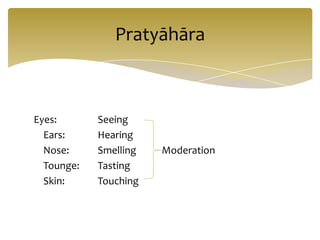
Pratyāhāra


Eyes:       Seeing
  Ears:     Hearing
  Nose:     Smelling   Moderation
  Tounge:   Tasting
  Skin:     Touching
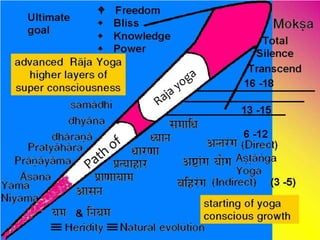
Antaranga Yoga


Direct way to get moksha

Three steps
  Dharana

  Dhyana

  Samadhi
Dharana


         Deśa bandha cittasya dhāraṇa
      Binding the mind to a particular place


                  Single subject ,single thought
Focusing
Less energy expenditure
Less tiredness
Dhyana


           Tatra pratyayaikatānatā dhyānam
            Uninterrupted flow of thought

             single object, Single thought
Features of Dhyāna
  Wakefulness, Awareness, Expansiveness
  Slowness, Effortlessness
Samādhi


    Samyak adhīyate iti samādhi


Becoming one with the seen (object)
According to patanjali’s yoga sutra


  Tadevārtha mātra nirbhāsaṁ svarupa śūnyamiva
                     samādhiḥ

  The object alone shines, our own reality vanishes
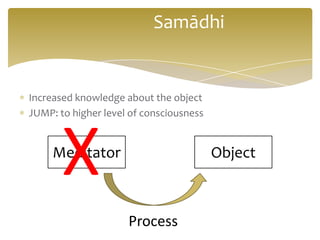
Samādhi


Increased knowledge about the object
JUMP: to higher level of consciousness


       X
     Meditator                           Object


                     Process
Thank you…

Raja yoga

  • 1.
    RAJA YOGA BY SRILOY MOHANTY
  • 2.
    CONTENTS… INTRODUCTION RAJA YOGA BAHIRANGAYOGA ANTARANGA YOGA YAMA DHARANA NIYAMA DHYANA ASANA SAMADHI PRANAYAMA PRATYAHARA
  • 3.
    INTRODUCTION… Raja yoga isthe path of will power It is also known as patanjali’s yoga or astanga yoga Astanga yoga = eight (asta) + limbs (anga) It is mainly divided in to two parts Antaranga yoga (direct way to moksha) Bahiranga yoga (indirect way to moksha)
  • 4.
    Antaranga yoga Yama (SocialDiscipline) Niyama (Self Discipline) Asana (yogic postures) Pranayama (mastery through breath) Pratyahara (mastery over senses)
  • 5.
    Yama – SocialDiscipline The first component of Ashtanga Yoga Rules for Social Discipline (Guidelines on how to behave in society) These are universal laws respected everywhere (Laws of Nature) These are easy to follow
  • 6.
    Yama 1. Ahimsa – Non Violence 2. Satya – Truthfulness 3. Asteya – Non Stealing 4. Brahmacharya – Sexual Control 5. Aparigraha – Non Possessiveness
  • 7.
    Ahimsa * Means ofbehavior towards all living creatures * Absence of harmful intentions or thoughts * To be followed on three levels i) Physical ii) Verbal iii) Mental * Generate love & compassion towards all living creatures
  • 8.
    Yama – SocialDiscipline Satya – Truthfulness Fact is fact There is no other way than to accept it We try to hide the facts We do not accept the facts One lie requires many more lies to support it Untruthfulness in all its various forms creates many types of unnecessary complications in life Truthfulness is absolutely necessary for the unfoldment of reality
  • 9.
    Asetya – NonStealing Stealing means to take anything without the permission of its owner Yoga sadhaka should not take anything, which does not belong to them. They should not even take intangible or highly prized things, such as credits for something they have not done.
  • 10.
    Brahmacharya – SexualControl In its real sense means the abstinence from sexual indulgence to obtain a higher yogic level One cannot get real bliss realised by the transcendent knowledge of higher yogic life, whilst having sexual pleasures at the same time One may not be required to give up sexual activities straightaway, but must completely abstain before commencing serious practice of Yoga on a higher level.
  • 11.
    Brahmacharya – SexualControl (cont.) A real yogi should be prepared to completely give up, not only physical indulgence in sexual activities, but also thoughts & emotions concerned with it In a wider sense Brahmacharya means a freedom from cravings of all sensual enjoyments The attitude of the mind is responsible for these cravings
  • 12.
    Aparigraha – NonPossessiveness The tendency to accumulate worldly goods is considered a basic instinct in human life Necessities – comforts – luxuries (These are subjective & limitless) One needs to satisfy its childish vanity & desires, to appear superior to others One must spend time & energy in accumulating these things, which are not really needed.
  • 13.
    Aparigraha – NonPossessiveness (cont.) Maintaining & guarding the accumulated items Constant fear of loosing them Feeling of pain if actually lost Feeling of regret to leave them behind, when bidding goodbye to this world. We spend our valuable time & resources to accumulate, yet they generate a constant source of disturbance to us. Hence minimise your needs
  • 14.
    Niyama Shoucha – Cleanliness,Purity Santosha – Contentment Tapa – Austerity Swadhyaya – Self Study Ishwara Pranidhana – Surrender to God
  • 15.
    Niyama – SelfDiscipline Shoucha – Cleanliness, Purity Santosha – Contentment Tapa – Austerity Swadhyaya – Self Study Ishwara Pranidhana – Surrender to God
  • 16.
    Niyama – SelfDiscipline Second component (Anga) of Ashtanga Yoga Rules for self discipline Yamas are moral & prohibitive, whereas Niyamas are disciplined & constructive Yamas provide ethical foundation & Niyamas provide physical & mental foundation for furthering studies of Yoga Yamas can be practiced only within a society, but Niyamas can be practiced anywhere irrespective of society Yamas are reactive & Niyamas are active
  • 17.
    Shoucha – Cleanliness,Purity Purity of body, mind & intellect These instruments become impure when things are added to them. Shoucha helps to eliminate these additions. Hatha Yoga prescribes many practices for the purification of the internal body The cleansing practices are divided into six major categories: Shatkarmas 1) Dhouti 2) Basti 3) Neti 4) Tratak 5) Nouli 6) Kapalbhati
  • 18.
    Santosha – Contentment Thisis a mental attitude that keeps the mind in a condition of equilibrium Circumstances impact on the mind & cause it to react. These reactions disturb the equilibrium of the mind & in turn disrupt the physical condition of the body To avoid these disturbances train your mind to react with contentment Always say “Very nice Very nice!” A continual practice of Ashtanga Yoga along with training the mind through Mantra Sadhana, is necessary to develop this attitude
  • 19.
    Tapa – Austerity,Self Discipline This includes various practices, the object of which is to purify the sadhakas body mind complex for further study of Yoga Practices include fasting & observing various vows. These are performed to control the functions of the body & mind A systematic practice begins with simple exercises, to exert control of willpower & in progression more difficult practices are performed. This practice loosens the association of the consciousness with the body mind complex
  • 20.
    Swadhyaya – SelfStudy Study is the process of acquiring knowledge, both theoretical & practical The explanation given by Patanjali of study is as follows: Deerghakaal – for long period Nairantarya – continued, uninterrupted Satakarasevito – with full unconditional faith The style of study will depend on the individual self
  • 21.
    Ishwarpranidhana – Total surrender to God The progressive practice of Ishwarpranidhana will lead to samadhi, the state of union Ishwarpranidhana is a process of transformation from human to God Ishwarpranidhana is the concept of loosing the identity of the self & merging it with that of Ishwara the God This effort may take many forms according to the temperaments & the previous Sanskaras of the sadhaka Ishwarpranidhana is explained in detail in Bhakti Yoga
  • 22.
    Asana “Sthiram Sukham asanam” Sthiram –steady Sukham-comfortable Asanam-posture According to hatha yoga “having done asana one gets steadiness of body and mind; diseaselessness and lightness of the limbs
  • 23.
    Classification of asanas Standingasanas (ardha chakrasana, ardhakati chakrasana) Sitting asanas (vakrasana, pada hastasana) Prone asanas (mayurasana, dhanurasana) Supine asanas (sarvangasana, chakrasana) Tropsy asanas (sirshasana, hand standing)
  • 24.
    classification Cultural asana –toculture your body Meditative asana –for meditations Relaxing asana –for relaxation
  • 25.
    Pranayama + Prāṇasya + Āyāma Mastery over Prāṇa (Lengthening of Prāṇa) What is Prāṇa?
  • 26.
    Prana Prana is thepre-existing force which continuously following n our body. 5 types of prana Apana Samana Prana Udana Vyana
  • 27.
  • 28.
    Pratyāhāra + Prati + Āhāra Withdrawal of food Withdrawal of food for sense organs Or Moderation of food for sense organs
  • 29.
    Pratyāhāra Eyes: Seeing Ears: Hearing Nose: Smelling Moderation Tounge: Tasting Skin: Touching
  • 30.
    Antaranga Yoga Direct wayto get moksha Three steps Dharana Dhyana Samadhi
  • 31.
    Dharana Deśa bandha cittasya dhāraṇa Binding the mind to a particular place Single subject ,single thought Focusing Less energy expenditure Less tiredness
  • 32.
    Dhyana Tatra pratyayaikatānatā dhyānam Uninterrupted flow of thought single object, Single thought Features of Dhyāna Wakefulness, Awareness, Expansiveness Slowness, Effortlessness
  • 33.
    Samādhi Samyak adhīyate iti samādhi Becoming one with the seen (object)
  • 34.
    According to patanjali’syoga sutra Tadevārtha mātra nirbhāsaṁ svarupa śūnyamiva samādhiḥ The object alone shines, our own reality vanishes
  • 35.
    Samādhi Increased knowledge aboutthe object JUMP: to higher level of consciousness X Meditator Object Process
  • 37.