Contents…
• Introduction
• Definition
• Exercise
• Rules of exercise
• Physiological response to
exercise
• Effects on heart
• Cardiac output
• Effects on lungs
• Changes in the blood
• Blood pressure
• Blood volume
• Effect on muscle
• Effect on elimination
• Precaution of exercise
• Purpose of exercise
• Research
• Rest and relaxation
• References
INTRODUCTION…
• In ancient world, every individual had hard work
associated with his profession
• Which is lacking in modern world and hence
inculcating a definite time and regular exercise to
be a part of our life style is a must
DEFINITION…
Exercise Physiology is the description and explanation
of functional changes brought about by single or
repeated exercise sessions
EXERCISE
Exercise is the repeated rhythmic movements
given to body parts to keep it healthy and
develop the body parts
EXERCISE (CONT…)
EXERCISE
FREE
ACTIVE PASSIVE
RESISTED
ASSISTED
WEIGHT
TRAINING
According to physiology, there are 3 types of exercises ;-
• Mild: minimum or no cardiovascular change.
Ex: Walking
• Moderate: No exertion but some cardiovascular changes can
seen
Ex: Jogging
• Severe: Complete exertion
Ex: Swimming
STAGES (SEVERITY) OF EXERCISE
• Empty stomach i.e., 3 to 4 hours after food
• Bowel and bladder should be evacuated
• Adequate rest in between and after is must
• Bath after exercise is compulsory
• Water should not be taken in between exercises
• Food should not be taken during exercise
• Very vigorous exercise should be avoided
• Proper timing should be followed
• Regularity of exercise gives better results
RULES OF EXERCISE
• Wrong practice and procedure
•For Ex: Weight training exercises should be done
carefully and slowly
• Muscles should not be worked to fatigue
• Irregularity and discontinuation of exercises leads to
problems
• Not following the rules of exercise properly leads to
disadvantages
• But when exercise are practiced properly and systematically
and correctly, no exercise is harmful or disadvantageous
PRECAUTIONS FOR EXERCISE
•The body becomes light after exercise
•The body relaxes
•The capacity to do work increases
•The digestive power of the individual increases
•There is fat depletion the muscles become
strong and compact
•The strength, power and endurance is increased
BENEFITS OF EXERCISE
•Physical appearance is improved
•Flexibility and mobility of the body increases
•The balance between elimination and nutrition is
established
•The cardiovascular efficiency is improved
•The respiratory capacity of the individual is improved
•The body becomes fit and healthy
•Proper blood circulation for various parts is
established
BENEFITS OF EXERCISE
Cont…
•Acute painful conditions
•Pregnancy
•Menstruation
•Cardiac patients
•Acute illness
CONTRAINDICATIONS
Immediate
responses
Cardiac output
increases
HR increases
Blood is sent
to working
muscles and
away from
visceral organs
Respiration
rate increases
BP increases
metabolism
increases
Body temp
rises and we
sweat to cool
the body’s core
PHYSIOLOGICAL RESPONSES TO EXERCISE
• Oxygen rich blood is pumped out
of the heart to the muscles and
organs via artery’s (red areas)
• De-oxygenated blood is returned
to the heart via veins (blue areas)
• Artery’s have plenty of pressure
on them from the heart
contracting to force the blood
away from the heart
• Veins however are not under any
pressure. To stop the blood going
backwards veins have valves
EFFECT ON THE HEART
• 5-6 liters of blood is pumped out of heart/min.
• In moderate-20liters/min.
• Severe exercise- 35 liters/min
• Cardiac output is directly proportional to oxygen
consumption
• This is due to increased heart rate and increased
stroke volume
• (70ml/contraction)
• CO=HR x SV
CARDIAC OUTPUT
EFFECTS ON THE LUNGS
• During exercise there is
increase in CO2 of blood
• Chemoreceptor in medulla
are stimulated
• Stimulation of dorsal
respiratory group of
neurons
• Increase the rate of
respiration
• Removal of CO2 is
increased
• The heart and lungs are
connected to supply the
body with oxygen rich
blood and work together
to take away and get rid
of carbon dioxide
• This happens at the
capillary networks that
cover the alveoli and
muscle cells
LINKING TOGETHER..
•Mild hypoxia: which increases CO2 concentration will
lead to pH decrease
•It stimulates the juxtaglomerular cells to synthesize
erythropoietin
•So that there is a production of RBCs
•There is increased heat production during exercise which
increases the body temperature
CHANGES IN THE BLOOD
• To compensate the body temperature sweating and fluid
loss occurs resulting into decreased blood volume which is
also due to vasodilatation in skin
• Decreased blood volume results in Hemoconcentration i.e.
water is lost through plasma
• That’s why severe exercise can even cause dehydration
CHANGES IN THE BLOOD
Cont…
• Systolic = the pressure
exerted on the walls of the
arteries when the heart
contracts
• Diastolic = the pressure
on the walls of the arteries
as the heart relaxes (fills)
• Normal BP tends to be
around:
• 120/80 mmHg.
BLOOD PRESSURE
•Venous return increased - Due to the muscle
pump and Respiratory pump
•Vasodilatation leads to relaxation of the muscles
•In the muscles end product of metabolism is
lactic acid which is further non-degradable is also a
stimulant for vasodilatation
EFFECT ON MUSCLES
• Skin - Sweating is improved
• Kidney - Urine output is increased
• Lungs – Carbon dioxide and other unwanted gases removed
• GIT- Excretion of feces is increased due to proper assimilation
and proper digestion
EFFECTS ON ELIMINATION
• Exercise keeps a person physically, mentally,
emotionally and spiritually healthy
•Indirectly aim of exercise is towards the positive health
• It is the set of systematic movement of the body
which helps in growth of the individual
• It gives happiness and helps in developing the mind
and mind becomes fresh
• To improve the stamina and strength
PURPOSE OF EXERCISE
RESEARCH
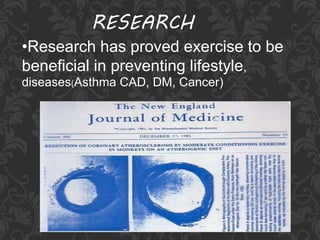
•Research has proved exercise to be
beneficial in preventing lifestyle,
diseases(Asthma CAD, DM, Cancer)
Why take drugs for problems that may be
helped by exercise, sleep, sunlight and other
natural remedies?
• Rest is total absence of work except the force of gravity
• Complete rest is not possible
• Sleep is one of the best ways to achieve rest.
• It is temporary suspension/reduction of activity with the
purpose to recuperate and repair
• Helps in regeneration i.e. it is physiological rest and
calmness of nervous system
REST AND RELAXATION
• Physical
• Reliving tensions of muscles to maximum
extent/simply relaxation of muscles
Ex: Shavasana /lying down.
TYPES OF REST
• Mental rest ;-
• Making the mind to centralize on a
fixed point or on object
• Works at a subconscious level of mind.
Very difficult to achieve complete mental
rest and probably impossible to the fullest
extent
Ex: Meditation
• Rest and relaxation enhance the eliminatory process
and help in recharging the body and mind
• After work, the body is fatigued or tired which is
because of the metabolic wastes produced in the body
with the need to eliminate them
• Hence rest and relaxation is very essential
REQUIREMENT FOR REST AND RELAXATION
•The atmosphere should be favourable
•There should be proper ventilation
•The person should be comfortable and calm
•There should be no much bright light
REQUISITES FOR REST
•Prolonged severe exercise can cause dehydration
•Incorrect methods like
•exercise soon after food
•wrong atmosphere
•wrong methods
•malnourishment etc… can be dangerous
DANGERS OF EXERCISE
• When exercise is done regularly following all
precautions and done systematically, it is beneficial to
maintain a good physical and mental health
• Exercise done without proper method and
precautions by not giving proper dietary
supplementation, can be harmful to the body
• One important aspect always forgotten during
exercise is proper sleep, rest and relaxation
CONCLUSION
REFERENCES
•www.wikipedia.com
• Physiology of Exercise
• Nature cure
by, Henry Linlard
• www.pubmed.com
Join us in this Journey towards Health &
Happiness……..
THANK YOU…

Exercise physiology

  • 2.
    Contents… • Introduction • Definition •Exercise • Rules of exercise • Physiological response to exercise • Effects on heart • Cardiac output • Effects on lungs • Changes in the blood • Blood pressure • Blood volume • Effect on muscle • Effect on elimination • Precaution of exercise • Purpose of exercise • Research • Rest and relaxation • References
  • 3.
    INTRODUCTION… • In ancientworld, every individual had hard work associated with his profession • Which is lacking in modern world and hence inculcating a definite time and regular exercise to be a part of our life style is a must
  • 4.
    DEFINITION… Exercise Physiology isthe description and explanation of functional changes brought about by single or repeated exercise sessions
  • 5.
    EXERCISE Exercise is therepeated rhythmic movements given to body parts to keep it healthy and develop the body parts
  • 6.
  • 7.
    According to physiology,there are 3 types of exercises ;- • Mild: minimum or no cardiovascular change. Ex: Walking • Moderate: No exertion but some cardiovascular changes can seen Ex: Jogging • Severe: Complete exertion Ex: Swimming STAGES (SEVERITY) OF EXERCISE
  • 8.
    • Empty stomachi.e., 3 to 4 hours after food • Bowel and bladder should be evacuated • Adequate rest in between and after is must • Bath after exercise is compulsory • Water should not be taken in between exercises • Food should not be taken during exercise • Very vigorous exercise should be avoided • Proper timing should be followed • Regularity of exercise gives better results RULES OF EXERCISE
  • 9.
    • Wrong practiceand procedure •For Ex: Weight training exercises should be done carefully and slowly • Muscles should not be worked to fatigue • Irregularity and discontinuation of exercises leads to problems • Not following the rules of exercise properly leads to disadvantages • But when exercise are practiced properly and systematically and correctly, no exercise is harmful or disadvantageous PRECAUTIONS FOR EXERCISE
  • 10.
    •The body becomeslight after exercise •The body relaxes •The capacity to do work increases •The digestive power of the individual increases •There is fat depletion the muscles become strong and compact •The strength, power and endurance is increased BENEFITS OF EXERCISE
  • 11.
    •Physical appearance isimproved •Flexibility and mobility of the body increases •The balance between elimination and nutrition is established •The cardiovascular efficiency is improved •The respiratory capacity of the individual is improved •The body becomes fit and healthy •Proper blood circulation for various parts is established BENEFITS OF EXERCISE Cont…
  • 12.
  • 13.
    Immediate responses Cardiac output increases HR increases Bloodis sent to working muscles and away from visceral organs Respiration rate increases BP increases metabolism increases Body temp rises and we sweat to cool the body’s core PHYSIOLOGICAL RESPONSES TO EXERCISE
  • 14.
    • Oxygen richblood is pumped out of the heart to the muscles and organs via artery’s (red areas) • De-oxygenated blood is returned to the heart via veins (blue areas) • Artery’s have plenty of pressure on them from the heart contracting to force the blood away from the heart • Veins however are not under any pressure. To stop the blood going backwards veins have valves EFFECT ON THE HEART
  • 15.
    • 5-6 litersof blood is pumped out of heart/min. • In moderate-20liters/min. • Severe exercise- 35 liters/min • Cardiac output is directly proportional to oxygen consumption • This is due to increased heart rate and increased stroke volume • (70ml/contraction) • CO=HR x SV CARDIAC OUTPUT
  • 16.
    EFFECTS ON THELUNGS • During exercise there is increase in CO2 of blood • Chemoreceptor in medulla are stimulated • Stimulation of dorsal respiratory group of neurons • Increase the rate of respiration • Removal of CO2 is increased
  • 17.
    • The heartand lungs are connected to supply the body with oxygen rich blood and work together to take away and get rid of carbon dioxide • This happens at the capillary networks that cover the alveoli and muscle cells LINKING TOGETHER..
  • 18.
    •Mild hypoxia: whichincreases CO2 concentration will lead to pH decrease •It stimulates the juxtaglomerular cells to synthesize erythropoietin •So that there is a production of RBCs •There is increased heat production during exercise which increases the body temperature CHANGES IN THE BLOOD
  • 19.
    • To compensatethe body temperature sweating and fluid loss occurs resulting into decreased blood volume which is also due to vasodilatation in skin • Decreased blood volume results in Hemoconcentration i.e. water is lost through plasma • That’s why severe exercise can even cause dehydration CHANGES IN THE BLOOD Cont…
  • 20.
    • Systolic =the pressure exerted on the walls of the arteries when the heart contracts • Diastolic = the pressure on the walls of the arteries as the heart relaxes (fills) • Normal BP tends to be around: • 120/80 mmHg. BLOOD PRESSURE
  • 21.
    •Venous return increased- Due to the muscle pump and Respiratory pump •Vasodilatation leads to relaxation of the muscles •In the muscles end product of metabolism is lactic acid which is further non-degradable is also a stimulant for vasodilatation EFFECT ON MUSCLES
  • 22.
    • Skin -Sweating is improved • Kidney - Urine output is increased • Lungs – Carbon dioxide and other unwanted gases removed • GIT- Excretion of feces is increased due to proper assimilation and proper digestion EFFECTS ON ELIMINATION
  • 23.
    • Exercise keepsa person physically, mentally, emotionally and spiritually healthy •Indirectly aim of exercise is towards the positive health • It is the set of systematic movement of the body which helps in growth of the individual • It gives happiness and helps in developing the mind and mind becomes fresh • To improve the stamina and strength PURPOSE OF EXERCISE
  • 24.
    RESEARCH •Research has provedexercise to be beneficial in preventing lifestyle, diseases(Asthma CAD, DM, Cancer)
  • 25.
    Why take drugsfor problems that may be helped by exercise, sleep, sunlight and other natural remedies?
  • 26.
    • Rest istotal absence of work except the force of gravity • Complete rest is not possible • Sleep is one of the best ways to achieve rest. • It is temporary suspension/reduction of activity with the purpose to recuperate and repair • Helps in regeneration i.e. it is physiological rest and calmness of nervous system REST AND RELAXATION
  • 27.
    • Physical • Relivingtensions of muscles to maximum extent/simply relaxation of muscles Ex: Shavasana /lying down. TYPES OF REST
  • 28.
    • Mental rest;- • Making the mind to centralize on a fixed point or on object • Works at a subconscious level of mind. Very difficult to achieve complete mental rest and probably impossible to the fullest extent Ex: Meditation
  • 29.
    • Rest andrelaxation enhance the eliminatory process and help in recharging the body and mind • After work, the body is fatigued or tired which is because of the metabolic wastes produced in the body with the need to eliminate them • Hence rest and relaxation is very essential REQUIREMENT FOR REST AND RELAXATION
  • 30.
    •The atmosphere shouldbe favourable •There should be proper ventilation •The person should be comfortable and calm •There should be no much bright light REQUISITES FOR REST
  • 31.
    •Prolonged severe exercisecan cause dehydration •Incorrect methods like •exercise soon after food •wrong atmosphere •wrong methods •malnourishment etc… can be dangerous DANGERS OF EXERCISE
  • 32.
    • When exerciseis done regularly following all precautions and done systematically, it is beneficial to maintain a good physical and mental health • Exercise done without proper method and precautions by not giving proper dietary supplementation, can be harmful to the body • One important aspect always forgotten during exercise is proper sleep, rest and relaxation CONCLUSION
  • 33.
    REFERENCES •www.wikipedia.com • Physiology ofExercise • Nature cure by, Henry Linlard • www.pubmed.com
  • 34.
    Join us inthis Journey towards Health & Happiness……..
  • 35.