AFFINITY
CHROMATOGRAPHY
Prepared by:-
• Suman Nath
Presented by:-
• Ritiraj Bhattacharya (78)
• Sabnam Parveen (80)
• Safikul Hussain (81)
• Suman Nath (91)
• Tonmoy Misra (93)
• Tulika Moni Deka (95)
• Wasim Jaffer (99)
CONTENT
1. Introduction
2. Principle
3. Stationary phase
4. Factors affecting affinity chromatography
5. Instrumentation
6. Application
7. Advantages & Disadvantages
8. Conclusion
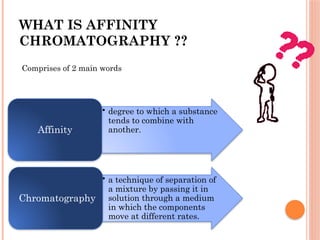
WHAT IS AFFINITY
CHROMATOGRAPHY ??
Comprises of 2 main words
• degree to which a substance
tends to combine with
another.
Affinity
• a technique of separation of
a mixture by passing it in
solution through a medium
in which the components
move at different rates.
Chromatography
INTRODUCTION
 Affinity chromatography is a powerful separation method
based on a highly specific and reversible binding interaction.
 Exploits selective & reversible binding of molecules.
 Binding interaction such as that between antigen and antibody,
enzyme and substrate or receptor and ligand.
 Affinity chromatography also known as bio-selective
adsorption.
 The technique utilise the “lock & key” biological structure or
function of a molecule.
 It separates a single target molecule from a complex mixture
with very high selectivity.
 Thus it can be used as protein purification technique.
 Affinity chromatography is caused by allowing the desired
molecule to interact with the stationary phase and be
bounded to stationary phase in order to be separated from
the undesired material which will not interact and elute first.
PRINCIPLE
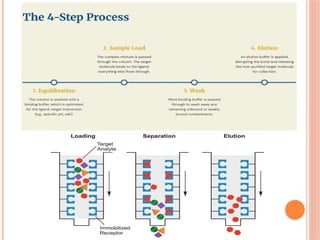
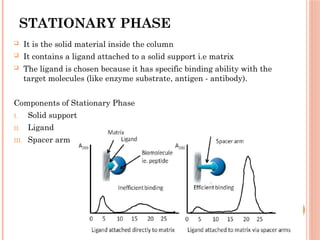
 Affinity chromatography works by using the specific
reversible binding between a target molecule and a ligand
that is covalently attached to a solid support matrix.
 When a sample passes through the column, only the
molecules that specifically bind to the ligand are retained
while all other components are washed through.
 The target molecule is then eluted by changing the mobile
phase conditions, such as pH or ionic strength.
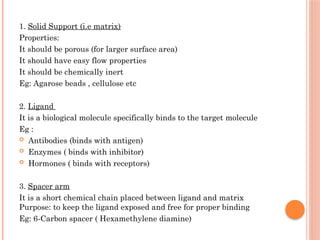
STATIONARY PHASE
 It is the solid material inside the column
 It contains a ligand attached to a solid support i.e matrix
 The ligand is chosen because it has specific binding ability with the
target molecules (like enzyme substrate, antigen - antibody).
Components of Stationary Phase
I. Solid support
II. Ligand
III. Spacer arm
1. Solid Support (i.e matrix)
Properties:
It should be porous (for larger surface area)
It should have easy flow properties
It should be chemically inert
Eg: Agarose beads , cellulose etc
2. Ligand
It is a biological molecule specifically binds to the target molecule
Eg :
 Antibodies (binds with antigen)
 Enzymes ( binds with inhibitor)
 Hormones ( binds with receptors)
3. Spacer arm
It is a short chemical chain placed between ligand and matrix
Purpose: to keep the ligand exposed and free for proper binding
Eg: 6-Carbon spacer ( Hexamethylene diamine)
FACTORS AFFECTING AFFINITY
CHROMATOGRAPHY
A. pH:
 Increase or decrease in pH affects the binding between ligand and target
 Extreme pH may also denatures proteins and reduce binding
B. Nature of Matrix :
 A physically and chemically inert matrix with more surface area is preferred.
 Pore size should be appropriate
C. Temperature
 High temperature - reduce the ligand -target interaction
 Proteins may denature at high temperatures
D. Flow rate
 Flow rate of
 sample solution
 The binding buffer
 The washing buffer
 The elution buffer
It should be slow for more contact time and stronger binding
E. Ligand density
 More ligand density results in more binding sites results in larger capacity
 Also high binding sites also results in steric hindrance (crowding) results in decreasing
binding efficiency
INSTRUMENTATIONS OF
AFFINITY CHROMATOGRAPHY
 Affinity chromatography is a separation method used for separating
biomolecules based on a highly specific interaction between a target
molecules and a ligand.
 This specific interactions can be between –
 Antigen and antibody.
 Enzymes and substrate.
 Receptors and ligand,
 Histones and DNA.
 Protein and nucleic acid.
 Lysine and rRNA.
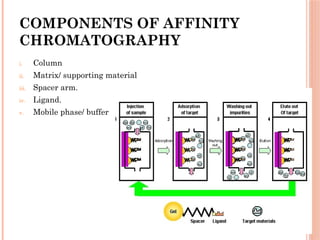
COMPONENTS OF AFFINITY
CHROMATOGRAPHY
i. Column
ii. Matrix/ supporting material
iii. Spacer arm.
iv. Ligand.
v. Mobile phase/ buffer
1. Column :-
 Couloms used in this type of chromatography short and wide..
 The length and the size of the column varies. .
 But standard dimensions ranges from 5 to 50 mm in diameter and 5 cm to
1 m length. .
 Shorter columns 50 mm-200 mm are generally used for faster separation..
 Columns are generally made of glass and plastics and other materials like
stainless steel. .
 The choice of material depends on the various factors like pressure, cost
effective and chemical compatibility.
2. Matrix or supporting materials :-
 The affinity chromatography is usually carried out in coulomn which is
filled with supporting material or matrix..
 The matrix should have the following properties-...
 It should be chemically inert....
 It should have good flow properties. ...
 It should be insoluble in solvent and buffers used in analysis. .
 Different material like agarose, polyacrylamide, polystyrene, cellulose,
silica, etc can be used as a matrix..
 The matrix is attached with a spacer arm, which is usually made up of
- ch2- groups.
3. Spacer arm :-
 The presence of spacer arm prevents the non specific interaction of
ligand with the matrix itself..
 Spacer is used to increase the binding between ligand and target
molecules. .
 It connects the ligands to the matrix. .
 Ligand bind reversibly with the target molecules
4. Ligand :-
 Ligand has a specific binding affinity towards the target molecule..
 Reversible binding takes place..
 The selection of the specific ligand depends on the nature of the
target molecules..
 Eg- antigen is used as a ligand for antibody separation
 Substrates for enzymes and histones for DNA.
5. Mobile phase :-
 Generally the mobile phase used are buffers.
 Three types of buffers are used in separation technique. –
 Binding buffer:-
 ph 8
 Washing buffer:
 remove all the non specific molecules or non bonded molecules
without interfering the specific interactions. .
 ph 8-9.
 Break weaker bonds like ionic bonds. It has slightly higher
salt concentration and mild detergent to wash away
impurities. .
 Salt concentration 0.3-0.5M Nacl.
 Elution buffer: disrupts or breaks the specific binding and release
the target molecules..
 Have higher salt concentration than washing buffers..
 0.5-1M Nacl solutions or sometimes 2 M. Also can add
competitive ligands. .
 Ph 3-4
ADVANTAGES OF AFFINITY
CHROMATOGRAPHY
1. Very specific separation – The target molecule binds only to its
matching ligand, so we get a highly pure product in just one
step.
2. No harsh treatment – The process is gentle, so the proteins or
biomolecules do not get damaged or denatured.
3. Resin can be used many times – The matrix is reusable, which
reduces cost.
4. Works for many biomolecules – Can purify proteins, enzymes,
antibodies, DNA/RNA, etc.
5. Quick and efficient – Purification is fast and can handle large
sample volumes.
6. Used widely in industries – Helpful in pharmaceuticals, genetic
engineering, vaccine production, and checking protein quality.
7. Protects protein activity – Gentle conditions prevent proteolysis
(protein breakdown) and keep proteins active and functional
protein quality.
DISADVANTAGES OF AFFINITY
CHROMATOGRAPHY
1. Expensive – The resins and ligands used are costly, and
sometimes special/custom ones are needed.
2. Not always available – Suitable ligands are not available for every
type of molecule.
3. Ligand leakage – The ligand may come off the resin over time,
reducing purity and shortening resin life.
4. Non-specific binding – Sometimes unwanted molecules also stick,
so method optimization is needed.
5. Complex process – It can be labor-intensive, difficult to set up, and
often gives lower productivity than simpler techniques.
6. Contamination issues – Metal ions or resin breakdown can affect
protein stability.
7. Limited capacity – Only a small amount of sample can be
processed at a time, and some molecules may interfere with
binding.
APPLICATION
 Affinity chromatography is one of the most useful methods
for the separation and purification of specific products.
 It is essentially a sample purification technique, used
primarily for biological molecules such as proteins.
 Its major application includes:
 Separation of mixture of compounds.
 Removal of impurities or in purification process.
 In enzyme assays
 Detection of substrates
 Investigation of binding sites of enzymes
 In in vitro antigen-antibody reactions
 Detection of Single Nucleotide polymorphisms and
mutations in nucleic acids.
CONCLUSION
 Affinity chromatography is a powerful purification
technique whose effectiveness stems from the interplay of
several key components: a solid support matrix, a
covalently attached ligand that binds the target molecule,
a defined buffer system for loading, washing and elution,
and the sample itself.
 The method’s performance is governed by factors such as
ligand specificity and affinity, matrix pore size and binding
capacity, pH and ionic strength of the mobile phase,
temperature, flow rate, and the amount of sample loaded.
Describe affinity in proper way on ppt.pptx

Describe affinity in proper way on ppt.pptx

  • 1.
    AFFINITY CHROMATOGRAPHY Prepared by:- • SumanNath Presented by:- • Ritiraj Bhattacharya (78) • Sabnam Parveen (80) • Safikul Hussain (81) • Suman Nath (91) • Tonmoy Misra (93) • Tulika Moni Deka (95) • Wasim Jaffer (99)
  • 2.
    CONTENT 1. Introduction 2. Principle 3.Stationary phase 4. Factors affecting affinity chromatography 5. Instrumentation 6. Application 7. Advantages & Disadvantages 8. Conclusion
  • 3.
    WHAT IS AFFINITY CHROMATOGRAPHY?? Comprises of 2 main words • degree to which a substance tends to combine with another. Affinity • a technique of separation of a mixture by passing it in solution through a medium in which the components move at different rates. Chromatography
  • 4.
    INTRODUCTION  Affinity chromatographyis a powerful separation method based on a highly specific and reversible binding interaction.  Exploits selective & reversible binding of molecules.  Binding interaction such as that between antigen and antibody, enzyme and substrate or receptor and ligand.  Affinity chromatography also known as bio-selective adsorption.  The technique utilise the “lock & key” biological structure or function of a molecule.  It separates a single target molecule from a complex mixture with very high selectivity.  Thus it can be used as protein purification technique.  Affinity chromatography is caused by allowing the desired molecule to interact with the stationary phase and be bounded to stationary phase in order to be separated from the undesired material which will not interact and elute first.
  • 5.
    PRINCIPLE  Affinity chromatographyworks by using the specific reversible binding between a target molecule and a ligand that is covalently attached to a solid support matrix.  When a sample passes through the column, only the molecules that specifically bind to the ligand are retained while all other components are washed through.  The target molecule is then eluted by changing the mobile phase conditions, such as pH or ionic strength.
  • 7.
    STATIONARY PHASE  Itis the solid material inside the column  It contains a ligand attached to a solid support i.e matrix  The ligand is chosen because it has specific binding ability with the target molecules (like enzyme substrate, antigen - antibody). Components of Stationary Phase I. Solid support II. Ligand III. Spacer arm
  • 8.
    1. Solid Support(i.e matrix) Properties: It should be porous (for larger surface area) It should have easy flow properties It should be chemically inert Eg: Agarose beads , cellulose etc 2. Ligand It is a biological molecule specifically binds to the target molecule Eg :  Antibodies (binds with antigen)  Enzymes ( binds with inhibitor)  Hormones ( binds with receptors) 3. Spacer arm It is a short chemical chain placed between ligand and matrix Purpose: to keep the ligand exposed and free for proper binding Eg: 6-Carbon spacer ( Hexamethylene diamine)
  • 9.
    FACTORS AFFECTING AFFINITY CHROMATOGRAPHY A.pH:  Increase or decrease in pH affects the binding between ligand and target  Extreme pH may also denatures proteins and reduce binding B. Nature of Matrix :  A physically and chemically inert matrix with more surface area is preferred.  Pore size should be appropriate C. Temperature  High temperature - reduce the ligand -target interaction  Proteins may denature at high temperatures D. Flow rate  Flow rate of  sample solution  The binding buffer  The washing buffer  The elution buffer It should be slow for more contact time and stronger binding E. Ligand density  More ligand density results in more binding sites results in larger capacity  Also high binding sites also results in steric hindrance (crowding) results in decreasing binding efficiency
  • 10.
    INSTRUMENTATIONS OF AFFINITY CHROMATOGRAPHY Affinity chromatography is a separation method used for separating biomolecules based on a highly specific interaction between a target molecules and a ligand.  This specific interactions can be between –  Antigen and antibody.  Enzymes and substrate.  Receptors and ligand,  Histones and DNA.  Protein and nucleic acid.  Lysine and rRNA.
  • 11.
    COMPONENTS OF AFFINITY CHROMATOGRAPHY i.Column ii. Matrix/ supporting material iii. Spacer arm. iv. Ligand. v. Mobile phase/ buffer
  • 12.
    1. Column :- Couloms used in this type of chromatography short and wide..  The length and the size of the column varies. .  But standard dimensions ranges from 5 to 50 mm in diameter and 5 cm to 1 m length. .  Shorter columns 50 mm-200 mm are generally used for faster separation..  Columns are generally made of glass and plastics and other materials like stainless steel. .  The choice of material depends on the various factors like pressure, cost effective and chemical compatibility. 2. Matrix or supporting materials :-  The affinity chromatography is usually carried out in coulomn which is filled with supporting material or matrix..  The matrix should have the following properties-...  It should be chemically inert....  It should have good flow properties. ...  It should be insoluble in solvent and buffers used in analysis. .
  • 13.
     Different materiallike agarose, polyacrylamide, polystyrene, cellulose, silica, etc can be used as a matrix..  The matrix is attached with a spacer arm, which is usually made up of - ch2- groups. 3. Spacer arm :-  The presence of spacer arm prevents the non specific interaction of ligand with the matrix itself..  Spacer is used to increase the binding between ligand and target molecules. .  It connects the ligands to the matrix. .  Ligand bind reversibly with the target molecules 4. Ligand :-  Ligand has a specific binding affinity towards the target molecule..  Reversible binding takes place..  The selection of the specific ligand depends on the nature of the target molecules..  Eg- antigen is used as a ligand for antibody separation  Substrates for enzymes and histones for DNA.
  • 14.
    5. Mobile phase:-  Generally the mobile phase used are buffers.  Three types of buffers are used in separation technique. –  Binding buffer:-  ph 8  Washing buffer:  remove all the non specific molecules or non bonded molecules without interfering the specific interactions. .  ph 8-9.  Break weaker bonds like ionic bonds. It has slightly higher salt concentration and mild detergent to wash away impurities. .  Salt concentration 0.3-0.5M Nacl.  Elution buffer: disrupts or breaks the specific binding and release the target molecules..  Have higher salt concentration than washing buffers..  0.5-1M Nacl solutions or sometimes 2 M. Also can add competitive ligands. .  Ph 3-4
  • 15.
    ADVANTAGES OF AFFINITY CHROMATOGRAPHY 1.Very specific separation – The target molecule binds only to its matching ligand, so we get a highly pure product in just one step. 2. No harsh treatment – The process is gentle, so the proteins or biomolecules do not get damaged or denatured. 3. Resin can be used many times – The matrix is reusable, which reduces cost. 4. Works for many biomolecules – Can purify proteins, enzymes, antibodies, DNA/RNA, etc. 5. Quick and efficient – Purification is fast and can handle large sample volumes. 6. Used widely in industries – Helpful in pharmaceuticals, genetic engineering, vaccine production, and checking protein quality. 7. Protects protein activity – Gentle conditions prevent proteolysis (protein breakdown) and keep proteins active and functional protein quality.
  • 16.
    DISADVANTAGES OF AFFINITY CHROMATOGRAPHY 1.Expensive – The resins and ligands used are costly, and sometimes special/custom ones are needed. 2. Not always available – Suitable ligands are not available for every type of molecule. 3. Ligand leakage – The ligand may come off the resin over time, reducing purity and shortening resin life. 4. Non-specific binding – Sometimes unwanted molecules also stick, so method optimization is needed. 5. Complex process – It can be labor-intensive, difficult to set up, and often gives lower productivity than simpler techniques. 6. Contamination issues – Metal ions or resin breakdown can affect protein stability. 7. Limited capacity – Only a small amount of sample can be processed at a time, and some molecules may interfere with binding.
  • 17.
    APPLICATION  Affinity chromatographyis one of the most useful methods for the separation and purification of specific products.  It is essentially a sample purification technique, used primarily for biological molecules such as proteins.  Its major application includes:  Separation of mixture of compounds.  Removal of impurities or in purification process.  In enzyme assays  Detection of substrates  Investigation of binding sites of enzymes  In in vitro antigen-antibody reactions  Detection of Single Nucleotide polymorphisms and mutations in nucleic acids.
  • 18.
    CONCLUSION  Affinity chromatographyis a powerful purification technique whose effectiveness stems from the interplay of several key components: a solid support matrix, a covalently attached ligand that binds the target molecule, a defined buffer system for loading, washing and elution, and the sample itself.  The method’s performance is governed by factors such as ligand specificity and affinity, matrix pore size and binding capacity, pH and ionic strength of the mobile phase, temperature, flow rate, and the amount of sample loaded.