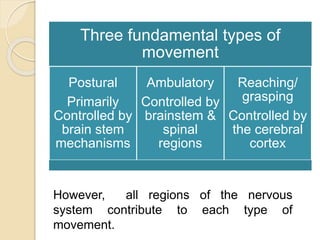
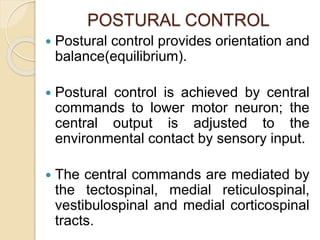
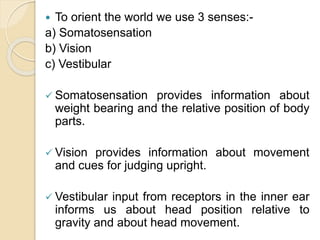
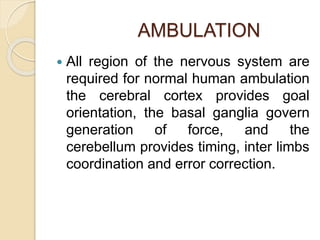
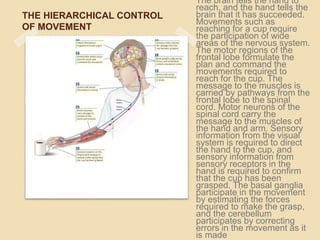
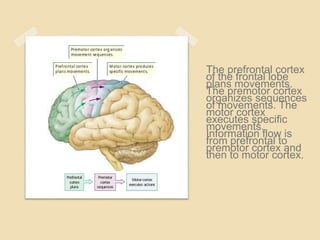
The document summarizes the physiology of human movement. It discusses how distinct areas of the brain plan, execute, and provide feedback for movements. The motor cortex, brainstem, cerebellum, basal ganglia, and spinal cord all contribute to different types of movement like postural control, ambulation, and reaching/grasping. Descending pathways like the corticospinal tract transmit signals from the motor cortex to the spinal cord to control muscle activation. Sensory feedback through pathways like the dorsal column-medial lemniscal pathway provides information to coordinate movement.




![Share CONTROL OF BODY MOVEMENT[1]PHYSIO PRESENTATION.pptx](https://cdn.slidesharecdn.com/ss_thumbnails/sharecontrolofbodymovement1physiopresentation-250504162954-915fb5e5-thumbnail.jpg?width=640&height=640&fit=bounds)
![Neurological assessmentv1[25 10_11][1]](https://cdn.slidesharecdn.com/ss_thumbnails/neurological-assessmentv1-5b25-10-11-5d-5b1-5d-130511142954-phpapp01-thumbnail.jpg?width=640&height=640&fit=bounds)


