KNOW YOUR BRAIN-
RETICULAR FORMATION
DR KIRAN KUMAR C
MBBS.,MD.,FAGE.,C DIAB
ASSISTANT PROFESSOR
DEPARTMENT OF PHYSIOLOGY
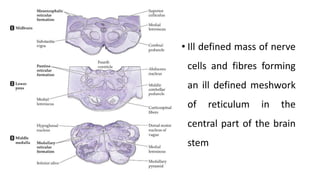
• Ill defined mass of nerve
cells and fibres forming
an ill defined meshwork
of reticulum in the
central part of the brain
stem
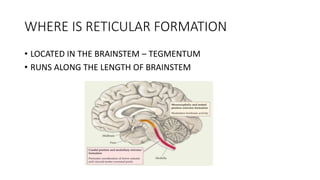
WHERE IS RETICULAR FORMATION
• LOCATED IN THE BRAINSTEM – TEGMENTUM
• RUNS ALONG THE LENGTH OF BRAINSTEM
• Formed by neurons & processes left over after well defined named
nuclei & pathways.
• Phylogenetically :- old system.
• Poorly defined
• Located in the brain stem.
• Comprises of Medullary, Pontine & Midbrain Reticular Formation.
• Poly synaptic.
• Has both ascending and descending components.
RETICULAR NUCLEI
Consists of deeply placed continuous network of
nerve cells and fibres that extends from the spinal
cord to thalamus
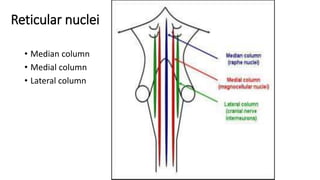
Reticular nuclei
• Median column
• Medial column
• Lateral column
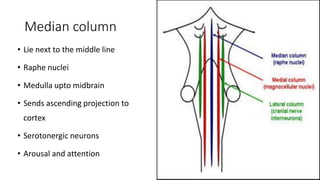
Median column
• Lie next to the middle line
• Raphe nuclei
• Medulla upto midbrain
• Sends ascending projection to
cortex
• Serotonergic neurons
• Arousal and attention
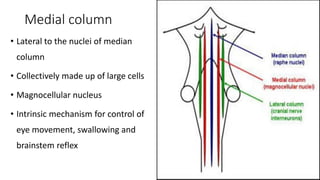
Medial column
• Lateral to the nuclei of median
column
• Collectively made up of large cells
• Magnocellular nucleus
• Intrinsic mechanism for control of
eye movement, swallowing and
brainstem reflex
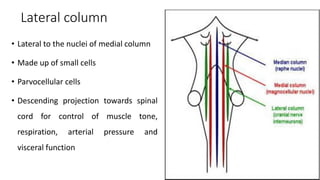
Lateral column
• Lateral to the nuclei of medial column
• Made up of small cells
• Parvocellular cells
• Descending projection towards spinal
cord for control of muscle tone,
respiration, arterial pressure and
visceral function
RETICULAR PATHWAYS
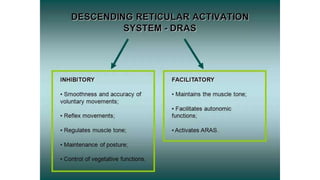
1. Ascending reticular activating system
2. Descending reticular activating system
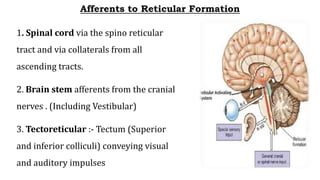
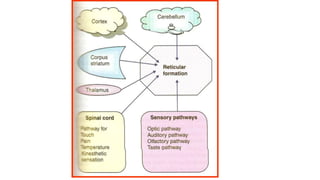
Afferents to Reticular Formation
1. Spinal cord via the spino reticular
tract and via collaterals from all
ascending tracts.
2. Brain stem afferents from the cranial
nerves . (Including Vestibular)
3. Tectoreticular :- Tectum (Superior
and inferior colliculi) conveying visual
and auditory impulses
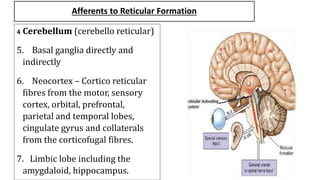
Afferents to Reticular Formation
4 Cerebellum (cerebello reticular)
5. Basal ganglia directly and
indirectly
6. Neocortex – Cortico reticular
fibres from the motor, sensory
cortex, orbital, prefrontal,
parietal and temporal lobes,
cingulate gyrus and collaterals
from the corticofugal fibres.
7. Limbic lobe including the
amygdaloid, hippocampus.
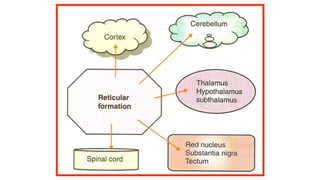
Efferents from Reticular Formation
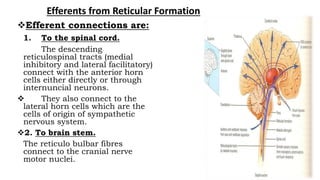
Efferent connections are:
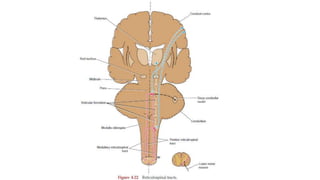
1. To the spinal cord.
The descending
reticulospinal tracts (medial
inhibitory and lateral facilitatory)
connect with the anterior horn
cells either directly or through
internuncial neurons.
 They also connect to the
lateral horn cells which are the
cells of origin of sympathetic
nervous system.
2. To brain stem.
The reticulo bulbar fibres
connect to the cranial nerve
motor nuclei.
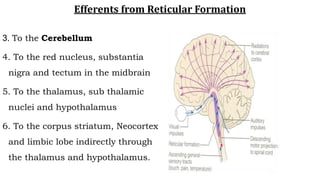
Efferents from Reticular Formation
3. To the Cerebellum
4. To the red nucleus, substantia
nigra and tectum in the midbrain
5. To the thalamus, sub thalamic
nuclei and hypothalamus
6. To the corpus striatum, Neocortex
and limbic lobe indirectly through
the thalamus and hypothalamus.
1). ARAS (ascending reticular activating pathway) :
The rostral part (vaguely begin at the level of the upper pons
and midbrain), contains neuro chemically classified groups of
neurons that project to the cerebral cortex either directly or
by relay in the thalamus; and it is important in alertness,
wakefulness, maintenance of attention and emotional
reactions and learning processes.
2). Descending pathway :
The caudal part (vaguely the lower pons and medulla) has
projection to the spinal cord and is involved in motor function,
respiration and regulation of blood pressure.
Neurotransmitters in RAS
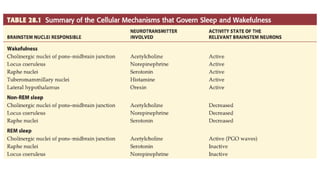
A). Cholinergic system
Cell bodies are found in :
1). Nucleus basalis of Meynert( NBM, basal forebrain system).
2). Pontomesencephalic tegmental neurons. (PMTN).
NBM and PMTN activate the cortical neurons via the thalamic neurons.
They are active during waking and REM sleep.
Functions:
1). Arousal.
2). Selective attention.
3). Learning and memory.
4). Neuronal degeneration. (Alzheimer disease).
Neurotransmitters in RAS
B). Adrenergic system
• Cell bodies are found in locus coeruleus in the
midbrain.
• The adrenergic neurons are active during waking and
slow wave sleep but cease firing during REM sleep.
Neurotransmitters in RAS
C). Serotonergic system:
Cell bodies are found in:
1). Caudal raphe nucleus.
2). Rostral raphe nucleus.
Functions:
1). Arousal and selective attention (RAS).
2). Sleep.
3). Processing sensory information (pain).
4). Regulation of muscle tone and segmental spinal reflexes.
Neurotransmitters in RAS
D). Histaminergic system:
Cell bodies found in:
1). Posterior lateral hypothalamus.
2). Tubero-mamilliary nucleus.
Function:
1). Maintaining arousal of the forebrain; which is important in
sleep wake cycle.
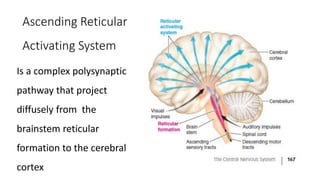
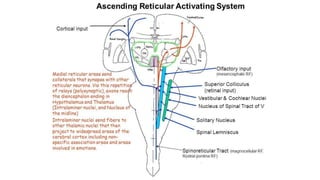
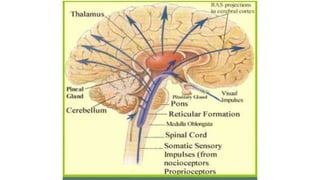
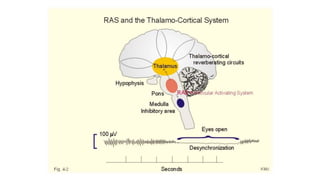
Ascending Reticular
Activating System
Is a complex polysynaptic
pathway that project
diffusely from the
brainstem reticular
formation to the cerebral
cortex
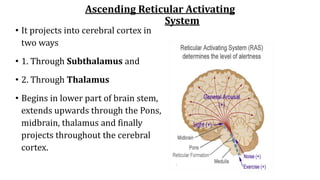
Ascending Reticular Activating
System
• It projects into cerebral cortex in
two ways
• 1. Through Subthalamus and
• 2. Through Thalamus
• Begins in lower part of brain stem,
extends upwards through the Pons,
midbrain, thalamus and finally
projects throughout the cerebral
cortex.
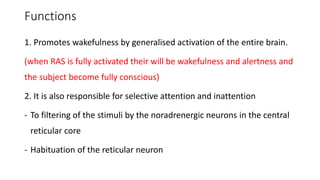
Functions
1. Promotes wakefulness by generalised activation of the entire brain.
(when RAS is fully activated their will be wakefulness and alertness and
the subject become fully conscious)
2. It is also responsible for selective attention and inattention
- To filtering of the stimuli by the noradrenergic neurons in the central
reticular core
- Habituation of the reticular neuron
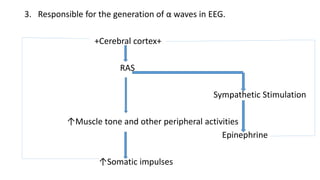
3. Responsible for the generation of α waves in EEG.
+Cerebral cortex+
RAS
Sympathetic Stimulation
↑Muscle tone and other peripheral activities
Epinephrine
↑Somatic impulses
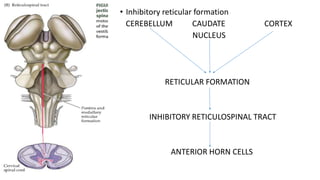
• Inhibitory reticular formation
CEREBELLUM CAUDATE CORTEX
NUCLEUS
RETICULAR FORMATION
INHIBITORY RETICULOSPINAL TRACT
ANTERIOR HORN CELLS
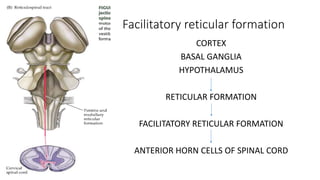
Facilitatory reticular formation
CORTEX
BASAL GANGLIA
HYPOTHALAMUS
RETICULAR FORMATION
FACILITATORY RETICULAR FORMATION
ANTERIOR HORN CELLS OF SPINAL CORD
FUNCTIONS
• It influences voluntary movement and reflex activity
• Also part of descending autonomic fibres
• Control sympathetic and parasympathetic outflow
• Pontine and medullary reticulospinal tract are antagonistic to each
other
• Pontine are excitatory and medullary are inhibitory to antigravity
muscle
• Pontine are excitatory and medullary are inhibitory to
voluntary muscle reflex and tone
• Pontine favour expiration and medullary favours inspiration
• Pontine produces vasoconstriction while medullary produces
vasodilatation
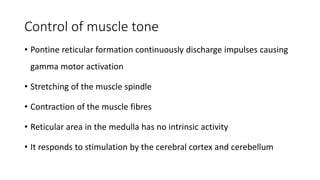
Control of muscle tone
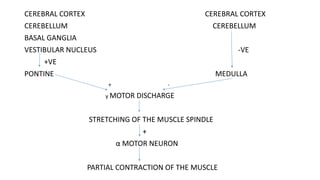
• Pontine reticular formation continuously discharge impulses causing
gamma motor activation
• Stretching of the muscle spindle
• Contraction of the muscle fibres
• Reticular area in the medulla has no intrinsic activity
• It responds to stimulation by the cerebral cortex and cerebellum
CEREBRAL CORTEX CEREBRAL CORTEX
CEREBELLUM CEREBELLUM
BASAL GANGLIA
VESTIBULAR NUCLEUS -VE
+VE
PONTINE MEDULLA
+ -
γ MOTOR DISCHARGE
STRETCHING OF THE MUSCLE SPINDLE
+
α MOTOR NEURON
PARTIAL CONTRACTION OF THE MUSCLE
APPLIED PHYSIOLOGY.
• Drugs Excite Reticular Formation:
• Alerting and arousal :-Sympathomimetic drugs
(eg., adrenaline, nor adrenaline, amphetamine).
• Acetylcholine also increases cortical activity.
• Increased CO2, rise of BP also increase the
excitability of the RAS.
• Drugs Inhibits Reticular Formation:
• General anesthetics, sedatives eg., barbiturates
diminish RAS activity
SLEEP AND WAKEFULNESS
Dr Kiran Kumar C
MBBS.,MD.,FAGE.,C DIAB
Assistant Professor
Department of Physiology
OVERVIEW
• Normal suspension of consciousness
• Consumes fully one- third of our lives.
• We crave sleep when deprived of
• Sleep is not the result of a simple diminution of brain activity.
• Indeed, in rapid eye movement (REM) sleep, the brain is
about as active as it is when people are awake.
• Sleep is a series of precisely controlled physiological states,
the sequence of which is governed by a group of brainstem
nuclei that projects widely throughout the brain and spinal
cord
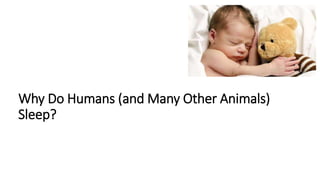
Why Do Humans (and Many Other Animals)
Sleep?
• To feel rested and refreshed upon awakening, most adults
require 7-8 hours of sleep, although this number varies
among individuals.
• Infants:17hrs
• Teenagers: 9hrs
• Old age : light sleep and for shorter duration
• Sleep debt
• It has to be repaid
• Judgement, reaction time and other functions are seriously
impaired
• Highly conserved behaviour in all animal kingdom
• From a perspective of energy conservation, one function of
sleep is to replenish brain glycogen levels, which fall during
the waking hours.
Why do we sleep at night???
• Since it is generally colder at night, more energy would have
to be expended to keep warm were we nocturnally active.
• Human body temperature has a 24-hour cycle, reaching a
minimum at night and thus reducing heat loss.
• Metabolism measured by oxygen consumption decreases
during sleep.
• Humans and many other animals that sleep at night are highly
dependent on visual information to find food and avoid
predators.
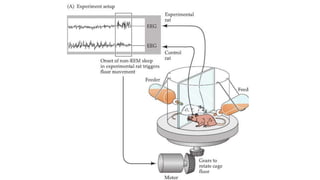
• A recent idea about the advantage of sleep proposes that
memories, in the form of changes in the strength of synaptic
connections induced by experiences during waking hours, are
consolidated while we sleep.
• In humans, lack of sleep leads to impaired memory and
reduced cognitive abilities
• If the deprivation persists, mood swings and often,
hallucinations.
• Fatal familial insomnia die within several years of onset.
• This rare disease, which appears in middle age, is
characterized by hallucinations, seizures, loss of motor
control, and the inability to enter a state of deep sleep
The Circadian Cycle of
Sleep and Wakefulness
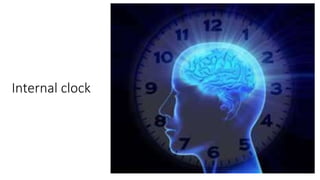
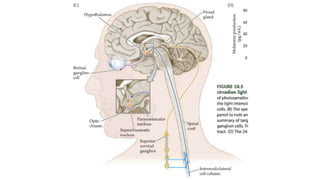
• Human sleep occurs with circadian (Latin for “about a day'')
periodicity,
• Biologists have explored a number of questions about this
24-hour cycle.
Internal clock
Stages of Sleep
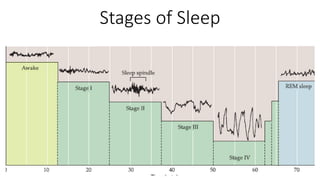
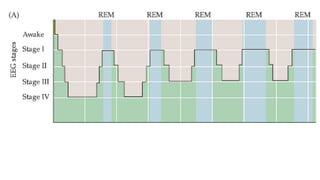
• In 1953, Nathaniel Kleitman and Eugene Aserinksy showed
by means of electroencephalographic (EEG) recordings from
normal subjects that sleep actually comprises different
stages that occur in a characteristic sequence.
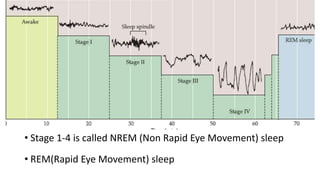
• Stage 1-4 is called NREM (Non Rapid Eye Movement) sleep
• REM(Rapid Eye Movement) sleep
Physiological Changes
in Sleep States
Physiological changes during non-REM sleep
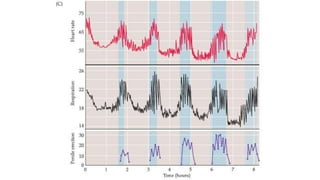
• Muscle tone decreases progressively.
• Heart rate and blood pressure are decreased.
• Respiration rate is also decreased.
• Eyes begin slow, rolling movement until they finally stop in stage 4 (deep
sleep) with eyes turned upwards.
• Body metabolism is lowered.
• Pituitary shows pulsatile release of growth hormone and gonadotropin.
Behavioural changes during non-REM sleep
• Progressive reduction in consciousness.
• An increasing resistance to being awakened
• It is more difficult to wake up a young person than elderly from sleep
because elderly person spends very little time in stage 3 and 4 of non-
REM stage.
• When awaken person does not report dreaming.
Intellectual functions during non-REM sleep
• Thoughts become illogical and incoherent towards the onset of sleep.
• Retrograde amnesia occurs during transition from wakefulness to sleep.
• This is because sleep inactivates the consolidation of short-term into long-
term memory.
Examples of retrograde amnesia include:
– Inability to grasp the instant of sleep onset in memory.
– Not remembering the ringing of alarm clock.
Physiological changes during REM sleep
• Rapid eye movements are the hallmark of this state of sleep
• Heart rate and respiration rate become irregular.
• Muscle tone is reduced due to inhibition of spinal motor neurons via
brain stem mechanisms.
• Snoring during sleep results from partial obstruction of airways caused
by relaxed tongue (due to muscular atonia) in supine position.
• Twitching of limb musculature occurs occasionally.
• Because muscle tone is reduced tremendously
• Middle ear muscles are also active during REM sleep.
• Penile erection in males and engorgement of clitoris in
females may occur during REM sleep.
• Teeth grinding (bruxism) may be seen in children.
Behavioural changes during REM sleep
• Arousal., it is difficult to arouse an individual from REM sleep as it is
from deep sleep.
• The individual is immediately alert and aware of the environment.
• Dreaming occurs during REM sleep, so it is also called ‘dream sleep’.
• There is vivid dream recall from approximately 80% of arousals from
REM sleep.
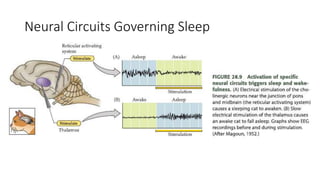
Neural Circuits Governing Sleep
Sleep disorder
Insomnia
• Insomnia is the inability to sleep for a sufficient length of
time (or deeply enough) to produce a subjective sense of
refreshment
Narcolepsy
• Individuals with narcolepsy have frequent uREM sleep attacks" during
the day, in which they enter REM sleep from wakefulness without
going through non-REM sleep. These attacks can last from 30 seconds
to 30 minutes or more
Restless legs syndrome
• Is a problem that affects many people.
• The disorder is characterized by unpleasant crawling, prickling, or
tingling sensations in one or both legs and feet, and the urge to move
them about to obtain relief
EEG
Functions of Reticular formation
 Role in Sleep and Wakefulness cycle.
Responsible for the alerting responses to emotion and to
muscular work.
Controls muscle tone .
Influences Endocrine Secretion
 Role in visceral function .
 Influences circadian rhythm.
 Influences EEG And LEARNING.
Modulates afferent transmission
 Influences Autonomic nervous system.
Role in sleep and wakefulness
RAS :- Strong facilitatory drive to
central neurons
Input through trigeminal
lemniscus and visuoauditory
tracts.
Experimental evidence
A section at the upper border of
the spinal cord separating the
entire brain - electrical activity
of the cortex showed a
desynchronized pattern,
indicating that the animal is
awake.
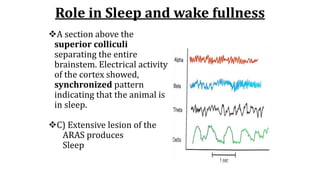
Role in Sleep and wake fullness
A section above the
superior colliculi
separating the entire
brainstem. Electrical activity
of the cortex showed,
synchronized pattern
indicating that the animal is
in sleep.
C) Extensive lesion of the
ARAS produces
Sleep
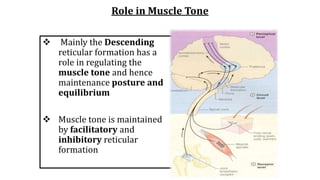
Role in Muscle Tone
 Mainly the Descending
reticular formation has a
role in regulating the
muscle tone and hence
maintenance posture and
equilibrium
 Muscle tone is maintained
by facilitatory and
inhibitory reticular
formation
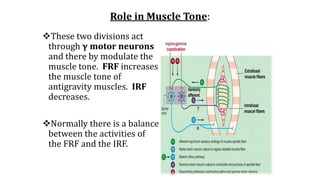
Role in Muscle Tone:
These two divisions act
through γ motor neurons
and there by modulate the
muscle tone. FRF increases
the muscle tone of
antigravity muscles. IRF
decreases.
Normally there is a balance
between the activities of
the FRF and the IRF.
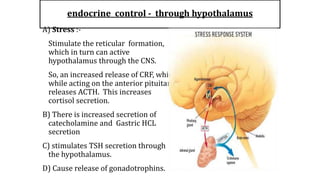
endocrine control - through hypothalamus
A) Stress :-
Stimulate the reticular formation,
which in turn can active
hypothalamus through the CNS.
So, an increased release of CRF, which
while acting on the anterior pituitary
releases ACTH. This increases
cortisol secretion.
B) There is increased secretion of
catecholamine and Gastric HCL
secretion
C) stimulates TSH secretion through
the hypothalamus.
D) Cause release of gonadotrophins.
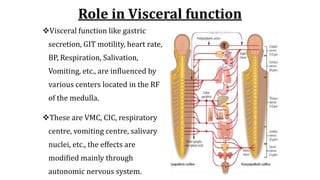
Role in Visceral function
Visceral function like gastric
secretion, GIT motility, heart rate,
BP, Respiration, Salivation,
Vomiting, etc., are influenced by
various centers located in the RF
of the medulla.
These are VMC, CIC, respiratory
centre, vomiting centre, salivary
nuclei, etc., the effects are
modified mainly through
autonomic nervous system.
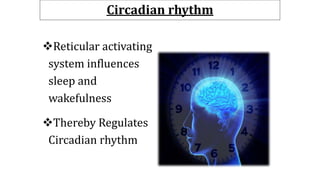
Circadian rhythm
Reticular activating
system influences
sleep and
wakefulness
Thereby Regulates
Circadian rhythm
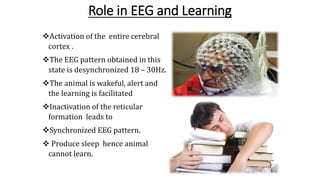
Role in EEG and Learning
Activation of the entire cerebral
cortex .
The EEG pattern obtained in this
state is desynchronized 18 – 30Hz.
The animal is wakeful, alert and
the learning is facilitated
Inactivation of the reticular
formation leads to
Synchronized EEG pattern.
 Produce sleep hence animal
cannot learn.
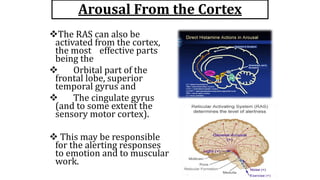
Arousal From the Cortex
The RAS can also be
activated from the cortex,
the most effective parts
being the
 Orbital part of the
frontal lobe, superior
temporal gyrus and
 The cingulate gyrus
(and to some extent the
sensory motor cortex).
 This may be responsible
for the alerting responses
to emotion and to muscular
work.
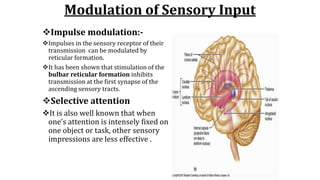
Modulation of Sensory Input
Impulse modulation:-
Impulses in the sensory receptor of their
transmission can be modulated by
reticular formation.
It has been shown that stimulation of the
bulbar reticular formation inhibits
transmission at the first synapse of the
ascending sensory tracts.
Selective attention
It is also well known that when
one’s attention is intensely fixed on
one object or task, other sensory
impressions are less effective .
Neurotransmitters of reticular
formation
Large cholinergic neuron.:- project to cortex via
thalamus.
Small adrenergic neurons:- via Intralaminar nuclei of
thalamus.
Noradrenergic neurons.:- To cerebellum.
Dopaminergic neurons :- To Basal ganglia
Serotonergic neurons:- Project to Thalamus, Cerebral
cortex, Hypothalamus & Limbic structure.

Reticular formation

  • 1.
    KNOW YOUR BRAIN- RETICULARFORMATION DR KIRAN KUMAR C MBBS.,MD.,FAGE.,C DIAB ASSISTANT PROFESSOR DEPARTMENT OF PHYSIOLOGY
  • 2.
    • Ill definedmass of nerve cells and fibres forming an ill defined meshwork of reticulum in the central part of the brain stem
  • 3.
    WHERE IS RETICULARFORMATION • LOCATED IN THE BRAINSTEM – TEGMENTUM • RUNS ALONG THE LENGTH OF BRAINSTEM
  • 4.
    • Formed byneurons & processes left over after well defined named nuclei & pathways. • Phylogenetically :- old system. • Poorly defined • Located in the brain stem. • Comprises of Medullary, Pontine & Midbrain Reticular Formation. • Poly synaptic. • Has both ascending and descending components.
  • 5.
    RETICULAR NUCLEI Consists ofdeeply placed continuous network of nerve cells and fibres that extends from the spinal cord to thalamus
  • 6.
    Reticular nuclei • Mediancolumn • Medial column • Lateral column
  • 7.
    Median column • Lienext to the middle line • Raphe nuclei • Medulla upto midbrain • Sends ascending projection to cortex • Serotonergic neurons • Arousal and attention
  • 8.
    Medial column • Lateralto the nuclei of median column • Collectively made up of large cells • Magnocellular nucleus • Intrinsic mechanism for control of eye movement, swallowing and brainstem reflex
  • 9.
    Lateral column • Lateralto the nuclei of medial column • Made up of small cells • Parvocellular cells • Descending projection towards spinal cord for control of muscle tone, respiration, arterial pressure and visceral function
  • 10.
    RETICULAR PATHWAYS 1. Ascendingreticular activating system 2. Descending reticular activating system
  • 11.
    Afferents to ReticularFormation 1. Spinal cord via the spino reticular tract and via collaterals from all ascending tracts. 2. Brain stem afferents from the cranial nerves . (Including Vestibular) 3. Tectoreticular :- Tectum (Superior and inferior colliculi) conveying visual and auditory impulses
  • 12.
    Afferents to ReticularFormation 4 Cerebellum (cerebello reticular) 5. Basal ganglia directly and indirectly 6. Neocortex – Cortico reticular fibres from the motor, sensory cortex, orbital, prefrontal, parietal and temporal lobes, cingulate gyrus and collaterals from the corticofugal fibres. 7. Limbic lobe including the amygdaloid, hippocampus.
  • 13.
    Efferents from ReticularFormation Efferent connections are: 1. To the spinal cord. The descending reticulospinal tracts (medial inhibitory and lateral facilitatory) connect with the anterior horn cells either directly or through internuncial neurons.  They also connect to the lateral horn cells which are the cells of origin of sympathetic nervous system. 2. To brain stem. The reticulo bulbar fibres connect to the cranial nerve motor nuclei.
  • 14.
    Efferents from ReticularFormation 3. To the Cerebellum 4. To the red nucleus, substantia nigra and tectum in the midbrain 5. To the thalamus, sub thalamic nuclei and hypothalamus 6. To the corpus striatum, Neocortex and limbic lobe indirectly through the thalamus and hypothalamus.
  • 17.
    1). ARAS (ascendingreticular activating pathway) : The rostral part (vaguely begin at the level of the upper pons and midbrain), contains neuro chemically classified groups of neurons that project to the cerebral cortex either directly or by relay in the thalamus; and it is important in alertness, wakefulness, maintenance of attention and emotional reactions and learning processes.
  • 18.
    2). Descending pathway: The caudal part (vaguely the lower pons and medulla) has projection to the spinal cord and is involved in motor function, respiration and regulation of blood pressure.
  • 19.
    Neurotransmitters in RAS A).Cholinergic system Cell bodies are found in : 1). Nucleus basalis of Meynert( NBM, basal forebrain system). 2). Pontomesencephalic tegmental neurons. (PMTN). NBM and PMTN activate the cortical neurons via the thalamic neurons. They are active during waking and REM sleep. Functions: 1). Arousal. 2). Selective attention. 3). Learning and memory. 4). Neuronal degeneration. (Alzheimer disease).
  • 20.
    Neurotransmitters in RAS B).Adrenergic system • Cell bodies are found in locus coeruleus in the midbrain. • The adrenergic neurons are active during waking and slow wave sleep but cease firing during REM sleep.
  • 21.
    Neurotransmitters in RAS C).Serotonergic system: Cell bodies are found in: 1). Caudal raphe nucleus. 2). Rostral raphe nucleus. Functions: 1). Arousal and selective attention (RAS). 2). Sleep. 3). Processing sensory information (pain). 4). Regulation of muscle tone and segmental spinal reflexes.
  • 22.
    Neurotransmitters in RAS D).Histaminergic system: Cell bodies found in: 1). Posterior lateral hypothalamus. 2). Tubero-mamilliary nucleus. Function: 1). Maintaining arousal of the forebrain; which is important in sleep wake cycle.
  • 23.
    Ascending Reticular Activating System Isa complex polysynaptic pathway that project diffusely from the brainstem reticular formation to the cerebral cortex
  • 24.
    Ascending Reticular Activating System •It projects into cerebral cortex in two ways • 1. Through Subthalamus and • 2. Through Thalamus • Begins in lower part of brain stem, extends upwards through the Pons, midbrain, thalamus and finally projects throughout the cerebral cortex.
  • 27.
    Functions 1. Promotes wakefulnessby generalised activation of the entire brain. (when RAS is fully activated their will be wakefulness and alertness and the subject become fully conscious) 2. It is also responsible for selective attention and inattention - To filtering of the stimuli by the noradrenergic neurons in the central reticular core - Habituation of the reticular neuron
  • 28.
    3. Responsible forthe generation of α waves in EEG. +Cerebral cortex+ RAS Sympathetic Stimulation ↑Muscle tone and other peripheral activities Epinephrine ↑Somatic impulses
  • 31.
    • Inhibitory reticularformation CEREBELLUM CAUDATE CORTEX NUCLEUS RETICULAR FORMATION INHIBITORY RETICULOSPINAL TRACT ANTERIOR HORN CELLS
  • 32.
    Facilitatory reticular formation CORTEX BASALGANGLIA HYPOTHALAMUS RETICULAR FORMATION FACILITATORY RETICULAR FORMATION ANTERIOR HORN CELLS OF SPINAL CORD
  • 33.
    FUNCTIONS • It influencesvoluntary movement and reflex activity • Also part of descending autonomic fibres • Control sympathetic and parasympathetic outflow • Pontine and medullary reticulospinal tract are antagonistic to each other • Pontine are excitatory and medullary are inhibitory to antigravity muscle
  • 34.
    • Pontine areexcitatory and medullary are inhibitory to voluntary muscle reflex and tone • Pontine favour expiration and medullary favours inspiration • Pontine produces vasoconstriction while medullary produces vasodilatation
  • 35.
    Control of muscletone • Pontine reticular formation continuously discharge impulses causing gamma motor activation • Stretching of the muscle spindle • Contraction of the muscle fibres • Reticular area in the medulla has no intrinsic activity • It responds to stimulation by the cerebral cortex and cerebellum
  • 36.
    CEREBRAL CORTEX CEREBRALCORTEX CEREBELLUM CEREBELLUM BASAL GANGLIA VESTIBULAR NUCLEUS -VE +VE PONTINE MEDULLA + - γ MOTOR DISCHARGE STRETCHING OF THE MUSCLE SPINDLE + α MOTOR NEURON PARTIAL CONTRACTION OF THE MUSCLE
  • 37.
    APPLIED PHYSIOLOGY. • DrugsExcite Reticular Formation: • Alerting and arousal :-Sympathomimetic drugs (eg., adrenaline, nor adrenaline, amphetamine). • Acetylcholine also increases cortical activity. • Increased CO2, rise of BP also increase the excitability of the RAS. • Drugs Inhibits Reticular Formation: • General anesthetics, sedatives eg., barbiturates diminish RAS activity
  • 38.
    SLEEP AND WAKEFULNESS DrKiran Kumar C MBBS.,MD.,FAGE.,C DIAB Assistant Professor Department of Physiology
  • 39.
  • 40.
    • Normal suspensionof consciousness • Consumes fully one- third of our lives. • We crave sleep when deprived of • Sleep is not the result of a simple diminution of brain activity.
  • 41.
    • Indeed, inrapid eye movement (REM) sleep, the brain is about as active as it is when people are awake. • Sleep is a series of precisely controlled physiological states, the sequence of which is governed by a group of brainstem nuclei that projects widely throughout the brain and spinal cord
  • 42.
    Why Do Humans(and Many Other Animals) Sleep?
  • 43.
    • To feelrested and refreshed upon awakening, most adults require 7-8 hours of sleep, although this number varies among individuals. • Infants:17hrs • Teenagers: 9hrs • Old age : light sleep and for shorter duration
  • 44.
    • Sleep debt •It has to be repaid • Judgement, reaction time and other functions are seriously impaired • Highly conserved behaviour in all animal kingdom • From a perspective of energy conservation, one function of sleep is to replenish brain glycogen levels, which fall during the waking hours.
  • 45.
    Why do wesleep at night???
  • 46.
    • Since itis generally colder at night, more energy would have to be expended to keep warm were we nocturnally active. • Human body temperature has a 24-hour cycle, reaching a minimum at night and thus reducing heat loss. • Metabolism measured by oxygen consumption decreases during sleep.
  • 47.
    • Humans andmany other animals that sleep at night are highly dependent on visual information to find food and avoid predators. • A recent idea about the advantage of sleep proposes that memories, in the form of changes in the strength of synaptic connections induced by experiences during waking hours, are consolidated while we sleep.
  • 49.
    • In humans,lack of sleep leads to impaired memory and reduced cognitive abilities • If the deprivation persists, mood swings and often, hallucinations.
  • 50.
    • Fatal familialinsomnia die within several years of onset. • This rare disease, which appears in middle age, is characterized by hallucinations, seizures, loss of motor control, and the inability to enter a state of deep sleep
  • 51.
    The Circadian Cycleof Sleep and Wakefulness
  • 52.
    • Human sleepoccurs with circadian (Latin for “about a day'') periodicity, • Biologists have explored a number of questions about this 24-hour cycle.
  • 53.
  • 55.
  • 56.
    • In 1953,Nathaniel Kleitman and Eugene Aserinksy showed by means of electroencephalographic (EEG) recordings from normal subjects that sleep actually comprises different stages that occur in a characteristic sequence.
  • 57.
    • Stage 1-4is called NREM (Non Rapid Eye Movement) sleep • REM(Rapid Eye Movement) sleep
  • 59.
  • 61.
    Physiological changes duringnon-REM sleep • Muscle tone decreases progressively. • Heart rate and blood pressure are decreased. • Respiration rate is also decreased. • Eyes begin slow, rolling movement until they finally stop in stage 4 (deep sleep) with eyes turned upwards. • Body metabolism is lowered. • Pituitary shows pulsatile release of growth hormone and gonadotropin.
  • 62.
    Behavioural changes duringnon-REM sleep • Progressive reduction in consciousness. • An increasing resistance to being awakened • It is more difficult to wake up a young person than elderly from sleep because elderly person spends very little time in stage 3 and 4 of non- REM stage. • When awaken person does not report dreaming.
  • 63.
    Intellectual functions duringnon-REM sleep • Thoughts become illogical and incoherent towards the onset of sleep. • Retrograde amnesia occurs during transition from wakefulness to sleep. • This is because sleep inactivates the consolidation of short-term into long- term memory. Examples of retrograde amnesia include: – Inability to grasp the instant of sleep onset in memory. – Not remembering the ringing of alarm clock.
  • 64.
    Physiological changes duringREM sleep • Rapid eye movements are the hallmark of this state of sleep • Heart rate and respiration rate become irregular. • Muscle tone is reduced due to inhibition of spinal motor neurons via brain stem mechanisms. • Snoring during sleep results from partial obstruction of airways caused by relaxed tongue (due to muscular atonia) in supine position.
  • 65.
    • Twitching oflimb musculature occurs occasionally. • Because muscle tone is reduced tremendously • Middle ear muscles are also active during REM sleep. • Penile erection in males and engorgement of clitoris in females may occur during REM sleep. • Teeth grinding (bruxism) may be seen in children.
  • 66.
    Behavioural changes duringREM sleep • Arousal., it is difficult to arouse an individual from REM sleep as it is from deep sleep. • The individual is immediately alert and aware of the environment. • Dreaming occurs during REM sleep, so it is also called ‘dream sleep’. • There is vivid dream recall from approximately 80% of arousals from REM sleep.
  • 67.
  • 69.
    Sleep disorder Insomnia • Insomniais the inability to sleep for a sufficient length of time (or deeply enough) to produce a subjective sense of refreshment
  • 70.
    Narcolepsy • Individuals withnarcolepsy have frequent uREM sleep attacks" during the day, in which they enter REM sleep from wakefulness without going through non-REM sleep. These attacks can last from 30 seconds to 30 minutes or more
  • 71.
    Restless legs syndrome •Is a problem that affects many people. • The disorder is characterized by unpleasant crawling, prickling, or tingling sensations in one or both legs and feet, and the urge to move them about to obtain relief
  • 72.
  • 74.
    Functions of Reticularformation  Role in Sleep and Wakefulness cycle. Responsible for the alerting responses to emotion and to muscular work. Controls muscle tone . Influences Endocrine Secretion  Role in visceral function .  Influences circadian rhythm.  Influences EEG And LEARNING. Modulates afferent transmission  Influences Autonomic nervous system.
  • 75.
    Role in sleepand wakefulness RAS :- Strong facilitatory drive to central neurons Input through trigeminal lemniscus and visuoauditory tracts. Experimental evidence A section at the upper border of the spinal cord separating the entire brain - electrical activity of the cortex showed a desynchronized pattern, indicating that the animal is awake.
  • 76.
    Role in Sleepand wake fullness A section above the superior colliculi separating the entire brainstem. Electrical activity of the cortex showed, synchronized pattern indicating that the animal is in sleep. C) Extensive lesion of the ARAS produces Sleep
  • 78.
    Role in MuscleTone  Mainly the Descending reticular formation has a role in regulating the muscle tone and hence maintenance posture and equilibrium  Muscle tone is maintained by facilitatory and inhibitory reticular formation
  • 79.
    Role in MuscleTone: These two divisions act through γ motor neurons and there by modulate the muscle tone. FRF increases the muscle tone of antigravity muscles. IRF decreases. Normally there is a balance between the activities of the FRF and the IRF.
  • 80.
    endocrine control -through hypothalamus A) Stress :- Stimulate the reticular formation, which in turn can active hypothalamus through the CNS. So, an increased release of CRF, which while acting on the anterior pituitary releases ACTH. This increases cortisol secretion. B) There is increased secretion of catecholamine and Gastric HCL secretion C) stimulates TSH secretion through the hypothalamus. D) Cause release of gonadotrophins.
  • 81.
    Role in Visceralfunction Visceral function like gastric secretion, GIT motility, heart rate, BP, Respiration, Salivation, Vomiting, etc., are influenced by various centers located in the RF of the medulla. These are VMC, CIC, respiratory centre, vomiting centre, salivary nuclei, etc., the effects are modified mainly through autonomic nervous system.
  • 82.
    Circadian rhythm Reticular activating systeminfluences sleep and wakefulness Thereby Regulates Circadian rhythm
  • 83.
    Role in EEGand Learning Activation of the entire cerebral cortex . The EEG pattern obtained in this state is desynchronized 18 – 30Hz. The animal is wakeful, alert and the learning is facilitated Inactivation of the reticular formation leads to Synchronized EEG pattern.  Produce sleep hence animal cannot learn.
  • 84.
    Arousal From theCortex The RAS can also be activated from the cortex, the most effective parts being the  Orbital part of the frontal lobe, superior temporal gyrus and  The cingulate gyrus (and to some extent the sensory motor cortex).  This may be responsible for the alerting responses to emotion and to muscular work.
  • 85.
    Modulation of SensoryInput Impulse modulation:- Impulses in the sensory receptor of their transmission can be modulated by reticular formation. It has been shown that stimulation of the bulbar reticular formation inhibits transmission at the first synapse of the ascending sensory tracts. Selective attention It is also well known that when one’s attention is intensely fixed on one object or task, other sensory impressions are less effective .
  • 86.
    Neurotransmitters of reticular formation Largecholinergic neuron.:- project to cortex via thalamus. Small adrenergic neurons:- via Intralaminar nuclei of thalamus. Noradrenergic neurons.:- To cerebellum. Dopaminergic neurons :- To Basal ganglia Serotonergic neurons:- Project to Thalamus, Cerebral cortex, Hypothalamus & Limbic structure.

Editor's Notes

  • #4 1949 by Guiseppi Moruzzi and Horace Magoun found that damage to the brain stem reticular formation in cats led to loss of wakefulness. Conversely, stimulating the reticular formation immediately converted the electroencephalogram (EEG) of a sleeping cat to a waking EEG. Transection of the brain stem at the level of the midpons or lower did not cause loss of wakefulness, indicating that the critical structures that need to be connected to the forebrain for wakefulness are located in the rostral pons and caudal midbrain. Some neurons in the brain stem that project to the forebrain control wakefulness and sleep. In the mid-1930s The Modulatory Functions of the Brain Stem 1039 Frederic Bremer found that transection of the cat’s brain stem at the midbrain level produced a continuous sleep-like state, whereas transections that separated the medulla from the spinal cord did not These experiments demonstrate that the portion of the brain stem from the midbrain to the medulla keeps the forebrain awake. Moruzzi and Magoun proposed that this part of the brain stem provides a general activation energy for the entire brain and therefore called it the reticular activating system. Today this system is more accurately called the ascending arousal system, because we know it is not con2ned to the reticular formation. As we shall learn in Chapter 51, sleep and waking are regulated by interactions between this ascending arousal system and sleep-promoting regions in other parts of the brain. Damage to the ascending arousal system or its projections in the thalamus and hypothalamus leads to coma
  • #7 A number of reticular nuclei have been described. These can be divided into three longitudinal columns (in each half of the brain stem): Nuclei of median column lie next to middle line and are called nuclei of raphe, e.g. raphe nuclei in the mid brain. Nuclei of medial column lie lateral to nuclei of median column. These are made of large cells and so also called magnocellular nuclei, e.g. nucleus gigantomedullaris in the medulla and pontine tegmental nuclei. Nuclei of lateral column lie lateral to nuclei of medial column. These are made of small neurons and so also called parvocellular nuclei. Examples of such nuclei are central nucleus of medulla and central nucleus of pons.
  • #21 The neuronal messenger nitric oxide (NO) may also play an important role in modulating the activity of the noradrenergic neurons in the RAS. NO diffusion from dendrites regulates regional blood flow in the thalamus, where NO concentrations are high during waking and REM sleep and significantly lower during slow-wave sleep. Furthermore, injections of NO inhibitors have been found to affect the sleep-wake cycle and arousal. Hypocretin/orexin neurons of the hypothalamus activate both the adrenergic and cholinergic components of the RAS and may coordinate activity of the entire system.
  • #44 For infants, the requirement is much higher (17 hours a day or more), and teenagers need on average about 9 houm of sleep. Thus we spend a substantial fraction of our lives in this mysterious state . .As people age, they tend to sleep more lightly and for shorter times (Figure 28.lB). Older adults often "make up"' for shorter and lighter nightly sleep periods by napping during the day. Getting too little sleep creates a "sleep debt"' that must be repaid in the following days. Jn the meantime, judgment, reaction time. and other furu:ti.oos are impaired in varying degrees. Poor sleep therefore ha& a price, and sometimes tragic consequences.
  • #58 electtoencephalogram shifts toward lower values and the amplitude of the cortical waves increases slightly. This drowsy period, called stage I sleep, eventually gives way to light stage II sleep, which is characterized by a further decrease in the frequency of the EEG waves and an increase in their amplitude, together with intennittent high-frequency spike clusters called sleep spindles. Sleep spindles are periodic bursts of activity at about 1~12 Hz that generally last 1-2 seconds and arise as a result of interactions between thalamic and cortical neurons (see below). In stage Ill sleep, which represents moderate to deep sleep, the number of spindles decreases, whereas the amplitude of EEG activity increases fwther and the frequency continues to fall. In the deepest level of sleep, stage IV sleep, the predominant EEG activity consists of very low frequency (0.5-4 Hz), high-amplitude fluctuations called delta waves, the characteristic slow waves for which this phase of sleep is named; stages m and IV together are known as slow-wave sleep.
  • #63 , it is more difficult to wake up a person from stage 3 and 4 than from stage 1 and 2 of non-REM sleep.