Musculoskeletal Injuries 
Presented By 
Sriloy Mohanty 
B.N.Y.S.
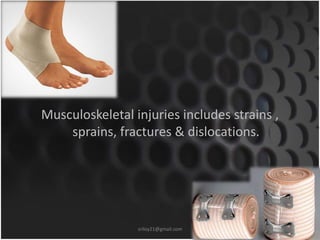
Musculoskeletal injuries includes strains , 
sprains, fractures & dislocations. 
sriloy21@gmail.com
sriloy21@gmail.com
Definition 
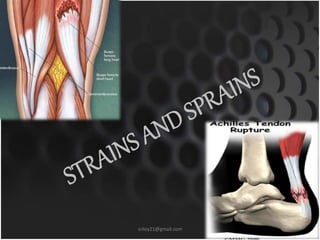
A strain is an injury to a muscle or tendon in 
which the muscle fibers tear as a result 
of overstretching 
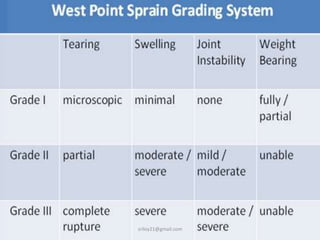
A sprain is an injury in a joint, caused by 
the ligament being stretched beyond its own 
capacity 
sriloy21@gmail.com
sriloy21@gmail.com
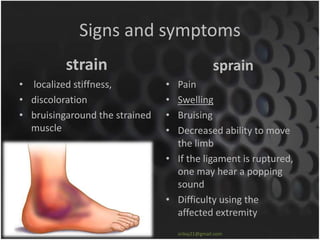
Signs and symptoms 
strain 
• localized stiffness, 
• discoloration 
• bruisingaround the strained 
muscle 
sprain 
• Pain 
• Swelling 
• Bruising 
• Decreased ability to move 
the limb 
• If the ligament is ruptured, 
one may hear a popping 
sound 
• Difficulty using the 
affected extremity 
sriloy21@gmail.com
Treatment 
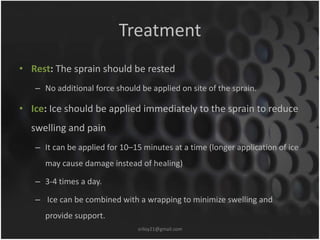
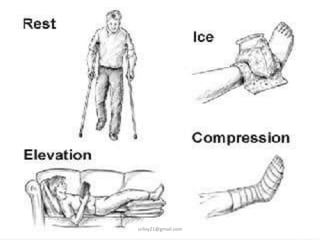
• Rest: The sprain should be rested 
– No additional force should be applied on site of the sprain. 
• Ice: Ice should be applied immediately to the sprain to reduce 
swelling and pain 
– It can be applied for 10–15 minutes at a time (longer application of ice 
may cause damage instead of healing) 
– 3-4 times a day. 
– Ice can be combined with a wrapping to minimize swelling and 
provide support. 
sriloy21@gmail.com
sriloy21@gmail.com
Cont… 
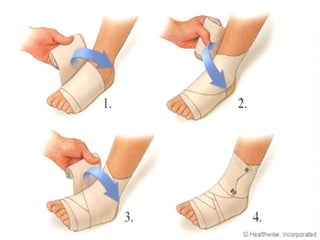
• Compression: Dressings, bandages, or ace-wraps should be 
used to immobilize the sprain and provide support 
– When wrapping the injury, more pressure should be applied at the far 
end of the injury and decrease in the direction of the heart 
– Compression should not cut off the circulation of the limb.[8] 
• Elevation: Keeping the sprained joint elevated (in relation to 
the rest of the body) will also help minimize swelling 
sriloy21@gmail.com
sriloy21@gmail.com
FRACTURE
Fracture is a partial or complete breakage or 
crack in a bone. 
Both direct & indirect force can cause fracture. 
fracture can be with / without displacement of 
bone fragments. 
sriloy21@gmail.com
Types: 
Stable fracture- broken bone ends do not move, 
either because they are incompletely broken 
or jammed together. 
Unstable fracture- broken bone ends can easily 
move out of position that increases the risk of 
damage to blood vessels, nerves & organs. 
sriloy21@gmail.com
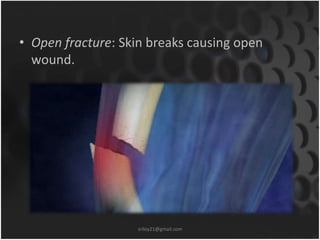
• Open fracture: Skin breaks causing open 
wound. 
sriloy21@gmail.com
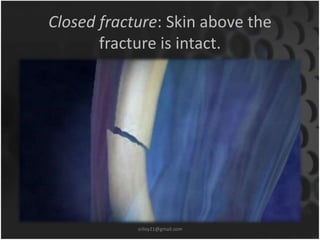
Closed fracture: Skin above the 
fracture is intact. 
sriloy21@gmail.com
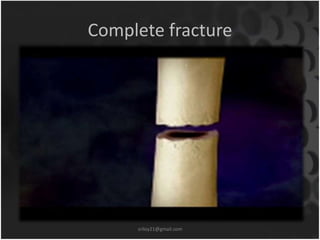
Complete fracture 
sriloy21@gmail.com
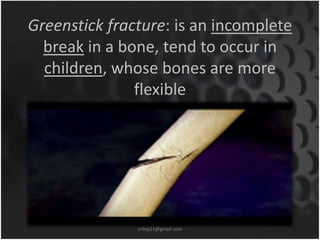
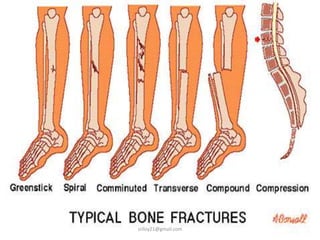
Greenstick fracture: is an incomplete 
break in a bone, tend to occur in 
children, whose bones are more 
flexible 
sriloy21@gmail.com
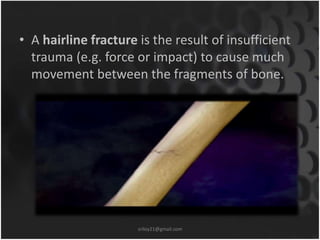
• A hairline fracture is the result of insufficient 
trauma (e.g. force or impact) to cause much 
movement between the fragments of bone. 
sriloy21@gmail.com
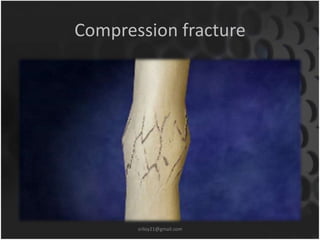
Compression fracture 
sriloy21@gmail.com
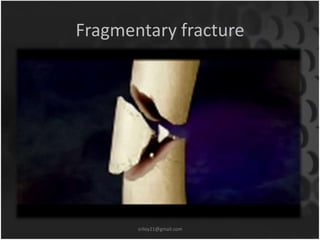
Fragmentary fracture 
sriloy21@gmail.com
sriloy21@gmail.com
Assessment: 
• Quickly assess five P’s in musculoskeletal 
injuries : 
Pain- location, severity & quality of pain. 
Paresthesia- abnormal sensation or loss of 
sensation indicates neuromuscular involvement. 
paralysis- nerve damage. 
pallor – neurovascular compromise. 
Pulse- decreased or absent pulse indicates 
reduced blood supply to the area. 
sriloy21@gmail.com
Symptoms 
• Severe pain 
• Difficulty in movement 
• Swelling/ bruising / bleeding 
• Deformity / abnormal twist of limb 
• Tenderness on applying pressure 
• Crepitus me be heard 
• Signs of shock 
sriloy21@gmail.com
First-aid 
Depends on type & location of fracture 
sriloy21@gmail.com
For open fractures: 
• Control bleeding 
• Dress the wound 
• Immobilize. 
For closed fractures: 
• Calm the person 
• Bandage the injured part to an unaffected part of 
the body 
• Immobilize 
• Shift to hospital 
sriloy21@gmail.com
DO NOT 
• Massage the affected area 
• Straighten the broken bone 
• Move without support to broken bone 
• Move joints above / below the fracture 
• Give oral liquids / food 
sriloy21@gmail.com
Prevention 
• Wear protective pads / helmets when driving 
• Teach children / practice, safe habits 
sriloy21@gmail.com
First aid 
Based on location of fracture: 
Facial fracture: 
• If unconscious but breathing normally, place the 
patient on their side in a supported position & 
Call for an ambulance. 
• If conscious, allow the patient to rest in the 
position of greatest comfort, generally half-sitting 
or lying down with the head tilted to the injured 
side. Provide a clean pad or some tissues for the 
patient to mop up any blood, saliva or mucus. 
sriloy21@gmail.com
• If the jaw appears broken or dislocated, allow 
the patient to support the injured part with 
soft pad. 
• Gently apply a cold compress to reduce pain & 
swelling. 
Note: ask the casualty to split out any blood, 
broken teeth or dentures from his mouth. 
sriloy21@gmail.com
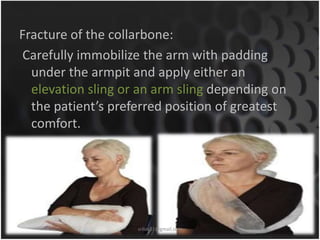
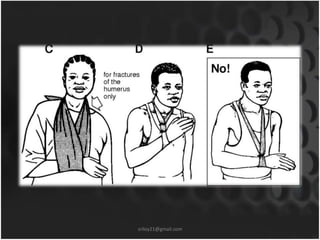
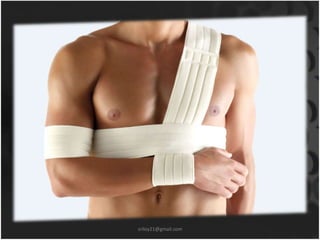
Fracture of the collarbone: 
Carefully immobilize the arm with padding 
under the armpit and apply either an 
elevation sling or an arm sling depending on 
the patient’s preferred position of greatest 
comfort. 
sriloy21@gmail.com
• Gently place soft padding between arm & 
body to make more comfortable. 
• Send the casualty to hospital in sitting 
position. 
sriloy21@gmail.com
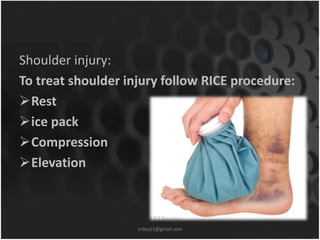
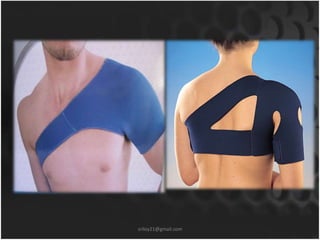
Shoulder injury: 
To treat shoulder injury follow RICE procedure: 
Rest 
ice pack 
Compression 
Elevation 
sriloy21@gmail.com
Upper arm, elbow & lower arm injury: 
position of greatest comfort- generally sitting in 
a chair or half sitting with support. 
Allow the patient to support the arm on the 
injured side on a pillow or folded clothing. 
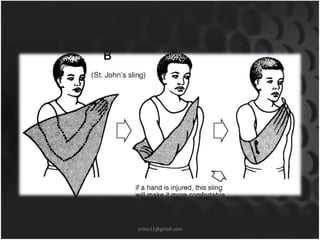
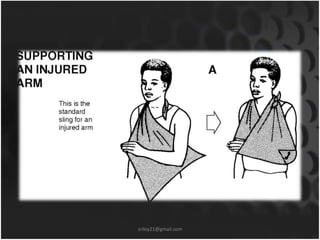
Place a triangular bandage between the chest & 
the injured arm. 
sriloy21@gmail.com
sriloy21@gmail.com
sriloy21@gmail.com
sriloy21@gmail.com
sriloy21@gmail.com
sriloy21@gmail.com
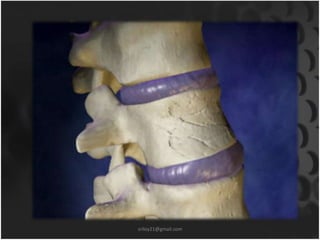
Spine fracture 
• Severe pain in the back 
• Loss of control over limbs 
• Loss of sensation of the limb below the injury 
sriloy21@gmail.com
sriloy21@gmail.com
Treatment 
• Do not move 
• Put a rolled cloth along the side of the trunk 
to support the person 
• Wait for ambulance 
• Place pads between leg and tie a bandage in 8 
shape 
• Always remember to take the patient in 
supine position 
sriloy21@gmail.com
Neck fracture 
• Use a cervical collar or make 1 with paper and 
triangular bandage 
• Maintain airway 
sriloy21@gmail.com
Facture of the lower limb 
• Pain with movement 
• Swelling 
• Tenderness 
• Not able to bend the leg 
• Signs of shock 
sriloy21@gmail.com
First aid 
• Use pads, sticks, bandages to immobilize 
• Elevate 
• Restrict movement 
• Supine position 
sriloy21@gmail.com
Dislocation 
• Dislocation occurs in a joint when it is pushed 
beyond its normal range of motion. 
• A dislocation is where a bone has been 
displaced from its normal position at a joint. 
sriloy21@gmail.com
Signs and symptoms 
• Strong pain in the articulation at the time of 
the accident. 
• A limb is deformed in case of sprains. 
• Swelling which manifest itself quickly. 
• Pain increase while moving the articulation 
sriloy21@gmail.com
thanQ... 
sriloy21@gmail.com

Fracture copy

  • 1.
    Musculoskeletal Injuries PresentedBy Sriloy Mohanty B.N.Y.S.
  • 2.
    Musculoskeletal injuries includesstrains , sprains, fractures & dislocations. sriloy21@gmail.com
  • 3.
  • 4.
    Definition A strainis an injury to a muscle or tendon in which the muscle fibers tear as a result of overstretching A sprain is an injury in a joint, caused by the ligament being stretched beyond its own capacity sriloy21@gmail.com
  • 5.
  • 6.
    Signs and symptoms strain • localized stiffness, • discoloration • bruisingaround the strained muscle sprain • Pain • Swelling • Bruising • Decreased ability to move the limb • If the ligament is ruptured, one may hear a popping sound • Difficulty using the affected extremity sriloy21@gmail.com
  • 7.
    Treatment • Rest:The sprain should be rested – No additional force should be applied on site of the sprain. • Ice: Ice should be applied immediately to the sprain to reduce swelling and pain – It can be applied for 10–15 minutes at a time (longer application of ice may cause damage instead of healing) – 3-4 times a day. – Ice can be combined with a wrapping to minimize swelling and provide support. sriloy21@gmail.com
  • 8.
  • 9.
    Cont… • Compression:Dressings, bandages, or ace-wraps should be used to immobilize the sprain and provide support – When wrapping the injury, more pressure should be applied at the far end of the injury and decrease in the direction of the heart – Compression should not cut off the circulation of the limb.[8] • Elevation: Keeping the sprained joint elevated (in relation to the rest of the body) will also help minimize swelling sriloy21@gmail.com
  • 10.
  • 11.
  • 12.
    Fracture is apartial or complete breakage or crack in a bone. Both direct & indirect force can cause fracture. fracture can be with / without displacement of bone fragments. sriloy21@gmail.com
  • 13.
    Types: Stable fracture-broken bone ends do not move, either because they are incompletely broken or jammed together. Unstable fracture- broken bone ends can easily move out of position that increases the risk of damage to blood vessels, nerves & organs. sriloy21@gmail.com
  • 14.
    • Open fracture:Skin breaks causing open wound. sriloy21@gmail.com
  • 15.
    Closed fracture: Skinabove the fracture is intact. sriloy21@gmail.com
  • 16.
  • 17.
    Greenstick fracture: isan incomplete break in a bone, tend to occur in children, whose bones are more flexible sriloy21@gmail.com
  • 18.
    • A hairlinefracture is the result of insufficient trauma (e.g. force or impact) to cause much movement between the fragments of bone. sriloy21@gmail.com
  • 19.
  • 20.
  • 21.
  • 22.
    Assessment: • Quicklyassess five P’s in musculoskeletal injuries : Pain- location, severity & quality of pain. Paresthesia- abnormal sensation or loss of sensation indicates neuromuscular involvement. paralysis- nerve damage. pallor – neurovascular compromise. Pulse- decreased or absent pulse indicates reduced blood supply to the area. sriloy21@gmail.com
  • 23.
    Symptoms • Severepain • Difficulty in movement • Swelling/ bruising / bleeding • Deformity / abnormal twist of limb • Tenderness on applying pressure • Crepitus me be heard • Signs of shock sriloy21@gmail.com
  • 24.
    First-aid Depends ontype & location of fracture sriloy21@gmail.com
  • 25.
    For open fractures: • Control bleeding • Dress the wound • Immobilize. For closed fractures: • Calm the person • Bandage the injured part to an unaffected part of the body • Immobilize • Shift to hospital sriloy21@gmail.com
  • 26.
    DO NOT •Massage the affected area • Straighten the broken bone • Move without support to broken bone • Move joints above / below the fracture • Give oral liquids / food sriloy21@gmail.com
  • 27.
    Prevention • Wearprotective pads / helmets when driving • Teach children / practice, safe habits sriloy21@gmail.com
  • 28.
    First aid Basedon location of fracture: Facial fracture: • If unconscious but breathing normally, place the patient on their side in a supported position & Call for an ambulance. • If conscious, allow the patient to rest in the position of greatest comfort, generally half-sitting or lying down with the head tilted to the injured side. Provide a clean pad or some tissues for the patient to mop up any blood, saliva or mucus. sriloy21@gmail.com
  • 29.
    • If thejaw appears broken or dislocated, allow the patient to support the injured part with soft pad. • Gently apply a cold compress to reduce pain & swelling. Note: ask the casualty to split out any blood, broken teeth or dentures from his mouth. sriloy21@gmail.com
  • 30.
    Fracture of thecollarbone: Carefully immobilize the arm with padding under the armpit and apply either an elevation sling or an arm sling depending on the patient’s preferred position of greatest comfort. sriloy21@gmail.com
  • 31.
    • Gently placesoft padding between arm & body to make more comfortable. • Send the casualty to hospital in sitting position. sriloy21@gmail.com
  • 32.
    Shoulder injury: Totreat shoulder injury follow RICE procedure: Rest ice pack Compression Elevation sriloy21@gmail.com
  • 33.
    Upper arm, elbow& lower arm injury: position of greatest comfort- generally sitting in a chair or half sitting with support. Allow the patient to support the arm on the injured side on a pillow or folded clothing. Place a triangular bandage between the chest & the injured arm. sriloy21@gmail.com
  • 34.
  • 35.
  • 36.
  • 37.
  • 38.
  • 39.
    Spine fracture •Severe pain in the back • Loss of control over limbs • Loss of sensation of the limb below the injury sriloy21@gmail.com
  • 40.
  • 41.
    Treatment • Donot move • Put a rolled cloth along the side of the trunk to support the person • Wait for ambulance • Place pads between leg and tie a bandage in 8 shape • Always remember to take the patient in supine position sriloy21@gmail.com
  • 42.
    Neck fracture •Use a cervical collar or make 1 with paper and triangular bandage • Maintain airway sriloy21@gmail.com
  • 43.
    Facture of thelower limb • Pain with movement • Swelling • Tenderness • Not able to bend the leg • Signs of shock sriloy21@gmail.com
  • 44.
    First aid •Use pads, sticks, bandages to immobilize • Elevate • Restrict movement • Supine position sriloy21@gmail.com
  • 45.
    Dislocation • Dislocationoccurs in a joint when it is pushed beyond its normal range of motion. • A dislocation is where a bone has been displaced from its normal position at a joint. sriloy21@gmail.com
  • 46.
    Signs and symptoms • Strong pain in the articulation at the time of the accident. • A limb is deformed in case of sprains. • Swelling which manifest itself quickly. • Pain increase while moving the articulation sriloy21@gmail.com
  • 47.