Motor unit
SR2002

October 28, 2013

Dr. Arimantas Lionikas
Motor Unit (MU)
Plan

•
•
•
•
•

Structural organization
Electromyography (EMG)
Recruitment threshold of MUs
MU types
MU recruitment during exercise

• Reading list:
1. Enoka R. Neuromechanics of human movement. 2002.
Publishers: Human Kinetics, p. 278-297
2. MacIntosh, B.R., Gardiner, P.F. McComas, A.J. Skeletal
muscle, 2nd edition. 2006. Publishers: Human Kinetics, p. 3239, 126-150.
3. McArdle W.D. et al. Exercise Physiology: energy, nutrition,
human performance. 2001. Publisher: Lippincott Williams &
Wilkins, p. p. 374-382, 394-400.
Structural organization
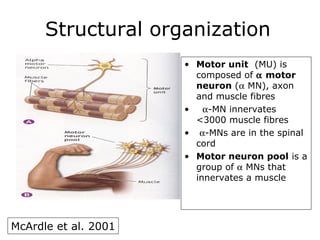
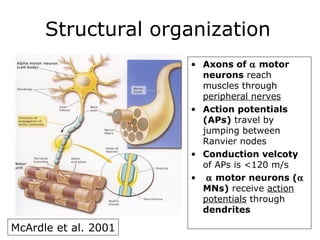
• Motor unit (MU) is
composed of α motor
neuron (α MN), axon
and muscle fibres
• α-MN innervates
<3000 muscle fibres
• α-MNs are in the spinal
cord
• Motor neuron pool is a
group of α MNs that
innervates a muscle

McArdle et al. 2001
Structural organization
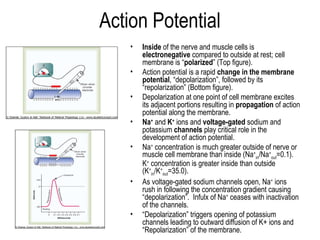
• Axons of α motor
neurons reach
muscles through
peripheral nerves
• Action potentials
(APs) travel by
jumping between
Ranvier nodes
• Conduction velcoty
of APs is <120 m/s
• α motor neurons (α
MNs) receive action
potentials through
dendrites

McArdle et al. 2001
Action Potential
•
•
•
•
•

•

•

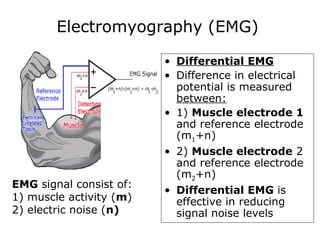
Inside of the nerve and muscle cells is
electronegative compared to outside at rest; cell
membrane is “polarized” (Top figure).
Action potential is a rapid change in the membrane
potential, “depolarization”, followed by its
“repolarization” (Bottom figure).
Depolarization at one point of cell membrane excites
its adjacent portions resulting in propagation of action
potential along the membrane.
Na+ and K+ ions and voltage-gated sodium and
potassium channels play critical role in the
development of action potential.
Na+ concentration is much greater outside of nerve or
muscle cell membrane than inside (Na+in/Na+out=0.1).
K+ concentration is greater inside than outside
(K+in/K+out=35.0).
As voltage-gated sodium channels open, Na+ ions
rush in following the concentration gradient causing
“depolarization”. Infulx of Na+ ceases with inactivation
of the channels.
“Depolarization” triggers opening of potassium
channels leading to outward diffusion of K+ ions and
“Repolarization” of the membrane.
Electromyography (EMG)

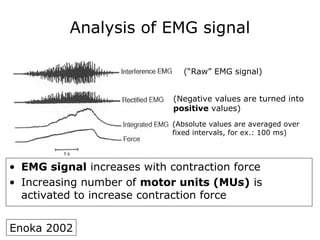
EMG signal consist of:
1) muscle activity (m)
2) electric noise (n)

• Differential EMG
• Difference in electrical
potential is measured
between:
• 1) Muscle electrode 1
and reference electrode
(m1+n)
• 2) Muscle electrode 2
and reference electrode
(m2+n)
• Differential EMG is
effective in reducing
signal noise levels
Analysis of EMG signal
(“Raw” EMG signal)
(Negative values are turned into
positive values)
(Absolute values are averaged over
fixed intervals, for ex.: 100 ms)

• EMG signal increases with contraction force
• Increasing number of motor units (MUs) is
activated to increase contraction force
Enoka 2002
Needle electromyography
MU1
MU2

MacIntosh et al. 2005

MU1
MU2

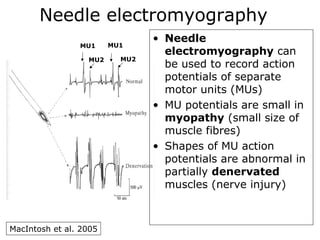
• Needle
electromyography can
be used to record action
potentials of separate
motor units (MUs)
• MU potentials are small in
myopathy (small size of
muscle fibres)
• Shapes of MU action
potentials are abnormal in
partially denervated
muscles (nerve injury)
Recruitment threshold of MUs
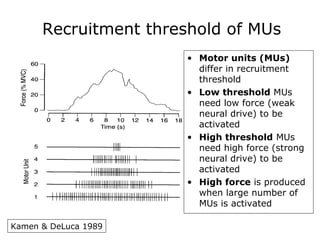
• Motor units (MUs)
differ in recruitment
threshold
• Low threshold MUs
need low force (weak
neural drive) to be
activated
• High threshold MUs
need high force (strong
neural drive) to be
activated
• High force is produced
when large number of
MUs is activated
Kamen & DeLuca 1989
Classification of MUs
• 1) S type (slow, fatigue resistant, small)
Easily activated even by weak neural inputs
• 2) FR type (fatigue resistant, fast, medium size)
Require stronger neural inputs for activation than S type
• 3) FF type (fast, fatigable, large size)
Recruited only by very strong neural inputs
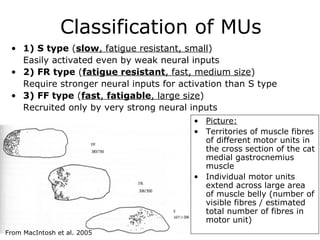
• Picture:
• Territories of muscle fibres
of different motor units in
the cross section of the cat
medial gastrocnemius
muscle
• Individual motor units
extend across large area
of muscle belly (number of
visible fibres / estimated
total number of fibres in
motor unit)
From MacIntosh et al. 2005
Important rule:
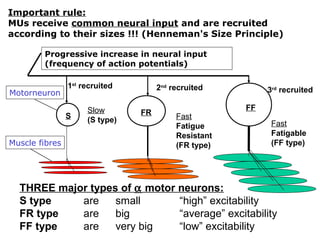
MUs receive common neural input and are recruited
according to their sizes !!! (Henneman's Size Principle)
Progressive increase in neural input
(frequency of action potentials)
Motorneuron

1st recruited

S
Muscle fibres

Slow
(S type)

2nd recruited
FR

Fast
Fatigue
Resistant
(FR type)

3rd recruited
FF
Fast
Fatigable
(FF type)

THREE major types of α motor neurons:
S type
are
small
“high” excitability
FR type
are
big
“average” excitability
FF type
are
very big
“low” excitability
MU recruitment

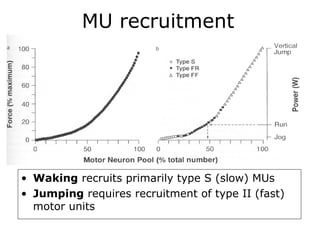
• Waking recruits primarily type S (slow) MUs
• Jumping requires recruitment of type II (fast)
motor units
MU recruitment (cont)
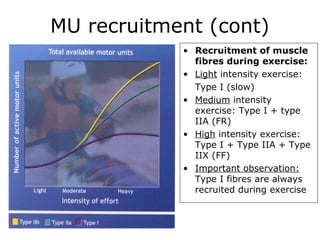
• Recruitment of muscle
fibres during exercise:
• Light intensity exercise:
Type I (slow)
• Medium intensity
exercise: Type I + type
IIA (FR)
• High intensity exercise:
Type I + Type IIA + Type
IIX (FF)
• Important observation:
Type I fibres are always
recruited during exercise
MU recruitment (cont)
• A number of activated
MUs increases with
effort and leads to the
increase in force
• Increments of MU force
become progressively
larger as big MUs are
activated at high forces
• Note: It is difficult to
grade muscle force
precisely when high
force is produced
Motor unit
Summary

• A Motor unit (MU) is composed of α motor
neuron, axon and muscle fibres
• Electromyography can be used to study
motor units (MUs)
• There are three main types of MUs (S, FR and
FF)
• MUs are recruited according to their sizes in
the following order: S => FR => FF

10 motor unit sr2002 2013 al

  • 1.
    Motor unit SR2002 October 28,2013 Dr. Arimantas Lionikas
  • 2.
    Motor Unit (MU) Plan • • • • • Structuralorganization Electromyography (EMG) Recruitment threshold of MUs MU types MU recruitment during exercise • Reading list: 1. Enoka R. Neuromechanics of human movement. 2002. Publishers: Human Kinetics, p. 278-297 2. MacIntosh, B.R., Gardiner, P.F. McComas, A.J. Skeletal muscle, 2nd edition. 2006. Publishers: Human Kinetics, p. 3239, 126-150. 3. McArdle W.D. et al. Exercise Physiology: energy, nutrition, human performance. 2001. Publisher: Lippincott Williams & Wilkins, p. p. 374-382, 394-400.
  • 3.
    Structural organization • Motorunit (MU) is composed of α motor neuron (α MN), axon and muscle fibres • α-MN innervates <3000 muscle fibres • α-MNs are in the spinal cord • Motor neuron pool is a group of α MNs that innervates a muscle McArdle et al. 2001
  • 4.
    Structural organization • Axonsof α motor neurons reach muscles through peripheral nerves • Action potentials (APs) travel by jumping between Ranvier nodes • Conduction velcoty of APs is <120 m/s • α motor neurons (α MNs) receive action potentials through dendrites McArdle et al. 2001
  • 5.
    Action Potential • • • • • • • Inside ofthe nerve and muscle cells is electronegative compared to outside at rest; cell membrane is “polarized” (Top figure). Action potential is a rapid change in the membrane potential, “depolarization”, followed by its “repolarization” (Bottom figure). Depolarization at one point of cell membrane excites its adjacent portions resulting in propagation of action potential along the membrane. Na+ and K+ ions and voltage-gated sodium and potassium channels play critical role in the development of action potential. Na+ concentration is much greater outside of nerve or muscle cell membrane than inside (Na+in/Na+out=0.1). K+ concentration is greater inside than outside (K+in/K+out=35.0). As voltage-gated sodium channels open, Na+ ions rush in following the concentration gradient causing “depolarization”. Infulx of Na+ ceases with inactivation of the channels. “Depolarization” triggers opening of potassium channels leading to outward diffusion of K+ ions and “Repolarization” of the membrane.
  • 6.
    Electromyography (EMG) EMG signalconsist of: 1) muscle activity (m) 2) electric noise (n) • Differential EMG • Difference in electrical potential is measured between: • 1) Muscle electrode 1 and reference electrode (m1+n) • 2) Muscle electrode 2 and reference electrode (m2+n) • Differential EMG is effective in reducing signal noise levels
  • 7.
    Analysis of EMGsignal (“Raw” EMG signal) (Negative values are turned into positive values) (Absolute values are averaged over fixed intervals, for ex.: 100 ms) • EMG signal increases with contraction force • Increasing number of motor units (MUs) is activated to increase contraction force Enoka 2002
  • 8.
    Needle electromyography MU1 MU2 MacIntosh etal. 2005 MU1 MU2 • Needle electromyography can be used to record action potentials of separate motor units (MUs) • MU potentials are small in myopathy (small size of muscle fibres) • Shapes of MU action potentials are abnormal in partially denervated muscles (nerve injury)
  • 9.
    Recruitment threshold ofMUs • Motor units (MUs) differ in recruitment threshold • Low threshold MUs need low force (weak neural drive) to be activated • High threshold MUs need high force (strong neural drive) to be activated • High force is produced when large number of MUs is activated Kamen & DeLuca 1989
  • 10.
    Classification of MUs •1) S type (slow, fatigue resistant, small) Easily activated even by weak neural inputs • 2) FR type (fatigue resistant, fast, medium size) Require stronger neural inputs for activation than S type • 3) FF type (fast, fatigable, large size) Recruited only by very strong neural inputs • Picture: • Territories of muscle fibres of different motor units in the cross section of the cat medial gastrocnemius muscle • Individual motor units extend across large area of muscle belly (number of visible fibres / estimated total number of fibres in motor unit) From MacIntosh et al. 2005
  • 11.
    Important rule: MUs receivecommon neural input and are recruited according to their sizes !!! (Henneman's Size Principle) Progressive increase in neural input (frequency of action potentials) Motorneuron 1st recruited S Muscle fibres Slow (S type) 2nd recruited FR Fast Fatigue Resistant (FR type) 3rd recruited FF Fast Fatigable (FF type) THREE major types of α motor neurons: S type are small “high” excitability FR type are big “average” excitability FF type are very big “low” excitability
  • 12.
    MU recruitment • Wakingrecruits primarily type S (slow) MUs • Jumping requires recruitment of type II (fast) motor units
  • 13.
    MU recruitment (cont) •Recruitment of muscle fibres during exercise: • Light intensity exercise: Type I (slow) • Medium intensity exercise: Type I + type IIA (FR) • High intensity exercise: Type I + Type IIA + Type IIX (FF) • Important observation: Type I fibres are always recruited during exercise
  • 14.
    MU recruitment (cont) •A number of activated MUs increases with effort and leads to the increase in force • Increments of MU force become progressively larger as big MUs are activated at high forces • Note: It is difficult to grade muscle force precisely when high force is produced
  • 15.
    Motor unit Summary • AMotor unit (MU) is composed of α motor neuron, axon and muscle fibres • Electromyography can be used to study motor units (MUs) • There are three main types of MUs (S, FR and FF) • MUs are recruited according to their sizes in the following order: S => FR => FF

Editor's Notes

  • #9 Needle EMG can be also use to study the in vivo patterns of activity of different muscles. Hennig &amp; Lømo (1984) examined patterns of MU activation in soleus and EDL muscles during normal motor behaviour in rats.
  • #10 Understanding of the concept of the Recruitment threshold of MU in critical for the ability to understand and predict effects of various training programs on skeletal muscle contractile properties.