KenaUpanishad
Sriloy mohanty
BNYS
Existance Of Soul
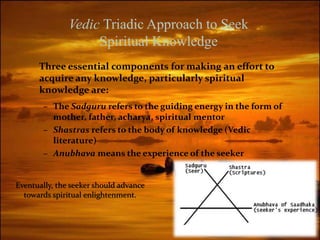
Three essential components for making an effort to
acquire any knowledge, particularly spiritual
knowledge are:
– The Sadguru refers to the guiding energy in the form of
mother, father, acharya, spiritual mentor
– Shastras refers to the body of knowledge (Vedic
literature)
– Anubhava means the experience of the seeker
Vedic Triadic Approach to Seek
Spiritual Knowledge
Eventually, the seeker should advance
towards spiritual enlightenment.
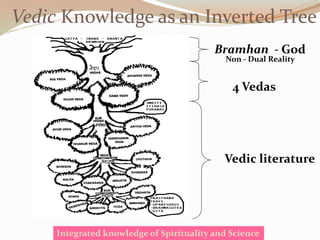
Vedic Knowledge as an Inverted Tree
Integrated knowledge of Spirituality and Science
Bramhan - God
Non - Dual Reality
Vedic literature
4 Vedas
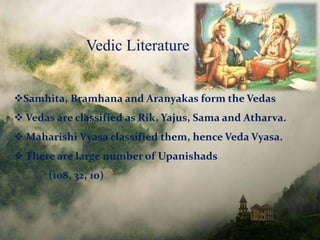
Samhita, Bramhana and Aranyakas form the Vedas
 Vedas are classified as Rik, Yajus, Sama and Atharva.
 Maharishi Vyasa classified them, hence Veda Vyasa.
 There are large number of Upanishads
(108, 32, 10)
Vedic Literature
Upanishads refers to the spiritual knowledge
obtained by disciples sitting near the realized Guru,
that destroys the ignorance of disciples.
 Upanishads are the Vedanta (essence of the Vedas)
Upanishads
 Upanishads are essentially in the form of stories and
dialogues such as those of Yama-Nachiketa, Varuna-Bhrigu,
Yajnavalkya-Maitreyi, etc.
Upanishads are the super conscious experiences of Atman
by several rishis and they form the foundation of Sanatana
Dharma.
The other two are Bramha Sutras and Bhagavadgita
Ten Upanishads are considered as major ones.
 Rigveda ---Aitareya
 Sukla Yajurveda ---Isavasya and
Brihadaranyaka
 Krishna Yajurveda --Katha and Taittiriya
 Samaveda ---Kena and Chandogya
 Atharva ---Prasna, Mundaka and Mandukya
Principal Upanishads
•Concept of bramhan
•Small in size (18 verses)
• Mystical experience of ubiquitous Atman.
• Karma yoga
Isavasya Upanishad
Katha Upanishad
 Mrutyu rahasya
 Dialogue of Yama-Nachiketa
 Sacred fire and yajna
 mortal body and immortal soul
 role of yoga and discipline
Katha upanishat
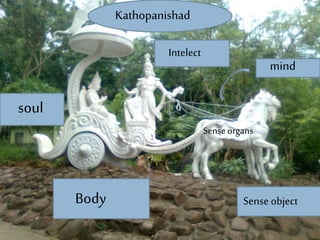
Sense organs
mind
Intelect
soul
Body Sense object
Kathopanishad
Nothing is superior to
Purusa
Purusa
Unmanifested
Atman
Intellect
Mind
Object
Senses
Kathopanishad
says…
Secret of prana
String of questions to rishi Pippalada by
Sukesi,
Satyakama,
Gargya,
Aswalayana,
Bhargava and Kabandhi
Systematic presentation through questions and
answers
“When is all this that is visible”-(Kabandhi)
“Who is the Purusha with sixteen kalas”-(Sukesha)
Prasna Upanishad
•Refers to the visions and experiences of Samnyasis
•Para and Apara Vidya
•Cosmology
•Karma and Jnana yoga
Mundaka Upanishad
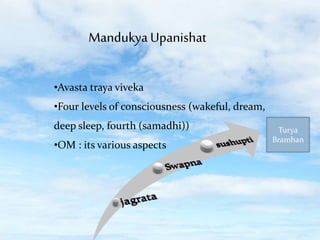
MandukyaUpanishat
•Avasta traya viveka
•Four levels of consciousness (wakeful, dream,
deep sleep, fourth (samadhi))
•OM : its various aspects
Turya
Bramhan
•Ethics, learning and advice at the end of studies
•Sheaths of Bramhan
•Levels and scale of happiness (bliss)
•Dialogue of Varuna and Bhrigu about Bramhan
•Ecstatic expressions of experience of Bramhan
TaittiriyaUpanishad
•Panchakosha viveka and ananda mimamsa
•Creation of world through Viraj (ananda mimamsa)
•Philosophy of the births (panchakosha)
•Nature of Atman
•Gurukula system-samavartana ceremony
TatryaUpanishad
ChandogyaUpanishad
Yajna and upasana
 Raikva, Satyakama Jabala, Usasti
Pravahana (Life after death), Narada (Para and Apara)
Bramhachari (worship of Prana), Indra (about Atman)
Thus spake Uddalaka Aruni
Brihdaranyaka Upanishat
•Karma (Soma sacrifice)
•Creation of Universe and four varnas
•Gargi-Yanjnavalkya, Balaki-Ajatashatru,
•Bramhan as Antaryamin
•Thus spake Yajnavalkya
Brihdaranyaka Upanishad
•Definition of consciousness
•Subjective (psychological-spiritual) and objective
(cosmological) approaches to proof of Atman.
•Atman as Ultimate Reality
•Omnipotence of Atman (Uma, the Goddess and Indra)
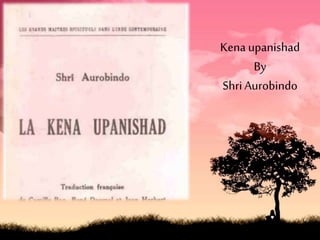
Kena upanishad
By
ShriAurobindo
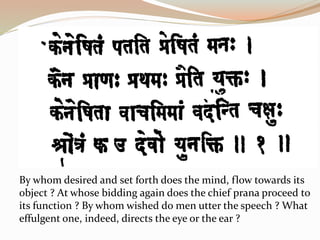
By whom desired and set forth does the mind, flow towards its
object ? At whose bidding again does the chief prana proceed to
its function ? By whom wished do men utter the speech ? What
effulgent one, indeed, directs the eye or the ear ?
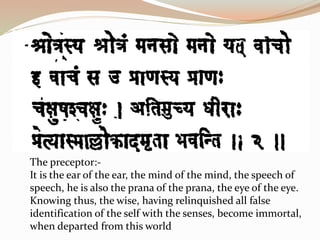
The preceptor:-
It is the ear of the ear, the mind of the mind, the speech of
speech, he is also the prana of the prana, the eye of the eye.
Knowing thus, the wise, having relinquished all false
identification of the self with the senses, become immortal,
when departed from this world
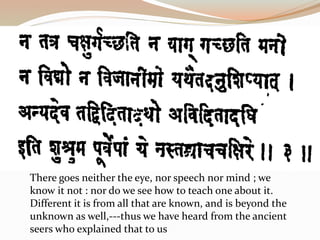
There goes neither the eye, nor speech nor mind ; we
know it not : nor do we see how to teach one about it.
Different it is from all that are known, and is beyond the
unknown as well,---thus we have heard from the ancient
seers who explained that to us
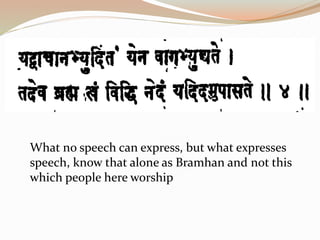
What no speech can express, but what expresses
speech, know that alone as Bramhan and not this
which people here worship
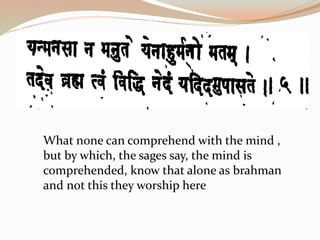
What none can comprehend with the mind ,
but by which, the sages say, the mind is
comprehended, know that alone as brahman
and not this they worship here
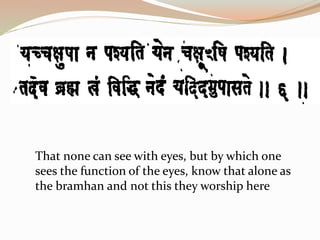
That none can see with eyes, but by which one
sees the function of the eyes, know that alone as
the bramhan and not this they worship here
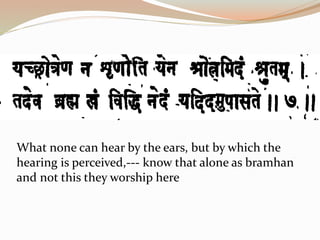
What none can hear by the ears, but by which the
hearing is perceived,--- know that alone as bramhan
and not this they worship here
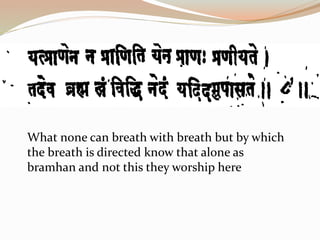
What none can breath with breath but by which
the breath is directed know that alone as
bramhan and not this they worship here
Thank you………Love All Serve

Kena upanishad

  • 1.
  • 2.
    Three essential componentsfor making an effort to acquire any knowledge, particularly spiritual knowledge are: – The Sadguru refers to the guiding energy in the form of mother, father, acharya, spiritual mentor – Shastras refers to the body of knowledge (Vedic literature) – Anubhava means the experience of the seeker Vedic Triadic Approach to Seek Spiritual Knowledge Eventually, the seeker should advance towards spiritual enlightenment.
  • 3.
    Vedic Knowledge asan Inverted Tree Integrated knowledge of Spirituality and Science Bramhan - God Non - Dual Reality Vedic literature 4 Vedas
  • 4.
    Samhita, Bramhana andAranyakas form the Vedas  Vedas are classified as Rik, Yajus, Sama and Atharva.  Maharishi Vyasa classified them, hence Veda Vyasa.  There are large number of Upanishads (108, 32, 10) Vedic Literature
  • 5.
    Upanishads refers tothe spiritual knowledge obtained by disciples sitting near the realized Guru, that destroys the ignorance of disciples.  Upanishads are the Vedanta (essence of the Vedas) Upanishads
  • 6.
     Upanishads areessentially in the form of stories and dialogues such as those of Yama-Nachiketa, Varuna-Bhrigu, Yajnavalkya-Maitreyi, etc. Upanishads are the super conscious experiences of Atman by several rishis and they form the foundation of Sanatana Dharma. The other two are Bramha Sutras and Bhagavadgita
  • 7.
    Ten Upanishads areconsidered as major ones.  Rigveda ---Aitareya  Sukla Yajurveda ---Isavasya and Brihadaranyaka  Krishna Yajurveda --Katha and Taittiriya  Samaveda ---Kena and Chandogya  Atharva ---Prasna, Mundaka and Mandukya Principal Upanishads
  • 8.
    •Concept of bramhan •Smallin size (18 verses) • Mystical experience of ubiquitous Atman. • Karma yoga Isavasya Upanishad
  • 9.
    Katha Upanishad  Mrutyurahasya  Dialogue of Yama-Nachiketa  Sacred fire and yajna  mortal body and immortal soul  role of yoga and discipline Katha upanishat
  • 10.
  • 11.
    Nothing is superiorto Purusa Purusa Unmanifested Atman Intellect Mind Object Senses Kathopanishad says…
  • 12.
    Secret of prana Stringof questions to rishi Pippalada by Sukesi, Satyakama, Gargya, Aswalayana, Bhargava and Kabandhi Systematic presentation through questions and answers “When is all this that is visible”-(Kabandhi) “Who is the Purusha with sixteen kalas”-(Sukesha) Prasna Upanishad
  • 13.
    •Refers to thevisions and experiences of Samnyasis •Para and Apara Vidya •Cosmology •Karma and Jnana yoga Mundaka Upanishad
  • 14.
    MandukyaUpanishat •Avasta traya viveka •Fourlevels of consciousness (wakeful, dream, deep sleep, fourth (samadhi)) •OM : its various aspects Turya Bramhan
  • 15.
    •Ethics, learning andadvice at the end of studies •Sheaths of Bramhan •Levels and scale of happiness (bliss) •Dialogue of Varuna and Bhrigu about Bramhan •Ecstatic expressions of experience of Bramhan TaittiriyaUpanishad
  • 16.
    •Panchakosha viveka andananda mimamsa •Creation of world through Viraj (ananda mimamsa) •Philosophy of the births (panchakosha) •Nature of Atman •Gurukula system-samavartana ceremony TatryaUpanishad
  • 17.
    ChandogyaUpanishad Yajna and upasana Raikva, Satyakama Jabala, Usasti Pravahana (Life after death), Narada (Para and Apara) Bramhachari (worship of Prana), Indra (about Atman) Thus spake Uddalaka Aruni
  • 18.
    Brihdaranyaka Upanishat •Karma (Somasacrifice) •Creation of Universe and four varnas •Gargi-Yanjnavalkya, Balaki-Ajatashatru, •Bramhan as Antaryamin •Thus spake Yajnavalkya Brihdaranyaka Upanishad
  • 19.
    •Definition of consciousness •Subjective(psychological-spiritual) and objective (cosmological) approaches to proof of Atman. •Atman as Ultimate Reality •Omnipotence of Atman (Uma, the Goddess and Indra)
  • 21.
  • 22.
    By whom desiredand set forth does the mind, flow towards its object ? At whose bidding again does the chief prana proceed to its function ? By whom wished do men utter the speech ? What effulgent one, indeed, directs the eye or the ear ?
  • 23.
    The preceptor:- It isthe ear of the ear, the mind of the mind, the speech of speech, he is also the prana of the prana, the eye of the eye. Knowing thus, the wise, having relinquished all false identification of the self with the senses, become immortal, when departed from this world
  • 24.
    There goes neitherthe eye, nor speech nor mind ; we know it not : nor do we see how to teach one about it. Different it is from all that are known, and is beyond the unknown as well,---thus we have heard from the ancient seers who explained that to us
  • 25.
    What no speechcan express, but what expresses speech, know that alone as Bramhan and not this which people here worship
  • 26.
    What none cancomprehend with the mind , but by which, the sages say, the mind is comprehended, know that alone as brahman and not this they worship here
  • 27.
    That none cansee with eyes, but by which one sees the function of the eyes, know that alone as the bramhan and not this they worship here
  • 28.
    What none canhear by the ears, but by which the hearing is perceived,--- know that alone as bramhan and not this they worship here
  • 29.
    What none canbreath with breath but by which the breath is directed know that alone as bramhan and not this they worship here
  • 30.