
Managing Conflicts

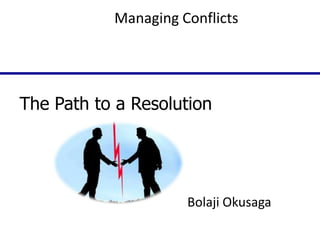
The Path to a Resolution

Bolaji Okusaga
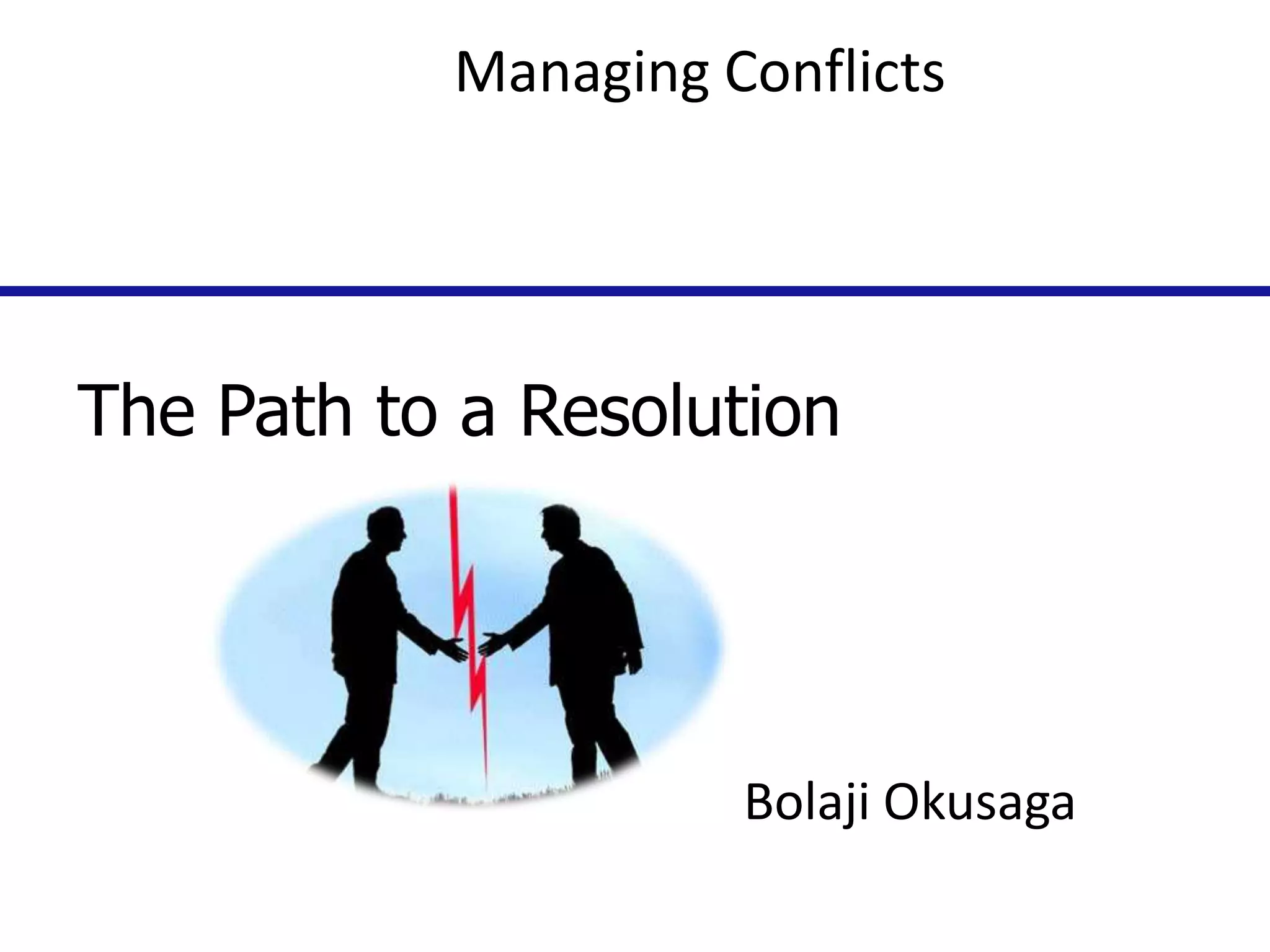
What is A Conflict?

Conflicts
exist where
there are
contending
interests

It arises
from a need
to secure
stakes and
positions

Conflicts
can be
active or
passive.
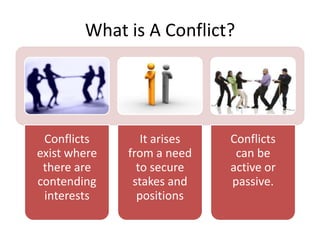
Personalities who cause conflict
The
Aggressor

Passive

The Arrogant
Buff

Mates

Habitual
Absentee

Error prone
Colleague

The
Chatterbox

HumptyDumpty

The
Unreliable

The Time
waster

The Hater
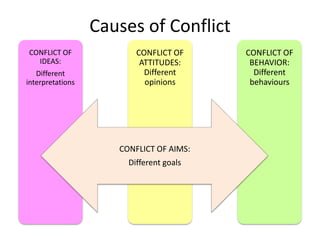
Causes of Conflict
CONFLICT OF
IDEAS:
Different
interpretations

CONFLICT OF
ATTITUDES:
Different
opinions

CONFLICT OF AIMS:
Different goals

CONFLICT OF
BEHAVIOR:
Different
behaviours
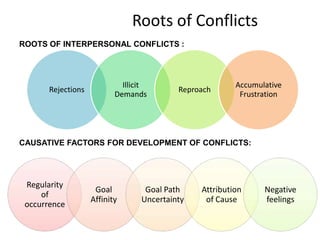
Roots of Conflicts
ROOTS OF INTERPERSONAL CONFLICTS :

Rejections

Illicit
Demands

Reproach

Accumulative
Frustration

CAUSATIVE FACTORS FOR DEVELOPMENT OF CONFLICTS:

Regularity
of
occurrence

Goal
Affinity

Goal Path
Uncertainty

Attribution
of Cause

Negative
feelings
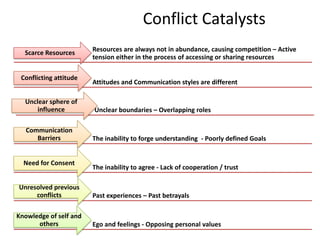
Conflict Catalysts
Scarce Resources

Conflicting attitude

Resources are always not in abundance, causing competition – Active
tension either in the process of accessing or sharing resources

Attitudes and Communication styles are different

Unclear sphere of
influence

Unclear boundaries – Overlapping roles

Communication
Barriers

The inability to forge understanding - Poorly defined Goals

Need for Consent
Unresolved previous
conflicts
Knowledge of self and
others

The inability to agree - Lack of cooperation / trust

Past experiences – Past betrayals

Ego and feelings - Opposing personal values
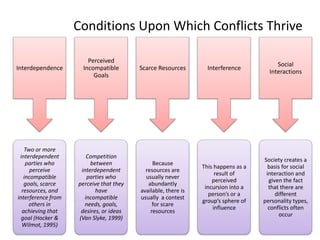
Conditions Upon Which Conflicts Thrive
Interdependence

Perceived
Incompatible
Goals

Scarce Resources

Two or more
interdependent
parties who
perceive
incompatible
goals, scarce
resources, and
interference from
others in
achieving that
goal (Hocker &
Wilmot, 1995)

Competition
between
interdependent
parties who
perceive that they
have
incompatible
needs, goals,
desires, or ideas
(Van Slyke, 1999)

Because
resources are
usually never
abundantly
available, there is
usually a contest
for scare
resources

Interference

Social
Interactions

This happens as a
result of
perceived
incursion into a
person’s or a
group’s sphere of
influence

Society creates a
basis for social
interaction and
given the fact
that there are
different
personality types,
conflicts often
occur
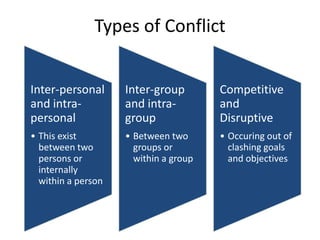
Types of Conflict
Inter-personal
and intrapersonal

Inter-group
and intragroup

Competitive
and
Disruptive

• This exist
between two
persons or
internally
within a person

• Between two
groups or
within a group

• Occuring out of
clashing goals
and objectives
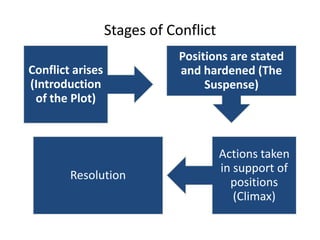
Stages of Conflict
Conflict arises
(Introduction
of the Plot)

Resolution

Positions are stated
and hardened (The
Suspense)

Actions taken
in support of
positions
(Climax)
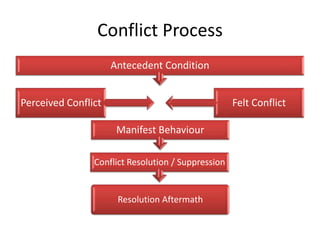
Conflict Process
Antecedent Condition
Perceived Conflict

Felt Conflict
Manifest Behaviour

Conflict Resolution / Suppression

Resolution Aftermath
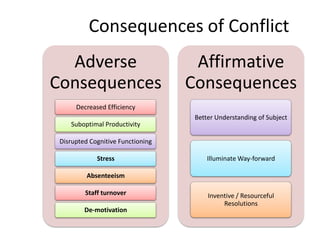
Consequences of Conflict
Adverse
Consequences

Affirmative
Consequences

Decreased Efficiency
Suboptimal Productivity

Better Understanding of Subject

Disrupted Cognitive Functioning
Stress

Illuminate Way-forward

Absenteeism
Staff turnover
De-motivation

Inventive / Resourceful
Resolutions
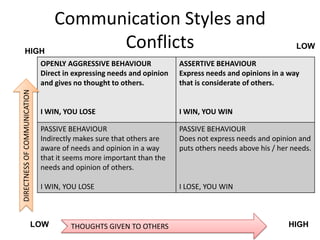
HIGH

Communication Styles and
Conflicts

LOW

DIRECTNESS OF COMMUNICATION

OPENLY AGGRESSIVE BEHAVIOUR
Direct in expressing needs and opinion
and gives no thought to others.

ASSERTIVE BEHAVIOUR
Express needs and opinions in a way
that is considerate of others.

I WIN, YOU LOSE

I WIN, YOU WIN

PASSIVE BEHAVIOUR
Indirectly makes sure that others are
aware of needs and opinion in a way
that it seems more important than the
needs and opinion of others.

PASSIVE BEHAVIOUR
Does not express needs and opinion and
puts others needs above his / her needs.

I WIN, YOU LOSE

I LOSE, YOU WIN

LOW

THOUGHTS GIVEN TO OTHERS

HIGH
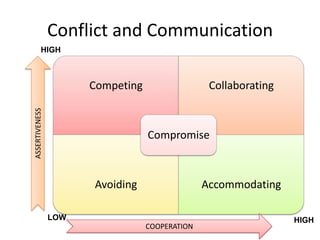
Conflict and Communication
HIGH

ASSERTIVENESS

Competing

Collaborating

Compromise

Avoiding

Accommodating

LOW
COOPERATION

HIGH
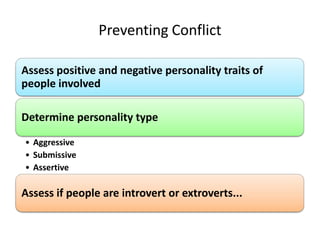
Preventing Conflict
Assess positive and negative personality traits of
people involved
Determine personality type
• Aggressive
• Submissive
• Assertive

Assess if people are introvert or extroverts...
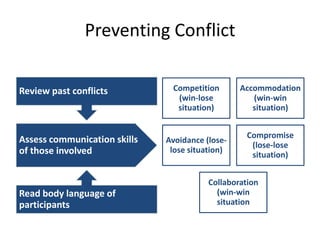
Preventing Conflict
Review past conflicts

Assess communication skills
of those involved

Read body language of
participants

Competition
(win-lose
situation)

Accommodation
(win-win
situation)

Avoidance (loselose situation)

Compromise
(lose-lose
situation)

Collaboration
(win-win
situation
Preventing Conflict

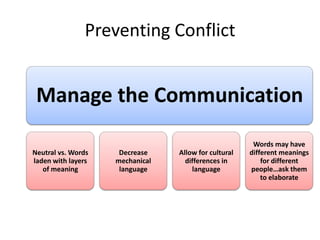
Manage the Communication
Neutral vs. Words
laden with layers
of meaning

Decrease
mechanical
language

Allow for cultural
differences in
language

Words may have
different meanings
for different
people…ask them
to elaborate
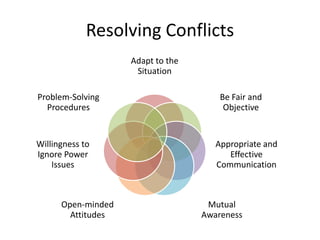
Resolving Conflicts
Adapt to the
Situation

Problem-Solving
Procedures

Willingness to
Ignore Power
Issues

Open-minded
Attitudes

Be Fair and
Objective

Appropriate and
Effective
Communication

Mutual
Awareness
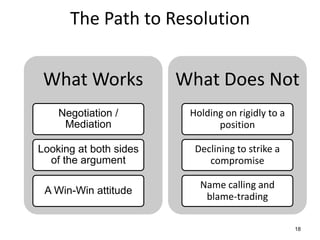
The Path to Resolution

What Works

What Does Not

Negotiation /
Mediation

Holding on rigidly to a
position

Looking at both sides
of the argument

Declining to strike a
compromise

A Win-Win attitude

Name calling and
blame-trading
18
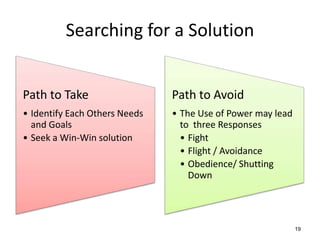
Searching for a Solution
Path to Take

Path to Avoid

• Identify Each Others Needs
and Goals
• Seek a Win-Win solution

• The Use of Power may lead
to three Responses
• Fight
• Flight / Avoidance
• Obedience/ Shutting
Down

19
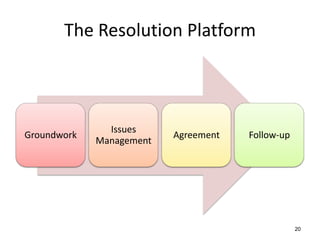
The Resolution Platform

Groundwork

Issues
Management

Agreement

Follow-up

20
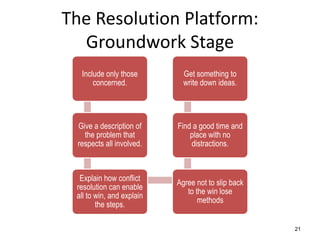
The Resolution Platform:
Groundwork Stage
Include only those
concerned.

Get something to
write down ideas.

Give a description of
the problem that
respects all involved.

Find a good time and
place with no
distractions.

Explain how conflict
resolution can enable
all to win, and explain
the steps.

Agree not to slip back
to the win lose
methods

21
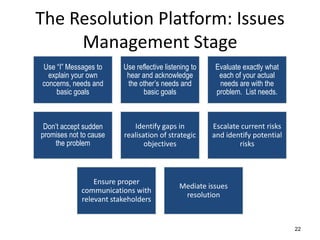
The Resolution Platform: Issues
Management Stage
Use “I” Messages to
explain your own
concerns, needs and
basic goals

Use reflective listening to
hear and acknowledge
the other’s needs and
basic goals

Evaluate exactly what
each of your actual
needs are with the
problem. List needs.

Don’t accept sudden
promises not to cause
the problem

Identify gaps in
realisation of strategic
objectives

Escalate current risks
and identify potential
risks

Ensure proper
communications with
relevant stakeholders

Mediate issues
resolution

22
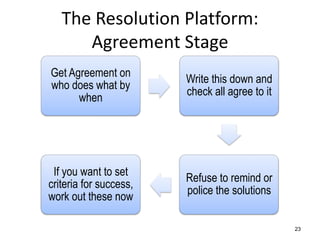
The Resolution Platform:
Agreement Stage
Get Agreement on
who does what by
when

Write this down and
check all agree to it

If you want to set
criteria for success,
work out these now

Refuse to remind or
police the solutions

23
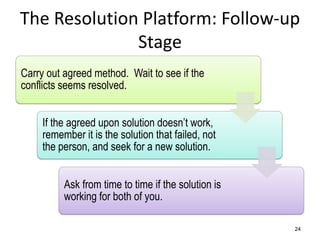
The Resolution Platform: Follow-up
Stage
Carry out agreed method. Wait to see if the
conflicts seems resolved.
If the agreed upon solution doesn’t work,
remember it is the solution that failed, not
the person, and seek for a new solution.
Ask from time to time if the solution is
working for both of you.
24
Thank You

Managing conflicts

  • 1.
    Managing Conflicts The Pathto a Resolution Bolaji Okusaga
  • 2.
    What is AConflict? Conflicts exist where there are contending interests It arises from a need to secure stakes and positions Conflicts can be active or passive.
  • 3.
    Personalities who causeconflict The Aggressor Passive The Arrogant Buff Mates Habitual Absentee Error prone Colleague The Chatterbox HumptyDumpty The Unreliable The Time waster The Hater
  • 4.
    Causes of Conflict CONFLICTOF IDEAS: Different interpretations CONFLICT OF ATTITUDES: Different opinions CONFLICT OF AIMS: Different goals CONFLICT OF BEHAVIOR: Different behaviours
  • 5.
    Roots of Conflicts ROOTSOF INTERPERSONAL CONFLICTS : Rejections Illicit Demands Reproach Accumulative Frustration CAUSATIVE FACTORS FOR DEVELOPMENT OF CONFLICTS: Regularity of occurrence Goal Affinity Goal Path Uncertainty Attribution of Cause Negative feelings
  • 6.
    Conflict Catalysts Scarce Resources Conflictingattitude Resources are always not in abundance, causing competition – Active tension either in the process of accessing or sharing resources Attitudes and Communication styles are different Unclear sphere of influence Unclear boundaries – Overlapping roles Communication Barriers The inability to forge understanding - Poorly defined Goals Need for Consent Unresolved previous conflicts Knowledge of self and others The inability to agree - Lack of cooperation / trust Past experiences – Past betrayals Ego and feelings - Opposing personal values
  • 7.
    Conditions Upon WhichConflicts Thrive Interdependence Perceived Incompatible Goals Scarce Resources Two or more interdependent parties who perceive incompatible goals, scarce resources, and interference from others in achieving that goal (Hocker & Wilmot, 1995) Competition between interdependent parties who perceive that they have incompatible needs, goals, desires, or ideas (Van Slyke, 1999) Because resources are usually never abundantly available, there is usually a contest for scare resources Interference Social Interactions This happens as a result of perceived incursion into a person’s or a group’s sphere of influence Society creates a basis for social interaction and given the fact that there are different personality types, conflicts often occur
  • 8.
    Types of Conflict Inter-personal andintrapersonal Inter-group and intragroup Competitive and Disruptive • This exist between two persons or internally within a person • Between two groups or within a group • Occuring out of clashing goals and objectives
  • 9.
    Stages of Conflict Conflictarises (Introduction of the Plot) Resolution Positions are stated and hardened (The Suspense) Actions taken in support of positions (Climax)
  • 10.
    Conflict Process Antecedent Condition PerceivedConflict Felt Conflict Manifest Behaviour Conflict Resolution / Suppression Resolution Aftermath
  • 11.
    Consequences of Conflict Adverse Consequences Affirmative Consequences DecreasedEfficiency Suboptimal Productivity Better Understanding of Subject Disrupted Cognitive Functioning Stress Illuminate Way-forward Absenteeism Staff turnover De-motivation Inventive / Resourceful Resolutions
  • 12.
    HIGH Communication Styles and Conflicts LOW DIRECTNESSOF COMMUNICATION OPENLY AGGRESSIVE BEHAVIOUR Direct in expressing needs and opinion and gives no thought to others. ASSERTIVE BEHAVIOUR Express needs and opinions in a way that is considerate of others. I WIN, YOU LOSE I WIN, YOU WIN PASSIVE BEHAVIOUR Indirectly makes sure that others are aware of needs and opinion in a way that it seems more important than the needs and opinion of others. PASSIVE BEHAVIOUR Does not express needs and opinion and puts others needs above his / her needs. I WIN, YOU LOSE I LOSE, YOU WIN LOW THOUGHTS GIVEN TO OTHERS HIGH
  • 13.
  • 14.
    Preventing Conflict Assess positiveand negative personality traits of people involved Determine personality type • Aggressive • Submissive • Assertive Assess if people are introvert or extroverts...
  • 15.
    Preventing Conflict Review pastconflicts Assess communication skills of those involved Read body language of participants Competition (win-lose situation) Accommodation (win-win situation) Avoidance (loselose situation) Compromise (lose-lose situation) Collaboration (win-win situation
  • 16.
    Preventing Conflict Manage theCommunication Neutral vs. Words laden with layers of meaning Decrease mechanical language Allow for cultural differences in language Words may have different meanings for different people…ask them to elaborate
  • 17.
    Resolving Conflicts Adapt tothe Situation Problem-Solving Procedures Willingness to Ignore Power Issues Open-minded Attitudes Be Fair and Objective Appropriate and Effective Communication Mutual Awareness
  • 18.
    The Path toResolution What Works What Does Not Negotiation / Mediation Holding on rigidly to a position Looking at both sides of the argument Declining to strike a compromise A Win-Win attitude Name calling and blame-trading 18
  • 19.
    Searching for aSolution Path to Take Path to Avoid • Identify Each Others Needs and Goals • Seek a Win-Win solution • The Use of Power may lead to three Responses • Fight • Flight / Avoidance • Obedience/ Shutting Down 19
  • 20.
  • 21.
    The Resolution Platform: GroundworkStage Include only those concerned. Get something to write down ideas. Give a description of the problem that respects all involved. Find a good time and place with no distractions. Explain how conflict resolution can enable all to win, and explain the steps. Agree not to slip back to the win lose methods 21
  • 22.
    The Resolution Platform:Issues Management Stage Use “I” Messages to explain your own concerns, needs and basic goals Use reflective listening to hear and acknowledge the other’s needs and basic goals Evaluate exactly what each of your actual needs are with the problem. List needs. Don’t accept sudden promises not to cause the problem Identify gaps in realisation of strategic objectives Escalate current risks and identify potential risks Ensure proper communications with relevant stakeholders Mediate issues resolution 22
  • 23.
    The Resolution Platform: AgreementStage Get Agreement on who does what by when Write this down and check all agree to it If you want to set criteria for success, work out these now Refuse to remind or police the solutions 23
  • 24.
    The Resolution Platform:Follow-up Stage Carry out agreed method. Wait to see if the conflicts seems resolved. If the agreed upon solution doesn’t work, remember it is the solution that failed, not the person, and seek for a new solution. Ask from time to time if the solution is working for both of you. 24
  • 25.