CONFLICT MANAGEMENT
PRESENTED BY; MARIYAM
KIDWAE
MANJHARI TRIPATHI
MANSI CHAURASIYA
MOHD. TAUHEED
UNDER THE GUIDANCE OF DR. TINU
KAUR
INDEX
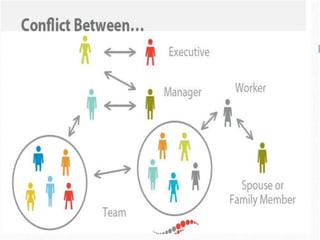
MEANING OF CONFLICT
DEFINITION OF CONFLICT
CONFLICT MANAGEMENT
CHARACTERSTICS OF CONFLICT
CONFLICT INDICATORS
REASONS OF CONFLICT
TECHNIQUES OF CONFLICT
MANAGEMENT
A-E-I-O-U MODEL OF MANAGING
CONFLICT
MEANING OF CONFLICT
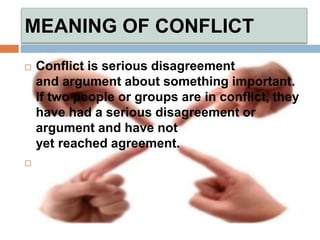
 Conflict is serious disagreement
and argument about something important.
If two people or groups are in conflict, they
have had a serious disagreement or
argument and have not
yet reached agreement.

DEFINITION OF CONFLICT
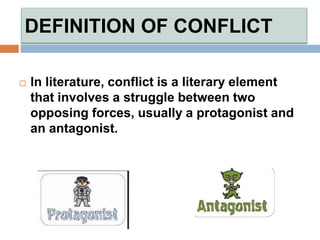
 In literature, conflict is a literary element
that involves a struggle between two
opposing forces, usually a protagonist and
an antagonist.
CONFLICT MANAGEMENT
MEANING
 Conflict management is the process of
limiting the negative aspects of conflict while
increasing the positive aspects of conflict. The
aim of conflict management is to
enhance learning and group outcomes,
including effectiveness or performance in an
organizational setting. Properly managed
conflict can improve group outcomes
CHARACTERSTICS OF
CONFLICT
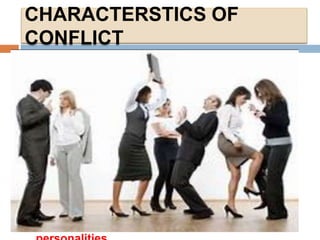
Here are eight characteristics of conflict:
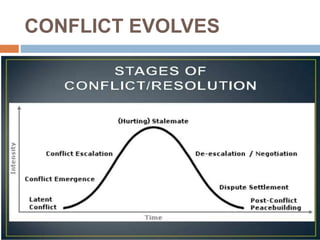
 1. Conflict does not just appear. Conflict
evolves.
 2. Conflict is like a virus when it appears it
begins to spread like crazy.
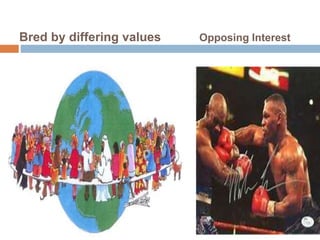
 3. Conflicts are bred by differing values.
 4. Conflict is energized through opposing
interests.
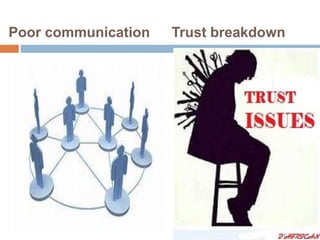
 5. Conflict is fueled by poor communications.
 6. Conflict intensifies when trust breaks down.
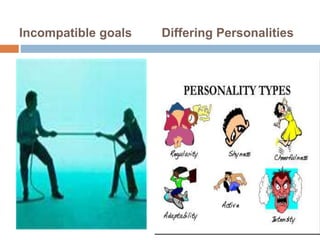
 7. Conflict is festered by incompatible goals.
 8. Conflicts are encouraged by differing
CONFLICT EVOLVES
LIKE A CRAZY VIRUS
Bred by differing values Opposing Interest
Poor communication Trust breakdown
Incompatible goals Differing Personalities
TYPES OF CONFLICT
Conflicts can be of different
types as described below:
On the basis of involvement:
Conflicts may be intrapersonal
(conflict with self), interpersonal
(between two persons) and
organisational.
Organizational
conflict, whether real or
perceived, is of two types -
intraorganizational and
interorganizational.
On the basis of Scope:
Conflicts may be substantive and
Affective.
On the basis of Results:
Conflict can be Constructive or
Destructive, creative or restricting,
and positive or negative. Destructive
conflicts are also known as
dysfunctional conflicti
On the basis of Sharing by Groups:
Conflicts may be Distributive and
Integrative. Distributive conflict is
approached as a distribution of a fixed
amount of positive outcomes or resources,
where one side will end up winning and
the other losing, even if they do win some
concessions.
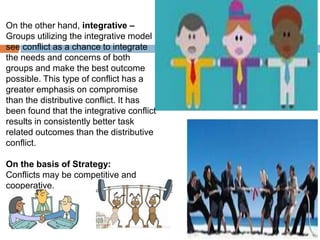
On the other hand, integrative –
Groups utilizing the integrative model
see conflict as a chance to integrate
the needs and concerns of both
groups and make the best outcome
possible. This type of conflict has a
greater emphasis on compromise
than the distributive conflict. It has
been found that the integrative conflict
results in consistently better task
related outcomes than the distributive
conflict.
On the basis of Strategy:
Conflicts may be competitive and
cooperative.
CONFLICT INDICATORS
a. Body language
b. Colleagues not speaking to each other or ignoring
each other
c. Deliberately undermining or not co-operating with
each other, to the downfall of the team
d. contradicting and bad-mouthing one another
e. Disagreements, regardless of issue
f. Withholding bad news
g. Surprises
h. Strong public statements
i. Airing disagreements through media etc.
REASONS OF CONFLICT
Conflicts may be caused by any one or more of the following
reasons:
Cognitive (Recognition and Understanding) Dissonance
(Difference of opinion)
Status:
Incongruence:
Incompatibility:
Stress:
Seeking Power:
Weak Leadership:
Differing viewpoints among colleagues about each other:
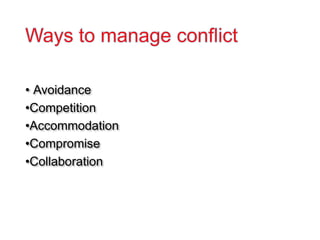
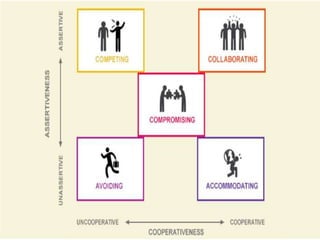
Technique of conflict
mngt
• Avoidance
•Competition
•Accommodation
•Compromise
•Collaboration
Competing
Competing
 Also known as Forcing.
 Competition operates as a zero-sum game, in which
one side wins and other loses.
 The competitive strategy works best in a limited
number of conflicts, such as emergency situations.
 In this technique, a decision is made in favor of one
party’s viewpoint at the expense of others. This risks
demoralizing team members and may cause an
increase in conflicts.
Competition
 The winner is clear
 Winners usually experience gains
 Establishes the battleground for the next
conflict
 May cause worthy competitors to withdraw or
leave the organization
Collaborating
 Also known as problem confronting or problem solving.
 A situation in which the parties to a conflict each desire to
satisfy fully the concerns of all parties
 The object is to find a creative solution acceptable to
everyone.
 Collaboration, though useful, calls for a significant time
commitment not appropriate to all conflicts
 the project manager will work with all parties to find a
resolution that involves multiple viewpoints and negotiates for
the best solution
Collaboration
 Everyone “wins”
 Creates good feelings
 Hard to achieve since no one knows how
 Often confusing since players can “win”
something they didn’t know they wanted
Withdrawing or Avoiding
 Here, the project manager chooses to avoid the
conflict, and allows the persons involved in the conflict
to find their own solution.
 The avoidance strategy seeks to put off conflict
indefinitely
 hose who actively avoid conflict frequently have low
esteem or hold a position of low power.
 Those who actively avoid conflict frequently have low
esteem or hold a position of low power
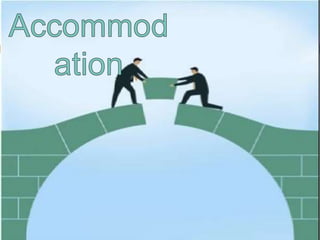
Accommodation
 The accommodating strategy essentially entails giving
the opposing side what it wants
 The use of accommodation often occurs when one of
the parties wishes to keep the peace or perceives the
issue as minor.
 Here, the project manager is involved in the conflict,
tries to avoid areas of disagreement, and focuses on
commonalities
 The willingness of one party in a conflict to place the
opponent’s interests above his or her own
Accommodation
 Curtails conflict situation
 Enhances ego of the other
 Sometimes establishes a precedence
 Does not fully engage participants
Advantages Of Conflicts
 • Accommodation: Accommodation allows one party to do
what another party wants when a conflict arises. The
advantage to accommodation is that conflict can be quickly
resolved, which helps with short-term goals. The
accommodating party may also feel like they have
contributed goodwill toward the goal.
 • Compromise: the outcome can generally be seen as "fair" to
both parties because each gets something in return. This can
also solve a short-term conflict while laying the foundation to
resolving a long-term problem.
 • Competition: Competition conflict resolution works if
authority must be established among parties to complete the
short- or long-term goals. This also fosters confidence for the
winning party in competitive environments. Shortterm goals
where there is little room or time for discussion can be met
quickly
Disadvantages of Conflicts
 • Avoidance: not addressing conflicts, long-term goals may
not be met. Avoiding conflicts may also cause a festering of
tension, which can result in a goal-stopping event, such as a
blow-out argument.
 • Accommodation: Accommodation can also lead to lack of
self-esteem within the accommodating party. The winning
party may also begin to take advantage. Another
disadvantage is that the accommodating party may end up
sacrificing a principle that hampers meeting the long-term
goal
 • Compromise: neither party leaves the negotiating table
completely happy. Since compromises are short-term, they
usually indicate that another conflict will occur in the future.
 • Competition: The losing party may bear a grudge leading to
another conflict. The personal stake in the competitive nature
can negatively effect relationships.
Compromise
 The project manager will conduct root cause
analysis of the reason for the conflict, encourage
open discussions to allow parties to express their
areas of disagreement, and then arrive at a
solution
 The compromising strategy typically calls for both
sides of a conflict to give up elements of their
position in order to establish an acceptable, if not
agreeable, solution.
 A situation in which each party to a conflict is
willing to give up something
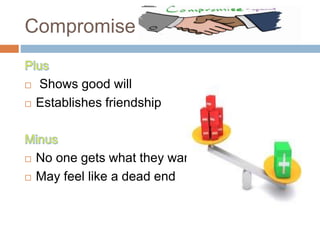
Compromise
 Shows good will
 Establishes friendship
 No one gets what they want
 May feel like a dead end
Resolution Of Conflict
 Goal structure
 Effective communication channel
 Trust
 Coordination
 Team work
 Reward system
A-E-I-O-U MODEL OF MANAGING
CONFLICT
Ever have a conflict with someone and not know
where to begin with addressing the situation? No
one likes confrotation,but when it is necessary,there
are a few basic tools out there that can make all the
differencebetween a succesful outcome and a
frustating one.
One model of effective communication that I like is
whats’s known as A-E-I-O-U(Wisinki,1993).This
model works with any level of conflict with in the
organization.
 A- Acknowledge: (Positive intention) Assume
the other person means well.Identify his/her
positive intention and state it to the other
person.Announce this as you begin facilitating
the problem-solving.
Here is a sample dialogue to see how
this plays out:
A cknowledge – “I know that you work hard to make this
department run smoothly and efficiently, and that you like
to know what is happening at all times.”
E – Express: (What I see) Affirm the positive
intention you’ve identified and express your own
specific concern. “I feel/think”… If you’re mediating,
invite each disputant to take a few minutes to clarify
their specific worries and problems.
Here is a sample dialogue to see how
this plays out:
E xpress – “While, I, too, want to work in an efficient
environment, I feel hampered by having to report to you
on everything I do.”
I – Identify: (I propose) Clearly define your
objectives and recommendations. What’s the
outcome each party wants to achieve? Non-
defensively propose the changes you would like to
see occur. Saying, “I would like,” as opposed to, “I
want,” will avoid inciting a defensive reaction.
Here’s where compromise may occur naturally.
Here is a sample dialogue to see how
this plays out:
I dentify – “I propose giving you a full
report of my work at a specific time,
once a week, rather than at various
times during each day.”
O – Outcome: (Outline the benefits of the outcome)
What’s in it for them if they agree to accommodate?
People respond much more positively when they can buy
into the reason for changing their actions or behavior.
What are the features or advantages? Don’t forget one of
the most powerful motivators is simply recognition:
“Thanks, I appreciate your flexibility with this issue.” “I owe
you one.”- goes a long way toward harmony.Here is a sample dialogue to see how
this plays out:
O utcome – “I anticipate that the weekly reports I
give you will be more clear and concise if I
prepare them, your time will be saved, and I will
feel more trusted and valued as an employee.”
U – Understanding: (Ask for feedback on what has been
proposed) Get agreement on a specific action step – or develop
alternatives. Asking, “Could we agree to try this for a while and
see if it works out for both of us?” gives the other person the
option to accept your proposal. Clarify as needed.
Here is a sample dialogue to see how this
plays out:
U nderstanding – “I understand that we’ve agreed to try
this plan for a month to see how it goes and then
review it to see if it meets both our needs.”
CONCLUSION
 Individuals should understand their own personal
triggers to better deal with conflict situations in
the workplace.
 Group members should think about other group
members early on to identify privately those
individuals andbehaviors that may push their
buttons.
 Conflicts are normal and a constant process in
any organization. Dealing around these conflicts
positively is important. Conflicts can be both
productive and destructive for the organization;
productive conflicts can help you by motivating
you in working better. Destructive conflicts need
management attention and need to be sorted so
that it does not spoil the atmosphere of
organization by demoralizing others.
Conflict management mmmt

Conflict management mmmt

  • 1.
    CONFLICT MANAGEMENT PRESENTED BY;MARIYAM KIDWAE MANJHARI TRIPATHI MANSI CHAURASIYA MOHD. TAUHEED UNDER THE GUIDANCE OF DR. TINU KAUR
  • 2.
    INDEX MEANING OF CONFLICT DEFINITIONOF CONFLICT CONFLICT MANAGEMENT CHARACTERSTICS OF CONFLICT CONFLICT INDICATORS REASONS OF CONFLICT TECHNIQUES OF CONFLICT MANAGEMENT A-E-I-O-U MODEL OF MANAGING CONFLICT
  • 3.
    MEANING OF CONFLICT Conflict is serious disagreement and argument about something important. If two people or groups are in conflict, they have had a serious disagreement or argument and have not yet reached agreement. 
  • 4.
    DEFINITION OF CONFLICT In literature, conflict is a literary element that involves a struggle between two opposing forces, usually a protagonist and an antagonist.
  • 5.
    CONFLICT MANAGEMENT MEANING  Conflictmanagement is the process of limiting the negative aspects of conflict while increasing the positive aspects of conflict. The aim of conflict management is to enhance learning and group outcomes, including effectiveness or performance in an organizational setting. Properly managed conflict can improve group outcomes
  • 6.
    CHARACTERSTICS OF CONFLICT Here areeight characteristics of conflict:  1. Conflict does not just appear. Conflict evolves.  2. Conflict is like a virus when it appears it begins to spread like crazy.  3. Conflicts are bred by differing values.  4. Conflict is energized through opposing interests.  5. Conflict is fueled by poor communications.  6. Conflict intensifies when trust breaks down.  7. Conflict is festered by incompatible goals.  8. Conflicts are encouraged by differing
  • 7.
  • 8.
  • 9.
    Bred by differingvalues Opposing Interest
  • 10.
  • 11.
  • 12.
    TYPES OF CONFLICT Conflictscan be of different types as described below: On the basis of involvement: Conflicts may be intrapersonal (conflict with self), interpersonal (between two persons) and organisational. Organizational conflict, whether real or perceived, is of two types - intraorganizational and interorganizational. On the basis of Scope: Conflicts may be substantive and Affective.
  • 13.
    On the basisof Results: Conflict can be Constructive or Destructive, creative or restricting, and positive or negative. Destructive conflicts are also known as dysfunctional conflicti On the basis of Sharing by Groups: Conflicts may be Distributive and Integrative. Distributive conflict is approached as a distribution of a fixed amount of positive outcomes or resources, where one side will end up winning and the other losing, even if they do win some concessions.
  • 14.
    On the otherhand, integrative – Groups utilizing the integrative model see conflict as a chance to integrate the needs and concerns of both groups and make the best outcome possible. This type of conflict has a greater emphasis on compromise than the distributive conflict. It has been found that the integrative conflict results in consistently better task related outcomes than the distributive conflict. On the basis of Strategy: Conflicts may be competitive and cooperative.
  • 15.
    CONFLICT INDICATORS a. Bodylanguage b. Colleagues not speaking to each other or ignoring each other c. Deliberately undermining or not co-operating with each other, to the downfall of the team d. contradicting and bad-mouthing one another e. Disagreements, regardless of issue f. Withholding bad news g. Surprises h. Strong public statements i. Airing disagreements through media etc.
  • 16.
    REASONS OF CONFLICT Conflictsmay be caused by any one or more of the following reasons: Cognitive (Recognition and Understanding) Dissonance (Difference of opinion) Status: Incongruence: Incompatibility: Stress: Seeking Power: Weak Leadership: Differing viewpoints among colleagues about each other:
  • 17.
  • 19.
  • 21.
  • 22.
    Competing  Also knownas Forcing.  Competition operates as a zero-sum game, in which one side wins and other loses.  The competitive strategy works best in a limited number of conflicts, such as emergency situations.  In this technique, a decision is made in favor of one party’s viewpoint at the expense of others. This risks demoralizing team members and may cause an increase in conflicts.
  • 23.
    Competition  The winneris clear  Winners usually experience gains  Establishes the battleground for the next conflict  May cause worthy competitors to withdraw or leave the organization
  • 25.
    Collaborating  Also knownas problem confronting or problem solving.  A situation in which the parties to a conflict each desire to satisfy fully the concerns of all parties  The object is to find a creative solution acceptable to everyone.  Collaboration, though useful, calls for a significant time commitment not appropriate to all conflicts  the project manager will work with all parties to find a resolution that involves multiple viewpoints and negotiates for the best solution
  • 26.
    Collaboration  Everyone “wins” Creates good feelings  Hard to achieve since no one knows how  Often confusing since players can “win” something they didn’t know they wanted
  • 28.
    Withdrawing or Avoiding Here, the project manager chooses to avoid the conflict, and allows the persons involved in the conflict to find their own solution.  The avoidance strategy seeks to put off conflict indefinitely  hose who actively avoid conflict frequently have low esteem or hold a position of low power.  Those who actively avoid conflict frequently have low esteem or hold a position of low power
  • 30.
    Accommodation  The accommodatingstrategy essentially entails giving the opposing side what it wants  The use of accommodation often occurs when one of the parties wishes to keep the peace or perceives the issue as minor.  Here, the project manager is involved in the conflict, tries to avoid areas of disagreement, and focuses on commonalities  The willingness of one party in a conflict to place the opponent’s interests above his or her own
  • 31.
    Accommodation  Curtails conflictsituation  Enhances ego of the other  Sometimes establishes a precedence  Does not fully engage participants
  • 32.
    Advantages Of Conflicts • Accommodation: Accommodation allows one party to do what another party wants when a conflict arises. The advantage to accommodation is that conflict can be quickly resolved, which helps with short-term goals. The accommodating party may also feel like they have contributed goodwill toward the goal.  • Compromise: the outcome can generally be seen as "fair" to both parties because each gets something in return. This can also solve a short-term conflict while laying the foundation to resolving a long-term problem.  • Competition: Competition conflict resolution works if authority must be established among parties to complete the short- or long-term goals. This also fosters confidence for the winning party in competitive environments. Shortterm goals where there is little room or time for discussion can be met quickly
  • 33.
    Disadvantages of Conflicts • Avoidance: not addressing conflicts, long-term goals may not be met. Avoiding conflicts may also cause a festering of tension, which can result in a goal-stopping event, such as a blow-out argument.  • Accommodation: Accommodation can also lead to lack of self-esteem within the accommodating party. The winning party may also begin to take advantage. Another disadvantage is that the accommodating party may end up sacrificing a principle that hampers meeting the long-term goal  • Compromise: neither party leaves the negotiating table completely happy. Since compromises are short-term, they usually indicate that another conflict will occur in the future.  • Competition: The losing party may bear a grudge leading to another conflict. The personal stake in the competitive nature can negatively effect relationships.
  • 35.
    Compromise  The projectmanager will conduct root cause analysis of the reason for the conflict, encourage open discussions to allow parties to express their areas of disagreement, and then arrive at a solution  The compromising strategy typically calls for both sides of a conflict to give up elements of their position in order to establish an acceptable, if not agreeable, solution.  A situation in which each party to a conflict is willing to give up something
  • 36.
    Compromise  Shows goodwill  Establishes friendship  No one gets what they want  May feel like a dead end
  • 37.
    Resolution Of Conflict Goal structure  Effective communication channel  Trust  Coordination  Team work  Reward system
  • 38.
    A-E-I-O-U MODEL OFMANAGING CONFLICT Ever have a conflict with someone and not know where to begin with addressing the situation? No one likes confrotation,but when it is necessary,there are a few basic tools out there that can make all the differencebetween a succesful outcome and a frustating one. One model of effective communication that I like is whats’s known as A-E-I-O-U(Wisinki,1993).This model works with any level of conflict with in the organization.
  • 39.
     A- Acknowledge:(Positive intention) Assume the other person means well.Identify his/her positive intention and state it to the other person.Announce this as you begin facilitating the problem-solving. Here is a sample dialogue to see how this plays out: A cknowledge – “I know that you work hard to make this department run smoothly and efficiently, and that you like to know what is happening at all times.”
  • 40.
    E – Express:(What I see) Affirm the positive intention you’ve identified and express your own specific concern. “I feel/think”… If you’re mediating, invite each disputant to take a few minutes to clarify their specific worries and problems. Here is a sample dialogue to see how this plays out: E xpress – “While, I, too, want to work in an efficient environment, I feel hampered by having to report to you on everything I do.”
  • 41.
    I – Identify:(I propose) Clearly define your objectives and recommendations. What’s the outcome each party wants to achieve? Non- defensively propose the changes you would like to see occur. Saying, “I would like,” as opposed to, “I want,” will avoid inciting a defensive reaction. Here’s where compromise may occur naturally. Here is a sample dialogue to see how this plays out: I dentify – “I propose giving you a full report of my work at a specific time, once a week, rather than at various times during each day.”
  • 42.
    O – Outcome:(Outline the benefits of the outcome) What’s in it for them if they agree to accommodate? People respond much more positively when they can buy into the reason for changing their actions or behavior. What are the features or advantages? Don’t forget one of the most powerful motivators is simply recognition: “Thanks, I appreciate your flexibility with this issue.” “I owe you one.”- goes a long way toward harmony.Here is a sample dialogue to see how this plays out: O utcome – “I anticipate that the weekly reports I give you will be more clear and concise if I prepare them, your time will be saved, and I will feel more trusted and valued as an employee.”
  • 43.
    U – Understanding:(Ask for feedback on what has been proposed) Get agreement on a specific action step – or develop alternatives. Asking, “Could we agree to try this for a while and see if it works out for both of us?” gives the other person the option to accept your proposal. Clarify as needed. Here is a sample dialogue to see how this plays out: U nderstanding – “I understand that we’ve agreed to try this plan for a month to see how it goes and then review it to see if it meets both our needs.”
  • 44.
    CONCLUSION  Individuals shouldunderstand their own personal triggers to better deal with conflict situations in the workplace.  Group members should think about other group members early on to identify privately those individuals andbehaviors that may push their buttons.  Conflicts are normal and a constant process in any organization. Dealing around these conflicts positively is important. Conflicts can be both productive and destructive for the organization; productive conflicts can help you by motivating you in working better. Destructive conflicts need management attention and need to be sorted so that it does not spoil the atmosphere of organization by demoralizing others.