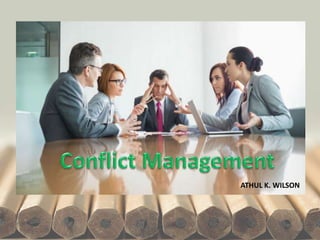
ATHUL K. WILSON
• Conflict may be defined simply as a struggle or
contest between people with opposing needs, ideas,
beliefs, values, or goals.
DEFINITION
Conflict - A process that begins when one party perceives that
another party has negatively affected, or is about to negatively affect ,
something that the first party cares about.
Conflict Management- The use of resolution and stimulation
techniques to achieve the desired level of conflict
The results of conflict are not predetermined.
Conflict might escalate and lead to nonproductive results, or conflict
can be beneficially resolved and lead to quality final products.
Therefore, learning to manage conflict is integral to a high-performance
team.
 Reasons of conflict are miscommunication between people with regard
to their needs, ideas, beliefs, goals, or values.
In Conflict management all conflicts cannot necessarily be resolved, but
learning how to manage conflicts can decrease the odds of nonproductive
escalation.
 Conflict management involves acquiring skills related to conflict
resolution, self-awareness about conflict modes, conflict communication
skills,
TRANSITIONS IN CONFLICT THOUGHT
 The traditional view of conflict- The belief that all conflict
is harmful and must be avoided .
 Interactionist view of conflict- The belief that conflict is not
only a positive force in a group but also an absolute necessity for a
group to perform effectively .
Managed – conflict views of conflict- Argues that instead of
encouraging good or discouraging bad conflict, it’s more important
to resolve naturally occurring conflict productively.
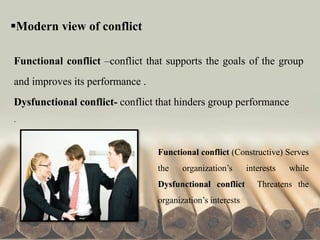
Functional conflict –conflict that supports the goals of the group
and improves its performance .
Dysfunctional conflict- conflict that hinders group performance
.
Modern view of conflict
Functional conflict (Constructive) Serves
the organization’s interests while
Dysfunctional conflict Threatens the
organization’s interests
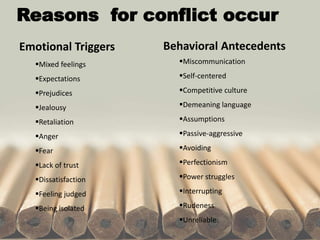
Emotional Triggers
Mixed feelings
Expectations
Prejudices
Jealousy
Retaliation
Anger
Fear
Lack of trust
Dissatisfaction
Feeling judged
Being isolated
Behavioral Antecedents
Miscommunication
Self-centered
Competitive culture
Demeaning language
Assumptions
Passive-aggressive
Avoiding
Perfectionism
Power struggles
Interrupting
Rudeness
Unreliable
Reasons for conflict occur
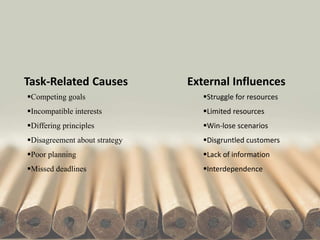
External Influences
Struggle for resources
Limited resources
Win-lose scenarios
Disgruntled customers
Lack of information
Interdependence
Task-Related Causes
Competing goals
Incompatible interests
Differing principles
Disagreement about strategy
Poor planning
Missed deadlines
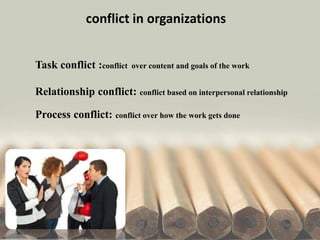
Task conflict :conflict over content and goals of the work
Relationship conflict: conflict based on interpersonal relationship
Process conflict: conflict over how the work gets done
conflict in organizations
A Conflict Model
• Latent Conflict. Latent conflict is essentially conflict waiting to
happen.
• Felt Conflict. Felt conflict is experienced as discomfort and
tension.
• Perceived Conflict. Perceived conflict is the awareness that we
are in a conflict situation.
• Manifest Conflict. After conflict is perceived and felt, it may or
may not become open, or manifest.
• Conflict Aftermath. Conflict is likely to breed more conflict and,
when it does, that conflict is likely to take on a life of its own.
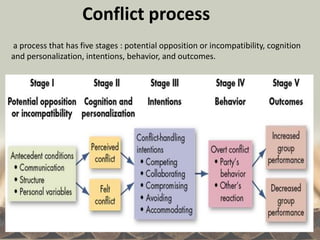
Conflict process
a process that has five stages : potential opposition or incompatibility, cognition
and personalization, intentions, behavior, and outcomes.
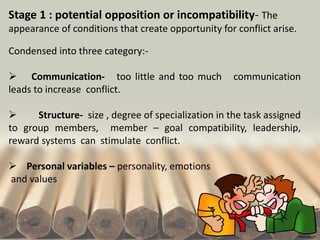
Stage 1 : potential opposition or incompatibility- The
appearance of conditions that create opportunity for conflict arise.
Condensed into three category:-
 Communication- too little and too much communication
leads to increase conflict.
 Structure- size , degree of specialization in the task assigned
to group members, member – goal compatibility, leadership,
reward systems can stimulate conflict.
 Personal variables – personality, emotions
and values
Stage 2 : cognition and personalization – If one party cares
about the condition cited in the first stage ,then the potential for
opposition or incompatibility becomes actualized in the second
stage.
Perceived conflict – awareness by one or more parties of the
existence of conditions that create opportunity for conflict to arise.
Felt conflict – emotional involvement in a conflict that creates
anxiety, tenseness , frustration or hostility
Two point
1. It is where conflict issues tend to be defined
2. emotions plays a major role (- ve emotion- oversimplify issues, lose
trust and negative interpretation on the other party’s behavior) (+ve -
potential relationship among the problem, develop more innovative
solution)
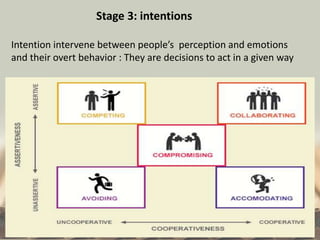
Stage 3: intentions
Intention intervene between people’s perception and emotions
and their overt behavior : They are decisions to act in a given way
Competing. Involves trying to win at the other party’s expense.
Generally leads to antagonism and festering resentment.
Avoiding. Attempts to avoid or smooth over conflict situations.
Generally unproductive.
Accommodating. Involves acceding completely to the other
party’s wishes or at least cooperating with little or no attention to
one’s own interests.
Compromising. Involves an attempt to find a satisfactory middle
ground (“split the difference”)
Collaborating. This problem-solving style is mutually beneficial.
Requires trust, open sharing of information, and creativity.
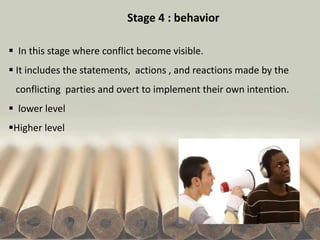
Stage 4 : behavior
 In this stage where conflict become visible.
 It includes the statements, actions , and reactions made by the
conflicting parties and overt to implement their own intention.
 lower level
Higher level
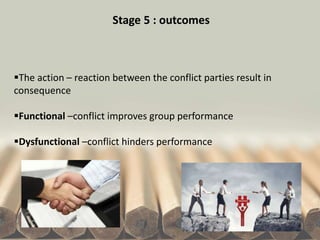
Stage 5 : outcomes
The action – reaction between the conflict parties result in
consequence
Functional –conflict improves group performance
Dysfunctional –conflict hinders performance
Levels Of Conflict
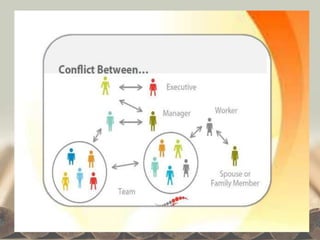
The five levels of conflict are intra-personal (within an individual),
inter-personal (between individuals), intra-group (within a group),
inter-group (between groups), and intra-organizational (within
organizations).
Intra-personal Conflict
Intrapersonal Conflict, which occurs within an individual, often
involves some form of goal conflict or cognitive conflict.
Inter-personal Conflict
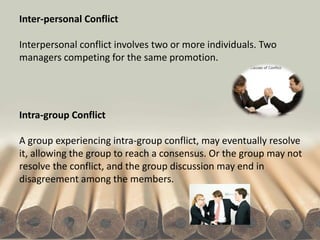
Interpersonal conflict involves two or more individuals. Two
managers competing for the same promotion.
Intra-group Conflict
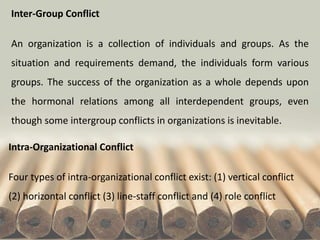
A group experiencing intra-group conflict, may eventually resolve
it, allowing the group to reach a consensus. Or the group may not
resolve the conflict, and the group discussion may end in
disagreement among the members.
Intra-Organizational Conflict
Four types of intra-organizational conflict exist: (1) vertical conflict
(2) horizontal conflict (3) line-staff conflict and (4) role conflict
Inter-Group Conflict
An organization is a collection of individuals and groups. As the
situation and requirements demand, the individuals form various
groups. The success of the organization as a whole depends upon
the hormonal relations among all interdependent groups, even
though some intergroup conflicts in organizations is inevitable.
Conflict Management Styles:
Orientations
• Win-win orientation
– You believe parties will find a mutually beneficial
solution to their disagreement
• Win-lose orientation
– You believe that the more one party receives, the less
the other receives
– Tends to escalate conflict, use of power/politics
conflict management
conflict management

conflict management

  • 1.
  • 2.
    • Conflict maybe defined simply as a struggle or contest between people with opposing needs, ideas, beliefs, values, or goals. DEFINITION Conflict - A process that begins when one party perceives that another party has negatively affected, or is about to negatively affect , something that the first party cares about. Conflict Management- The use of resolution and stimulation techniques to achieve the desired level of conflict
  • 3.
    The results ofconflict are not predetermined. Conflict might escalate and lead to nonproductive results, or conflict can be beneficially resolved and lead to quality final products. Therefore, learning to manage conflict is integral to a high-performance team.  Reasons of conflict are miscommunication between people with regard to their needs, ideas, beliefs, goals, or values. In Conflict management all conflicts cannot necessarily be resolved, but learning how to manage conflicts can decrease the odds of nonproductive escalation.  Conflict management involves acquiring skills related to conflict resolution, self-awareness about conflict modes, conflict communication skills,
  • 4.
    TRANSITIONS IN CONFLICTTHOUGHT  The traditional view of conflict- The belief that all conflict is harmful and must be avoided .  Interactionist view of conflict- The belief that conflict is not only a positive force in a group but also an absolute necessity for a group to perform effectively . Managed – conflict views of conflict- Argues that instead of encouraging good or discouraging bad conflict, it’s more important to resolve naturally occurring conflict productively.
  • 5.
    Functional conflict –conflictthat supports the goals of the group and improves its performance . Dysfunctional conflict- conflict that hinders group performance . Modern view of conflict Functional conflict (Constructive) Serves the organization’s interests while Dysfunctional conflict Threatens the organization’s interests
  • 6.
    Emotional Triggers Mixed feelings Expectations Prejudices Jealousy Retaliation Anger Fear Lackof trust Dissatisfaction Feeling judged Being isolated Behavioral Antecedents Miscommunication Self-centered Competitive culture Demeaning language Assumptions Passive-aggressive Avoiding Perfectionism Power struggles Interrupting Rudeness Unreliable Reasons for conflict occur
  • 7.
    External Influences Struggle forresources Limited resources Win-lose scenarios Disgruntled customers Lack of information Interdependence Task-Related Causes Competing goals Incompatible interests Differing principles Disagreement about strategy Poor planning Missed deadlines
  • 8.
    Task conflict :conflictover content and goals of the work Relationship conflict: conflict based on interpersonal relationship Process conflict: conflict over how the work gets done conflict in organizations
  • 9.
    A Conflict Model •Latent Conflict. Latent conflict is essentially conflict waiting to happen. • Felt Conflict. Felt conflict is experienced as discomfort and tension. • Perceived Conflict. Perceived conflict is the awareness that we are in a conflict situation. • Manifest Conflict. After conflict is perceived and felt, it may or may not become open, or manifest. • Conflict Aftermath. Conflict is likely to breed more conflict and, when it does, that conflict is likely to take on a life of its own.
  • 10.
    Conflict process a processthat has five stages : potential opposition or incompatibility, cognition and personalization, intentions, behavior, and outcomes.
  • 11.
    Stage 1 :potential opposition or incompatibility- The appearance of conditions that create opportunity for conflict arise. Condensed into three category:-  Communication- too little and too much communication leads to increase conflict.  Structure- size , degree of specialization in the task assigned to group members, member – goal compatibility, leadership, reward systems can stimulate conflict.  Personal variables – personality, emotions and values
  • 12.
    Stage 2 :cognition and personalization – If one party cares about the condition cited in the first stage ,then the potential for opposition or incompatibility becomes actualized in the second stage. Perceived conflict – awareness by one or more parties of the existence of conditions that create opportunity for conflict to arise. Felt conflict – emotional involvement in a conflict that creates anxiety, tenseness , frustration or hostility Two point 1. It is where conflict issues tend to be defined 2. emotions plays a major role (- ve emotion- oversimplify issues, lose trust and negative interpretation on the other party’s behavior) (+ve - potential relationship among the problem, develop more innovative solution)
  • 13.
    Stage 3: intentions Intentionintervene between people’s perception and emotions and their overt behavior : They are decisions to act in a given way
  • 14.
    Competing. Involves tryingto win at the other party’s expense. Generally leads to antagonism and festering resentment. Avoiding. Attempts to avoid or smooth over conflict situations. Generally unproductive. Accommodating. Involves acceding completely to the other party’s wishes or at least cooperating with little or no attention to one’s own interests. Compromising. Involves an attempt to find a satisfactory middle ground (“split the difference”) Collaborating. This problem-solving style is mutually beneficial. Requires trust, open sharing of information, and creativity.
  • 15.
    Stage 4 :behavior  In this stage where conflict become visible.  It includes the statements, actions , and reactions made by the conflicting parties and overt to implement their own intention.  lower level Higher level
  • 16.
    Stage 5 :outcomes The action – reaction between the conflict parties result in consequence Functional –conflict improves group performance Dysfunctional –conflict hinders performance
  • 17.
    Levels Of Conflict Thefive levels of conflict are intra-personal (within an individual), inter-personal (between individuals), intra-group (within a group), inter-group (between groups), and intra-organizational (within organizations). Intra-personal Conflict Intrapersonal Conflict, which occurs within an individual, often involves some form of goal conflict or cognitive conflict.
  • 18.
    Inter-personal Conflict Interpersonal conflictinvolves two or more individuals. Two managers competing for the same promotion. Intra-group Conflict A group experiencing intra-group conflict, may eventually resolve it, allowing the group to reach a consensus. Or the group may not resolve the conflict, and the group discussion may end in disagreement among the members.
  • 19.
    Intra-Organizational Conflict Four typesof intra-organizational conflict exist: (1) vertical conflict (2) horizontal conflict (3) line-staff conflict and (4) role conflict Inter-Group Conflict An organization is a collection of individuals and groups. As the situation and requirements demand, the individuals form various groups. The success of the organization as a whole depends upon the hormonal relations among all interdependent groups, even though some intergroup conflicts in organizations is inevitable.
  • 21.
    Conflict Management Styles: Orientations •Win-win orientation – You believe parties will find a mutually beneficial solution to their disagreement • Win-lose orientation – You believe that the more one party receives, the less the other receives – Tends to escalate conflict, use of power/politics