A Presentation
on
CONFLICT MANAGEMENT
(Conflict & Negotiation)

BY:
Rajiv
Ramesh
Narayan
Ramchandra
Learning Objectives
Learning Objectives
1. Define conflict.
2. Differentiate between the traditional, human
relations, and integrationist views of conflict.
3. Contrast task, relationship, and process conflict.
4. Outline the conflict process.
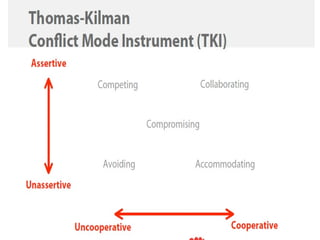
5. Describe the five conflict-handling intentions.
6. Contrast distributive and integrative bargaining.
7. Identify the five steps in the negotiating process.
8. Describe cultural differences in negotiations.
What is Conflict?
What is Conflict?
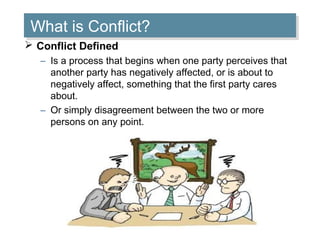
 Conflict Defined
– Is a process that begins when one party perceives that
another party has negatively affected, or is about to
negatively affect, something that the first party cares
about.
– Or simply disagreement between the two or more
persons on any point.
What is conflict.
What is conflict.
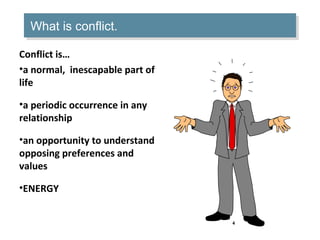
Conflict is…
•a normal, inescapable part of
life
•a periodic occurrence in any
relationship
•an opportunity to understand
opposing preferences and
values
•ENERGY
4
How many people ???
How many people ???
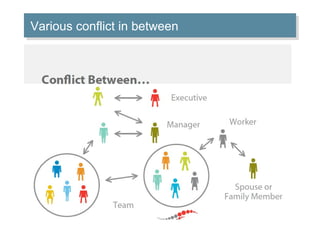
Various conflict in between
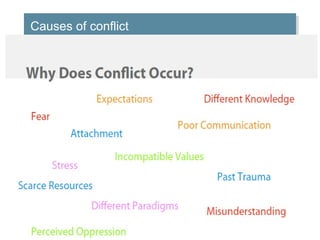
Causes of conflict
Causes of conflict
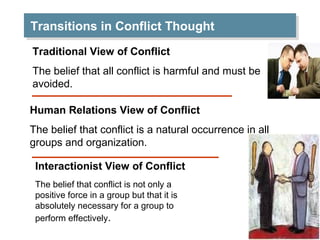
Transitions in Conflict Thought
Traditional View of Conflict
The belief that all conflict is harmful and must be
avoided.
Human Relations View of Conflict
The belief that conflict is a natural occurrence in all
groups and organization.
Interactionist View of Conflict
The belief that conflict is not only a
positive force in a group but that it is
absolutely necessary for a group to
perform effectively.
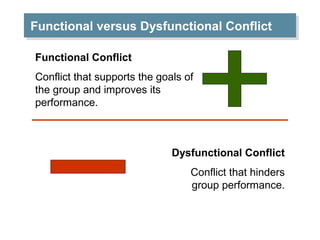
Functional versus Dysfunctional Conflict
Functional Conflict
Conflict that supports the goals of
the group and improves its
performance.

Dysfunctional Conflict
Conflict that hinders
group performance.
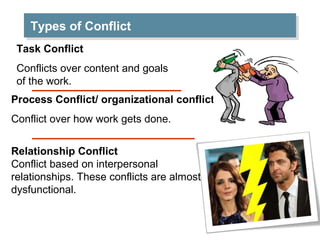
Types of Conflict
Types of Conflict
Task Conflict
Conflicts over content and goals
of the work.
Process Conflict/ organizational conflict
Conflict over how work gets done.
Relationship Conflict
Conflict based on interpersonal
relationships. These conflicts are almost
dysfunctional.
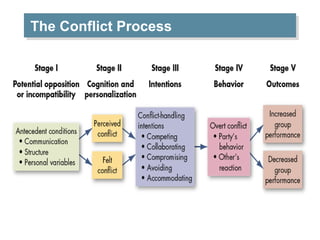
The Conflict Process
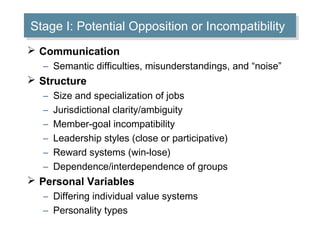
Stage I: Potential Opposition or Incompatibility
 Communication
– Semantic difficulties, misunderstandings, and “noise”

 Structure
–
–
–
–
–
–

Size and specialization of jobs
Jurisdictional clarity/ambiguity
Member-goal incompatibility
Leadership styles (close or participative)
Reward systems (win-lose)
Dependence/interdependence of groups

 Personal Variables
– Differing individual value systems
– Personality types
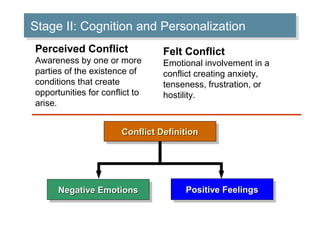
Stage II: Cognition and Personalization
Perceived Conflict

Awareness by one or more
parties of the existence of
conditions that create
opportunities for conflict to
arise.

Felt Conflict

Emotional involvement in a
conflict creating anxiety,
tenseness, frustration, or
hostility.

Conflict Definition
Conflict Definition

Negative Emotions
Negative Emotions

Positive Feelings
Positive Feelings
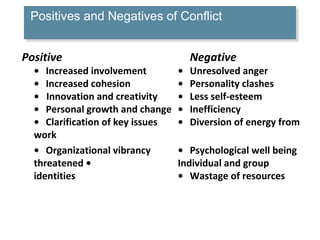
Positives and Negatives of Conflict
Positive

• Increased involvement
• Increased cohesion
• Innovation and creativity
• Personal growth and change
• Clarification of key issues
work
• Organizational vibrancy
threatened •
identities

•
•
•
•
•

Negative

Unresolved anger
Personality clashes
Less self-esteem
Inefficiency
Diversion of energy from

• Psychological well being
Individual and group
• Wastage of resources
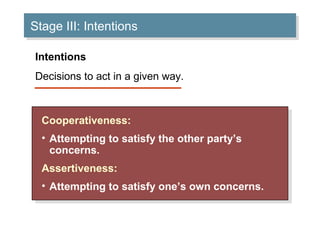
Stage III: Intentions
Intentions
Decisions to act in a given way.

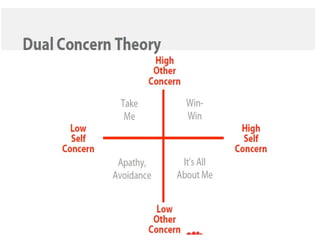
Cooperativeness:
Cooperativeness:
•• Attempting to satisfy the other party’s
Attempting to satisfy the other party’s
concerns.
concerns.
Assertiveness:
Assertiveness:
•• Attempting to satisfy one’s own concerns.
Attempting to satisfy one’s own concerns.
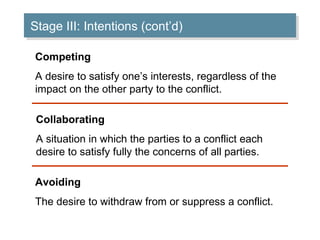
Stage III: Intentions (cont’d)
Competing
A desire to satisfy one’s interests, regardless of the
impact on the other party to the conflict.
Collaborating
A situation in which the parties to a conflict each
desire to satisfy fully the concerns of all parties.
Avoiding
The desire to withdraw from or suppress a conflict.
Stage III: Intentions (cont’d)
Accommodating
The willingness of one party in a conflict to place the
opponent’s interests above his or her own.
Compromising
A situation in which each party to a conflict is
willing to give up something.
Stage IV: Behavior
Stage IV: Behavior
Conflict Management
The use of resolution and stimulation techniques to
achieve the desired level of conflict.
Stage V: Outcomes
Stage V: Outcomes
 Functional Outcomes from Conflict
– Increased group performance
– Improved quality of decisions
– Stimulation of creativity and innovation
– Encouragement of interest and curiosity
– Provision of a medium for problem-solving
– Creation of an environment for self-evaluation and
change

 Creating Functional Conflict
– Reward dissent (dispute) and punish conflict avoiders.
Stage V: Outcomes
Stage V: Outcomes
 Dysfunctional Outcomes from Conflict
– Development of discontent(dissatisfaction)
– Reduced group effectiveness
– Retarded communication
– Reduced group cohesiveness
– Infighting among group members overcomes group
goals
Conflict Management Techniques

Conflict Resolution Techniques
•• Problem solving
Problem solving
•• Superordinate goals
Superordinate goals
•• Expansion of resources
Expansion of resources
•• Smoothing
Smoothing
•• Authoritative command
Authoritative command
•• Altering the human variable
Altering the human variable
Conflict Resolution Techniques
 Problem Solving.
Face to face meeting with conflicting parties for the purpose of
identifying the problem and resolving it through open discussion.
 Super ordinate goals.
Creating a shared goal that cannot be attained without the
cooperation of each of the conflicting parties.
 Expansion of Resources.
When a conflict is caused by the scarcity of resources,
expansion of resources can create win-win solution.
Conflict Resolution Techniques
 Smoothing
Playing down differences while emphasizing common
interests between the conflicting parties.
 Authoritative command.
Management uses its formal authority to resolve the
conflicts.
 Altering the human variables.
Uses behavioral change techniques as human
relations training and alter attitude and behaviors that
cause conflict.
n
on
iio
t
t
a
iia
t
ot
o
g
eg
e
N
N
Negotiation
Negotiation
Negotiation
A process in which two or more parties exchange
goods or services and attempt to agree on the
exchange rate for them.
BATNA
The Best Alternative To a
Negotiated Agreement; the
lowest acceptable value
(outcome) to an individual
for a negotiated agreement.
Bargaining Strategies
Distributive Bargaining
Negotiation that seeks to divide up a fixed amount of
resources; a win-lose situation.
Integrative Bargaining
Negotiation that seeks one or more settlements that
can create a win-win solution.
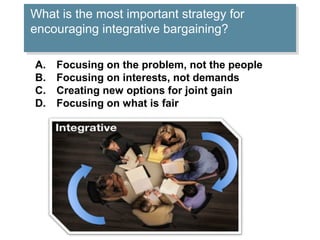
What is the most important strategy for
encouraging integrative bargaining?
A.
B.
C.
D.

Focusing on the problem, not the people
Focusing on interests, not demands
Creating new options for joint gain
Focusing on what is fair
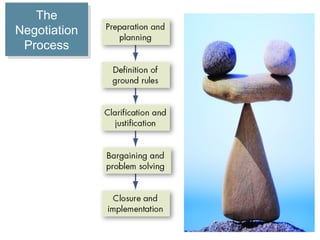
The
The
Negotiation
Negotiation
Process
Process
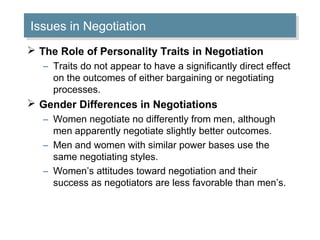
Issues in Negotiation
 The Role of Personality Traits in Negotiation
– Traits do not appear to have a significantly direct effect
on the outcomes of either bargaining or negotiating
processes.

 Gender Differences in Negotiations
– Women negotiate no differently from men, although
men apparently negotiate slightly better outcomes.
– Men and women with similar power bases use the
same negotiating styles.
– Women’s attitudes toward negotiation and their
success as negotiators are less favorable than men’s.
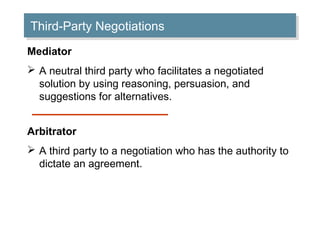
Third-Party Negotiations
Mediator
 A neutral third party who facilitates a negotiated
solution by using reasoning, persuasion, and
suggestions for alternatives.
Arbitrator
 A third party to a negotiation who has the authority to
dictate an agreement.
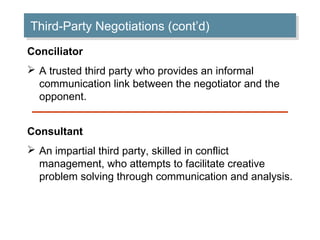
Third-Party Negotiations (cont’d)
Conciliator
 A trusted third party who provides an informal
communication link between the negotiator and the
opponent.
Consultant
 An impartial third party, skilled in conflict
management, who attempts to facilitate creative
problem solving through communication and analysis.
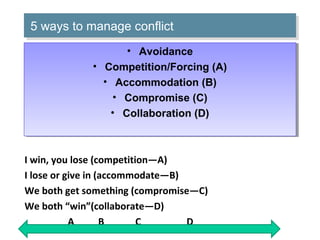
5 ways to manage conflict
•• Avoidance
Avoidance
•• Competition/Forcing (A)
Competition/Forcing (A)
•• Accommodation (B)
Accommodation (B)
•• Compromise (C)
Compromise (C)
•• Collaboration (D)
Collaboration (D)

I win, you lose (competition—A)
I lose or give in (accommodate—B)
We both get something (compromise—C)
We both “win”(collaborate—D)
A
B
C
D
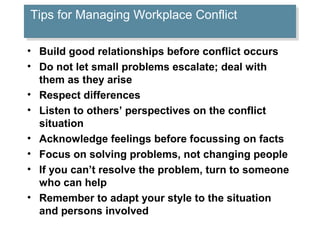
Tips for Managing Workplace Conflict
• Build good relationships before conflict occurs
• Do not let small problems escalate; deal with
them as they arise
• Respect differences
• Listen to others’ perspectives on the conflict
situation
• Acknowledge feelings before focussing on facts
• Focus on solving problems, not changing people
• If you can’t resolve the problem, turn to someone
who can help
• Remember to adapt your style to the situation
and persons involved
Ramesh K Raut

Ramesh K Raut

  • 1.
    A Presentation on CONFLICT MANAGEMENT (Conflict& Negotiation) BY: Rajiv Ramesh Narayan Ramchandra
  • 2.
    Learning Objectives Learning Objectives 1.Define conflict. 2. Differentiate between the traditional, human relations, and integrationist views of conflict. 3. Contrast task, relationship, and process conflict. 4. Outline the conflict process. 5. Describe the five conflict-handling intentions. 6. Contrast distributive and integrative bargaining. 7. Identify the five steps in the negotiating process. 8. Describe cultural differences in negotiations.
  • 3.
    What is Conflict? Whatis Conflict?  Conflict Defined – Is a process that begins when one party perceives that another party has negatively affected, or is about to negatively affect, something that the first party cares about. – Or simply disagreement between the two or more persons on any point.
  • 4.
    What is conflict. Whatis conflict. Conflict is… •a normal, inescapable part of life •a periodic occurrence in any relationship •an opportunity to understand opposing preferences and values •ENERGY 4
  • 5.
    How many people??? How many people ???
  • 6.
    Various conflict inbetween Various conflict in between
  • 7.
  • 8.
    Transitions in ConflictThought Transitions in Conflict Thought Traditional View of Conflict The belief that all conflict is harmful and must be avoided. Human Relations View of Conflict The belief that conflict is a natural occurrence in all groups and organization. Interactionist View of Conflict The belief that conflict is not only a positive force in a group but that it is absolutely necessary for a group to perform effectively.
  • 9.
    Functional versus DysfunctionalConflict Functional versus Dysfunctional Conflict Functional Conflict Conflict that supports the goals of the group and improves its performance. Dysfunctional Conflict Conflict that hinders group performance.
  • 10.
    Types of Conflict Typesof Conflict Task Conflict Conflicts over content and goals of the work. Process Conflict/ organizational conflict Conflict over how work gets done. Relationship Conflict Conflict based on interpersonal relationships. These conflicts are almost dysfunctional.
  • 11.
    The Conflict Process TheConflict Process
  • 12.
    Stage I: PotentialOpposition or Incompatibility Stage I: Potential Opposition or Incompatibility  Communication – Semantic difficulties, misunderstandings, and “noise”  Structure – – – – – – Size and specialization of jobs Jurisdictional clarity/ambiguity Member-goal incompatibility Leadership styles (close or participative) Reward systems (win-lose) Dependence/interdependence of groups  Personal Variables – Differing individual value systems – Personality types
  • 13.
    Stage II: Cognitionand Personalization Stage II: Cognition and Personalization Perceived Conflict Awareness by one or more parties of the existence of conditions that create opportunities for conflict to arise. Felt Conflict Emotional involvement in a conflict creating anxiety, tenseness, frustration, or hostility. Conflict Definition Conflict Definition Negative Emotions Negative Emotions Positive Feelings Positive Feelings
  • 14.
    Positives and Negativesof Conflict Positives and Negatives of Conflict Positive • Increased involvement • Increased cohesion • Innovation and creativity • Personal growth and change • Clarification of key issues work • Organizational vibrancy threatened • identities • • • • • Negative Unresolved anger Personality clashes Less self-esteem Inefficiency Diversion of energy from • Psychological well being Individual and group • Wastage of resources
  • 15.
    Stage III: Intentions StageIII: Intentions Intentions Decisions to act in a given way. Cooperativeness: Cooperativeness: •• Attempting to satisfy the other party’s Attempting to satisfy the other party’s concerns. concerns. Assertiveness: Assertiveness: •• Attempting to satisfy one’s own concerns. Attempting to satisfy one’s own concerns.
  • 16.
    Stage III: Intentions(cont’d) Stage III: Intentions (cont’d) Competing A desire to satisfy one’s interests, regardless of the impact on the other party to the conflict. Collaborating A situation in which the parties to a conflict each desire to satisfy fully the concerns of all parties. Avoiding The desire to withdraw from or suppress a conflict.
  • 17.
    Stage III: Intentions(cont’d) Stage III: Intentions (cont’d) Accommodating The willingness of one party in a conflict to place the opponent’s interests above his or her own. Compromising A situation in which each party to a conflict is willing to give up something.
  • 18.
    Stage IV: Behavior StageIV: Behavior Conflict Management The use of resolution and stimulation techniques to achieve the desired level of conflict.
  • 19.
    Stage V: Outcomes StageV: Outcomes  Functional Outcomes from Conflict – Increased group performance – Improved quality of decisions – Stimulation of creativity and innovation – Encouragement of interest and curiosity – Provision of a medium for problem-solving – Creation of an environment for self-evaluation and change  Creating Functional Conflict – Reward dissent (dispute) and punish conflict avoiders.
  • 20.
    Stage V: Outcomes StageV: Outcomes  Dysfunctional Outcomes from Conflict – Development of discontent(dissatisfaction) – Reduced group effectiveness – Retarded communication – Reduced group cohesiveness – Infighting among group members overcomes group goals
  • 21.
    Conflict Management Techniques ConflictManagement Techniques Conflict Resolution Techniques Conflict Resolution Techniques •• Problem solving Problem solving •• Superordinate goals Superordinate goals •• Expansion of resources Expansion of resources •• Smoothing Smoothing •• Authoritative command Authoritative command •• Altering the human variable Altering the human variable
  • 22.
    Conflict Resolution Techniques ConflictResolution Techniques  Problem Solving. Face to face meeting with conflicting parties for the purpose of identifying the problem and resolving it through open discussion.  Super ordinate goals. Creating a shared goal that cannot be attained without the cooperation of each of the conflicting parties.  Expansion of Resources. When a conflict is caused by the scarcity of resources, expansion of resources can create win-win solution.
  • 23.
    Conflict Resolution Techniques ConflictResolution Techniques  Smoothing Playing down differences while emphasizing common interests between the conflicting parties.  Authoritative command. Management uses its formal authority to resolve the conflicts.  Altering the human variables. Uses behavioral change techniques as human relations training and alter attitude and behaviors that cause conflict.
  • 24.
  • 25.
    Negotiation Negotiation Negotiation A process inwhich two or more parties exchange goods or services and attempt to agree on the exchange rate for them. BATNA The Best Alternative To a Negotiated Agreement; the lowest acceptable value (outcome) to an individual for a negotiated agreement.
  • 26.
    Bargaining Strategies Bargaining Strategies DistributiveBargaining Negotiation that seeks to divide up a fixed amount of resources; a win-lose situation. Integrative Bargaining Negotiation that seeks one or more settlements that can create a win-win solution.
  • 27.
    What is themost important strategy for What is the most important strategy for encouraging integrative bargaining? encouraging integrative bargaining? A. B. C. D. Focusing on the problem, not the people Focusing on interests, not demands Creating new options for joint gain Focusing on what is fair
  • 28.
  • 29.
    Issues in Negotiation Issuesin Negotiation  The Role of Personality Traits in Negotiation – Traits do not appear to have a significantly direct effect on the outcomes of either bargaining or negotiating processes.  Gender Differences in Negotiations – Women negotiate no differently from men, although men apparently negotiate slightly better outcomes. – Men and women with similar power bases use the same negotiating styles. – Women’s attitudes toward negotiation and their success as negotiators are less favorable than men’s.
  • 30.
    Third-Party Negotiations Third-Party Negotiations Mediator A neutral third party who facilitates a negotiated solution by using reasoning, persuasion, and suggestions for alternatives. Arbitrator  A third party to a negotiation who has the authority to dictate an agreement.
  • 31.
    Third-Party Negotiations (cont’d) Third-PartyNegotiations (cont’d) Conciliator  A trusted third party who provides an informal communication link between the negotiator and the opponent. Consultant  An impartial third party, skilled in conflict management, who attempts to facilitate creative problem solving through communication and analysis.
  • 32.
    5 ways tomanage conflict 5 ways to manage conflict •• Avoidance Avoidance •• Competition/Forcing (A) Competition/Forcing (A) •• Accommodation (B) Accommodation (B) •• Compromise (C) Compromise (C) •• Collaboration (D) Collaboration (D) I win, you lose (competition—A) I lose or give in (accommodate—B) We both get something (compromise—C) We both “win”(collaborate—D) A B C D
  • 35.
    Tips for ManagingWorkplace Conflict Tips for Managing Workplace Conflict • Build good relationships before conflict occurs • Do not let small problems escalate; deal with them as they arise • Respect differences • Listen to others’ perspectives on the conflict situation • Acknowledge feelings before focussing on facts • Focus on solving problems, not changing people • If you can’t resolve the problem, turn to someone who can help • Remember to adapt your style to the situation and persons involved

Editor's Notes

  • #5 Conflict can be defined as a process in which an effort is purposely made by “A” to offset the efforts of “B” by some form of blocking that will result in frustrating “B” in attaining his or her goals or furthering his or her interests. This definition is comprised of five elements. Conflict must be perceived by the parties to it. If there is no awareness, then no conflict exists. Additional elements are opposition, scarcity, and blockage and the assumption that there are two or more parties whose interests or goals appear to be incompatible. Resources are limited, and scarcity encourages blocking behavior. The parties, therefore, are in opposition. And when one party blocks another’s means to a goal, conflict exists. There is debate over whether conflict is limited to only overt acts. The above definition assumes that conflict is a determined action, which can exist at either the latent or overt level.