
Presented by:-
  Presented to               Anshul Goyal
Prof. Gautam Bansal          Karan Sachdeva
                             Nitin Bansal
                             Rohit Kumar
Conflict
                       
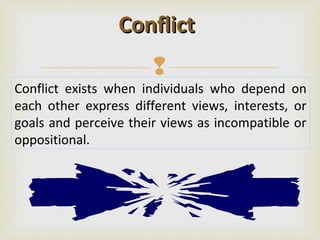
Conflict exists when individuals who depend on
each other express different views, interests, or
goals and perceive their views as incompatible or
oppositional.
What is Conflict?
                   
Conflict is…                   Conflict is not…
•Perceived difference          •Sign of a bad relationship
   • needs, values and goals   •Negative experience
•Part of a relationship        •Mistake
•Consequence of                •Struggle between right and
   • growth                    wrong
   • change
Conflict is
               
• Natural

• Inevitable

• Potentially constructive
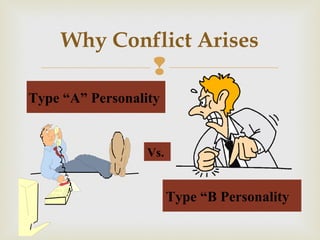
Why Conflict Arises
                   
Type “A” Personality


                  Vs.


                        Type “B Personality
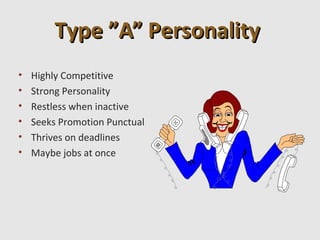
Type ”A” Personality
•   Highly Competitive
•   Strong Personality
•   Restless when inactive
•   Seeks Promotion Punctual
•   Thrives on deadlines
•   Maybe jobs at once
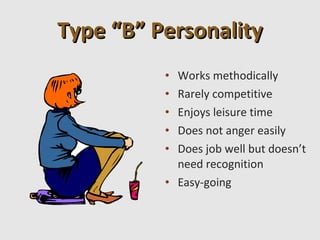
Type “B” Personality
          • Works methodically
          • Rarely competitive
          • Enjoys leisure time
          • Does not anger easily
          • Does job well but doesn’t
            need recognition
          • Easy-going
Types of Conflict
                    
•   Within an individual
•   Between two individuals
•   Within a team of individuals
•   Between two or more teams within an organization
Types of Conflict
       


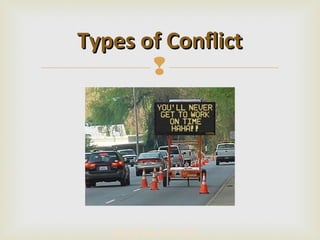
   Being late to work…
Types of Conflict
            


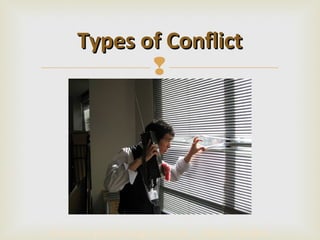
Personal phone usage at work… Minor Conflict
Types of Conflict
            


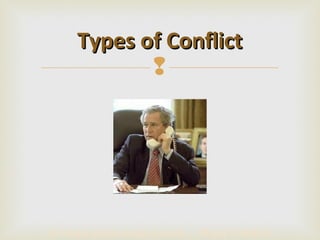
Personal phone usage at work… Major Conflict!
Types of Conflict
       


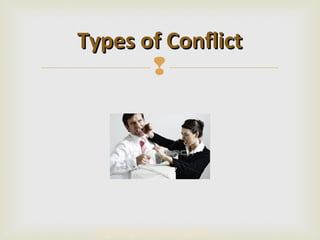
 Fighting in the workplace…
Causes of conflict
                  
•   Conflict of aims- different goals
•   Conflict of ideas- different interpretations
•   Conflict of attitudes - different opinions
•   Conflict of behavior- different behaviors are
    unacceptable
Sources of Conflict
•   Fear               • Mishandling conflict in
•   Dishonesty           the past
•   Boundaries         • Hidden agenda
•   Negligence         • Revenge
•   Need to be right   • Fighting the “last war”
•   Miscommunication
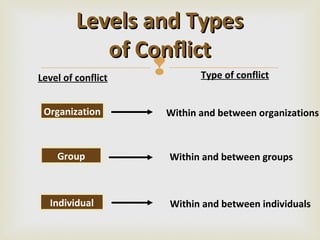
Levels and Types
                  of Conflict
Level of conflict
                       Type of conflict
Organization          Within and between organizations


   Group              Within and between groups


  Individual          Within and between individuals
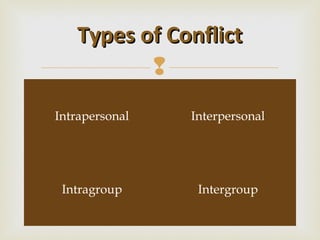
Types of Conflict
          
Intrapersonal   Interpersonal


 Intragroup      Intergroup
Causes of conflict
                  
•   Conflict of aims- different goals
•   Conflict of ideas- different interpretations
•   Conflict of attitudes - different opinions
•   Conflict of behavior- different behaviors are
    unacceptable
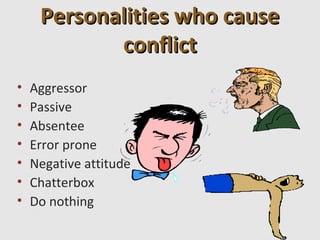
Personalities who cause
            conflict
•   Aggressor
•   Passive
•   Absentee
•   Error prone
•   Negative attitude
•   Chatterbox
•   Do nothing
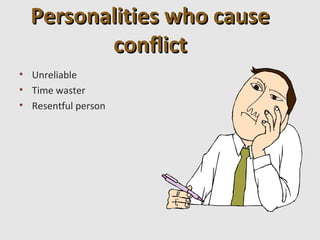
Personalities who cause
         conflict
• Unreliable
• Time waster
• Resentful person
WAC method
What’s bothering you?

A -What do you want to Ask the person to do?

 Check in to see if what you’ve asked for can happen
Disadvantages of Conflict
               
•   Time consuming
•   Disrupts progress/ problem solving
•   Detracts from job at hand
•   Keeps people apart; if unresolved
•   Poor quality, lowers productivity
•   Reduces team effectiveness
CONFLICT RESOLUTION
         TECHNIQUES
               
• Attack the problem not the person:
  • Define the problem
  • Explore each person's perception of the problem
  • Try to understand and respect each point of view without
    judging
Cont.
                       
• Concentrate on interests, not positions
  • The position is the outcome you are interested in
    getting
  • The interest is why you want that outcome

• Come up with options in which both sides can win
  (Win-Win options)

• Cooperate together to solve the problem fairly
  • A fair solution respects the interests of both sides
• PROBLEM SOLVING
• FACE TO FACE MEETING OF CONFLICTING PARTIES.
• SUPERORDINATE GOALS
• CREATING A SHARED GOAL.

• EXPANSION OF RESOURCES
• WHEN A CONFLICT IS CAUSED BY SCARCITY OF A RESOURCE –
  EXPANSION OF RESOURCES CAN CREATE A WIN-WIN
  SOLUTION.
Reducing Conflict
                
• Overview
  • Lose-lose methods: parties to the conflict episode do not
    get what they want
  • Win-lose methods: one party a clear winner; other party a
    clear loser
  • Win-win methods: each party to the conflict episode gets
    what he or she wants
Reducing Conflict (cont.)
            
• Lose-lose methods
  • Avoidance
  • Compromise
  • Similarities
Reducing Conflict (Cont.)
            
• Win-lose methods
  • Dominance
  • Authoritative command:
  • Majority rule
Reducing Conflict (Cont.)
• Win-win methods
                  
 • Problem solving
 • Integration
 • Superordinate goal
Reducing Conflict (Cont.)
            
• Summary
  • Lose-lose methods: compromise
  • Win-lose methods: dominance
  • Win-win methods: problem solving
The Seven Steps to Effective
    Conflict Resolution
             
•   Identify and clearly define the real problem.
•   Brainstorm solutions.
•   Evaluate the solutions.
•   Choose the best win/win solution.
•   Implement this solution.
•   Choose a follow up date to evaluate.
•   Celebrate your success!


Resolving conflits

  • 1.
    Presented by:- Presented to Anshul Goyal Prof. Gautam Bansal Karan Sachdeva Nitin Bansal Rohit Kumar
  • 2.
    Conflict  Conflict exists when individuals who depend on each other express different views, interests, or goals and perceive their views as incompatible or oppositional.
  • 3.
    What is Conflict?  Conflict is… Conflict is not… •Perceived difference •Sign of a bad relationship • needs, values and goals •Negative experience •Part of a relationship •Mistake •Consequence of •Struggle between right and • growth wrong • change
  • 4.
    Conflict is  • Natural • Inevitable • Potentially constructive
  • 5.
    Why Conflict Arises  Type “A” Personality Vs. Type “B Personality
  • 6.
    Type ”A” Personality • Highly Competitive • Strong Personality • Restless when inactive • Seeks Promotion Punctual • Thrives on deadlines • Maybe jobs at once
  • 7.
    Type “B” Personality • Works methodically • Rarely competitive • Enjoys leisure time • Does not anger easily • Does job well but doesn’t need recognition • Easy-going
  • 8.
    Types of Conflict  • Within an individual • Between two individuals • Within a team of individuals • Between two or more teams within an organization
  • 9.
    Types of Conflict  Being late to work…
  • 10.
    Types of Conflict  Personal phone usage at work… Minor Conflict
  • 11.
    Types of Conflict  Personal phone usage at work… Major Conflict!
  • 12.
    Types of Conflict  Fighting in the workplace…
  • 13.
    Causes of conflict  • Conflict of aims- different goals • Conflict of ideas- different interpretations • Conflict of attitudes - different opinions • Conflict of behavior- different behaviors are unacceptable
  • 14.
    Sources of Conflict • Fear • Mishandling conflict in • Dishonesty the past • Boundaries • Hidden agenda • Negligence • Revenge • Need to be right • Fighting the “last war” • Miscommunication
  • 15.
    Levels and Types of Conflict Level of conflict  Type of conflict Organization Within and between organizations Group Within and between groups Individual Within and between individuals
  • 16.
    Types of Conflict  Intrapersonal Interpersonal Intragroup Intergroup
  • 17.
    Causes of conflict  • Conflict of aims- different goals • Conflict of ideas- different interpretations • Conflict of attitudes - different opinions • Conflict of behavior- different behaviors are unacceptable
  • 18.
    Personalities who cause conflict • Aggressor • Passive • Absentee • Error prone • Negative attitude • Chatterbox • Do nothing
  • 19.
    Personalities who cause conflict • Unreliable • Time waster • Resentful person
  • 20.
    WAC method What’s botheringyou? A -What do you want to Ask the person to do? Check in to see if what you’ve asked for can happen
  • 21.
    Disadvantages of Conflict  • Time consuming • Disrupts progress/ problem solving • Detracts from job at hand • Keeps people apart; if unresolved • Poor quality, lowers productivity • Reduces team effectiveness
  • 22.
    CONFLICT RESOLUTION TECHNIQUES  • Attack the problem not the person: • Define the problem • Explore each person's perception of the problem • Try to understand and respect each point of view without judging
  • 23.
    Cont.  • Concentrate on interests, not positions • The position is the outcome you are interested in getting • The interest is why you want that outcome • Come up with options in which both sides can win (Win-Win options) • Cooperate together to solve the problem fairly • A fair solution respects the interests of both sides
  • 24.
    • PROBLEM SOLVING •FACE TO FACE MEETING OF CONFLICTING PARTIES. • SUPERORDINATE GOALS • CREATING A SHARED GOAL. • EXPANSION OF RESOURCES • WHEN A CONFLICT IS CAUSED BY SCARCITY OF A RESOURCE – EXPANSION OF RESOURCES CAN CREATE A WIN-WIN SOLUTION.
  • 25.
    Reducing Conflict  • Overview • Lose-lose methods: parties to the conflict episode do not get what they want • Win-lose methods: one party a clear winner; other party a clear loser • Win-win methods: each party to the conflict episode gets what he or she wants
  • 26.
    Reducing Conflict (cont.)  • Lose-lose methods • Avoidance • Compromise • Similarities
  • 27.
    Reducing Conflict (Cont.)  • Win-lose methods • Dominance • Authoritative command: • Majority rule
  • 28.
    Reducing Conflict (Cont.) •Win-win methods  • Problem solving • Integration • Superordinate goal
  • 29.
    Reducing Conflict (Cont.)  • Summary • Lose-lose methods: compromise • Win-lose methods: dominance • Win-win methods: problem solving
  • 30.
    The Seven Stepsto Effective Conflict Resolution  • Identify and clearly define the real problem. • Brainstorm solutions. • Evaluate the solutions. • Choose the best win/win solution. • Implement this solution. • Choose a follow up date to evaluate. • Celebrate your success!
  • 31.