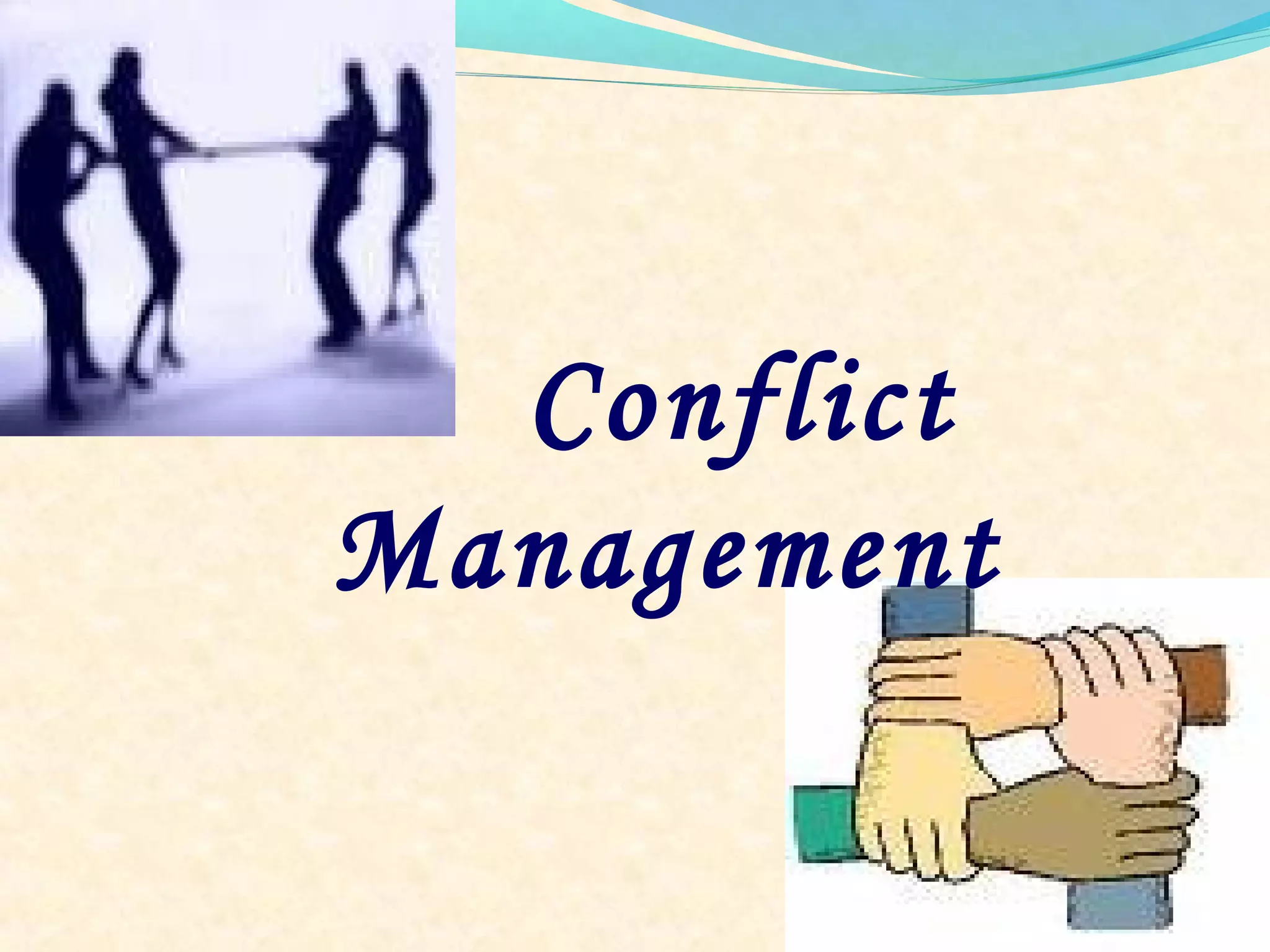
Conflict
Management
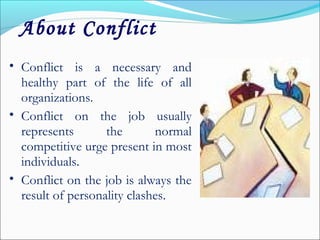
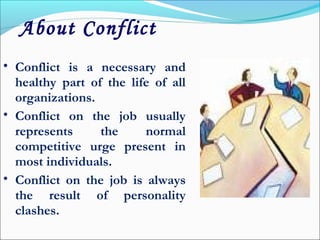
• Conflict is a necessary and
healthy part of the life of all
organizations.
• Conflict on the job usually
represents the normal
competitive urge present in most
individuals.
• Conflict on the job is always the
result of personality clashes.
About Conflict
• Conflict is a primary source of stress on the job.
• One of the benefits of conflict on the job is that it
sometimes produces useful change.
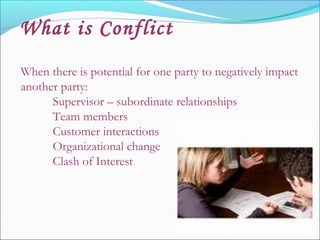
• Conflict arises when there is potential for one party to
negatively impact another party:
Supervisor – subordinate relationships
Team members
Customer interactions
Organizational change
Clash of Interest
About Conflict
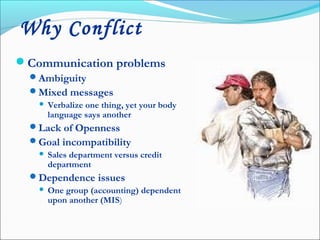
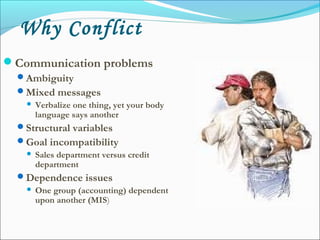
Communication problems
Ambiguity
Mixed messages
 Verbalize one thing, yet your body
language says another
Lack of Openness
Goal incompatibility
 Sales department versus credit
department
Dependence issues
 One group (accounting) dependent
upon another (MIS)
Why Conflict
Personal factors
Personality clashes
 Type A versus Type B
Value systems
 National culture dimensions
 Different emphasis on quality or quantity
 Different perception and area of interest.
 Differences in Perspectives
 Seeking power
 Dissatisfaction with management style
 Weak leadership
Contd…
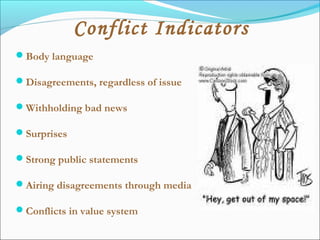
Body language
Disagreements, regardless of issue
Withholding bad news
Surprises
Strong public statements
Airing disagreements through media
Conflicts in value system
Conflict Indicators
 Desire for power
 Increasing lack of respect
 Open disagreement
 Lack of clear goals
 No discussion of progress, failure relative to goals, failure to
evaluate the superintendent fairly, thoroughly or at all.
Contd…
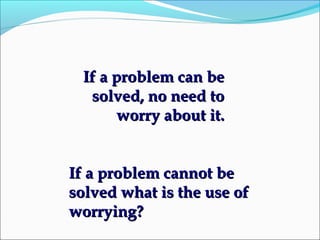
If a problem can beIf a problem can be
solved, no need tosolved, no need to
worry about it.worry about it.
If a problem cannot beIf a problem cannot be
solved what is the use ofsolved what is the use of
worrying?worrying?
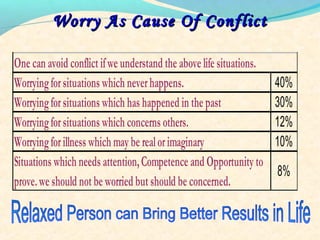
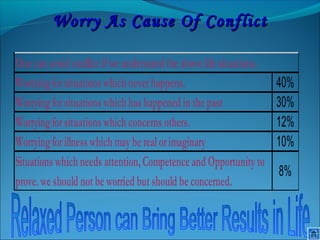
Worry As Cause Of ConflictWorry As Cause Of Conflict
Worryingforsituationswhich neverhappens. 40%
Worryingforsituationswhich hashappened in thepast 30%
Worryingforsituationswhich concerns others. 12%
Worryingforillness which mayberealorimaginary 10%
Situations which needs attention,Competenceand Opportunityto
prove.weshould not beworried but should beconcerned.
8%
Onecan avoid conflict ifweunderstand theabovelifesituations.
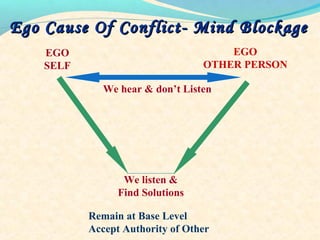
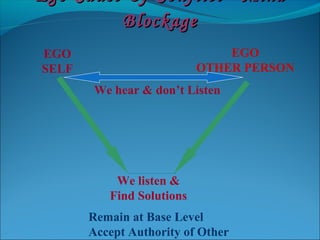
We listen &
Find Solutions
EGO
SELF
Remain at Base Level
Accept Authority of Other
EGO
OTHER PERSON
Ego Cause Of Conflict- Mind BlockageEgo Cause Of Conflict- Mind Blockage
We hear & don’t Listen
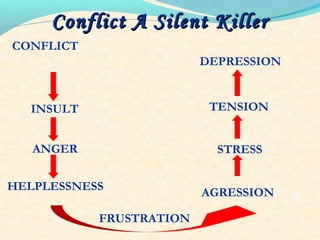
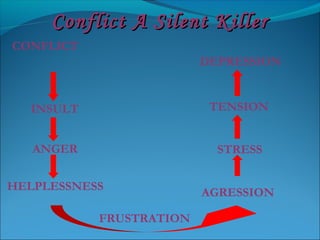
TENSION
CONFLICT
FRUSTRATION
HELPLESSNESS
INSULT
ANGER
DEPRESSION
STRESS
Conflict A Silent KillerConflict A Silent Killer
AGRESSION
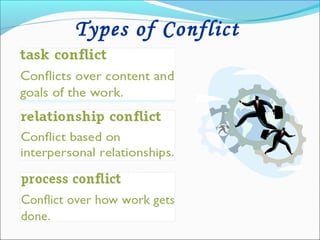
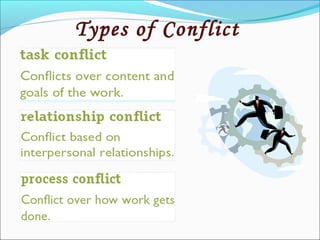
Types of Conflict
Constructive Conflict
Results in clarification of important problems
and issues.
Results in solutions to problems.
Causes authentic communication.
Helps release emotion, anxiety, and stress.
Builds cooperation among people through
learning more about each other.
Helps individuals develop understanding and
skills.
Helps people "be real", for example, it
motivates them to participate.
Helps people learn how to recognize and
benefit from their differences.
Destructive Conflict
Takes attention away from other important
activities.
Undermines morale or self-concept.
Polarizes people and groups, reducing
cooperation.
Increases or sharpens difference.
Leads to irresponsible and harmful behavior,
such as fighting, name-calling.
Hampers productivity.
Lowers morale.
Causes more and continued conflicts.
Causes inappropriate behaviors.
If We Handle Life Situations
Well, the Conflict can be
better Managed
Functional Conflict
Functional Conflict
Conflict that supports the goals of the group and
improves performance
 “When two people in business always agree, one of them is unnecessary”
 “You put a lot of smart people in a room and listen to them duke it out,
and the best idea will pop out”
Task conflict
 Conflicts over content and goals of work
 Low to moderate level is functional
 Stimulates discussion and ideas
Managing Functional Conflict
Encouraging Functional Conflicts
Encourage dissent by asking tough questions.
Bring people with different points of view.
Designate someone to be a devil’s advocate.
Ask the team to consider an unthinkable alternatives.
Dysfunctional Conflict
Conflict that hinders performance
Relationship conflict
Stems from interpersonal relationships
Personality clashes, value differences
Results in hostility & friction
Decreases mutual understanding and makes task completion more
difficult
Managing Dysfunctional
conflict
Managing Dysfunctional Conflicts
Mediates the conflicts
Arbitrate the conflicts.
Control the conflicts.
Accept the conflicts.
Eliminate the conflicts.
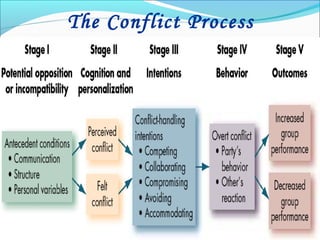
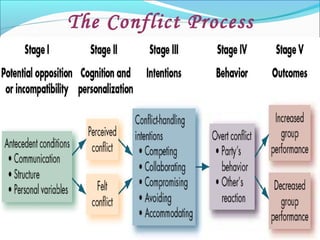
The Conflict Process
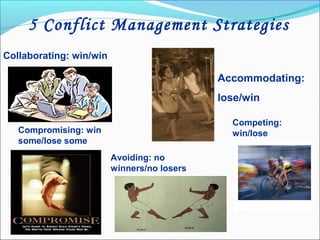
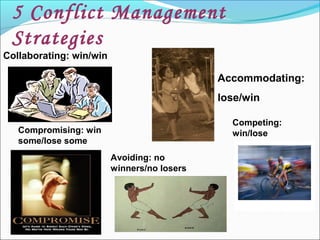
Collaborating: win/win
Compromising: win
some/lose some
Accommodating:
lose/win
Competing:
win/lose
Avoiding: no
winners/no losers
5 Conflict Management Strategies
Resolving Team Conflict
• Conflict is an emotional disturbance or disagreement
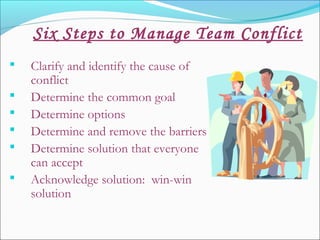
Six Steps to Manage Team Conflict
 Clarify and identify the cause of
conflict
 Determine the common goal
 Determine options
 Determine and remove the barriers
 Determine solution that everyone
can accept
 Acknowledge solution: win-win
solution
Conflict Resolution
Super-ordinate goals
Overarching, shared goal that cannot be attained without
cooperation of each of the conflicting parties
Altering structural variables
Changing the organizational chart
 Reporting relationships
Create joint-task forces
 Gain appreciation of each others (groups) constraints and
needs
Altering individuals
Human relations training
Transfers
Conflict Resolution
Mediation
Neutral third party attempts to find mutually beneficial trade-offs,
suggests alternatives & serves as a sounding board for the
conflicting parties
 Growing area of legal practices
 60% of cases in mediation reach settlement
Arbitration
Neutral third party can dictate an agreement
 Allows parties to avoid the high-costs of going to trial
 Always results in settlement
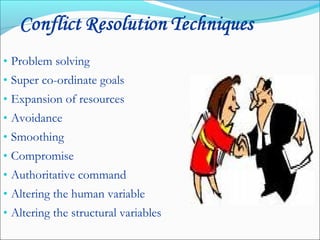
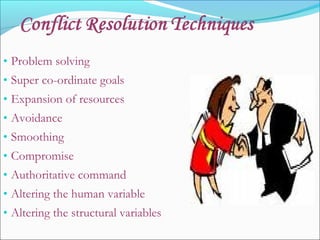
• Problem solving
• Super co-ordinate goals
• Expansion of resources
• Avoidance
• Smoothing
• Compromise
• Authoritative command
• Altering the human variable
• Altering the structural variables
Close your eyes – Relax
Wear a Gentle Smile
Go in deeper Relaxation
Deep Breathe
Gently roll up your Eyeballs
Surrender to Subconscious Mind
Handover the problem to subconscious mind
(Now go to sleep – Expectantly)
Visualize Results / Express Gratefulness next morning
(Before opening your eyes)
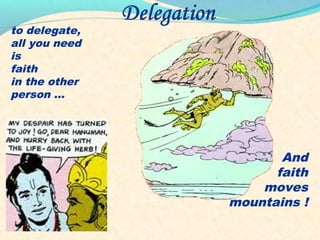
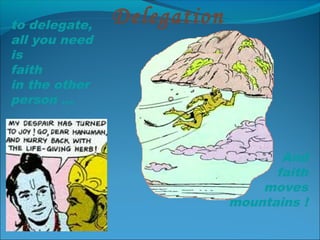
to delegate,
all you need
is
faith
in the other
person ...
And
faith
moves
mountains !
When you think positively about yourself, you work
harder at what you want to do - and give up less easily.
You make a better impression on others, which
encourages them to help you.
When you think more positively about your colleagues,
employees, spouse and children, you build stronger and
more productive relationships - leading to greater success
at work and at home.
• No Matter what Attitude we adopt, the flow of life
continues but in the moment we do have choice
about the direction in which we lean.
•When we resist the flow, life becomes more difficult.
“ Positive Attitude Means Leaning In The Direction
In Which Life Is Flowing”
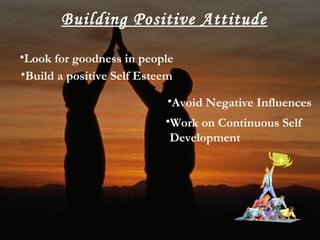
Building Positive Attitude
•Look for goodness in people
•Build a positive Self Esteem
•Avoid Negative Influences
•Work on Continuous Self
Development
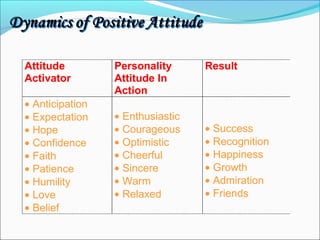
Attitude
Activator
Personality
Attitude In
Action
Result
• Anticipation
• Expectation
• Hope
• Confidence
• Faith
• Patience
• Humility
• Love
• Belief
• Enthusiastic
• Courageous
• Optimistic
• Cheerful
• Sincere
• Warm
• Relaxed
• Success
• Recognition
• Happiness
• Growth
• Admiration
• Friends
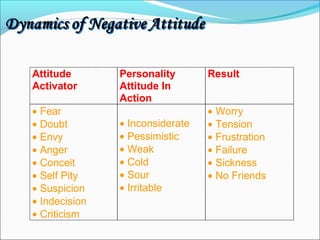
Attitude
Activator
Personality
Attitude In
Action
Result
• Fear
• Doubt
• Envy
• Anger
• Conceit
• Self Pity
• Suspicion
• Indecision
• Criticism
• Inconsiderate
• Pessimistic
• Weak
• Cold
• Sour
• Irritable
• Worry
• Tension
• Frustration
• Failure
• Sickness
• No Friends
“ A young lady was
waiting her flight in
the boarding room of a
big airport.
As she
would wait
for many
hours, she
decided to
buy a book
to spend her
time. She
also bought
a packet of
cookies.
She sat down on
a airmchair, in
the VIP room of
the airport, to
rest and read in
peace.
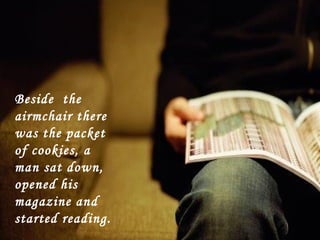
Beside the
airmchair there
was the packet
of cookies, a
man sat down,
opened his
magazine and
started reading.
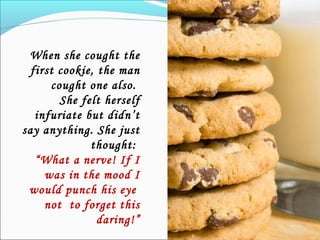
When she cought the
first cookie, the man
cought one also.
She felt herself
infuriate but didn’t
say anything. She just
thought:
“What a nerve! If I
was in the mood I
would punch his eye
not to forget this
daring!”
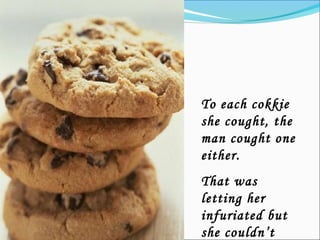
To each cokkie
she cought, the
man cought one
either.
That was
letting her
infuriated but
she couldn’t
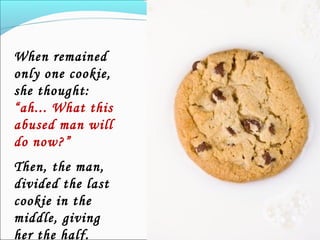
When remained
only one cookie,
she thought:
“ah... What this
abused man will
do now?”
Then, the man,
divided the last
cookie in the
middle, giving
her the half.
Ah! That was too much!
She was too much angry!
Then, she caught her book, caught her things and
headed to the boarding place.
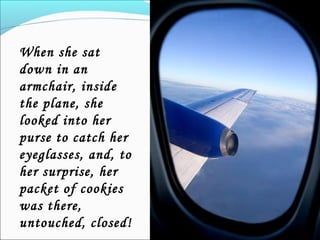
When she sat
down in an
armchair, inside
the plane, she
looked into her
purse to catch her
eyeglasses, and, to
her surprise, her
packet of cookies
was there,
untouched, closed!
She felt so
much
ashamed!!
She realized
that she
was the
wrong one...
She had
forgotten
that her
cookies were
kept into
her purse.
The man divided
his cookies with
her, wihtout
feeling infuriated,
nervous or mad...
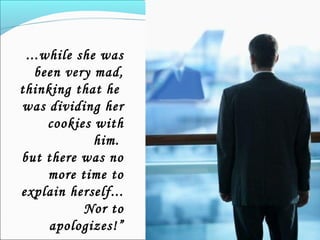
...while she was
been very mad,
thinking that he
was dividing her
cookies with
him.
but there was no
more time to
explain herself...
Nor to
apologizes!”
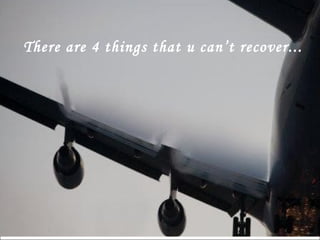
There are 4 things that u can’t recover...
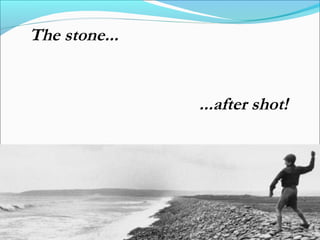
The stone...
...after shot!
The word... ...
...after pronounced!
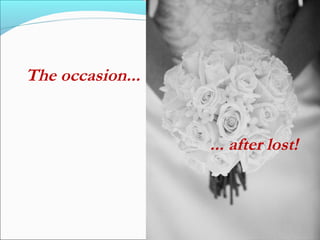
The occasion...
... after lost!
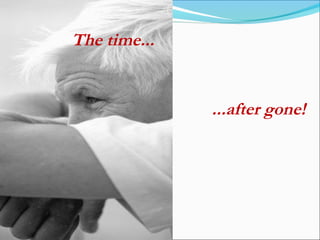
The time...
...after gone!
Forgiveness is your Biggest
Asset
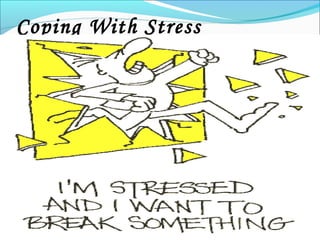
Coping With Stress
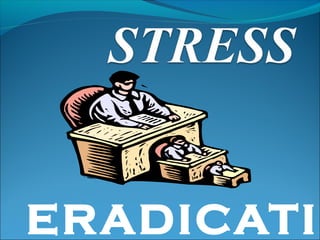
ERADICATI
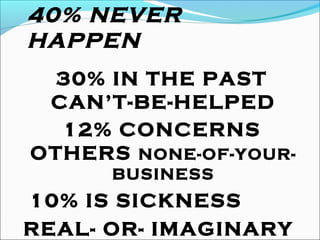
40% NEVER
HAPPEN
30% IN THE PAST
CAN’T-BE-HELPED
12% CONCERNS
OTHERS NONE-OF-YOUR-
BUSINESS
10% IS SICKNESS
REAL- OR- IMAGINARY
8% ARE
THE SITUATIONS
FACED IN THE
PRESENT
WHICH MUST
NEVER BE
IGNORED
PROBLEMS
BLESSING
OR
CURSE
IT IS INDEED A
COMPLIMENT
ON THE COMPETENCE
GAINED IN THE PAST
FEEL HONOURED
OPPORTUNIT
Y
TO DEVELOP
FURTHER
COMPETENCE
FOR THE
FUTURE
Manage The Situation
And Stress Stands
ERADICATED
Learn To Unlearn
The Stressful Habits
And
Learn To
Develop
On The
Relevant
Ones
living
A STRESS-FREE
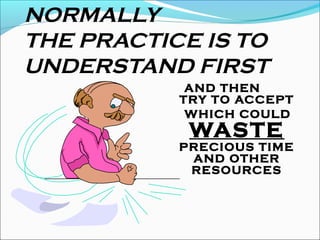
NORMALLY
THE PRACTICE IS TO
UNDERSTAND FIRST
AND THEN
TRY TO ACCEPT
WHICH COULD
WASTE
PRECIOUS TIME
AND OTHER
RESOURCES
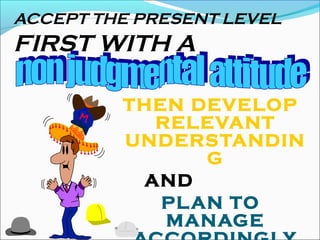
ACCEPT THE PRESENT LEVEL
FIRST WITH A
THEN DEVELOP
RELEVANT
UNDERSTANDIN
G
AND
PLAN TO
MANAGE
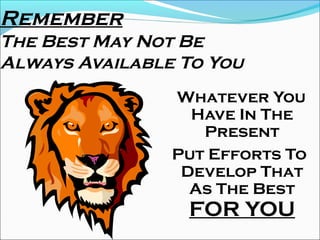
Remember
The Best May Not Be
Always Available To You
Whatever You
Have In The
Present
Put Efforts To
Develop That
As The Best
FOR YOU
ACCEPT THE PRESENT
AS IT IS
BUT NEVER ACCEPT
THE LINKED
CONSEQUENCES
MUST USE YOUR
JUDGMENT TO
PLAN FUTURE
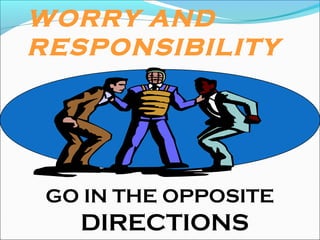
WORRY AND
RESPONSIBILITY
GO IN THE OPPOSITE
DIRECTIONS
ENERGY
WORRYWORRY
(Waste)(Waste)
RESPONSIBILITYRESPONSIBILITY
(Investment)(Investment)
20%20% 20%20% 60%60%
50%50% 50%50% NILNIL
MIND CAN’T FUNCTIONMIND CAN’T FUNCTION
100%100% 100%100%
FROM BODY’SFROM BODY’S
RESERVERESERVE
QUOTA OFQUOTA OF
ENERGYENERGY
FEELINGFEELING
[80%][80%]
WHEN YOU
WORRY
YOUR ENERGY IS
DIVERTED
TOWARDS
WORRY
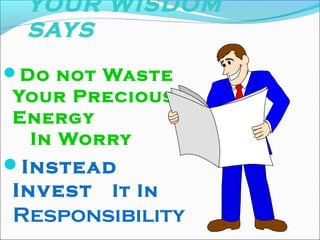
YOUR WISDOM
SAYS
Do not Waste
Your Precious
Energy
In Worry
Instead
Invest It In
Responsibility
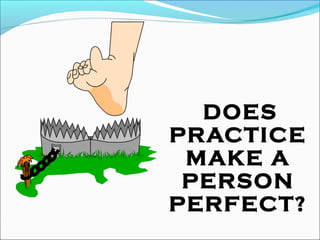
DOES
PRACTICE
MAKE A
PERSON
PERFECT?
PRACTICE
GENERATES
PERMANENCE
MUST TAKE A
DECISION
PRACTICE
USE POSITIVE
WORD
CONCER
N
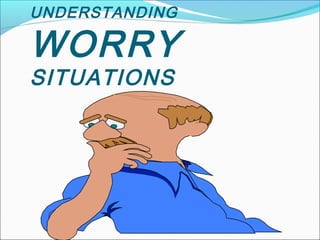
UNDERSTANDING
WORRY
SITUATIONS
Max & Max
Meet Max
Max is a dog of the finest breeding.
He was rigorously trained to retrieve game at the
slightest nod from his owner.
He is slightly motivate to serve his master’s needs.
Meet Max
Max is talented, amiable, full of energy, and well
educated.
He is anxious to enter the arena of customer service
and make a contribution, and he’s bursting with
innovative ideas.
Meet Mr. Harold
Mr. Harold is an average manager of customer
service for New World Imports.
Service is the byword in his department.
He has some untapped ideas about customer service.
Max and Max
Max and Max both have new opportunities – a
chance to learn, a chance to show their stuff.
Each comes to learn about limits, though: stay on the
lawn; get your own job figured out first, then you can
start worrying about mine.
• Conflict is a necessary and
healthy part of the life of all
organizations.
• Conflict on the job usually
represents the normal
competitive urge present in
most individuals.
• Conflict on the job is always
the result of personality
clashes.
About Conflict
• Conflict is a primary source of stress on the job.
• One of the benefits of conflict on the job is that it
sometimes produces useful change.
• In resolving a conflict, a team leader must determine
whether the cause is :
a) Personality clash
b) The way the work is structured.
Contd…
When there is potential for one party to negatively impact
another party:
Supervisor – subordinate relationships
Team members
Customer interactions
Organizational change
Clash of Interest
What is Conflict
Communication problems
Ambiguity
Mixed messages
 Verbalize one thing, yet your body
language says another
Structural variables
Goal incompatibility
 Sales department versus credit
department
Dependence issues
 One group (accounting) dependent
upon another (MIS)
Why Conflict
Personal factors
Personality clashes
 Type A versus Type B
Value systems
 National culture dimensions
 Different emphasis on quality or quantity
 Different perception and area of interest.
Contd…
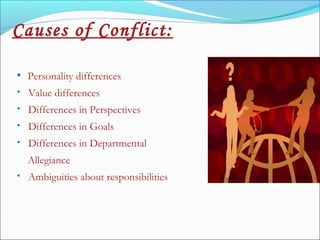
Causes of Conflict:
• Personality differences
• Value differences
• Differences in Perspectives
• Differences in Goals
• Differences in Departmental
Allegiance
• Ambiguities about responsibilities
Poor communication
Seeking power
Dissatisfaction with management style
Weak leadership
Lack of openness
Change in leadership
Beginning of Conflict
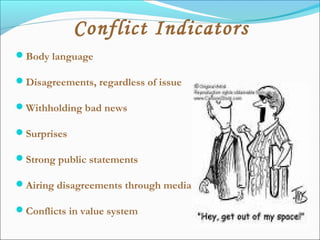
Body language
Disagreements, regardless of issue
Withholding bad news
Surprises
Strong public statements
Airing disagreements through media
Conflicts in value system
Conflict Indicators
 Desire for power
 Increasing lack of respect
 Open disagreement
 Lack of candor on budget problems or other sensitive issues
 Lack of clear goals
 No discussion of progress, failure relative to goals, failure to
evaluate the superintendent fairly, thoroughly or at all.
Contd…
Constructive Conflict
Results in clarification of important problems
and issues.
Results in solutions to problems.
Causes authentic communication.
Helps release emotion, anxiety, and stress.
Builds cooperation among people through
learning more about each other.
Helps individuals develop understanding and
skills.
Helps people "be real", for example, it
motivates them to participate.
Helps people learn how to recognize and
benefit from their differences.
Destructive Conflict
Takes attention away from other important
activities.
Undermines morale or self-concept.
Polarizes people and groups, reducing
cooperation.
Increases or sharpens difference.
Leads to irresponsible and harmful behavior,
such as fighting, name-calling.
Hampers productivity.
Lowers morale.
Causes more and continued conflicts.
Causes inappropriate behaviors.
Types of Conflict
The Conflict Process
Managing conflict
Encouraging Functional Conflicts
Encourage dissent by asking tough questions.
Bring people with different points of view.
Designate someone to be a devil’s advocate.
Ask the team to consider an unthinkable alternatives.
Functional Conflict
Functional Conflict
Conflict that supports the goals of the group and
improves performance
 “When two people in business always agree, one of them is unnecessary”
 “You put a lot of smart people in a room and listen to them duke it out,
and the best idea will pop out”
Task conflict
 Conflicts over content and goals of work
 Low to moderate level is functional
 Stimulates discussion and ideas
Dysfunctional Conflict
Conflict that hinders performance
Relationship conflict
Stems from interpersonal relationships
Personality clashes, value differences
Results in hostility & friction
Decreases mutual understanding and makes task completion
more difficult
Managing Dysfunctional
conflict
Managing Dysfunctional Conflicts
Mediates the conflicts
Arbitrate the conflicts.
Control the conflicts.
Accept the conflicts.
Eliminate the conflicts.
Collaborating: win/win
Compromising: win
some/lose some
Accommodating:
lose/win
Competing:
win/lose
Avoiding: no
winners/no losers
5 Conflict Management
Strategies
Win – Win Negotiation
Ask from yourself.
Do you feel that someone is continually taking advantage of
you?
Do you seem to have fight aggressively with other to win the
resources you need?
Do you struggle to get what you want from people whose help
you need but over whom you have little direct authority?
If so you need to brush up your win-win negotiation skills.
The aim of win-win situation is to find a solution
that is acceptable to both parties and leaves both
parties feeling that they have won.
Effective negotiation skills helps you to resolve
where what you want conflicts with what
someone else wants.
Win – Win Negotiation
Inputs for a Successful Negotiation
Depending on the scale of disagreement one should think through the
following points before starting the negotiation:
Goal for negotiation
Trades one has for negotiation:
- What do you and the other person have that you can trade?
- What are you each comfortable giving away?
Alternatives for negotiation if the other person do not reach to the
agreement:
- Does failure to each an agreement cut you out of future opportunities?
Relationship with the other person:
- Will there be any hidden issues that may influence the negotiation? How
will
you handle these?
Inputs for a Successful Negotiation
Expected outcomes from negotiation and action plan for the same:
- What has the outcome in the past and what precedents have been set?
Expected consequences after winning or loosing the negotiation
for both the parties.
Who is Powerful negotiator and what powers he has?
- Who controls the resources?
- Who stands to loose the most if agreement isn’t reached?
Possible Solutions:
- What possible compromises might there be?
Resolving Team Conflict• Conflict is an emotional disturbance or disagreement
Six Steps to Manage Team Conflict
 Clarify and identify the cause of
conflict
 Determine the common goal
 Determine options
 Determine and remove the barriers
 Determine solution that everyone
can accept
 Acknowledge solution: win-win
solution
Conflict Resolution
Super-ordinate goals
Overarching, shared goal that cannot be attained without
cooperation of each of the conflicting parties
Altering structural variables
Changing the organizational chart
 Reporting relationships
Create joint-task forces
 Gain appreciation of each others (groups) constraints and
needs
Altering individuals
Human relations training
Transfers
Conflict Resolution
Mediation
Neutral third party attempts to find mutually beneficial trade-offs,
suggests alternatives, & serves as a sounding board for the
conflicting parties
 Growing area of legal practices
 60% of cases in mediation reach settlement
Arbitration
Neutral third party can dictate an agreement
 Allows parties to avoid the high-costs of going to trial
 Always results in settlement
• Problem solving
• Super co-ordinate goals
• Expansion of resources
• Avoidance
• Smoothing
• Compromise
• Authoritative command
• Altering the human variable
• Altering the structural variables
Meditation
Close your eyes – Relax
Wear a Gentle Smile
Go in deeper Relaxation
Deep Breathe
Gently roll up your Eyeballs
Surrender to Subconscious Mind
Handover the problem to subconscious mind
(Now go to sleep – Expectantly)
Visualize Results / Express Gratefulness next morning
(Before opening your eyes)
to delegate,
all you need
is
faith
in the other
person ...
And
faith
moves
mountains !
Delegation
If We Handle Life Situations
Well, the Conflict can be
better Managed
Worry As Cause Of ConflictWorry As Cause Of Conflict
Worryingforsituationswhich neverhappens. 40%
Worryingforsituationswhich hashappened in thepast 30%
Worryingforsituationswhich concerns others. 12%
Worryingforillness which mayberealorimaginary 10%
Situations which needs attention,Competenceand Opportunityto
prove.weshould not beworried but should beconcerned.
8%
Onecan avoid conflict ifweunderstand theabovelifesituations.
We listen &
Find Solutions
EGO
SELF
Remain at Base Level
Accept Authority of Other
EGO
OTHER PERSON
Ego Cause Of Conflict-Ego Cause Of Conflict- MindMind
BlockageBlockage
We hear & don’t Listen
TENSION
CONFLICT
FRUSTRATION
HELPLESSNESS
INSULT
ANGER
DEPRESSION
STRESS
Conflict A Silent KillerConflict A Silent Killer
AGRESSION
Forgiveness is your Biggest
Asset

Conflict management

  • 1.
  • 2.
    • Conflict isa necessary and healthy part of the life of all organizations. • Conflict on the job usually represents the normal competitive urge present in most individuals. • Conflict on the job is always the result of personality clashes. About Conflict
  • 3.
    • Conflict isa primary source of stress on the job. • One of the benefits of conflict on the job is that it sometimes produces useful change. • Conflict arises when there is potential for one party to negatively impact another party: Supervisor – subordinate relationships Team members Customer interactions Organizational change Clash of Interest About Conflict
  • 4.
    Communication problems Ambiguity Mixed messages Verbalize one thing, yet your body language says another Lack of Openness Goal incompatibility  Sales department versus credit department Dependence issues  One group (accounting) dependent upon another (MIS) Why Conflict
  • 5.
    Personal factors Personality clashes Type A versus Type B Value systems  National culture dimensions  Different emphasis on quality or quantity  Different perception and area of interest.  Differences in Perspectives  Seeking power  Dissatisfaction with management style  Weak leadership Contd…
  • 6.
    Body language Disagreements, regardlessof issue Withholding bad news Surprises Strong public statements Airing disagreements through media Conflicts in value system Conflict Indicators
  • 7.
     Desire forpower  Increasing lack of respect  Open disagreement  Lack of clear goals  No discussion of progress, failure relative to goals, failure to evaluate the superintendent fairly, thoroughly or at all. Contd…
  • 8.
    If a problemcan beIf a problem can be solved, no need tosolved, no need to worry about it.worry about it. If a problem cannot beIf a problem cannot be solved what is the use ofsolved what is the use of worrying?worrying?
  • 9.
    Worry As CauseOf ConflictWorry As Cause Of Conflict Worryingforsituationswhich neverhappens. 40% Worryingforsituationswhich hashappened in thepast 30% Worryingforsituationswhich concerns others. 12% Worryingforillness which mayberealorimaginary 10% Situations which needs attention,Competenceand Opportunityto prove.weshould not beworried but should beconcerned. 8% Onecan avoid conflict ifweunderstand theabovelifesituations.
  • 10.
    We listen & FindSolutions EGO SELF Remain at Base Level Accept Authority of Other EGO OTHER PERSON Ego Cause Of Conflict- Mind BlockageEgo Cause Of Conflict- Mind Blockage We hear & don’t Listen
  • 11.
  • 12.
  • 13.
    Constructive Conflict Results inclarification of important problems and issues. Results in solutions to problems. Causes authentic communication. Helps release emotion, anxiety, and stress. Builds cooperation among people through learning more about each other. Helps individuals develop understanding and skills. Helps people "be real", for example, it motivates them to participate. Helps people learn how to recognize and benefit from their differences.
  • 14.
    Destructive Conflict Takes attentionaway from other important activities. Undermines morale or self-concept. Polarizes people and groups, reducing cooperation. Increases or sharpens difference. Leads to irresponsible and harmful behavior, such as fighting, name-calling. Hampers productivity. Lowers morale. Causes more and continued conflicts. Causes inappropriate behaviors.
  • 15.
    If We HandleLife Situations Well, the Conflict can be better Managed
  • 16.
    Functional Conflict Functional Conflict Conflictthat supports the goals of the group and improves performance  “When two people in business always agree, one of them is unnecessary”  “You put a lot of smart people in a room and listen to them duke it out, and the best idea will pop out” Task conflict  Conflicts over content and goals of work  Low to moderate level is functional  Stimulates discussion and ideas
  • 17.
    Managing Functional Conflict EncouragingFunctional Conflicts Encourage dissent by asking tough questions. Bring people with different points of view. Designate someone to be a devil’s advocate. Ask the team to consider an unthinkable alternatives.
  • 18.
    Dysfunctional Conflict Conflict thathinders performance Relationship conflict Stems from interpersonal relationships Personality clashes, value differences Results in hostility & friction Decreases mutual understanding and makes task completion more difficult
  • 19.
    Managing Dysfunctional conflict Managing DysfunctionalConflicts Mediates the conflicts Arbitrate the conflicts. Control the conflicts. Accept the conflicts. Eliminate the conflicts.
  • 20.
  • 21.
    Collaborating: win/win Compromising: win some/losesome Accommodating: lose/win Competing: win/lose Avoiding: no winners/no losers 5 Conflict Management Strategies
  • 22.
    Resolving Team Conflict •Conflict is an emotional disturbance or disagreement
  • 23.
    Six Steps toManage Team Conflict  Clarify and identify the cause of conflict  Determine the common goal  Determine options  Determine and remove the barriers  Determine solution that everyone can accept  Acknowledge solution: win-win solution
  • 24.
    Conflict Resolution Super-ordinate goals Overarching,shared goal that cannot be attained without cooperation of each of the conflicting parties Altering structural variables Changing the organizational chart  Reporting relationships Create joint-task forces  Gain appreciation of each others (groups) constraints and needs Altering individuals Human relations training Transfers
  • 25.
    Conflict Resolution Mediation Neutral thirdparty attempts to find mutually beneficial trade-offs, suggests alternatives & serves as a sounding board for the conflicting parties  Growing area of legal practices  60% of cases in mediation reach settlement Arbitration Neutral third party can dictate an agreement  Allows parties to avoid the high-costs of going to trial  Always results in settlement
  • 26.
    • Problem solving •Super co-ordinate goals • Expansion of resources • Avoidance • Smoothing • Compromise • Authoritative command • Altering the human variable • Altering the structural variables
  • 27.
    Close your eyes– Relax Wear a Gentle Smile Go in deeper Relaxation Deep Breathe Gently roll up your Eyeballs Surrender to Subconscious Mind Handover the problem to subconscious mind (Now go to sleep – Expectantly) Visualize Results / Express Gratefulness next morning (Before opening your eyes)
  • 28.
    to delegate, all youneed is faith in the other person ... And faith moves mountains !
  • 29.
    When you thinkpositively about yourself, you work harder at what you want to do - and give up less easily. You make a better impression on others, which encourages them to help you. When you think more positively about your colleagues, employees, spouse and children, you build stronger and more productive relationships - leading to greater success at work and at home.
  • 30.
    • No Matterwhat Attitude we adopt, the flow of life continues but in the moment we do have choice about the direction in which we lean. •When we resist the flow, life becomes more difficult. “ Positive Attitude Means Leaning In The Direction In Which Life Is Flowing”
  • 31.
    Building Positive Attitude •Lookfor goodness in people •Build a positive Self Esteem •Avoid Negative Influences •Work on Continuous Self Development
  • 32.
    Attitude Activator Personality Attitude In Action Result • Anticipation •Expectation • Hope • Confidence • Faith • Patience • Humility • Love • Belief • Enthusiastic • Courageous • Optimistic • Cheerful • Sincere • Warm • Relaxed • Success • Recognition • Happiness • Growth • Admiration • Friends
  • 33.
    Attitude Activator Personality Attitude In Action Result • Fear •Doubt • Envy • Anger • Conceit • Self Pity • Suspicion • Indecision • Criticism • Inconsiderate • Pessimistic • Weak • Cold • Sour • Irritable • Worry • Tension • Frustration • Failure • Sickness • No Friends
  • 34.
    “ A younglady was waiting her flight in the boarding room of a big airport.
  • 35.
    As she would wait formany hours, she decided to buy a book to spend her time. She also bought a packet of cookies.
  • 36.
    She sat downon a airmchair, in the VIP room of the airport, to rest and read in peace.
  • 37.
    Beside the airmchair there wasthe packet of cookies, a man sat down, opened his magazine and started reading.
  • 38.
    When she coughtthe first cookie, the man cought one also. She felt herself infuriate but didn’t say anything. She just thought: “What a nerve! If I was in the mood I would punch his eye not to forget this daring!”
  • 39.
    To each cokkie shecought, the man cought one either. That was letting her infuriated but she couldn’t
  • 40.
    When remained only onecookie, she thought: “ah... What this abused man will do now?” Then, the man, divided the last cookie in the middle, giving her the half.
  • 41.
    Ah! That wastoo much! She was too much angry! Then, she caught her book, caught her things and headed to the boarding place.
  • 42.
    When she sat downin an armchair, inside the plane, she looked into her purse to catch her eyeglasses, and, to her surprise, her packet of cookies was there, untouched, closed!
  • 43.
    She felt so much ashamed!! Sherealized that she was the wrong one... She had forgotten that her cookies were kept into her purse.
  • 44.
    The man divided hiscookies with her, wihtout feeling infuriated, nervous or mad...
  • 45.
    ...while she was beenvery mad, thinking that he was dividing her cookies with him. but there was no more time to explain herself... Nor to apologizes!”
  • 46.
    There are 4things that u can’t recover...
  • 47.
  • 48.
  • 49.
  • 50.
  • 51.
    Forgiveness is yourBiggest Asset
  • 52.
  • 53.
  • 54.
    40% NEVER HAPPEN 30% INTHE PAST CAN’T-BE-HELPED 12% CONCERNS OTHERS NONE-OF-YOUR- BUSINESS 10% IS SICKNESS REAL- OR- IMAGINARY
  • 55.
    8% ARE THE SITUATIONS FACEDIN THE PRESENT WHICH MUST NEVER BE IGNORED
  • 56.
  • 57.
    IT IS INDEEDA COMPLIMENT ON THE COMPETENCE GAINED IN THE PAST FEEL HONOURED
  • 58.
  • 59.
    Manage The Situation AndStress Stands ERADICATED
  • 60.
    Learn To Unlearn TheStressful Habits And Learn To Develop On The Relevant Ones
  • 61.
  • 62.
    NORMALLY THE PRACTICE ISTO UNDERSTAND FIRST AND THEN TRY TO ACCEPT WHICH COULD WASTE PRECIOUS TIME AND OTHER RESOURCES
  • 63.
    ACCEPT THE PRESENTLEVEL FIRST WITH A THEN DEVELOP RELEVANT UNDERSTANDIN G AND PLAN TO MANAGE
  • 64.
    Remember The Best MayNot Be Always Available To You Whatever You Have In The Present Put Efforts To Develop That As The Best FOR YOU
  • 65.
    ACCEPT THE PRESENT ASIT IS BUT NEVER ACCEPT THE LINKED CONSEQUENCES MUST USE YOUR JUDGMENT TO PLAN FUTURE
  • 66.
    WORRY AND RESPONSIBILITY GO INTHE OPPOSITE DIRECTIONS
  • 67.
    ENERGY WORRYWORRY (Waste)(Waste) RESPONSIBILITYRESPONSIBILITY (Investment)(Investment) 20%20% 20%20% 60%60% 50%50%50%50% NILNIL MIND CAN’T FUNCTIONMIND CAN’T FUNCTION 100%100% 100%100% FROM BODY’SFROM BODY’S RESERVERESERVE QUOTA OFQUOTA OF ENERGYENERGY FEELINGFEELING [80%][80%]
  • 68.
    WHEN YOU WORRY YOUR ENERGYIS DIVERTED TOWARDS WORRY
  • 69.
    YOUR WISDOM SAYS Do notWaste Your Precious Energy In Worry Instead Invest It In Responsibility
  • 70.
  • 71.
  • 72.
  • 73.
  • 74.
  • 75.
    Meet Max Max isa dog of the finest breeding. He was rigorously trained to retrieve game at the slightest nod from his owner. He is slightly motivate to serve his master’s needs. Meet Max Max is talented, amiable, full of energy, and well educated. He is anxious to enter the arena of customer service and make a contribution, and he’s bursting with innovative ideas.
  • 76.
    Meet Mr. Harold Mr.Harold is an average manager of customer service for New World Imports. Service is the byword in his department. He has some untapped ideas about customer service. Max and Max Max and Max both have new opportunities – a chance to learn, a chance to show their stuff. Each comes to learn about limits, though: stay on the lawn; get your own job figured out first, then you can start worrying about mine.
  • 77.
    • Conflict isa necessary and healthy part of the life of all organizations. • Conflict on the job usually represents the normal competitive urge present in most individuals. • Conflict on the job is always the result of personality clashes. About Conflict
  • 78.
    • Conflict isa primary source of stress on the job. • One of the benefits of conflict on the job is that it sometimes produces useful change. • In resolving a conflict, a team leader must determine whether the cause is : a) Personality clash b) The way the work is structured. Contd…
  • 79.
    When there ispotential for one party to negatively impact another party: Supervisor – subordinate relationships Team members Customer interactions Organizational change Clash of Interest What is Conflict
  • 80.
    Communication problems Ambiguity Mixed messages Verbalize one thing, yet your body language says another Structural variables Goal incompatibility  Sales department versus credit department Dependence issues  One group (accounting) dependent upon another (MIS) Why Conflict
  • 81.
    Personal factors Personality clashes Type A versus Type B Value systems  National culture dimensions  Different emphasis on quality or quantity  Different perception and area of interest. Contd…
  • 82.
    Causes of Conflict: •Personality differences • Value differences • Differences in Perspectives • Differences in Goals • Differences in Departmental Allegiance • Ambiguities about responsibilities
  • 83.
    Poor communication Seeking power Dissatisfactionwith management style Weak leadership Lack of openness Change in leadership Beginning of Conflict
  • 84.
    Body language Disagreements, regardlessof issue Withholding bad news Surprises Strong public statements Airing disagreements through media Conflicts in value system Conflict Indicators
  • 85.
     Desire forpower  Increasing lack of respect  Open disagreement  Lack of candor on budget problems or other sensitive issues  Lack of clear goals  No discussion of progress, failure relative to goals, failure to evaluate the superintendent fairly, thoroughly or at all. Contd…
  • 86.
    Constructive Conflict Results inclarification of important problems and issues. Results in solutions to problems. Causes authentic communication. Helps release emotion, anxiety, and stress. Builds cooperation among people through learning more about each other. Helps individuals develop understanding and skills. Helps people "be real", for example, it motivates them to participate. Helps people learn how to recognize and benefit from their differences.
  • 87.
    Destructive Conflict Takes attentionaway from other important activities. Undermines morale or self-concept. Polarizes people and groups, reducing cooperation. Increases or sharpens difference. Leads to irresponsible and harmful behavior, such as fighting, name-calling. Hampers productivity. Lowers morale. Causes more and continued conflicts. Causes inappropriate behaviors.

  • 88.
  • 89.
  • 90.
    Managing conflict Encouraging FunctionalConflicts Encourage dissent by asking tough questions. Bring people with different points of view. Designate someone to be a devil’s advocate. Ask the team to consider an unthinkable alternatives.
  • 91.
    Functional Conflict Functional Conflict Conflictthat supports the goals of the group and improves performance  “When two people in business always agree, one of them is unnecessary”  “You put a lot of smart people in a room and listen to them duke it out, and the best idea will pop out” Task conflict  Conflicts over content and goals of work  Low to moderate level is functional  Stimulates discussion and ideas
  • 92.
    Dysfunctional Conflict Conflict thathinders performance Relationship conflict Stems from interpersonal relationships Personality clashes, value differences Results in hostility & friction Decreases mutual understanding and makes task completion more difficult
  • 93.
    Managing Dysfunctional conflict Managing DysfunctionalConflicts Mediates the conflicts Arbitrate the conflicts. Control the conflicts. Accept the conflicts. Eliminate the conflicts.
  • 94.
    Collaborating: win/win Compromising: win some/losesome Accommodating: lose/win Competing: win/lose Avoiding: no winners/no losers 5 Conflict Management Strategies
  • 95.
    Win – WinNegotiation Ask from yourself. Do you feel that someone is continually taking advantage of you? Do you seem to have fight aggressively with other to win the resources you need? Do you struggle to get what you want from people whose help you need but over whom you have little direct authority? If so you need to brush up your win-win negotiation skills.
  • 96.
    The aim ofwin-win situation is to find a solution that is acceptable to both parties and leaves both parties feeling that they have won. Effective negotiation skills helps you to resolve where what you want conflicts with what someone else wants. Win – Win Negotiation
  • 97.
    Inputs for aSuccessful Negotiation Depending on the scale of disagreement one should think through the following points before starting the negotiation: Goal for negotiation Trades one has for negotiation: - What do you and the other person have that you can trade? - What are you each comfortable giving away? Alternatives for negotiation if the other person do not reach to the agreement: - Does failure to each an agreement cut you out of future opportunities? Relationship with the other person: - Will there be any hidden issues that may influence the negotiation? How will you handle these?
  • 98.
    Inputs for aSuccessful Negotiation Expected outcomes from negotiation and action plan for the same: - What has the outcome in the past and what precedents have been set? Expected consequences after winning or loosing the negotiation for both the parties. Who is Powerful negotiator and what powers he has? - Who controls the resources? - Who stands to loose the most if agreement isn’t reached? Possible Solutions: - What possible compromises might there be?
  • 99.
    Resolving Team Conflict•Conflict is an emotional disturbance or disagreement
  • 100.
    Six Steps toManage Team Conflict  Clarify and identify the cause of conflict  Determine the common goal  Determine options  Determine and remove the barriers  Determine solution that everyone can accept  Acknowledge solution: win-win solution
  • 101.
    Conflict Resolution Super-ordinate goals Overarching,shared goal that cannot be attained without cooperation of each of the conflicting parties Altering structural variables Changing the organizational chart  Reporting relationships Create joint-task forces  Gain appreciation of each others (groups) constraints and needs Altering individuals Human relations training Transfers
  • 102.
    Conflict Resolution Mediation Neutral thirdparty attempts to find mutually beneficial trade-offs, suggests alternatives, & serves as a sounding board for the conflicting parties  Growing area of legal practices  60% of cases in mediation reach settlement Arbitration Neutral third party can dictate an agreement  Allows parties to avoid the high-costs of going to trial  Always results in settlement
  • 103.
    • Problem solving •Super co-ordinate goals • Expansion of resources • Avoidance • Smoothing • Compromise • Authoritative command • Altering the human variable • Altering the structural variables
  • 104.
    Meditation Close your eyes– Relax Wear a Gentle Smile Go in deeper Relaxation Deep Breathe Gently roll up your Eyeballs Surrender to Subconscious Mind Handover the problem to subconscious mind (Now go to sleep – Expectantly) Visualize Results / Express Gratefulness next morning (Before opening your eyes)
  • 105.
    to delegate, all youneed is faith in the other person ... And faith moves mountains ! Delegation
  • 106.
    If We HandleLife Situations Well, the Conflict can be better Managed
  • 107.
    Worry As CauseOf ConflictWorry As Cause Of Conflict Worryingforsituationswhich neverhappens. 40% Worryingforsituationswhich hashappened in thepast 30% Worryingforsituationswhich concerns others. 12% Worryingforillness which mayberealorimaginary 10% Situations which needs attention,Competenceand Opportunityto prove.weshould not beworried but should beconcerned. 8% Onecan avoid conflict ifweunderstand theabovelifesituations.
  • 108.
    We listen & FindSolutions EGO SELF Remain at Base Level Accept Authority of Other EGO OTHER PERSON Ego Cause Of Conflict-Ego Cause Of Conflict- MindMind BlockageBlockage We hear & don’t Listen
  • 109.
  • 110.
    Forgiveness is yourBiggest Asset

Editor's Notes

  • #23 The last factor for successful teamwork is to have an effective method for resolving conflict. A natural by-product of decision making is conflict. Conflict is the emotional disturbance or disagreement resulting from a clash of opposing points of view. There are many causes for conflict in a team environment. To better understand and eliminate the conflicts within a team, one should better understand the causes of the conflicts. If teams members take steps of communication, cooperation and support, they will help to prevent conflict. However, when conflict does occur, a successful team has an effective strategy to manage the conflict.
  • #24 Effective conflict management is necessary for a team to be successful. Here is one method to manage team conflict. There are six steps as follows: Step 1: Clarify and identify the cause of conflict. Team members should seek and try to understand each other’s point of view. Step 2: Determine the common goal: Team members should try to find common goals on which all members can agree. Step 3: Determine the options: team members should discuss their ideas with other members, look for other options and explore all the options. Step 4: Determine and remove barriers: The team should ask “ what are the barriers? What would happen if they are removed?”. This will help the team determine what can or cannot be changed. Step 5: Team members should settle on a solution that everyone can accept. Finally, Step 6: team members should recognize the win-win solution. They should make sure that all parties understand what the solution means to them.
  • #83 As stated in the previous slide, there are many different causes for conflict. The results of the Myers-Briggs test confirm that people inherently process and interact with others differently. Consequently, personality differences will most likely exist among team members. The conflict arises when the differences in personality involve a mismatch in the behavioral expectations. Understanding this, team members should look beyond the personalities and search for the objective, subject matter at hand. It may not be possible to get the team members to like one another, but at least they should be able to reach a state where the member’s expectations are clearly defined, the team members understand their differences and can work collaboratively together. Value differences exist when team members have divergent points of view based on strongly held personal values. These value differences could be from personal, cultural, social, or religious influences. This may lead to conflict when the team members holds his/her value above collaboration. The members need to strive to consider these value differences and determine the impact on the project. Members also have differences in perspectives because of their background, experiences, skills and position. The team should look to exploit these differences to strengthen the team’s effectiveness, not weakness. Identifying and recognizing these strengths in a task oriented manner will help the team be more effective. Team members should recognize and respect the differences which enhance creativity and collective imagination. Team members may also have personal objectives that conflict with the team goals. These are called “hidden agenda”. Members need to reflect on their own priorities and recognize that the importance of the team’s goals over personal goals. Many times, especially in cross-functional teams, members may report to a different department manager in the organization. Conflicts can arise from issues based on the departmental affiliations. Team leaders should look to work out the conflict within the organization and focus the team members to the team’s objectives. Ambiguities about responsibilities can also cause conflict between members. When this occurs, the team should try to eliminate the ambiguity by either setting up a procedure or encouraging communication to deal with the special situation.
  • #100 The last factor for successful teamwork is to have an effective method for resolving conflict. A natural by-product of decision making is conflict. Conflict is the emotional disturbance or disagreement resulting from a clash of opposing points of view. There are many causes for conflict in a team environment. To better understand and eliminate the conflicts within a team, one should better understand the causes of the conflicts. If teams members take steps of communication, cooperation and support, they will help to prevent conflict. However, when conflict does occur, a successful team has an effective strategy to manage the conflict.
  • #101 Effective conflict management is necessary for a team to be successful. Here is one method to manage team conflict. There are six steps as follows: Step 1: Clarify and identify the cause of conflict. Team members should seek and try to understand each other’s point of view. Step 2: Determine the common goal: Team members should try to find common goals on which all members can agree. Step 3: Determine the options: team members should discuss their ideas with other members, look for other options and explore all the options. Step 4: Determine and remove barriers: The team should ask “ what are the barriers? What would happen if they are removed?”. This will help the team determine what can or cannot be changed. Step 5: Team members should settle on a solution that everyone can accept. Finally, Step 6: team members should recognize the win-win solution. They should make sure that all parties understand what the solution means to them.