CONFLICT RESOLUTION
CONTENTS
• What is conflict?
• Sources of conflict
• Symptoms of conflict
• Conflict Levels
• Stages of conflict
• Conflict thoughts
• Conflict Resolution Styles
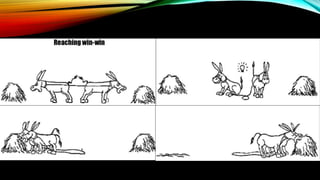
• How to arrive at win-win outcomes?
WHAT IS CONFLICT?
• Conflict begins when one party perceives that another party has negatively
affected, or is about to negatively affect something that the first party cares
about.
• It can also mean a psychological state of mind when people are in a
dilemma whether to do or not do a thing that the first party cares about.
• In an organization, conflicts may arise due to
• Incompatibility of goals
• Differences over interpretation of facts
• Differences based on behavioral expectations
SOURCES OF CONFLICT
• Competition for limited resources
• Frustration
• Introduction of change
• Clashes between values and interest
• Cultural influences
• Misinformation and assumptions
• Expectations
• Role and status issues
SYMPTOMS OF CONFLICTS
• Tensions
• No desire to communicate
• Work not done properly
• Disastrous meetings
• Anger occurs quickly and easily
• Falling productivity
• Slipping morale
• Escalating Costs
• Slamming doors
• Shouting
• Disagreements become more
pronounced
• Absenteeism
• Accidents
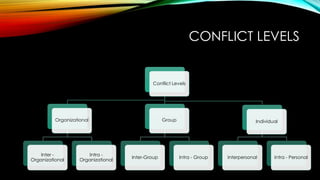
CONFLICT LEVELS
Conflict Levels
Organizational
Inter -
Organizational
Intra -
Organizational
Group
Inter-Group Intra - Group
Individual
Interpersonal Intra - Personal
Organizational Group
INTRAPERSONAL CONFLICT
• It refers to actual or perceived pressures from incompatible goals or expectations.
Interpersonal conflict is within yourself.
Approach- Approach Conflict –
This conflict arises when one has to choose between two positive goals Ex. When you
have job offers from two equally prestigious firms
Avoidance-Avoidance Conflict
When you must choose between two negative outcomes. Ex. An employee must
choose between unemployment or a salary cut
Approach-Avoidance Conflict
Such conflicts arise when the same goal or situation have a positive and negative
aspect. Ex. You are offered a promotion. How exciting! The new position comes with
a $10,000 raise and a new title. However, you also learn that you will be required to
work an additional ten hours per week and travel out of town one weekend per
month
INTERPERSONAL CONFLICT
• It occurs between two or more individuals who are in opposition to one
another.
• It can occur between co-workers, siblings, spouses, roommates and
neighbors
• Ex. One person feels that another person is taking the credit for their hard
work
INTER- GROUP CONFLICT
• It takes place when a misunderstanding arises among different teams within
an organization.
• For instance, the sales department of an organization can come in conflict
with the customer support department. This is due to the varied sets of goals
and interests of these different groups.
• In addition, competition also contributes for intergroup conflict to arise.
• Some of these factors may include a rivalry in resources or the boundaries set
by a group to others which establishes their own identity as a team.
INTRA-GROUP CONFLICT
• It is a type of conflict that happens among individuals within a team. The
incompatibilities and misunderstandings among these individuals lead to an
intragroup conflict.
• It is arises from interpersonal disagreements (e.g. team members have
different personalities which may lead to tension) or differences in views and
ideas (e.g. in a presentation, members of the team might find the notions
presented by the one presiding to be erroneous due to their differences in
opinion).
• Within a team, conflict can be helpful in coming up with decisions which will
eventually allow them to reach their objectives as a team.
• However, if the degree of conflict disrupts harmony among the members,
then some serious guidance from a different party will be needed for it to be
settled.
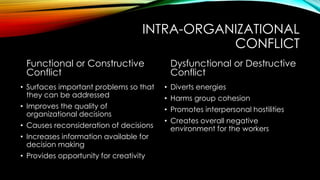
INTRA-ORGANIZATIONAL
CONFLICT
Functional or Constructive
Conflict
• Surfaces important problems so that
they can be addressed
• Improves the quality of
organizational decisions
• Causes reconsideration of decisions
• Increases information available for
decision making
• Provides opportunity for creativity
Dysfunctional or Destructive
Conflict
• Diverts energies
• Harms group cohesion
• Promotes interpersonal hostilities
• Creates overall negative
environment for the workers
INTER-ORGANIZATIONAL
CONFLICT
• Occurs in the competition and rivalry that characterize firms operating in
the same markets
• Occurs between unions and organizations employing their members
• Occurs between government regulatory agencies and organizations subject
to their surveillance
• Occurs between organizations and suppliers of raw materials.
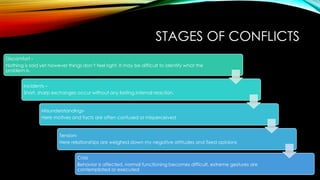
STAGES OF CONFLICTS
Discomfort –
Nothing is said yet however things don’t feel right. It may be difficult to identify what the
problem is.
Incidents –
Short, sharp exchanges occur without any lasting internal reaction.
Misunderstandings-
Here motives and facts are often confused or misperceived
Tension-
Here relationships are weighed down my negative attitudes and fixed opinions
Crisis
Behavior is affected, normal functioning becomes difficult, extreme gestures are
contemplated or executed
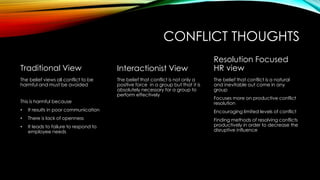
CONFLICT THOUGHTS
Traditional View
The belief views all conflict to be
harmful and must be avoided
This is harmful because
• It results in poor communication
• There is lack of openness
• It leads to failure to respond to
employee needs
Interactionist View
The belief that conflict is not only a
positive force in a group but that it is
absolutely necessary for a group to
perform effectively
Resolution Focused
HR view
The belief that conflict is a natural
and inevitable out come in any
group
Focuses more on productive conflict
resolution
Encouraging limited levels of conflict
Finding methods of resolving conflicts
productively in order to decrease the
disruptive influence
CONFLICT RESOLUTION
STYLES
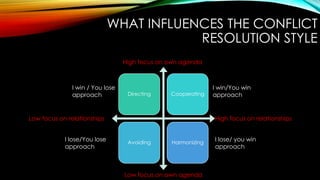
WHAT INFLUENCES THE CONFLICT
RESOLUTION STYLE
Directing Cooperating
Avoiding Harmonizing
High focus on own agenda
Low focus on own agenda
I win / You lose
approach
Low focus on relationships High focus on relationships
I lose/ you win
approach
I lose/You lose
approach
I win/You win
approach
• There are 5 conflict resolution styles that vary in degrees of assertiveness and
cooperation
Cooperation – Extent to which an individual tries to satisfy and consider the
other individuals needs
Assertiveness – Extent to which the individual attempts to satisfy their own
concerns.
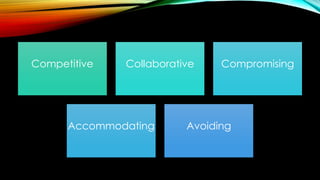
Competitive Collaborative Compromising
Accommodating Avoiding
COMPETITIVE
• This approach is assertive and uncooperative
• It is a power oriented style
• Such people generally operate from a position of power such as position or
persuasion ability
• Best used when swift action is required, in case of an emergency or when
the decision is undesirable.
• However it can leave people alienated when used in less important
situations
COLLABORATIVE
• It is both assertive and cooperative
• You try to meet the need of all people involved
• You cooperate effectively and acknowledge that everyone is important
• Best used to get a variety of viewpoints to get the best solutions or when the
situation is too important for a trade off
COMPROMISING
• Is an intermediate in assertiveness and cooperation
• You find a solution that will to some extent, satisfy everyone.
• Everyone is expected to give up and relinquish something
• Best used when 2 opponents with equal power are committed to mutually
exclusive goal.
ACCOMMODATING
• It is the opposite of competing- it is unassertive and cooperative
• It meets the needs of others at the expense of your own needs
• Conflict is perceived as a social and emotional issue which can be resolved
through support and understanding
• Best used when maintaining harmony and avoiding conflict is more
important
• Best used when you want to help your employees develop by allowing them
to try out and learn from their mistakes
AVOIDING
• It is unassertive and uncooperative
• It attempts to avoid the conflict entirely
• Best used when the conflict is not al all important
• It helps to reduce tension and get back to productive levels and regain
harmony and composure
HOW TO ARRIVE AT WIN-
WIN OUTCOMES?
• Understand that you cannot have all the answers
• Ask questions to understand the other person
• Be prepared to compromise or make a deal
• Listen actively
• Empathize – Try to put yourself in their shoes and acknowledge their feelings. Try
to see their point of view
• Gain participation from everyone involved in the conflict
• State the reason to work on a solution
• Deal with the emotional issues first and then address the values and interests
Conflict resolution

Conflict resolution

  • 1.
  • 2.
    CONTENTS • What isconflict? • Sources of conflict • Symptoms of conflict • Conflict Levels • Stages of conflict • Conflict thoughts • Conflict Resolution Styles • How to arrive at win-win outcomes?
  • 3.
    WHAT IS CONFLICT? •Conflict begins when one party perceives that another party has negatively affected, or is about to negatively affect something that the first party cares about. • It can also mean a psychological state of mind when people are in a dilemma whether to do or not do a thing that the first party cares about. • In an organization, conflicts may arise due to • Incompatibility of goals • Differences over interpretation of facts • Differences based on behavioral expectations
  • 4.
    SOURCES OF CONFLICT •Competition for limited resources • Frustration • Introduction of change • Clashes between values and interest • Cultural influences • Misinformation and assumptions • Expectations • Role and status issues
  • 5.
    SYMPTOMS OF CONFLICTS •Tensions • No desire to communicate • Work not done properly • Disastrous meetings • Anger occurs quickly and easily • Falling productivity • Slipping morale • Escalating Costs • Slamming doors • Shouting • Disagreements become more pronounced • Absenteeism • Accidents
  • 6.
    CONFLICT LEVELS Conflict Levels Organizational Inter- Organizational Intra - Organizational Group Inter-Group Intra - Group Individual Interpersonal Intra - Personal Organizational Group
  • 7.
    INTRAPERSONAL CONFLICT • Itrefers to actual or perceived pressures from incompatible goals or expectations. Interpersonal conflict is within yourself. Approach- Approach Conflict – This conflict arises when one has to choose between two positive goals Ex. When you have job offers from two equally prestigious firms Avoidance-Avoidance Conflict When you must choose between two negative outcomes. Ex. An employee must choose between unemployment or a salary cut Approach-Avoidance Conflict Such conflicts arise when the same goal or situation have a positive and negative aspect. Ex. You are offered a promotion. How exciting! The new position comes with a $10,000 raise and a new title. However, you also learn that you will be required to work an additional ten hours per week and travel out of town one weekend per month
  • 8.
    INTERPERSONAL CONFLICT • Itoccurs between two or more individuals who are in opposition to one another. • It can occur between co-workers, siblings, spouses, roommates and neighbors • Ex. One person feels that another person is taking the credit for their hard work
  • 9.
    INTER- GROUP CONFLICT •It takes place when a misunderstanding arises among different teams within an organization. • For instance, the sales department of an organization can come in conflict with the customer support department. This is due to the varied sets of goals and interests of these different groups. • In addition, competition also contributes for intergroup conflict to arise. • Some of these factors may include a rivalry in resources or the boundaries set by a group to others which establishes their own identity as a team.
  • 10.
    INTRA-GROUP CONFLICT • Itis a type of conflict that happens among individuals within a team. The incompatibilities and misunderstandings among these individuals lead to an intragroup conflict. • It is arises from interpersonal disagreements (e.g. team members have different personalities which may lead to tension) or differences in views and ideas (e.g. in a presentation, members of the team might find the notions presented by the one presiding to be erroneous due to their differences in opinion). • Within a team, conflict can be helpful in coming up with decisions which will eventually allow them to reach their objectives as a team. • However, if the degree of conflict disrupts harmony among the members, then some serious guidance from a different party will be needed for it to be settled.
  • 11.
    INTRA-ORGANIZATIONAL CONFLICT Functional or Constructive Conflict •Surfaces important problems so that they can be addressed • Improves the quality of organizational decisions • Causes reconsideration of decisions • Increases information available for decision making • Provides opportunity for creativity Dysfunctional or Destructive Conflict • Diverts energies • Harms group cohesion • Promotes interpersonal hostilities • Creates overall negative environment for the workers
  • 12.
    INTER-ORGANIZATIONAL CONFLICT • Occurs inthe competition and rivalry that characterize firms operating in the same markets • Occurs between unions and organizations employing their members • Occurs between government regulatory agencies and organizations subject to their surveillance • Occurs between organizations and suppliers of raw materials.
  • 13.
    STAGES OF CONFLICTS Discomfort– Nothing is said yet however things don’t feel right. It may be difficult to identify what the problem is. Incidents – Short, sharp exchanges occur without any lasting internal reaction. Misunderstandings- Here motives and facts are often confused or misperceived Tension- Here relationships are weighed down my negative attitudes and fixed opinions Crisis Behavior is affected, normal functioning becomes difficult, extreme gestures are contemplated or executed
  • 14.
    CONFLICT THOUGHTS Traditional View Thebelief views all conflict to be harmful and must be avoided This is harmful because • It results in poor communication • There is lack of openness • It leads to failure to respond to employee needs Interactionist View The belief that conflict is not only a positive force in a group but that it is absolutely necessary for a group to perform effectively Resolution Focused HR view The belief that conflict is a natural and inevitable out come in any group Focuses more on productive conflict resolution Encouraging limited levels of conflict Finding methods of resolving conflicts productively in order to decrease the disruptive influence
  • 15.
  • 16.
    WHAT INFLUENCES THECONFLICT RESOLUTION STYLE Directing Cooperating Avoiding Harmonizing High focus on own agenda Low focus on own agenda I win / You lose approach Low focus on relationships High focus on relationships I lose/ you win approach I lose/You lose approach I win/You win approach
  • 17.
    • There are5 conflict resolution styles that vary in degrees of assertiveness and cooperation Cooperation – Extent to which an individual tries to satisfy and consider the other individuals needs Assertiveness – Extent to which the individual attempts to satisfy their own concerns.
  • 18.
  • 19.
    COMPETITIVE • This approachis assertive and uncooperative • It is a power oriented style • Such people generally operate from a position of power such as position or persuasion ability • Best used when swift action is required, in case of an emergency or when the decision is undesirable. • However it can leave people alienated when used in less important situations
  • 20.
    COLLABORATIVE • It isboth assertive and cooperative • You try to meet the need of all people involved • You cooperate effectively and acknowledge that everyone is important • Best used to get a variety of viewpoints to get the best solutions or when the situation is too important for a trade off
  • 21.
    COMPROMISING • Is anintermediate in assertiveness and cooperation • You find a solution that will to some extent, satisfy everyone. • Everyone is expected to give up and relinquish something • Best used when 2 opponents with equal power are committed to mutually exclusive goal.
  • 22.
    ACCOMMODATING • It isthe opposite of competing- it is unassertive and cooperative • It meets the needs of others at the expense of your own needs • Conflict is perceived as a social and emotional issue which can be resolved through support and understanding • Best used when maintaining harmony and avoiding conflict is more important • Best used when you want to help your employees develop by allowing them to try out and learn from their mistakes
  • 23.
    AVOIDING • It isunassertive and uncooperative • It attempts to avoid the conflict entirely • Best used when the conflict is not al all important • It helps to reduce tension and get back to productive levels and regain harmony and composure
  • 24.
    HOW TO ARRIVEAT WIN- WIN OUTCOMES?
  • 25.
    • Understand thatyou cannot have all the answers • Ask questions to understand the other person • Be prepared to compromise or make a deal • Listen actively • Empathize – Try to put yourself in their shoes and acknowledge their feelings. Try to see their point of view • Gain participation from everyone involved in the conflict • State the reason to work on a solution • Deal with the emotional issues first and then address the values and interests