Conflict Management
Definition of Conflict It is a process that begins when one party perceives that another party has negatively affected or is about to negatively affect something that the first party cares about.
Views on conflict Traditional view Human Relations view Interactionist View
Types of conflict Functional – support the goals of the group and improves its performance Dysfunctional – conflict that hinders group performance
Levels of Conflict Conflict can occur at three levels namely: Individual level– intra individual conflict Interpersonal level – interpersonal conflict Group or organisational level
Intra individual conflict Within every individual there are usually  A number of competing needs and roles A variety of ways that drives and roles can be expressed Many types of barriers that can occur between the drive and the goal Both negative and positive aspects attached to desired goals
Causes of intra individual conflict Conflict due to frustration Goal Conflict Role Conflict – may be conflict between personality of the person and the expectations of the role
Interpersonal Conflicts Sources of Interpersonal Conflicts Personal differences Information deficiency Environmental stress
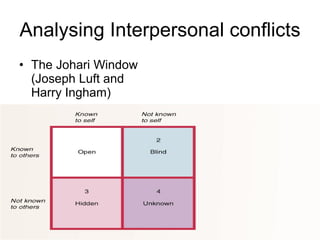
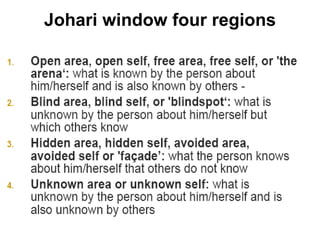
Analysing Interpersonal conflicts The Johari Window (Joseph Luft and Harry Ingham)
Johari window four regions
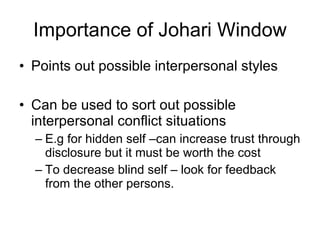
Importance of Johari Window Points out possible interpersonal styles Can be used to sort out possible interpersonal conflict situations E.g for hidden self –can increase trust through disclosure but it must be worth the cost To decrease blind self – look for feedback from the other persons.
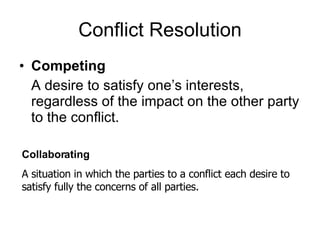
Conflict Resolution Competing A desire to satisfy one’s interests, regardless of the impact on the other party to the conflict. Collaborating A situation in which the parties to a conflict each desire to satisfy fully the concerns of all parties.
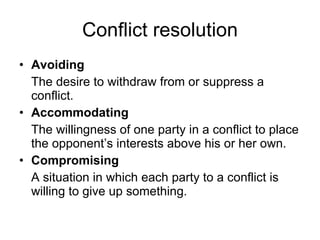
Conflict resolution Avoiding The desire to withdraw from or suppress a conflict. Accommodating The willingness of one party in a conflict to place the opponent’s interests above his or her own. Compromising A situation in which each party to a conflict is willing to give up something.
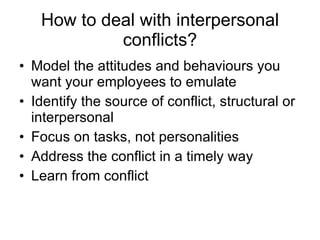
How to deal with interpersonal conflicts? Model the attitudes and behaviours you want your employees to emulate Identify the source of conflict, structural or interpersonal Focus on tasks, not personalities Address the conflict in a timely way Learn from conflict
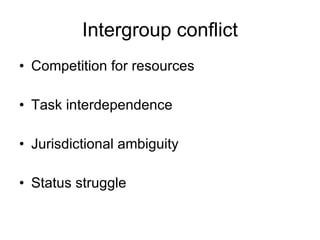
Intergroup conflict Competition for resources Task interdependence Jurisdictional ambiguity Status struggle

Conflict Management

  • 1.
  • 2.
    Definition of ConflictIt is a process that begins when one party perceives that another party has negatively affected or is about to negatively affect something that the first party cares about.
  • 3.
    Views on conflictTraditional view Human Relations view Interactionist View
  • 4.
    Types of conflictFunctional – support the goals of the group and improves its performance Dysfunctional – conflict that hinders group performance
  • 5.
    Levels of ConflictConflict can occur at three levels namely: Individual level– intra individual conflict Interpersonal level – interpersonal conflict Group or organisational level
  • 6.
    Intra individual conflictWithin every individual there are usually A number of competing needs and roles A variety of ways that drives and roles can be expressed Many types of barriers that can occur between the drive and the goal Both negative and positive aspects attached to desired goals
  • 7.
    Causes of intraindividual conflict Conflict due to frustration Goal Conflict Role Conflict – may be conflict between personality of the person and the expectations of the role
  • 8.
    Interpersonal Conflicts Sourcesof Interpersonal Conflicts Personal differences Information deficiency Environmental stress
  • 9.
    Analysing Interpersonal conflictsThe Johari Window (Joseph Luft and Harry Ingham)
  • 10.
  • 11.
    Importance of JohariWindow Points out possible interpersonal styles Can be used to sort out possible interpersonal conflict situations E.g for hidden self –can increase trust through disclosure but it must be worth the cost To decrease blind self – look for feedback from the other persons.
  • 12.
    Conflict Resolution CompetingA desire to satisfy one’s interests, regardless of the impact on the other party to the conflict. Collaborating A situation in which the parties to a conflict each desire to satisfy fully the concerns of all parties.
  • 13.
    Conflict resolution AvoidingThe desire to withdraw from or suppress a conflict. Accommodating The willingness of one party in a conflict to place the opponent’s interests above his or her own. Compromising A situation in which each party to a conflict is willing to give up something.
  • 14.
    How to dealwith interpersonal conflicts? Model the attitudes and behaviours you want your employees to emulate Identify the source of conflict, structural or interpersonal Focus on tasks, not personalities Address the conflict in a timely way Learn from conflict
  • 15.
    Intergroup conflict Competitionfor resources Task interdependence Jurisdictional ambiguity Status struggle