CONFLICT MANAGEMENT CSH Pharma Group
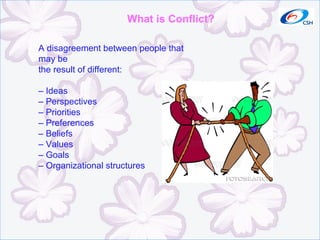
What is Conflict? A disagreement between people that may be the result of different: –  Ideas –  Perspectives –  Priorities –  Preferences –  Beliefs –  Values –  Goals –  Organizational structures
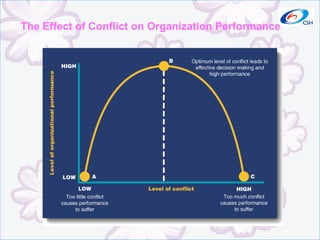
Organizational Conflict Organizational Conflict The discord that arises when goals, interests or values of  different individuals or groups are incompatible and those people block or thwart each other’s efforts to achieve their objectives. Conflict is inevitable given the wide range of goals for the  different stakeholder in the organization. Lack of conflict signals that management  emphasizes conformity and stifles innovation. Conflict is good for organizational performance  although excessive conflict causes managers to  spend too much time achieving their own ends.
Conflict Can cause organizational distress •  Low morale •  Complaints and bickering •  Minimum creativity •  Lack of team spirit •  Absenteeism and turnover
The Effect of Conflict on Organization Performance
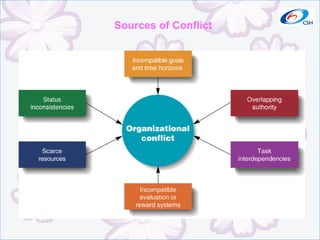
Sources of Conflict
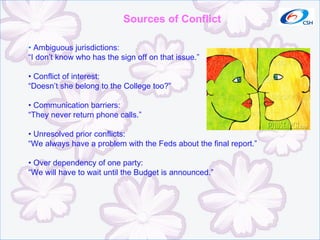
Sources of Conflict •  Ambiguous jurisdictions: “ I don’t know who has the sign off on that issue.” •  Conflict of interest: “ Doesn’t she belong to the College too?” •  Communication barriers: “ They never return phone calls.” •  Unresolved prior conflicts: “ We always have a problem with the Feds about the final report.” •  Over dependency of one party: “ We will have to wait until the Budget is announced.”
Misconceptions about Conflict Harmony is “normal”  •  Conflict is “abnormal” •  Conflicts and disagreements are the same •  Conflict is the result of “personality problems” •  Conflict and anger are the same
Interpersonal Conflict Conflict between individuals due to differences in their goals or values. Intragroup Conflict Conflict within a group or team. Intergroup Conflict Conflict between two or more teams or groups. Managers play a key role in resolution of this conflict Interorganizational Conflict Conflict that arises across organizations. Types of Conflict
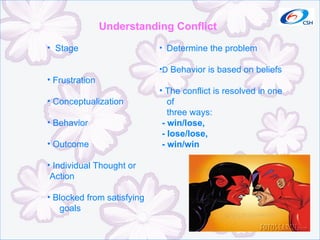
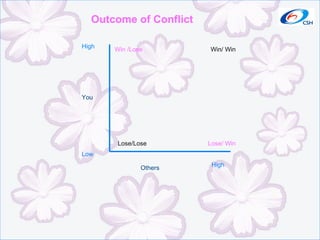
Understanding Conflict Stage  Frustration Conceptualization Behavior Outcome Individual Thought or  Action Blocked from satisfying  goals Determine the problem 􀂄  Behavior is based on beliefs The conflict is resolved in one  of three ways:  - win/lose,  - lose/lose, - win/win
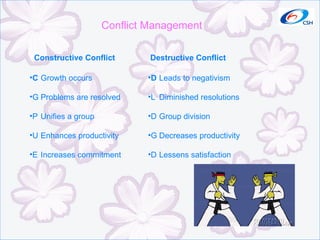
Conflict Management Constructive Conflict  􀂄  Growth occurs  􀂄  Problems are resolved 􀂄  Unifies a group 􀂄  Enhances productivity 􀂄  Increases commitment Destructive Conflict 􀂄  Leads to negativism 􀂄  Diminished resolutions 􀂄  Group division 􀂄  Decreases productivity 􀂄  Lessens satisfaction
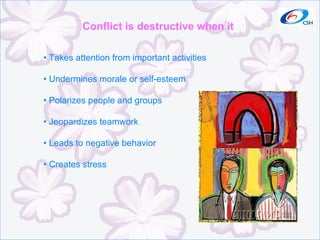
Conflict is destructive when it •  Takes attention from important activities •  Undermines morale or self-esteem •  Polarizes people and groups •  Jeopardizes teamwork •  Leads to negative behavior •  Creates stress
Conflict is constructive when it •  Identifies and clarifies important issues  •  Solves problems  •  Results in “something for everyone”  •  Causes authentic communication  •  Leads to sharing information  •  Encourages cooperation •  Builds/strengthens interpersonal skills
Conflict Manifestation Phase One –  Frustration •  Phase Two –  Conceptualization of cause •  Phase Three –  Behavior directed at cause •  Phase Four –  Outcome as a result of the behavior
Defensive Coping Assumes that the problem is caused  by the other person. Develops a private diagnosis and  solution. Tries to get other person to change  by using logic, indirect influence, or critique. If other person resists, that confirms  #1. Responds to resistance through intensifying pressure,  protecting, or rejecting the other person. If efforts are unsuccessful, it’s the other person’s fault.
Going Beyond Defensive Coping Begin with communication Focus on active listening techniques Separate the problem from the person Use “I” statements
Conflict Resolution
Phases of Conflict Management Collect data: know the cause and remain objective. Probe: ask open-ended questions and listen actively. Save face: work toward a win/win result. Common interests: redefine the conflict. Reinforce: give support to common ideas. Negotiate: suggest partial solutions or compromises. Solidify adjustments: review agreements/resolutions.
How Do You Cope With Conflict? Five strategies exist for coping with conflict Avoidance Competition Accommodation Compromise Collaboration
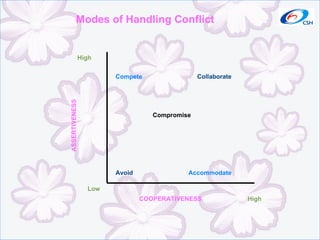
Five Modes for Handling Conflict Avoidance:  steering clear of and denying the existence of the conflict and disagreement. Accommodate:  letting the other person decide totally what the resolve is to be. Compete:  aggressively pursuing ways to win from my own perspective. Compromise:  looking after both parties interests. Collaborate:  assertively looking after my interests but equally concerned  with the interests of the other person.
Coping With Conflict Avoidance. Most preferred strategy during initial stages. Individuals fail to address the conflict. -Nothing to lose. -Lack of time. -Inappropriate time or place. -Individuals are angry. -Emotional involvement. Postponing a resolution hinders group progress.
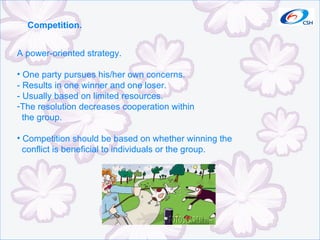
Competition. A power-oriented strategy. One party pursues his/her own concerns. - Results in one winner and one loser. - Usually based on limited resources. The resolution decreases cooperation within  the group. Competition should be based on whether winning the conflict is beneficial to individuals or the group.
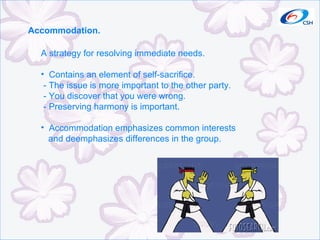
Accommodation. A strategy for resolving immediate needs. Contains an element of self-sacrifice. - The issue is more important to the other party. - You discover that you were wrong. - Preserving harmony is important. Accommodation emphasizes common interests  and deemphasizes differences in the group.
Compromise. A strategy for finding an expedient solution. Resolution is mutually acceptable for all parties. - A temporary settlement for complex issues. - Group goals outweigh assertive strategies. -  Individuals of equal status are equally committed. Compromise works towards partially satisfying both parties, but each party must honor the resolution for continued satisfaction.
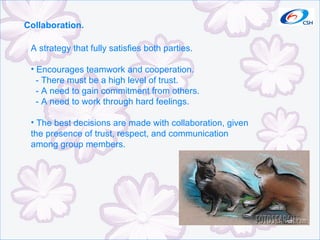
Collaboration. A strategy that fully satisfies both parties. Encourages teamwork and cooperation. - There must be a high level of trust. - A need to gain commitment from others. - A need to work through hard feelings. The best decisions are made with collaboration, given the presence of trust, respect, and communication among group members.
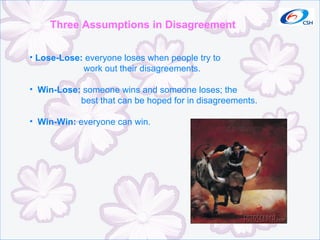
Three Assumptions in Disagreement Lose-Lose:  everyone loses when people try to work out their disagreements. Win-Lose:  someone wins and someone loses; the best that can be hoped for in disagreements. Win-Win:  everyone can win.
High Low High You Others Lose/Lose Win/ Win Win /Lose Lose/ Win Outcome of Conflict
ASSERTIVENESS COOPERATIVENESS Compete Collaborate Avoid Accommodate Compromise Low High High Modes of Handling Conflict
Dysfunctional Consequences When it keeps people from getting work done. When it threatens the relationship; destroys confidence and trust. When it becomes personal; feelings are hurt. When it dictates conformity; people are forced to a decision.
Functional Consequences When it increases the involvement of people. When it leads to growth. When relationships are clearly defined. When it provides an outlet for stress, anxiety,  frustration, anger. When it leads to cohesion within the group.
Wilson’s Method of Conflict Management 1. Evaluate interpersonally: know and understand the conflict. 2. Define interpersonally: share feelings and perceptions publicly. 3. Identify shared goals: this may mean developing some ideas about both parties would like to have as a result. 4. Generate possible resolutions: develop a list of all possible ways the differences can be resolved.
5. Weigh the resolutions against the goals: find out how well each of the possible resolutions satisfy or meet the goal or goals generated in step 3. 6. Select best solution: identify which among the alternatives is the best, most satisfying and agreeable one. 7. Evaluate resolution: when the resolution has been put into place or acted upon, ascertain whether it had its intended effect
Conclusion: Conflict Management Individual worth and integrity remain intact or are preserved. Unreal assumptions are filtered out, and replaced with reality centered and agreed upon ones. Goal setting becomes realistic and futuristic. Action steps for what was decided are clearly outlined and agreed upon.
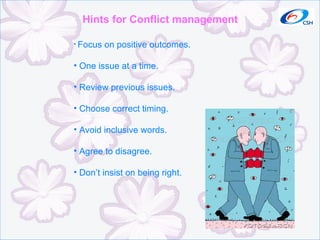
Hints for Conflict management Focus on positive outcomes. One issue at a time. Review previous issues. Choose correct timing. Avoid inclusive words. Agree to disagree. Don’t insist on being right.
THANK YOU


Conflict Management

  • 1.
  • 2.
    What is Conflict?A disagreement between people that may be the result of different: – Ideas – Perspectives – Priorities – Preferences – Beliefs – Values – Goals – Organizational structures
  • 3.
    Organizational Conflict OrganizationalConflict The discord that arises when goals, interests or values of different individuals or groups are incompatible and those people block or thwart each other’s efforts to achieve their objectives. Conflict is inevitable given the wide range of goals for the different stakeholder in the organization. Lack of conflict signals that management emphasizes conformity and stifles innovation. Conflict is good for organizational performance although excessive conflict causes managers to spend too much time achieving their own ends.
  • 4.
    Conflict Can causeorganizational distress • Low morale • Complaints and bickering • Minimum creativity • Lack of team spirit • Absenteeism and turnover
  • 5.
    The Effect ofConflict on Organization Performance
  • 6.
  • 7.
    Sources of Conflict• Ambiguous jurisdictions: “ I don’t know who has the sign off on that issue.” • Conflict of interest: “ Doesn’t she belong to the College too?” • Communication barriers: “ They never return phone calls.” • Unresolved prior conflicts: “ We always have a problem with the Feds about the final report.” • Over dependency of one party: “ We will have to wait until the Budget is announced.”
  • 8.
    Misconceptions about ConflictHarmony is “normal” • Conflict is “abnormal” • Conflicts and disagreements are the same • Conflict is the result of “personality problems” • Conflict and anger are the same
  • 9.
    Interpersonal Conflict Conflictbetween individuals due to differences in their goals or values. Intragroup Conflict Conflict within a group or team. Intergroup Conflict Conflict between two or more teams or groups. Managers play a key role in resolution of this conflict Interorganizational Conflict Conflict that arises across organizations. Types of Conflict
  • 10.
    Understanding Conflict Stage Frustration Conceptualization Behavior Outcome Individual Thought or Action Blocked from satisfying goals Determine the problem 􀂄 Behavior is based on beliefs The conflict is resolved in one of three ways: - win/lose, - lose/lose, - win/win
  • 11.
    Conflict Management ConstructiveConflict 􀂄 Growth occurs 􀂄 Problems are resolved 􀂄 Unifies a group 􀂄 Enhances productivity 􀂄 Increases commitment Destructive Conflict 􀂄 Leads to negativism 􀂄 Diminished resolutions 􀂄 Group division 􀂄 Decreases productivity 􀂄 Lessens satisfaction
  • 12.
    Conflict is destructivewhen it • Takes attention from important activities • Undermines morale or self-esteem • Polarizes people and groups • Jeopardizes teamwork • Leads to negative behavior • Creates stress
  • 13.
    Conflict is constructivewhen it • Identifies and clarifies important issues • Solves problems • Results in “something for everyone” • Causes authentic communication • Leads to sharing information • Encourages cooperation • Builds/strengthens interpersonal skills
  • 14.
    Conflict Manifestation PhaseOne – Frustration • Phase Two – Conceptualization of cause • Phase Three – Behavior directed at cause • Phase Four – Outcome as a result of the behavior
  • 15.
    Defensive Coping Assumesthat the problem is caused by the other person. Develops a private diagnosis and solution. Tries to get other person to change by using logic, indirect influence, or critique. If other person resists, that confirms #1. Responds to resistance through intensifying pressure, protecting, or rejecting the other person. If efforts are unsuccessful, it’s the other person’s fault.
  • 16.
    Going Beyond DefensiveCoping Begin with communication Focus on active listening techniques Separate the problem from the person Use “I” statements
  • 17.
  • 18.
    Phases of ConflictManagement Collect data: know the cause and remain objective. Probe: ask open-ended questions and listen actively. Save face: work toward a win/win result. Common interests: redefine the conflict. Reinforce: give support to common ideas. Negotiate: suggest partial solutions or compromises. Solidify adjustments: review agreements/resolutions.
  • 19.
    How Do YouCope With Conflict? Five strategies exist for coping with conflict Avoidance Competition Accommodation Compromise Collaboration
  • 20.
    Five Modes forHandling Conflict Avoidance: steering clear of and denying the existence of the conflict and disagreement. Accommodate: letting the other person decide totally what the resolve is to be. Compete: aggressively pursuing ways to win from my own perspective. Compromise: looking after both parties interests. Collaborate: assertively looking after my interests but equally concerned with the interests of the other person.
  • 21.
    Coping With ConflictAvoidance. Most preferred strategy during initial stages. Individuals fail to address the conflict. -Nothing to lose. -Lack of time. -Inappropriate time or place. -Individuals are angry. -Emotional involvement. Postponing a resolution hinders group progress.
  • 22.
    Competition. A power-orientedstrategy. One party pursues his/her own concerns. - Results in one winner and one loser. - Usually based on limited resources. The resolution decreases cooperation within the group. Competition should be based on whether winning the conflict is beneficial to individuals or the group.


  • 23.
    Accommodation. A strategyfor resolving immediate needs. Contains an element of self-sacrifice. - The issue is more important to the other party. - You discover that you were wrong. - Preserving harmony is important. Accommodation emphasizes common interests and deemphasizes differences in the group.
  • 24.
    Compromise. A strategyfor finding an expedient solution. Resolution is mutually acceptable for all parties. - A temporary settlement for complex issues. - Group goals outweigh assertive strategies. - Individuals of equal status are equally committed. Compromise works towards partially satisfying both parties, but each party must honor the resolution for continued satisfaction.
  • 25.
    Collaboration. A strategythat fully satisfies both parties. Encourages teamwork and cooperation. - There must be a high level of trust. - A need to gain commitment from others. - A need to work through hard feelings. The best decisions are made with collaboration, given the presence of trust, respect, and communication among group members.
  • 26.
    Three Assumptions inDisagreement Lose-Lose: everyone loses when people try to work out their disagreements. Win-Lose: someone wins and someone loses; the best that can be hoped for in disagreements. Win-Win: everyone can win.
  • 27.
    High Low HighYou Others Lose/Lose Win/ Win Win /Lose Lose/ Win Outcome of Conflict
  • 28.
    ASSERTIVENESS COOPERATIVENESS CompeteCollaborate Avoid Accommodate Compromise Low High High Modes of Handling Conflict
  • 29.
    Dysfunctional Consequences Whenit keeps people from getting work done. When it threatens the relationship; destroys confidence and trust. When it becomes personal; feelings are hurt. When it dictates conformity; people are forced to a decision.
  • 30.
    Functional Consequences Whenit increases the involvement of people. When it leads to growth. When relationships are clearly defined. When it provides an outlet for stress, anxiety, frustration, anger. When it leads to cohesion within the group.
  • 31.
    Wilson’s Method ofConflict Management 1. Evaluate interpersonally: know and understand the conflict. 2. Define interpersonally: share feelings and perceptions publicly. 3. Identify shared goals: this may mean developing some ideas about both parties would like to have as a result. 4. Generate possible resolutions: develop a list of all possible ways the differences can be resolved.
  • 32.
    5. Weigh theresolutions against the goals: find out how well each of the possible resolutions satisfy or meet the goal or goals generated in step 3. 6. Select best solution: identify which among the alternatives is the best, most satisfying and agreeable one. 7. Evaluate resolution: when the resolution has been put into place or acted upon, ascertain whether it had its intended effect
  • 33.
    Conclusion: Conflict ManagementIndividual worth and integrity remain intact or are preserved. Unreal assumptions are filtered out, and replaced with reality centered and agreed upon ones. Goal setting becomes realistic and futuristic. Action steps for what was decided are clearly outlined and agreed upon.
  • 34.
    Hints for Conflictmanagement Focus on positive outcomes. One issue at a time. Review previous issues. Choose correct timing. Avoid inclusive words. Agree to disagree. Don’t insist on being right.
  • 35.
  • 36.
  • 37.
  • 38.
  • 39.
  • 40.
  • 41.
  • 42.
  • 43.
  • 44.
  • 45.
  • 46.