Workplace Conflict
TIPS FOR REDUCING AND RESOLVING WORKPLACE
CONFLICT
Agenda
• What is “problem” conflict?
• Conflict and workplace teams
• Common Approaches
• Exercise: What are your usual Conflict Styles?
• Tips and strategies to reduce conflict
• When to bring in an umpire (Mediator)

• Recap
Introductions
• Joanne Law is an Accredited Mediator and Family Dispute Resolution
Practitioner, Life, Business and Divorce coach and trainer.
• Medi8 provides Mediation and Dispute Resolution Services
• You can find out more at www.medi8.com.au

• Contact Joanne on 03 8370 2301
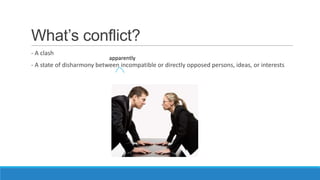
What’s conflict?
- A clash

apparently

- A state of disharmony between incompatible or directly opposed persons, ideas, or interests
Kids and Conflict
Has your approach to conflict grown with your children
or are you still trying to control them?
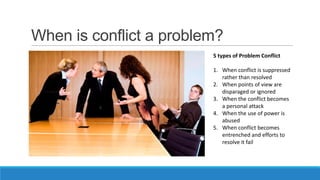
When is conflict a problem?
5 types of Problem Conflict
1. When conflict is suppressed
rather than resolved
2. When points of view are
disparaged or ignored
3. When the conflict becomes
a personal attack
4. When the use of power is
abused
5. When conflict becomes
entrenched and efforts to
resolve it fail
Is conflict always bad?
6 benefits of Conflict
1. Conflict gets people involved so that decisions
are more robust
2. If feeds innovation and new ideas
3. You learn more about others
4. You see different perspectives
5. You understand yourself more
6. You improve your communication skills

The clash of ideas is the sound of freedom.
Lady Bird Johnston
Is conflict in the workplace
inevitable?
Performing
Norming
Storming
Forming
• New team / new
members
• Formal Roles and
Purpose defined

•Team members learn
how to work together
•Conflict is common as
they learn each others
abilities and build trust

Source: Bruce Tuckmans 1965 model of group dynamics

• Team starts to work
together
• Roles evolve based on
abilities
• Rules, norms and team
culture established

• Team members work
together towards the
common goal
• Members are flexible,
collaborative and help
each other
What Conflict Styles do you Use?
Competing

Accommodating

Withdrawing

Compromising

Collaborating
Situational Conflict Style Assessment
• Read through the scenarios provided and identify your preferred conflict style.
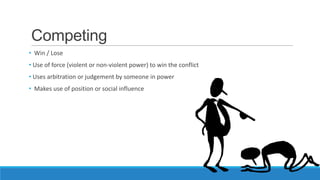
Competing
• Win / Lose
• Use of force (violent or non-violent power) to win the conflict
• Uses arbitration or judgement by someone in power
• Makes use of position or social influence
Accommodating
• Lose / Win
• Gives in to perceived superior power or force
• Accepts defeat easily and doesn’t defend position
• Gives in to keep the peace and reduce conflict
Withdrawing
•
•
•
•

Lose / lose
Minimises or denies that the conflict exists
Limits communication or avoids contact
Allows the issues to fester unresolved
Compromising
• Win some / lose some
• You assert you position but are willing to negotiate with the other party
• You trade off non-essential elements of position
• Neither party gets what they state they want
Collaborating
• Win / Win
• Assert your needs rather than just a fixed position
• Willingness to listen to and accommodate other sides needs
• Look at the big picture and maximise relationship not just the current issue
• Allows for creative solutions through open communication and problem solving
Exercise
• Form into groups of three.
• Using the scenario’s provided to you to come up with a resolution for the situation
• Discuss your experiences
• Feedback your solutions and any key learnings to the group
Approaches to Conflict

Approaches to Conflict Summary
Competing

Win / Lose

Accommodating

Lose / Win

Withdrawing

Lose / Lose

No resolution

Compromising

Win Some / Lose
Some

Collaborating

Win / Win
The role of the Mediator
1.

Impartial

2.

Confidential

3.

Skilled in facilitating communication and taking the conversation beyond positions to
interests

4.

Helps participants to deal with their emotions

5.

Practical and future focused

6.

Aims to facilitate Collaborative or Compromise Negotiation
Internal or External Mediator?
Internal Mediator

External Mediator

• Lower cost if trained mediator is available

• Fee payable - average fee for Medi8 is $600 - $1,000
for a workplace mediation

• Needs to be someone who is seen by both
participants as impartial

• Impartial

• Must be able to maintain confidentiality

• Bound by a Confidentiality Agreement

• Must have the required skills and knowledge e.g
• Positions vs Interests
• Able to establish rapport and elicit emotions
• Ability to control a meeting and generate
practical agreements
• Ability to future pace agreements for workability

• Trained and accredited mediator who has all required
skills and a knowledge of business
Tips to avoid “problem conflict”
1.

Tune in and raise your awareness of the impact of your behavour

2.

Provide / seek out an appropriate forum to discuss the conflict

3.

Limit the use of force / competing mediation styles (short term thinking)

4.

Recognise the situations where you avoid or withdraw from conflict and seek support to
reach a resolution

5.

Look at the big picture and long term effect on yourself and others of not resolving the
conflict
Books
- Kenneth E. Boulding, Three Faces of Power, (Sage Publications, 1989)
- Dr Henry Cloud, Dr John Townsend, Difficult Conversations (Zondervan, 2006)
Medi8 Mediation Services
• Workplace Mediation ( disputes between employees)
• Education Mediation ( disputes between trainees and institutions)
• Business Mediation ( disputes between businesses and customers or between two businesses)

• Franchise Mediation (disputes between Franchisees and Franchisors)
• Family Mediation (disputes between family members not family law)
• Family Dispute Mediation (dispute between husband and wife in the context of Family Law)
• Neighbourhood Dispute Resolution Mediation ( neighbourhood conflicts)
• Any other interpersonal or inter institution disputes
www.medi8.com.au or 03 8370 2301
Medi8 Educational Services
• Workplace Mediator Training Course
• Nationally Accredited Mediator Training Course
• Certificate IV in Mediation
• Family Dispute Resolution Practitioner
• Graduate Diploma in Family Dispute Resolution

Tips for reducing and resolving workplace conflict

  • 1.
    Workplace Conflict TIPS FORREDUCING AND RESOLVING WORKPLACE CONFLICT
  • 2.
    Agenda • What is“problem” conflict? • Conflict and workplace teams • Common Approaches • Exercise: What are your usual Conflict Styles? • Tips and strategies to reduce conflict • When to bring in an umpire (Mediator) • Recap
  • 3.
    Introductions • Joanne Lawis an Accredited Mediator and Family Dispute Resolution Practitioner, Life, Business and Divorce coach and trainer. • Medi8 provides Mediation and Dispute Resolution Services • You can find out more at www.medi8.com.au • Contact Joanne on 03 8370 2301
  • 4.
    What’s conflict? - Aclash apparently - A state of disharmony between incompatible or directly opposed persons, ideas, or interests
  • 5.
    Kids and Conflict Hasyour approach to conflict grown with your children or are you still trying to control them?
  • 6.
    When is conflicta problem? 5 types of Problem Conflict 1. When conflict is suppressed rather than resolved 2. When points of view are disparaged or ignored 3. When the conflict becomes a personal attack 4. When the use of power is abused 5. When conflict becomes entrenched and efforts to resolve it fail
  • 7.
    Is conflict alwaysbad? 6 benefits of Conflict 1. Conflict gets people involved so that decisions are more robust 2. If feeds innovation and new ideas 3. You learn more about others 4. You see different perspectives 5. You understand yourself more 6. You improve your communication skills The clash of ideas is the sound of freedom. Lady Bird Johnston
  • 8.
    Is conflict inthe workplace inevitable? Performing Norming Storming Forming • New team / new members • Formal Roles and Purpose defined •Team members learn how to work together •Conflict is common as they learn each others abilities and build trust Source: Bruce Tuckmans 1965 model of group dynamics • Team starts to work together • Roles evolve based on abilities • Rules, norms and team culture established • Team members work together towards the common goal • Members are flexible, collaborative and help each other
  • 9.
    What Conflict Stylesdo you Use? Competing Accommodating Withdrawing Compromising Collaborating
  • 10.
    Situational Conflict StyleAssessment • Read through the scenarios provided and identify your preferred conflict style.
  • 11.
    Competing • Win /Lose • Use of force (violent or non-violent power) to win the conflict • Uses arbitration or judgement by someone in power • Makes use of position or social influence
  • 12.
    Accommodating • Lose /Win • Gives in to perceived superior power or force • Accepts defeat easily and doesn’t defend position • Gives in to keep the peace and reduce conflict
  • 13.
    Withdrawing • • • • Lose / lose Minimisesor denies that the conflict exists Limits communication or avoids contact Allows the issues to fester unresolved
  • 14.
    Compromising • Win some/ lose some • You assert you position but are willing to negotiate with the other party • You trade off non-essential elements of position • Neither party gets what they state they want
  • 15.
    Collaborating • Win /Win • Assert your needs rather than just a fixed position • Willingness to listen to and accommodate other sides needs • Look at the big picture and maximise relationship not just the current issue • Allows for creative solutions through open communication and problem solving
  • 16.
    Exercise • Form intogroups of three. • Using the scenario’s provided to you to come up with a resolution for the situation • Discuss your experiences • Feedback your solutions and any key learnings to the group
  • 17.
    Approaches to Conflict Approachesto Conflict Summary Competing Win / Lose Accommodating Lose / Win Withdrawing Lose / Lose No resolution Compromising Win Some / Lose Some Collaborating Win / Win
  • 18.
    The role ofthe Mediator 1. Impartial 2. Confidential 3. Skilled in facilitating communication and taking the conversation beyond positions to interests 4. Helps participants to deal with their emotions 5. Practical and future focused 6. Aims to facilitate Collaborative or Compromise Negotiation
  • 19.
    Internal or ExternalMediator? Internal Mediator External Mediator • Lower cost if trained mediator is available • Fee payable - average fee for Medi8 is $600 - $1,000 for a workplace mediation • Needs to be someone who is seen by both participants as impartial • Impartial • Must be able to maintain confidentiality • Bound by a Confidentiality Agreement • Must have the required skills and knowledge e.g • Positions vs Interests • Able to establish rapport and elicit emotions • Ability to control a meeting and generate practical agreements • Ability to future pace agreements for workability • Trained and accredited mediator who has all required skills and a knowledge of business
  • 20.
    Tips to avoid“problem conflict” 1. Tune in and raise your awareness of the impact of your behavour 2. Provide / seek out an appropriate forum to discuss the conflict 3. Limit the use of force / competing mediation styles (short term thinking) 4. Recognise the situations where you avoid or withdraw from conflict and seek support to reach a resolution 5. Look at the big picture and long term effect on yourself and others of not resolving the conflict
  • 21.
    Books - Kenneth E.Boulding, Three Faces of Power, (Sage Publications, 1989) - Dr Henry Cloud, Dr John Townsend, Difficult Conversations (Zondervan, 2006)
  • 22.
    Medi8 Mediation Services •Workplace Mediation ( disputes between employees) • Education Mediation ( disputes between trainees and institutions) • Business Mediation ( disputes between businesses and customers or between two businesses) • Franchise Mediation (disputes between Franchisees and Franchisors) • Family Mediation (disputes between family members not family law) • Family Dispute Mediation (dispute between husband and wife in the context of Family Law) • Neighbourhood Dispute Resolution Mediation ( neighbourhood conflicts) • Any other interpersonal or inter institution disputes www.medi8.com.au or 03 8370 2301
  • 23.
    Medi8 Educational Services •Workplace Mediator Training Course • Nationally Accredited Mediator Training Course • Certificate IV in Mediation • Family Dispute Resolution Practitioner • Graduate Diploma in Family Dispute Resolution

Editor's Notes

  • #4 Introduce Presenter: Name and qualificationsMission: Reduce and resolve conflictAsk the group to introduce themselves and identify their attitude to conflict.
  • #5 As the group to define conflict.
  • #6 Kids and especially teenagers are often in conflict with their parents. Learning more about conflict doesn’t just help you at work it can help you at home as well. Consider what conflict style you use within your family.
  • #7 Ask participants What are some problems associated with Conflict?
  • #8 Ask the group for examples of situations where conflict in the workplace or in their lives has had a positive benefit
  • #9 If conflict isn’t dealt with appropriately the team may never pass the Storming stage into establishing functional roles
  • #14 Lose / loseMinimises or denies that the conflict existsLimits communication or avoids contactAllows the issues to fester unresolved
  • #15 Leader facilitates/mandates negotiation Parties trade off non-essential elements to reach an agreement May involve establishing positions and compromising based on relative power and/or ability to withstand conflict Mediation by a third party such as HR, Boss or external Mediator
  • #16 Interests based negotiation (what you need rather than what you want specifically) Removes sides and has both parties working towards resolving a common problem or through understanding the bigger picture Requires self awareness and honesty about what matters, working through emotional barriers and willingness to develop empathy for the other side Mediation by a highly skilled third party such as HR, Boss or external Mediator
  • #18 Force – make your opponent to do what they don’t want to do through violent or non-violent meansExchange - compromise on something that is not a core value for you to get something you want moreIntegrate - use bonds of common identity, values or needs to bring disputing parties back together to colloaborate
  • #21 Tune in to conflict such as a bad “vibe”, workmates avoiding each other or clashing frequently or over trivial issuesProvide a forum for conflicts to be raised and resolved e.g team meeting, issue management boardRecognise that the use of force can generate passive resistance, anger and sabotageEncourage discussion and the expression of various points of view but don’t permit personal attacks e.g focus on ideas or specific behaviours not character assassination or identityDon’t allow conflict to become entrenched