CONFLICT MANAGEMENT
GROUP - 8
TEAM :
1. AISHA SHAIKH
2. ADITYA GOTAD
CONTENTS
 WHAT IS CONFLICT
 VIEWS OF CONFLICT
 SOURCES OF CONFLICT
 LEVELS OF CONFLICT
 TYPES OF CONFLICT
 CONFLICT MANAGEMENT
 CONFLICT PROCESS
 CONFLICT MANAGEMENT TECHNIQUES
 CONCLUSION
LEARNING OBJECTIVES
 Explain why conflict arises, and identify the types and sources of conflict
in organizations.
 Understand the fundamental concepts of conflict management
 Describe conflict management strategies that managers can use to
resolve conflict effectively.
WHAT DOYOU UNDERSTAND BY
CONFLICT?
A serious disagreement or
argument, typically a
protracted one.
VIEWS OF CONFLICT
Traditional view of conflict.
Human relations view of conflict.
Interactionist view of conflict.
THETRADITIONALVIEW OF CONFLICT
 The traditional view is the early approach to conflict which
assumed that all conflict was bad and to be avoided. The conflict
was treated negatively and discussed with such terms as
violence, destruction, and irrationality to reinforce its negative
implication.
HUMAN RELATIONSVIEW OF CONFLICT
 The human relations view of conflict treats conflict as a natural
and inevitable phenomenon and, so can’t be eliminated
completely from any organization.
 Here, the conflict was seen in a positive light as it was suggested
that conflict may lead to an improvement in a group’s
performance.
INTERACTIONISTVIEW OF CONFLICT
 The interactionist view indicates that conflict is not only an
encouraging force in a group but also an absolute necessity for a
group to perform effectively.
 The major contribution of the interactionist view is encouraging
group leaders to sustain an ongoing minimum level of conflict
enough to keep the group viable, self-critical and inspired.
WHERE DOES A CONFLICT ARISE FROM?
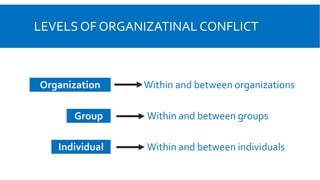
LEVELS OF ORGANIZATINAL CONFLICT
Organization
Group
Individual
Within and between organizations
Within and between groups
Within and between individuals
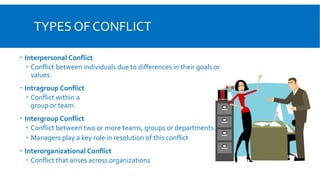
TYPES OF CONFLICT
TYPES OF CONFLICT
 Interpersonal Conflict
 Conflict between individuals due to differences in their goals or
values.
 Intragroup Conflict
 Conflict within a
group or team.
 Intergroup Conflict
 Conflict between two or more teams, groups or departments.
 Managers play a key role in resolution of this conflict
 Interorganizational Conflict
 Conflict that arises across organizations
WHAT IS CONFLICT MANAGEMENT?
Conflict management is the practice of
being able to identify and handle
conflicts sensibly, fairly, and efficiently.
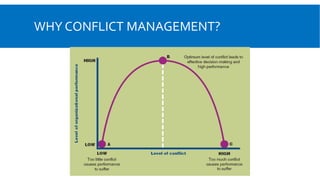
WHY CONFLICT MANAGEMENT?
EFFECTS OF CONFLICT IN ORGANIZATIONS
Stress
Absenteeism
Staff turnover
De-motivation
Non-productivity
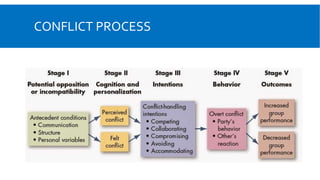
CONFLICT PROCESS
STAGE 1: POTENTIAL OPPOSITION OR
INCOMPATIBILITY
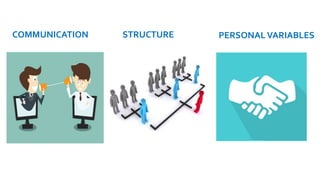
The first step in the conflict process is the
presence of conditions that create opportunities
for conflict to develop. These cause or create
opportunities for organizational conflict to rise.
COMMUNICATION STRUCTURE PERSONALVARIABLES
STAGE 2: COGNITION AND PERSONALIZATION
 This step in the conflict process is important because it is in the
step the parties decide what the conflict is.
• PERCIEVED CONFLICT
• FELT CONFLICT
STAGE 3: INTENTIONS
 Intentions are decisions to act in a given way, intentions
intervene between people’s perception and emotions and their
overt behavior.
 Using two dimensions cooperativeness (the degree to which one
party attempts to satisfy the other party’s concerns) and
assertiveness (the degree to which one party attempts to satisfy
his or her own concerns) five conflict-handling intentions can be
identified.
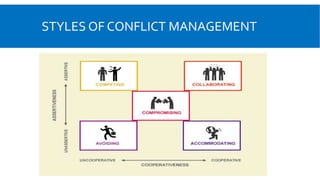
STYLES OF CONFLICT MANAGEMENT
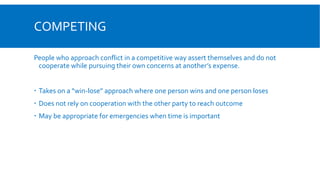
COMPETING
People who approach conflict in a competitive way assert themselves and do not
cooperate while pursuing their own concerns at another’s expense.
 Takes on a “win-lose” approach where one person wins and one person loses
 Does not rely on cooperation with the other party to reach outcome
 May be appropriate for emergencies when time is important
ACCOMODATING
People who accommodate are unassertive and very cooperative.
 Give in during a conflict
 Acknowledge they made a mistake/decide it was no big deal
 Put relationships first, ignore issues, and try to keep peace at any price
 Effective when the other person or party has a better plan or solution
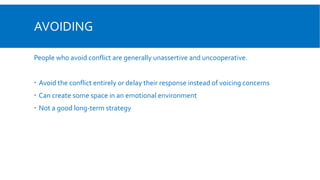
AVOIDING
People who avoid conflict are generally unassertive and uncooperative.
 Avoid the conflict entirely or delay their response instead of voicing concerns
 Can create some space in an emotional environment
 Not a good long-term strategy
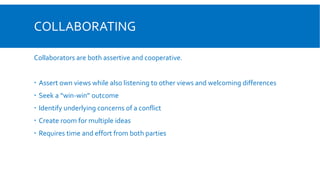
COLLABORATING
Collaborators are both assertive and cooperative.
 Assert own views while also listening to other views and welcoming differences
 Seek a “win-win” outcome
 Identify underlying concerns of a conflict
 Create room for multiple ideas
 Requires time and effort from both parties
COMPROMISING
Compromisers are moderately assertive and moderately cooperative.
 Try to find fast, mutually acceptable solutions to conflicts that partially satisfy
both parties
 Results in a “lose-lose” approach
 Appropriate temporary solution
 Considered an easy way out when you need more time to collaborate to find a
better solution
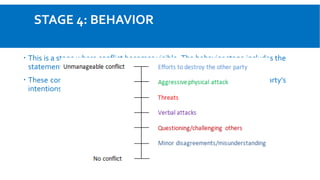
STAGE 4: BEHAVIOR
 This is a stage where conflict becomes visible. The behavior stage includes the
statements, actions, and reactions made by the conflicting parties.
 These conflict behaviors are usually overt attempt to implement each party’s
intentions.
STAGE 5: OUTCOMES
 The action-reaction interplay between the conflicting parties results in
consequences.
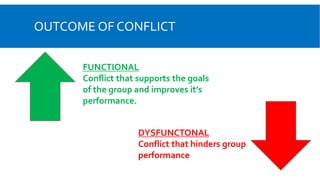
 These outcomes may be functional in that the conflict results in an improvement
in the group’s performance, or dysfunctional in that it hinders group performance.
OUTCOME OF CONFLICT
FUNCTIONAL
Conflict that supports the goals
of the group and improves it’s
performance.
DYSFUNCTONAL
Conflict that hinders group
performance
CONFLICT MANAGEMENTTECHNIQUES
WHATWORKS? WHAT DOES NOT?
THAT’STRUE, AND…… THAT’STRUE, BUT……
CONFLICT MANAGEMENTTECHNIQUES
WHATWORKS? WHAT DOES NOT?
BLAMETHE ‘’THIRD STORY’’
CONFLICT MANAGEMENTTECHNIQUES
 Problem Solving
 Superordinate goals
 Expansion of resources
 Avoidance
 Smoothing
 Compromise
 Authoritative command
 CONFLICT RESOLUTION
TECHNIQUES
CONFLICT MANAGEMENTTECHNIQUES
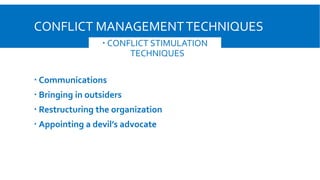
 Communications
 Bringing in outsiders
 Restructuring the organization
 Appointing a devil’s advocate
 CONFLICT STIMULATION
TECHNIQUES
CASE OF MARUTI SUZUKI
SOURCES
http://peacebuilding.caritas.org/index.php/Conflict_Handling_Styles
https://www.ukessays.com/essays/management/the-conflict-maruti-suzuki-
india-ltd-management-essay.php
http://www.swiftutors.com/conflict-process.html
CONCLUSION
Different conflict management styles may be used when
faced with different situations.
Knowing yourself and fully understanding each situation
will help you understand the conflict management style
needed.
Try a scenario-based approach to test the effectiveness of
different approaches to specific situations.

Conflict Management

  • 1.
  • 2.
    TEAM : 1. AISHASHAIKH 2. ADITYA GOTAD
  • 3.
    CONTENTS  WHAT ISCONFLICT  VIEWS OF CONFLICT  SOURCES OF CONFLICT  LEVELS OF CONFLICT  TYPES OF CONFLICT  CONFLICT MANAGEMENT  CONFLICT PROCESS  CONFLICT MANAGEMENT TECHNIQUES  CONCLUSION
  • 4.
    LEARNING OBJECTIVES  Explainwhy conflict arises, and identify the types and sources of conflict in organizations.  Understand the fundamental concepts of conflict management  Describe conflict management strategies that managers can use to resolve conflict effectively.
  • 5.
    WHAT DOYOU UNDERSTANDBY CONFLICT? A serious disagreement or argument, typically a protracted one.
  • 6.
    VIEWS OF CONFLICT Traditionalview of conflict. Human relations view of conflict. Interactionist view of conflict.
  • 7.
    THETRADITIONALVIEW OF CONFLICT The traditional view is the early approach to conflict which assumed that all conflict was bad and to be avoided. The conflict was treated negatively and discussed with such terms as violence, destruction, and irrationality to reinforce its negative implication.
  • 8.
    HUMAN RELATIONSVIEW OFCONFLICT  The human relations view of conflict treats conflict as a natural and inevitable phenomenon and, so can’t be eliminated completely from any organization.  Here, the conflict was seen in a positive light as it was suggested that conflict may lead to an improvement in a group’s performance.
  • 9.
    INTERACTIONISTVIEW OF CONFLICT The interactionist view indicates that conflict is not only an encouraging force in a group but also an absolute necessity for a group to perform effectively.  The major contribution of the interactionist view is encouraging group leaders to sustain an ongoing minimum level of conflict enough to keep the group viable, self-critical and inspired.
  • 10.
    WHERE DOES ACONFLICT ARISE FROM?
  • 11.
    LEVELS OF ORGANIZATINALCONFLICT Organization Group Individual Within and between organizations Within and between groups Within and between individuals
  • 12.
  • 13.
    TYPES OF CONFLICT Interpersonal Conflict  Conflict between individuals due to differences in their goals or values.  Intragroup Conflict  Conflict within a group or team.  Intergroup Conflict  Conflict between two or more teams, groups or departments.  Managers play a key role in resolution of this conflict  Interorganizational Conflict  Conflict that arises across organizations
  • 14.
    WHAT IS CONFLICTMANAGEMENT? Conflict management is the practice of being able to identify and handle conflicts sensibly, fairly, and efficiently.
  • 15.
  • 16.
    EFFECTS OF CONFLICTIN ORGANIZATIONS Stress Absenteeism Staff turnover De-motivation Non-productivity
  • 17.
  • 18.
    STAGE 1: POTENTIALOPPOSITION OR INCOMPATIBILITY The first step in the conflict process is the presence of conditions that create opportunities for conflict to develop. These cause or create opportunities for organizational conflict to rise.
  • 19.
  • 20.
    STAGE 2: COGNITIONAND PERSONALIZATION  This step in the conflict process is important because it is in the step the parties decide what the conflict is. • PERCIEVED CONFLICT • FELT CONFLICT
  • 21.
    STAGE 3: INTENTIONS Intentions are decisions to act in a given way, intentions intervene between people’s perception and emotions and their overt behavior.  Using two dimensions cooperativeness (the degree to which one party attempts to satisfy the other party’s concerns) and assertiveness (the degree to which one party attempts to satisfy his or her own concerns) five conflict-handling intentions can be identified.
  • 22.
  • 23.
    COMPETING People who approachconflict in a competitive way assert themselves and do not cooperate while pursuing their own concerns at another’s expense.  Takes on a “win-lose” approach where one person wins and one person loses  Does not rely on cooperation with the other party to reach outcome  May be appropriate for emergencies when time is important
  • 24.
    ACCOMODATING People who accommodateare unassertive and very cooperative.  Give in during a conflict  Acknowledge they made a mistake/decide it was no big deal  Put relationships first, ignore issues, and try to keep peace at any price  Effective when the other person or party has a better plan or solution
  • 25.
    AVOIDING People who avoidconflict are generally unassertive and uncooperative.  Avoid the conflict entirely or delay their response instead of voicing concerns  Can create some space in an emotional environment  Not a good long-term strategy
  • 26.
    COLLABORATING Collaborators are bothassertive and cooperative.  Assert own views while also listening to other views and welcoming differences  Seek a “win-win” outcome  Identify underlying concerns of a conflict  Create room for multiple ideas  Requires time and effort from both parties
  • 27.
    COMPROMISING Compromisers are moderatelyassertive and moderately cooperative.  Try to find fast, mutually acceptable solutions to conflicts that partially satisfy both parties  Results in a “lose-lose” approach  Appropriate temporary solution  Considered an easy way out when you need more time to collaborate to find a better solution
  • 28.
    STAGE 4: BEHAVIOR This is a stage where conflict becomes visible. The behavior stage includes the statements, actions, and reactions made by the conflicting parties.  These conflict behaviors are usually overt attempt to implement each party’s intentions.
  • 29.
    STAGE 5: OUTCOMES The action-reaction interplay between the conflicting parties results in consequences.  These outcomes may be functional in that the conflict results in an improvement in the group’s performance, or dysfunctional in that it hinders group performance.
  • 30.
    OUTCOME OF CONFLICT FUNCTIONAL Conflictthat supports the goals of the group and improves it’s performance. DYSFUNCTONAL Conflict that hinders group performance
  • 31.
    CONFLICT MANAGEMENTTECHNIQUES WHATWORKS? WHATDOES NOT? THAT’STRUE, AND…… THAT’STRUE, BUT……
  • 32.
    CONFLICT MANAGEMENTTECHNIQUES WHATWORKS? WHATDOES NOT? BLAMETHE ‘’THIRD STORY’’
  • 33.
    CONFLICT MANAGEMENTTECHNIQUES  ProblemSolving  Superordinate goals  Expansion of resources  Avoidance  Smoothing  Compromise  Authoritative command  CONFLICT RESOLUTION TECHNIQUES
  • 34.
    CONFLICT MANAGEMENTTECHNIQUES  Communications Bringing in outsiders  Restructuring the organization  Appointing a devil’s advocate  CONFLICT STIMULATION TECHNIQUES
  • 35.
  • 36.
  • 37.
    CONCLUSION Different conflict managementstyles may be used when faced with different situations. Knowing yourself and fully understanding each situation will help you understand the conflict management style needed. Try a scenario-based approach to test the effectiveness of different approaches to specific situations.