

CSR and Corporate Governance
The Convergence
Bolaji Okusaga
1. Cases and Causes
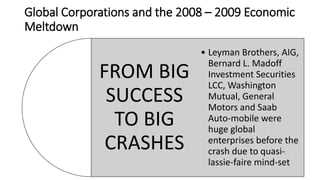
Global Corporations and the 2008 – 2009 Economic
Meltdown
FROM BIG
SUCCESS
TO BIG
CRASHES
• Leyman Brothers, AIG,
Bernard L. Madoff
Investment Securities
LCC, Washington
Mutual, General
Motors and Saab
Auto-mobile were
huge global
enterprises before the
crash due to quasi-
lassie-faire mind-set
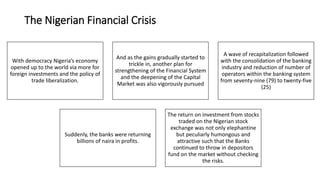
The Nigerian Financial Crisis
With democracy Nigeria’s economy
opened up to the world via more for
foreign investments and the policy of
trade liberalization.
And as the gains gradually started to
trickle in, another plan for
strengthening of the Financial System
and the deepening of the Capital
Market was also vigorously pursued
A wave of recapitalization followed
with the consolidation of the banking
industry and reduction of number of
operators within the banking system
from seventy-nine (79) to twenty-five
(25)
Suddenly, the banks were returning
billions of naira in profits.
The return on investment from stocks
traded on the Nigerian stock
exchange was not only elephantine
but peculiarly humongous and
attractive such that the Banks
continued to throw in depositors
fund on the market without checking
the risks.
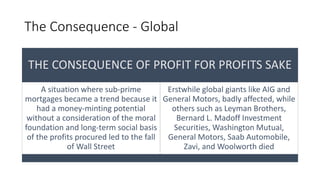
The Consequence - Global
THE CONSEQUENCE OF PROFIT FOR PROFITS SAKE
A situation where sub-prime
mortgages became a trend because it
had a money-minting potential
without a consideration of the moral
foundation and long-term social basis
of the profits procured led to the fall
of Wall Street
Erstwhile global giants like AIG and
General Motors, badly affected, while
others such as Leyman Brothers,
Bernard L. Madoff Investment
Securities, Washington Mutual,
General Motors, Saab Automobile,
Zavi, and Woolworth died
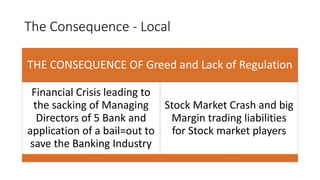
The Consequence - Local
THE CONSEQUENCE OF Greed and Lack of Regulation
Financial Crisis leading to
the sacking of Managing
Directors of 5 Bank and
application of a bail=out to
save the Banking Industry
Stock Market Crash and big
Margin trading liabilities
for Stock market players
2. Reactions and Refocus
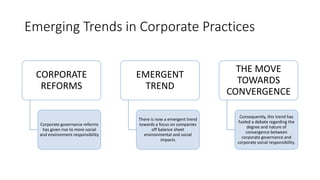
Emerging Trends in Corporate Practices
CORPORATE
REFORMS
Corporate governance reforms
has given rise to more social
and environment responsibility
EMERGENT
TREND
There is now a emergent trend
towards a focus on companies
off balance sheet
environmental and social
impacts
THE MOVE
TOWARDS
CONVERGENCE
Consequently, this trend has
fueled a debate regarding the
degree and nature of
convergence between
corporate governance and
corporate social responsibility.
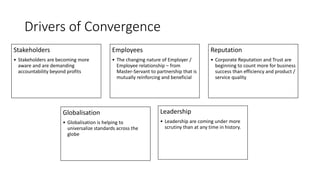
Drivers of Convergence
Stakeholders
• Stakeholders are becoming more
aware and are demanding
accountability beyond profits
Employees
• The changing nature of Employer /
Employee relationship – from
Master-Servant to partnership that is
mutually reinforcing and beneficial
Reputation
• Corporate Reputation and Trust are
beginning to count more for business
success than efficiency and product /
service quality
Globalisation
• Globalisation is helping to
universalize standards across the
globe
Leadership
• Leadership are coming under more
scrutiny than at any time in history.
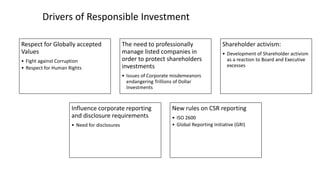
Drivers of Responsible Investment
Respect for Globally accepted
Values
• Fight against Corruption
• Respect for Human Rights
The need to professionally
manage listed companies in
order to protect shareholders
investments
• Issues of Corporate misdemeanors
endangering Trillions of Dollar
Investments
Shareholder activism:
• Development of Shareholder activism
as a reaction to Board and Executive
excesses
Influence corporate reporting
and disclosure requirements
• Need for disclosures
New rules on CSR reporting
• ISO 2600
• Global Reporting Initiative (GRI)
3. Finding the Meeting Point
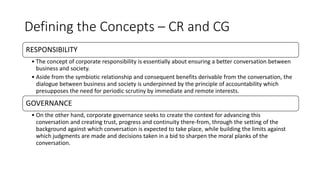
Defining the Concepts – CR and CG
RESPONSIBILITY
• The concept of corporate responsibility is essentially about ensuring a better conversation between
business and society.
• Aside from the symbiotic relationship and consequent benefits derivable from the conversation, the
dialogue between business and society is underpinned by the principle of accountability which
presupposes the need for periodic scrutiny by immediate and remote interests.
GOVERNANCE
• On the other hand, corporate governance seeks to create the context for advancing this
conversation and creating trust, progress and continuity there-from, through the setting of the
background against which conversation is expected to take place, while building the limits against
which judgments are made and decisions taken in a bid to sharpen the moral planks of the
conversation.
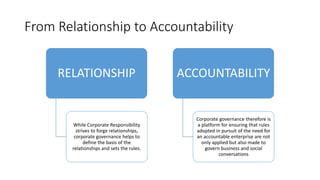
From Relationship to Accountability
RELATIONSHIP
While Corporate Responsibility
strives to forge relationships,
corporate governance helps to
define the basis of the
relationships and sets the rules.
ACCOUNTABILITY
Corporate governance therefore is
a platform for ensuring that rules
adopted in pursuit of the need for
an accountable enterprise are not
only applied but also made to
govern business and social
conversations
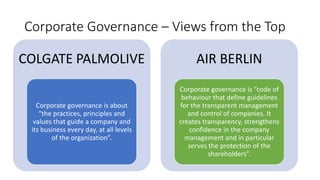
Corporate Governance – Views from the Top
COLGATE PALMOLIVE
Corporate governance is about
“the practices, principles and
values that guide a company and
its business every day, at all levels
of the organization”.
AIR BERLIN
Corporate governance is “code of
behaviour that define guidelines
for the transparent management
and control of companies. It
creates transparency, strengthens
confidence in the company
management and in particular
serves the protection of the
shareholders”.
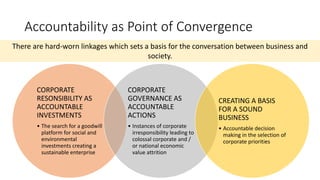
Accountability as Point of Convergence
CORPORATE
RESONSIBILITY AS
ACCOUNTABLE
INVESTMENTS
• The search for a goodwill
platform for social and
environmental
investments creating a
sustainable enterprise
CORPORATE
GOVERNANCE AS
ACCOUNTABLE
ACTIONS
• Instances of corporate
irresponsibility leading to
colossal corporate and /
or national economic
value attrition
CREATING A BASIS
FOR A SOUND
BUSINESS
• Accountable decision
making in the selection of
corporate priorities
There are hard-worn linkages which sets a basis for the conversation between business and
society.
4. Reputation as Radar
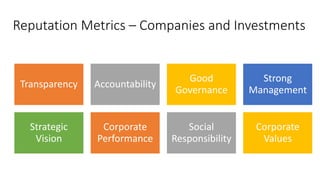
Reputation Metrics – Companies and Investments
Transparency Accountability
Good
Governance
Strong
Management
Strategic
Vision
Corporate
Performance
Social
Responsibility
Corporate
Values
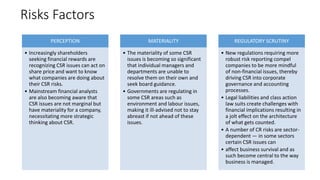
Risks Factors
PERCEPTION
• Increasingly shareholders
seeking financial rewards are
recognizing CSR issues can act on
share price and want to know
what companies are doing about
their CSR risks.
• Mainstream financial analysts
are also becoming aware that
CSR issues are not marginal but
have materiality for a company,
necessitating more strategic
thinking about CSR.
MATERIALITY
• The materiality of some CSR
issues is becoming so significant
that individual managers and
departments are unable to
resolve them on their own and
seek board guidance.
• Governments are regulating in
some CSR areas such as
environment and labour issues,
making it ill-advised not to stay
abreast if not ahead of these
issues.
REGULATORY SCRUTINY
• New regulations requiring more
robust risk reporting compel
companies to be more mindful
of non-financial issues, thereby
driving CSR into corporate
governance and accounting
processes.
• Legal liabilities and class action
law suits create challenges with
financial implications resulting in
a jolt effect on the architecture
of what gets counted.
• A number of CR risks are sector-
dependent — in some sectors
certain CSR issues can
• affect business survival and as
such become central to the way
business is managed.
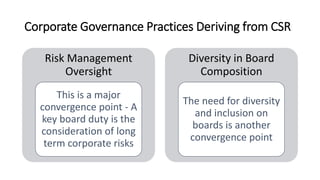
Corporate Governance Practices Deriving from CSR
Risk Management
Oversight
This is a major
convergence point - A
key board duty is the
consideration of long
term corporate risks
Diversity in Board
Composition
The need for diversity
and inclusion on
boards is another
convergence point
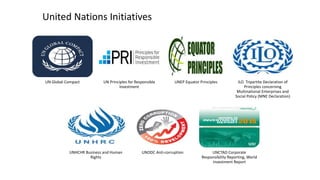
United Nations Initiatives
UN Global Compact UN Principles for Responsible
Investment
UNEP Equator Principles ILO Tripartite Declaration of
Principles concerning
Multinational Enterprises and
Social Policy (MNE Declaration)
UNHCHR Business and Human
Rights
UNODC Anti-corruption UNCTAD Corporate
Responsibility Reporting, World
Investment Report
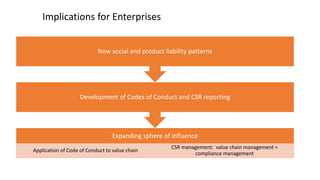
Implications for Enterprises
Expanding sphere of influence
Application of Code of Conduct to value chain
CSR management: value chain management =
compliance management
Development of Codes of Conduct and CSR reporting
New social and product liability patterns
CSR Drivers
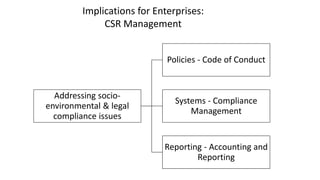
Implications for Enterprises:
CSR Management
Addressing socio-
environmental & legal
compliance issues
Policies - Code of Conduct
Systems - Compliance
Management
Reporting - Accounting and
Reporting
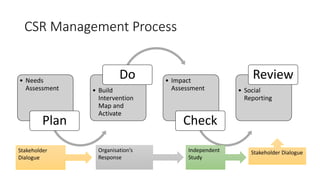
CSR Management Process
• Needs
Assessment
Plan
• Build
Intervention
Map and
Activate
Do • Impact
Assessment
Check
• Social
Reporting
Review
Stakeholder
Dialogue
Organisation’s
Response
Independent
Study
Stakeholder Dialogue
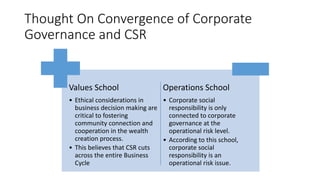
Thought On Convergence of Corporate
Governance and CSR
Values School
• Ethical considerations in
business decision making are
critical to fostering
community connection and
cooperation in the wealth
creation process.
• This believes that CSR cuts
across the entire Business
Cycle
Operations School
• Corporate social
responsibility is only
connected to corporate
governance at the
operational risk level.
• According to this school,
corporate social
responsibility is an
operational risk issue.
Conclusion
• Dislocations in the global economy in recent history which has called
into question the place of capitalism in guaranteeing global peace and
prosperity
• The dearth of a deep-seated understanding of how social and
environmental factors shape business outcomes and affect
organizational success has been at the heart of most corporate
failures and systems collapse

CSR and Corporate Governance

  • 1.
    CSR and CorporateGovernance The Convergence Bolaji Okusaga
  • 2.
  • 3.
    Global Corporations andthe 2008 – 2009 Economic Meltdown FROM BIG SUCCESS TO BIG CRASHES • Leyman Brothers, AIG, Bernard L. Madoff Investment Securities LCC, Washington Mutual, General Motors and Saab Auto-mobile were huge global enterprises before the crash due to quasi- lassie-faire mind-set
  • 4.
    The Nigerian FinancialCrisis With democracy Nigeria’s economy opened up to the world via more for foreign investments and the policy of trade liberalization. And as the gains gradually started to trickle in, another plan for strengthening of the Financial System and the deepening of the Capital Market was also vigorously pursued A wave of recapitalization followed with the consolidation of the banking industry and reduction of number of operators within the banking system from seventy-nine (79) to twenty-five (25) Suddenly, the banks were returning billions of naira in profits. The return on investment from stocks traded on the Nigerian stock exchange was not only elephantine but peculiarly humongous and attractive such that the Banks continued to throw in depositors fund on the market without checking the risks.
  • 5.
    The Consequence -Global THE CONSEQUENCE OF PROFIT FOR PROFITS SAKE A situation where sub-prime mortgages became a trend because it had a money-minting potential without a consideration of the moral foundation and long-term social basis of the profits procured led to the fall of Wall Street Erstwhile global giants like AIG and General Motors, badly affected, while others such as Leyman Brothers, Bernard L. Madoff Investment Securities, Washington Mutual, General Motors, Saab Automobile, Zavi, and Woolworth died
  • 6.
    The Consequence -Local THE CONSEQUENCE OF Greed and Lack of Regulation Financial Crisis leading to the sacking of Managing Directors of 5 Bank and application of a bail=out to save the Banking Industry Stock Market Crash and big Margin trading liabilities for Stock market players
  • 7.
  • 8.
    Emerging Trends inCorporate Practices CORPORATE REFORMS Corporate governance reforms has given rise to more social and environment responsibility EMERGENT TREND There is now a emergent trend towards a focus on companies off balance sheet environmental and social impacts THE MOVE TOWARDS CONVERGENCE Consequently, this trend has fueled a debate regarding the degree and nature of convergence between corporate governance and corporate social responsibility.
  • 9.
    Drivers of Convergence Stakeholders •Stakeholders are becoming more aware and are demanding accountability beyond profits Employees • The changing nature of Employer / Employee relationship – from Master-Servant to partnership that is mutually reinforcing and beneficial Reputation • Corporate Reputation and Trust are beginning to count more for business success than efficiency and product / service quality Globalisation • Globalisation is helping to universalize standards across the globe Leadership • Leadership are coming under more scrutiny than at any time in history.
  • 10.
    Drivers of ResponsibleInvestment Respect for Globally accepted Values • Fight against Corruption • Respect for Human Rights The need to professionally manage listed companies in order to protect shareholders investments • Issues of Corporate misdemeanors endangering Trillions of Dollar Investments Shareholder activism: • Development of Shareholder activism as a reaction to Board and Executive excesses Influence corporate reporting and disclosure requirements • Need for disclosures New rules on CSR reporting • ISO 2600 • Global Reporting Initiative (GRI)
  • 11.
    3. Finding theMeeting Point
  • 12.
    Defining the Concepts– CR and CG RESPONSIBILITY • The concept of corporate responsibility is essentially about ensuring a better conversation between business and society. • Aside from the symbiotic relationship and consequent benefits derivable from the conversation, the dialogue between business and society is underpinned by the principle of accountability which presupposes the need for periodic scrutiny by immediate and remote interests. GOVERNANCE • On the other hand, corporate governance seeks to create the context for advancing this conversation and creating trust, progress and continuity there-from, through the setting of the background against which conversation is expected to take place, while building the limits against which judgments are made and decisions taken in a bid to sharpen the moral planks of the conversation.
  • 13.
    From Relationship toAccountability RELATIONSHIP While Corporate Responsibility strives to forge relationships, corporate governance helps to define the basis of the relationships and sets the rules. ACCOUNTABILITY Corporate governance therefore is a platform for ensuring that rules adopted in pursuit of the need for an accountable enterprise are not only applied but also made to govern business and social conversations
  • 14.
    Corporate Governance –Views from the Top COLGATE PALMOLIVE Corporate governance is about “the practices, principles and values that guide a company and its business every day, at all levels of the organization”. AIR BERLIN Corporate governance is “code of behaviour that define guidelines for the transparent management and control of companies. It creates transparency, strengthens confidence in the company management and in particular serves the protection of the shareholders”.
  • 15.
    Accountability as Pointof Convergence CORPORATE RESONSIBILITY AS ACCOUNTABLE INVESTMENTS • The search for a goodwill platform for social and environmental investments creating a sustainable enterprise CORPORATE GOVERNANCE AS ACCOUNTABLE ACTIONS • Instances of corporate irresponsibility leading to colossal corporate and / or national economic value attrition CREATING A BASIS FOR A SOUND BUSINESS • Accountable decision making in the selection of corporate priorities There are hard-worn linkages which sets a basis for the conversation between business and society.
  • 16.
  • 17.
    Reputation Metrics –Companies and Investments Transparency Accountability Good Governance Strong Management Strategic Vision Corporate Performance Social Responsibility Corporate Values
  • 18.
    Risks Factors PERCEPTION • Increasinglyshareholders seeking financial rewards are recognizing CSR issues can act on share price and want to know what companies are doing about their CSR risks. • Mainstream financial analysts are also becoming aware that CSR issues are not marginal but have materiality for a company, necessitating more strategic thinking about CSR. MATERIALITY • The materiality of some CSR issues is becoming so significant that individual managers and departments are unable to resolve them on their own and seek board guidance. • Governments are regulating in some CSR areas such as environment and labour issues, making it ill-advised not to stay abreast if not ahead of these issues. REGULATORY SCRUTINY • New regulations requiring more robust risk reporting compel companies to be more mindful of non-financial issues, thereby driving CSR into corporate governance and accounting processes. • Legal liabilities and class action law suits create challenges with financial implications resulting in a jolt effect on the architecture of what gets counted. • A number of CR risks are sector- dependent — in some sectors certain CSR issues can • affect business survival and as such become central to the way business is managed.
  • 19.
    Corporate Governance PracticesDeriving from CSR Risk Management Oversight This is a major convergence point - A key board duty is the consideration of long term corporate risks Diversity in Board Composition The need for diversity and inclusion on boards is another convergence point
  • 20.
    United Nations Initiatives UNGlobal Compact UN Principles for Responsible Investment UNEP Equator Principles ILO Tripartite Declaration of Principles concerning Multinational Enterprises and Social Policy (MNE Declaration) UNHCHR Business and Human Rights UNODC Anti-corruption UNCTAD Corporate Responsibility Reporting, World Investment Report
  • 21.
    Implications for Enterprises Expandingsphere of influence Application of Code of Conduct to value chain CSR management: value chain management = compliance management Development of Codes of Conduct and CSR reporting New social and product liability patterns CSR Drivers
  • 22.
    Implications for Enterprises: CSRManagement Addressing socio- environmental & legal compliance issues Policies - Code of Conduct Systems - Compliance Management Reporting - Accounting and Reporting
  • 23.
    CSR Management Process •Needs Assessment Plan • Build Intervention Map and Activate Do • Impact Assessment Check • Social Reporting Review Stakeholder Dialogue Organisation’s Response Independent Study Stakeholder Dialogue
  • 24.
    Thought On Convergenceof Corporate Governance and CSR Values School • Ethical considerations in business decision making are critical to fostering community connection and cooperation in the wealth creation process. • This believes that CSR cuts across the entire Business Cycle Operations School • Corporate social responsibility is only connected to corporate governance at the operational risk level. • According to this school, corporate social responsibility is an operational risk issue.
  • 25.
    Conclusion • Dislocations inthe global economy in recent history which has called into question the place of capitalism in guaranteeing global peace and prosperity • The dearth of a deep-seated understanding of how social and environmental factors shape business outcomes and affect organizational success has been at the heart of most corporate failures and systems collapse