Introduction to Management 1 
Lecture 2: Dealing with Conflict 
Stage 2 Session 7
Overview 
• What is conflict at work and how does it manifest 
itself 
• What happens when it arises? 
• Thomas and Kilman Model of Conflict 
• Conflict and personality type 
2
Learning Outcomes of this lecture 
• To understand how conflict manifests itself in organisations 
• To understand the strategies to employ to meet it effectively, 
and how they relate to each other 
• To appreciate further the consequences of these strategies 
• To understand the link, or not, between conflict style and 
personality
4 
Statements on Conflict to complete 
• When I think of conflict I... 
• When someone disagrees with me about something important I usually... 
• I was brought up to deal with conflict by…
5 
Definition of Conflict 
Where the concerns 
of two people or parties 
appear to be incompatible.
6 
Assumptions about Conflict 
• Inevitable 
• Result of interdependence and interaction 
• Source of growth, quality, good decision making, 
creativity 
• When ineffective: Source of pain and destructiveness 
• When effective: Leads to change and empowerment 
• All may not be resolved, but all can be managed
Conflict: origins 
• Conflict can exist at several levels: 
– Intra-personal (e.g., personal dilemma) 
– Inter-personal: one-to-one, one-to-several, several-to-one 
– Inter-group 
– Intercultural, international 
• Usually results from one party sensing interference by another, then expressing 
antagonism. 
• Shouldn’t necessarily be perceived as negative or “unhealthy”. Can be used 
positively to, e.g., effect change. 
• Is pervasive in and between organizations - wherever multiple agendas exist.
8 
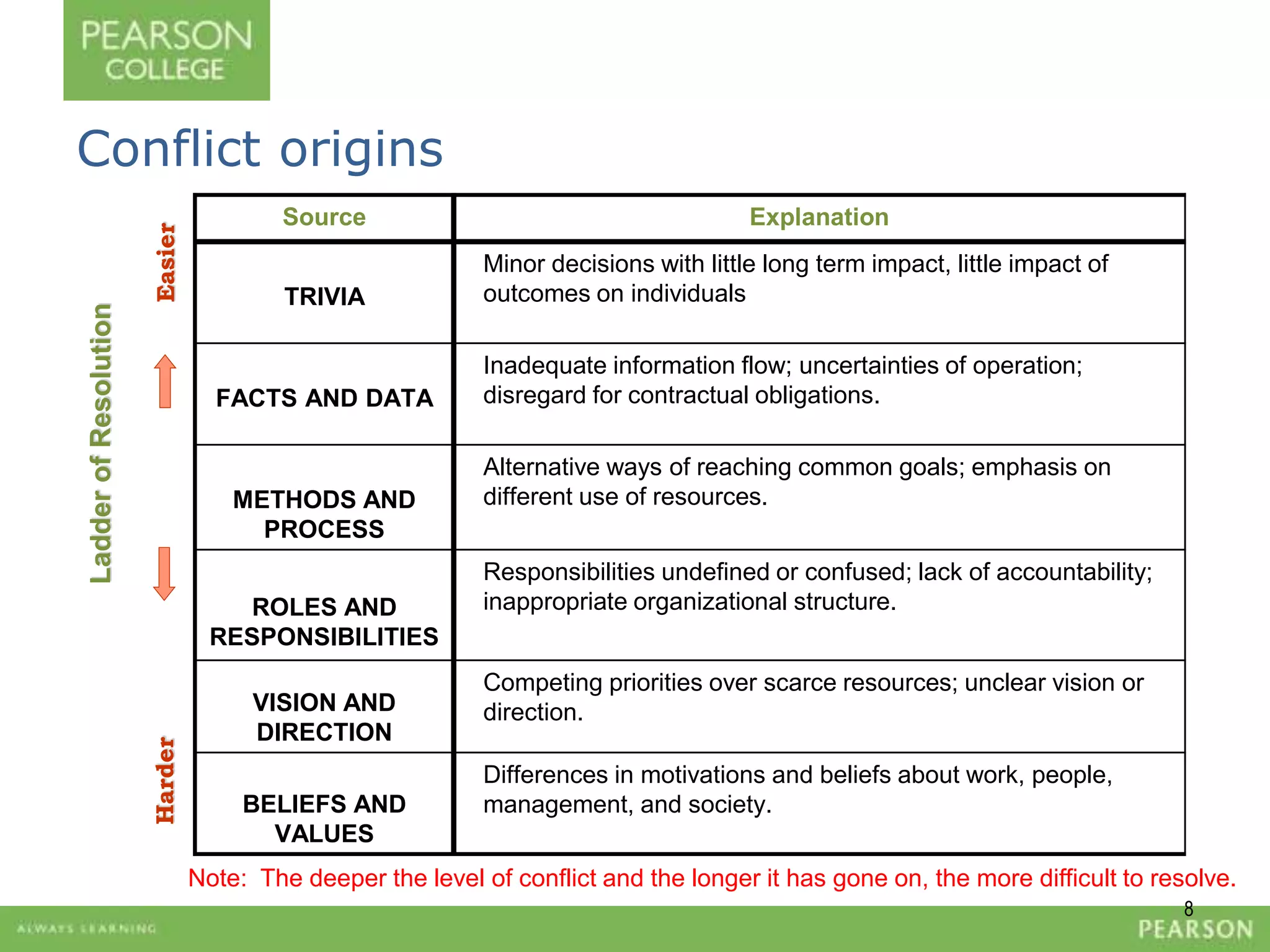
Conflict origins 
Source Explanation 
TRIVIA 
Minor decisions with little long term impact, little impact of 
outcomes on individuals 
FACTS AND DATA 
Inadequate information flow; uncertainties of operation; 
disregard for contractual obligations. 
METHODS AND 
PROCESS 
Alternative ways of reaching common goals; emphasis on 
different use of resources. 
ROLES AND 
RESPONSIBILITIES 
Responsibilities undefined or confused; lack of accountability; 
inappropriate organizational structure. 
VISION AND 
DIRECTION 
Competing priorities over scarce resources; unclear vision or 
direction. 
BELIEFS AND 
VALUES 
Differences in motivations and beliefs about work, people, 
management, and society. 
Ladder of Resolution 
Harder Easier 
Note: The deeper the level of conflict and the longer it has gone on, the more difficult to resolve.
Conflict outcomes – they can be… 
• Resolved, which are: 
– Over (or look like being over); 
– Have an outcome which is beneficial to the organization(s) concerned. 
– The result of one party taking positive action. 
• Extinct – gone, but not actively resolved. 
• Continuing: 
– Escalating (increasing severity) 
– “Oscillating” - going on and on, but not increasing in severity.
Nature of relationship with other party(ies) 
• “Anchored” vs “Distant” 
• Anchored: 
– Not necessarily warm or intimate. 
– But parties interact a lot... “share the same space “. 
– Often have a shared “sense of destiny”. 
• Distant: 
– Characterized by detachment and psychological distance, e.g. doctor: patient. 
Questions 
• How does the degree of being anchored in the relationship affect the likelihood of 
resolution? 
• How does the degree of personality type affect your ability to deal with conflict?
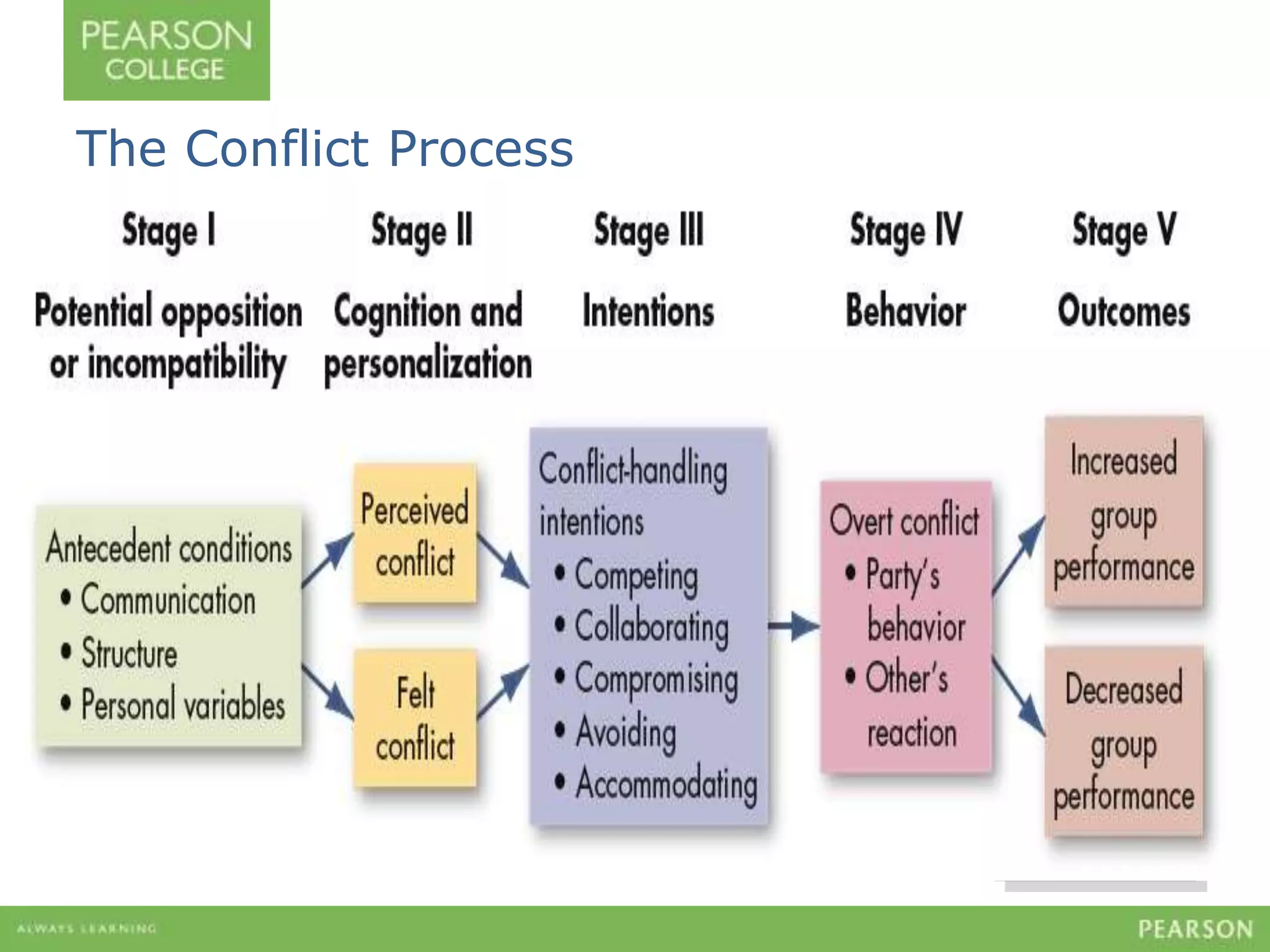
The Conflict Process 
E X H I B I T 14–1
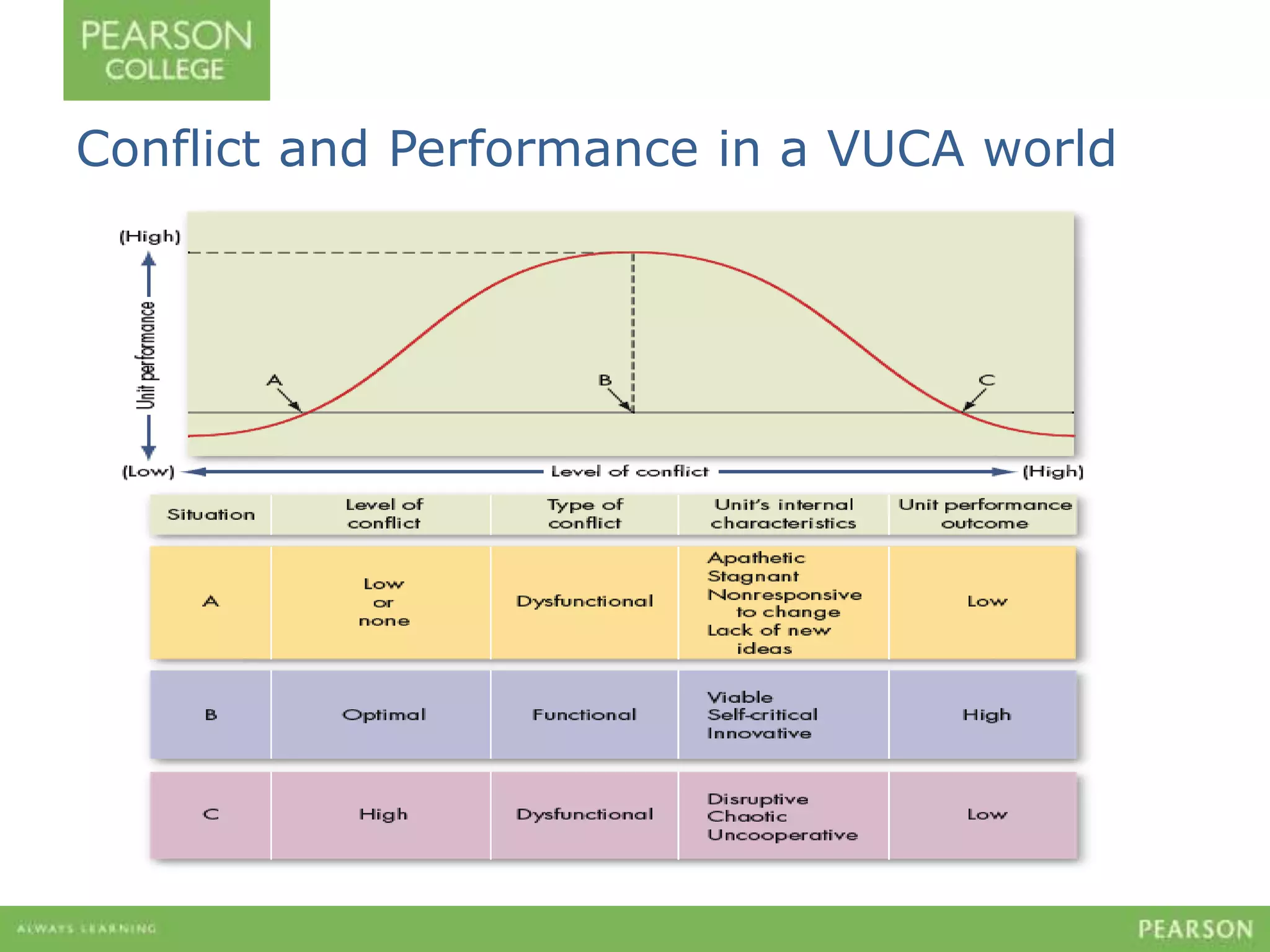
Conflict and Performance in a VUCA world
The Thomas-Kilmann Conflict Mode Instrument (TKI) 
• Initially a research tool developed in the 1970s 
• Thomas’ theoretical refinement of Blake and Moulton’s Managerial Grid 
• Leading measure of conflict-handling behavior 
• Recently re-normed (gender, race/ethnicity, org level) 
• Good reliability and validity data 
• Now computerized and available from Consulting Psychologists Press
14 
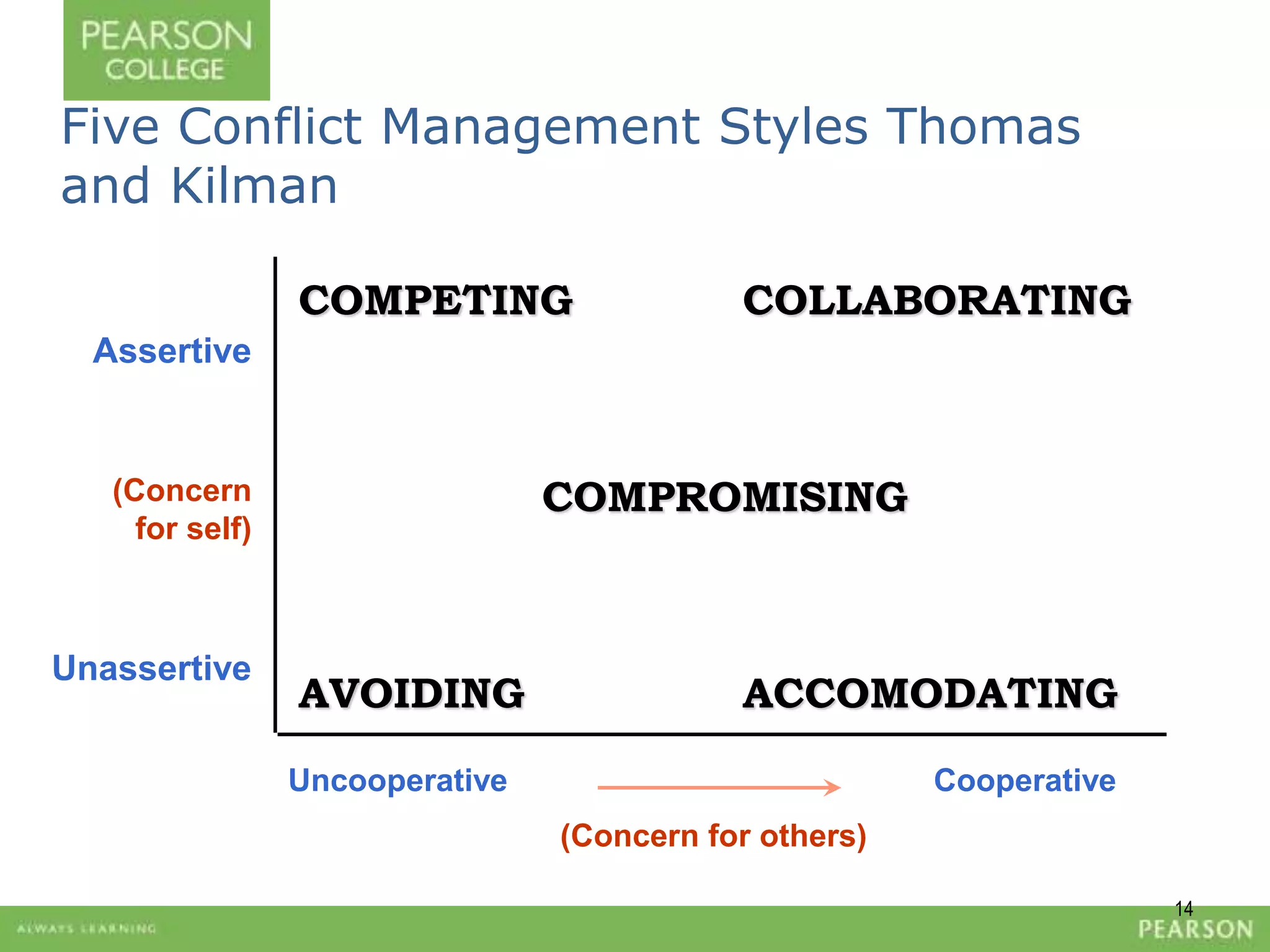
Five Conflict Management Styles Thomas 
and Kilman 
COMPETING COLLABORATING 
COMPROMISING 
AVOIDING ACCOMODATING 
Uncooperative Cooperative 
(Concern for others) 
Assertive 
(Concern 
for self) 
Unassertive
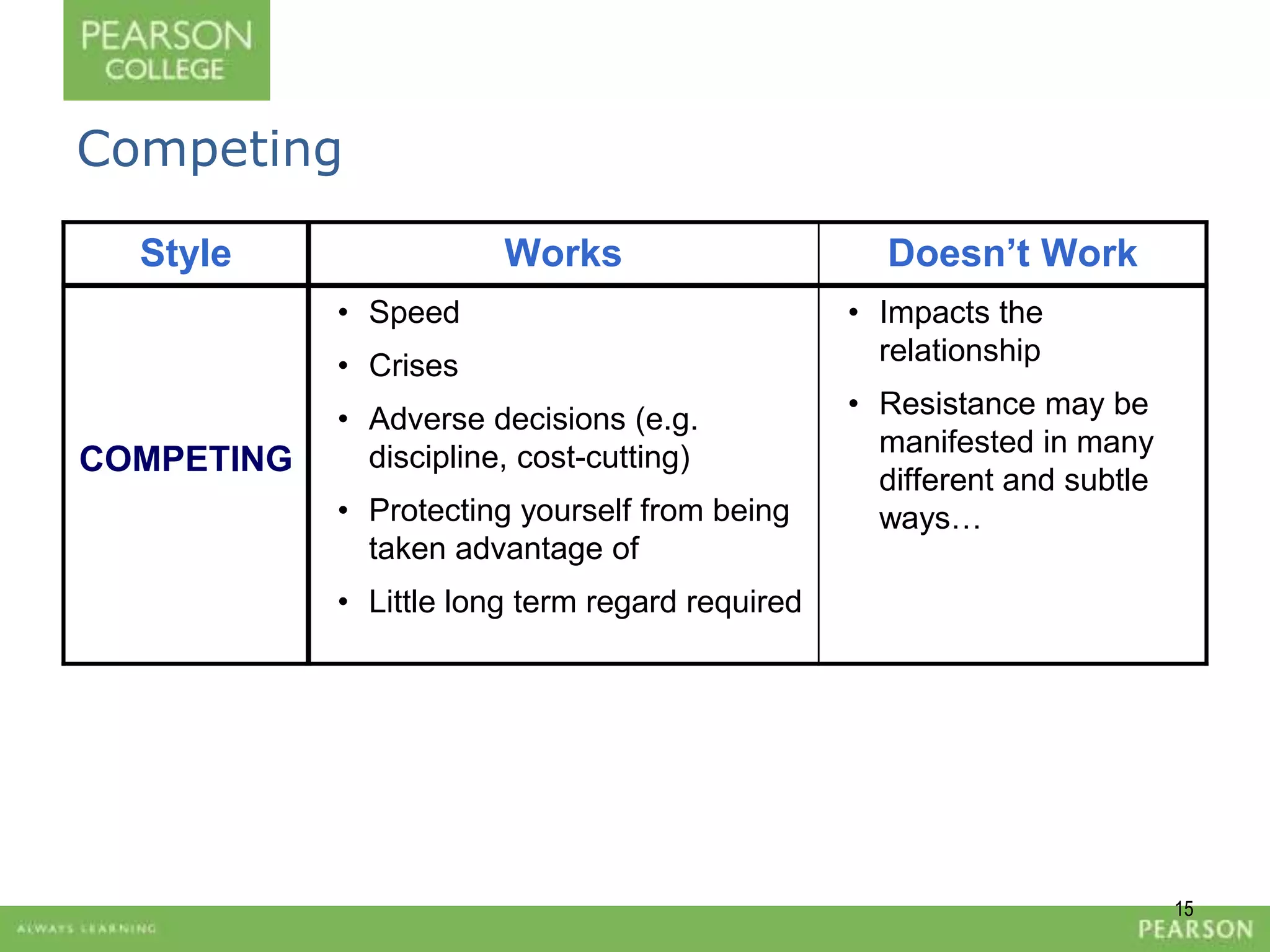
Competing 
Style Works Doesn’t Work 
COMPETING 
• Speed 
• Crises 
• Adverse decisions (e.g. 
discipline, cost-cutting) 
• Protecting yourself from being 
taken advantage of 
• Little long term regard required 
• Impacts the 
relationship 
• Resistance may be 
manifested in many 
different and subtle 
ways… 
15
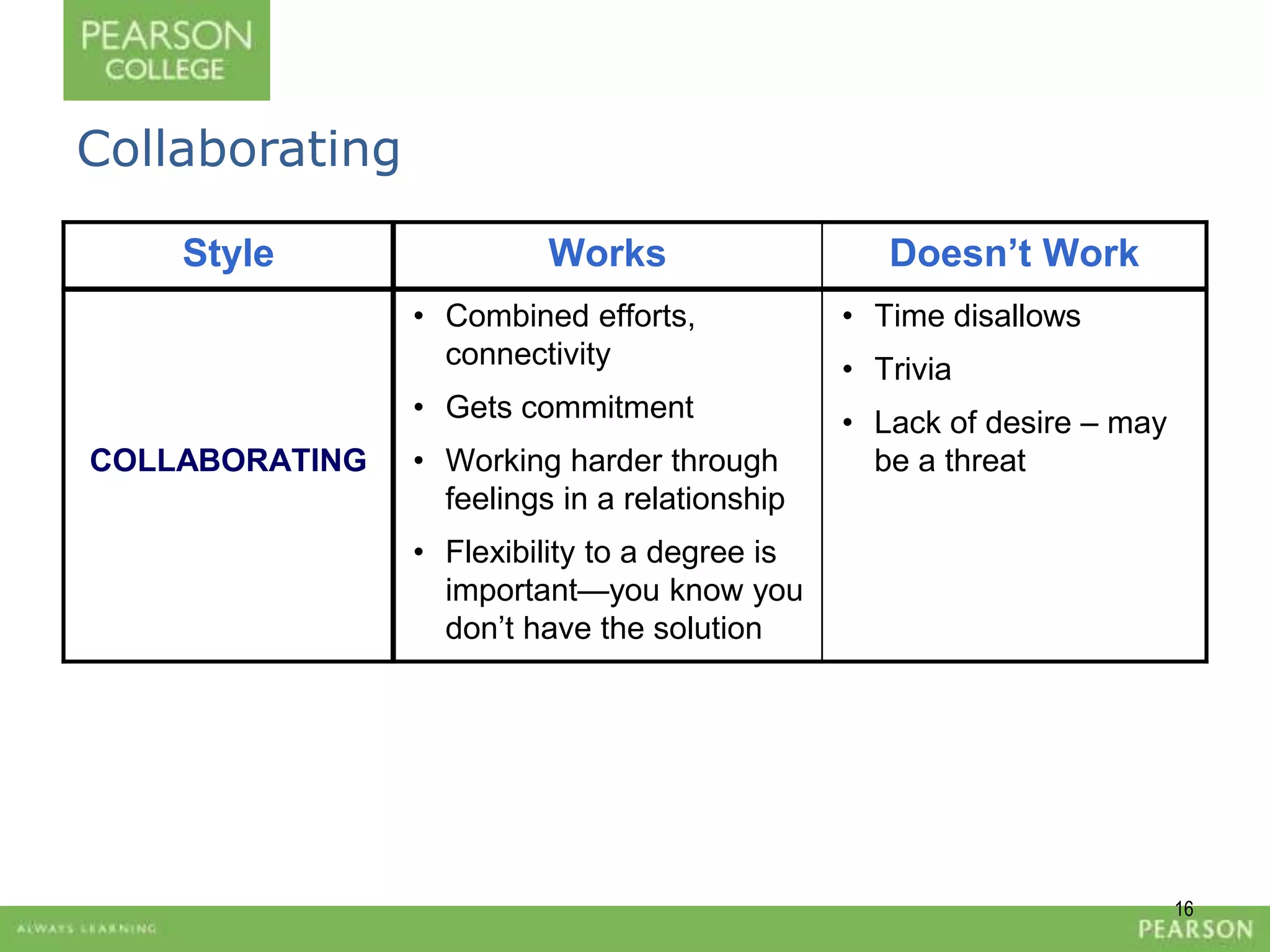
Collaborating 
Style Works Doesn’t Work 
COLLABORATING 
• Combined efforts, 
connectivity 
• Gets commitment 
• Working harder through 
feelings in a relationship 
• Flexibility to a degree is 
important—you know you 
don’t have the solution 
• Time disallows 
• Trivia 
• Lack of desire – may 
be a threat 
16
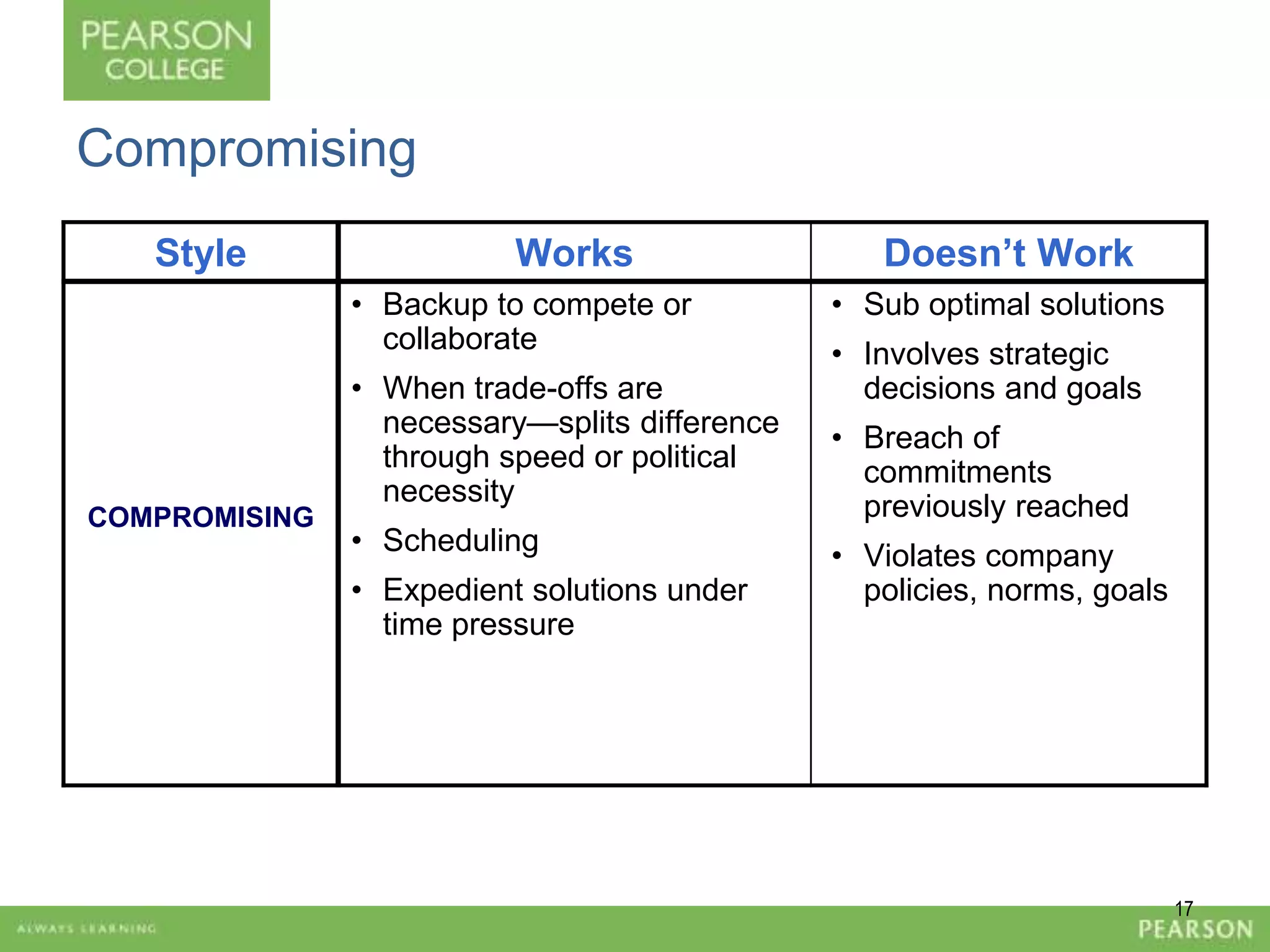
Compromising 
Style Works Doesn’t Work 
COMPROMISING 
• Backup to compete or 
collaborate 
• When trade-offs are 
necessary—splits difference 
through speed or political 
necessity 
• Scheduling 
• Expedient solutions under 
time pressure 
• Sub optimal solutions 
• Involves strategic 
decisions and goals 
• Breach of 
commitments 
previously reached 
• Violates company 
policies, norms, goals 
17
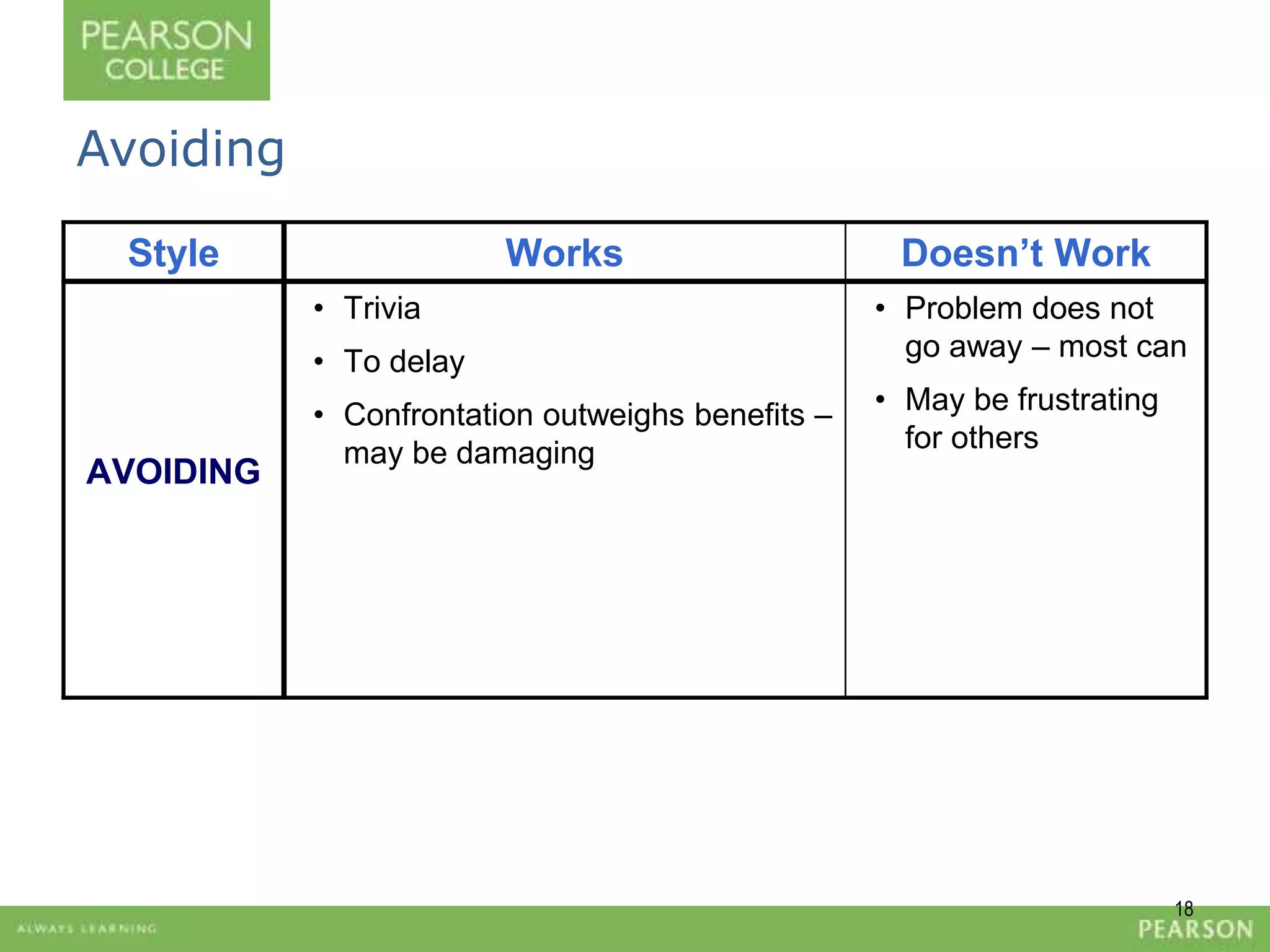
Avoiding 
Style Works Doesn’t Work 
AVOIDING 
• Trivia 
• To delay 
• Confrontation outweighs benefits – 
may be damaging 
• Problem does not 
go away – most can 
• May be frustrating 
for others 
18
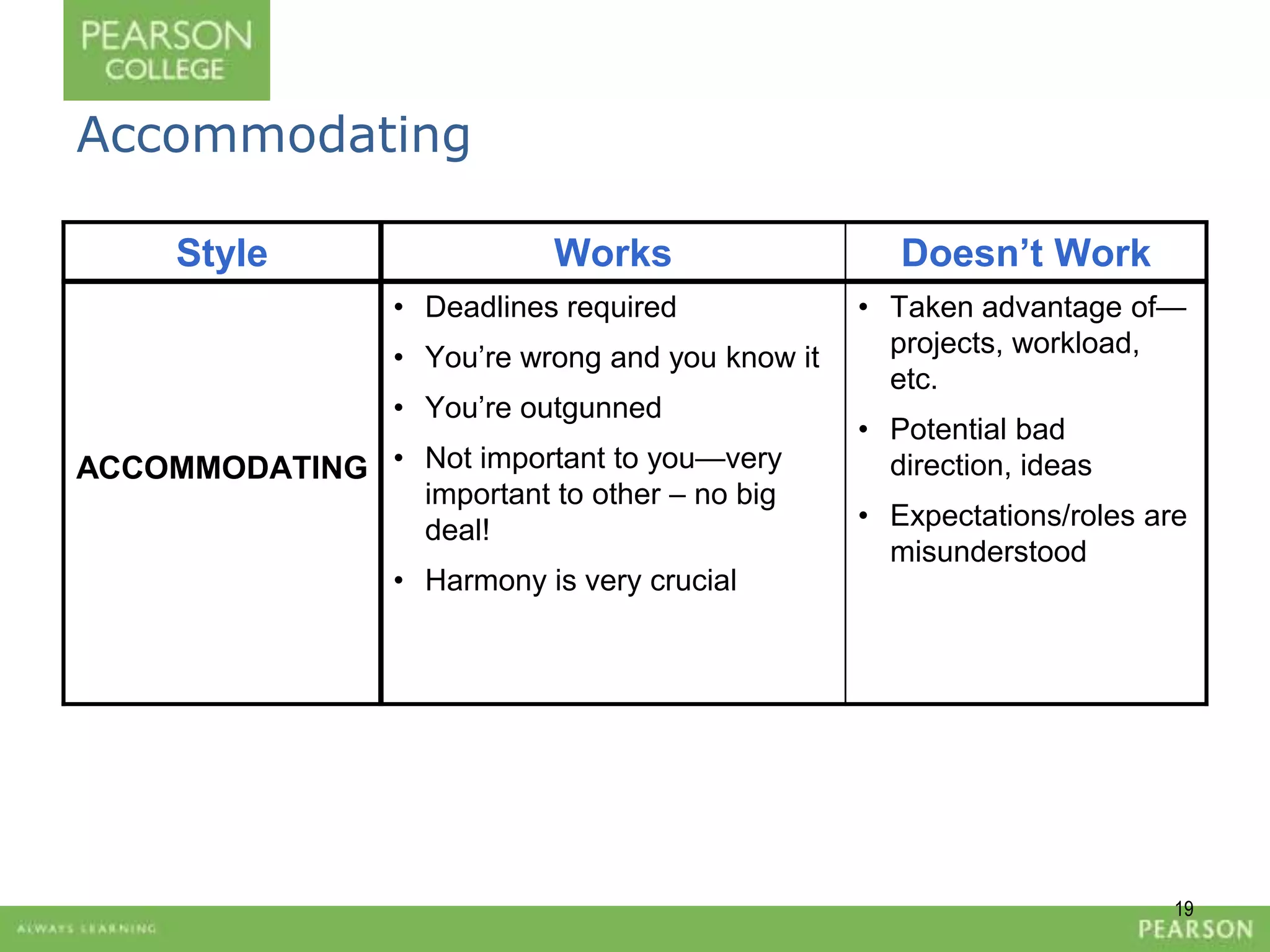
Accommodating 
Style Works Doesn’t Work 
ACCOMMODATING 
• Deadlines required 
• You’re wrong and you know it 
• You’re outgunned 
• Not important to you—very 
important to other – no big 
deal! 
• Harmony is very crucial 
• Taken advantage of— 
projects, workload, 
etc. 
• Potential bad 
direction, ideas 
• Expectations/roles are 
misunderstood 
19
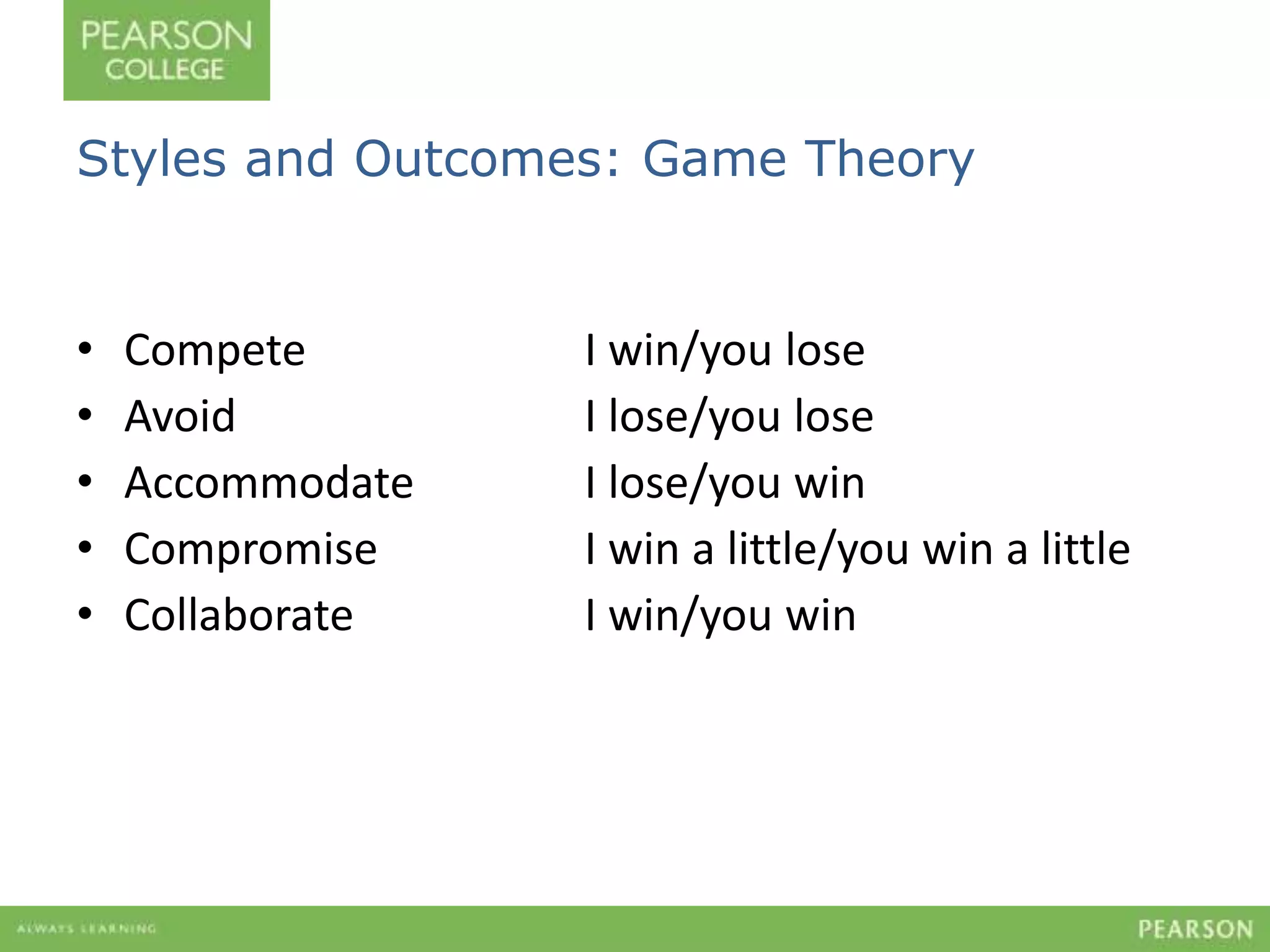
Styles and Outcomes: Game Theory 
• Compete I win/you lose 
• Avoid I lose/you lose 
• Accommodate I lose/you win 
• Compromise I win a little/you win a little 
• Collaborate I win/you win
21 
Choosing a Style: 
• How important is the task and how important is the 
relationship? 
• What is its nature? 
• Degree of risk involved: 
– Personal (e.g., status, economic loss, self-esteem) 
– Organizational (e.g., credibility, cultural norms, legal) 
• Power and other differences. What range of styles 
are available to you in this context
“But it’s not in my nature….” 
• Ability to influence in conflict is not a “special gift”: 
– Conflict is a social interaction; learning how to interact with others is perfectly 
natural. 
– The problem is usually a reliance on too narrow a range of tactics. 
– Tactics can be learned - but it’s not always a comfortable process learning to 
apply them. 
• Ability to handle conflict is not an unchangeable aspect of your “personality”: 
– You do many things you’d prefer not to do. 
– There is no known pathology called “unassertiveness”. 
– There is no evidence of a link between “personality type” and effective 
handling of conflicts.
Tactical range is crucial not personality type 
• Persuading 
• Building case 
• Challenging 
• Allying 
• Impression management – “stagecraft” 
• Using structure 
• Confronting 
• Coercing 
• Punishing
Questions regarding ‘styles’ 
• Personal ‘styles’ and the underpinning skills employed are one ‘lens’ on conflict 
handling – however they also raise other questions: 
• T and K is primarily based upon a US perspective 
• Context is always crucial – individual, organisational, and cultural 
• Power is a crucial determinant of outcome 
• National culture is an extremely strong context: Hofstede, Trompenaars (another 
lecture) 
• Latest research on Neuro Leadership indicates that the biology of the brain will 
overide all other considerations, and our key drivers are fight/flight/freeze, and 
understanding that biological programming is crucial to managing conflict
Conflict is Impacted by ‘Culture’ 
• Male and Female Gender Socialization 
• Individualism – Collectivism 
• High Context – Low Context Communication 
• Low Power Distance – High Power Distance 
• Time as Monochronic or Polychronic perspectives: 
– One thing at a time Many things at a time. 
– Punctual Not punctual 
– Low context inf. High context information 
– Stick to the plan Change plan often 
– Respect others Family, close friends come first 
– Respect rules Rules can be change 
• Uncertainty Avoidance – Uncertainty Acceptance 
• Verbal and Non-verbal Behavior
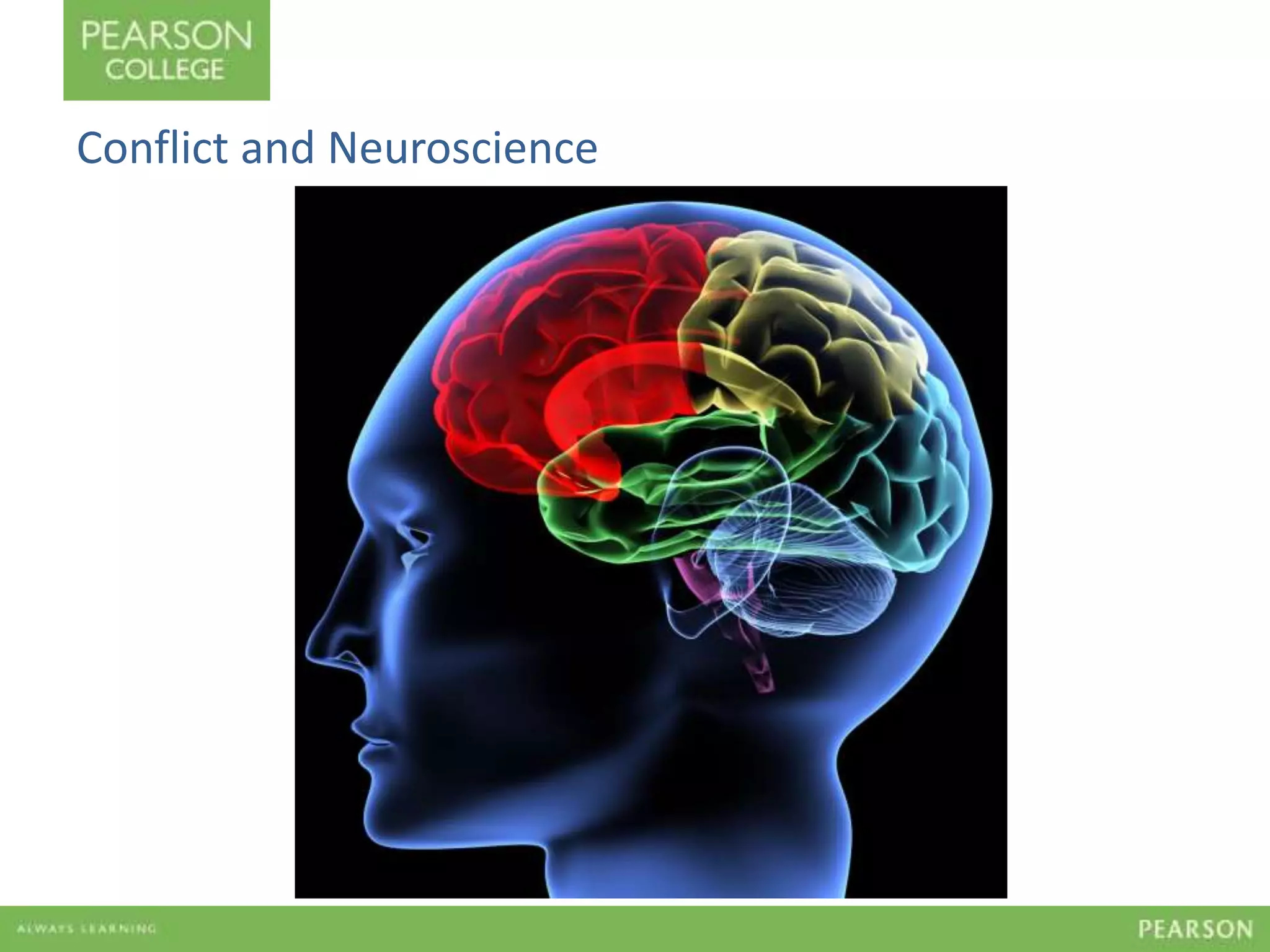
Conflict and Neuroscience
End of Lecture 
Note: This recording is for your 
personal use only and not for further 
distribution or wider review. 
© Pearson College 2013

Management 2 lecture1v1

  • 1.
    Introduction to Management1 Lecture 2: Dealing with Conflict Stage 2 Session 7
  • 2.
    Overview • Whatis conflict at work and how does it manifest itself • What happens when it arises? • Thomas and Kilman Model of Conflict • Conflict and personality type 2
  • 3.
    Learning Outcomes ofthis lecture • To understand how conflict manifests itself in organisations • To understand the strategies to employ to meet it effectively, and how they relate to each other • To appreciate further the consequences of these strategies • To understand the link, or not, between conflict style and personality
  • 4.
    4 Statements onConflict to complete • When I think of conflict I... • When someone disagrees with me about something important I usually... • I was brought up to deal with conflict by…
  • 5.
    5 Definition ofConflict Where the concerns of two people or parties appear to be incompatible.
  • 6.
    6 Assumptions aboutConflict • Inevitable • Result of interdependence and interaction • Source of growth, quality, good decision making, creativity • When ineffective: Source of pain and destructiveness • When effective: Leads to change and empowerment • All may not be resolved, but all can be managed
  • 7.
    Conflict: origins •Conflict can exist at several levels: – Intra-personal (e.g., personal dilemma) – Inter-personal: one-to-one, one-to-several, several-to-one – Inter-group – Intercultural, international • Usually results from one party sensing interference by another, then expressing antagonism. • Shouldn’t necessarily be perceived as negative or “unhealthy”. Can be used positively to, e.g., effect change. • Is pervasive in and between organizations - wherever multiple agendas exist.
  • 8.
    8 Conflict origins Source Explanation TRIVIA Minor decisions with little long term impact, little impact of outcomes on individuals FACTS AND DATA Inadequate information flow; uncertainties of operation; disregard for contractual obligations. METHODS AND PROCESS Alternative ways of reaching common goals; emphasis on different use of resources. ROLES AND RESPONSIBILITIES Responsibilities undefined or confused; lack of accountability; inappropriate organizational structure. VISION AND DIRECTION Competing priorities over scarce resources; unclear vision or direction. BELIEFS AND VALUES Differences in motivations and beliefs about work, people, management, and society. Ladder of Resolution Harder Easier Note: The deeper the level of conflict and the longer it has gone on, the more difficult to resolve.
  • 9.
    Conflict outcomes –they can be… • Resolved, which are: – Over (or look like being over); – Have an outcome which is beneficial to the organization(s) concerned. – The result of one party taking positive action. • Extinct – gone, but not actively resolved. • Continuing: – Escalating (increasing severity) – “Oscillating” - going on and on, but not increasing in severity.
  • 10.
    Nature of relationshipwith other party(ies) • “Anchored” vs “Distant” • Anchored: – Not necessarily warm or intimate. – But parties interact a lot... “share the same space “. – Often have a shared “sense of destiny”. • Distant: – Characterized by detachment and psychological distance, e.g. doctor: patient. Questions • How does the degree of being anchored in the relationship affect the likelihood of resolution? • How does the degree of personality type affect your ability to deal with conflict?
  • 11.
    The Conflict Process E X H I B I T 14–1
  • 12.
    Conflict and Performancein a VUCA world
  • 13.
    The Thomas-Kilmann ConflictMode Instrument (TKI) • Initially a research tool developed in the 1970s • Thomas’ theoretical refinement of Blake and Moulton’s Managerial Grid • Leading measure of conflict-handling behavior • Recently re-normed (gender, race/ethnicity, org level) • Good reliability and validity data • Now computerized and available from Consulting Psychologists Press
  • 14.
    14 Five ConflictManagement Styles Thomas and Kilman COMPETING COLLABORATING COMPROMISING AVOIDING ACCOMODATING Uncooperative Cooperative (Concern for others) Assertive (Concern for self) Unassertive
  • 15.
    Competing Style WorksDoesn’t Work COMPETING • Speed • Crises • Adverse decisions (e.g. discipline, cost-cutting) • Protecting yourself from being taken advantage of • Little long term regard required • Impacts the relationship • Resistance may be manifested in many different and subtle ways… 15
  • 16.
    Collaborating Style WorksDoesn’t Work COLLABORATING • Combined efforts, connectivity • Gets commitment • Working harder through feelings in a relationship • Flexibility to a degree is important—you know you don’t have the solution • Time disallows • Trivia • Lack of desire – may be a threat 16
  • 17.
    Compromising Style WorksDoesn’t Work COMPROMISING • Backup to compete or collaborate • When trade-offs are necessary—splits difference through speed or political necessity • Scheduling • Expedient solutions under time pressure • Sub optimal solutions • Involves strategic decisions and goals • Breach of commitments previously reached • Violates company policies, norms, goals 17
  • 18.
    Avoiding Style WorksDoesn’t Work AVOIDING • Trivia • To delay • Confrontation outweighs benefits – may be damaging • Problem does not go away – most can • May be frustrating for others 18
  • 19.
    Accommodating Style WorksDoesn’t Work ACCOMMODATING • Deadlines required • You’re wrong and you know it • You’re outgunned • Not important to you—very important to other – no big deal! • Harmony is very crucial • Taken advantage of— projects, workload, etc. • Potential bad direction, ideas • Expectations/roles are misunderstood 19
  • 20.
    Styles and Outcomes:Game Theory • Compete I win/you lose • Avoid I lose/you lose • Accommodate I lose/you win • Compromise I win a little/you win a little • Collaborate I win/you win
  • 21.
    21 Choosing aStyle: • How important is the task and how important is the relationship? • What is its nature? • Degree of risk involved: – Personal (e.g., status, economic loss, self-esteem) – Organizational (e.g., credibility, cultural norms, legal) • Power and other differences. What range of styles are available to you in this context
  • 22.
    “But it’s notin my nature….” • Ability to influence in conflict is not a “special gift”: – Conflict is a social interaction; learning how to interact with others is perfectly natural. – The problem is usually a reliance on too narrow a range of tactics. – Tactics can be learned - but it’s not always a comfortable process learning to apply them. • Ability to handle conflict is not an unchangeable aspect of your “personality”: – You do many things you’d prefer not to do. – There is no known pathology called “unassertiveness”. – There is no evidence of a link between “personality type” and effective handling of conflicts.
  • 23.
    Tactical range iscrucial not personality type • Persuading • Building case • Challenging • Allying • Impression management – “stagecraft” • Using structure • Confronting • Coercing • Punishing
  • 24.
    Questions regarding ‘styles’ • Personal ‘styles’ and the underpinning skills employed are one ‘lens’ on conflict handling – however they also raise other questions: • T and K is primarily based upon a US perspective • Context is always crucial – individual, organisational, and cultural • Power is a crucial determinant of outcome • National culture is an extremely strong context: Hofstede, Trompenaars (another lecture) • Latest research on Neuro Leadership indicates that the biology of the brain will overide all other considerations, and our key drivers are fight/flight/freeze, and understanding that biological programming is crucial to managing conflict
  • 25.
    Conflict is Impactedby ‘Culture’ • Male and Female Gender Socialization • Individualism – Collectivism • High Context – Low Context Communication • Low Power Distance – High Power Distance • Time as Monochronic or Polychronic perspectives: – One thing at a time Many things at a time. – Punctual Not punctual – Low context inf. High context information – Stick to the plan Change plan often – Respect others Family, close friends come first – Respect rules Rules can be change • Uncertainty Avoidance – Uncertainty Acceptance • Verbal and Non-verbal Behavior
  • 26.
  • 27.
    End of Lecture Note: This recording is for your personal use only and not for further distribution or wider review. © Pearson College 2013

Editor's Notes

  • #2 Tutor notes to go in here
  • #5 4
  • #6 © 2006 Chaos Management, Ltd.
  • #7 © 2006 Chaos Management, Ltd.
  • #9 © 2006 Chaos Management, Ltd.
  • #15 © 2006 Chaos Management, Ltd.
  • #16 © 2006 Chaos Management, Ltd.
  • #17 © 2006 Chaos Management, Ltd.
  • #18 © 2006 Chaos Management, Ltd.
  • #19 © 2006 Chaos Management, Ltd.
  • #20 © 2006 Chaos Management, Ltd.
  • #22 © 2006 Chaos Management, Ltd.