How to manage conflict
Done by Shamoi Pakita
Content
• Introduction
• Conflict resolution guidelines
• Strategies to manage conflict
forcing
accommodation
avoiding
compromising
collaborating
• Pros of the conflict
• Conclusion
Title
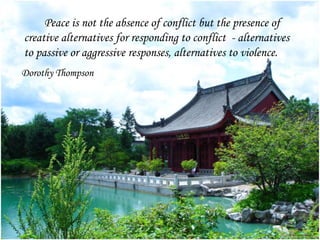
Peace is not the absence of conflict but the presence of
creative alternatives for responding to conflict - alternatives
to passive or aggressive responses, alternatives to violence.
Dorothy Thompson
Introduction
• Nowadays nearly everyone encounters conflicts in their life.
• Conflict arises from differences - it occurs whenever people disagree
over their values and assumptions, motivations and perceptions, ideas
and desires.
• It is important to know how to manage conflict effectively. Conflict
management is one of many coping skills that make day-to-day living
easier.
Conflict resolution guidelines
• Be aware of and respectful of differences
Avoiding disrespectful words and actions.
• Improve your nonverbal communication skills
Eye contact, facial expression, tone of voice, posture, touch, and gestures
• Use humor and play to deal with challenges.
Laugh with the other person, not at them.
• Try not to use the words "you", “why”.
Use “I”, open-ended questions, "I understand" instead. This will help you to avoid
blaming.
• Control your emotions and behaviour
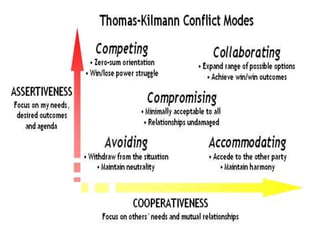
Thomas-Kilmann Conflict Instrument
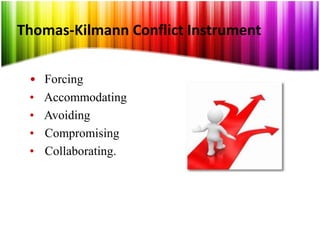
• Forcing
• Accommodating
• Avoiding
• Compromising
• Collaborating.
Forcing
• Implies to use formal authority to satisfy your concerns without paying
attention to the other person's concerns.
• A win-lose strategy
• Use when you have a very strong conviction about your position
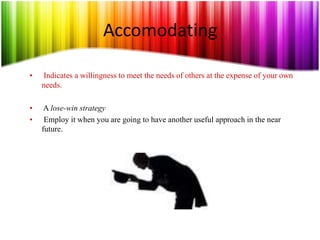
Accomodating
• Indicates a willingness to meet the needs of others at the expense of your own
needs.
• A lose-win strategy
• Employ it when you are going to have another useful approach in the near
future.
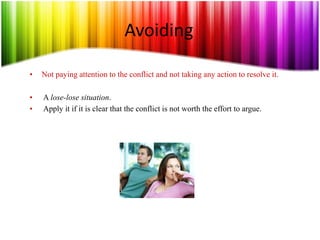
Avoiding
• Not paying attention to the conflict and not taking any action to resolve it.
• A lose-lose situation.
• Apply it if it is clear that the conflict is not worth the effort to argue.
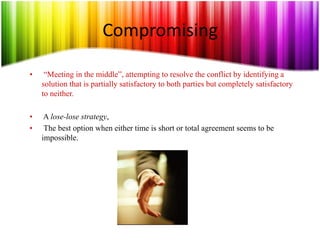
Compromising
• “Meeting in the middle”, attempting to resolve the conflict by identifying a
solution that is partially satisfactory to both parties but completely satisfactory
to neither.
• A lose-lose strategy,
• The best option when either time is short or total agreement seems to be
impossible.
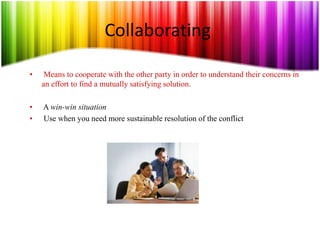
Collaborating
• Means to cooperate with the other party in order to understand their concerns in
an effort to find a mutually satisfying solution.
• A win-win situation
• Use when you need more sustainable resolution of the conflict
Once again...
• As a rule, collaboration is the way to
deal with important issues, whereas
forcing can sometimes be appropriate
if time is an issue. For moderately
important issues, compromising can
lead to quick solutions which are not
the optimal ones, so collaboration is
probably better. Finally,
accommodating is the best approach
for unimportant issues as it leads to
quick resolution without straining the
relationship.
Pros of a conflict
It is important to keep in mind that conflict does have a positive side.
As long as it is resolved effectively, it can promote:
• Collaboration
• Increase performance
• Foster creativity
• Build deeper relationships
Thus leading to personal and professional growth.
Conclusion
• Conflicts are natural, normal, and inevitable occurrences in our everyday life.
• They are unavoidable, so, try to learn to deal with them in a healthy way to
avoid hurt feelings, discomforts, resentments, and break-ups.
And the last advice…
Be a man of culture

How to manage conflict

  • 1.
    How to manageconflict Done by Shamoi Pakita
  • 2.
    Content • Introduction • Conflictresolution guidelines • Strategies to manage conflict forcing accommodation avoiding compromising collaborating • Pros of the conflict • Conclusion
  • 3.
    Title Peace is notthe absence of conflict but the presence of creative alternatives for responding to conflict - alternatives to passive or aggressive responses, alternatives to violence. Dorothy Thompson
  • 4.
    Introduction • Nowadays nearlyeveryone encounters conflicts in their life. • Conflict arises from differences - it occurs whenever people disagree over their values and assumptions, motivations and perceptions, ideas and desires. • It is important to know how to manage conflict effectively. Conflict management is one of many coping skills that make day-to-day living easier.
  • 5.
    Conflict resolution guidelines •Be aware of and respectful of differences Avoiding disrespectful words and actions. • Improve your nonverbal communication skills Eye contact, facial expression, tone of voice, posture, touch, and gestures • Use humor and play to deal with challenges. Laugh with the other person, not at them. • Try not to use the words "you", “why”. Use “I”, open-ended questions, "I understand" instead. This will help you to avoid blaming. • Control your emotions and behaviour
  • 6.
    Thomas-Kilmann Conflict Instrument •Forcing • Accommodating • Avoiding • Compromising • Collaborating.
  • 7.
    Forcing • Implies touse formal authority to satisfy your concerns without paying attention to the other person's concerns. • A win-lose strategy • Use when you have a very strong conviction about your position
  • 8.
    Accomodating • Indicates awillingness to meet the needs of others at the expense of your own needs. • A lose-win strategy • Employ it when you are going to have another useful approach in the near future.
  • 9.
    Avoiding • Not payingattention to the conflict and not taking any action to resolve it. • A lose-lose situation. • Apply it if it is clear that the conflict is not worth the effort to argue.
  • 10.
    Compromising • “Meeting inthe middle”, attempting to resolve the conflict by identifying a solution that is partially satisfactory to both parties but completely satisfactory to neither. • A lose-lose strategy, • The best option when either time is short or total agreement seems to be impossible.
  • 11.
    Collaborating • Means tocooperate with the other party in order to understand their concerns in an effort to find a mutually satisfying solution. • A win-win situation • Use when you need more sustainable resolution of the conflict
  • 12.
    Once again... • Asa rule, collaboration is the way to deal with important issues, whereas forcing can sometimes be appropriate if time is an issue. For moderately important issues, compromising can lead to quick solutions which are not the optimal ones, so collaboration is probably better. Finally, accommodating is the best approach for unimportant issues as it leads to quick resolution without straining the relationship.
  • 14.
    Pros of aconflict It is important to keep in mind that conflict does have a positive side. As long as it is resolved effectively, it can promote: • Collaboration • Increase performance • Foster creativity • Build deeper relationships Thus leading to personal and professional growth.
  • 15.
    Conclusion • Conflicts arenatural, normal, and inevitable occurrences in our everyday life. • They are unavoidable, so, try to learn to deal with them in a healthy way to avoid hurt feelings, discomforts, resentments, and break-ups.
  • 16.
    And the lastadvice… Be a man of culture