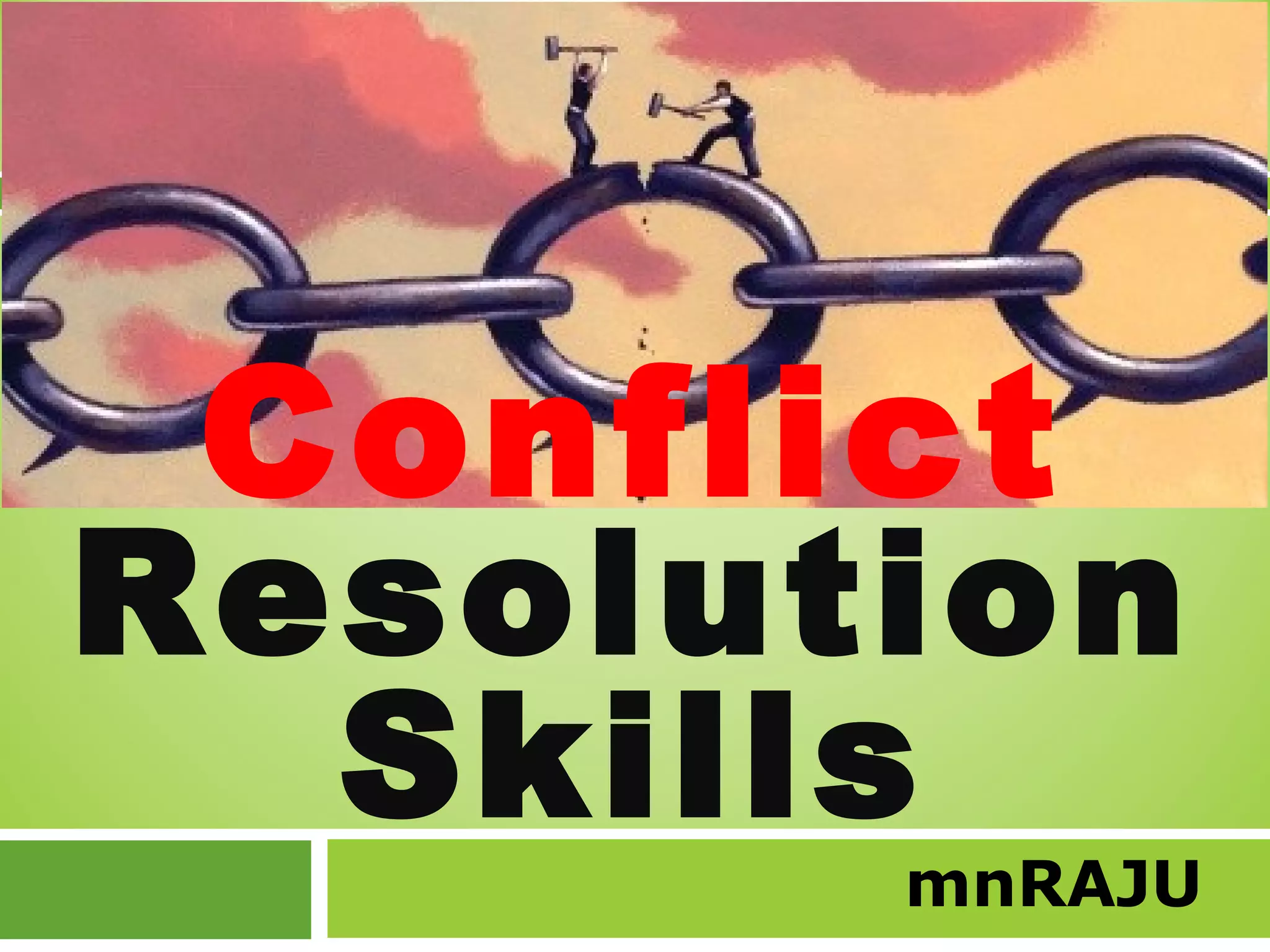

Conflict
Resolution
Skills

mnRAJU
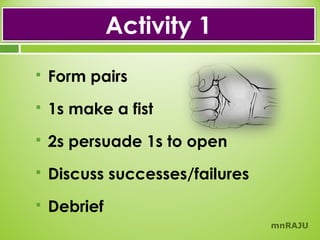
Activity 1


Form pairs



1s make a fist



2s persuade 1s to open



Discuss successes/failures



Debrief
mnRAJU
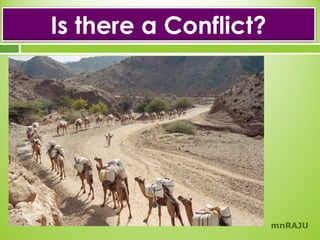
Is there a Conflict?

mnRAJU
Session Objectives


Identify and understand conflict



Identify factors leading to conflicts



Learn conflict management styles



Practise resolution strategies
mnRAJU
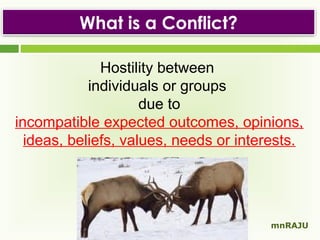
What is a Conflict?
Hostility between
individuals or groups
due to
incompatible expected outcomes, opinions,
ideas, beliefs, values, needs or interests.

mnRAJU
What Causes Conflicts?

If you agree with the first statement/word,
move left and turn left.
If you agree with the second,
move right and turn right.
Reset in the middle after each round.
Debrief
mnRAJU
Working Together is NOT Easy
 No two people are alike
 Competition for limited resources
 Misconceptions, miscommunication
 Trust deficit
 Diverse beliefs/views/approaches
 Personality clashes
 Jurisdictional ambiguities
mnRAJU
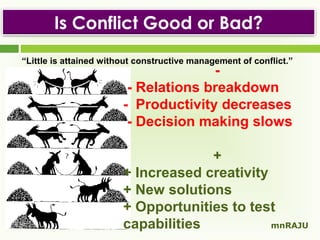
Is Conflict Good or Bad?
“Little is attained without constructive management of conflict.”

- Relations breakdown
- Productivity decreases
- Decision making slows

+
+ Increased creativity
+ New solutions
+ Opportunities to test
mnRAJU
capabilities
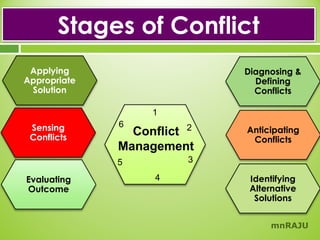
Stages of Conflict
Applying
Appropriate
Solution

Diagnosing &
Defining
Conflicts
1

Sensing
Conflicts

6

Conflict 2
Management
3

5
Evaluating
Outcome

Anticipating
Conflicts

4

Identifying
Alternative
Solutions
mnRAJU
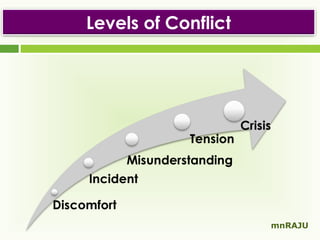
Levels of Conflict

mnRAJU
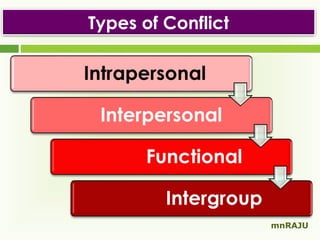
Types of Conflict

mnRAJU
What is Management?

Skilful use of available resources
mnRAJU
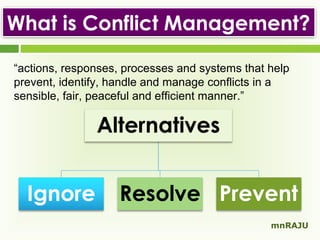
What is Conflict Management?
“actions, responses, processes and systems that help
prevent, identify, handle and manage conflicts in a
sensible, fair, peaceful and efficient manner.”

mnRAJU
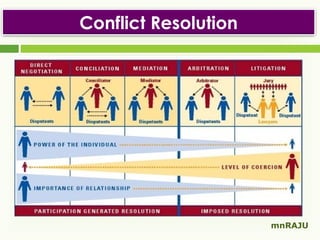
Conflict Resolution

mnRAJU
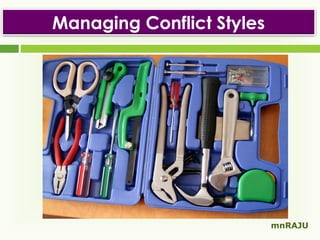
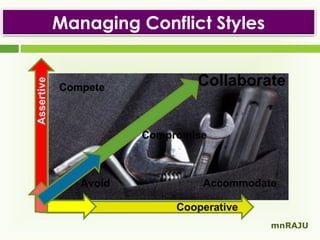
Managing Conflict Styles

mnRAJU
Assertive

Managing Conflict Styles

Compete

Collaborate
Compromise

Avoid

Accommodate
Cooperative
mnRAJU
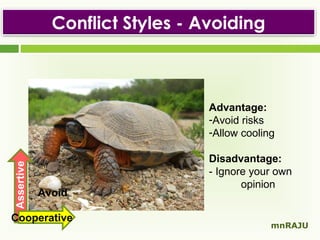
Conflict Styles - Avoiding

Assertive

Advantage:
-Avoid risks
-Allow cooling

Avoid

Cooperative

Disadvantage:
- Ignore your own
opinion

mnRAJU
Assertive

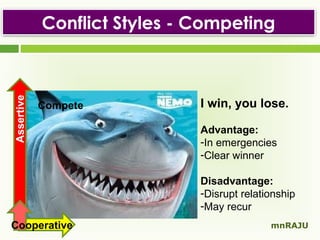
Conflict Styles - Competing

Compete

I win, you lose.
Advantage:
-In emergencies
-Clear winner
Disadvantage:
-Disrupt relationship
-May recur

Cooperative

mnRAJU
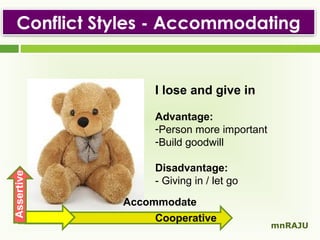
Conflict Styles - Accommodating

I lose and give in

Assertive

Advantage:
-Person more important
-Build goodwill
Disadvantage:
- Giving in / let go
Accommodate
Cooperative

mnRAJU
Assertive

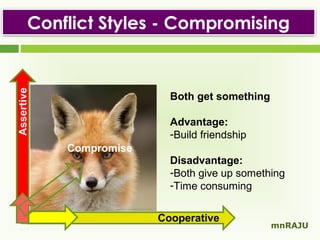
Conflict Styles - Compromising

Both get something
Advantage:
-Build friendship
Compromise
Disadvantage:
-Both give up something
-Time consuming
Cooperative

mnRAJU
Assertive

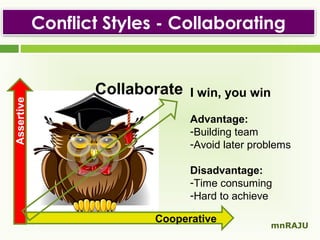
Conflict Styles - Collaborating

Collaborate

I win, you win
Advantage:
-Building team
-Avoid later problems
Disadvantage:
-Time consuming
-Hard to achieve

Cooperative

mnRAJU
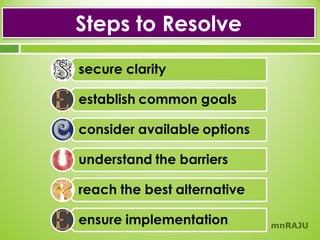
Steps to Resolve

mnRAJU
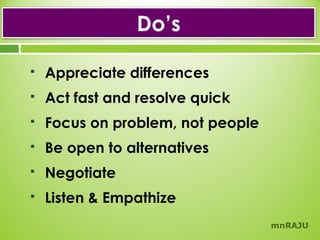
Do’s


Appreciate differences



Act fast and resolve quick



Focus on problem, not people



Be open to alternatives



Negotiate



Listen & Empathize
mnRAJU
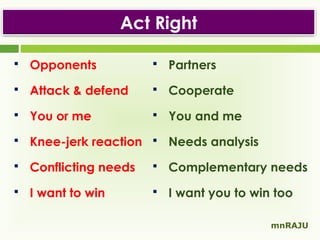
Act Right


Opponents



Partners



Attack & defend



Cooperate



You or me



You and me



Knee-jerk reaction  Needs analysis



Conflicting needs



Complementary needs



I want to win



I want you to win too
mnRAJU
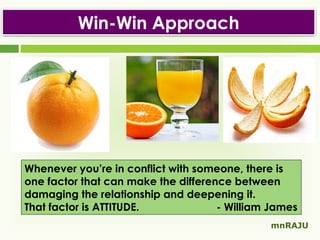
Win-Win Approach

Whenever you’re in conflict with someone, there is
one factor that can make the difference between
damaging the relationship and deepening it.
That factor is ATTITUDE.
- William James
mnRAJU
This slideshow is available at
www.slideshare.net/lionnagaraju
www.authorstream.com/tag/lionnagaraju
Send your comments to

lionnagaraju@gmail.com
mnRAJU

Conflict Resolution Skills

Editor's Notes

  • #2 Wherever choices exist there is potential for disagreement. Such differences, when handled properly, can result in richer, more effective, creative solutions and interaction. When disagreement is poorly dealt with, the outcome can be contention. Contention creates a sense of psychological distance between people, such as feelings of dislike, bitter antagonism, competition, alienation, and disregard. Conflict resolution skills are very essential to succeed in life, business or organization. Conflicts are unavoidable because people have diverse beliefs, goals, ideas, views and perspectives and they clash. If disagreements are immediately not resolved, they fester and affect employee morale, leading to business productivity and efficiency. Conflicts can cause irreparable rifts, resentments and ruin. Accept people differences.
  • #7 Tomorrow is going to be better, Tomorrow is going to be worse English medium schools, Regional medium schools Love marriages, Arranged marriages There is life on other planets, there is no life on other planets Truth is a great virtue, truth should be tempered with commonsense Travel interests me, staying home interests me
  • #11 Discomfort: Nothing is said, yet. Things don’t feel right. Difficult to identify the problem. Not sure why the discomfort. Incident: a short and sharp exchange occurs without internal reaction. Leaves you upset, irritated or with an undesired result. Misunderstanding: Motives and facts are confused. Thoughts keep returning to the problem. Tension: relationships are weighed down by negative attitudes and fixed opinions. Regard or opinion of the other person changes significantly. Relationship becomes a constant source of worry and concern. Crisis: behavior is affected. Normal functioning becomes difficult. Extreme gestures are contemplated or executed. A rupture or violence is considered.
  • #14 The term conflict management is sometimes used interchangeably with conflict resolution. The difference, however, is that the concept of conflict management is based on a premise that not all disputes end in resolution.
  • #17 Styles may vary from one situation to the next. Assertiveness – focus on MY needs, desired outcomes and agenda Cooperativeness – focus on OTHERS’ needs and mutual relationship Compromising: both sides agreeing to make small or superficial concessions. Both parties make concession and bargaining to and reach a settlement to which both agree. Accommodating: cooperation wherein one side agrees to other's wants. Usually occurs when the outcome of the situation is very important to one but less so to the other. Collaborating: meeting underlying needs of both parties. It allows assertiveness and cooperation in the search for a solution that meets the needs of all. Competing: is used when outcome is more important than relationship, e.g., in emergencies. This also involves assertiveness but not cooperation. Avoiding: can mean running away but evasion or delay can be appropriate and constructive. Useful in highly emotional situations where time is needed to gain perspective.
  • #18 Avoiding - “I will be quiet and listen.” “It's not that big a deal.” “I'd rather just forget it.” “It's not worth the trouble.” “What difference could I make anyway?” “I lose, you lose.” A turtle. When an issue is trivial, of only passing importance, or when other more important issues are pressing.  You perceive no chance of satisfying your concerns-e.g., when you have low power or you are frustrated by something which would be very difficult to change (national policies, someone's personality structure, etc.)
  • #19 Competing - “I value the point being made more than our relationship.” “It's them or me.” “I've got to win this one!” “I'm sure they will see it my way if they just think about it.” “I know I'm right.” This is the “I win, you lose” position. A person whose actions are expressed this way is sometimes symbolized as a shark. When quick, decisive action is vital-e.g., emergencies. On important issues where unpopular courses of action need implementing-e.g., cost cutting, enforcing unpopular rules, discipline.
  • #20 Accommodating - “I value our relationship more than this point.” “Let's just get this over with so we can get on to other things.” “This tension is very uncomfortable. I'll just do what they want.” “Fine I give in, have it your way.” “I lose, you win.” A teddy bear.
  • #21 Compromising - “This isn't important enough to fight over.” “I don't want to be unreasonable.” “If I give her this, maybe she'll give me that.” “We could both live with that.” A fox.
  • #22 Collaborating - “I'm sure if we work together we can come up with a better answer than either of us individually.” “I'm not giving in yet, but I am willing to hear your opinion, and give you mine.” “I win, you win.” An owl.
  • #23 Take responsibility Uncover Define Bring parties together Discuss Help parties open up Allow ventilation Deal with emotions Ask open ended questions Ground rules Everyone agrees to be open and honest Everyone agrees to speak and be heard Everyone agrees to take a positive attitude
  • #24 Different styles are appropriate for different situations. Various skills are utilized in managing conflict: Open Communication Lines (attending skills, minimal encouragers, feedback, reflecting and active listening) Be polite and respectfyl Establish Ground Rules, guidelines for productive discussion, i.e., no interruptions, everyone has chance, one at a time. Confront the Current Issues--not people, not the past Use Listening Skills for both feelings and content; listen to understand, paraphrase to check understanding Assertive action Keep Emotions in Check and be aware of the emotions of others Consider the Physical Arrangements, space, location, seating, comfort, barriers Be unbiased Use Humor to relieve tension