Recreating the Context
How Going Digital Changes Business Models
Content
S/N SUBJECT SLIDE
1. Digital Transformation – Building a Digital Business 3 - 15
2. Moving From Analogue to Digital – Recreating the Context 16 - 38
3. Integration – Accelerating Digital Transformation 39 - 42
1. Digital Transformation
Building a Digital Business
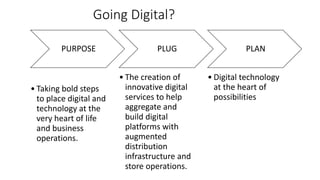
Going Digital?
PURPOSE
• Taking bold steps
to place digital and
technology at the
very heart of life
and business
operations.
PLUG
• The creation of
innovative digital
services to help
aggregate and
build digital
platforms with
augmented
distribution
infrastructure and
store operations.
PLAN
• Digital technology
at the heart of
possibilities
What is Driving Digital Transformation
Information as
Asset
In this age of interactivity,
information as moved from
being a process commodity
to a critical business asset.
Speed as
Competitive
Advantage
Beyond the use of
information technology to
improve productivity and
efficiency, speed to market
and optimize supply chains
are part of the demands.
Customers as
Value Innovators
Customers demand to co-
create value and delivery
process.
The end-point being to quickly drive down costs and complexity.
Life Without These Things…
INFORMATION
Being able to
search for
information on
Google
MAILS
Being able to
send mails
without visiting
the post office
SHOP
Being able to
shop without
going to the
Mall or Market
COMMUNICATE
Being able to
communicate
without a face
to face
encounter
SOCIALIZE
Being able to
express our
views, vent and
socialize
outside a
physical space
The Information Age
Now Imagine…
• Imagine being able to
ride a driverless car that
knows and can navigate
the fastest route to your
destination?
The
Autonomous Car
• Imagine ordering an
item online and have
delivery done within
minutes from a location
as far as 100Km?
Drone Delivery
• Imagine giving your
shoe specification and
unique design online
and having same
produced in seconds
using 3D print?
3D
Manufacturing
The Era of Internet of Things (IoT)
Nikolay SPASOV
Copyright: Nikolay SPASOV, TBI Bank
Digital Maturity Model
Ad-Hoc
• Digital Resister
Opportunistic
• Digital Explorer
Repeatable
• Digital Player
Managed
• Digital
Transformer
Optimised
• Digital
Disrupter
Copyright: IDC, Digital Transformation Maturity Model, 2015
Key Imperatives for Digital Transformation
Cost Efficiency
Build cost efficiency by digging into
current cost models and making
adjustments.
Business
Efficiency
Innovate either through seeking
vertical or horizontal possibilities
with a view to support the new
value proposition.
10
Driving Digital Transformation
“What
Is”
Analogue systems and
Manual Operations
Current
Business
Model
Half-hearted digital
adoption with little
impact on business
models
“What
Should
Be”
An integrated delivery
model which enables
the business deliver
access and convenience
with or without physical
presence
Route
• To allow, and
encourage, community
to share experiences
and affect product
offering and delivery
Understand
the Customer
• To understand, engage
and retail to customer
base and primary
market via digital
tools.
Reinvent the
Business • To provide insights on
people’s ethnos,
behavior and other
required metrics .
Build Eco-
systems
The Path to Digital Transformation
Delivering
the New
Vision
Aligning the
entire
Organization
Taking an
Ecosystem
Approach
Growing not just
the customer
base for the core
of the business
but an aligned
community
Curating
and
Managing
Information
Delivering
precise insights
from tracking
communities
interaction with
products and
other activities
Delivering a
flexible
Business
Model
Being able to
learn, unlearn,
relearn and retool
quickly.
Optimising
Processes
Doing things
easier, quicker
and cheaper.
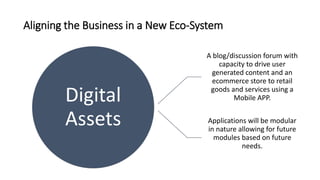
Aligning the Business in a New Eco-System
Digital
Assets
A blog/discussion forum with
capacity to drive user
generated content and an
ecommerce store to retail
goods and services using a
Mobile APP.
Applications will be modular
in nature allowing for future
modules based on future
needs.
Requirements
DATA
• Customer Data
• Customer Datamart
• Demography and
geography
PROCESS
• Streamlined
• Shorter
• Cheaper
• More Accessible
2. Moving from Analogue to Digital
Recreating the Context
1. Publishing
From Manual Publishing to Digital Publishing
Manual Publishing
Publishing with
Paper and Print
as core
Hard and Soft-
Cover Books
E-Publishing
Using electronic
Platforms
E-Books
Need for Information
on the Go
News and
Information is
today consumed
on the go.
Innovation is
driving access
and Delivery
Digital Publishing Eco-System
Sony Reader
Stanza –I-Phone
Adobe DE
E-Publishers
Mobi - Kindle
Lit
E Reader
Global Reader
Distributors
Adobe
OverDrive
DNAML
LibreDigital
eBook Technologies
Publishing Dimensions
VitalSource Technologies
Innodata Isogen
Support
2. Commerce
FromManualCommerce toElectronicCommerce
The Dynamics
• The retail industry in Nigeria has become increasingly sophisticated, evolving from open-air
markets to modern malls and online shops, mainly due to a growing population of
urbanization and emerging middle class.
• Online shopping has become quite popular due to its relative convenience and the
reasonable prices of goods and services available.
Recent Developments
• The increase in internet penetration in Nigeria has created huge opportunities for the online
retail markets, hence the rise of stiff competition in the e-commerce industry in Nigeria.
• The CBN cashless policy has further driven the e-commerce and online shopping industry, as
it seeks to reduce the use of physical cash while adopting various electronic mode of payment
like the JumiaPay.
Order
Processing
• In-house
Stock Management
• In-house
Dispatch
• In-house Jumia
Picking and PackingComputer Processing
Payment Management
• Visa
• Verve
• Banks
The E-Commerce Value Chain
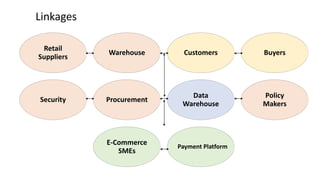
Linkages
Retail
Suppliers
Warehouse Customers Buyers
Security Procurement
Data
Warehouse
Policy
Makers
E-Commerce
SMEs
Payment Platform
Types of E-Commerce Players in Nigeria
B2B (Business to
Business)
• This refers to e-
commerce activities
between businesses.
• Quill.com
• www.ferguson.com
B2C (Business to
Consumer)
• This refers to e-
commerce activities
between a business and
a consumer.
• Jumia, Kaymu and
Jumia, Cheki
C2B (Consumer to
Business)
• This type of e-
commerce usually
refers more to services
rather than goods.
• Jobberman.com
C2C (Consumer to
Consumer)
• This type of e-
commerce is made up
of online classifieds
• OLX
• Jiji
• Carmudi
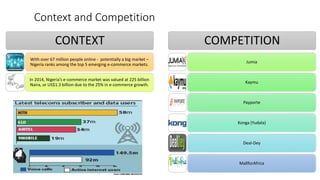
Context and Competition
CONTEXT
With over 67 million people online - potentially a big market –
Nigeria ranks among the top 5 emerging e-commerce markets.
In 2014, Nigeria’s e-commerce market was valued at 225 billion
Naira, or US$1.3 billion due to the 25% in e-commerce growth.
COMPETITION
Jumia
Kaymu
Payporte
Konga (Yudala)
Deal-Dey
MallforAfrica
Challenges facing the Ecommerce Industry
Teething problems of Logistics
•Logistics and supply chains remain tough
challenges for the e-commerce platforms in
Nigeria. Delivery within 24 hours is not feasible in
major cities and some parts of Nigeria do not yet
have good standardized physical address pattern.
High cost of internet services
•The high cost of Bandwidth is still a major set back
for most e-commerce companies. The cost of
Broadband services is high in major parts of the
country.
Security
• Most Nigerians still find it difficult to do
financial transactions through e-commerce
websites due to internet security threats.
Low literacy rates
• Illiterate citizens may be unable to participate directly
on e-commerce sites that require reading and writing
skills. Without investing in the education of these
citizens, the pool of potential customers for web
entrepreneurs is greatly reduced.
Payment (Online/Offline)
• The current systems are not user friendly
and they create additional steps to the
checkout process. There is also no viable
payment system for in-app purchases.
Upcoming Trend in E-commerce Industry
Growth of Online Malls
• Many e-commerce companies discover
that rather than being burdened with
inventory, they could set and provide
e-commerce as a service to traders
• ( eg., Jumia MarketPlace)
Ease of Payment
Integration
• Jumia also pioneered this initiative
with the JumiaPay solution
Credit Easing
• Easy credit in form of credit cards allow
buyers to act on impulse. They buy
now and pay later using dedicated
credit cards tied to an account.
Beyond Lagos
• The opportunity for e-commerce is
growing all over the country, beyond
the main cities of Abuja, Port Harcourt
and Warri. Now, there are online stores
as far as Maiduguri in the Northern
area.
Outsourced Delivery
• Currently, courier companies are
making delivery arrangements on a
bilateral, ad-hoc basis. In the near
future, we may see tailored products
being rolled out that target e-
commerce stores.
The Coming Legislation
• Nigeria does not have a specific e-
commerce law. The Legislature is
taking a top down approach to work
on a Cyber-security Bill with more
inputs from foreign NGOs.
3. Banking
The Banking Industry Reforms – Entry of FINTECH
Policy Thrust
• The banking reforms in
Nigeria are an integral
part of the country-wide
reforms being undertaken
to reposition the Nigerian
economy.
Key Issues
• Address failures in
corporate governance in
banks
• Fill critical gaps in the
regulatory framework
and regulations
Projections
• From the Financial System
Strategy 2020 (FSS2020), of the
Central Bank of Nigeria (CBN), it
is envisaged that the financial
system should be robust enough
to support economic growth
• Drive towards Cashless
creating possibilities for
FINTECHS especially around
payment solutions
Creating a Digital Bank
• "Start-ups and emerging providers of digital banking platforms
offer banks interesting opportunities for innovation."
- Stessa Cohen, Research Director at Gartner.
INTERNET OF THINGS (IoT)DIGITAL BANKING
Some Digital Banks in Nigeria
BANK FOCUS YEAR LAUNCHED/ANALYSIS
https://www.lidya.co/
The platform’s first product is targeted at
SMEs as a receivables based loan, which
can be between $500 and $15,000. The
credit will be disbursed to the customers
within 72 hours as opposed to the 6
months it would normally take were it a
traditional bank. (Culled from Herald News)
2016
• Calls itself the first Digital Bank in
Nigeria
https://www.kiakia.co/
90% of KiaKia customers have never
accessed a loan from any traditional
financial institutions in their life and do not
even have credit score. So, you can see the
power of fintech”
2017
Is strategized as a digital lending platform
http://www.alat.ng/ Focus on easing Banking transactions
by creating a branchless bank which is
driven using a mobile app
2017
Big on Digital Savings
4. News
From the Manual Newsroom to the Digital Newsroom
24 HOUR
NEWS CYCLE
The invention of the
24 hour cycle
THE COMING
OF ONLINE
NEWSSITES
Online New-site’s
speed converted
Newspapers to
mere News Rebase
Platforms
BREAKING
NEWS
Breaking news
delivered online and
to mobile devices
can compete with
TV.
Factors Driving the Growth of Digital News
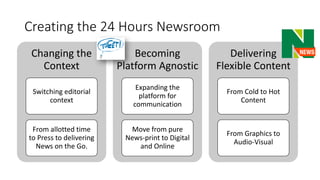
Creating the 24 Hours Newsroom
Changing the
Context
Switching editorial
context
From allotted time
to Press to delivering
News on the Go.
Becoming
Platform Agnostic
Expanding the
platform for
communication
Move from pure
News-print to Digital
and Online
Delivering
Flexible Content
From Cold to Hot
Content
From Graphics to
Audio-Visual
From Rebasing to Breaking the News
Differentiating
Newsprint and Online
Coverage
Integrating platform
possibilities using Digital
to deliver Omnichannel
News and Information
5. Film and Music
Market Dynamics
Digital Switch-
over
Cable
Television
Digital Film
and Music
Distribution
Move from Analogue to Digital
Production
• Adoption of
Digital
Production
• From
Instrumentation
to Editing
Distribution
• Move to arrest
Intellectual
Property Theft
• Adoption of
Digital
Distribution
Models
Exhibition
• Netflix
• Iroko
• Apple Music
3. Integration
Accelerating Digital Transformation
Accelerating Transformation – Key Considerations
Looking Beyond Current
Business Model
• Production
• Distribution
• Delivery
Getting New Insights
• The problem area
associated with the
current model – Access
to Raw Materials,
Environmental Factors
etc.
• The sustainability
Question – For How
Long Can We Continue
to Do This?
Trend Spotting and
Disruption
• TRENDS - How do
customers prefer to be
served?
• DISTRUPTION - Do
Customers know what
they want until they
see it?
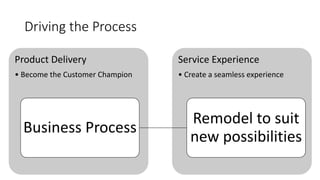
Driving the Process
Service Experience
• Create a seamless experience
Product Delivery
• Become the Customer Champion
Business Process
Remodel to suit
new possibilities
Conclusion
Driving Innovation and Entrenching New Values
Stretching the boundaries….
1. Create differentiation – Redefining route to Market
2. Decrease Volatility – Reduction Complexities
3. Broaden Income Base – Creation of Access through Aggregation
Cost Efficiencies.
Compelling
Models
Customer
Connection
42
Lagos - Nigeria
99 Awolowo Road, Ikoyi
Lagos
Tel +234 (0) 80 991 2629
www.precise.com.ng
Thank You

Recreating the context through digital transformation a precise presentation

  • 1.
    Recreating the Context HowGoing Digital Changes Business Models
  • 2.
    Content S/N SUBJECT SLIDE 1.Digital Transformation – Building a Digital Business 3 - 15 2. Moving From Analogue to Digital – Recreating the Context 16 - 38 3. Integration – Accelerating Digital Transformation 39 - 42
  • 3.
  • 4.
    Going Digital? PURPOSE • Takingbold steps to place digital and technology at the very heart of life and business operations. PLUG • The creation of innovative digital services to help aggregate and build digital platforms with augmented distribution infrastructure and store operations. PLAN • Digital technology at the heart of possibilities
  • 5.
    What is DrivingDigital Transformation Information as Asset In this age of interactivity, information as moved from being a process commodity to a critical business asset. Speed as Competitive Advantage Beyond the use of information technology to improve productivity and efficiency, speed to market and optimize supply chains are part of the demands. Customers as Value Innovators Customers demand to co- create value and delivery process. The end-point being to quickly drive down costs and complexity.
  • 6.
    Life Without TheseThings… INFORMATION Being able to search for information on Google MAILS Being able to send mails without visiting the post office SHOP Being able to shop without going to the Mall or Market COMMUNICATE Being able to communicate without a face to face encounter SOCIALIZE Being able to express our views, vent and socialize outside a physical space The Information Age
  • 7.
    Now Imagine… • Imaginebeing able to ride a driverless car that knows and can navigate the fastest route to your destination? The Autonomous Car • Imagine ordering an item online and have delivery done within minutes from a location as far as 100Km? Drone Delivery • Imagine giving your shoe specification and unique design online and having same produced in seconds using 3D print? 3D Manufacturing The Era of Internet of Things (IoT)
  • 8.
  • 9.
    Digital Maturity Model Ad-Hoc •Digital Resister Opportunistic • Digital Explorer Repeatable • Digital Player Managed • Digital Transformer Optimised • Digital Disrupter Copyright: IDC, Digital Transformation Maturity Model, 2015
  • 10.
    Key Imperatives forDigital Transformation Cost Efficiency Build cost efficiency by digging into current cost models and making adjustments. Business Efficiency Innovate either through seeking vertical or horizontal possibilities with a view to support the new value proposition. 10
  • 11.
    Driving Digital Transformation “What Is” Analoguesystems and Manual Operations Current Business Model Half-hearted digital adoption with little impact on business models “What Should Be” An integrated delivery model which enables the business deliver access and convenience with or without physical presence
  • 12.
    Route • To allow,and encourage, community to share experiences and affect product offering and delivery Understand the Customer • To understand, engage and retail to customer base and primary market via digital tools. Reinvent the Business • To provide insights on people’s ethnos, behavior and other required metrics . Build Eco- systems
  • 13.
    The Path toDigital Transformation Delivering the New Vision Aligning the entire Organization Taking an Ecosystem Approach Growing not just the customer base for the core of the business but an aligned community Curating and Managing Information Delivering precise insights from tracking communities interaction with products and other activities Delivering a flexible Business Model Being able to learn, unlearn, relearn and retool quickly. Optimising Processes Doing things easier, quicker and cheaper.
  • 14.
    Aligning the Businessin a New Eco-System Digital Assets A blog/discussion forum with capacity to drive user generated content and an ecommerce store to retail goods and services using a Mobile APP. Applications will be modular in nature allowing for future modules based on future needs.
  • 15.
    Requirements DATA • Customer Data •Customer Datamart • Demography and geography PROCESS • Streamlined • Shorter • Cheaper • More Accessible
  • 16.
    2. Moving fromAnalogue to Digital Recreating the Context
  • 17.
  • 18.
    From Manual Publishingto Digital Publishing Manual Publishing Publishing with Paper and Print as core Hard and Soft- Cover Books E-Publishing Using electronic Platforms E-Books Need for Information on the Go News and Information is today consumed on the go. Innovation is driving access and Delivery
  • 19.
    Digital Publishing Eco-System SonyReader Stanza –I-Phone Adobe DE E-Publishers Mobi - Kindle Lit E Reader Global Reader Distributors Adobe OverDrive DNAML LibreDigital eBook Technologies Publishing Dimensions VitalSource Technologies Innodata Isogen Support
  • 20.
  • 21.
    FromManualCommerce toElectronicCommerce The Dynamics •The retail industry in Nigeria has become increasingly sophisticated, evolving from open-air markets to modern malls and online shops, mainly due to a growing population of urbanization and emerging middle class. • Online shopping has become quite popular due to its relative convenience and the reasonable prices of goods and services available. Recent Developments • The increase in internet penetration in Nigeria has created huge opportunities for the online retail markets, hence the rise of stiff competition in the e-commerce industry in Nigeria. • The CBN cashless policy has further driven the e-commerce and online shopping industry, as it seeks to reduce the use of physical cash while adopting various electronic mode of payment like the JumiaPay.
  • 22.
    Order Processing • In-house Stock Management •In-house Dispatch • In-house Jumia Picking and PackingComputer Processing Payment Management • Visa • Verve • Banks The E-Commerce Value Chain
  • 23.
    Linkages Retail Suppliers Warehouse Customers Buyers SecurityProcurement Data Warehouse Policy Makers E-Commerce SMEs Payment Platform
  • 24.
    Types of E-CommercePlayers in Nigeria B2B (Business to Business) • This refers to e- commerce activities between businesses. • Quill.com • www.ferguson.com B2C (Business to Consumer) • This refers to e- commerce activities between a business and a consumer. • Jumia, Kaymu and Jumia, Cheki C2B (Consumer to Business) • This type of e- commerce usually refers more to services rather than goods. • Jobberman.com C2C (Consumer to Consumer) • This type of e- commerce is made up of online classifieds • OLX • Jiji • Carmudi
  • 25.
    Context and Competition CONTEXT Withover 67 million people online - potentially a big market – Nigeria ranks among the top 5 emerging e-commerce markets. In 2014, Nigeria’s e-commerce market was valued at 225 billion Naira, or US$1.3 billion due to the 25% in e-commerce growth. COMPETITION Jumia Kaymu Payporte Konga (Yudala) Deal-Dey MallforAfrica
  • 26.
    Challenges facing theEcommerce Industry Teething problems of Logistics •Logistics and supply chains remain tough challenges for the e-commerce platforms in Nigeria. Delivery within 24 hours is not feasible in major cities and some parts of Nigeria do not yet have good standardized physical address pattern. High cost of internet services •The high cost of Bandwidth is still a major set back for most e-commerce companies. The cost of Broadband services is high in major parts of the country. Security • Most Nigerians still find it difficult to do financial transactions through e-commerce websites due to internet security threats. Low literacy rates • Illiterate citizens may be unable to participate directly on e-commerce sites that require reading and writing skills. Without investing in the education of these citizens, the pool of potential customers for web entrepreneurs is greatly reduced. Payment (Online/Offline) • The current systems are not user friendly and they create additional steps to the checkout process. There is also no viable payment system for in-app purchases.
  • 27.
    Upcoming Trend inE-commerce Industry Growth of Online Malls • Many e-commerce companies discover that rather than being burdened with inventory, they could set and provide e-commerce as a service to traders • ( eg., Jumia MarketPlace) Ease of Payment Integration • Jumia also pioneered this initiative with the JumiaPay solution Credit Easing • Easy credit in form of credit cards allow buyers to act on impulse. They buy now and pay later using dedicated credit cards tied to an account. Beyond Lagos • The opportunity for e-commerce is growing all over the country, beyond the main cities of Abuja, Port Harcourt and Warri. Now, there are online stores as far as Maiduguri in the Northern area. Outsourced Delivery • Currently, courier companies are making delivery arrangements on a bilateral, ad-hoc basis. In the near future, we may see tailored products being rolled out that target e- commerce stores. The Coming Legislation • Nigeria does not have a specific e- commerce law. The Legislature is taking a top down approach to work on a Cyber-security Bill with more inputs from foreign NGOs.
  • 28.
  • 29.
    The Banking IndustryReforms – Entry of FINTECH Policy Thrust • The banking reforms in Nigeria are an integral part of the country-wide reforms being undertaken to reposition the Nigerian economy. Key Issues • Address failures in corporate governance in banks • Fill critical gaps in the regulatory framework and regulations Projections • From the Financial System Strategy 2020 (FSS2020), of the Central Bank of Nigeria (CBN), it is envisaged that the financial system should be robust enough to support economic growth • Drive towards Cashless creating possibilities for FINTECHS especially around payment solutions
  • 30.
    Creating a DigitalBank • "Start-ups and emerging providers of digital banking platforms offer banks interesting opportunities for innovation." - Stessa Cohen, Research Director at Gartner. INTERNET OF THINGS (IoT)DIGITAL BANKING
  • 31.
    Some Digital Banksin Nigeria BANK FOCUS YEAR LAUNCHED/ANALYSIS https://www.lidya.co/ The platform’s first product is targeted at SMEs as a receivables based loan, which can be between $500 and $15,000. The credit will be disbursed to the customers within 72 hours as opposed to the 6 months it would normally take were it a traditional bank. (Culled from Herald News) 2016 • Calls itself the first Digital Bank in Nigeria https://www.kiakia.co/ 90% of KiaKia customers have never accessed a loan from any traditional financial institutions in their life and do not even have credit score. So, you can see the power of fintech” 2017 Is strategized as a digital lending platform http://www.alat.ng/ Focus on easing Banking transactions by creating a branchless bank which is driven using a mobile app 2017 Big on Digital Savings
  • 32.
  • 33.
    From the ManualNewsroom to the Digital Newsroom 24 HOUR NEWS CYCLE The invention of the 24 hour cycle THE COMING OF ONLINE NEWSSITES Online New-site’s speed converted Newspapers to mere News Rebase Platforms BREAKING NEWS Breaking news delivered online and to mobile devices can compete with TV. Factors Driving the Growth of Digital News
  • 34.
    Creating the 24Hours Newsroom Changing the Context Switching editorial context From allotted time to Press to delivering News on the Go. Becoming Platform Agnostic Expanding the platform for communication Move from pure News-print to Digital and Online Delivering Flexible Content From Cold to Hot Content From Graphics to Audio-Visual
  • 35.
    From Rebasing toBreaking the News Differentiating Newsprint and Online Coverage Integrating platform possibilities using Digital to deliver Omnichannel News and Information
  • 36.
  • 37.
  • 38.
    Move from Analogueto Digital Production • Adoption of Digital Production • From Instrumentation to Editing Distribution • Move to arrest Intellectual Property Theft • Adoption of Digital Distribution Models Exhibition • Netflix • Iroko • Apple Music
  • 39.
  • 40.
    Accelerating Transformation –Key Considerations Looking Beyond Current Business Model • Production • Distribution • Delivery Getting New Insights • The problem area associated with the current model – Access to Raw Materials, Environmental Factors etc. • The sustainability Question – For How Long Can We Continue to Do This? Trend Spotting and Disruption • TRENDS - How do customers prefer to be served? • DISTRUPTION - Do Customers know what they want until they see it?
  • 41.
    Driving the Process ServiceExperience • Create a seamless experience Product Delivery • Become the Customer Champion Business Process Remodel to suit new possibilities
  • 42.
    Conclusion Driving Innovation andEntrenching New Values Stretching the boundaries…. 1. Create differentiation – Redefining route to Market 2. Decrease Volatility – Reduction Complexities 3. Broaden Income Base – Creation of Access through Aggregation Cost Efficiencies. Compelling Models Customer Connection 42
  • 43.
    Lagos - Nigeria 99Awolowo Road, Ikoyi Lagos Tel +234 (0) 80 991 2629 www.precise.com.ng Thank You