Bolaji Okusaga
Redefining Contexts – Creating Possibilities
Creative Thinking and Innovation
Content
S/N SUBJECT SLIDES
1 Creativity 3 - 9
2. Innovation 10 - 25
1. Creativity
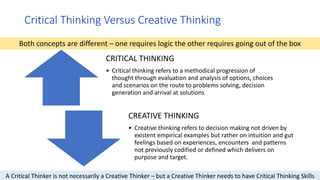
Critical Thinking Versus Creative Thinking
CRITICAL THINKING
• Critical thinking refers to a methodical progression of
thought through evaluation and analysis of options, choices
and scenarios on the route to problems solving, decision
generation and arrival at solutions
CREATIVE THINKING
• Creative thinking refers to decision making not driven by
existent empirical examples but rather on intuition and gut
feelings based on experiences, encounters and patterns
not previously codified or defined which delivers on
purpose and target.
Both concepts are different – one requires logic the other requires going out of the box
A Critical Thinker is not necessarily a Creative Thinker – but a Creative Thinker needs to have Critical Thinking Skills
Left Brain Versus Right Brain
Logic
Analysis
Process
Sequencing
Computation
Intuition
Imagination
Creativity
Emotions
Visualisation
Creative Thinking Defined
“The attitude to accept change and new ideas, a willingness to play with
ideas and possibilities, a flexibility of outlook.”
- Harris, 1998
COMPONENTS OF CREATIVITY
Aptitude to imagine and draw
inferences from unnoticed patterns
Aptitude for innovation and ideas
by combining hitherto unrelated
things, changing sequence of
actions and patterns or reimagining
old ideas and concepts
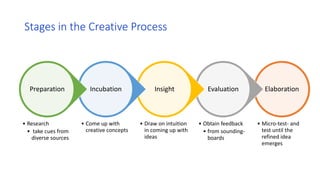
Stages in the Creative Process
Elaboration
• Micro-test- and
test until the
refined idea
emerges
Evaluation
• Obtain feedback
• from sounding-
boards
Insight
• Draw on intuition
in coming up with
ideas
Incubation
• Come up with
creative concepts
Preparation
• Research
• take cues from
diverse sources
Gains of Creativity
Breaking new
grounds
Creation of
new trends
Defeat of
conventional
wisdom
Break through
solution
Impact of Creativity
New ways of
doing things
Increased
productivity
Creates
wealth
Improves work
and wellbeing
Creativity Drives:
2. Innovation
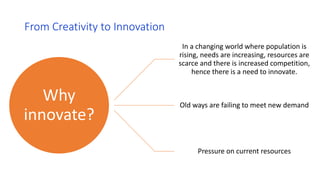
From Creativity to Innovation
Why
innovate?
In a changing world where population is
rising, needs are increasing, resources are
scarce and there is increased competition,
hence there is a need to innovate.
Old ways are failing to meet new demand
Pressure on current resources
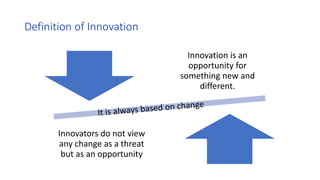
Definition of Innovation
Innovation is an
opportunity for
something new and
different.
Innovators do not view
any change as a threat
but as an opportunity
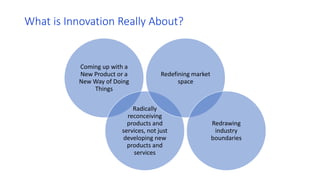
What is Innovation Really About?
Coming up with a
New Product or a
New Way of Doing
Things
Radically
reconceiving
products and
services, not just
developing new
products and
services
Redefining market
space
Redrawing
industry
boundaries
What innovation Entails?
• Capacity to imagine and
quickly adapt
Curiousity and
Adaptibilty
• Ability to identify needs
and opportunity
Insight and
Foresight • Ability to create
previously unthought-
about Possibilities - new
products or processes
and new business
models
Risk and
Result
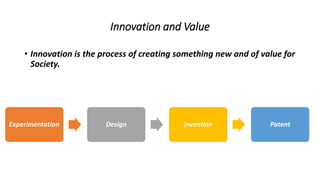
Innovation and Value
• Innovation is the process of creating something new and of value for
Society.
Experimentation Design Invention Patent
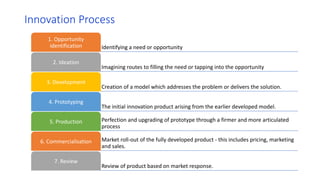
Innovation Process
Identifying a need or opportunity
1. Opportunity
identification
Imagining routes to filling the need or tapping into the opportunity
2. Ideation
Creation of a model which addresses the problem or delivers the solution.
3. Development
The initial innovation product arising from the earlier developed model.
4. Prototyping
Perfection and upgrading of prototype through a firmer and more articulated
process
5. Production
Market roll-out of the fully developed product - this includes pricing, marketing
and sales.
6. Commercialisation
Review of product based on market response.
7. Review
Sources of Innovation
Rapidly
Changing
Environment
Economy Technology Customers Competitors
Maverick Government Regulations Distribution Channels
Management Employees Suppliers
The Oslo Manual for Innovation
Product innovation
• A good or service
that is new or
significantly
improved.
• This includes
significant
improvements in
technical
specifications,
components and
materials, software
in the product, user
friendliness or
other functional
characteristics.
Process innovation
• A new or
significantly
improved
production or
delivery method.
• This includes
significant changes
in techniques,
equipment and/or
software.
Marketing
innovation
• A new marketing
method involving
significant changes
in product design or
packaging, product
placement, product
promotion or
pricing.
Organisational
innovation
• A new
organisational
method in business
practices,
workplace
organisation or
external relations.
Drivers for innovation
Financial pressures
•Need to reduce costs, increase
efficiency or do more with less, etc
Increased competition
•Greater availability of potentially
useful technologies coupled with a
need to exceed the competition in
these technologies
Shorter product life cycles
•Arising from adaptive competitors
and Consumer sophistication.
Value migration
•Demographic, social and maket
changes
•Rising customer expectations
regarding service and quality
Stricter regulation
•Increased demand for
accountability
Industry and community
needs for sustainable
development
•The need to replenish the earth
and create a basis for friendly
environmental practices.
Changing economy
•Recessions and depressions
usually lead to changes in
economic models and this compels
innovation
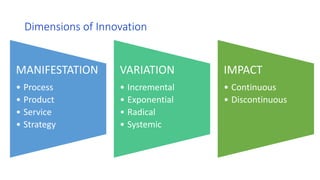
Dimensions of Innovation
MANIFESTATION
• Process
• Product
• Service
• Strategy
VARIATION
• Incremental
• Exponential
• Radical
• Systemic
IMPACT
• Continuous
• Discontinuous
SYSTEM New series of cars,
planes, computers, TV
New generation (MP3
and download as
substitution of CD)
Steam engine, ICT,
biotechnology,
nanotechnology
COMPONENT Improvement of
components
New components for
existing systems
Advanced materials
improving component
properties
INCREMENTAL
“do better what we
already do”
“new for the company”
RADICAL
“new for the world”
SYSTEM New series of cars,
planes, computers, TV
New generation (MP3
and download as
substitution of CD)
Steam engine, ICT,
biotechnology,
nanotechnology
Classification of Innovations
Creating the Innovation DNA
Systematic
collection of all
impulses that could
lead to innovation
Creativity of
employees
Ability to evaluate
the possibility of
the innovation idea
Good team work
Project-based
approach and
ability to manage
projects
Proper rate of risk-taking
Employees’ motivation (the
employees are willing to improve
the product and the operation of
the whole company)
Continued education of employees
Driving Innovation to Transformation
• To allow, and
encourage, community
to share experiences
and affect product
offering and delivery
Understand
the Customer
• To understand, engage
and retail to customer
base and primary
market via digital
tools.
Reinvent the
Business • To provide insights on
people’s ethnos,
behavior and other
required metrics .
Build Eco-
systems
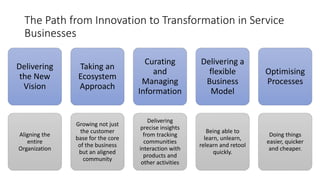
The Path from Innovation to Transformation in Service
Businesses
Delivering
the New
Vision
Aligning the
entire
Organization
Taking an
Ecosystem
Approach
Growing not just
the customer
base for the core
of the business
but an aligned
community
Curating
and
Managing
Information
Delivering
precise insights
from tracking
communities
interaction with
products and
other activities
Delivering a
flexible
Business
Model
Being able to
learn, unlearn,
relearn and retool
quickly.
Optimising
Processes
Doing things
easier, quicker
and cheaper.
Thank You.

Creative Thinking and Innovation

  • 1.
    Bolaji Okusaga Redefining Contexts– Creating Possibilities Creative Thinking and Innovation
  • 2.
    Content S/N SUBJECT SLIDES 1Creativity 3 - 9 2. Innovation 10 - 25
  • 3.
  • 4.
    Critical Thinking VersusCreative Thinking CRITICAL THINKING • Critical thinking refers to a methodical progression of thought through evaluation and analysis of options, choices and scenarios on the route to problems solving, decision generation and arrival at solutions CREATIVE THINKING • Creative thinking refers to decision making not driven by existent empirical examples but rather on intuition and gut feelings based on experiences, encounters and patterns not previously codified or defined which delivers on purpose and target. Both concepts are different – one requires logic the other requires going out of the box A Critical Thinker is not necessarily a Creative Thinker – but a Creative Thinker needs to have Critical Thinking Skills
  • 5.
    Left Brain VersusRight Brain Logic Analysis Process Sequencing Computation Intuition Imagination Creativity Emotions Visualisation
  • 6.
    Creative Thinking Defined “Theattitude to accept change and new ideas, a willingness to play with ideas and possibilities, a flexibility of outlook.” - Harris, 1998 COMPONENTS OF CREATIVITY Aptitude to imagine and draw inferences from unnoticed patterns Aptitude for innovation and ideas by combining hitherto unrelated things, changing sequence of actions and patterns or reimagining old ideas and concepts
  • 7.
    Stages in theCreative Process Elaboration • Micro-test- and test until the refined idea emerges Evaluation • Obtain feedback • from sounding- boards Insight • Draw on intuition in coming up with ideas Incubation • Come up with creative concepts Preparation • Research • take cues from diverse sources
  • 8.
    Gains of Creativity Breakingnew grounds Creation of new trends Defeat of conventional wisdom Break through solution
  • 9.
    Impact of Creativity Newways of doing things Increased productivity Creates wealth Improves work and wellbeing Creativity Drives:
  • 10.
  • 11.
    From Creativity toInnovation Why innovate? In a changing world where population is rising, needs are increasing, resources are scarce and there is increased competition, hence there is a need to innovate. Old ways are failing to meet new demand Pressure on current resources
  • 12.
    Definition of Innovation Innovationis an opportunity for something new and different. Innovators do not view any change as a threat but as an opportunity
  • 13.
    What is InnovationReally About? Coming up with a New Product or a New Way of Doing Things Radically reconceiving products and services, not just developing new products and services Redefining market space Redrawing industry boundaries
  • 14.
    What innovation Entails? •Capacity to imagine and quickly adapt Curiousity and Adaptibilty • Ability to identify needs and opportunity Insight and Foresight • Ability to create previously unthought- about Possibilities - new products or processes and new business models Risk and Result
  • 15.
    Innovation and Value •Innovation is the process of creating something new and of value for Society. Experimentation Design Invention Patent
  • 16.
    Innovation Process Identifying aneed or opportunity 1. Opportunity identification Imagining routes to filling the need or tapping into the opportunity 2. Ideation Creation of a model which addresses the problem or delivers the solution. 3. Development The initial innovation product arising from the earlier developed model. 4. Prototyping Perfection and upgrading of prototype through a firmer and more articulated process 5. Production Market roll-out of the fully developed product - this includes pricing, marketing and sales. 6. Commercialisation Review of product based on market response. 7. Review
  • 17.
    Sources of Innovation Rapidly Changing Environment EconomyTechnology Customers Competitors Maverick Government Regulations Distribution Channels Management Employees Suppliers
  • 18.
    The Oslo Manualfor Innovation Product innovation • A good or service that is new or significantly improved. • This includes significant improvements in technical specifications, components and materials, software in the product, user friendliness or other functional characteristics. Process innovation • A new or significantly improved production or delivery method. • This includes significant changes in techniques, equipment and/or software. Marketing innovation • A new marketing method involving significant changes in product design or packaging, product placement, product promotion or pricing. Organisational innovation • A new organisational method in business practices, workplace organisation or external relations.
  • 19.
    Drivers for innovation Financialpressures •Need to reduce costs, increase efficiency or do more with less, etc Increased competition •Greater availability of potentially useful technologies coupled with a need to exceed the competition in these technologies Shorter product life cycles •Arising from adaptive competitors and Consumer sophistication. Value migration •Demographic, social and maket changes •Rising customer expectations regarding service and quality Stricter regulation •Increased demand for accountability Industry and community needs for sustainable development •The need to replenish the earth and create a basis for friendly environmental practices. Changing economy •Recessions and depressions usually lead to changes in economic models and this compels innovation
  • 20.
    Dimensions of Innovation MANIFESTATION •Process • Product • Service • Strategy VARIATION • Incremental • Exponential • Radical • Systemic IMPACT • Continuous • Discontinuous
  • 21.
    SYSTEM New seriesof cars, planes, computers, TV New generation (MP3 and download as substitution of CD) Steam engine, ICT, biotechnology, nanotechnology COMPONENT Improvement of components New components for existing systems Advanced materials improving component properties INCREMENTAL “do better what we already do” “new for the company” RADICAL “new for the world” SYSTEM New series of cars, planes, computers, TV New generation (MP3 and download as substitution of CD) Steam engine, ICT, biotechnology, nanotechnology Classification of Innovations
  • 22.
    Creating the InnovationDNA Systematic collection of all impulses that could lead to innovation Creativity of employees Ability to evaluate the possibility of the innovation idea Good team work Project-based approach and ability to manage projects Proper rate of risk-taking Employees’ motivation (the employees are willing to improve the product and the operation of the whole company) Continued education of employees
  • 23.
    Driving Innovation toTransformation • To allow, and encourage, community to share experiences and affect product offering and delivery Understand the Customer • To understand, engage and retail to customer base and primary market via digital tools. Reinvent the Business • To provide insights on people’s ethnos, behavior and other required metrics . Build Eco- systems
  • 24.
    The Path fromInnovation to Transformation in Service Businesses Delivering the New Vision Aligning the entire Organization Taking an Ecosystem Approach Growing not just the customer base for the core of the business but an aligned community Curating and Managing Information Delivering precise insights from tracking communities interaction with products and other activities Delivering a flexible Business Model Being able to learn, unlearn, relearn and retool quickly. Optimising Processes Doing things easier, quicker and cheaper.
  • 25.