Place Potential Prospects Problems Perspective Promise
RETHINKING NIGERIA
By Bolaji Okusaga
Content
No Subject Slides
1. Place 3 - 12
2. Potential 13 - 18
3. Prospect 19 - 23
4. Problems 24 - 39
5. Perspective 40 - 48
6. Promise 49 - 56
1. Place
Nigeria – Global Position
POSITION
• A Federation of 36 States with
a land Mass of 910770 sq. Km -
Larger than Britain and France
combined
POPULATION AND POWER
• .Largest Black Nation on Earth
• 7th Largest Population in the
World
• 1/5 of the people in Africa
• Over 20% of Africa’s Output
• Over 60% of West Africa’s
Economic Output
Language and Culture
A country with rich and diverse
culture
With 3 major Languages and
over 250 other Languages
Culturally and linguistically
diverse
Islam is predominant in the
North and the South is made up
majorly of Christians
Diversity and Divisions
Over 250 ethnic groups
• Hausa-Fulani 29%
• northern half, overwhelmingly
Muslim
• Yoruba 21%
• southwest forest and Lagos
• Igbo 18%
• southeastern market agriculture
Religion: Christian-Muslim
split nearly 50-50
• There are pockets of Animists and
Traditional Religious Worshippers
Colonial History
British interest in West
Africa
• slave trade from the
16th century to 1807
The Conference of
Berlin in 1884-1885
• Africa was divided
into spheres of
influence
• the colonial
boundaries extended
northward
• the climate and
cultural zones run east
and west
Federal system of 3
regions in 1954
• State creation
followed after the Civil
War
Independence: 1960-10-01
Without exception, British colonies came to independence
with a parliamentary system based on the Westminster model
A ceremonial governor-general was named by the British
monarch until 1963
The disastrous failure of the first republic in 1966 called into
question the previous parliamentary system
29 Years of Military Rule
Military Incursion
from 1966 to 1976,
five Nigerian chief
executives were
killed or removed by
military coups
confusion and clash
between the
“modern” and the
hundreds of
“traditions”
resultant confusion
produced political
instability, economic
woes, and constant
military
interventions
From Military Rule to Democracy
Almost 16 years of military rule by
the Provisional Ruling Council after
1984
• General Abdulsami Abubakar handed over
power to civilians in 1999
In 1999 Nigeria returned to civilian
rule
• Obasanjo was elected president
• A new legislature was elected
In 2003 President Obasanjo was
reelected
• His People’s Democratic Party also won
majority of seats in both houses
In 2007, there was a Civilian to
Civilian hand-over a President
Obasanjo handed over to Umaru
Yaradua
• With the death of Umaru Yaradua, Goodluck
Jonathan became President in 2010
• President Jonathan won elections as
President in 2011
Presidential System
The 1979 Constitution
of the 2nd Republic
was modeled on the
US model
The 1999 Constitution
of the 4th Republic
• The 1989 Constitution followed the
1979 example
• an independently elected president
• bicameral National Assembly at the
federal level serve 4-year terms
• House of Representatives: 360
• Senate: 3 senators from each of 36
states
Prevailing Issues
1. Boko Haram
• The issue of National
Security , internal
cohesion and
harmony
• Since 2010, a Terrorist
group: Boko Haram
has been battling to
have an Islamic State
in Northern Nigeria
2. The Integrity of
Elections and the
Electoral Process
• There were
allegations that the
2007 Elections
marking the first
Civilian to Civilian
Handover, were not
credible
3. Corruption –
Siemens, Halliburton,
Daimler and others
• There has been
allegations of
Corruption involving
Government Officials
and some Multi-
National Companies
over Contract Awards
2. Potential
Nigeria – Fast Facts
Total Population
based on latest
United Nations
estimates is
196,742,363
POPULATION SIZE
The median age in
Nigeria is 17.9 years
DEMOGRAPHY
Ranks 10th among
the countries with
the highest average
birth rate for the
time period
between 2010 and
2015
BIRTH RATE
•2014 GDP – $568.5B
•2015GDP - $493.84
•2016 GDP - $405.44
•2017 GDP - $376.28
ECONOMY
Nigeria’s Competitive Edge
Large indigenous
consumer market
Abundant natural
resources
Strong agricultural
base
Hardworking and
resourceful labor
force
Central location in
Africa
Pros: Largest market in Africa
Young Population
Cheaper Labour
Cons: Red-tap
Unclear Policies
Tough Operating Environment
Nigeria Has Abundant Natural Resources
Large Petroleum and Large natural gas reserves
◦ Sixth Largest Crude Oil Producer in the World
A huge variety of natural resources:
COAL
South East (Enugu)
GOLD
South West and parts of North- Central
COLUMBITE AND TANTALITE
North Central especially around
Plateau and Nasarawa States
BITUMEN
South West and Edo State
IRON ORE
North-Central, around Ajaokuta
URANIUM
Cross River State, Adamawa State,
Taraba State, Plateau State,
Bauchi State, and Kano State
Nigeria Has a Large Arable Land and Agricultural Base
Nigeria has ecosystems, arable lands and yield gaps that can be
exploited:
Well over two-third
of the land is
cultivable: 30,850
thousand hectares
of Arable Land
Rainfall supports
rain-fed agriculture
in the whole of
Nigeria
Northern, irrigated
agriculture
predominates in
the area around
the Lake T-Chad
Basin
3. Prospects
BEFORE
• Lull in investment activities post 2015
elections
• The fall in Oil prices and attendant dip
in foreign reserves
• Multiple exchange regime
• Hazy understanding of investment
climate given low ranking on the ease of
doing business ranking
NOW
• Reawakened response to investment
opportunities given the following actions
taken by government:
• Intervention in by the CBN in forex
market gradually bridging the gap
between official and black market rates.
• Executive orders issued on
competitiveness and ease of doing
business.
• The setting up of the Nigerian Industrial
Policy and Competitiveness Advisory
made up of government and private
sector players also gives a boost to flow
of FPIs and FDIs
• Economic Recovery and Growth Plan
Investment Climate
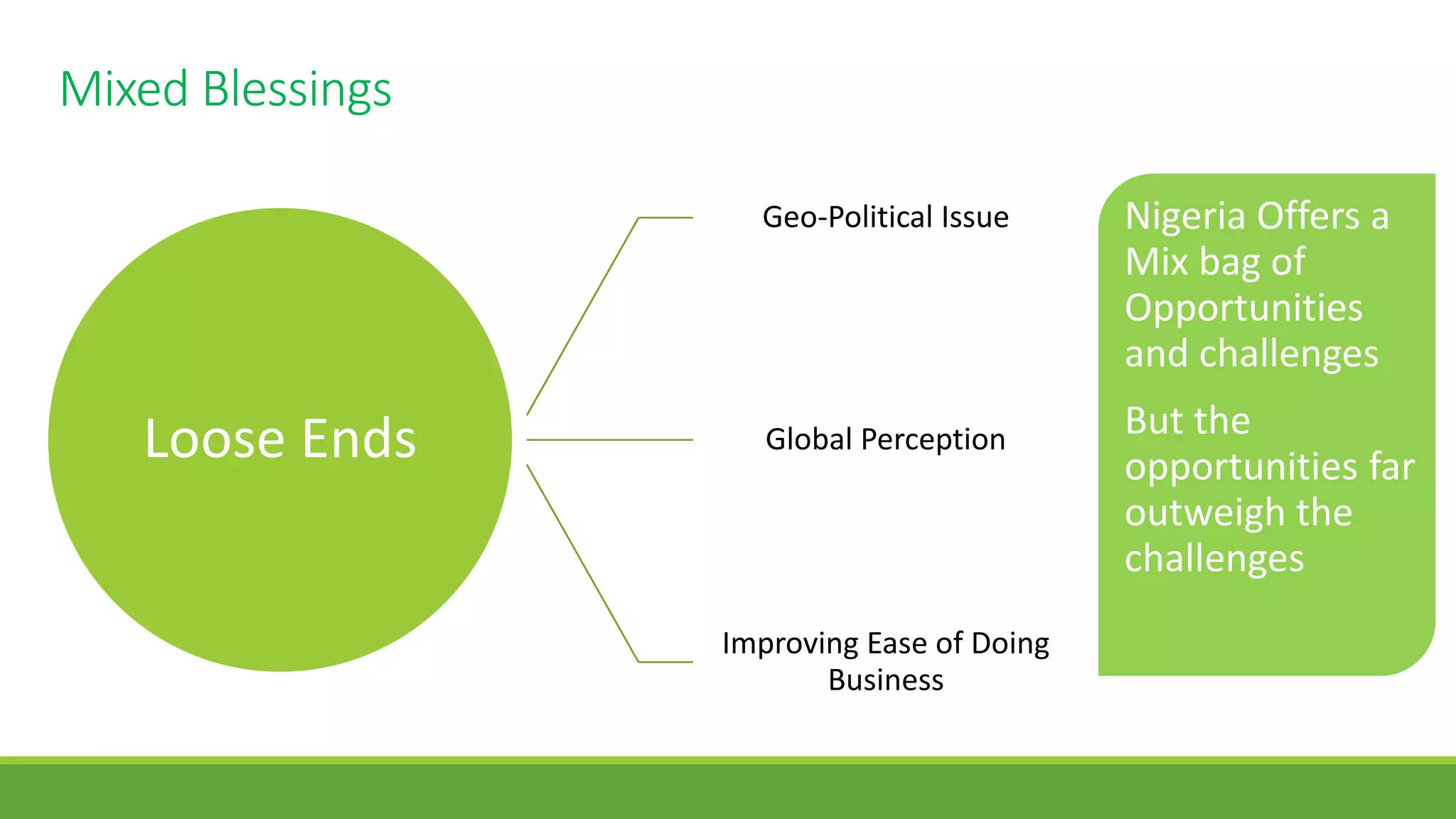
Mixed Blessings
Loose Ends
Geo-Political Issue
Global Perception
Improving Ease of Doing
Business
Nigeria Offers a
Mix bag of
Opportunities
and challenges
But the
opportunities far
outweigh the
challenges
4. Problems
Political Economy
A Primary
Product
Economy
with Weak
States that are
not able to
Lead Growth
Differences in commodities advantage either through agricultural or mineral
resources determine the success or failure of States.
A few States with industrial and commercial advantages such as Lagos and
Ogun also reap economic advantages given their unique positioning.
Economic opportunities and potential for growth are more pronounced in
just four regions out of the six regions of Nigeria with the North East being
the least advantaged given the activities of terrorists which has been raging
for almost a decade now in that part of the Country.
Institutional Issues
Corruption, Ethics
and transparency
issue
Bureaucracy
Regulatory issues
and cost of
compliance
Tax issues
Licensing issues
Contract
enforcement
Property right
protection
Standards
enforcement
Market Issues
Competitivenss
issues
Market
demand
Domestic
demand
Global market
Strucutre of
demand
Cost Issues
Cost of
funds
Tenure of
funds
Intervention
funds
Exchange
rate
Captial
market
Corporate
bonds
Nigeria Competitiveness
Ranked 94th but further dropped to 124
out of the 140 countries in the Global
Competitiveness Index
Ranked 127th out of f 138 economies.
Mauritius remains the region’s most
competitive economy rated 46, while Côte
d’Ivoire at 91 is the most improved country
in Sub-Saharan Africa, followed by Ethiopia
ranked 109.”
https://www.vanguardngr.com/2016/07/nigeria-ranks-124-
global-competitiveness-index-world-bank/
https://www.vanguardngr.com/2016/07/ni
geria-ranks-124-global-competitiveness-
index-world-bank/
Global Competitiveness
Report
Year 2016-2017
Ranked 127th in the World Economic Forum
(WEF) report globally and 26th Africa’s most
competitive economies
http://www.businessjournalng.com/nigeria-ranks-127-
wef-2016-2017-global-competitiveness-report/
Global Competitiveness
Report
Year 2014-2015
Global Competitiveness
Report
Year 2005
Nigeria’s Competitiveness (contd.)
Nigeria remains a factor-
driven Economy
Economy is dependent on
Natural Resources
Crude Oil is yet to have a
maximal effect on GDP
However there is a move
towards an efficiency driven
economy through reforms
and better macro-economic
management
…Nigeria Competitiveness Index
(2016 – 2017)
Factors influencing Nigeria’s Competitiveness
High Inflation
rate
Low Labour
Productivity
High exchange
value
High Tax Rate
High Costs of
doing business
Over-reliant on
foreign exchange
earnings from
petroleum
product
Doing Business in Nigeria
% of sales, additional costs from :
29
Constraints of Doing Business in Nigeria
Weak Infrastructure,
particularly power and
transportation
Businesses have to provide
alternatives to public
services:
• Alternative Power Generation
(Nigeria is the world’s biggest
market for private
generators).
• Security Services
• Courier and Postal Deliveries
• Water Boreholes
Problems associated
with export and import
logistics-ports; customs;
inspection services; etc
30
Understanding the Risks
The risk of
expropriation
Dealing with
periodic Geo-
political Tension
Policy
Somersaults
The Result
Education
• Over 10 Million Children of
School Age out of School
• 1.8 Million Youths graduate
annually from the Tertiary
Institutions
Unemployment.
• Unemployment – 18.8%
• Youth unemployed over 11.1
million
Industry
• Over 60% of all major
Industries in Nigeria are closed
down from Operations - from
Cottage Industries to Auto-
Industry, from Food
Manufacturing to Textiles
• 40 - 30% Operating, Operate
at below 50% Capacity.
The major cause of poverty in Nigeria is the inability of the system to
create opportunities for its teeming population.
Source: NBS
Gaps
Reality
Check
A combination of resource endowments and favorable
global commodity prices now determine which
states/regions enjoy growth. Two regions, North West
and North Central, account for 90 percent of crop
production, South-South accounts for 92 percent of
oil production, and South West (essentially Lagos and
Ogun) account for 60 percent of trading and
commercial activities, with North Central and South-
South also contributing 30 percent of this.
Other Resource based Economies in Africa
Congo
(DRC)
Though War-torn, a
number of Canadian
and Belgian mining
companies are
already operating in
the Country
Liberia /
Sierra
Leone
Emerging from the
devastating
experience of war
but with huge solid
mineral potentials
Angola
Coming out of
decades of war,
Angola is presently
positioning as the
seed-bed for solid
minerals
South
Africa
By far the greatest
competitor. Has a
more developed
market and better
infrastructure
Implications of Building Foreign Earnings on a Wasting Asset
The Need to raise Industrial
capacity in the Economy
• Agriculture accounts for over 60%
employment, but weak
infrastructure and a lack of a
value chain approach to sector
development militates against
growth
• Petroleum Industry’s rating is
poor given the fact that the
down-stream sector remains
largely undeveloped
• Mining is basically absent on the
radar because of a lack of policy
and regulatory environment to
harness this great potential
Crude Oil is a Wasting Asset
• It is projected by 2048 Nigeria’s
Oil Reserves will dry up
• The invention of Electric Cars,
Shale Oil and mainstreaming of
alternative energy sources also
spell doom for Crude Oil
Commodities will not mean much
except it is backed with value
addition
• Without secondary industries
that add value to Agricultural
output, poverty and
underdevelopment will continue
to plague the Nation
36
The Development
Plans under the
Military
NEEDS
Seven-Point
Agenda
Economic
Recovery and
Growth Plan ERGP
Development Policies Examined:
The broad goals are :
Lowering of domestic
cost structure
especially
infrastructure cost
Strong promotion of
exports
Harmonization of
tariffs across ECOWAS
to create the common
external tariff (CET);
Use of systemic
import restrictions in
particular in particular
sectors to quicken
local capacity
The restructuring of
institutions
responsible for trade
facilitation
Little has been achieved
in terms of
rebalancing the Economy
by diversifying its
productive base.
The Reality…
The Challenge – The Oil Doom of 2014 - 2017
Removal of
41 Items
from Official
Forex
Allocation
Sourcing of imported materials was negatively impacted
by the ban on 41 items from forex
Local sourcing of materials was extremely high on pricing
in comparison to importation of raw materials
Drop in oil price:
Largest contributor to
Nigeria’s FX earnings
and government
revenue
Declining reserves:
FX reserves declined to
USD30.3bn (November
2015) from USD34.6bn
at the beginning of the
year due to significantly
lower oil revenues.
Devaluation of
naira:
In Feb 2015 with the
closure of the
WDAS/RDAS window.
Tightened FX
market:
Restrictions on forex
transactions: “41 items
introduced”.
Demand / supply
disparity:
Corporate demand
rationed with an
estimated backlog of
around USD3.0bn.
The Reaction
Source: Standard Bank
5. Perspective
EDUCATION
Tied to poverty is illiteracy. How do we avail the
right kind of education that can feed our
development needs?
Is it education that prioritises white-collar jobs
or blue-collar, one that seeks to accelerate
development and one that targets the bottom
of the pyramid - giving them requisite
vocational skills that can feed into a chain of
small businesses and can guarantee a supply of
support skills that can help quicken our
infrastructure and industrial development?
ENERGY
Growth and Development
are actually not synonyms.
In Nigeria's case, growth
averaged 7.4% between
2004 – 2014 without
commensurate
development.
How can a nation fast-track
development with
electricity supplies to the
national grid averaging
2,500 Megawatts in a nation
of 193 million people?
It is often said that small
businesses are the engine
room of development in any
economy, and China
remains a classic example.
There is a correlation
between access to energy
and cost doing business as
well as the development of
small businesses.
EMPOWERMENT
Agriculture contributes about 25% of
Nigeria's GDP, but it is largely done at
subsistence level with no empowerment
for rural and small-holder farmer, hence
the high-level of rural-urban drift and
tied to this is the high level of destitute
and crime in our urban centres.
How can we empower smallholder
farmers, implement a value chain
approach to the development of our
Agriculture while moving from Farm-gate
to factory-gate?
Rethinking Political Structure
In the absence of a grand plan to open up opportunities
in every region of Nigeria, rich regions will continue to
get richer and poor regions will continue to decline.
The reality is that some states/regions can
achieve faster growth in the prevailing global
economic and financial environment, while
others will need to look inward and draw
strengths from underleveraged advantages
Otherwise, states/regions with economic
advantages are going to continue to get
richer while the poor states/regions will get
poorer.
Restructure Politically, Integrate Economically
Honing and Owning Competitive Advantage – Regional Integration is the Way to Go
• STRUCTURE
• Break Federating Units into Regions to pull resources and leverage scale advantage
• INTEGRATION
• Fast and efficient rail links between rich and poor regions could bring resource-poor regions
closer to needful inputs
• But a whole lot will depend on how fast States are able to bond together under a regional
arrangement with the centre devolving more power in order to allow regions leverage scale
and scope advantage and by so doing, hone and own their competitive advantages.
• The centre will however continue to help with policies which create a better business
environment and attract the investments needed to jumpstart regional economies.
Rethinking Internal Security
Searching
for the Right
Type of
Security
Architecture
Buhari government scores relatively high in the area of security and attempts to
reintegrate the North East into Nigeria’s economic architecture
The reality is that tensions originating from states/regions excluded from
economic growth and employment opportunities will continue threaten the
sustenance of growth in states/regions that currently enjoy economic advantages.
It is necessary for the government to look at national security beyond military
interventions, as the root cause of tensions and political instability are more linked
to Nigeria’s current combined unemployment and underemployment statistics
which is put at 45%, and the non engagement of the youth segment of the
population in gainful economic activities.
Rethinking Growth
Banking and Financial
Services
Oil and Gas Agriculture
Construction and
Infrastructure
Information Technology
and
Telecommunications
Manufacturing
Transport and Aviation
Mining and Solid
Minerals
Publishing
Arts, Media and
Entertainment
Informal Sector and
SME’s
Energy and Electricity
Enhancing growth through optimizing sectorial GDP contribution
Retaining Value…
Rich in Natural
Resources
Cheap Labour
Biggest
Economy in
Africa
Need to arrest corruption to stave-off VALUE ATTRITION
Advantages
Need to keep improving Ease of Doing Business
Need to invest more in Human Capital
Development
The Push for “Made in Nigeria”
GLOBAL REALITY
• World over,
Manufacturing and
Productive Activities
plays a major role in the
improvement of a
nations economic
fortunes
THE BENCHMARK
• Following the examples
of the Asian Tigers
Nigeria intends to
initiate an active
campaign towards
driving in In-bound
Manufacturing
opportunities
GETTING THERE…
• The Nigeria Made in
Nigeria Show is therefore
one of the tactical
imperatives for achieving
the target objective.
The Role of Trade
TRADE AS
PLATFORM
The need for cooperation
with other African and
developing countries to
ensure that the WTO
trade negotiations
address the concerns and
interests of Nigeria
including the negotiation
of Economic Partnership
Agreements (EPAs);
We have seen the
recent attempts by
Morrocco to join
ECOWAS and the
push by European
Union to push its
trade agenda
The Role of Investments
FDI is a means to
development, not an end
in itself
Complementary domestic
policies are needed to
facilitate spillovers,
growth and environmental
protection
Trade and financial
agreements must
preserve the ‘policy space’
for complementary efforts
on a national scale
• FDI is Good, but real development comes from domesticating our
advantages first
6. Promises
Critical Success Factor – Growing an Home Advantage
A holistic approach, where Nigeria would tie into the on going reforms of the Federal
Government, by lending a voice to the call on Nigerians in Diaspora to come back
home, and in so doing, begin a decision towards taking an economic stake in Nigeria
Subtly projecting the advantages of taking an economic stake in Nigeria, while bringing
out the benefits of Nigeria Manufacturing opportunity
Attempt a comparative analysis of
Manufacturing opportunities and the
offer from Nigeria
Ensure ease of accessibility to
Manufacturing opportunity, convenient
and affordable structure and process
Desired Destination
Design Develop Deploy
ACTIVATING NIGERIA’S COLLECTIVE
PROSPERITY
Design
Strengthen institutions
Support transparency, fight
against corruption
Structural reforms
Fiscal Federalism
Privatization, liberalization and
deregulation.
Development Agenda
Investment in Health and
Education
Investment in priority sectors
creating jobs
Right Policies
Ensure macroeconomic stability
& sustainable growth
Develop
Technology
Scientific knowledge - turn knowledge into products
Strategic assets
Human Capital 70% of Population below 40
Efficiency
Exploiting different factor endowments, cultures, institutional arrangements, economic systems and
policies and market structures
Deploy
A Country can boost productivity
by restructuring and removing
bureaucracy , but it cannot
sustain high productivity without
having a motivated and
committed citizenry.
Our emotional
energy must be
focused on
building our
collective
dream as a
nation.
Passing Shot
What’s said
and what’s
left?
You have heard about the place
Its potential
Its prospects
Its problems
A perspective on the problem
The promise it holds for the black race…
IT IS NOW TIME FOR PERFORMANCE!
Thank You

Rethinking nigeria

  • 1.
    Place Potential ProspectsProblems Perspective Promise RETHINKING NIGERIA By Bolaji Okusaga
  • 2.
    Content No Subject Slides 1.Place 3 - 12 2. Potential 13 - 18 3. Prospect 19 - 23 4. Problems 24 - 39 5. Perspective 40 - 48 6. Promise 49 - 56
  • 3.
  • 4.
    Nigeria – GlobalPosition POSITION • A Federation of 36 States with a land Mass of 910770 sq. Km - Larger than Britain and France combined POPULATION AND POWER • .Largest Black Nation on Earth • 7th Largest Population in the World • 1/5 of the people in Africa • Over 20% of Africa’s Output • Over 60% of West Africa’s Economic Output
  • 5.
    Language and Culture Acountry with rich and diverse culture With 3 major Languages and over 250 other Languages Culturally and linguistically diverse Islam is predominant in the North and the South is made up majorly of Christians
  • 6.
    Diversity and Divisions Over250 ethnic groups • Hausa-Fulani 29% • northern half, overwhelmingly Muslim • Yoruba 21% • southwest forest and Lagos • Igbo 18% • southeastern market agriculture Religion: Christian-Muslim split nearly 50-50 • There are pockets of Animists and Traditional Religious Worshippers
  • 7.
    Colonial History British interestin West Africa • slave trade from the 16th century to 1807 The Conference of Berlin in 1884-1885 • Africa was divided into spheres of influence • the colonial boundaries extended northward • the climate and cultural zones run east and west Federal system of 3 regions in 1954 • State creation followed after the Civil War
  • 8.
    Independence: 1960-10-01 Without exception,British colonies came to independence with a parliamentary system based on the Westminster model A ceremonial governor-general was named by the British monarch until 1963 The disastrous failure of the first republic in 1966 called into question the previous parliamentary system
  • 9.
    29 Years ofMilitary Rule Military Incursion from 1966 to 1976, five Nigerian chief executives were killed or removed by military coups confusion and clash between the “modern” and the hundreds of “traditions” resultant confusion produced political instability, economic woes, and constant military interventions
  • 10.
    From Military Ruleto Democracy Almost 16 years of military rule by the Provisional Ruling Council after 1984 • General Abdulsami Abubakar handed over power to civilians in 1999 In 1999 Nigeria returned to civilian rule • Obasanjo was elected president • A new legislature was elected In 2003 President Obasanjo was reelected • His People’s Democratic Party also won majority of seats in both houses In 2007, there was a Civilian to Civilian hand-over a President Obasanjo handed over to Umaru Yaradua • With the death of Umaru Yaradua, Goodluck Jonathan became President in 2010 • President Jonathan won elections as President in 2011
  • 11.
    Presidential System The 1979Constitution of the 2nd Republic was modeled on the US model The 1999 Constitution of the 4th Republic • The 1989 Constitution followed the 1979 example • an independently elected president • bicameral National Assembly at the federal level serve 4-year terms • House of Representatives: 360 • Senate: 3 senators from each of 36 states
  • 12.
    Prevailing Issues 1. BokoHaram • The issue of National Security , internal cohesion and harmony • Since 2010, a Terrorist group: Boko Haram has been battling to have an Islamic State in Northern Nigeria 2. The Integrity of Elections and the Electoral Process • There were allegations that the 2007 Elections marking the first Civilian to Civilian Handover, were not credible 3. Corruption – Siemens, Halliburton, Daimler and others • There has been allegations of Corruption involving Government Officials and some Multi- National Companies over Contract Awards
  • 13.
  • 14.
    Nigeria – FastFacts Total Population based on latest United Nations estimates is 196,742,363 POPULATION SIZE The median age in Nigeria is 17.9 years DEMOGRAPHY Ranks 10th among the countries with the highest average birth rate for the time period between 2010 and 2015 BIRTH RATE •2014 GDP – $568.5B •2015GDP - $493.84 •2016 GDP - $405.44 •2017 GDP - $376.28 ECONOMY
  • 15.
    Nigeria’s Competitive Edge Largeindigenous consumer market Abundant natural resources Strong agricultural base Hardworking and resourceful labor force Central location in Africa Pros: Largest market in Africa Young Population Cheaper Labour Cons: Red-tap Unclear Policies Tough Operating Environment
  • 16.
    Nigeria Has AbundantNatural Resources Large Petroleum and Large natural gas reserves ◦ Sixth Largest Crude Oil Producer in the World A huge variety of natural resources: COAL South East (Enugu) GOLD South West and parts of North- Central COLUMBITE AND TANTALITE North Central especially around Plateau and Nasarawa States BITUMEN South West and Edo State IRON ORE North-Central, around Ajaokuta URANIUM Cross River State, Adamawa State, Taraba State, Plateau State, Bauchi State, and Kano State
  • 17.
    Nigeria Has aLarge Arable Land and Agricultural Base Nigeria has ecosystems, arable lands and yield gaps that can be exploited: Well over two-third of the land is cultivable: 30,850 thousand hectares of Arable Land Rainfall supports rain-fed agriculture in the whole of Nigeria Northern, irrigated agriculture predominates in the area around the Lake T-Chad Basin
  • 18.
  • 19.
    BEFORE • Lull ininvestment activities post 2015 elections • The fall in Oil prices and attendant dip in foreign reserves • Multiple exchange regime • Hazy understanding of investment climate given low ranking on the ease of doing business ranking NOW • Reawakened response to investment opportunities given the following actions taken by government: • Intervention in by the CBN in forex market gradually bridging the gap between official and black market rates. • Executive orders issued on competitiveness and ease of doing business. • The setting up of the Nigerian Industrial Policy and Competitiveness Advisory made up of government and private sector players also gives a boost to flow of FPIs and FDIs • Economic Recovery and Growth Plan Investment Climate
  • 20.
    Mixed Blessings Loose Ends Geo-PoliticalIssue Global Perception Improving Ease of Doing Business Nigeria Offers a Mix bag of Opportunities and challenges But the opportunities far outweigh the challenges
  • 21.
  • 22.
    Political Economy A Primary Product Economy withWeak States that are not able to Lead Growth Differences in commodities advantage either through agricultural or mineral resources determine the success or failure of States. A few States with industrial and commercial advantages such as Lagos and Ogun also reap economic advantages given their unique positioning. Economic opportunities and potential for growth are more pronounced in just four regions out of the six regions of Nigeria with the North East being the least advantaged given the activities of terrorists which has been raging for almost a decade now in that part of the Country.
  • 23.
    Institutional Issues Corruption, Ethics andtransparency issue Bureaucracy Regulatory issues and cost of compliance Tax issues Licensing issues Contract enforcement Property right protection Standards enforcement
  • 24.
    Market Issues Competitivenss issues Market demand Domestic demand Global market Strucutreof demand Cost Issues Cost of funds Tenure of funds Intervention funds Exchange rate Captial market Corporate bonds
  • 25.
    Nigeria Competitiveness Ranked 94thbut further dropped to 124 out of the 140 countries in the Global Competitiveness Index Ranked 127th out of f 138 economies. Mauritius remains the region’s most competitive economy rated 46, while Côte d’Ivoire at 91 is the most improved country in Sub-Saharan Africa, followed by Ethiopia ranked 109.” https://www.vanguardngr.com/2016/07/nigeria-ranks-124- global-competitiveness-index-world-bank/ https://www.vanguardngr.com/2016/07/ni geria-ranks-124-global-competitiveness- index-world-bank/ Global Competitiveness Report Year 2016-2017 Ranked 127th in the World Economic Forum (WEF) report globally and 26th Africa’s most competitive economies http://www.businessjournalng.com/nigeria-ranks-127- wef-2016-2017-global-competitiveness-report/ Global Competitiveness Report Year 2014-2015 Global Competitiveness Report Year 2005
  • 26.
    Nigeria’s Competitiveness (contd.) Nigeriaremains a factor- driven Economy Economy is dependent on Natural Resources Crude Oil is yet to have a maximal effect on GDP However there is a move towards an efficiency driven economy through reforms and better macro-economic management
  • 27.
  • 28.
    Factors influencing Nigeria’sCompetitiveness High Inflation rate Low Labour Productivity High exchange value High Tax Rate High Costs of doing business Over-reliant on foreign exchange earnings from petroleum product
  • 29.
    Doing Business inNigeria % of sales, additional costs from : 29
  • 30.
    Constraints of DoingBusiness in Nigeria Weak Infrastructure, particularly power and transportation Businesses have to provide alternatives to public services: • Alternative Power Generation (Nigeria is the world’s biggest market for private generators). • Security Services • Courier and Postal Deliveries • Water Boreholes Problems associated with export and import logistics-ports; customs; inspection services; etc 30
  • 31.
    Understanding the Risks Therisk of expropriation Dealing with periodic Geo- political Tension Policy Somersaults
  • 32.
    The Result Education • Over10 Million Children of School Age out of School • 1.8 Million Youths graduate annually from the Tertiary Institutions Unemployment. • Unemployment – 18.8% • Youth unemployed over 11.1 million Industry • Over 60% of all major Industries in Nigeria are closed down from Operations - from Cottage Industries to Auto- Industry, from Food Manufacturing to Textiles • 40 - 30% Operating, Operate at below 50% Capacity. The major cause of poverty in Nigeria is the inability of the system to create opportunities for its teeming population. Source: NBS
  • 33.
    Gaps Reality Check A combination ofresource endowments and favorable global commodity prices now determine which states/regions enjoy growth. Two regions, North West and North Central, account for 90 percent of crop production, South-South accounts for 92 percent of oil production, and South West (essentially Lagos and Ogun) account for 60 percent of trading and commercial activities, with North Central and South- South also contributing 30 percent of this.
  • 34.
    Other Resource basedEconomies in Africa Congo (DRC) Though War-torn, a number of Canadian and Belgian mining companies are already operating in the Country Liberia / Sierra Leone Emerging from the devastating experience of war but with huge solid mineral potentials Angola Coming out of decades of war, Angola is presently positioning as the seed-bed for solid minerals South Africa By far the greatest competitor. Has a more developed market and better infrastructure
  • 35.
    Implications of BuildingForeign Earnings on a Wasting Asset The Need to raise Industrial capacity in the Economy • Agriculture accounts for over 60% employment, but weak infrastructure and a lack of a value chain approach to sector development militates against growth • Petroleum Industry’s rating is poor given the fact that the down-stream sector remains largely undeveloped • Mining is basically absent on the radar because of a lack of policy and regulatory environment to harness this great potential Crude Oil is a Wasting Asset • It is projected by 2048 Nigeria’s Oil Reserves will dry up • The invention of Electric Cars, Shale Oil and mainstreaming of alternative energy sources also spell doom for Crude Oil Commodities will not mean much except it is backed with value addition • Without secondary industries that add value to Agricultural output, poverty and underdevelopment will continue to plague the Nation
  • 36.
    36 The Development Plans underthe Military NEEDS Seven-Point Agenda Economic Recovery and Growth Plan ERGP Development Policies Examined: The broad goals are : Lowering of domestic cost structure especially infrastructure cost Strong promotion of exports Harmonization of tariffs across ECOWAS to create the common external tariff (CET); Use of systemic import restrictions in particular in particular sectors to quicken local capacity The restructuring of institutions responsible for trade facilitation
  • 37.
    Little has beenachieved in terms of rebalancing the Economy by diversifying its productive base. The Reality…
  • 38.
    The Challenge –The Oil Doom of 2014 - 2017 Removal of 41 Items from Official Forex Allocation Sourcing of imported materials was negatively impacted by the ban on 41 items from forex Local sourcing of materials was extremely high on pricing in comparison to importation of raw materials Drop in oil price: Largest contributor to Nigeria’s FX earnings and government revenue Declining reserves: FX reserves declined to USD30.3bn (November 2015) from USD34.6bn at the beginning of the year due to significantly lower oil revenues. Devaluation of naira: In Feb 2015 with the closure of the WDAS/RDAS window. Tightened FX market: Restrictions on forex transactions: “41 items introduced”. Demand / supply disparity: Corporate demand rationed with an estimated backlog of around USD3.0bn. The Reaction Source: Standard Bank
  • 39.
  • 40.
    EDUCATION Tied to povertyis illiteracy. How do we avail the right kind of education that can feed our development needs? Is it education that prioritises white-collar jobs or blue-collar, one that seeks to accelerate development and one that targets the bottom of the pyramid - giving them requisite vocational skills that can feed into a chain of small businesses and can guarantee a supply of support skills that can help quicken our infrastructure and industrial development?
  • 41.
    ENERGY Growth and Development areactually not synonyms. In Nigeria's case, growth averaged 7.4% between 2004 – 2014 without commensurate development. How can a nation fast-track development with electricity supplies to the national grid averaging 2,500 Megawatts in a nation of 193 million people? It is often said that small businesses are the engine room of development in any economy, and China remains a classic example. There is a correlation between access to energy and cost doing business as well as the development of small businesses.
  • 42.
    EMPOWERMENT Agriculture contributes about25% of Nigeria's GDP, but it is largely done at subsistence level with no empowerment for rural and small-holder farmer, hence the high-level of rural-urban drift and tied to this is the high level of destitute and crime in our urban centres. How can we empower smallholder farmers, implement a value chain approach to the development of our Agriculture while moving from Farm-gate to factory-gate?
  • 43.
    Rethinking Political Structure Inthe absence of a grand plan to open up opportunities in every region of Nigeria, rich regions will continue to get richer and poor regions will continue to decline. The reality is that some states/regions can achieve faster growth in the prevailing global economic and financial environment, while others will need to look inward and draw strengths from underleveraged advantages Otherwise, states/regions with economic advantages are going to continue to get richer while the poor states/regions will get poorer.
  • 44.
    Restructure Politically, IntegrateEconomically Honing and Owning Competitive Advantage – Regional Integration is the Way to Go • STRUCTURE • Break Federating Units into Regions to pull resources and leverage scale advantage • INTEGRATION • Fast and efficient rail links between rich and poor regions could bring resource-poor regions closer to needful inputs • But a whole lot will depend on how fast States are able to bond together under a regional arrangement with the centre devolving more power in order to allow regions leverage scale and scope advantage and by so doing, hone and own their competitive advantages. • The centre will however continue to help with policies which create a better business environment and attract the investments needed to jumpstart regional economies.
  • 45.
    Rethinking Internal Security Searching forthe Right Type of Security Architecture Buhari government scores relatively high in the area of security and attempts to reintegrate the North East into Nigeria’s economic architecture The reality is that tensions originating from states/regions excluded from economic growth and employment opportunities will continue threaten the sustenance of growth in states/regions that currently enjoy economic advantages. It is necessary for the government to look at national security beyond military interventions, as the root cause of tensions and political instability are more linked to Nigeria’s current combined unemployment and underemployment statistics which is put at 45%, and the non engagement of the youth segment of the population in gainful economic activities.
  • 46.
    Rethinking Growth Banking andFinancial Services Oil and Gas Agriculture Construction and Infrastructure Information Technology and Telecommunications Manufacturing Transport and Aviation Mining and Solid Minerals Publishing Arts, Media and Entertainment Informal Sector and SME’s Energy and Electricity Enhancing growth through optimizing sectorial GDP contribution
  • 47.
    Retaining Value… Rich inNatural Resources Cheap Labour Biggest Economy in Africa Need to arrest corruption to stave-off VALUE ATTRITION Advantages Need to keep improving Ease of Doing Business Need to invest more in Human Capital Development
  • 48.
    The Push for“Made in Nigeria” GLOBAL REALITY • World over, Manufacturing and Productive Activities plays a major role in the improvement of a nations economic fortunes THE BENCHMARK • Following the examples of the Asian Tigers Nigeria intends to initiate an active campaign towards driving in In-bound Manufacturing opportunities GETTING THERE… • The Nigeria Made in Nigeria Show is therefore one of the tactical imperatives for achieving the target objective.
  • 49.
    The Role ofTrade TRADE AS PLATFORM The need for cooperation with other African and developing countries to ensure that the WTO trade negotiations address the concerns and interests of Nigeria including the negotiation of Economic Partnership Agreements (EPAs); We have seen the recent attempts by Morrocco to join ECOWAS and the push by European Union to push its trade agenda
  • 50.
    The Role ofInvestments FDI is a means to development, not an end in itself Complementary domestic policies are needed to facilitate spillovers, growth and environmental protection Trade and financial agreements must preserve the ‘policy space’ for complementary efforts on a national scale • FDI is Good, but real development comes from domesticating our advantages first
  • 51.
  • 52.
    Critical Success Factor– Growing an Home Advantage A holistic approach, where Nigeria would tie into the on going reforms of the Federal Government, by lending a voice to the call on Nigerians in Diaspora to come back home, and in so doing, begin a decision towards taking an economic stake in Nigeria Subtly projecting the advantages of taking an economic stake in Nigeria, while bringing out the benefits of Nigeria Manufacturing opportunity Attempt a comparative analysis of Manufacturing opportunities and the offer from Nigeria Ensure ease of accessibility to Manufacturing opportunity, convenient and affordable structure and process
  • 53.
    Desired Destination Design DevelopDeploy ACTIVATING NIGERIA’S COLLECTIVE PROSPERITY
  • 54.
    Design Strengthen institutions Support transparency,fight against corruption Structural reforms Fiscal Federalism Privatization, liberalization and deregulation. Development Agenda Investment in Health and Education Investment in priority sectors creating jobs Right Policies Ensure macroeconomic stability & sustainable growth
  • 55.
    Develop Technology Scientific knowledge -turn knowledge into products Strategic assets Human Capital 70% of Population below 40 Efficiency Exploiting different factor endowments, cultures, institutional arrangements, economic systems and policies and market structures
  • 56.
    Deploy A Country canboost productivity by restructuring and removing bureaucracy , but it cannot sustain high productivity without having a motivated and committed citizenry. Our emotional energy must be focused on building our collective dream as a nation.
  • 57.
    Passing Shot What’s said andwhat’s left? You have heard about the place Its potential Its prospects Its problems A perspective on the problem The promise it holds for the black race… IT IS NOW TIME FOR PERFORMANCE!
  • 58.