CONFLICT MANAGEMENT
By: Marlon Manalo
CONFLICT
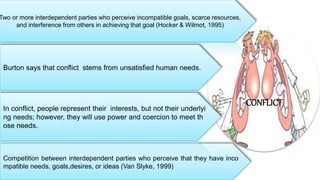
Two or more interdependent parties who perceive incompatible goals, scarce resources,
and interference from others in achieving that goal (Hocker & Wilmot, 1995)
Competition between interdependent parties who perceive that they have inco
mpatible needs, goals,desires, or ideas (Van Slyke, 1999)
Burton says that conflict stems from unsatisfied human needs.
In conflict, people represent their interests, but not their underlyi
ng needs; however, they will use power and coercion to meet th
ose needs.
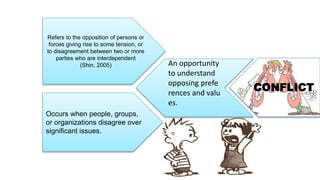
Refers to the opposition of persons or
forces giving rise to some tension, or
to disagreement between two or more
parties who are interdependent
(Shin, 2005)
Occurs when people, groups,
or organizations disagree over
significant issues.
An opportunity
to understand
opposing prefe
rences and valu
es.
CONFLICT
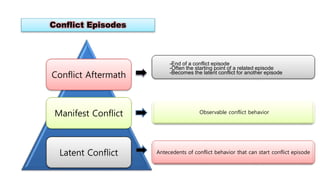
Latent Conflict
Manifest Conflict
Conflict Aftermath
Conflict Episodes
Antecedents of conflict behavior that can start conflict episode
Observable conflict behavior
-End of a conflict episode
-Often the starting point of a related episode
-Becomes the latent conflict for another episode
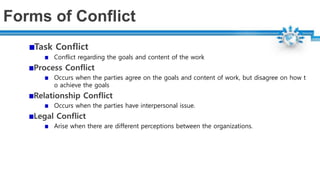
Forms of Conflict
Task Conflict
Conflict regarding the goals and content of the work
Process Conflict
Occurs when the parties agree on the goals and content of work, but disagree on how t
o achieve the goals
Relationship Conflict
Occurs when the parties have interpersonal issue.
Legal Conflict
Arise when there are different perceptions between the organizations.
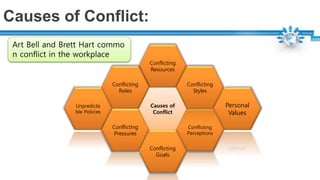
Causes of Conflict:
Causes of
Conflict
Conflicting
Perceptions
Conflicting
Styles
Conflicting
Resources
Conflicting
Roles
Conflicting
Pressures
Conflicting
Goals
Personal
Values
Unpredicta
ble Policies
Art Bell and Brett Hart commo
n conflict in the workplace
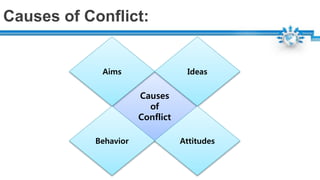
Causes of Conflict:
Causes
of
Conflict
Aims Ideas
AttitudesBehavior
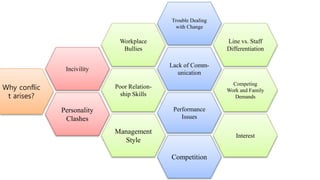
Why conflic
t arises?
Incivility
Workplace
Bullies
Personality
Clashes
Poor Relation-
ship Skills
Management
Style
Trouble Dealing
with Change
Lack of Comm-
unication
Performance
Issues
Competition
Line vs. Staff
Differentiation
Competing
Work and Family
Demands
Interest
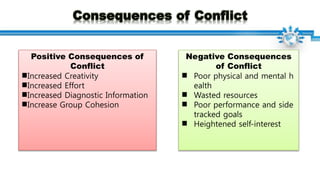
Consequences of Conflict
Positive Consequences of
Conflict
Increased Creativity
Increased Effort
Increased Diagnostic Information
Increase Group Cohesion
Negative Consequences
of Conflict
Poor physical and mental h
ealth
Wasted resources
Poor performance and side
tracked goals
Heightened self-interest
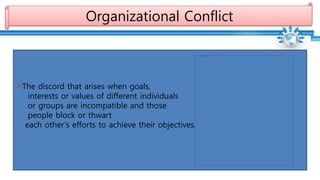
Organizational Conflict
The discord that arises when goals,
interests or values of different individuals
or groups are incompatible and those
people block or thwart
each other’s efforts to achieve their objectives.
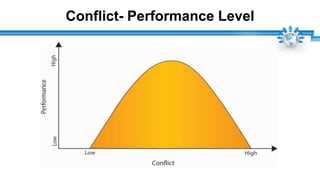
Conflict- Performance Level
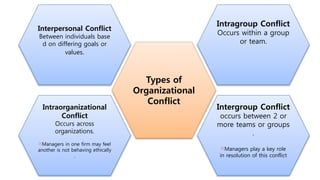
Types of
Organizational
Conflict
Interpersonal Conflict
Between individuals base
d on differing goals or
values.
Intragroup Conflict
Occurs within a group
or team.
Intergroup Conflict
occurs between 2 or
more teams or groups
.
Managers play a key role
in resolution of this conflict
Intraorganizational
Conflict
Occurs across
organizations.
Managers in one firm may feel
another is not behaving ethically
.
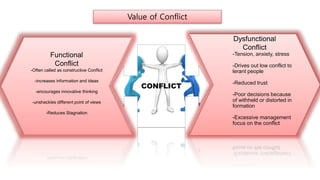
CONFLICT
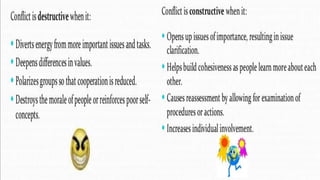
Functional
Conflict
-Often called as constructive Conflict
-increases information and ideas
-encourages innovative thinking
-unshackles different point of views
-Reduces Stagnation
Dysfunctional
Conflict
-Tension, anxiety, stress
-Drives out low conflict to
lerant people
-Reduced trust
-Poor decisions because
of withheld or distorted in
formation
-Excessive management
focus on the conflict
Value of Conflict
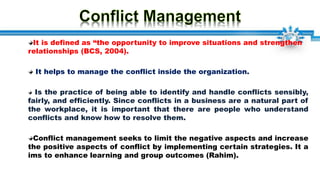
It is defined as “the opportunity to improve situations and strengthen
relationships (BCS, 2004).
It helps to manage the conflict inside the organization.
Is the practice of being able to identify and handle conflicts sensibly,
fairly, and efficiently. Since conflicts in a business are a natural part of
the workplace, it is important that there are people who understand
conflicts and know how to resolve them.
Conflict management seeks to limit the negative aspects and increase
the positive aspects of conflict by implementing certain strategies. It a
ims to enhance learning and group outcomes (Rahim).
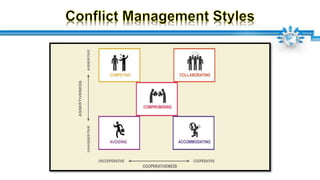
Competing
Competing is assertive and uncooperative, a power-oriented mode. Whe
n competing, an individual pursues his or her own concerns at the other
person’s expense, using whatever power seems appropriate to win his or
her position. Competing might mean standing up for your rights, defendi
ng a position you believe is correct, or simply trying to win.
Collaborating
Collaborating is both assertive and cooperative. When collaborating, an indivi
dual attempts to work with the other person to find a solution that fully satisfi
es the concerns of both. It involves digging into an issue to identify the underl
ying concerns of the two individuals and to find an alternative that meets both
sets of concerns. Collaborating between two persons might take the form of e
xploring a disagreement to learn from each other’s insights, resolving some co
ndition that would otherwise have them competing for resources, or confronti
ng and trying to find a creative solution to an interpersonal problem.
Compromising
Avoiding
Compromising is intermediate in both assertiveness and cooperativeness. When comprom
ising, an individual has the objective of finding an expedient, mutually acceptable solution
that partially satisfies both parties. Compromising falls on a middle ground between co
mpeting and accommodating, giving up more than competing but less than accommodati
ng. Likewise, it addresses an issue more directly than avoiding but doesn’t explore it in
as much depth as collaborating. Compromising might mean splitting the difference, excha
nging concessions, or seeking a quick middle-ground position.
Avoiding is unassertive and uncooperative. When avoiding, an individual
does not immediately pursue his or her own concerns or those of the ot
her person. He or she does not address the conflict. Avoiding might tak
e the form of diplomatically sidestepping an issue, postponing an issue u
ntil a better time, or simply withdrawing from a threatening situation.
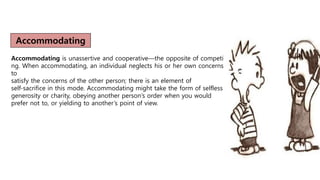
Accommodating
Accommodating is unassertive and cooperative—the opposite of competi
ng. When accommodating, an individual neglects his or her own concerns
to
satisfy the concerns of the other person; there is an element of
self-sacrifice in this mode. Accommodating might take the form of selfless
generosity or charity, obeying another person’s order when you would
prefer not to, or yielding to another’s point of view.
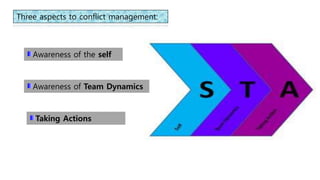
Three aspects to conflict management:
Awareness of the self
Awareness of Team Dynamics
Taking Actions
Awareness of the Self (S)
Awareness of the self is important in conflict management. As a manager, your be
havior in the workplace (as a professional) and toward your team (as a person with integrity)
will be a key defining factor with regard to how much individual team members trust and res
pect you. A manager who has the trust and respect of the team members will find it easier to
get various members to understand the situation from others' standpoints. They would then
be more willing to compromise or adhere to a proposed solution.
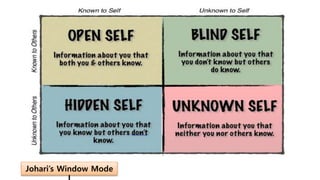
The Johari Window, a model created by Joseph Luft and Harry Ingham in 1955, ca
n be used to inform self-awareness and the individual's relationship with other team member
s, which hinges on mutual understanding. The aim is to develop the 'open area' (i.e., informat
ion known by the individual and by the group) (Chapman)
Johari’s Window Mode
Awareness of Team Dynamics (T)
Four stages of group development:
Forming
Each team member desires to be accepted by others and will tend to agree readily to
avoid conflict. Although the manager of such a team almost has no issue with conflict, it is impor
tant for him/ her to be mindful of creating a firm foundation for the team in this stage. The ma
nager should facilitate team members to get to know one another, develop mutual trust and esta
blish positive relationships. It is crucial for the manager to establish and communicate exp
ectations, and assist the team to identify similarities and agree on common goals.
Storming
In this stage, team members open up to one another and confront differences in opini
ons. In expressing such differences, team members would develop skills in communication, which
sets the foundation for good team dynamics. As team members seek to resolve these differences,
it is important for the manager to be directive in guiding the decision-making in a professional m
anner.
Norming
In this third stage, the team has come to a consensus and arrived at a common
agreement on roles and processes for problem solving. Some team members might have to
compromise on their own opinion to ensure the success of the team's goals. The manager ca
n encourage this by recognizing and celebrating the progress of the team.
Performing
In this stage, team members are interdependent, competent, motivated, able to work c
ollaboratively and handle conflicts and decision-making without supervision. Managers of suc
h teams can switch to a participative role as the team is autonomous and capable of making
decisions.
Taking Action (A)
When dealing with conflict within the team, it is best to intervene as soon as the tea
m exhibits signs of distress and inability to resolve differences. Thereafter, follow-u
p action will be required to ensure all members of the team are on the same page an
d aware of the entire situation. All action taken should also be in line with compan
y policy, and clearly communicated so that the entire process is transparent, an
d no member feels that he or she is unfairly treated.
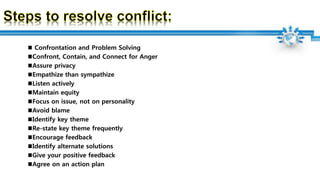
Confrontation and Problem Solving
Confront, Contain, and Connect for Anger
Assure privacy
Empathize than sympathize
Listen actively
Maintain equity
Focus on issue, not on personality
Avoid blame
Identify key theme
Re-state key theme frequently
Encourage feedback
Identify alternate solutions
Give your positive feedback
Agree on an action plan
Frequent meeting of your team
Allow your team to express openly
Sharing objectives
Having a clear and detailed job description
Distributing task fairly
Never criticize team members publicly
Always be fair and just with your team
Being a role model
Be Objective
– Analyze and separate content and personal issues
– Planning stage for strategic communication
Be Aware of Preferred Style of Conflict Resolution
– Plan, Recognize, Contain, and Cope
Distinguish Symptoms from Causes
– Symptoms let us know a conflict is present
– Causes of conflict are issues underlying the symptoms
Identify Success of Methods already Implemented
– Ignore problems
– Persuasion
– Compromise
Be Sensitive to Different Approaches and Views of Conflict based on Gender and Cultural Di
versity

Conflict Management

  • 1.
  • 2.
    CONFLICT Two or moreinterdependent parties who perceive incompatible goals, scarce resources, and interference from others in achieving that goal (Hocker & Wilmot, 1995) Competition between interdependent parties who perceive that they have inco mpatible needs, goals,desires, or ideas (Van Slyke, 1999) Burton says that conflict stems from unsatisfied human needs. In conflict, people represent their interests, but not their underlyi ng needs; however, they will use power and coercion to meet th ose needs.
  • 3.
    Refers to theopposition of persons or forces giving rise to some tension, or to disagreement between two or more parties who are interdependent (Shin, 2005) Occurs when people, groups, or organizations disagree over significant issues. An opportunity to understand opposing prefe rences and valu es. CONFLICT
  • 5.
    Latent Conflict Manifest Conflict ConflictAftermath Conflict Episodes Antecedents of conflict behavior that can start conflict episode Observable conflict behavior -End of a conflict episode -Often the starting point of a related episode -Becomes the latent conflict for another episode
  • 6.
    Forms of Conflict TaskConflict Conflict regarding the goals and content of the work Process Conflict Occurs when the parties agree on the goals and content of work, but disagree on how t o achieve the goals Relationship Conflict Occurs when the parties have interpersonal issue. Legal Conflict Arise when there are different perceptions between the organizations.
  • 7.
    Causes of Conflict: Causesof Conflict Conflicting Perceptions Conflicting Styles Conflicting Resources Conflicting Roles Conflicting Pressures Conflicting Goals Personal Values Unpredicta ble Policies Art Bell and Brett Hart commo n conflict in the workplace
  • 8.
  • 9.
    Why conflic t arises? Incivility Workplace Bullies Personality Clashes PoorRelation- ship Skills Management Style Trouble Dealing with Change Lack of Comm- unication Performance Issues Competition Line vs. Staff Differentiation Competing Work and Family Demands Interest
  • 10.
    Consequences of Conflict PositiveConsequences of Conflict Increased Creativity Increased Effort Increased Diagnostic Information Increase Group Cohesion Negative Consequences of Conflict Poor physical and mental h ealth Wasted resources Poor performance and side tracked goals Heightened self-interest
  • 12.
    Organizational Conflict The discordthat arises when goals, interests or values of different individuals or groups are incompatible and those people block or thwart each other’s efforts to achieve their objectives.
  • 13.
  • 14.
    Types of Organizational Conflict Interpersonal Conflict Betweenindividuals base d on differing goals or values. Intragroup Conflict Occurs within a group or team. Intergroup Conflict occurs between 2 or more teams or groups . Managers play a key role in resolution of this conflict Intraorganizational Conflict Occurs across organizations. Managers in one firm may feel another is not behaving ethically .
  • 15.
    CONFLICT Functional Conflict -Often called asconstructive Conflict -increases information and ideas -encourages innovative thinking -unshackles different point of views -Reduces Stagnation Dysfunctional Conflict -Tension, anxiety, stress -Drives out low conflict to lerant people -Reduced trust -Poor decisions because of withheld or distorted in formation -Excessive management focus on the conflict Value of Conflict
  • 19.
    It is definedas “the opportunity to improve situations and strengthen relationships (BCS, 2004). It helps to manage the conflict inside the organization. Is the practice of being able to identify and handle conflicts sensibly, fairly, and efficiently. Since conflicts in a business are a natural part of the workplace, it is important that there are people who understand conflicts and know how to resolve them. Conflict management seeks to limit the negative aspects and increase the positive aspects of conflict by implementing certain strategies. It a ims to enhance learning and group outcomes (Rahim).
  • 21.
    Competing Competing is assertiveand uncooperative, a power-oriented mode. Whe n competing, an individual pursues his or her own concerns at the other person’s expense, using whatever power seems appropriate to win his or her position. Competing might mean standing up for your rights, defendi ng a position you believe is correct, or simply trying to win. Collaborating Collaborating is both assertive and cooperative. When collaborating, an indivi dual attempts to work with the other person to find a solution that fully satisfi es the concerns of both. It involves digging into an issue to identify the underl ying concerns of the two individuals and to find an alternative that meets both sets of concerns. Collaborating between two persons might take the form of e xploring a disagreement to learn from each other’s insights, resolving some co ndition that would otherwise have them competing for resources, or confronti ng and trying to find a creative solution to an interpersonal problem.
  • 22.
    Compromising Avoiding Compromising is intermediatein both assertiveness and cooperativeness. When comprom ising, an individual has the objective of finding an expedient, mutually acceptable solution that partially satisfies both parties. Compromising falls on a middle ground between co mpeting and accommodating, giving up more than competing but less than accommodati ng. Likewise, it addresses an issue more directly than avoiding but doesn’t explore it in as much depth as collaborating. Compromising might mean splitting the difference, excha nging concessions, or seeking a quick middle-ground position. Avoiding is unassertive and uncooperative. When avoiding, an individual does not immediately pursue his or her own concerns or those of the ot her person. He or she does not address the conflict. Avoiding might tak e the form of diplomatically sidestepping an issue, postponing an issue u ntil a better time, or simply withdrawing from a threatening situation.
  • 23.
    Accommodating Accommodating is unassertiveand cooperative—the opposite of competi ng. When accommodating, an individual neglects his or her own concerns to satisfy the concerns of the other person; there is an element of self-sacrifice in this mode. Accommodating might take the form of selfless generosity or charity, obeying another person’s order when you would prefer not to, or yielding to another’s point of view.
  • 24.
    Three aspects toconflict management: Awareness of the self Awareness of Team Dynamics Taking Actions
  • 25.
    Awareness of theSelf (S) Awareness of the self is important in conflict management. As a manager, your be havior in the workplace (as a professional) and toward your team (as a person with integrity) will be a key defining factor with regard to how much individual team members trust and res pect you. A manager who has the trust and respect of the team members will find it easier to get various members to understand the situation from others' standpoints. They would then be more willing to compromise or adhere to a proposed solution. The Johari Window, a model created by Joseph Luft and Harry Ingham in 1955, ca n be used to inform self-awareness and the individual's relationship with other team member s, which hinges on mutual understanding. The aim is to develop the 'open area' (i.e., informat ion known by the individual and by the group) (Chapman)
  • 26.
  • 27.
    Awareness of TeamDynamics (T) Four stages of group development: Forming Each team member desires to be accepted by others and will tend to agree readily to avoid conflict. Although the manager of such a team almost has no issue with conflict, it is impor tant for him/ her to be mindful of creating a firm foundation for the team in this stage. The ma nager should facilitate team members to get to know one another, develop mutual trust and esta blish positive relationships. It is crucial for the manager to establish and communicate exp ectations, and assist the team to identify similarities and agree on common goals. Storming In this stage, team members open up to one another and confront differences in opini ons. In expressing such differences, team members would develop skills in communication, which sets the foundation for good team dynamics. As team members seek to resolve these differences, it is important for the manager to be directive in guiding the decision-making in a professional m anner.
  • 28.
    Norming In this thirdstage, the team has come to a consensus and arrived at a common agreement on roles and processes for problem solving. Some team members might have to compromise on their own opinion to ensure the success of the team's goals. The manager ca n encourage this by recognizing and celebrating the progress of the team. Performing In this stage, team members are interdependent, competent, motivated, able to work c ollaboratively and handle conflicts and decision-making without supervision. Managers of suc h teams can switch to a participative role as the team is autonomous and capable of making decisions.
  • 29.
    Taking Action (A) Whendealing with conflict within the team, it is best to intervene as soon as the tea m exhibits signs of distress and inability to resolve differences. Thereafter, follow-u p action will be required to ensure all members of the team are on the same page an d aware of the entire situation. All action taken should also be in line with compan y policy, and clearly communicated so that the entire process is transparent, an d no member feels that he or she is unfairly treated.
  • 30.
    Confrontation and ProblemSolving Confront, Contain, and Connect for Anger Assure privacy Empathize than sympathize Listen actively Maintain equity Focus on issue, not on personality Avoid blame Identify key theme Re-state key theme frequently Encourage feedback Identify alternate solutions Give your positive feedback Agree on an action plan
  • 31.
    Frequent meeting ofyour team Allow your team to express openly Sharing objectives Having a clear and detailed job description Distributing task fairly Never criticize team members publicly Always be fair and just with your team Being a role model
  • 32.
    Be Objective – Analyzeand separate content and personal issues – Planning stage for strategic communication Be Aware of Preferred Style of Conflict Resolution – Plan, Recognize, Contain, and Cope Distinguish Symptoms from Causes – Symptoms let us know a conflict is present – Causes of conflict are issues underlying the symptoms Identify Success of Methods already Implemented – Ignore problems – Persuasion – Compromise Be Sensitive to Different Approaches and Views of Conflict based on Gender and Cultural Di versity