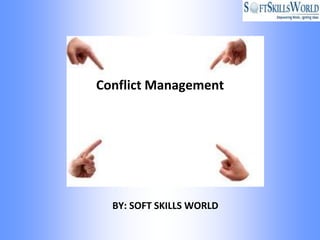

Conflict Management


  BY: SOFT SKILLS WORLD
Genesis of Conflict


     Opposition arising from disagreements due to undefined
     objectives, thoughts, or emotions within or among
     individuals, teams, departments or organizations.

   Where does it come from……….
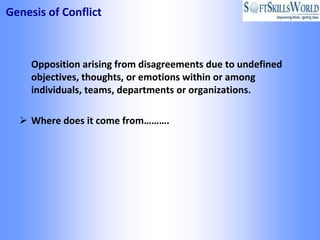
Why does Conflict occur?
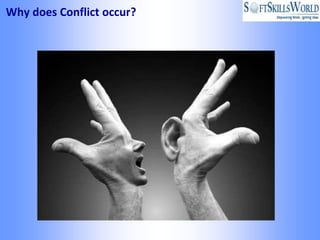
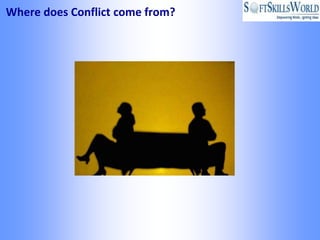
Where does Conflict come from?
Misconceptions about Conflict

•   Harmony is “normal”
•   Conflict is “abnormal”
•   Conflicts and disagreements are the same
•   Conflict is the result of “personality problems”
•   Conflict and anger are the same
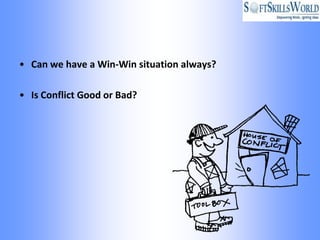
• Can we have a Win-Win situation always?

• Is Conflict Good or Bad?
How Conflict Benefits Positively


1.    Expresses caring
2.    Demonstrates trust
3.    Issues get explored
4.    Increases group cohesion
5.    Produces growth
6.    Enhances identity
7.    Facilitates participation
8.    Improves decision making
9.    Demonstrates diversity
10.   Increases commitment
We Learn to Deal Positively With Conflict as
                We Grow


•   The relationships and functions within a family
•   Interaction with peers
•   Accepting diversity
•   Establishing peace and safety in community
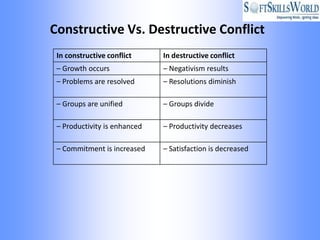
Constructive Vs. Destructive Conflict
 In constructive conflict     In destructive conflict
 – Growth occurs              – Negativism results
 – Problems are resolved      – Resolutions diminish

 – Groups are unified         – Groups divide

 – Productivity is enhanced   – Productivity decreases

 – Commitment is increased    – Satisfaction is decreased
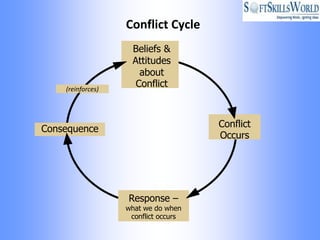
Conflict Cycle
                     Beliefs &
                     Attitudes
                       about
    (reinforces)
                      Conflict


Consequence                           Conflict
                                      Occurs


                   Response –
                   what we do when
                    conflict occurs
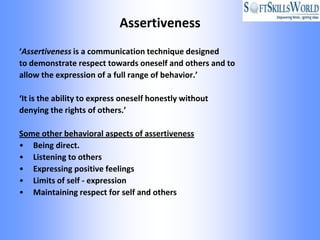
Assertiveness
‘Assertiveness is a communication technique designed
to demonstrate respect towards oneself and others and to
allow the expression of a full range of behavior.’

‘It is the ability to express oneself honestly without
denying the rights of others.’

Some other behavioral aspects of assertiveness
• Being direct.
• Listening to others
• Expressing positive feelings
• Limits of self - expression
• Maintaining respect for self and others
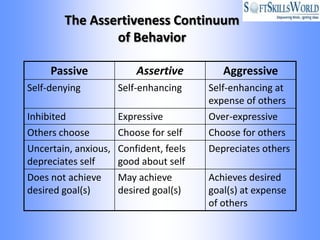
The Assertiveness Continuum
                of Behavior

     Passive              Assertive         Aggressive
Self-denying          Self-enhancing     Self-enhancing at
                                         expense of others
Inhibited             Expressive         Over-expressive
Others choose         Choose for self    Choose for others
Uncertain, anxious,   Confident, feels   Depreciates others
depreciates self      good about self
Does not achieve      May achieve        Achieves desired
desired goal(s)       desired goal(s)    goal(s) at expense
                                         of others
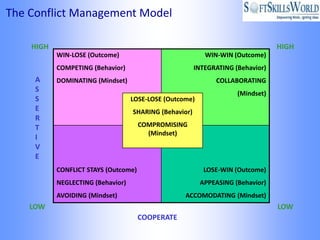
The Conflict Management Model

    HIGH                                                                         HIGH
           WIN-LOSE (Outcome)                              WIN-WIN (Outcome)
           COMPETING (Behavior)                         INTEGRATING (Behavior)
     A     DOMINATING (Mindset)                               COLLABORATING
     S                                                               (Mindset)
     S                             LOSE-LOSE (Outcome)
     E                             SHARING (Behavior)
     R
     T                                COMPROMISING
                                        (Mindset)
     I
     V
     E
           CONFLICT STAYS (Outcome)                       LOSE-WIN (Outcome)
           NEGLECTING (Behavior)                         APPEASING (Behavior)
           AVOIDING (Mindset)                      ACCOMODATING (Mindset)
    LOW                                                                          LOW
                                      COOPERATE
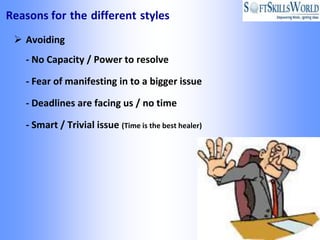
Reasons for the different styles
  Avoiding
   - No Capacity / Power to resolve

   - Fear of manifesting in to a bigger issue

   - Deadlines are facing us / no time

   - Smart / Trivial issue (Time is the best healer)
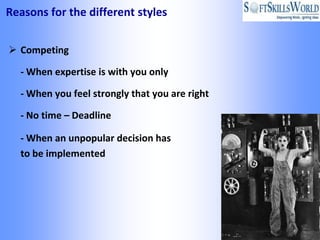
Reasons for the different styles


 Competing

  - When expertise is with you only

  - When you feel strongly that you are right

  - No time – Deadline

  - When an unpopular decision has
  to be implemented
Competition


• Plus
   – The winner is clear
   – Winners usually experience gains
• Minus
   – Establishes the battleground for the next conflict
   – May cause worthy competitors to withdraw or leave the
     organization
Reasons for the different styles


   Accommodating

    - When the other party has the correct point
    - I need to create a debt (Obligation)

    - To repair a burnt bridge (Broken Relationship)
Accommodation


• Plus
   – Curtails conflict situation
   – Enhances ego of the other
• Minus
   – Sometimes establishes a precedence
   – Does not fully engage participants


                                          18
Reasons for the different styles


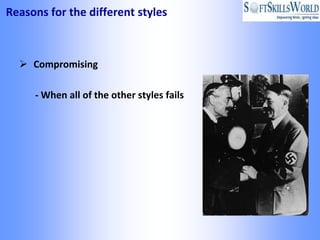
   Compromising

     - When all of the other styles fails
Compromise


• Plus
   – Shows good will
   – Establishes friendship
• Minus
   – No one gets what they want
   – May feel like a dead end


                                  20
Reasons for the different styles


   Collaboration


     - When the output is critically important to both (will be
       committed whole heartedly)

     - When enough time is available and conflict will impact
       the long-term working together

     - When u see an opportunity to explore

        possibilities (Using Brainstorming)
Collaboration

• Plus
   – Everyone “wins”
   – Creates good feelings
• Minus
   – Hard to achieve since no one knows how
   – Often confusing since players can “win” something they
     didn’t know they wanted


                                                   22
Tips for Managing Workplace Conflict

•   Build good relationships before conflict occurs
•   Do not let small problems escalate; deal with them as they arise
•   Respect differences
•   Listen to others’ perspectives on the conflict situation
•   Acknowledge feelings before focussing on facts
•   Focus on solving problems, not changing people
•   If you can’t resolve the problem, turn to someone who can help
•   Remember to adapt your style to the situation and persons involved


                                                               23
Tips for Managing Workplace Conflict
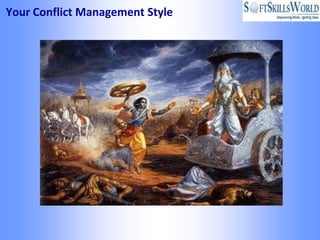
Your Conflict Management Style
Conflict Style

• Not only is it important to know what relationship or situation
  is causing conflict in our life, but it is also important to look at
  how we normally resolve conflict (our natural inclination).

• We must then decide whether we are satisfied with our
  current approach or if we would like to change it in some way
  to improve our effectiveness at conflict resolution.
One-to-one
 Conflict
If you want to constructively resolve a
             conflict with another person…


• FIRST, get into the right frame of mind for a positive discussion,
  always remembering to treat the other person with respect

• SECOND, agree on the best time and place for both of you to
  discuss the conflict with each other.

• THIRD, Set some ground rules.

• FOURTH, have a discussion.
Step 1:


Adopt the right frame of
         mind
The Approach


          When you are ready to approach
          the other person remember to:


•   Go in with the right attitude
•   Send positive non-verbal signals
•   Focus on the real issues
•   Pay attention to communication style
Your Attitude
      Leave Behind…                      Take With You…
• Your desire to win, punish, or   • A willingness to work at this
  control                          • An understanding that
• Your desire that everything be     “perception is reality” both for
  “fair”                             you and those around you.
• Your assumption that it won’t    • A willingness to learn from the
  work                               situation
• Your tendency to think in        • A willingness to see and
  “black and white”, “right or       acknowledge your own
  wrong”                             contribution to the problem.
• Your determination to be
  right.
Be aware of your nonverbal
         signals:
   Others impression of you is based on:
     • 7 % of the words used;

     • 38% on voice quality; and

     • 55% on nonverbal communication
Focus on underlying Issues
• What happened?
   – Difference in expectations:
       • What did I expect to happen?; What actually happened?
         Who did what?
   – Intention inventory (Who meant what?)
• Feelings
   – Don’t ignore or fail to acknowledge
   – Feelings make relationships enjoyable and difficult
     conversations difficult (can’t have one without the other!)
• Identity
   – Must face ourselves as well as other person
   – Am I competent?; Am I a good person?; Am I worthy of love?
Communication Tips

   Avoid “you” statements
   Focus on behavior, not employee
   Focus on actions, not intent
   Be descriptive and specific (bring data)
   Practice active listening skills
   Ask open and closed questions to clarify points
Step 2:


Consider time factors
Be Timely:

talk to the other person while the issues are
                 still current


         Anger and negative feelings
   tend to fester if not dealt with quickly!!
Consider the other person’s time
             needs
 • Don’t interrupt the other person’s schedule
   and state that you need to talk
 • Agree on a time to meet with the other
   person and inform him/her of the topic.
 • Give him/her time to prepare mentally.
Step 3:


Set some ground rules!
3 “Golden” Rules


1. Everyone tells it like they see it.

2. Get everything on the table.

3. Focus on the future.
Sample Rules for discussion


In addition to general rules, it is helpful to agree on how
               you will talk with each other

•   No interruptions
•   No yelling
•   Time limit on certain topics of discussion
•   Words to avoid
•   Agreement on what to do if you can’t agree ahead of
    time
Step 4:


The Actual Discussion
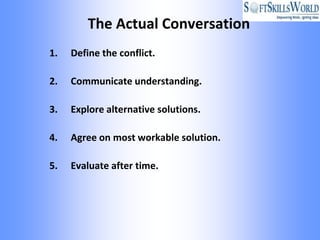
The Actual Conversation
1.   Define the conflict.

2.   Communicate understanding.

3.   Explore alternative solutions.

4.   Agree on most workable solution.

5.   Evaluate after time.
Define the Conflict

 Describe the problem in clear, concrete
  terms. Be specific (use “I” not “you”)

 Focus on behaviors or problems, not people

 Talk about the impact on you

 Define the conflict as a problem to solve
  together, not a battle to be won
2. Communicate Understanding

   Listen to really understand the other person’s feelings,
    needs, Reflect back.

–   Explain how you see the problem after you have heard
    them.

–   Identify your contribution to the situation.

–   Describe feelings (not judgments or accusations)

–   Talk about identity issues.
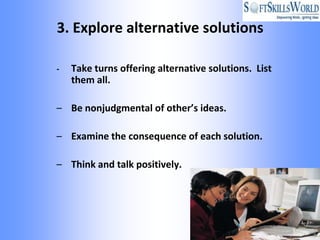
3. Explore alternative solutions

-   Take turns offering alternative solutions. List
    them all.

– Be nonjudgmental of other’s ideas.

– Examine the consequence of each solution.

– Think and talk positively.
4. Agree on most workable solution


     - Agree on a solution you both understand
        and can live with.

     – Be committed to resolving the conflict
5. Evaluate after time


  Get together after
  some time and see
    how the new arrangement
 is
  working for both parties
Tips in difficult Situations
• Pacing: one approximates the behavior of the other person to
  subconsciously build rapport.


• “Mental Aikido”: mentally moving away from the focal point
  of the adversary’s attack. Make a non-linear response to the
  adversary’s words. “Sharks expect you to react.”


• “Patterned interruption”: involves varying your usual
  response. “You have the capacity to interrupt the usual destructive
  pattern by doing something completely different or unexpected.”
Resolving Group Conflict


 Workforce Development Toolkit
            Part VII
Meeting Conflict

1.   If you sense a spoken or unspoken conflict in a meeting over an issue, address it.
          “There seems to be some disagreement over this issue. Can we take a few minutes to clarify the
        issue.

2.   Clarify the conflict.
     “O.K. so there seems to be some disagreement over…….”

3.     Decide if there is time to deal with it today or if another meeting needs to be set up to give it full
       attention.
     “Since this seems to be quite an important issue and we don’t have much time today. Let’s agree to
       meet again to discuss it further. Can we meet on….”

4.   If another meeting is necessary, assign responsibility for gathering more information on the subject
        to staff.
     “Sue, can you please research information on…. And Diane can you please check on that State
        mandate.”

5.    Insist employees let it go until the next meeting.
     “We have a lot of other issues to discuss today so let’s free our minds of this issue until the set
      meeting and move on.”
Group Resolution


1.   Restate the issue to ensure clarity.

2.   Have each group member, share information gathered and give his/her
     opinion.

3.   Make sure everything is put on the table (no unresolved feelings popping up
     later)

4.   Brainstorm alternatives

5.   Agree on best solution using team decision-making steps (see reference list at
     end)

6.   Develop action steps.

7.   Agree on follow-up session.
Supervisor’s role in resolving
          conflict


      Conflict Management Toolkit
                 Part IV
Your Role as a Supervisor
Involves:
 • Looking for ways to reduce and prevent conflict in
   your work area

 • Handling conflict as a third party

 • Handling grievances as they come to you
You can reduce conflict by:

• Being a good leader

• Being aware of your management style

• Training yourself and your staff on conflict resolution

• Looking out for signs
Be a Good Leader


• Set a good example

• Communicate clear standards

• Set ground rules

• Provide clear rationale for decisions

• Ensure employees have resources and training to do their jobs

• Get to know your employees
Be a Good Leader


• Conduct performance counseling

• Assist employees who have performance problems

• Address misconduct promptly

• Get advice from HR when you have questions or concerns prior to
  the need to pursue disciplinary actions

• Treat employees fairly and equitably, applying rules consistently
Be aware of your own behavior

1.   Allowing aggressive or inappropriate conduct without taking action
     can foster a hostile or intimidating work environment.

2.   Decision-making without employee input or participation can lead to
     frustrated employees who don’t feel valued as anything but “worker
     bees.”

3.   Your staff looks to you to assist in resolving conflicts. You are better
     equipped to resolve conflicts if both you and your staff have had
     conflict resolution training.

4.   If you are inconsistent or unpredictable, your employees will be
     unsure of your expectations and become frustrated.

5.   Engaging in relationships with your employees that are personal or
     too informal may lead to misunderstandings, as well as other
     employees feeling alienated.
Lookout for Signs of discontentment

• A usually outgoing, communicative employee becomes withdrawn and
  quiet.

• An employee frequently comes in late for work.

• An employee is more argumentative and erratic than usual.

• An employee suddenly takes no interest in maintaining his or her
  personal appearance or hygiene.

• An employee makes comments about violent means of dealing with, or
  coping with, a particular situation.

• An employee talks about “having nothing to lose” or not caring about
  anything anymore.
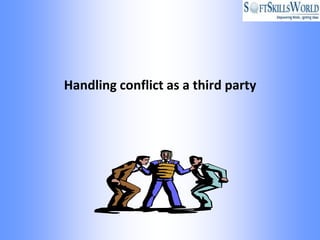
Handling conflict as a third party
Handling Employee Conflicts

• Situation 1: An employee complains to you about another
  employee


• Situation 2 You observe a conflict situation

• Situation 3: An employee would like to file a formal
  grievance
If an employee comes to you with a
                   possible grievance:
• Take the complaint seriously

• Set a professional tone for the interview– put the complainant at ease

• Provide assurance of confidentiality & non-retaliation

• Ask for– but do not require- a written statement.

• Gather facts, do not make judgments.

• Listen and get answers to: “who, what, when, where, why, how.”

• Communicate your concern and describe the available options.
Handling a formal complaint cont…

• Ask how the complainant would like to proceed.

• Tell the complainant that prompt action will be taken.

• Ask about the person (s) need for immediate assistance.

• Refer them to UMW’s grievance policy

• Set a time for a follow-up meeting and/or refer the person to the
  HR office

• Document and contact HR.
Conflict management

Conflict management

  • 1.
    Conflict Management BY: SOFT SKILLS WORLD
  • 2.
    Genesis of Conflict Opposition arising from disagreements due to undefined objectives, thoughts, or emotions within or among individuals, teams, departments or organizations.  Where does it come from……….
  • 3.
  • 4.
  • 5.
    Misconceptions about Conflict • Harmony is “normal” • Conflict is “abnormal” • Conflicts and disagreements are the same • Conflict is the result of “personality problems” • Conflict and anger are the same
  • 6.
    • Can wehave a Win-Win situation always? • Is Conflict Good or Bad?
  • 7.
    How Conflict BenefitsPositively 1. Expresses caring 2. Demonstrates trust 3. Issues get explored 4. Increases group cohesion 5. Produces growth 6. Enhances identity 7. Facilitates participation 8. Improves decision making 9. Demonstrates diversity 10. Increases commitment
  • 8.
    We Learn toDeal Positively With Conflict as We Grow • The relationships and functions within a family • Interaction with peers • Accepting diversity • Establishing peace and safety in community
  • 9.
    Constructive Vs. DestructiveConflict In constructive conflict In destructive conflict – Growth occurs – Negativism results – Problems are resolved – Resolutions diminish – Groups are unified – Groups divide – Productivity is enhanced – Productivity decreases – Commitment is increased – Satisfaction is decreased
  • 10.
    Conflict Cycle Beliefs & Attitudes about (reinforces) Conflict Consequence Conflict Occurs Response – what we do when conflict occurs
  • 11.
    Assertiveness ‘Assertiveness is acommunication technique designed to demonstrate respect towards oneself and others and to allow the expression of a full range of behavior.’ ‘It is the ability to express oneself honestly without denying the rights of others.’ Some other behavioral aspects of assertiveness • Being direct. • Listening to others • Expressing positive feelings • Limits of self - expression • Maintaining respect for self and others
  • 12.
    The Assertiveness Continuum of Behavior Passive Assertive Aggressive Self-denying Self-enhancing Self-enhancing at expense of others Inhibited Expressive Over-expressive Others choose Choose for self Choose for others Uncertain, anxious, Confident, feels Depreciates others depreciates self good about self Does not achieve May achieve Achieves desired desired goal(s) desired goal(s) goal(s) at expense of others
  • 13.
    The Conflict ManagementModel HIGH HIGH WIN-LOSE (Outcome) WIN-WIN (Outcome) COMPETING (Behavior) INTEGRATING (Behavior) A DOMINATING (Mindset) COLLABORATING S (Mindset) S LOSE-LOSE (Outcome) E SHARING (Behavior) R T COMPROMISING (Mindset) I V E CONFLICT STAYS (Outcome) LOSE-WIN (Outcome) NEGLECTING (Behavior) APPEASING (Behavior) AVOIDING (Mindset) ACCOMODATING (Mindset) LOW LOW COOPERATE
  • 14.
    Reasons for thedifferent styles  Avoiding - No Capacity / Power to resolve - Fear of manifesting in to a bigger issue - Deadlines are facing us / no time - Smart / Trivial issue (Time is the best healer)
  • 15.
    Reasons for thedifferent styles  Competing - When expertise is with you only - When you feel strongly that you are right - No time – Deadline - When an unpopular decision has to be implemented
  • 16.
    Competition • Plus – The winner is clear – Winners usually experience gains • Minus – Establishes the battleground for the next conflict – May cause worthy competitors to withdraw or leave the organization
  • 17.
    Reasons for thedifferent styles  Accommodating - When the other party has the correct point - I need to create a debt (Obligation) - To repair a burnt bridge (Broken Relationship)
  • 18.
    Accommodation • Plus – Curtails conflict situation – Enhances ego of the other • Minus – Sometimes establishes a precedence – Does not fully engage participants 18
  • 19.
    Reasons for thedifferent styles  Compromising - When all of the other styles fails
  • 20.
    Compromise • Plus – Shows good will – Establishes friendship • Minus – No one gets what they want – May feel like a dead end 20
  • 21.
    Reasons for thedifferent styles  Collaboration - When the output is critically important to both (will be committed whole heartedly) - When enough time is available and conflict will impact the long-term working together - When u see an opportunity to explore possibilities (Using Brainstorming)
  • 22.
    Collaboration • Plus – Everyone “wins” – Creates good feelings • Minus – Hard to achieve since no one knows how – Often confusing since players can “win” something they didn’t know they wanted 22
  • 23.
    Tips for ManagingWorkplace Conflict • Build good relationships before conflict occurs • Do not let small problems escalate; deal with them as they arise • Respect differences • Listen to others’ perspectives on the conflict situation • Acknowledge feelings before focussing on facts • Focus on solving problems, not changing people • If you can’t resolve the problem, turn to someone who can help • Remember to adapt your style to the situation and persons involved 23
  • 24.
    Tips for ManagingWorkplace Conflict
  • 25.
  • 26.
    Conflict Style • Notonly is it important to know what relationship or situation is causing conflict in our life, but it is also important to look at how we normally resolve conflict (our natural inclination). • We must then decide whether we are satisfied with our current approach or if we would like to change it in some way to improve our effectiveness at conflict resolution.
  • 27.
  • 28.
    If you wantto constructively resolve a conflict with another person… • FIRST, get into the right frame of mind for a positive discussion, always remembering to treat the other person with respect • SECOND, agree on the best time and place for both of you to discuss the conflict with each other. • THIRD, Set some ground rules. • FOURTH, have a discussion.
  • 29.
    Step 1: Adopt theright frame of mind
  • 30.
    The Approach When you are ready to approach the other person remember to: • Go in with the right attitude • Send positive non-verbal signals • Focus on the real issues • Pay attention to communication style
  • 31.
    Your Attitude Leave Behind… Take With You… • Your desire to win, punish, or • A willingness to work at this control • An understanding that • Your desire that everything be “perception is reality” both for “fair” you and those around you. • Your assumption that it won’t • A willingness to learn from the work situation • Your tendency to think in • A willingness to see and “black and white”, “right or acknowledge your own wrong” contribution to the problem. • Your determination to be right.
  • 32.
    Be aware ofyour nonverbal signals: Others impression of you is based on: • 7 % of the words used; • 38% on voice quality; and • 55% on nonverbal communication
  • 33.
    Focus on underlyingIssues • What happened? – Difference in expectations: • What did I expect to happen?; What actually happened? Who did what? – Intention inventory (Who meant what?) • Feelings – Don’t ignore or fail to acknowledge – Feelings make relationships enjoyable and difficult conversations difficult (can’t have one without the other!) • Identity – Must face ourselves as well as other person – Am I competent?; Am I a good person?; Am I worthy of love?
  • 34.
    Communication Tips  Avoid “you” statements  Focus on behavior, not employee  Focus on actions, not intent  Be descriptive and specific (bring data)  Practice active listening skills  Ask open and closed questions to clarify points
  • 35.
  • 36.
    Be Timely: talk tothe other person while the issues are still current Anger and negative feelings tend to fester if not dealt with quickly!!
  • 37.
    Consider the otherperson’s time needs • Don’t interrupt the other person’s schedule and state that you need to talk • Agree on a time to meet with the other person and inform him/her of the topic. • Give him/her time to prepare mentally.
  • 38.
    Step 3: Set someground rules!
  • 39.
    3 “Golden” Rules 1.Everyone tells it like they see it. 2. Get everything on the table. 3. Focus on the future.
  • 40.
    Sample Rules fordiscussion In addition to general rules, it is helpful to agree on how you will talk with each other • No interruptions • No yelling • Time limit on certain topics of discussion • Words to avoid • Agreement on what to do if you can’t agree ahead of time
  • 41.
  • 42.
    The Actual Conversation 1. Define the conflict. 2. Communicate understanding. 3. Explore alternative solutions. 4. Agree on most workable solution. 5. Evaluate after time.
  • 43.
    Define the Conflict Describe the problem in clear, concrete terms. Be specific (use “I” not “you”)  Focus on behaviors or problems, not people  Talk about the impact on you  Define the conflict as a problem to solve together, not a battle to be won
  • 44.
    2. Communicate Understanding  Listen to really understand the other person’s feelings, needs, Reflect back. – Explain how you see the problem after you have heard them. – Identify your contribution to the situation. – Describe feelings (not judgments or accusations) – Talk about identity issues.
  • 45.
    3. Explore alternativesolutions - Take turns offering alternative solutions. List them all. – Be nonjudgmental of other’s ideas. – Examine the consequence of each solution. – Think and talk positively.
  • 46.
    4. Agree onmost workable solution - Agree on a solution you both understand and can live with. – Be committed to resolving the conflict
  • 47.
    5. Evaluate aftertime Get together after some time and see how the new arrangement is working for both parties
  • 48.
    Tips in difficultSituations • Pacing: one approximates the behavior of the other person to subconsciously build rapport. • “Mental Aikido”: mentally moving away from the focal point of the adversary’s attack. Make a non-linear response to the adversary’s words. “Sharks expect you to react.” • “Patterned interruption”: involves varying your usual response. “You have the capacity to interrupt the usual destructive pattern by doing something completely different or unexpected.”
  • 49.
    Resolving Group Conflict Workforce Development Toolkit Part VII
  • 50.
    Meeting Conflict 1. If you sense a spoken or unspoken conflict in a meeting over an issue, address it. “There seems to be some disagreement over this issue. Can we take a few minutes to clarify the issue. 2. Clarify the conflict. “O.K. so there seems to be some disagreement over…….” 3. Decide if there is time to deal with it today or if another meeting needs to be set up to give it full attention. “Since this seems to be quite an important issue and we don’t have much time today. Let’s agree to meet again to discuss it further. Can we meet on….” 4. If another meeting is necessary, assign responsibility for gathering more information on the subject to staff. “Sue, can you please research information on…. And Diane can you please check on that State mandate.” 5. Insist employees let it go until the next meeting. “We have a lot of other issues to discuss today so let’s free our minds of this issue until the set meeting and move on.”
  • 51.
    Group Resolution 1. Restate the issue to ensure clarity. 2. Have each group member, share information gathered and give his/her opinion. 3. Make sure everything is put on the table (no unresolved feelings popping up later) 4. Brainstorm alternatives 5. Agree on best solution using team decision-making steps (see reference list at end) 6. Develop action steps. 7. Agree on follow-up session.
  • 52.
    Supervisor’s role inresolving conflict Conflict Management Toolkit Part IV
  • 53.
    Your Role asa Supervisor Involves: • Looking for ways to reduce and prevent conflict in your work area • Handling conflict as a third party • Handling grievances as they come to you
  • 54.
    You can reduceconflict by: • Being a good leader • Being aware of your management style • Training yourself and your staff on conflict resolution • Looking out for signs
  • 55.
    Be a GoodLeader • Set a good example • Communicate clear standards • Set ground rules • Provide clear rationale for decisions • Ensure employees have resources and training to do their jobs • Get to know your employees
  • 56.
    Be a GoodLeader • Conduct performance counseling • Assist employees who have performance problems • Address misconduct promptly • Get advice from HR when you have questions or concerns prior to the need to pursue disciplinary actions • Treat employees fairly and equitably, applying rules consistently
  • 57.
    Be aware ofyour own behavior 1. Allowing aggressive or inappropriate conduct without taking action can foster a hostile or intimidating work environment. 2. Decision-making without employee input or participation can lead to frustrated employees who don’t feel valued as anything but “worker bees.” 3. Your staff looks to you to assist in resolving conflicts. You are better equipped to resolve conflicts if both you and your staff have had conflict resolution training. 4. If you are inconsistent or unpredictable, your employees will be unsure of your expectations and become frustrated. 5. Engaging in relationships with your employees that are personal or too informal may lead to misunderstandings, as well as other employees feeling alienated.
  • 58.
    Lookout for Signsof discontentment • A usually outgoing, communicative employee becomes withdrawn and quiet. • An employee frequently comes in late for work. • An employee is more argumentative and erratic than usual. • An employee suddenly takes no interest in maintaining his or her personal appearance or hygiene. • An employee makes comments about violent means of dealing with, or coping with, a particular situation. • An employee talks about “having nothing to lose” or not caring about anything anymore.
  • 59.
    Handling conflict asa third party
  • 60.
    Handling Employee Conflicts •Situation 1: An employee complains to you about another employee • Situation 2 You observe a conflict situation • Situation 3: An employee would like to file a formal grievance
  • 61.
    If an employeecomes to you with a possible grievance: • Take the complaint seriously • Set a professional tone for the interview– put the complainant at ease • Provide assurance of confidentiality & non-retaliation • Ask for– but do not require- a written statement. • Gather facts, do not make judgments. • Listen and get answers to: “who, what, when, where, why, how.” • Communicate your concern and describe the available options.
  • 62.
    Handling a formalcomplaint cont… • Ask how the complainant would like to proceed. • Tell the complainant that prompt action will be taken. • Ask about the person (s) need for immediate assistance. • Refer them to UMW’s grievance policy • Set a time for a follow-up meeting and/or refer the person to the HR office • Document and contact HR.