‫بسم ا الرحمن الرحيم‬

GENUS:
STAPHYLOCOCCUS
Prof. Khalifa Sifaw Ghenghesh
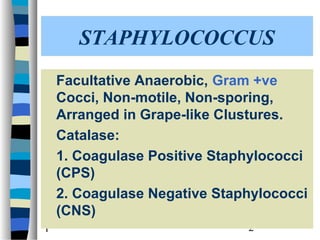
STAPHYLOCOCCUS
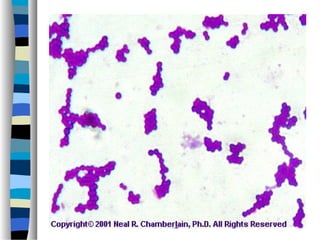
Facultative Anaerobic, Gram +ve
Cocci, Non-motile, Non-sporing,
Arranged in Grape-like Clustures.
Catalase:
1. Coagulase Positive Staphylococci
(CPS)
2. Coagulase Negative Staphylococci
(CNS)
1

2
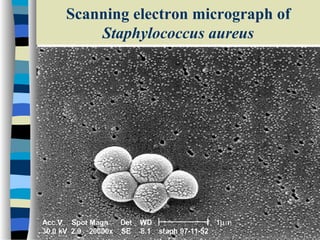
Scanning electron micrograph of
Staphylococcus aureus
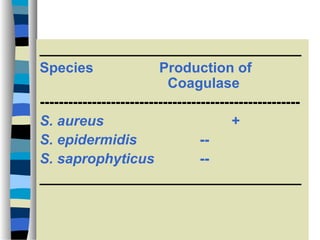
_________________________________
Species
Production of
Coagulase
------------------------------------------------------S. aureus
+
S. epidermidis
-S. saprophyticus
-_________________________________
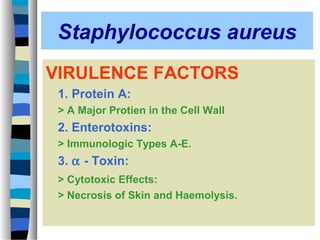
Staphylococcus aureus
VIRULENCE FACTORS
1. Protein A:
> A Major Protien in the Cell Wall

2. Enterotoxins:
> Immunologic Types A-E.

3. α - Toxin:
> Cytotoxic Effects:
> Necrosis of Skin and Haemolysis.
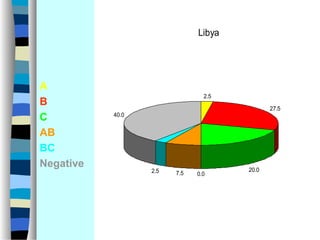
Libya

A
B
C
AB
BC
Negative

2.5
27.5

40.0

2.5

7.5

0.0

20.0
4. Epidermolytic Toxins:
> Impetigo and Scalded-Skin Syndrome.

5. Toxic-Shock Syndrome Toxin (TSST-1):
> Toxic Shock in Tampon Using Menstruating
Women.

6. Enzymes:
i. Coagulase
ii. Fibrinolysin
iii. Hyaluronidase
iv. Lipase
CLINICAL INFECTION
1. Skin Infections:
> Impetigo, Furuncles, Cellulitis, Surgical and
Wound Infections and Postpartum Breast
Infections.

2. Bacteraemia:
>From Localized Lesions

3. Endocarditis:
4. Osteomyelitis:

5. Pneumonia:
6. Abscesses (metastatic):
> In any Organ
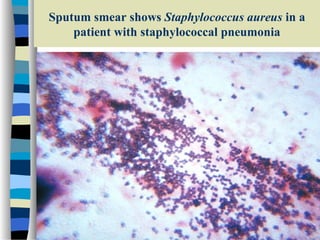
Sputum smear shows Staphylococcus aureus in a
patient with staphylococcal pneumonia
7. Food Poisoning:
8. Toxic Shock Syndrome:
> Fever, Hypotension>> Multisystem
Involvement.
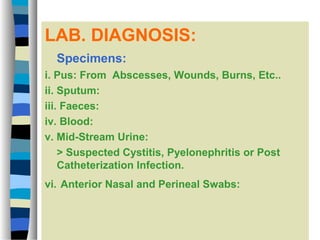
LAB. DIAGNOSIS:
Specimens:
i. Pus: From Abscesses, Wounds, Burns, Etc..
ii. Sputum:
iii. Faeces:
iv. Blood:
v. Mid-Stream Urine:
> Suspected Cystitis, Pyelonephritis or Post
Catheterization Infection.
vi. Anterior Nasal and Perineal Swabs:
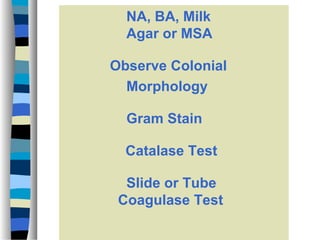
NA, BA, Milk
Agar or MSA
Observe Colonial
Morphology
Gram Stain
Catalase Test
Slide or Tube
Coagulase Test
PHAGE TYPING
> For Epidemiological Studies.

TREATMENT
i. Production of β-Lactamase> Resistance to
Penicillins.
ii. Penicillins Stable to Staphylococcal Penicillinase:
> Methicillin, Cloxacillin and Flucloxacillin.
iii. Other Antibiotics:

iv. MRSA >>> Vancomycin.
EPIDEMIOLOGY:
1. Sources of Infection:
i. Infected Lesions:
> Doctors and Nurses.
> Foodhandlers.

ii. Healthy Carriers:
iii. Animals:
> Domesticated and Some Wild Animals:

2. Modes of Infection:
– Exogenous
– Endogenous

Cross Infections:
> Important in Hospitals >> by Direct Contact.

Lecture 1 Staphylococcus aureus