




































By Dr. Rakesh Prasad Sah
Associate Professor, Microbiology
Clostridium Perfringens
(Gas gangrene)
Introduction
•Anaerobic bacteria  do not have cytochrome system for oxyg
en metabolism  unable to neutralize toxic oxygen metabolites
 either can not grow in presence of oxygen (obligate anaero
bes) or do not utilize oxygen but tolerate its presence of (aerotol
erant anaerobes).
•Needs special requirements for their growth in culture (Anaero
bic Conditions)
•Needs special requirements for their growth in culture (Anaero
bic Conditions)
• McIntosh and Filde’s anaerobic Jar
• GasPak system
•Medium with low redox potential: by adding reducing substances to m
edia e.g.
• Unsaturated fatty acid
• Ascorbic acid
• Glutathione
• Cysteine
• Glucose
• Sulfites
• Metallic iron
Clostridium
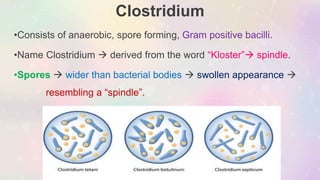
•Consists of anaerobic, spore forming, Gram positive bacilli.
•Name Clostridium  derived from the word “Kloster” spindle.
•Spores  wider than bacterial bodies  swollen appearance 
resembling a “spindle”.
•Genus contains bacteria causes 3 major ds.  due to powerful
exotoxins.
• Tetanus
• Gas gangrene
• Food Poisoning
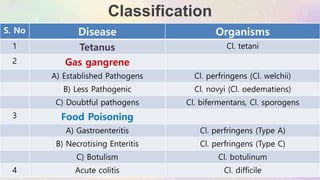
Classification
S. No Disease Organisms
1 Tetanus Cl. tetani
2 Gas gangrene
A) Established Pathogens Cl. perfringens (Cl. welchii)
B) Less Pathogenic Cl. novyi (Cl. oedematiens)
C) Doubtful pathogens Cl. bifermentans, Cl. sporogens
3 Food Poisoning
A) Gastroenteritis Cl. perfringens (Type A)
B) Necrotising Enteritis Cl. perfringens (Type C)
C) Botulism Cl. botulinum
4 Acute colitis Cl. difficile
Cl. perfringens (Cl. welchii)
•Cultivated by Achalme (1891) and was first described in detail by We
lch and Nuttal (1892).
•Cl. Perfringens most common & impt etiological agent of gas gangren
e (60%), followed by Cl. Novyi (30-40%) and Cl. Septicum (10-20%).
•Cl. Perfringens also produces  food poisoining and
necrotising enteritis in man.
•Commensals of large intestine and spores are found in soil and dust.
•Is invasive as well as toxigenic
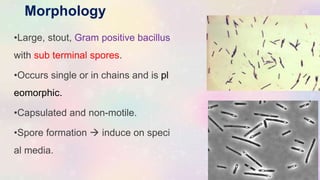
Morphology
•Large, stout, Gram positive bacillus
with sub terminal spores.
•Occurs single or in chains and is pl
eomorphic.
•Capsulated and non-motile.
•Spore formation  induce on speci
al media.
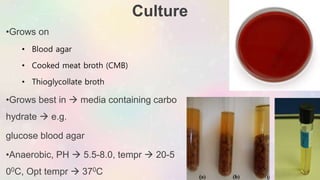
Culture
•Grows on
• Blood agar
• Cooked meat broth (CMB)
• Thioglycollate broth
•Grows best in  media containing carbo
hydrate  e.g.
glucose blood agar
•Anaerobic, PH  5.5-8.0, tempr  20-5
00C, Opt tempr  370C
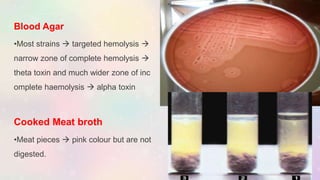
Blood Agar
•Most strains  targeted hemolysis 
narrow zone of complete hemolysis 
theta toxin and much wider zone of inc
omplete haemolysis  alpha toxin
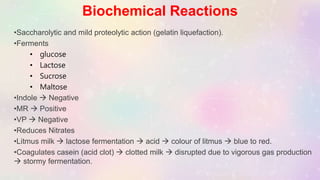
Cooked Meat broth
•Meat pieces  pink colour but are not
digested.
Biochemical Reactions
•Saccharolytic and mild proteolytic action (gelatin liquefaction).
•Ferments
• glucose
• Lactose
• Sucrose
• Maltose
•Indole  Negative
•MR  Positive
•VP  Negative
•Reduces Nitrates
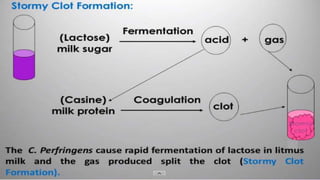
•Litmus milk  lactose fermentation  acid  colour of litmus  blue to red.
•Coagulates casein (acid clot)  clotted milk  disrupted due to vigorous gas production
 stormy fermentation.
Classification
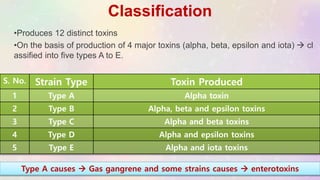
•Produces 12 distinct toxins
•On the basis of production of 4 major toxins (alpha, beta, epsilon and iota)  cl
assified into five types A to E.
S. No. Strain Type Toxin Produced
1 Type A Alpha toxin
2 Type B Alpha, beta and epsilon toxins
3 Type C Alpha and beta toxins
4 Type D Alpha and epsilon toxins
5 Type E Alpha and iota toxins
Type A causes  Gas gangrene and some strains causes  enterotoxins
Alpha (α) Toxin
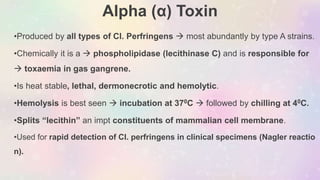
•Produced by all types of Cl. Perfringens  most abundantly by type A strains.
•Chemically it is a  phospholipidase (lecithinase C) and is responsible for
 toxaemia in gas gangrene.
•Is heat stable, lethal, dermonecrotic and hemolytic.
•Hemolysis is best seen  incubation at 370C  followed by chilling at 40C.
•Splits “lecithin” an impt constituents of mammalian cell membrane.
•Used for rapid detection of Cl. perfringens in clinical specimens (Nagler reactio
n).
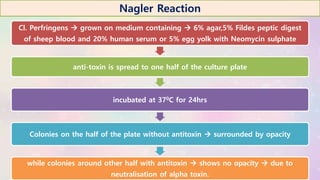
Cl. Perfringens  grown on medium containing  6% agar,5% Fildes peptic digest
of sheep blood and 20% human serum or 5% egg yolk with Neomycin sulphate
anti-toxin is spread to one half of the culture plate
incubated at 370C for 24hrs
Colonies on the half of the plate without antitoxin  surrounded by opacity
while colonies around other half with antitoxin  shows no opacity  due to
neutralisation of alpha toxin.
Nagler Reaction
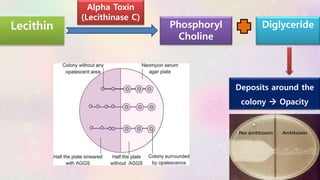
Alpha Toxin
(Lecithinase C)
Lecithin Diglyceride
Phosphoryl
Choline
Deposits around the
colony  Opacity
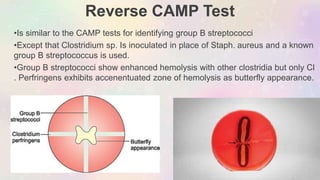
Reverse CAMP Test
•Is similar to the CAMP tests for identifying group B streptococci
•Except that Clostridium sp. Is inoculated in place of Staph. aureus and a known
group B streptococcus is used.
•Group B streptococci show enhanced hemolysis with other clostridia but only Cl
. Perfringens exhibits accenentuated zone of hemolysis as butterfly appearance.
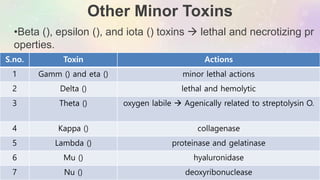
Other Minor Toxins
S.no. Toxin Actions
1 Gamm () and eta () minor lethal actions
2 Delta () lethal and hemolytic
3 Theta () oxygen labile  Agenically related to streptolysin O.
4 Kappa () collagenase
5 Lambda () proteinase and gelatinase
6 Mu () hyaluronidase
7 Nu () deoxyribonuclease
•Beta (), epsilon (), and iota () toxins  lethal and necrotizing pr
operties.
Enterotoxin
•Some strains of type A  enterotoxin  diarrhoea & other sym
ptoms of food poisoning.
Other Soluble Substances
• Haemagglutinins
• Neuraminidase
• Fibrinolysin
• Haemolysin
• Histamine
Pathogenesis
•Produces following human infections
• Gas Gangrene
• Food Poisoning
• Necrotising Enteritis
Gas Gangrene
•Cl. Perfringens type A  predominant bacteria  causing Gas
gangrene
•Wound  contaminated by fecal matter or soil  simple woun
d contamination, anaerobic cellulitis or myonecrosis ( gas gangr
ene proper).
•Is only when muscle tissues  invaded  results gas gangren
e.
•I.P.  6hr to 6 weeks.
Food Poisoning
•Some strains of type A.
•I.P.  8-12 hrs
•Heat labile enterotoxin is liberated in the small intestine  after
ingestion of contaminated food, usually undercooked
meat and poultry.
•Toxin acts like enterotoxin of V. cholera and leads to fluid accu
mulation in the rabbit ileal loop.
Clinical Manifestations
•Polymicrobial involving other clostridia species.
Clostridial Wound infections
•Simple wound contamination
• Involves wound surface contamination without invasion of
underlying tissue  occurs in absence of devitalized tissue
Anaerobic cellulitis
•Involves facial plane with minimal toxin release,
without muscle invasion.
Anaerobic myositis (gas gangrene)
•Muscle invasion occurs  leads to gas in the muscle com
partment with abundant toxin release.
Clostridial Enteric infections
Food Poisoning
•Caused by C. perfringens type A enterotoxin
•Occurs  consumption of improperly cooked contaminated
meat
•Enterotoxin  acts by forming pores in the intestinal mucosal
membrane.
Enteritis necroticans (gas gangrene of the bowel)
•A life threatining condition
•Characterized by  ischemic necrosis of the Jejunum and gas
in the tissue.
•Caused by C. perfringens type C strains  β-toxin.
Necrotizing enterocolitis
•Resembles enteritis necroticans but associated with C. perfring
ens type A
•Gangrenous appendicitis.
Other Clostridial infections
•Bacteremia
•Skin and soft tissue infections
• C. perfringens, C. histolyticum, C. septicum, C. novyi and C. sordellii
 cause necrotizing infections of skin and soft tissues
• Infection of the endometrium  toxic shock syndrome
• Meningitis and brain abscess
• Panophthalmitis (C. sordellii or C. perfrngens)
Gas Gangrene
Definition
•A rapidly spreading, edematous myonecrosis occuring in
association with severly crushed wounds contaminated with
pathogenic clostridia, particularly with C. perfringens.
•Previously the disease was called malignant edema or
clostridial myonecrosis.
Pathogenesis
•Development of gas gangrene requires
•Anaerobic environment
• Crushing injuries of muscles  RTA  causing liberation of large or
medium sized arteries  open fractures of long bones or foreign b
odies (bullet injuries) or devitalized tissues  lead to interruption in
blood supply and tissue ischemia.
• Anoxic muscle  starts utilizing pyruvate anaerobically to produce
lactic acid.
•Contamination of wound  with Clostridial spores present In the soil or
clothes.
•Rarely non-traumatic gas gangrene  hematogenous seeding of normal
muscle with bowel clostridia  occurs in people with GIT pathologies (e.
g. colonic malignancy)
Clinical Manifestations of Gas Gangrene
•I.P.  10-48hrs for C. perfringens
•2-3 days for C. septicum
•5-6 days for C. novyi
•Various manifestation include
• Sudden onset of excruciating pain at the affected site.
• Rapid development of a foul-smelling thin serosanguineous dischar
ge
• Gas bubbles (Crepitus) in the muscle planes
• Brawny edema and induration
• Gangrenous tissues  become liquefied and sloughed off
• Shock and organ failure develop later
• High mortality rate (50%)
Laboratory Diagnosis
•Specimens
• Necrotic tissues
• Muscle fragments
• Exudates from deeper parts of the wound
•Direct Microscopy
• Gram Positive bacilli without spores  suggestive of Cl. Perfringens
•Culture
• Media RCM (Robertson cooked meat broth, egg yolk, agar etc)
• Incubation  anaerobically by GasPak
Identification
•Nagler reaction
•Reverse CAMP test
•In litmus milk  produces stormy clot reaction.
Prophylaxis
•Surgery
•Antibiotics: Metronidazole, penicillin, sulphonamide, tetracycl
ine, and amoxycillin.
•Antitoxin
•Hyperbaric oxygen
•Active immunisation  Toxoids.
Free PPT _ Click to add title
Click to edit text styles - Widescreen(16:9)
This PowerPoint Template has clean and neutral design that can be adapted to
any content and meets various market segments. With this many slides you are
able to make a complete PowerPoint Presentation that best suit your needs.
This PowerPoint Template has clean and neutral design that can be adapted to
any content and meets various market segments. With this many slides you are
able to make a complete PowerPoint Presentation that best suit your needs.
This PowerPoint Template has clean and neutral design that can be adapted to
any content and meets various market segments. With this many slides you are
able to make a complete PowerPoint Presentation that best suit your needs.

Clostridium perfringens

  • 1.
    By Dr. RakeshPrasad Sah Associate Professor, Microbiology Clostridium Perfringens (Gas gangrene)
  • 2.
    Introduction •Anaerobic bacteria do not have cytochrome system for oxyg en metabolism  unable to neutralize toxic oxygen metabolites  either can not grow in presence of oxygen (obligate anaero bes) or do not utilize oxygen but tolerate its presence of (aerotol erant anaerobes). •Needs special requirements for their growth in culture (Anaero bic Conditions)
  • 3.
    •Needs special requirementsfor their growth in culture (Anaero bic Conditions) • McIntosh and Filde’s anaerobic Jar • GasPak system •Medium with low redox potential: by adding reducing substances to m edia e.g. • Unsaturated fatty acid • Ascorbic acid • Glutathione • Cysteine • Glucose • Sulfites • Metallic iron
  • 4.
    Clostridium •Consists of anaerobic,spore forming, Gram positive bacilli. •Name Clostridium  derived from the word “Kloster” spindle. •Spores  wider than bacterial bodies  swollen appearance  resembling a “spindle”.
  • 5.
    •Genus contains bacteriacauses 3 major ds.  due to powerful exotoxins. • Tetanus • Gas gangrene • Food Poisoning
  • 6.
    Classification S. No DiseaseOrganisms 1 Tetanus Cl. tetani 2 Gas gangrene A) Established Pathogens Cl. perfringens (Cl. welchii) B) Less Pathogenic Cl. novyi (Cl. oedematiens) C) Doubtful pathogens Cl. bifermentans, Cl. sporogens 3 Food Poisoning A) Gastroenteritis Cl. perfringens (Type A) B) Necrotising Enteritis Cl. perfringens (Type C) C) Botulism Cl. botulinum 4 Acute colitis Cl. difficile
  • 7.
    Cl. perfringens (Cl.welchii) •Cultivated by Achalme (1891) and was first described in detail by We lch and Nuttal (1892). •Cl. Perfringens most common & impt etiological agent of gas gangren e (60%), followed by Cl. Novyi (30-40%) and Cl. Septicum (10-20%). •Cl. Perfringens also produces  food poisoining and necrotising enteritis in man. •Commensals of large intestine and spores are found in soil and dust. •Is invasive as well as toxigenic
  • 8.
    Morphology •Large, stout, Grampositive bacillus with sub terminal spores. •Occurs single or in chains and is pl eomorphic. •Capsulated and non-motile. •Spore formation  induce on speci al media.
  • 9.
    Culture •Grows on • Bloodagar • Cooked meat broth (CMB) • Thioglycollate broth •Grows best in  media containing carbo hydrate  e.g. glucose blood agar •Anaerobic, PH  5.5-8.0, tempr  20-5 00C, Opt tempr  370C
  • 10.
    Blood Agar •Most strains targeted hemolysis  narrow zone of complete hemolysis  theta toxin and much wider zone of inc omplete haemolysis  alpha toxin Cooked Meat broth •Meat pieces  pink colour but are not digested.
  • 11.
    Biochemical Reactions •Saccharolytic andmild proteolytic action (gelatin liquefaction). •Ferments • glucose • Lactose • Sucrose • Maltose •Indole  Negative •MR  Positive •VP  Negative •Reduces Nitrates •Litmus milk  lactose fermentation  acid  colour of litmus  blue to red. •Coagulates casein (acid clot)  clotted milk  disrupted due to vigorous gas production  stormy fermentation.
  • 13.
    Classification •Produces 12 distincttoxins •On the basis of production of 4 major toxins (alpha, beta, epsilon and iota)  cl assified into five types A to E. S. No. Strain Type Toxin Produced 1 Type A Alpha toxin 2 Type B Alpha, beta and epsilon toxins 3 Type C Alpha and beta toxins 4 Type D Alpha and epsilon toxins 5 Type E Alpha and iota toxins Type A causes  Gas gangrene and some strains causes  enterotoxins
  • 14.
    Alpha (α) Toxin •Producedby all types of Cl. Perfringens  most abundantly by type A strains. •Chemically it is a  phospholipidase (lecithinase C) and is responsible for  toxaemia in gas gangrene. •Is heat stable, lethal, dermonecrotic and hemolytic. •Hemolysis is best seen  incubation at 370C  followed by chilling at 40C. •Splits “lecithin” an impt constituents of mammalian cell membrane. •Used for rapid detection of Cl. perfringens in clinical specimens (Nagler reactio n).
  • 15.
    Cl. Perfringens grown on medium containing  6% agar,5% Fildes peptic digest of sheep blood and 20% human serum or 5% egg yolk with Neomycin sulphate anti-toxin is spread to one half of the culture plate incubated at 370C for 24hrs Colonies on the half of the plate without antitoxin  surrounded by opacity while colonies around other half with antitoxin  shows no opacity  due to neutralisation of alpha toxin. Nagler Reaction
  • 16.
    Alpha Toxin (Lecithinase C) LecithinDiglyceride Phosphoryl Choline Deposits around the colony  Opacity
  • 17.
    Reverse CAMP Test •Issimilar to the CAMP tests for identifying group B streptococci •Except that Clostridium sp. Is inoculated in place of Staph. aureus and a known group B streptococcus is used. •Group B streptococci show enhanced hemolysis with other clostridia but only Cl . Perfringens exhibits accenentuated zone of hemolysis as butterfly appearance.
  • 18.
    Other Minor Toxins S.no.Toxin Actions 1 Gamm () and eta () minor lethal actions 2 Delta () lethal and hemolytic 3 Theta () oxygen labile  Agenically related to streptolysin O. 4 Kappa () collagenase 5 Lambda () proteinase and gelatinase 6 Mu () hyaluronidase 7 Nu () deoxyribonuclease •Beta (), epsilon (), and iota () toxins  lethal and necrotizing pr operties.
  • 19.
    Enterotoxin •Some strains oftype A  enterotoxin  diarrhoea & other sym ptoms of food poisoning. Other Soluble Substances • Haemagglutinins • Neuraminidase • Fibrinolysin • Haemolysin • Histamine
  • 20.
    Pathogenesis •Produces following humaninfections • Gas Gangrene • Food Poisoning • Necrotising Enteritis
  • 21.
    Gas Gangrene •Cl. Perfringenstype A  predominant bacteria  causing Gas gangrene •Wound  contaminated by fecal matter or soil  simple woun d contamination, anaerobic cellulitis or myonecrosis ( gas gangr ene proper). •Is only when muscle tissues  invaded  results gas gangren e. •I.P.  6hr to 6 weeks.
  • 22.
    Food Poisoning •Some strainsof type A. •I.P.  8-12 hrs •Heat labile enterotoxin is liberated in the small intestine  after ingestion of contaminated food, usually undercooked meat and poultry. •Toxin acts like enterotoxin of V. cholera and leads to fluid accu mulation in the rabbit ileal loop.
  • 23.
    Clinical Manifestations •Polymicrobial involvingother clostridia species. Clostridial Wound infections •Simple wound contamination • Involves wound surface contamination without invasion of underlying tissue  occurs in absence of devitalized tissue
  • 24.
    Anaerobic cellulitis •Involves facialplane with minimal toxin release, without muscle invasion. Anaerobic myositis (gas gangrene) •Muscle invasion occurs  leads to gas in the muscle com partment with abundant toxin release.
  • 25.
    Clostridial Enteric infections FoodPoisoning •Caused by C. perfringens type A enterotoxin •Occurs  consumption of improperly cooked contaminated meat •Enterotoxin  acts by forming pores in the intestinal mucosal membrane. Enteritis necroticans (gas gangrene of the bowel) •A life threatining condition •Characterized by  ischemic necrosis of the Jejunum and gas in the tissue. •Caused by C. perfringens type C strains  β-toxin.
  • 26.
    Necrotizing enterocolitis •Resembles enteritisnecroticans but associated with C. perfring ens type A •Gangrenous appendicitis.
  • 27.
    Other Clostridial infections •Bacteremia •Skinand soft tissue infections • C. perfringens, C. histolyticum, C. septicum, C. novyi and C. sordellii  cause necrotizing infections of skin and soft tissues • Infection of the endometrium  toxic shock syndrome • Meningitis and brain abscess • Panophthalmitis (C. sordellii or C. perfrngens)
  • 28.
    Gas Gangrene Definition •A rapidlyspreading, edematous myonecrosis occuring in association with severly crushed wounds contaminated with pathogenic clostridia, particularly with C. perfringens. •Previously the disease was called malignant edema or clostridial myonecrosis.
  • 29.
    Pathogenesis •Development of gasgangrene requires •Anaerobic environment • Crushing injuries of muscles  RTA  causing liberation of large or medium sized arteries  open fractures of long bones or foreign b odies (bullet injuries) or devitalized tissues  lead to interruption in blood supply and tissue ischemia. • Anoxic muscle  starts utilizing pyruvate anaerobically to produce lactic acid. •Contamination of wound  with Clostridial spores present In the soil or clothes. •Rarely non-traumatic gas gangrene  hematogenous seeding of normal muscle with bowel clostridia  occurs in people with GIT pathologies (e. g. colonic malignancy)
  • 30.
    Clinical Manifestations ofGas Gangrene •I.P.  10-48hrs for C. perfringens •2-3 days for C. septicum •5-6 days for C. novyi •Various manifestation include • Sudden onset of excruciating pain at the affected site. • Rapid development of a foul-smelling thin serosanguineous dischar ge • Gas bubbles (Crepitus) in the muscle planes • Brawny edema and induration • Gangrenous tissues  become liquefied and sloughed off • Shock and organ failure develop later • High mortality rate (50%)
  • 31.
    Laboratory Diagnosis •Specimens • Necrotictissues • Muscle fragments • Exudates from deeper parts of the wound •Direct Microscopy • Gram Positive bacilli without spores  suggestive of Cl. Perfringens •Culture • Media RCM (Robertson cooked meat broth, egg yolk, agar etc) • Incubation  anaerobically by GasPak
  • 32.
    Identification •Nagler reaction •Reverse CAMPtest •In litmus milk  produces stormy clot reaction.
  • 33.
    Prophylaxis •Surgery •Antibiotics: Metronidazole, penicillin,sulphonamide, tetracycl ine, and amoxycillin. •Antitoxin •Hyperbaric oxygen •Active immunisation  Toxoids.
  • 70.
    Free PPT _Click to add title Click to edit text styles - Widescreen(16:9) This PowerPoint Template has clean and neutral design that can be adapted to any content and meets various market segments. With this many slides you are able to make a complete PowerPoint Presentation that best suit your needs. This PowerPoint Template has clean and neutral design that can be adapted to any content and meets various market segments. With this many slides you are able to make a complete PowerPoint Presentation that best suit your needs. This PowerPoint Template has clean and neutral design that can be adapted to any content and meets various market segments. With this many slides you are able to make a complete PowerPoint Presentation that best suit your needs.