STAPHYLOCOCCUS
MADE BY:
SHALINI BISHT
INTRODUCTION
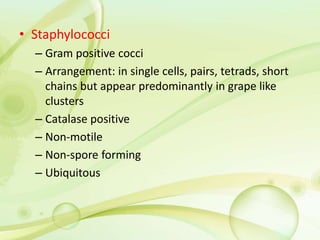
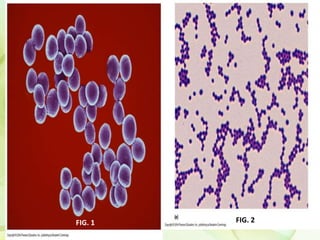
• Staphylococci
– Gram positive cocci
– Arrangement: in single cells, pairs, tetrads, short
chains but appear predominantly in grape like
clusters
– Catalase positive
– Non-motile
– Non-spore forming
– Ubiquitous
FIG. 1 FIG. 2
HISTORY
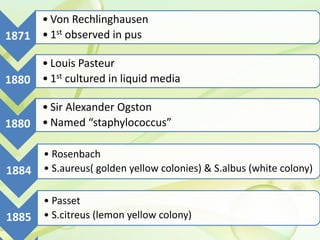
1871
• Von Rechlinghausen
• 1st observed in pus
1880
• Louis Pasteur
• 1st cultured in liquid media
1880
• Sir Alexander Ogston
• Named “staphylococcus”
1884
• Rosenbach
• S.aureus( golden yellow colonies) & S.albus (white colony)
1885
• Passet
• S.citreus (lemon yellow colony)
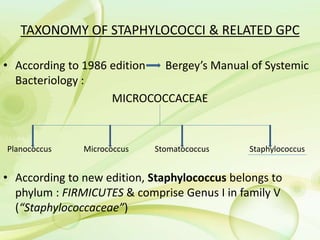
TAXONOMY OF STAPHYLOCOCCI & RELATED GPC
• According to 1986 edition Bergey’s Manual of Systemic
Bacteriology :
MICROCOCCACEAE
Planococcus Micrococcus Stomatococcus Staphylococcus
• According to new edition, Staphylococcus belongs to
phylum : FIRMICUTES & comprise Genus I in family V
(“Staphylococcaceae”)
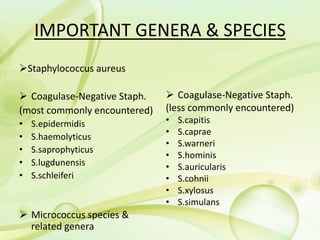
IMPORTANT GENERA & SPECIES
Staphylococcus aureus
 Coagulase-Negative Staph.
(most commonly encountered)
• S.epidermidis
• S.haemolyticus
• S.saprophyticus
• S.lugdunensis
• S.schleiferi
 Micrococcus species &
related genera
 Coagulase-Negative Staph.
(less commonly encountered)
• S.capitis
• S.caprae
• S.warneri
• S.hominis
• S.auricularis
• S.cohnii
• S.xylosus
• S.simulans
Staphylococcus aureus
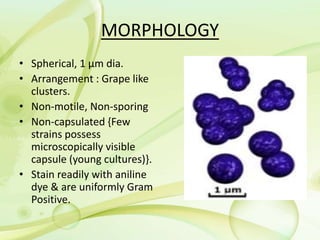
MORPHOLOGY
• Spherical, 1 µm dia.
• Arrangement : Grape like
clusters.
• Non-motile, Non-sporing
• Non-capsulated {Few
strains possess
microscopically visible
capsule (young cultures)}.
• Stain readily with aniline
dye & are uniformly Gram
Positive.
CULTURE CHARACTERICTICS
•Aerobes and facultative anaerobes
•Temperature = 10°C to 42°C (37°C)
•pH = 7.4 - 7.6
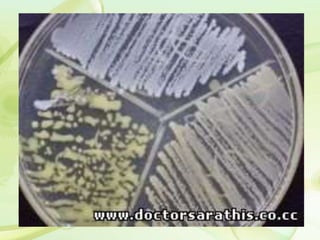
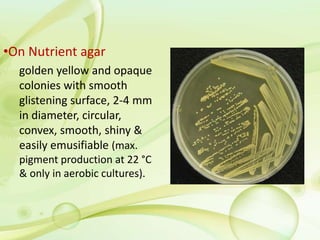
•On Nutrient agar
golden yellow and opaque
colonies with smooth
glistening surface, 2-4 mm
in diameter, circular,
convex, smooth, shiny &
easily emusifiable (max.
pigment production at 22 °C
& only in aerobic cultures).
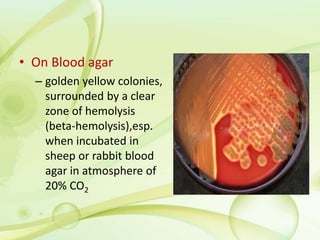
• On Blood agar
– golden yellow colonies,
surrounded by a clear
zone of hemolysis
(beta-hemolysis),esp.
when incubated in
sheep or rabbit blood
agar in atmosphere of
20% CO2
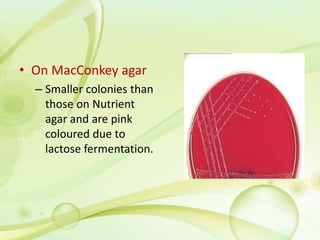
• On MacConkey agar
– Smaller colonies than
those on Nutrient
agar and are pink
coloured due to
lactose fermentation.
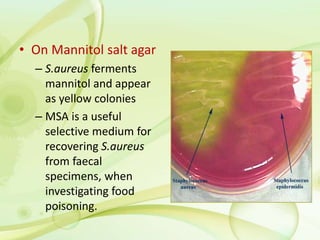
• On Mannitol salt agar
– S.aureus ferments
mannitol and appear
as yellow colonies
– MSA is a useful
selective medium for
recovering S.aureus
from faecal
specimens, when
investigating food
poisoning.
BIOCHEMICAL PROPERTIES
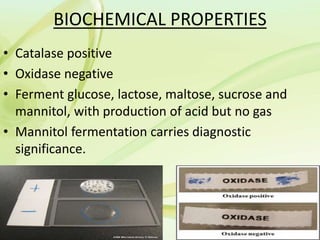
• Catalase positive
• Oxidase negative
• Ferment glucose, lactose, maltose, sucrose and
mannitol, with production of acid but no gas
• Mannitol fermentation carries diagnostic
significance.
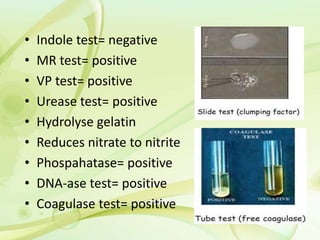
• Indole test= negative
• MR test= positive
• VP test= positive
• Urease test= positive
• Hydrolyse gelatin
• Reduces nitrate to nitrite
• Phospahatase= positive
• DNA-ase test= positive
• Coagulase test= positive
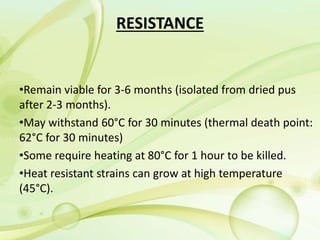
RESISTANCE
•Remain viable for 3-6 months (isolated from dried pus
after 2-3 months).
•May withstand 60°C for 30 minutes (thermal death point:
62°C for 30 minutes)
•Some require heating at 80°C for 1 hour to be killed.
•Heat resistant strains can grow at high temperature
(45°C).
•Most strains grow at 10% NaCl conc.
•Bactericidal aniline dyes:
•Crystal violet (conc. 1 in 500,000)
•Brilliant green (conc. 1 in 10,000,000)
•Resist 1 % phenol for 15 mins.
•Mercury peroxide 1% solution can kill them in 10
minutes.
PENICILLIN RESISTANCE
•3 types:
Production of Beta lactamase
Alteration in penicillin binding protein
PBP2a
Development of tolerance to penicillin
Bacterium is only inhibited but not killed
PRODUCTION OF BETA LACTAMASE:(PENICILLINASE)
•Inactivates penicillin
•Staphylococci produces 4 types of penicillinases(A-D)
•Hospital strains:type A penicillinase
•Penicillinase:
•inducible enzyme
•Production usually controlled by plasmids,which are
transmitted by transduction or conjugation
•Same plasmid: may carry genes for resistance to a range of
other antibiotics and heavy metals
ALTERATION IN PENICILLIN BINDING PROTEIN(PBP2A)
& CHANGES IN BACTERIAL SURFACE RECEPTORS:
•Reduces binding of beta lactam antibiotics to cells
•Normally chromosomal in nature
•Expressed more at 30°C than at 37°C
•Also extends to cover beta lactamase-resistant penicillins
such as methicillin and cloxacillins (MRSA)
•EMRSA: “epidemic methicillin-resistant Staphylococcus
aureus”
•erythromycins,tetracyclines,aminoglycosides and heavy
metals
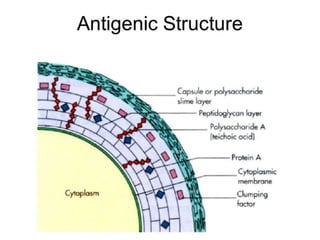
ANTIGENIC STRUCTURE
PATHOGENECITY & VIRULENCE
FACTORS
PATHOGENICITY
Source of infection:
A) Exogenous: patients or carriers
B) Endogenous: From colonized site
Mode of transmission:
A) Contact: direct or indirect( through fomites)
B) Inhalation of infected air borne droplets
VIRULENCE FACTORS
 Two types:
 CELL ASSOCIATED FACTORS
 EXTRACELLULAR FACTORS
A. Cell associated polymers
B. Cell surface proteins
C. Enzymes
D. Toxins
CELL ASSOCIATED FACTORS
CELL ASSOCIATED POLYMERS
1. CAPSULAR POLYSACCHARIDE
 Some strains produce exopolysaccharide (helps
in adherence to host cell & prosthetic devices).
Clinical isolates of SA – classified into 11 types
based on capsular polysaccharide immunotyping.
70-80% of significant clinical isolate belong to
capsular serotype 5 or 8.
2. PEPTIDOGLYCAN & TEICHOIC ACID
Cell wall contain peptidoglycan (NAG & NAM) & teichoic
acid.
Functions:
Specific adherence of bacteria to mucosal surfaces.
Provides rigidity & resilience to cell wall.
Adhesins, fibronectin-binding proteins, collagen-binding
proteins & clumping factors are covalently incorporated
into peptidoglycan.
CELL SURFACE PROTEINS
1. PROTEIN A
 MW: 42 kDa
 Found on cell surface & in growth medium.
 Ability to bind the Fc region of all human IgG (except IgG3 ).
 Interfere with opsonization & ingestion of the organism by
PMN cells, activating complement & eliciting immediate &
delayed type hypersensitivity reactions.
 It is immunogenic; abs are found in patient with serious
S.aureus infections.
 Presence of protein A provides basis for Co-agglutination
reaction (used to identify gonococci, streptococcal
grouping) and detection of bacterial Ags in body fluids.
2. CLUMPING FACTORS
 Cell bound material able to bind fibrinogen, responsible
for binding of S.aureus to both fibrin & fibrinogen.
EXTRACELLULAR FACTORS
ENZYMES
1. CATALASE
 All staphylococci produce catalase, which catalyzes
the conversion of toxic hydrogen peroxide to water
and oxygen.
 Hydrogen peroxide can accumulate during bacterial
metabolism or after phagycytosis.
2. COAGULASE
S. aureus strains possess two forms of coagulase:
bound,
Free.
Coagulase bound to the staphylococcal cell wall can
directly convert fibrinogen to insoluble fibrin and cause
the staphylococci to clump.
The cell-free coagulase accomplishes the same result by
reacting with a globulin plasma factor.
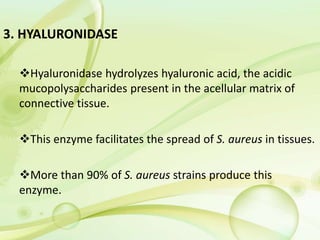
3. HYALURONIDASE
Hyaluronidase hydrolyzes hyaluronic acid, the acidic
mucopolysaccharides present in the acellular matrix of
connective tissue.
This enzyme facilitates the spread of S. aureus in tissues.
More than 90% of S. aureus strains produce this
enzyme.
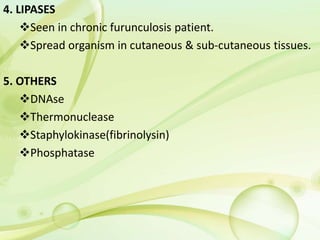
4. LIPASES
Seen in chronic furunculosis patient.
Spread organism in cutaneous & sub-cutaneous tissues.
5. OTHERS
DNAse
Thermonuclease
Staphylokinase(fibrinolysin)
Phosphatase
TOXINS
1. CYTOLYTIC TOXINS: membrane active
substances, consisting of four hemolysins & a
leucocidin
1. Alpha hemolysin
2. Beta hemolysin
3. Gamma hemolysin
4. Delta hemolysin
5. Leucocidin
• ALPHA HEMOLYSIN
– inactivated at 70°C but reactivated at 100°C
– Lyse rabbit erythrocyte but less active against
sheep and human red cells.
– Toxic to macrophages, lysosome, muscle tissue,
renal cortex & circulatory system.
• BETA HEMOLYSIN
– It is a sphingomyelinase, hemolytic for sheep cell
but not for human & rabbit cell.
– Exhibit hot-cold phenomenon(hemolysis being
initiated at 37°C but become evident only after
chilling)
• GAMMA HEMOLYSIN
– Composed of 2 separate proteins ( necessary for
hemolytic activity)
• DELTA HEMOLYSIN
– Detergent like effect on cell membrane of
erythrocyte, leucocyte, macrophage & platelet
• LEUCOCIDIN (PANTON-VALENTINE TOXIN/PVL)
– Composed of S & F components.
– Damages PMN cells & macro-phages.
– Grouped as synergo-hymenotropic toxins.
2. ENTEROTOXINS
– Staphylococcal Food poisoning: contaminated food.
– Nine antigenic types currently known
(A,B,C1,C2,C3,D,E,H,I).
– Toxin A – most cases.
– Resistance
• Gut enzymes
• Boiling for 30 minutes
– Common food items: carbohydrate, protein food, meat
& fish, milk & milk product cooked & left at room
temperature.
- Source of infection: food handler(carrier).
- Recovery: 24-48 hours.
- Toxin act directly on ANS.
- Enterotoxin : superantigen
- Toxin is antigenic-neutralized by specific antitoxin.
- Toxin detection: ELISA, latex agglutination.
3.TOXIC SHOCK SYNDROME TOXIN (TSST)
• Superantigen TOXIC SHOCK SYNDROME
• Most TSST producing strain belongs to
Bacteriophage group-I.(TSST TYPE-I)
4. EXFOLIATIVE (EPIDERMOLYTIC) TOXIN
• 2 types
• ET-A and ET-B
– ET-A – heat stable (chromosomal)
– ET-B – heat labile (plasmid mediated)
• Produced by some strains of Staph. aureus (phage
group II)
• Proteolytic, dissolve mucopolysaccharide matrix of
epidermis.
• Epidermal splitting blistering disease.
• Staphylococcal Scalded Skin Syndrome (SSSS).
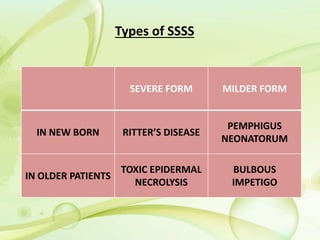
• Severe form : Ritter’s disease (newborn) & toxic
epidermal necrolysis (older patients)
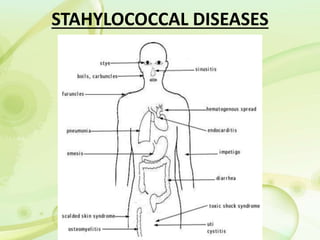
STAPHYLOCOCCAL DISEASES
STAHYLOCOCCAL DISEASES
Diseases produced by staphylococcus aureus: 2
groups
INFECTIONS
INTOXICATION
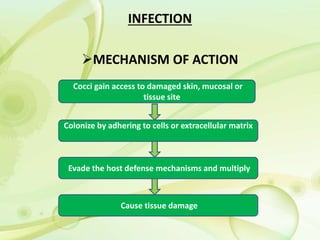
INFECTION
MECHANISM OF ACTION
Cocci gain access to damaged skin, mucosal or
tissue site
Colonize by adhering to cells or extracellular matrix
Evade the host defense mechanisms and multiply
Cause tissue damage
• Skin and soft tissue infection
– Folliculitis
– Furuncle (boil)
– Carbuncle
– Impetigo
– abscess
– Wound infection
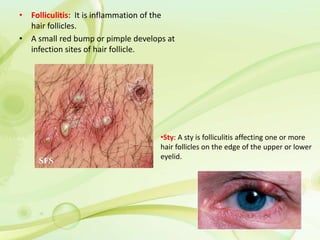
• Folliculitis: It is inflammation of the
hair follicles.
• A small red bump or pimple develops at
infection sites of hair follicle.
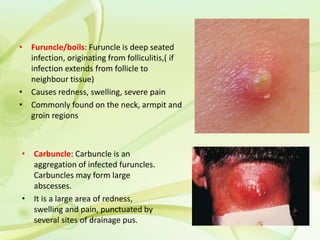
•Sty: A sty is folliculitis affecting one or more
hair follicles on the edge of the upper or lower
eyelid.
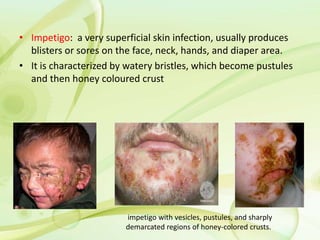
• Furuncle/boils: Furuncle is deep seated
infection, originating from folliculitis,( if
infection extends from follicle to
neighbour tissue)
• Causes redness, swelling, severe pain
• Commonly found on the neck, armpit and
groin regions
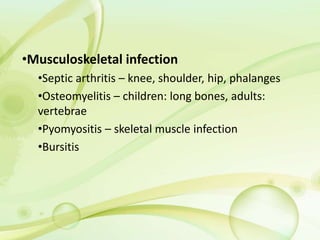
• Carbuncle: Carbuncle is an
aggregation of infected furuncles.
Carbuncles may form large
abscesses.
• It is a large area of redness,
swelling and pain, punctuated by
several sites of drainage pus.
• Impetigo: a very superficial skin infection, usually produces
blisters or sores on the face, neck, hands, and diaper area.
• It is characterized by watery bristles, which become pustules
and then honey coloured crust
impetigo with vesicles, pustules, and sharply
demarcated regions of honey-colored crusts.
•Musculoskeletal infection
•Septic arthritis – knee, shoulder, hip, phalanges
•Osteomyelitis – children: long bones, adults:
vertebrae
•Pyomyositis – skeletal muscle infection
•Bursitis
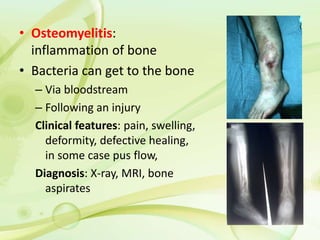
• Osteomyelitis:
inflammation of bone
• Bacteria can get to the bone
– Via bloodstream
– Following an injury
Clinical features: pain, swelling,
deformity, defective healing,
in some case pus flow,
Diagnosis: X-ray, MRI, bone
aspirates
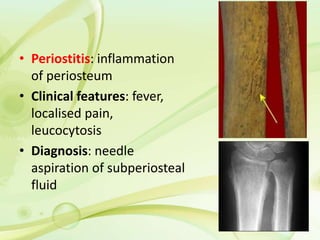
• Periostitis: inflammation
of periosteum
• Clinical features: fever,
localised pain,
leucocytosis
• Diagnosis: needle
aspiration of subperiosteal
fluid
•Respiratory
•Tonsilitis
•Pharyngitis
•Sinusitis
•Otitis
•Bronchopneumonia
•Lung abscess
•empyema
•Central nervous system
•Abscess
•Meningitis
•Intracranial thrombophlebitis
•Endovascular
•Bacteremia
•Septicemia
•Pyemia
•Endocarditis
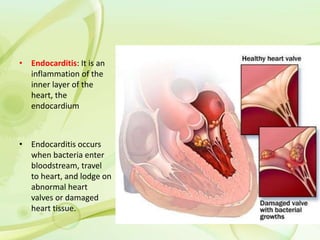
• Endocarditis: It is an
inflammation of the
inner layer of the
heart, the
endocardium
• Endocarditis occurs
when bacteria enter
bloodstream, travel
to heart, and lodge on
abnormal heart
valves or damaged
heart tissue.
•Urinary
•Urinary tract infection
INTOXICATION
The diseases are caused by bacterial toxins.
1. Food poisoning
2. Toxic sock syndrome (TSS)
3. Staphylococcal scalded skin syndrome (SSSS)
1) Food poisoning: (Enterotoxin)
•Enterotoxin is responsible for manifestations of
staphylococcal food poisoning.
•Nine types of enterotoxin are currently known, named A, B,
C1-3, D, E, H & I.
•It usually occurs when preformed toxin is ingested with
contaminated food.
•The toxin acts directly on the autonomic nervous system to
cause the illness, rather than gut mucosa.
•The common food items responsible are - milk and
milk products, meat, fish and ice cream.
•Source of infection- food handler who is a carrier.
•Incubation period- 2 to 6 hours.
•Clinical symptoms- nausea, vomiting and diarrhoea.
•The illness is usually self limited, with recovery in a
day or so.
2) Staphylococcal Toxic shock syndrome (STSS):
•STSS is associated with infection of mucosal or
sequestered sites by TSST( formerly known as
enterotoxin type F) producing S.aureus.
•It is fatal multisystem disease presenting with fever,
hypotension, myalgia, vomiting, diarrhoea, mucosal
hyperemia and erythematous rash which
desquamates subsequently.
3) Staphylococcal scalded skin syndrome
(SSSS):
•Exfoliative toxin produced by S.aureus is responsible
for this.
•It is a skin disease in which outer layer of epidermis
gets separated from the underlying tissues.
Types of SSSS
SEVERE FORM MILDER FORM
IN NEW BORN RITTER’S DISEASE
PEMPHIGUS
NEONATORUM
IN OLDER PATIENTS
TOXIC EPIDERMAL
NECROLYSIS
BULBOUS
IMPETIGO
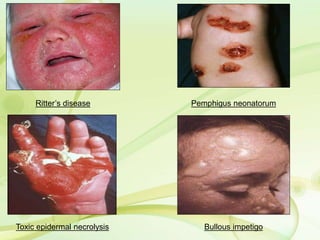
Ritter’s disease Pemphigus neonatorum
Toxic epidermal necrolysis Bullous impetigo
Staphylococcus

Staphylococcus

  • 1.
  • 2.
  • 3.
    • Staphylococci – Grampositive cocci – Arrangement: in single cells, pairs, tetrads, short chains but appear predominantly in grape like clusters – Catalase positive – Non-motile – Non-spore forming – Ubiquitous
  • 4.
  • 5.
  • 6.
    1871 • Von Rechlinghausen •1st observed in pus 1880 • Louis Pasteur • 1st cultured in liquid media 1880 • Sir Alexander Ogston • Named “staphylococcus” 1884 • Rosenbach • S.aureus( golden yellow colonies) & S.albus (white colony) 1885 • Passet • S.citreus (lemon yellow colony)
  • 8.
    TAXONOMY OF STAPHYLOCOCCI& RELATED GPC • According to 1986 edition Bergey’s Manual of Systemic Bacteriology : MICROCOCCACEAE Planococcus Micrococcus Stomatococcus Staphylococcus • According to new edition, Staphylococcus belongs to phylum : FIRMICUTES & comprise Genus I in family V (“Staphylococcaceae”)
  • 9.
    IMPORTANT GENERA &SPECIES Staphylococcus aureus  Coagulase-Negative Staph. (most commonly encountered) • S.epidermidis • S.haemolyticus • S.saprophyticus • S.lugdunensis • S.schleiferi  Micrococcus species & related genera  Coagulase-Negative Staph. (less commonly encountered) • S.capitis • S.caprae • S.warneri • S.hominis • S.auricularis • S.cohnii • S.xylosus • S.simulans
  • 10.
  • 11.
    MORPHOLOGY • Spherical, 1µm dia. • Arrangement : Grape like clusters. • Non-motile, Non-sporing • Non-capsulated {Few strains possess microscopically visible capsule (young cultures)}. • Stain readily with aniline dye & are uniformly Gram Positive.
  • 12.
    CULTURE CHARACTERICTICS •Aerobes andfacultative anaerobes •Temperature = 10°C to 42°C (37°C) •pH = 7.4 - 7.6
  • 13.
    •On Nutrient agar goldenyellow and opaque colonies with smooth glistening surface, 2-4 mm in diameter, circular, convex, smooth, shiny & easily emusifiable (max. pigment production at 22 °C & only in aerobic cultures).
  • 14.
    • On Bloodagar – golden yellow colonies, surrounded by a clear zone of hemolysis (beta-hemolysis),esp. when incubated in sheep or rabbit blood agar in atmosphere of 20% CO2
  • 15.
    • On MacConkeyagar – Smaller colonies than those on Nutrient agar and are pink coloured due to lactose fermentation.
  • 16.
    • On Mannitolsalt agar – S.aureus ferments mannitol and appear as yellow colonies – MSA is a useful selective medium for recovering S.aureus from faecal specimens, when investigating food poisoning.
  • 17.
    BIOCHEMICAL PROPERTIES • Catalasepositive • Oxidase negative • Ferment glucose, lactose, maltose, sucrose and mannitol, with production of acid but no gas • Mannitol fermentation carries diagnostic significance.
  • 18.
    • Indole test=negative • MR test= positive • VP test= positive • Urease test= positive • Hydrolyse gelatin • Reduces nitrate to nitrite • Phospahatase= positive • DNA-ase test= positive • Coagulase test= positive
  • 19.
    RESISTANCE •Remain viable for3-6 months (isolated from dried pus after 2-3 months). •May withstand 60°C for 30 minutes (thermal death point: 62°C for 30 minutes) •Some require heating at 80°C for 1 hour to be killed. •Heat resistant strains can grow at high temperature (45°C).
  • 20.
    •Most strains growat 10% NaCl conc. •Bactericidal aniline dyes: •Crystal violet (conc. 1 in 500,000) •Brilliant green (conc. 1 in 10,000,000) •Resist 1 % phenol for 15 mins. •Mercury peroxide 1% solution can kill them in 10 minutes.
  • 21.
    PENICILLIN RESISTANCE •3 types: Productionof Beta lactamase Alteration in penicillin binding protein PBP2a Development of tolerance to penicillin Bacterium is only inhibited but not killed
  • 22.
    PRODUCTION OF BETALACTAMASE:(PENICILLINASE) •Inactivates penicillin •Staphylococci produces 4 types of penicillinases(A-D) •Hospital strains:type A penicillinase •Penicillinase: •inducible enzyme •Production usually controlled by plasmids,which are transmitted by transduction or conjugation •Same plasmid: may carry genes for resistance to a range of other antibiotics and heavy metals
  • 23.
    ALTERATION IN PENICILLINBINDING PROTEIN(PBP2A) & CHANGES IN BACTERIAL SURFACE RECEPTORS: •Reduces binding of beta lactam antibiotics to cells •Normally chromosomal in nature •Expressed more at 30°C than at 37°C •Also extends to cover beta lactamase-resistant penicillins such as methicillin and cloxacillins (MRSA) •EMRSA: “epidemic methicillin-resistant Staphylococcus aureus” •erythromycins,tetracyclines,aminoglycosides and heavy metals
  • 24.
  • 25.
  • 26.
    PATHOGENICITY Source of infection: A)Exogenous: patients or carriers B) Endogenous: From colonized site Mode of transmission: A) Contact: direct or indirect( through fomites) B) Inhalation of infected air borne droplets
  • 27.
    VIRULENCE FACTORS  Twotypes:  CELL ASSOCIATED FACTORS  EXTRACELLULAR FACTORS A. Cell associated polymers B. Cell surface proteins C. Enzymes D. Toxins
  • 28.
  • 29.
    CELL ASSOCIATED POLYMERS 1.CAPSULAR POLYSACCHARIDE  Some strains produce exopolysaccharide (helps in adherence to host cell & prosthetic devices). Clinical isolates of SA – classified into 11 types based on capsular polysaccharide immunotyping. 70-80% of significant clinical isolate belong to capsular serotype 5 or 8.
  • 30.
    2. PEPTIDOGLYCAN &TEICHOIC ACID Cell wall contain peptidoglycan (NAG & NAM) & teichoic acid. Functions: Specific adherence of bacteria to mucosal surfaces. Provides rigidity & resilience to cell wall. Adhesins, fibronectin-binding proteins, collagen-binding proteins & clumping factors are covalently incorporated into peptidoglycan.
  • 31.
    CELL SURFACE PROTEINS 1.PROTEIN A  MW: 42 kDa  Found on cell surface & in growth medium.  Ability to bind the Fc region of all human IgG (except IgG3 ).  Interfere with opsonization & ingestion of the organism by PMN cells, activating complement & eliciting immediate & delayed type hypersensitivity reactions.  It is immunogenic; abs are found in patient with serious S.aureus infections.  Presence of protein A provides basis for Co-agglutination reaction (used to identify gonococci, streptococcal grouping) and detection of bacterial Ags in body fluids.
  • 32.
    2. CLUMPING FACTORS Cell bound material able to bind fibrinogen, responsible for binding of S.aureus to both fibrin & fibrinogen.
  • 33.
  • 34.
    ENZYMES 1. CATALASE  Allstaphylococci produce catalase, which catalyzes the conversion of toxic hydrogen peroxide to water and oxygen.  Hydrogen peroxide can accumulate during bacterial metabolism or after phagycytosis.
  • 35.
    2. COAGULASE S. aureusstrains possess two forms of coagulase: bound, Free. Coagulase bound to the staphylococcal cell wall can directly convert fibrinogen to insoluble fibrin and cause the staphylococci to clump. The cell-free coagulase accomplishes the same result by reacting with a globulin plasma factor.
  • 36.
    3. HYALURONIDASE Hyaluronidase hydrolyzeshyaluronic acid, the acidic mucopolysaccharides present in the acellular matrix of connective tissue. This enzyme facilitates the spread of S. aureus in tissues. More than 90% of S. aureus strains produce this enzyme.
  • 37.
    4. LIPASES Seen inchronic furunculosis patient. Spread organism in cutaneous & sub-cutaneous tissues. 5. OTHERS DNAse Thermonuclease Staphylokinase(fibrinolysin) Phosphatase
  • 38.
    TOXINS 1. CYTOLYTIC TOXINS:membrane active substances, consisting of four hemolysins & a leucocidin 1. Alpha hemolysin 2. Beta hemolysin 3. Gamma hemolysin 4. Delta hemolysin 5. Leucocidin
  • 39.
    • ALPHA HEMOLYSIN –inactivated at 70°C but reactivated at 100°C – Lyse rabbit erythrocyte but less active against sheep and human red cells. – Toxic to macrophages, lysosome, muscle tissue, renal cortex & circulatory system.
  • 40.
    • BETA HEMOLYSIN –It is a sphingomyelinase, hemolytic for sheep cell but not for human & rabbit cell. – Exhibit hot-cold phenomenon(hemolysis being initiated at 37°C but become evident only after chilling)
  • 41.
    • GAMMA HEMOLYSIN –Composed of 2 separate proteins ( necessary for hemolytic activity) • DELTA HEMOLYSIN – Detergent like effect on cell membrane of erythrocyte, leucocyte, macrophage & platelet
  • 42.
    • LEUCOCIDIN (PANTON-VALENTINETOXIN/PVL) – Composed of S & F components. – Damages PMN cells & macro-phages. – Grouped as synergo-hymenotropic toxins.
  • 43.
    2. ENTEROTOXINS – StaphylococcalFood poisoning: contaminated food. – Nine antigenic types currently known (A,B,C1,C2,C3,D,E,H,I). – Toxin A – most cases. – Resistance • Gut enzymes • Boiling for 30 minutes – Common food items: carbohydrate, protein food, meat & fish, milk & milk product cooked & left at room temperature.
  • 44.
    - Source ofinfection: food handler(carrier). - Recovery: 24-48 hours. - Toxin act directly on ANS. - Enterotoxin : superantigen - Toxin is antigenic-neutralized by specific antitoxin. - Toxin detection: ELISA, latex agglutination.
  • 45.
    3.TOXIC SHOCK SYNDROMETOXIN (TSST) • Superantigen TOXIC SHOCK SYNDROME • Most TSST producing strain belongs to Bacteriophage group-I.(TSST TYPE-I)
  • 46.
    4. EXFOLIATIVE (EPIDERMOLYTIC)TOXIN • 2 types • ET-A and ET-B – ET-A – heat stable (chromosomal) – ET-B – heat labile (plasmid mediated) • Produced by some strains of Staph. aureus (phage group II) • Proteolytic, dissolve mucopolysaccharide matrix of epidermis. • Epidermal splitting blistering disease. • Staphylococcal Scalded Skin Syndrome (SSSS). • Severe form : Ritter’s disease (newborn) & toxic epidermal necrolysis (older patients)
  • 47.
  • 48.
  • 49.
    Diseases produced bystaphylococcus aureus: 2 groups INFECTIONS INTOXICATION
  • 50.
    INFECTION MECHANISM OF ACTION Coccigain access to damaged skin, mucosal or tissue site Colonize by adhering to cells or extracellular matrix Evade the host defense mechanisms and multiply Cause tissue damage
  • 51.
    • Skin andsoft tissue infection – Folliculitis – Furuncle (boil) – Carbuncle – Impetigo – abscess – Wound infection
  • 52.
    • Folliculitis: Itis inflammation of the hair follicles. • A small red bump or pimple develops at infection sites of hair follicle. •Sty: A sty is folliculitis affecting one or more hair follicles on the edge of the upper or lower eyelid.
  • 53.
    • Furuncle/boils: Furuncleis deep seated infection, originating from folliculitis,( if infection extends from follicle to neighbour tissue) • Causes redness, swelling, severe pain • Commonly found on the neck, armpit and groin regions • Carbuncle: Carbuncle is an aggregation of infected furuncles. Carbuncles may form large abscesses. • It is a large area of redness, swelling and pain, punctuated by several sites of drainage pus.
  • 54.
    • Impetigo: avery superficial skin infection, usually produces blisters or sores on the face, neck, hands, and diaper area. • It is characterized by watery bristles, which become pustules and then honey coloured crust impetigo with vesicles, pustules, and sharply demarcated regions of honey-colored crusts.
  • 55.
    •Musculoskeletal infection •Septic arthritis– knee, shoulder, hip, phalanges •Osteomyelitis – children: long bones, adults: vertebrae •Pyomyositis – skeletal muscle infection •Bursitis
  • 56.
    • Osteomyelitis: inflammation ofbone • Bacteria can get to the bone – Via bloodstream – Following an injury Clinical features: pain, swelling, deformity, defective healing, in some case pus flow, Diagnosis: X-ray, MRI, bone aspirates
  • 57.
    • Periostitis: inflammation ofperiosteum • Clinical features: fever, localised pain, leucocytosis • Diagnosis: needle aspiration of subperiosteal fluid
  • 58.
  • 59.
  • 60.
  • 61.
    • Endocarditis: Itis an inflammation of the inner layer of the heart, the endocardium • Endocarditis occurs when bacteria enter bloodstream, travel to heart, and lodge on abnormal heart valves or damaged heart tissue.
  • 62.
  • 63.
    INTOXICATION The diseases arecaused by bacterial toxins. 1. Food poisoning 2. Toxic sock syndrome (TSS) 3. Staphylococcal scalded skin syndrome (SSSS)
  • 64.
    1) Food poisoning:(Enterotoxin) •Enterotoxin is responsible for manifestations of staphylococcal food poisoning. •Nine types of enterotoxin are currently known, named A, B, C1-3, D, E, H & I. •It usually occurs when preformed toxin is ingested with contaminated food. •The toxin acts directly on the autonomic nervous system to cause the illness, rather than gut mucosa.
  • 65.
    •The common fooditems responsible are - milk and milk products, meat, fish and ice cream. •Source of infection- food handler who is a carrier. •Incubation period- 2 to 6 hours. •Clinical symptoms- nausea, vomiting and diarrhoea. •The illness is usually self limited, with recovery in a day or so.
  • 66.
    2) Staphylococcal Toxicshock syndrome (STSS): •STSS is associated with infection of mucosal or sequestered sites by TSST( formerly known as enterotoxin type F) producing S.aureus. •It is fatal multisystem disease presenting with fever, hypotension, myalgia, vomiting, diarrhoea, mucosal hyperemia and erythematous rash which desquamates subsequently.
  • 67.
    3) Staphylococcal scaldedskin syndrome (SSSS): •Exfoliative toxin produced by S.aureus is responsible for this. •It is a skin disease in which outer layer of epidermis gets separated from the underlying tissues.
  • 68.
    Types of SSSS SEVEREFORM MILDER FORM IN NEW BORN RITTER’S DISEASE PEMPHIGUS NEONATORUM IN OLDER PATIENTS TOXIC EPIDERMAL NECROLYSIS BULBOUS IMPETIGO
  • 69.
    Ritter’s disease Pemphigusneonatorum Toxic epidermal necrolysis Bullous impetigo

Editor's Notes

  • #6 1st observed in pus: von Recklinghausen (1871) 1st cultured in liquid media: Louis Pasteur (1880) Named ‘Staphylococcus’ (Gr. Staphyle – bunch of grapes, kokkos - berry) by Sir Alexander Ogston (1880) Rosenbach (1884) – named S.aureus (golden yellow colonies), S.albus (white colonies) Passet (1885) – S.citreus (lemon yellow colonies)