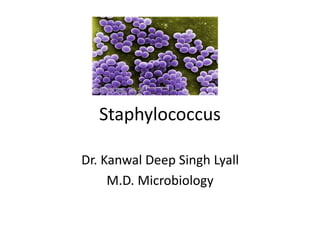
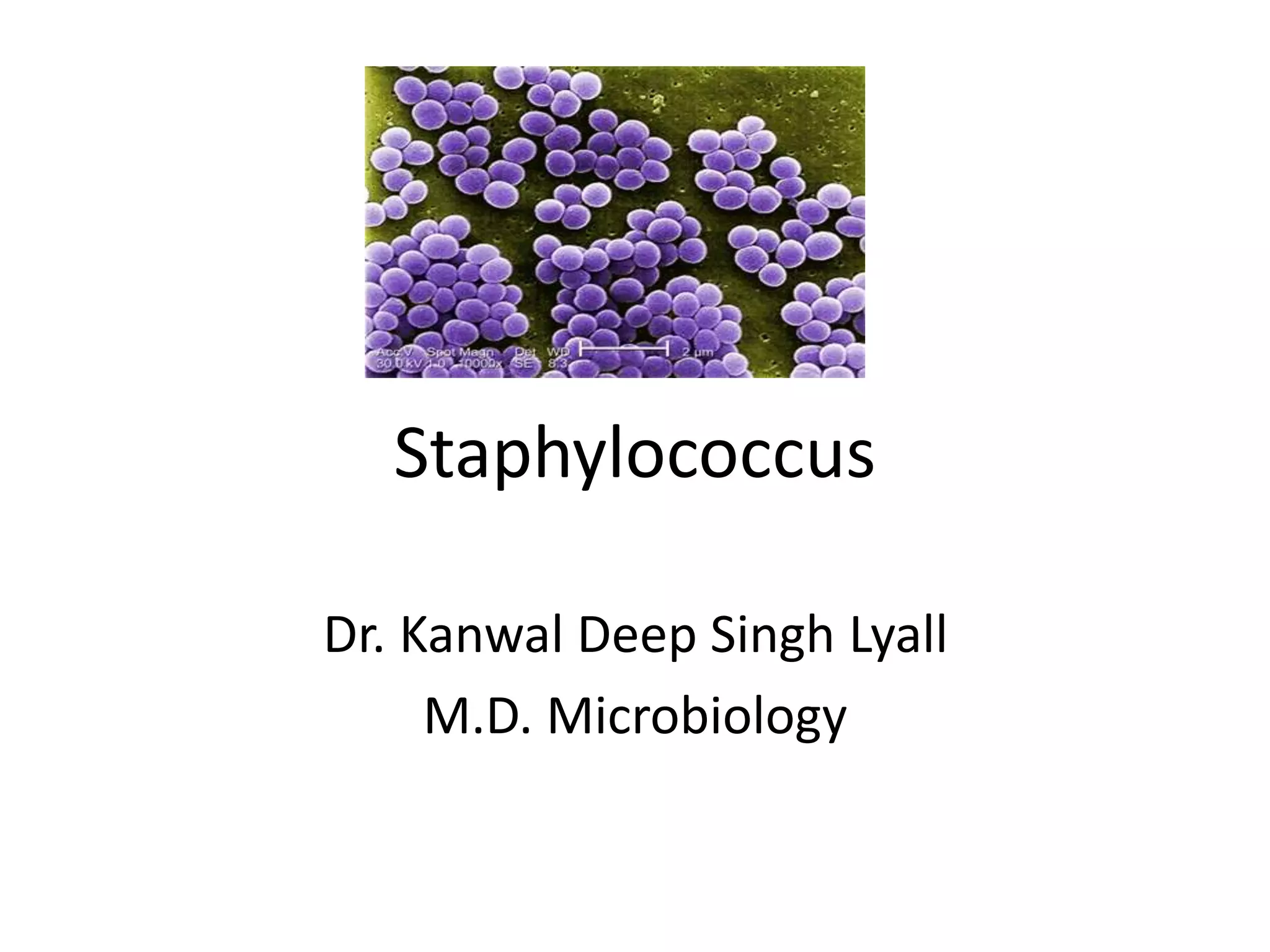
Staphylococcus
Dr. Kanwal Deep Singh Lyall
M.D. Microbiology
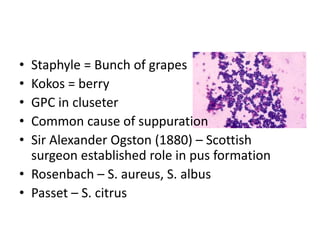
• Staphyle = Bunch of grapes
• Kokos = berry
• GPC in cluseter
• Common cause of suppuration
• Sir Alexander Ogston (1880) – Scottish
surgeon established role in pus formation
• Rosenbach – S. aureus, S. albus
• Passet – S. citrus
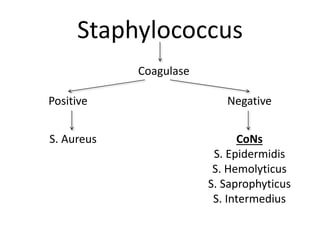
Staphylococcus
Coagulase
Positive Negative
S. Aureus CoNs
S. Epidermidis
S. Hemolyticus
S. Saprophyticus
S. Intermedius
S. Aureus
• GPC in clusters , 1µm , non-motiles, non-
sporing
• Divide in 3 perpendicluar planes – daughter
cells remain in close proximity
• Pigment : golden yellow, non-diffuseble,
carotenoid, best seen at 22 – 25 C, aerobic con
• ↑ed by 1% Glc. Monoacetate, milk
• Grows on BA, MA, NA, MSA (selective)
Resistance
• Hardy organisms
• Survives in dried pus x 2 – 3 mnths
• Killed @ 62 C x 30 M
• Tolerates 10% NaCl
• Crystal violet (1:500000)
• Brilliant green (1:10 million)
Lethal
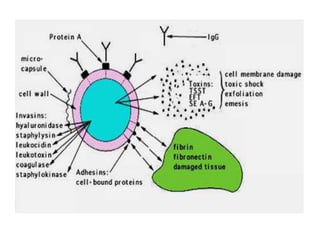
Antigenic structure (CPTP)
• Capsule: polysaccharide – virulence
• Peptidoglycan: rigidity, complement
activation, cytokine production
• Teichoic acid: major Ag, adhesions & inhib of
opsonisation
• Protein A: chemotactic, antiphagocytic, anti-
complementary, Cowan – 1 strain, binds IgG,
Used for coaglutination
Toxins & Enzymes
• Toxins (HLETEx)
• Hemolysins
• Leucocidens
• Enterotoxins
• TSST
• Exfloiative toxin
• Coagulase
• Clumping factor
• DNAse
• Phosphatase
Toxins
• Hemolysins – alpha, beta, gamma, delta
– Alpha lysin – in aerobic cond., protein, inactivates @
60 C, Reactivates @ 80 - 100 C – cytotoxic,
leucotoxic, dermonecrotic
– Beta lysin – lysis activated @ 37, evident on cooling
• Leucocidin – PVL, slow & fast components – damages
PMNs & Macrophages
• Enyterotoxins – A(m/c) BC1,2,3,DEH (8) – food
poisoning, nausea, vomiting, diarrhea with 6 – 8 hrs ,
resist boiling x 30 m, active in minute quantities,
autonomic nervous system
• TSST – t , BP, vomitings, diarhoea,, rash,
deaquamation, hyperemia, tampoon users
• Exfoliative toxin: SSSS, Rieter’s disases
– Toxin A : heat stable, chromosome coded
– Toxin B: heat labile, plasmid coded
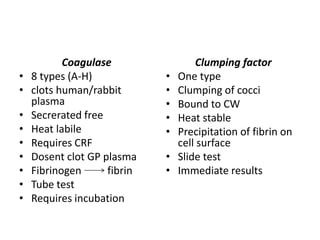
Coagulase
• 8 types (A-H)
• clots human/rabbit
plasma
• Secrerated free
• Heat labile
• Requires CRF
• Dosent clot GP plasma
• Fibrinogen fibrin
• Tube test
• Requires incubation
Clumping factor
• One type
• Clumping of cocci
• Bound to CW
• Heat stable
• Precipitation of fibrin on
cell surface
• Slide test
• Immediate results
Pathogenesis
• Cutaneous infections
• Pyogenic infections
• Respiratory infections
• Deep seated infections
• Food poisoning
• Nosocomial infections
• Exfoliative infections
• TSST
• SSSS
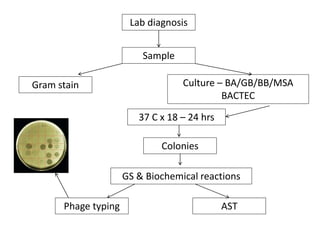
Lab diagnosis
Sample
Gram stain Culture – BA/GB/BB/MSA
BACTEC
37 C x 18 – 24 hrs
Colonies
GS & Biochemical reactions
Phage typing AST
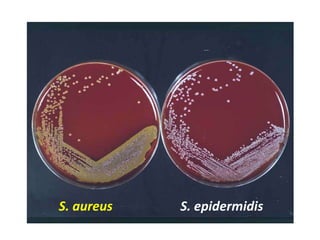
S. aureus S. epidermidis
Biochemical reactions
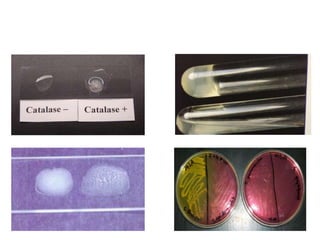
• Catalase + , coagulase +, ferments mannitol,
liquifies gelatin, produces phosphatase,DNAse
• NA + Phen. Pthal. Diphos. Free
phosphatase ammonia vapours Pink
• Urease +, Indole production – ve , MR,VP +
• Nitrate +ve
MRSA
• Penicillinase – plasmid coded
• PBP2 – Chromosome coded (mecA gene)
• Resistant to all beta lactams, beta lactam +
beta latamase inhb., monobactams
CoNS
• S. epidermidis - Opportunistic infections
• S. saprophyticus – UTI in sexually active females,
resistant to Novobiocin (5µg,< 12mm)
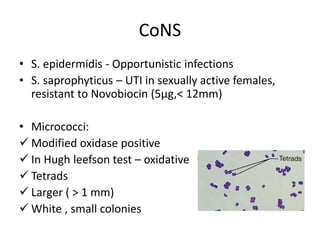
• Micrococci:
 Modified oxidase positive
 In Hugh leefson test – oxidative
 Tetrads
 Larger ( > 1 mm)
 White , small colonies

Staphylococcus

  • 1.
    Staphylococcus Dr. Kanwal DeepSingh Lyall M.D. Microbiology
  • 2.
    • Staphyle =Bunch of grapes • Kokos = berry • GPC in cluseter • Common cause of suppuration • Sir Alexander Ogston (1880) – Scottish surgeon established role in pus formation • Rosenbach – S. aureus, S. albus • Passet – S. citrus
  • 3.
    Staphylococcus Coagulase Positive Negative S. AureusCoNs S. Epidermidis S. Hemolyticus S. Saprophyticus S. Intermedius
  • 4.
    S. Aureus • GPCin clusters , 1µm , non-motiles, non- sporing • Divide in 3 perpendicluar planes – daughter cells remain in close proximity • Pigment : golden yellow, non-diffuseble, carotenoid, best seen at 22 – 25 C, aerobic con • ↑ed by 1% Glc. Monoacetate, milk • Grows on BA, MA, NA, MSA (selective)
  • 5.
    Resistance • Hardy organisms •Survives in dried pus x 2 – 3 mnths • Killed @ 62 C x 30 M • Tolerates 10% NaCl • Crystal violet (1:500000) • Brilliant green (1:10 million) Lethal
  • 6.
    Antigenic structure (CPTP) •Capsule: polysaccharide – virulence • Peptidoglycan: rigidity, complement activation, cytokine production • Teichoic acid: major Ag, adhesions & inhib of opsonisation • Protein A: chemotactic, antiphagocytic, anti- complementary, Cowan – 1 strain, binds IgG, Used for coaglutination
  • 7.
    Toxins & Enzymes •Toxins (HLETEx) • Hemolysins • Leucocidens • Enterotoxins • TSST • Exfloiative toxin • Coagulase • Clumping factor • DNAse • Phosphatase
  • 8.
    Toxins • Hemolysins –alpha, beta, gamma, delta – Alpha lysin – in aerobic cond., protein, inactivates @ 60 C, Reactivates @ 80 - 100 C – cytotoxic, leucotoxic, dermonecrotic – Beta lysin – lysis activated @ 37, evident on cooling • Leucocidin – PVL, slow & fast components – damages PMNs & Macrophages • Enyterotoxins – A(m/c) BC1,2,3,DEH (8) – food poisoning, nausea, vomiting, diarrhea with 6 – 8 hrs , resist boiling x 30 m, active in minute quantities, autonomic nervous system
  • 10.
    • TSST –t , BP, vomitings, diarhoea,, rash, deaquamation, hyperemia, tampoon users • Exfoliative toxin: SSSS, Rieter’s disases – Toxin A : heat stable, chromosome coded – Toxin B: heat labile, plasmid coded
  • 11.
    Coagulase • 8 types(A-H) • clots human/rabbit plasma • Secrerated free • Heat labile • Requires CRF • Dosent clot GP plasma • Fibrinogen fibrin • Tube test • Requires incubation Clumping factor • One type • Clumping of cocci • Bound to CW • Heat stable • Precipitation of fibrin on cell surface • Slide test • Immediate results
  • 12.
    Pathogenesis • Cutaneous infections •Pyogenic infections • Respiratory infections • Deep seated infections • Food poisoning • Nosocomial infections • Exfoliative infections • TSST • SSSS
  • 13.
    Lab diagnosis Sample Gram stainCulture – BA/GB/BB/MSA BACTEC 37 C x 18 – 24 hrs Colonies GS & Biochemical reactions Phage typing AST
  • 14.
    S. aureus S.epidermidis
  • 15.
    Biochemical reactions • Catalase+ , coagulase +, ferments mannitol, liquifies gelatin, produces phosphatase,DNAse • NA + Phen. Pthal. Diphos. Free phosphatase ammonia vapours Pink • Urease +, Indole production – ve , MR,VP + • Nitrate +ve
  • 17.
    MRSA • Penicillinase –plasmid coded • PBP2 – Chromosome coded (mecA gene) • Resistant to all beta lactams, beta lactam + beta latamase inhb., monobactams
  • 18.
    CoNS • S. epidermidis- Opportunistic infections • S. saprophyticus – UTI in sexually active females, resistant to Novobiocin (5µg,< 12mm) • Micrococci:  Modified oxidase positive  In Hugh leefson test – oxidative  Tetrads  Larger ( > 1 mm)  White , small colonies