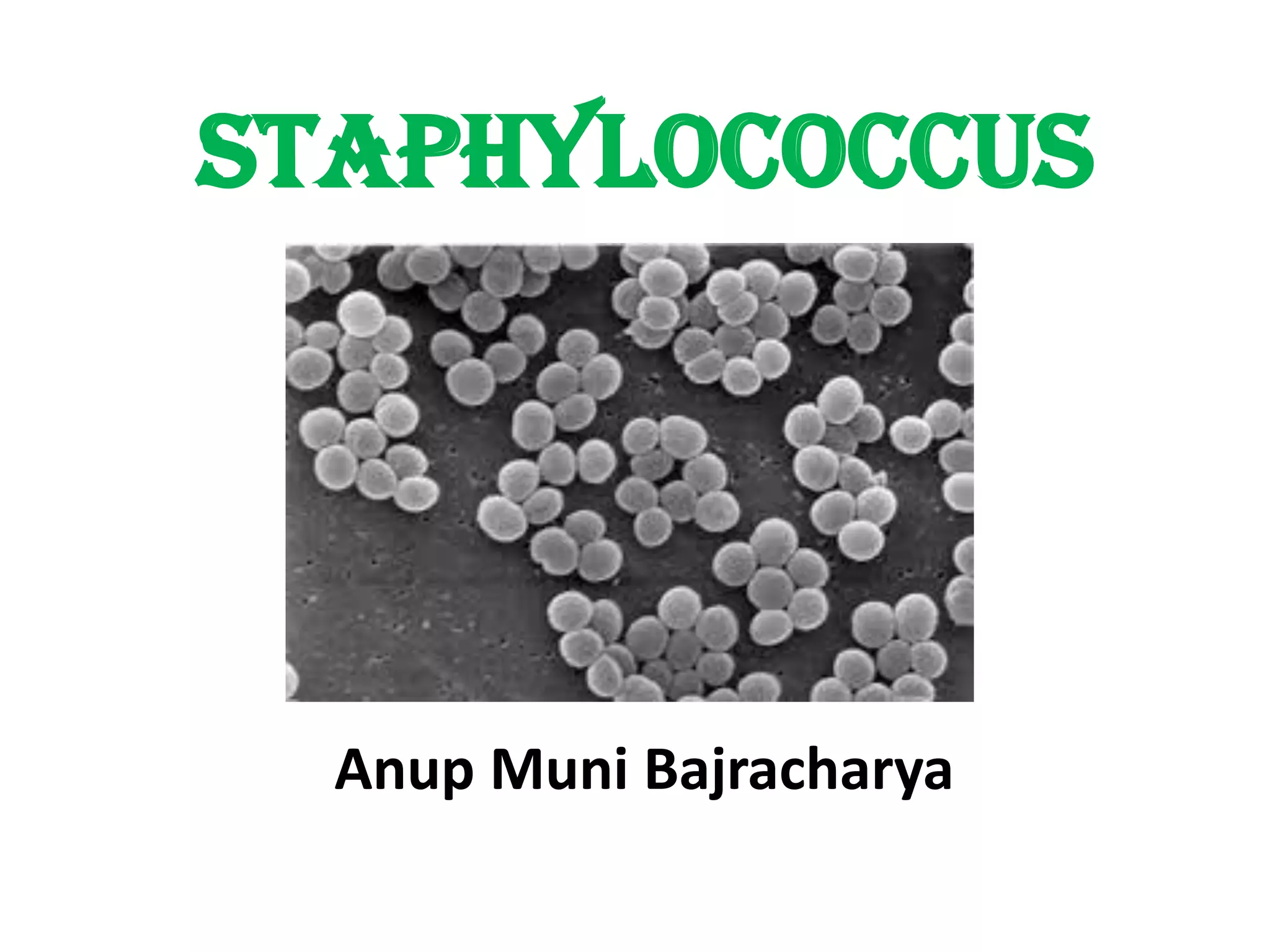
Staphylococcus
Anup Muni Bajracharya
Introduction
Staphylococcus
➢Gram positive cocci, belongs to Family Micrococcaceae.
➢Aerobic , some facultative anaerobes.
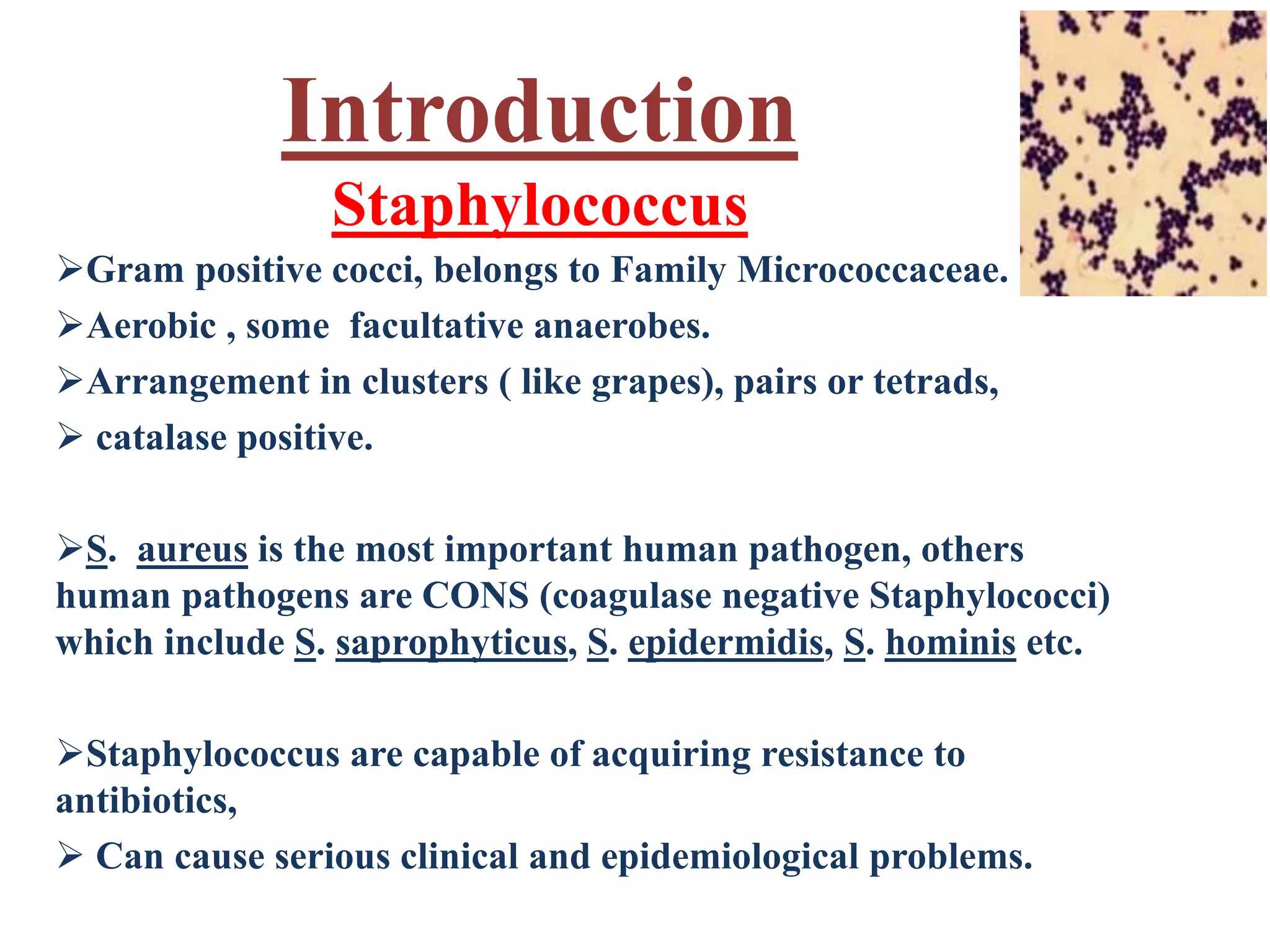
➢Arrangement in clusters ( like grapes), pairs or tetrads,
➢ catalase positive.
➢S. aureus is the most important human pathogen, others
human pathogens are CONS (coagulase negative Staphylococci)
which include S. saprophyticus, S. epidermidis, S. hominis etc.
➢Staphylococcus are capable of acquiring resistance to
antibiotics,
➢ Can cause serious clinical and epidemiological problems.
Human Infections caused by Staphylococcus
❖ S. aureus cause:
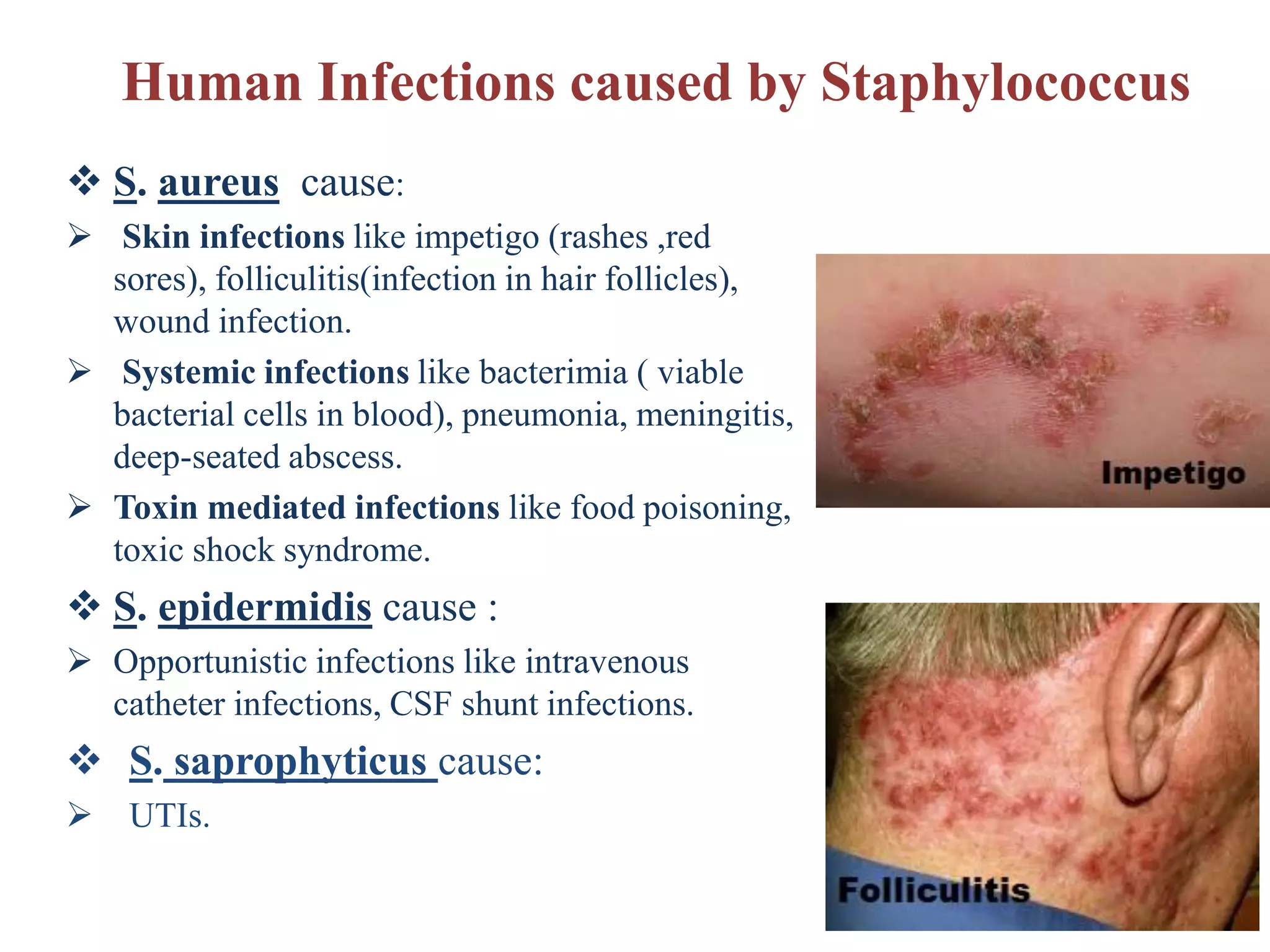
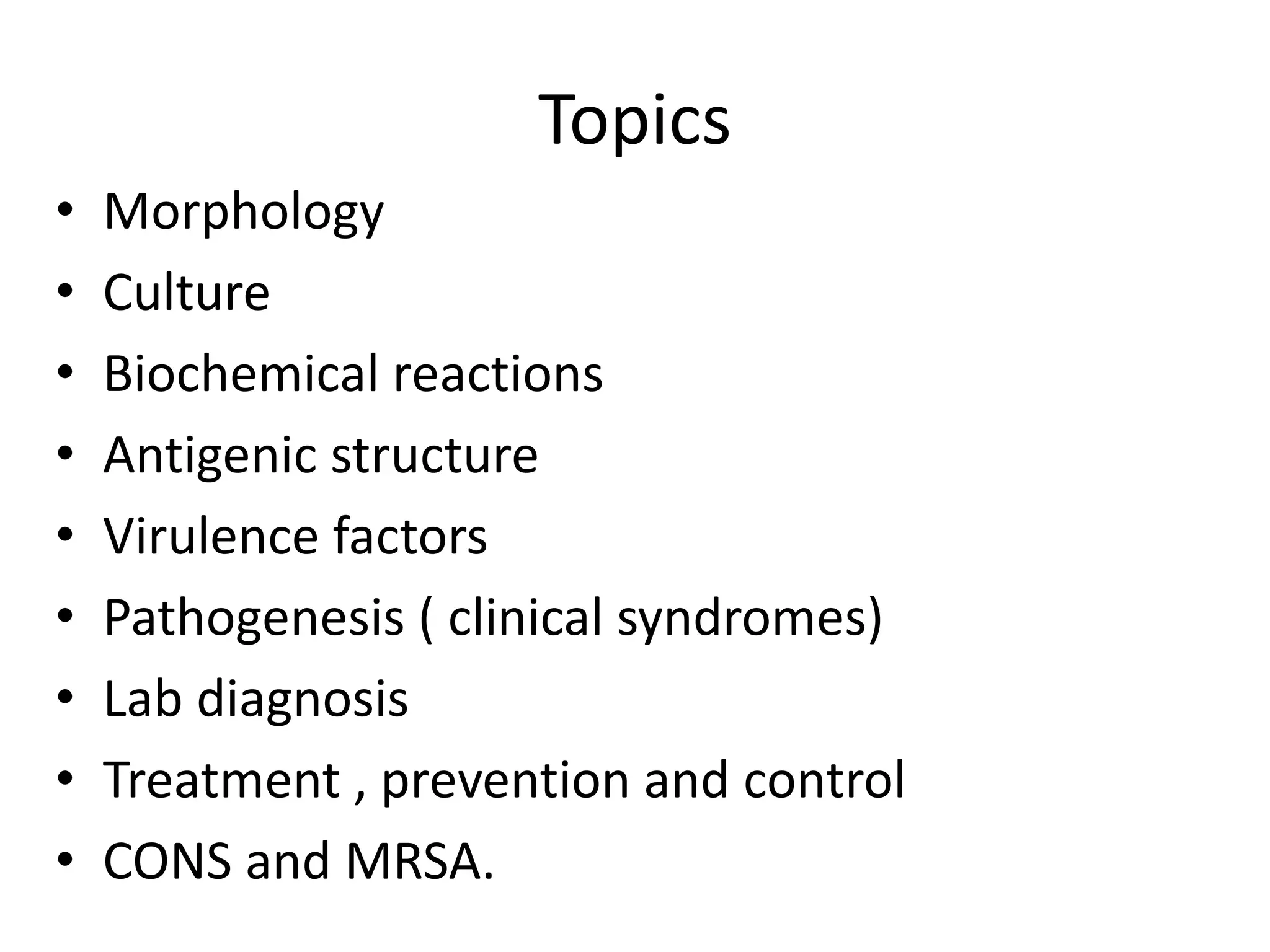
➢ Skin infections like impetigo (rashes ,red
sores), folliculitis(infection in hair follicles),
wound infection.
➢ Systemic infections like bacterimia ( viable
bacterial cells in blood), pneumonia, meningitis,
deep-seated abscess.
➢ Toxin mediated infections like food poisoning,
toxic shock syndrome.
❖ S. epidermidis cause :
➢ Opportunistic infections like intravenous
catheter infections, CSF shunt infections.
❖ S. saprophyticus cause:
➢ UTIs.
Topics
• Morphology
• Culture
• Biochemical reactions
• Antigenic structure
• Virulence factors
• Pathogenesis ( clinical syndromes)
• Lab diagnosis
• Treatment , prevention and control
• CONS and MRSA.
Staphylococcus aureus
MORPHOLOGY :
➢ Gm +ve cocci, 1µm in diameter.
➢ Non motile, Non sporing,
➢ Arranged in grape like structure when grown in solid media (due to
incomplete separation of daughter cells during successive divisions of
bacteria)
➢ Short chains in liquid media.
➢ Facultative anaerobes
➢ Grows in large, round , opaque colonies
➢ Withstand high salt, extreme pH
➢ Normal flora of skin, nasal area.
Culture
➢ Staphylococcus grows in wide range of media ; Mannitol salt agar,
Nutrient agar (NA) , Blood agar (BA), Macconkey agar etc. Primary
isolation on NA and BA.
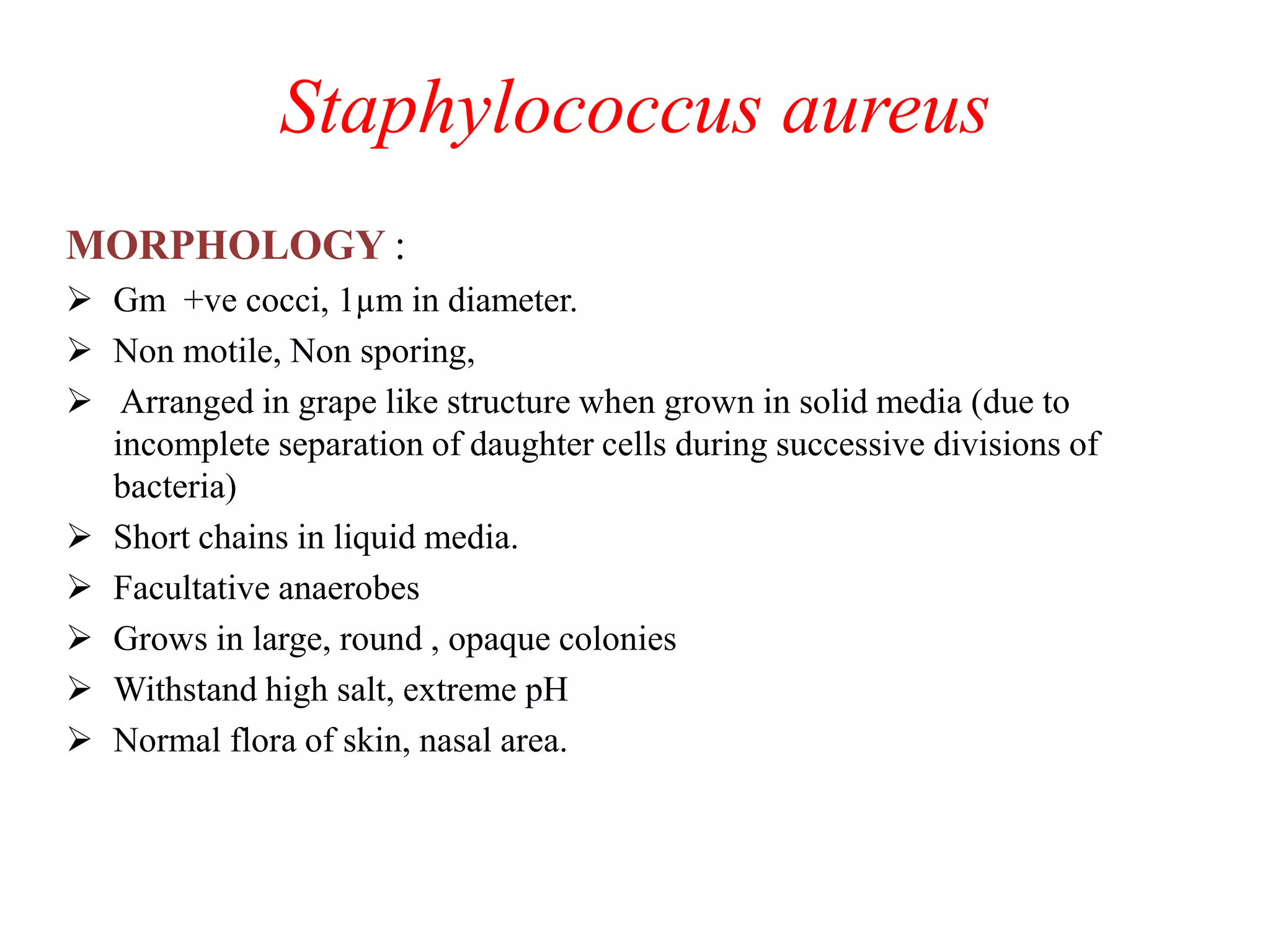
➢ On NA, S. aureus gives round, convex, smooth glistening , golden yellow
colonies( believed to be lipoprotein allied to carotene).
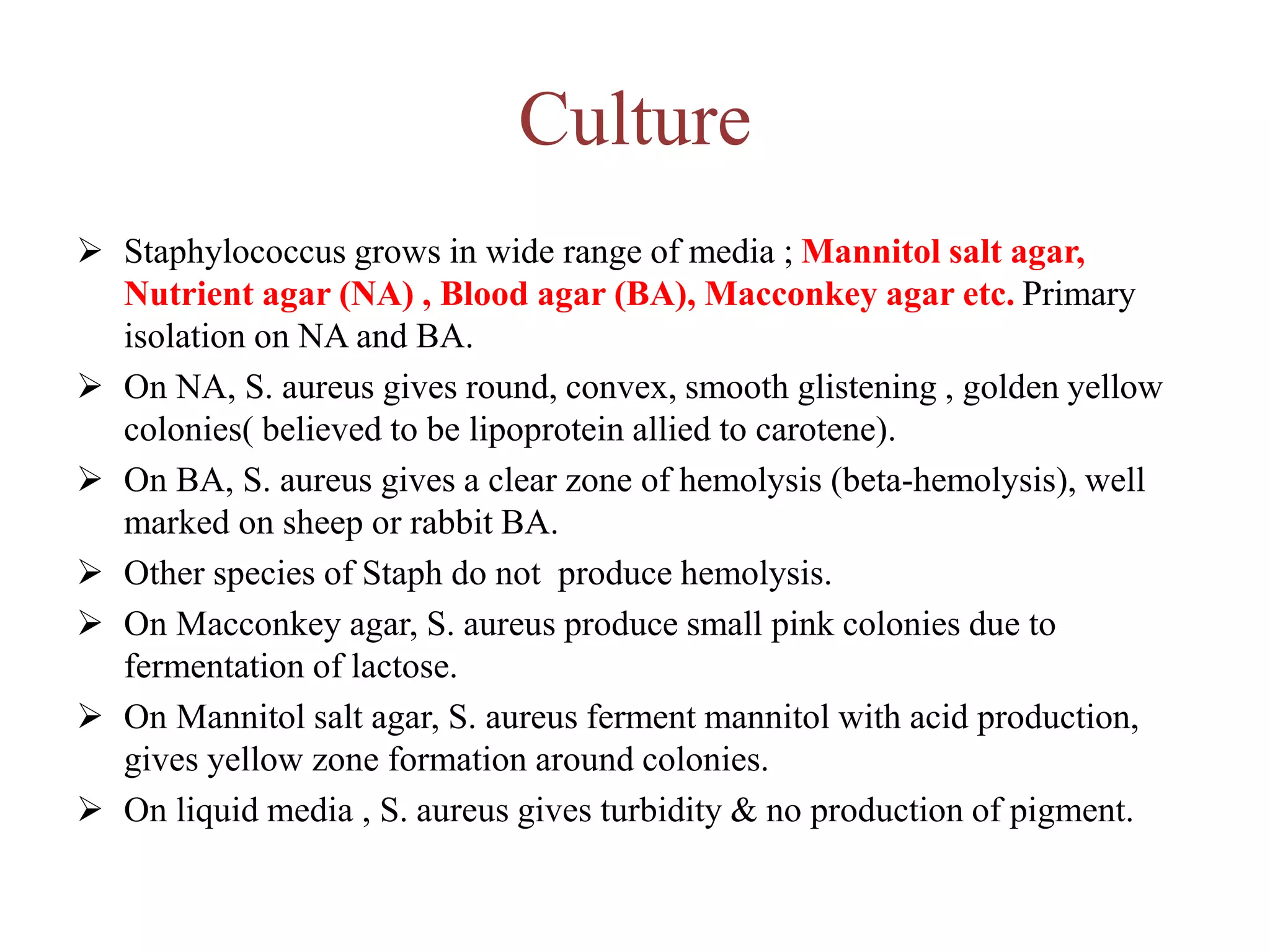
➢ On BA, S. aureus gives a clear zone of hemolysis (beta-hemolysis), well
marked on sheep or rabbit BA.
➢ Other species of Staph do not produce hemolysis.
➢ On Macconkey agar, S. aureus produce small pink colonies due to
fermentation of lactose.
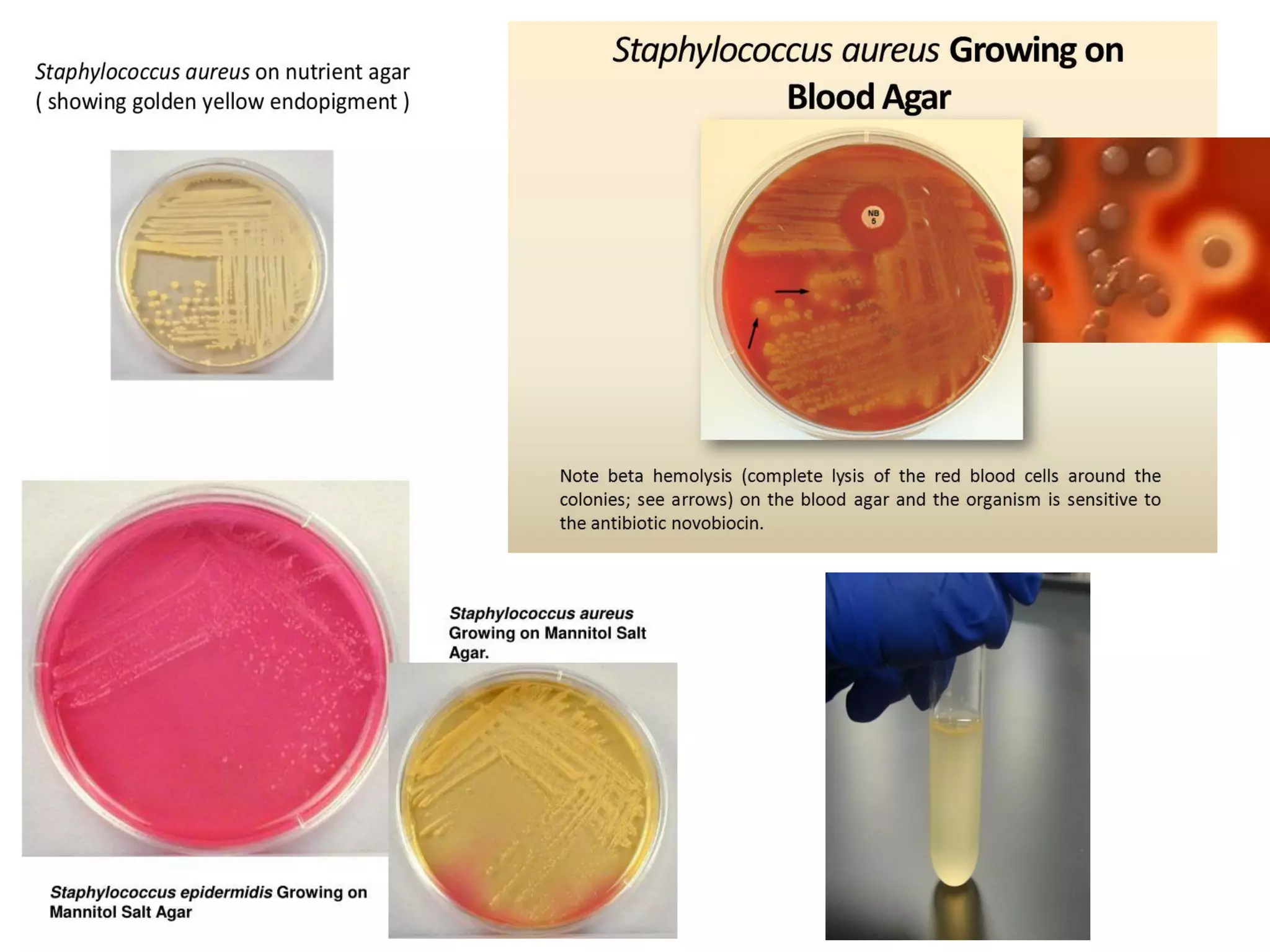
➢ On Mannitol salt agar, S. aureus ferment mannitol with acid production,
gives yellow zone formation around colonies.
➢ On liquid media , S. aureus gives turbidity & no production of pigment.
Biochemical reactions
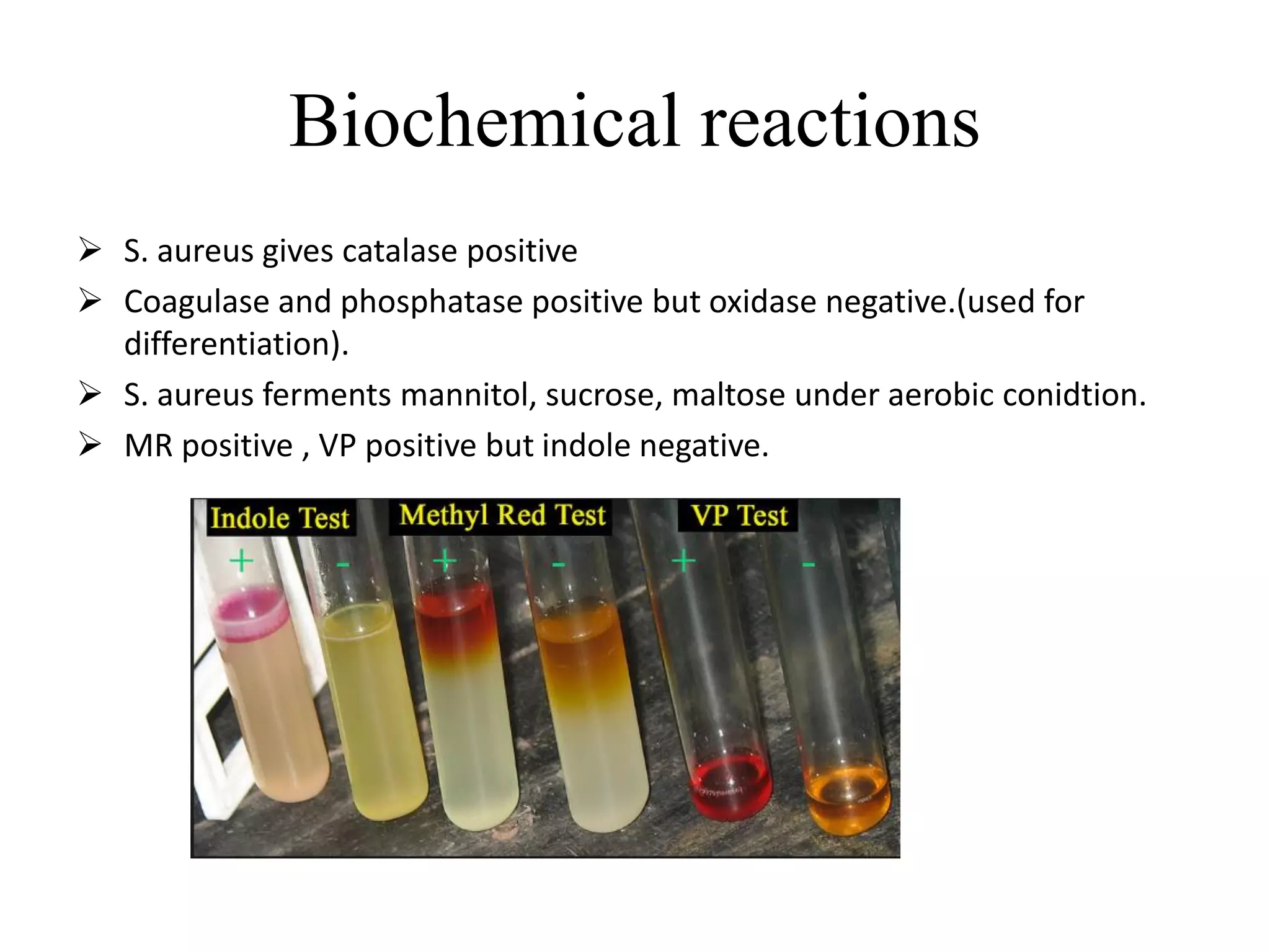
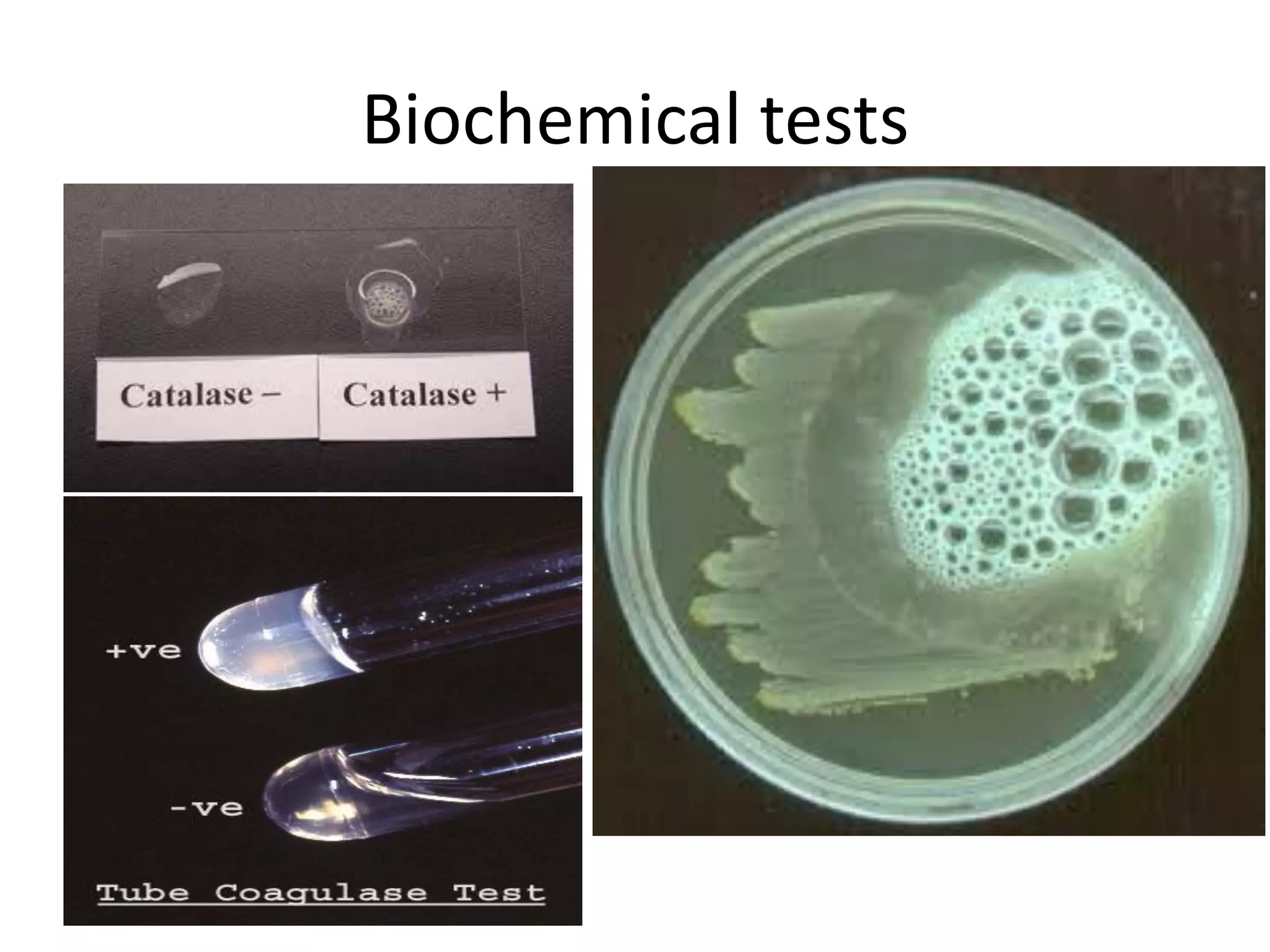
➢ S. aureus gives catalase positive
➢ Coagulase and phosphatase positive but oxidase negative.(used for
differentiation).
➢ S. aureus ferments mannitol, sucrose, maltose under aerobic conidtion.
➢ MR positive , VP positive but indole negative.
Biochemical tests
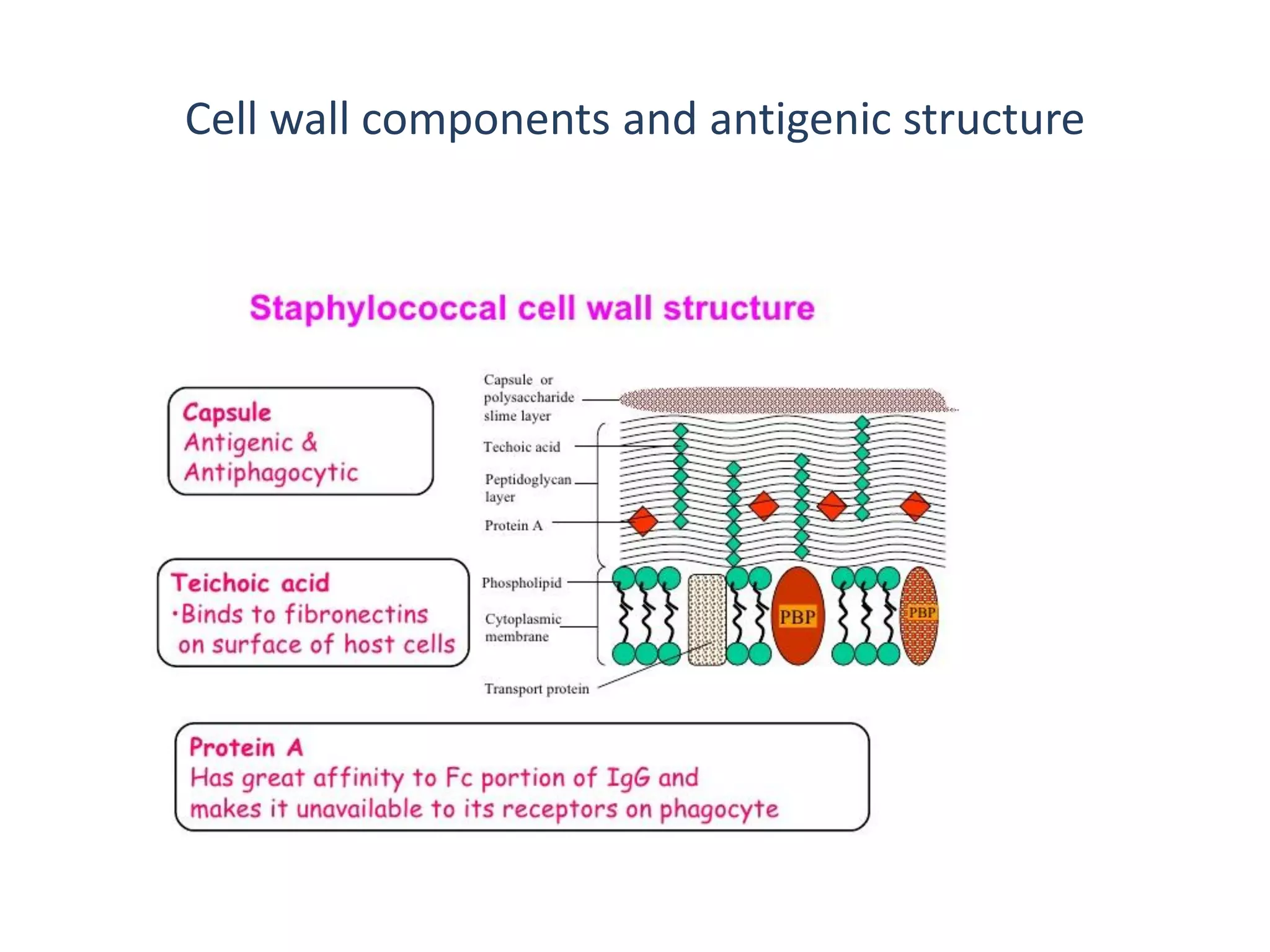
Cell wall components and antigenic structure
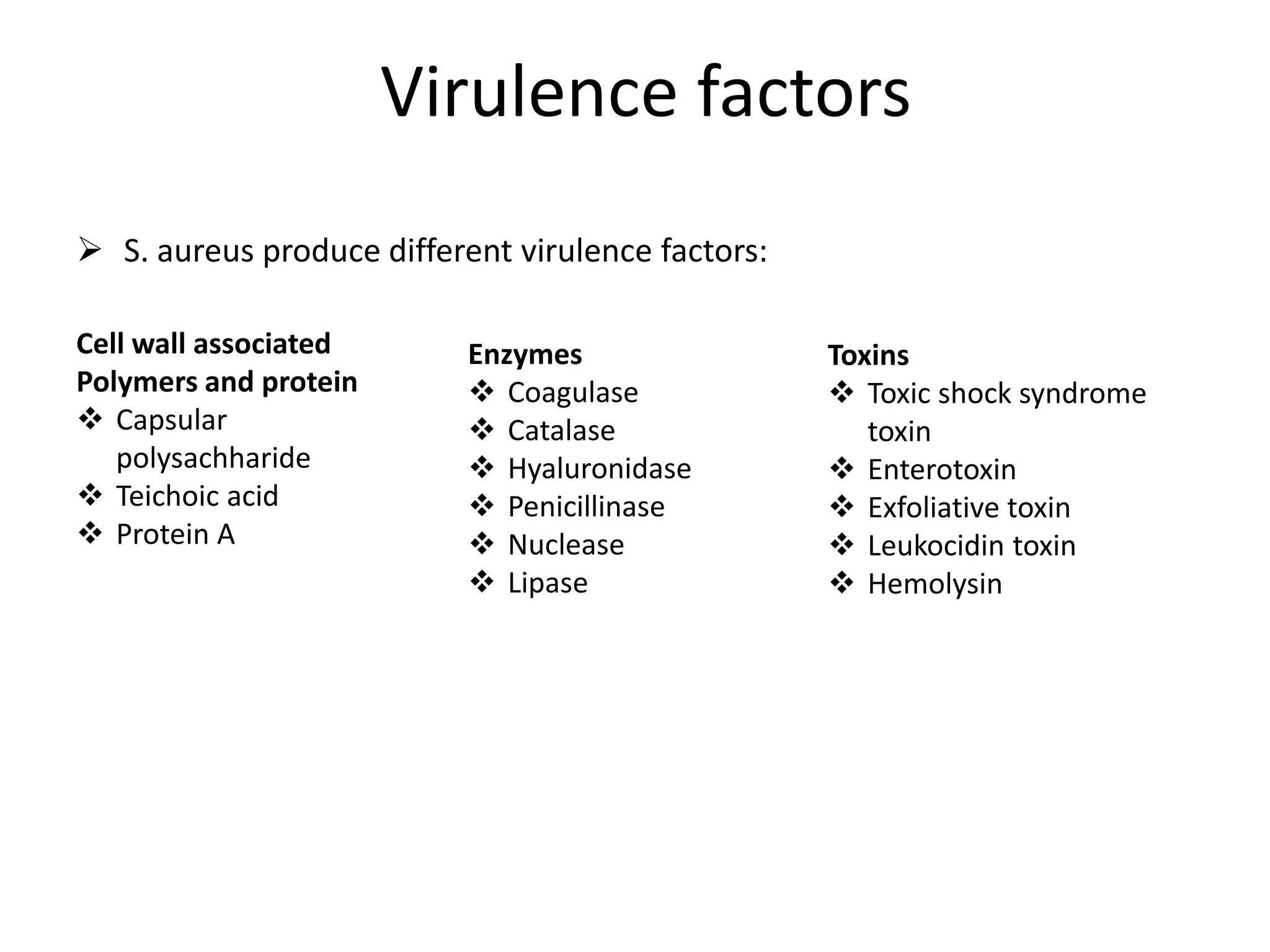
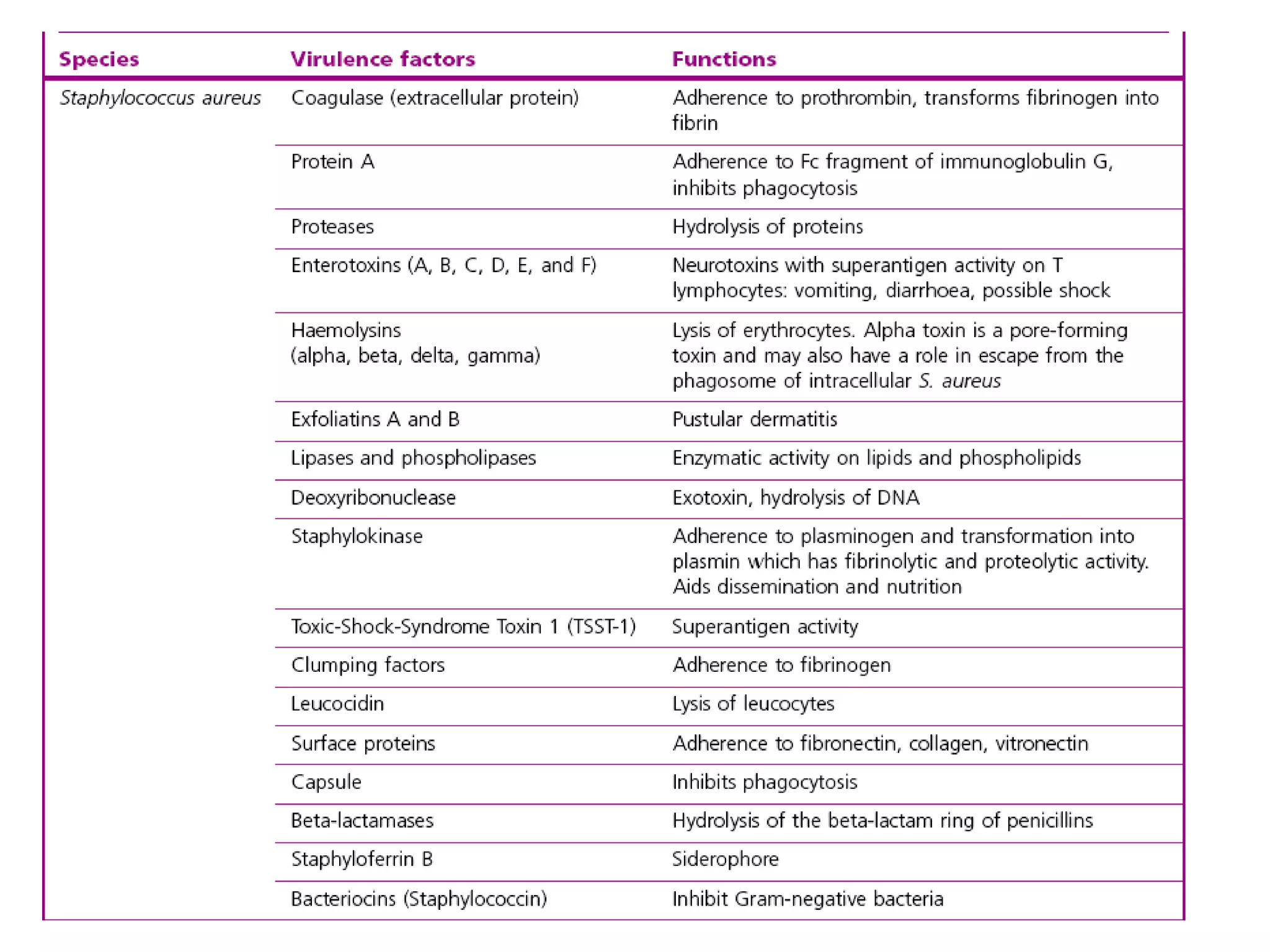
Virulence factors
➢ S. aureus produce different virulence factors:
Cell wall associated
Polymers and protein
❖ Capsular
polysachharide
❖ Teichoic acid
❖ Protein A
Enzymes
❖ Coagulase
❖ Catalase
❖ Hyaluronidase
❖ Penicillinase
❖ Nuclease
❖ Lipase
Toxins
❖ Toxic shock syndrome
toxin
❖ Enterotoxin
❖ Exfoliative toxin
❖ Leukocidin toxin
❖ Hemolysin
Pathogenesis
➢ Cause localised lesions
➢ First multiply in tissues, produce toxins and stimulate inflammation.
➢ Adhere to damaged skin.
➢ Evade defense mechanism of host.
➢ Cause tissue damage and form abscesses, produce extracellular enzymes
and exotoxins.
Host immunity:
▪ No life long immunity.
▪ Repeated infections occur in susceptible host.
Clinical syndrome:
➢ 2 types: inflammatory and toxin mediated staphylococcal disease.
INFLAMMATORY DISEASES :
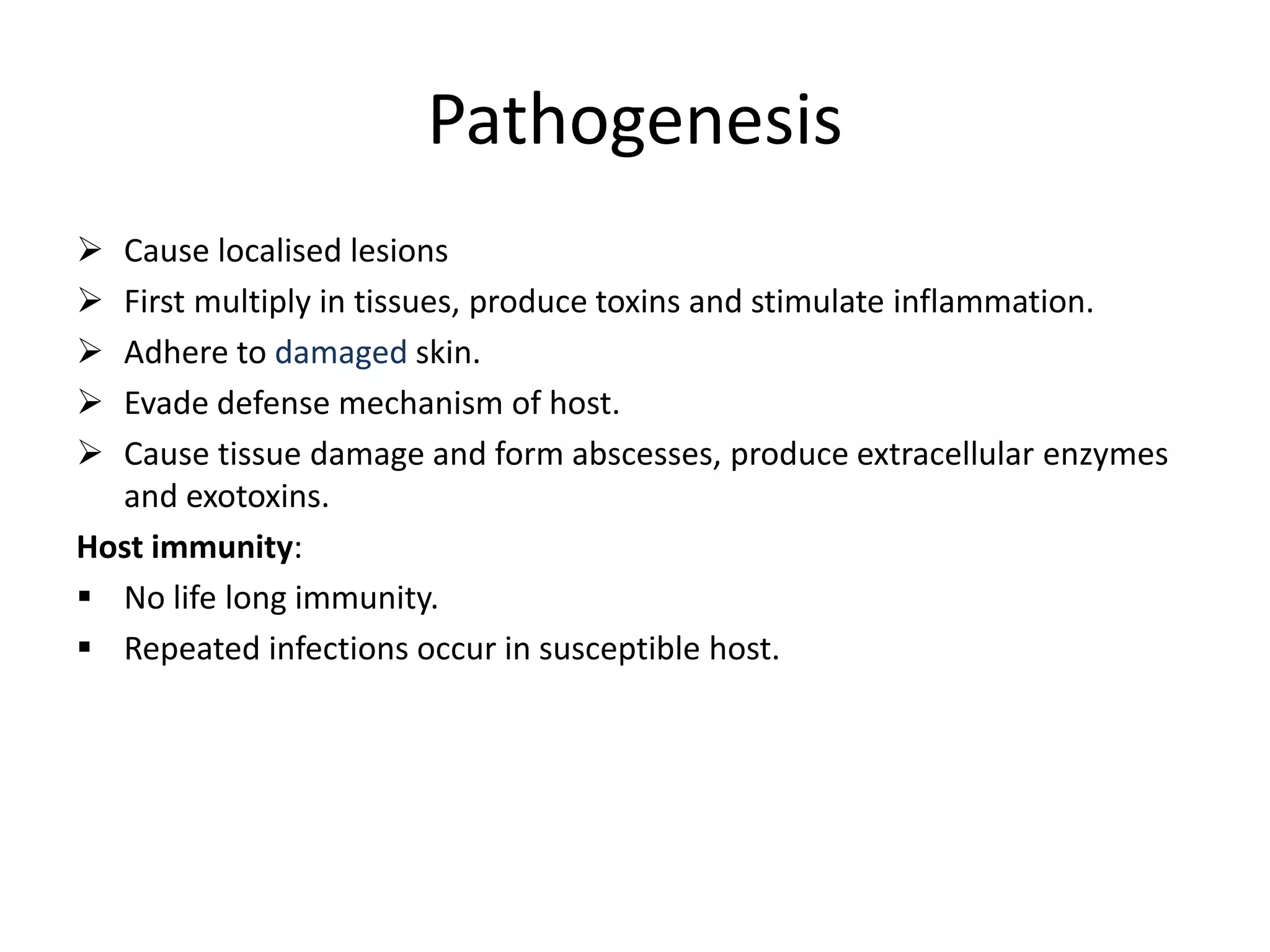
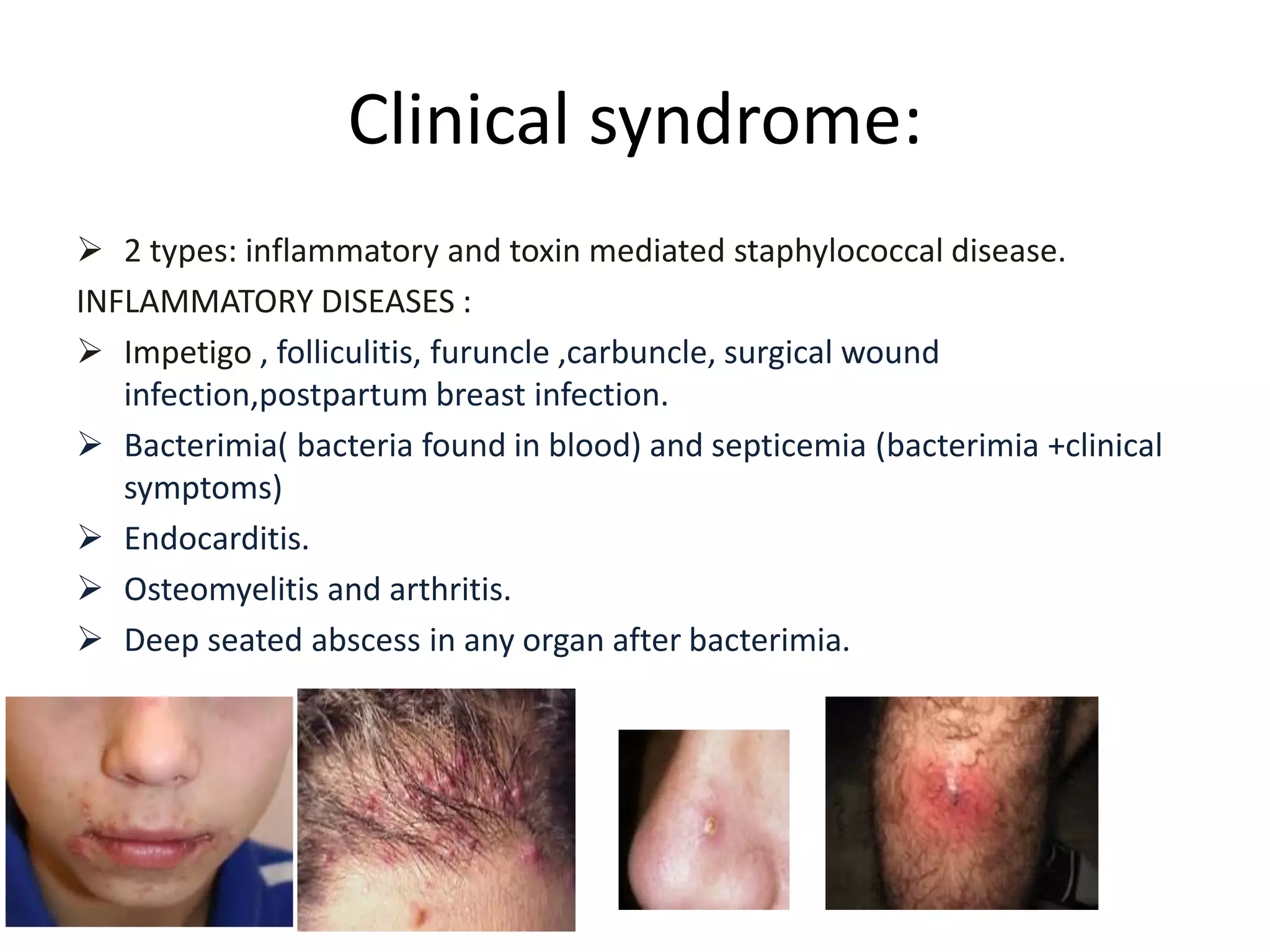
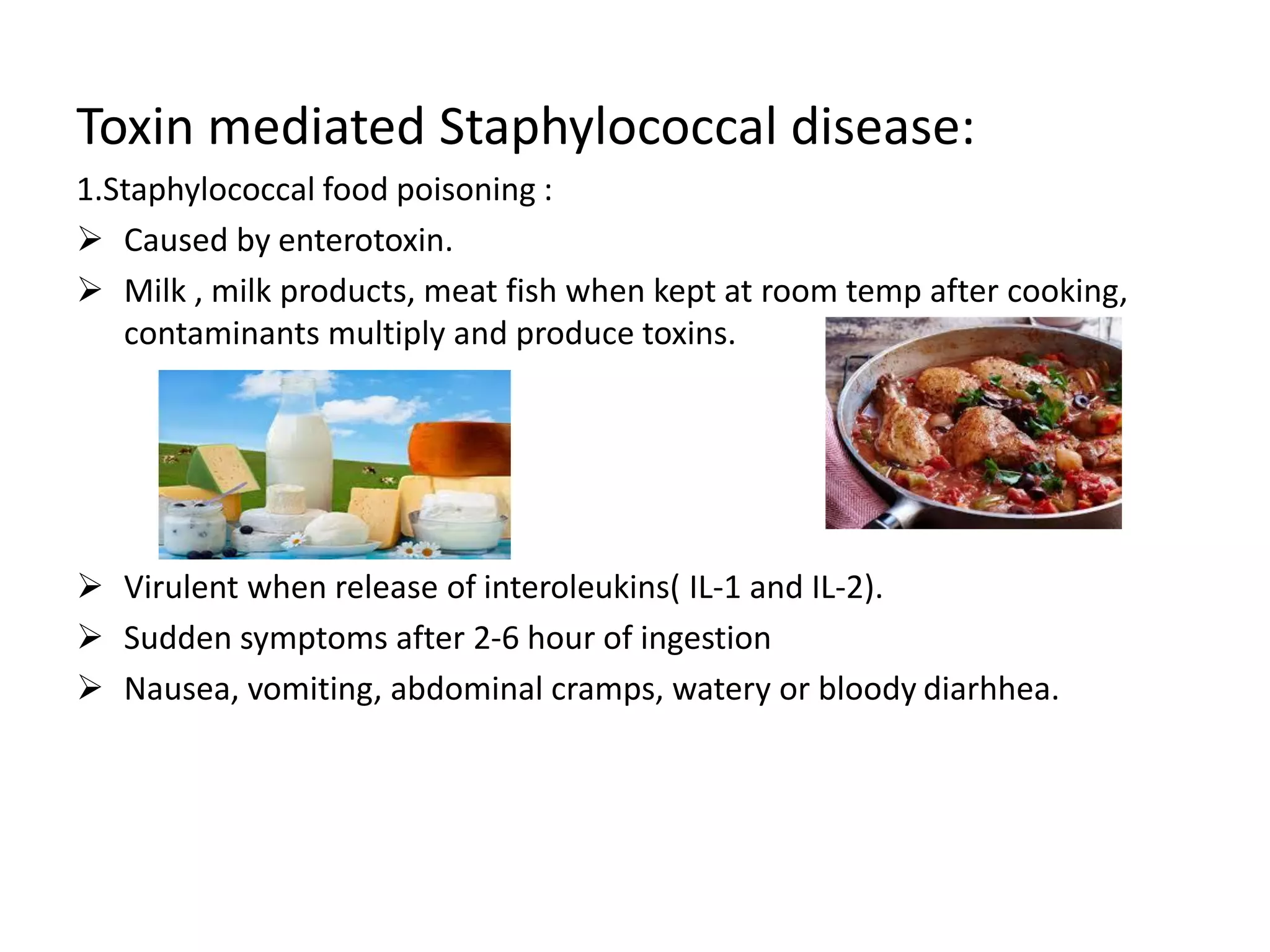
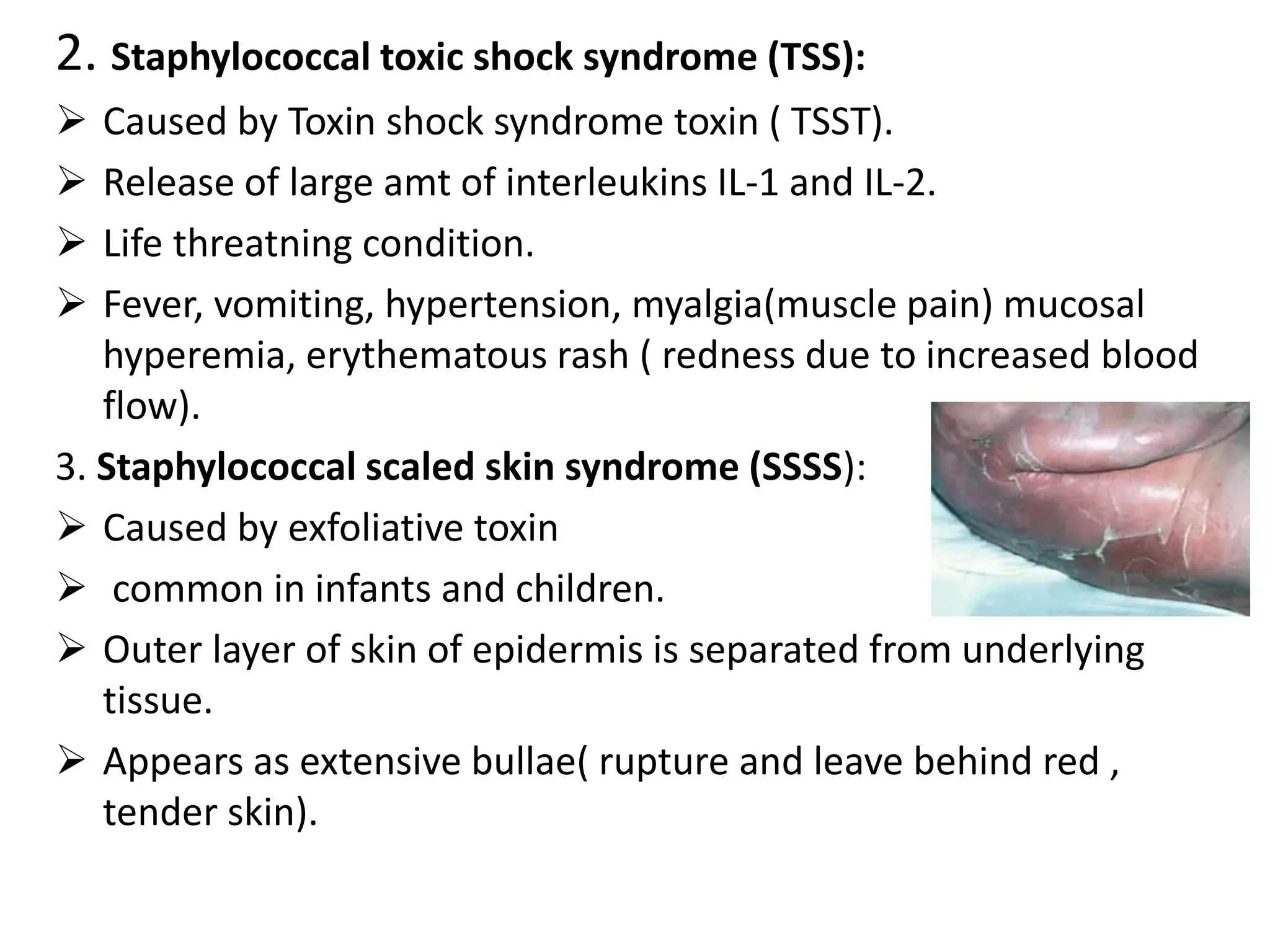
➢ Impetigo , folliculitis, furuncle ,carbuncle, surgical wound
infection,postpartum breast infection.
➢ Bacterimia( bacteria found in blood) and septicemia (bacterimia +clinical
symptoms)
➢ Endocarditis.
➢ Osteomyelitis and arthritis.
➢ Deep seated abscess in any organ after bacterimia.
Toxin mediated Staphylococcal disease:
1.Staphylococcal food poisoning :
➢ Caused by enterotoxin.
➢ Milk , milk products, meat fish when kept at room temp after cooking,
contaminants multiply and produce toxins.
➢ Virulent when release of interoleukins( IL-1 and IL-2).
➢ Sudden symptoms after 2-6 hour of ingestion
➢ Nausea, vomiting, abdominal cramps, watery or bloody diarhhea.
2. Staphylococcal toxic shock syndrome (TSS):
➢ Caused by Toxin shock syndrome toxin ( TSST).
➢ Release of large amt of interleukins IL-1 and IL-2.
➢ Life threatning condition.
➢ Fever, vomiting, hypertension, myalgia(muscle pain) mucosal
hyperemia, erythematous rash ( redness due to increased blood
flow).
3. Staphylococcal scaled skin syndrome (SSSS):
➢ Caused by exfoliative toxin
➢ common in infants and children.
➢ Outer layer of skin of epidermis is separated from underlying
tissue.
➢ Appears as extensive bullae( rupture and leave behind red ,
tender skin).
Lab Diagnosis
➢ Sample collection
➢ Direct smear microscopy
➢ Culture
➢ Biochemical tests
➢ Typing of S. aureus
➢ Antibiotic susceptibility test (AST)
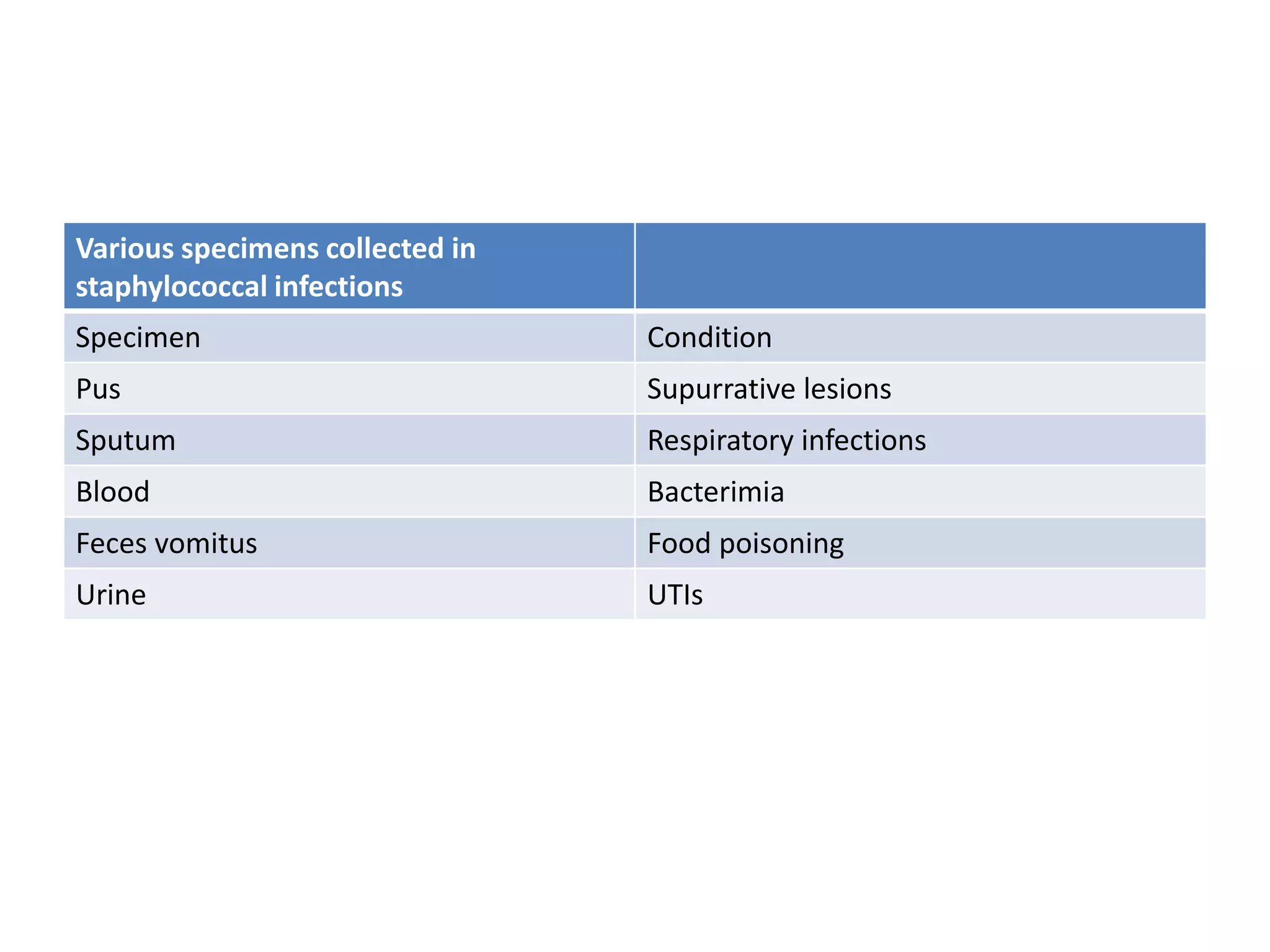
Various specimens collected in
staphylococcal infections
Specimen Condition
Pus Supurrative lesions
Sputum Respiratory infections
Blood Bacterimia
Feces vomitus Food poisoning
Urine UTIs
Microscopy
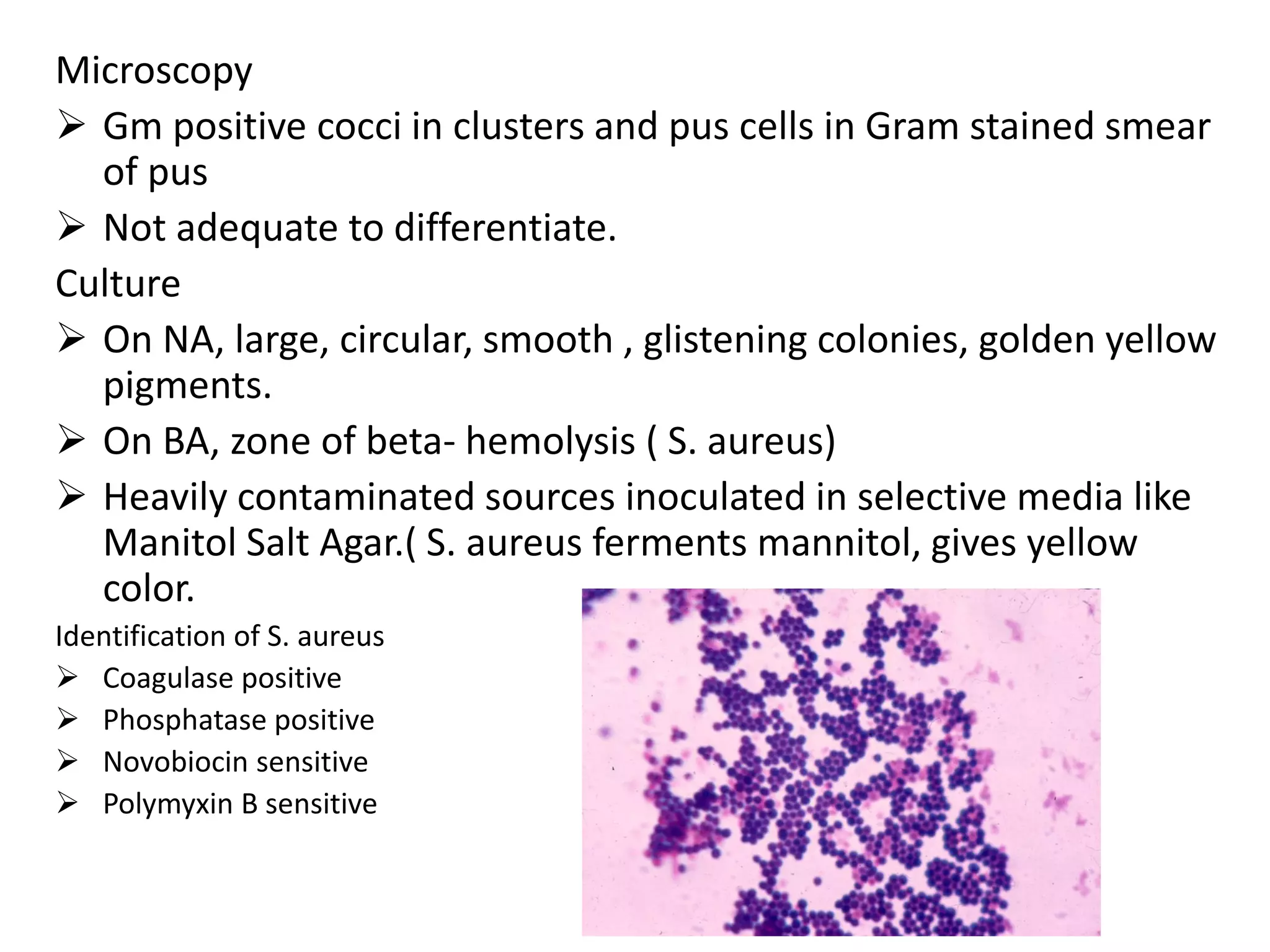
➢ Gm positive cocci in clusters and pus cells in Gram stained smear
of pus
➢ Not adequate to differentiate.
Culture
➢ On NA, large, circular, smooth , glistening colonies, golden yellow
pigments.
➢ On BA, zone of beta- hemolysis ( S. aureus)
➢ Heavily contaminated sources inoculated in selective media like
Manitol Salt Agar.( S. aureus ferments mannitol, gives yellow
color.
Identification of S. aureus
➢ Coagulase positive
➢ Phosphatase positive
➢ Novobiocin sensitive
➢ Polymyxin B sensitive
Biochemical test
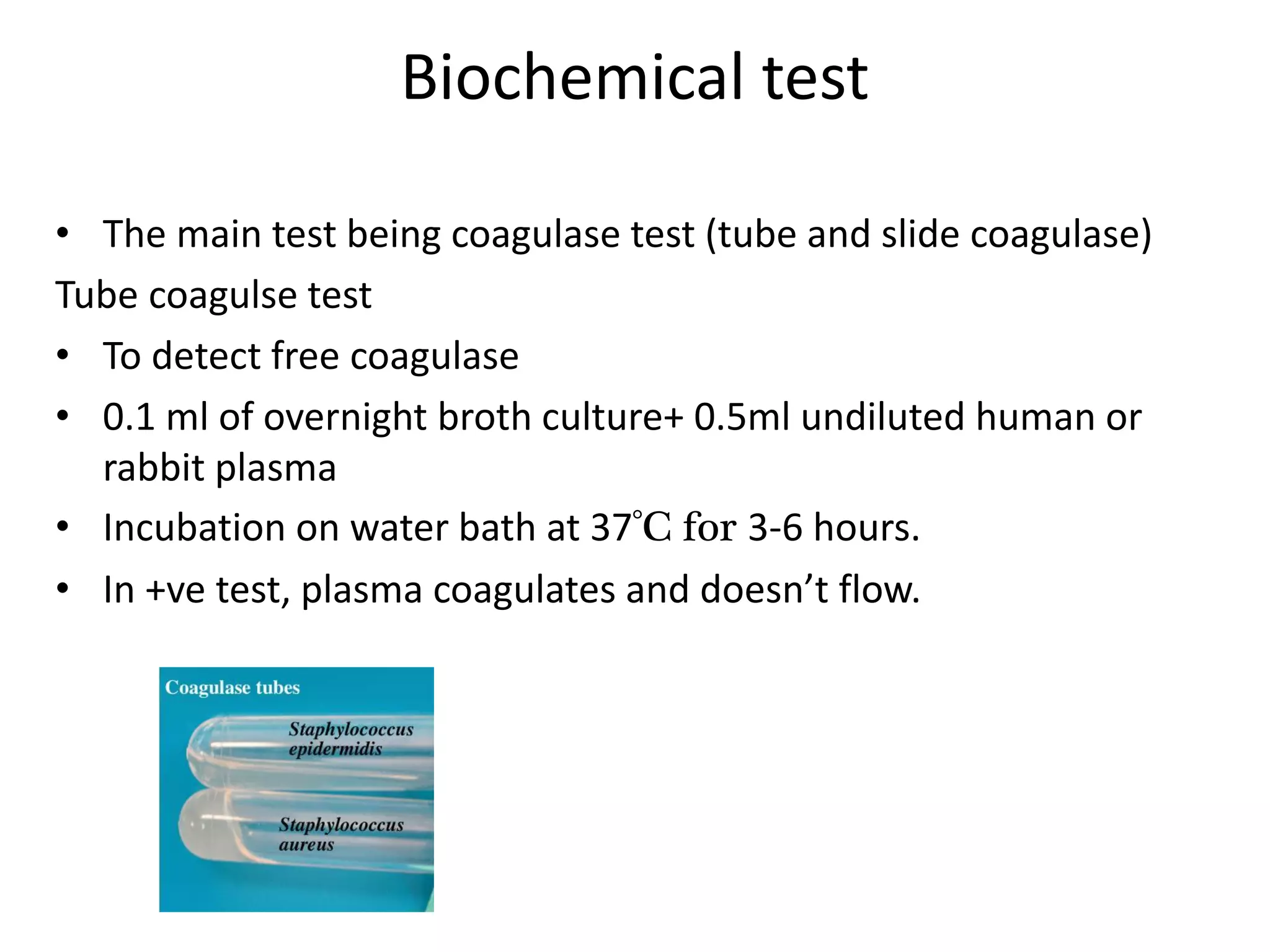
• The main test being coagulase test (tube and slide coagulase)
Tube coagulse test
• To detect free coagulase
• 0.1 ml of overnight broth culture+ 0.5ml undiluted human or
rabbit plasma
• Incubation on water bath at 37°C for 3-6 hours.
• In +ve test, plasma coagulates and doesn’t flow.
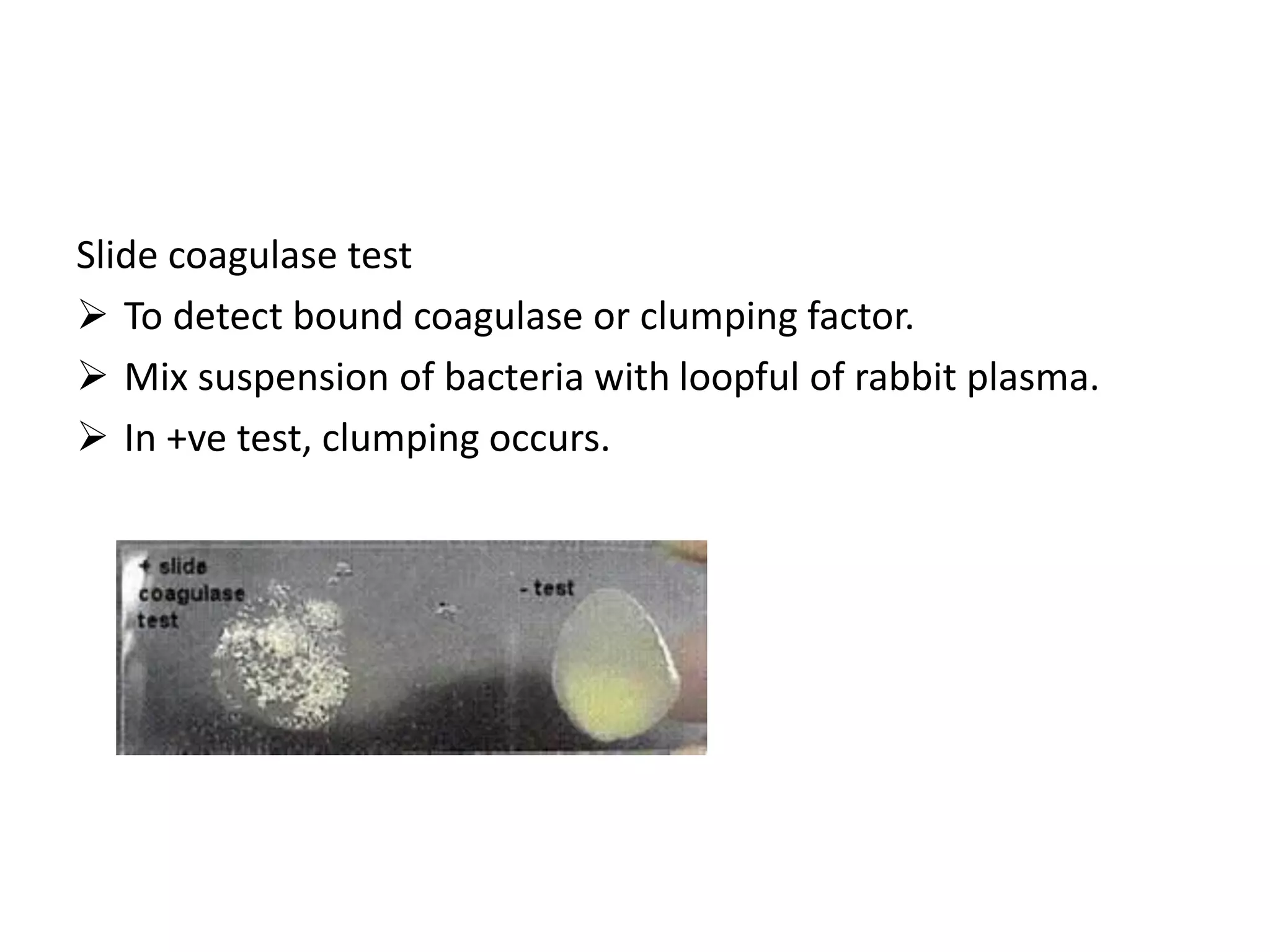
Slide coagulase test
➢ To detect bound coagulase or clumping factor.
➢ Mix suspension of bacteria with loopful of rabbit plasma.
➢ In +ve test, clumping occurs.
AST(antibiotic sensitivity test)
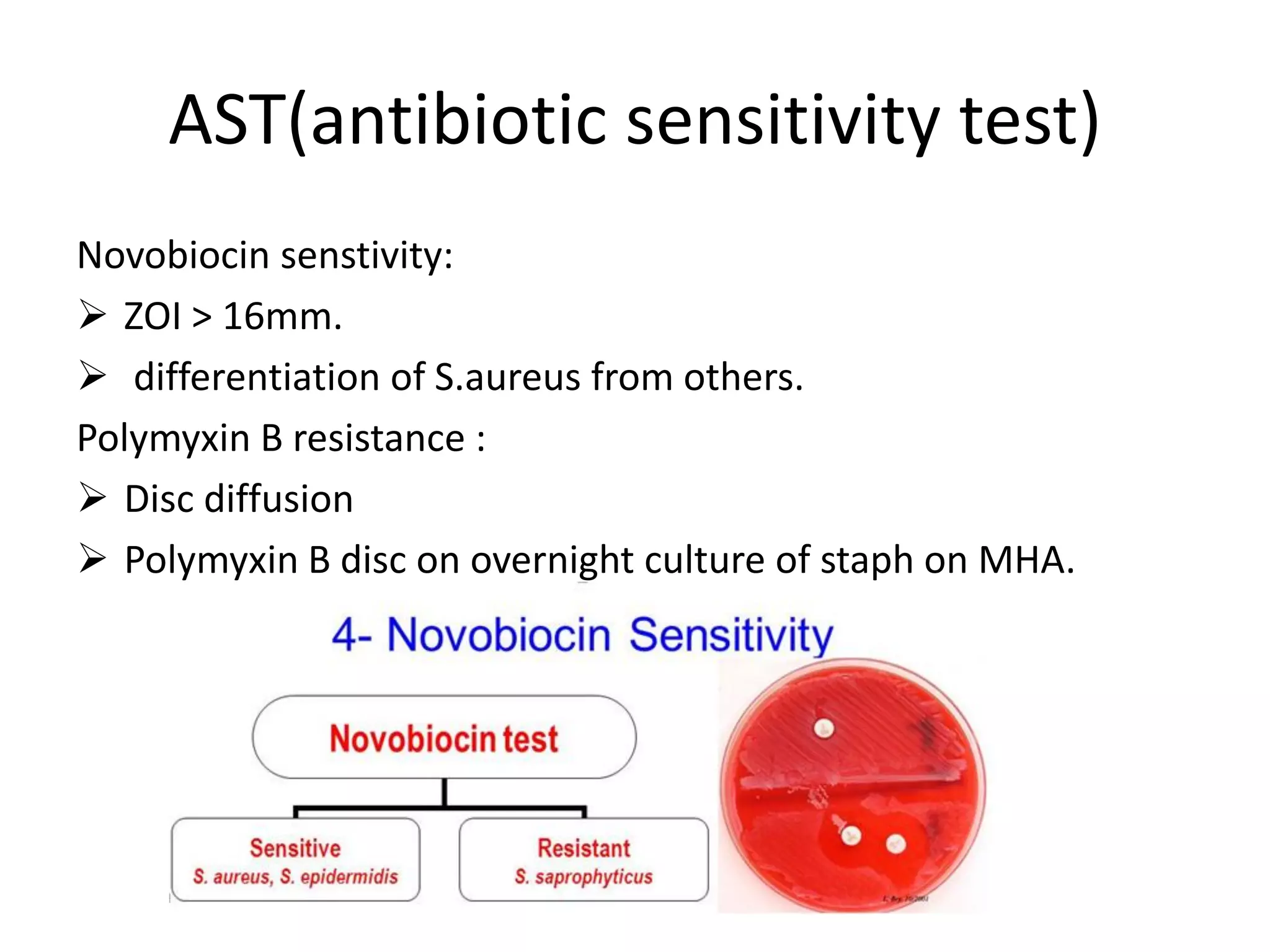
Novobiocin senstivity:
➢ ZOI > 16mm.
➢ differentiation of S.aureus from others.
Polymyxin B resistance :
➢ Disc diffusion
➢ Polymyxin B disc on overnight culture of staph on MHA.
Treatment
➢ Spontaneous or surgical drainage of pus and debridement.
➢ Systemic antibiotics necessary for deep seated and systemic
infections
➢ Benzyl penicillin for penicillin resistant strains of S. aureus.
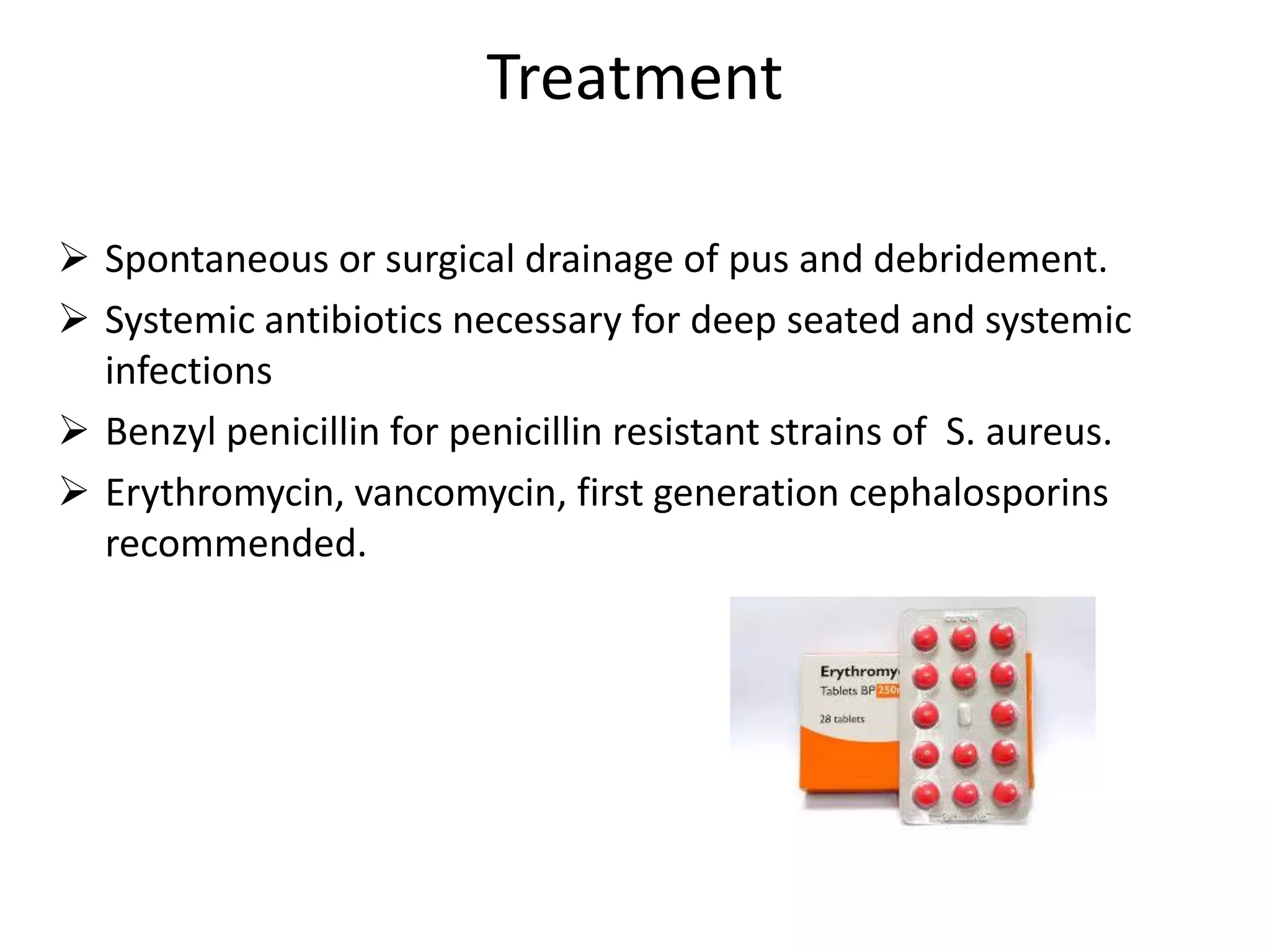
➢ Erythromycin, vancomycin, first generation cephalosporins
recommended.
Penicillin resistance in Staphylococci
➢ Increasing since 1945.
➢ 80% or more strains are resistant to penicillin.
3 types:
1. Plasma mediated resitance ( production of penicillinase
enzyme which is mediated by plasma)
2. Chromosomal mediated resistance( reduces affinity of
penicillin binding proteins to beta lactam antibiotics)
3. Tolerance to penicillin.
Prevention and control
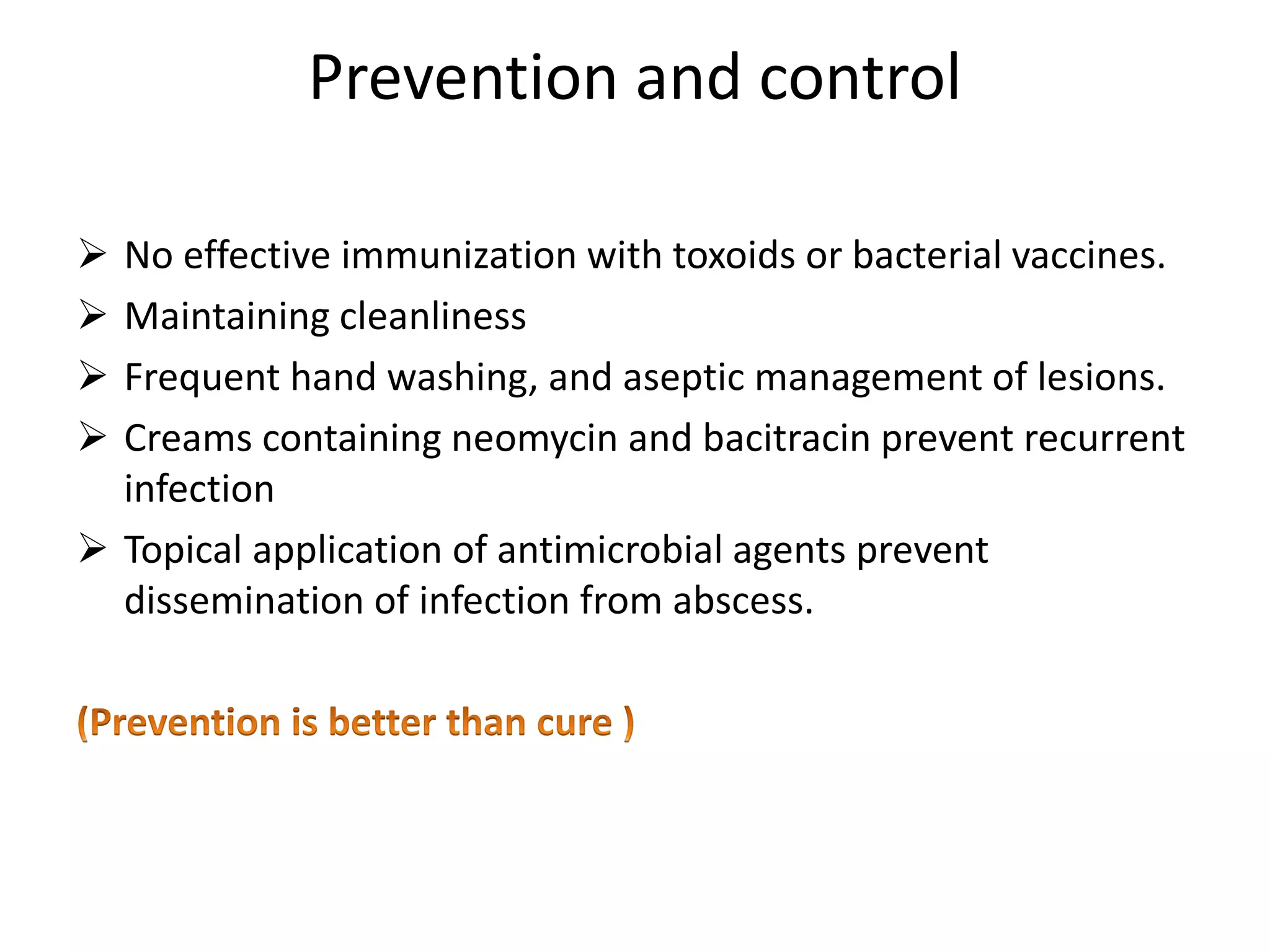
➢ No effective immunization with toxoids or bacterial vaccines.
➢ Maintaining cleanliness
➢ Frequent hand washing, and aseptic management of lesions.
➢ Creams containing neomycin and bacitracin prevent recurrent
infection
➢ Topical application of antimicrobial agents prevent
dissemination of infection from abscess.
Coagulase negative Staphylococci
(CONS)
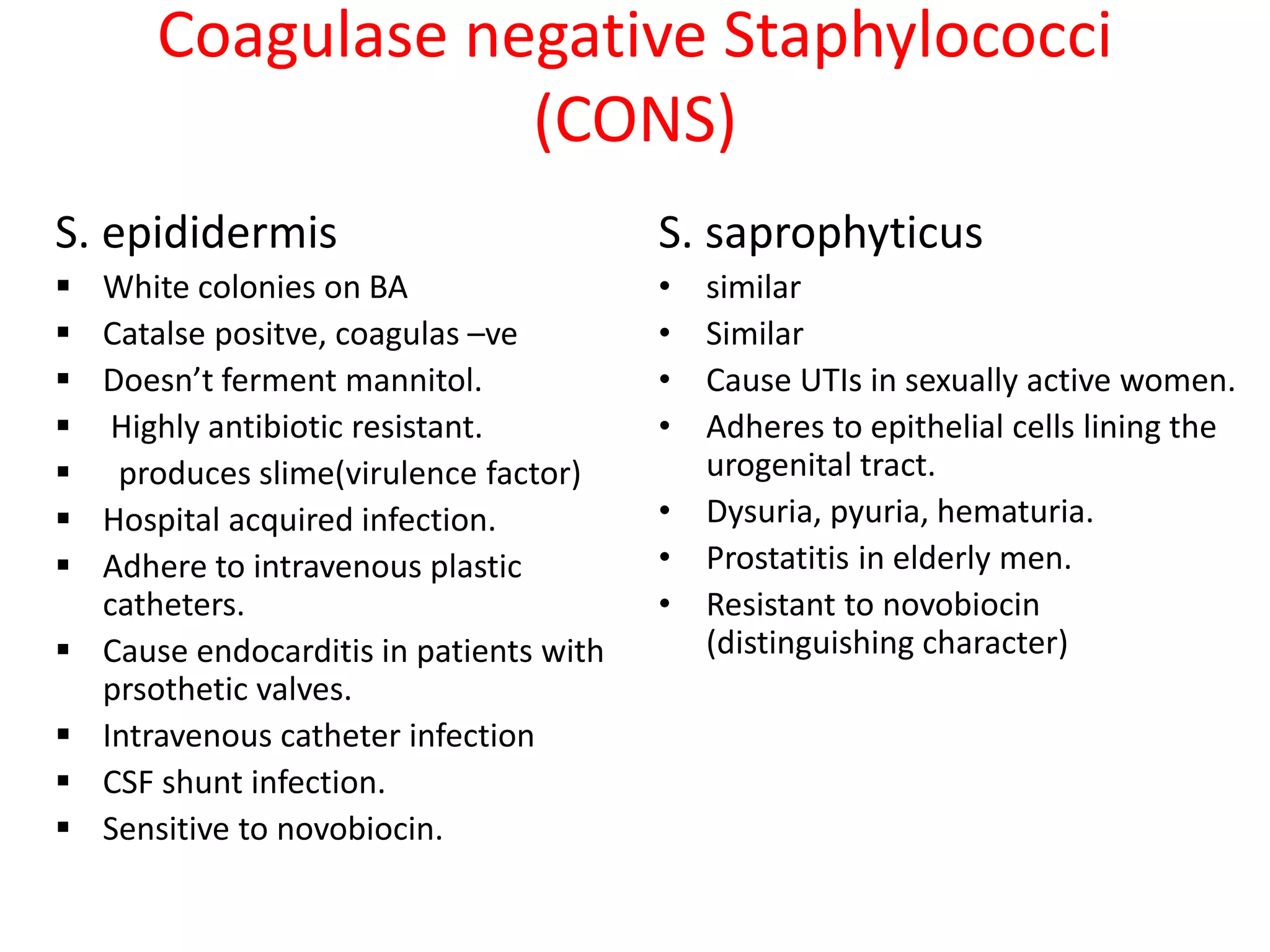
S. epididermis
▪ White colonies on BA
▪ Catalse positve, coagulas –ve
▪ Doesn’t ferment mannitol.
▪ Highly antibiotic resistant.
▪ produces slime(virulence factor)
▪ Hospital acquired infection.
▪ Adhere to intravenous plastic
catheters.
▪ Cause endocarditis in patients with
prsothetic valves.
▪ Intravenous catheter infection
▪ CSF shunt infection.
▪ Sensitive to novobiocin.
S. saprophyticus
• similar
• Similar
• Cause UTIs in sexually active women.
• Adheres to epithelial cells lining the
urogenital tract.
• Dysuria, pyuria, hematuria.
• Prostatitis in elderly men.
• Resistant to novobiocin
(distinguishing character)
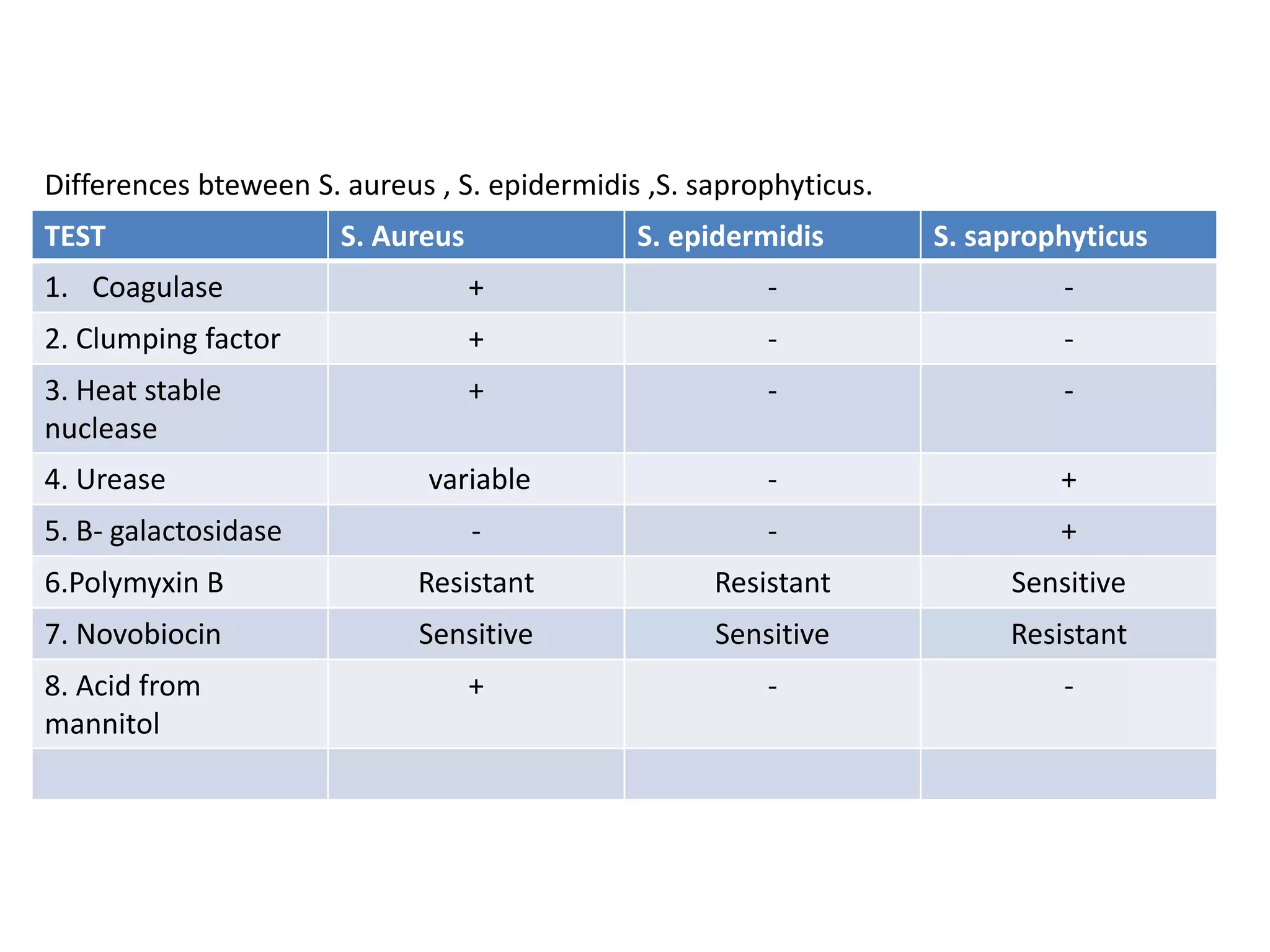
TEST S. Aureus S. epidermidis S. saprophyticus
1. Coagulase + - -
2. Clumping factor + - -
3. Heat stable
nuclease
+ - -
4. Urease variable - +
5. B- galactosidase - - +
6.Polymyxin B Resistant Resistant Sensitive
7. Novobiocin Sensitive Sensitive Resistant
8. Acid from
mannitol
+ - -
Differences bteween S. aureus , S. epidermidis ,S. saprophyticus.
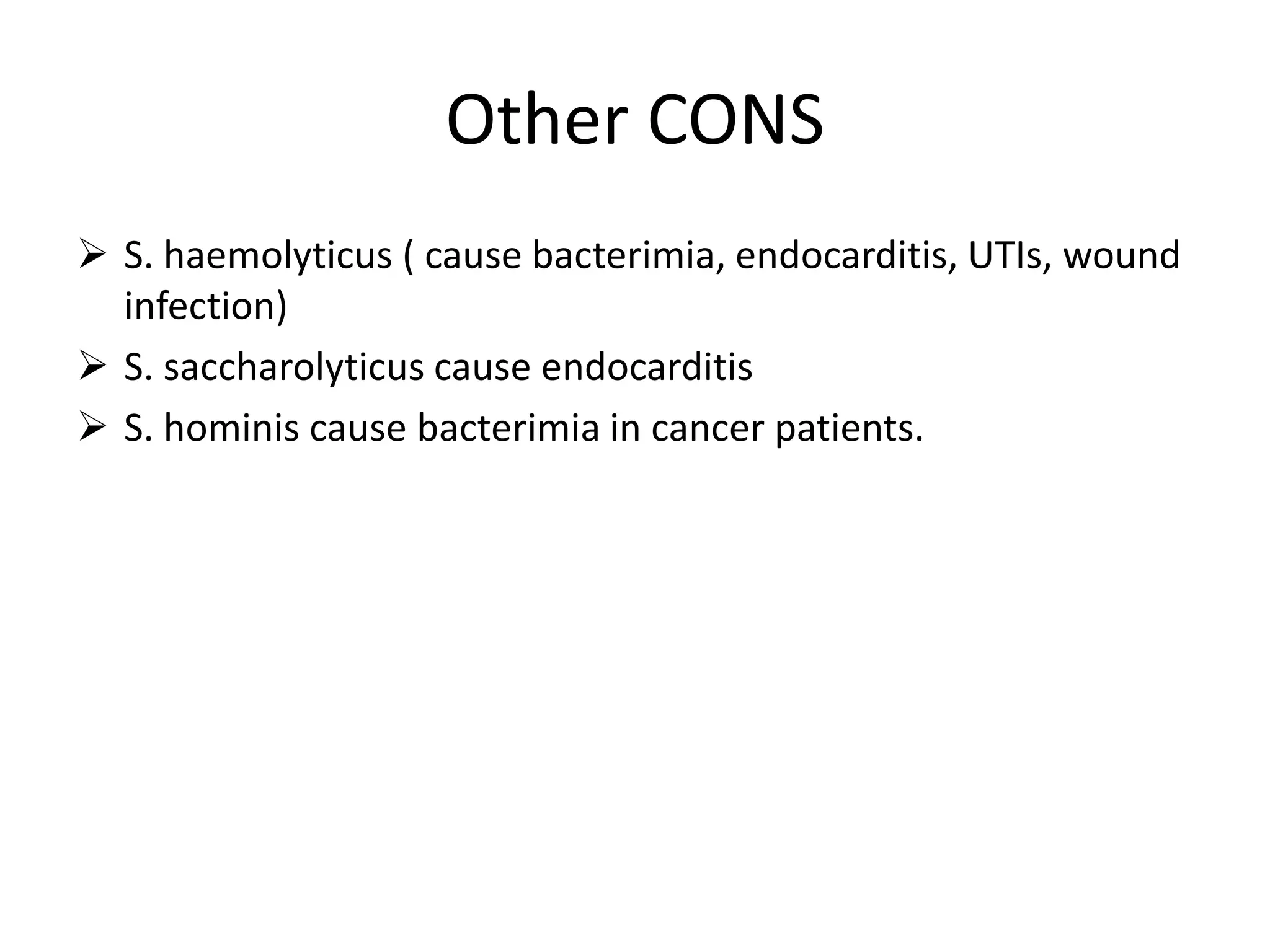
Other CONS
➢ S. haemolyticus ( cause bacterimia, endocarditis, UTIs, wound
infection)
➢ S. saccharolyticus cause endocarditis
➢ S. hominis cause bacterimia in cancer patients.
Staphylococcus

Staphylococcus

  • 1.
  • 2.
    Introduction Staphylococcus ➢Gram positive cocci,belongs to Family Micrococcaceae. ➢Aerobic , some facultative anaerobes. ➢Arrangement in clusters ( like grapes), pairs or tetrads, ➢ catalase positive. ➢S. aureus is the most important human pathogen, others human pathogens are CONS (coagulase negative Staphylococci) which include S. saprophyticus, S. epidermidis, S. hominis etc. ➢Staphylococcus are capable of acquiring resistance to antibiotics, ➢ Can cause serious clinical and epidemiological problems.
  • 3.
    Human Infections causedby Staphylococcus ❖ S. aureus cause: ➢ Skin infections like impetigo (rashes ,red sores), folliculitis(infection in hair follicles), wound infection. ➢ Systemic infections like bacterimia ( viable bacterial cells in blood), pneumonia, meningitis, deep-seated abscess. ➢ Toxin mediated infections like food poisoning, toxic shock syndrome. ❖ S. epidermidis cause : ➢ Opportunistic infections like intravenous catheter infections, CSF shunt infections. ❖ S. saprophyticus cause: ➢ UTIs.
  • 4.
    Topics • Morphology • Culture •Biochemical reactions • Antigenic structure • Virulence factors • Pathogenesis ( clinical syndromes) • Lab diagnosis • Treatment , prevention and control • CONS and MRSA.
  • 5.
    Staphylococcus aureus MORPHOLOGY : ➢Gm +ve cocci, 1µm in diameter. ➢ Non motile, Non sporing, ➢ Arranged in grape like structure when grown in solid media (due to incomplete separation of daughter cells during successive divisions of bacteria) ➢ Short chains in liquid media. ➢ Facultative anaerobes ➢ Grows in large, round , opaque colonies ➢ Withstand high salt, extreme pH ➢ Normal flora of skin, nasal area.
  • 6.
    Culture ➢ Staphylococcus growsin wide range of media ; Mannitol salt agar, Nutrient agar (NA) , Blood agar (BA), Macconkey agar etc. Primary isolation on NA and BA. ➢ On NA, S. aureus gives round, convex, smooth glistening , golden yellow colonies( believed to be lipoprotein allied to carotene). ➢ On BA, S. aureus gives a clear zone of hemolysis (beta-hemolysis), well marked on sheep or rabbit BA. ➢ Other species of Staph do not produce hemolysis. ➢ On Macconkey agar, S. aureus produce small pink colonies due to fermentation of lactose. ➢ On Mannitol salt agar, S. aureus ferment mannitol with acid production, gives yellow zone formation around colonies. ➢ On liquid media , S. aureus gives turbidity & no production of pigment.
  • 8.
    Biochemical reactions ➢ S.aureus gives catalase positive ➢ Coagulase and phosphatase positive but oxidase negative.(used for differentiation). ➢ S. aureus ferments mannitol, sucrose, maltose under aerobic conidtion. ➢ MR positive , VP positive but indole negative.
  • 9.
  • 10.
    Cell wall componentsand antigenic structure
  • 11.
    Virulence factors ➢ S.aureus produce different virulence factors: Cell wall associated Polymers and protein ❖ Capsular polysachharide ❖ Teichoic acid ❖ Protein A Enzymes ❖ Coagulase ❖ Catalase ❖ Hyaluronidase ❖ Penicillinase ❖ Nuclease ❖ Lipase Toxins ❖ Toxic shock syndrome toxin ❖ Enterotoxin ❖ Exfoliative toxin ❖ Leukocidin toxin ❖ Hemolysin
  • 13.
    Pathogenesis ➢ Cause localisedlesions ➢ First multiply in tissues, produce toxins and stimulate inflammation. ➢ Adhere to damaged skin. ➢ Evade defense mechanism of host. ➢ Cause tissue damage and form abscesses, produce extracellular enzymes and exotoxins. Host immunity: ▪ No life long immunity. ▪ Repeated infections occur in susceptible host.
  • 14.
    Clinical syndrome: ➢ 2types: inflammatory and toxin mediated staphylococcal disease. INFLAMMATORY DISEASES : ➢ Impetigo , folliculitis, furuncle ,carbuncle, surgical wound infection,postpartum breast infection. ➢ Bacterimia( bacteria found in blood) and septicemia (bacterimia +clinical symptoms) ➢ Endocarditis. ➢ Osteomyelitis and arthritis. ➢ Deep seated abscess in any organ after bacterimia.
  • 15.
    Toxin mediated Staphylococcaldisease: 1.Staphylococcal food poisoning : ➢ Caused by enterotoxin. ➢ Milk , milk products, meat fish when kept at room temp after cooking, contaminants multiply and produce toxins. ➢ Virulent when release of interoleukins( IL-1 and IL-2). ➢ Sudden symptoms after 2-6 hour of ingestion ➢ Nausea, vomiting, abdominal cramps, watery or bloody diarhhea.
  • 16.
    2. Staphylococcal toxicshock syndrome (TSS): ➢ Caused by Toxin shock syndrome toxin ( TSST). ➢ Release of large amt of interleukins IL-1 and IL-2. ➢ Life threatning condition. ➢ Fever, vomiting, hypertension, myalgia(muscle pain) mucosal hyperemia, erythematous rash ( redness due to increased blood flow). 3. Staphylococcal scaled skin syndrome (SSSS): ➢ Caused by exfoliative toxin ➢ common in infants and children. ➢ Outer layer of skin of epidermis is separated from underlying tissue. ➢ Appears as extensive bullae( rupture and leave behind red , tender skin).
  • 17.
    Lab Diagnosis ➢ Samplecollection ➢ Direct smear microscopy ➢ Culture ➢ Biochemical tests ➢ Typing of S. aureus ➢ Antibiotic susceptibility test (AST)
  • 18.
    Various specimens collectedin staphylococcal infections Specimen Condition Pus Supurrative lesions Sputum Respiratory infections Blood Bacterimia Feces vomitus Food poisoning Urine UTIs
  • 19.
    Microscopy ➢ Gm positivecocci in clusters and pus cells in Gram stained smear of pus ➢ Not adequate to differentiate. Culture ➢ On NA, large, circular, smooth , glistening colonies, golden yellow pigments. ➢ On BA, zone of beta- hemolysis ( S. aureus) ➢ Heavily contaminated sources inoculated in selective media like Manitol Salt Agar.( S. aureus ferments mannitol, gives yellow color. Identification of S. aureus ➢ Coagulase positive ➢ Phosphatase positive ➢ Novobiocin sensitive ➢ Polymyxin B sensitive
  • 20.
    Biochemical test • Themain test being coagulase test (tube and slide coagulase) Tube coagulse test • To detect free coagulase • 0.1 ml of overnight broth culture+ 0.5ml undiluted human or rabbit plasma • Incubation on water bath at 37°C for 3-6 hours. • In +ve test, plasma coagulates and doesn’t flow.
  • 21.
    Slide coagulase test ➢To detect bound coagulase or clumping factor. ➢ Mix suspension of bacteria with loopful of rabbit plasma. ➢ In +ve test, clumping occurs.
  • 22.
    AST(antibiotic sensitivity test) Novobiocinsenstivity: ➢ ZOI > 16mm. ➢ differentiation of S.aureus from others. Polymyxin B resistance : ➢ Disc diffusion ➢ Polymyxin B disc on overnight culture of staph on MHA.
  • 23.
    Treatment ➢ Spontaneous orsurgical drainage of pus and debridement. ➢ Systemic antibiotics necessary for deep seated and systemic infections ➢ Benzyl penicillin for penicillin resistant strains of S. aureus. ➢ Erythromycin, vancomycin, first generation cephalosporins recommended.
  • 24.
    Penicillin resistance inStaphylococci ➢ Increasing since 1945. ➢ 80% or more strains are resistant to penicillin. 3 types: 1. Plasma mediated resitance ( production of penicillinase enzyme which is mediated by plasma) 2. Chromosomal mediated resistance( reduces affinity of penicillin binding proteins to beta lactam antibiotics) 3. Tolerance to penicillin.
  • 25.
    Prevention and control ➢No effective immunization with toxoids or bacterial vaccines. ➢ Maintaining cleanliness ➢ Frequent hand washing, and aseptic management of lesions. ➢ Creams containing neomycin and bacitracin prevent recurrent infection ➢ Topical application of antimicrobial agents prevent dissemination of infection from abscess.
  • 26.
    Coagulase negative Staphylococci (CONS) S.epididermis ▪ White colonies on BA ▪ Catalse positve, coagulas –ve ▪ Doesn’t ferment mannitol. ▪ Highly antibiotic resistant. ▪ produces slime(virulence factor) ▪ Hospital acquired infection. ▪ Adhere to intravenous plastic catheters. ▪ Cause endocarditis in patients with prsothetic valves. ▪ Intravenous catheter infection ▪ CSF shunt infection. ▪ Sensitive to novobiocin. S. saprophyticus • similar • Similar • Cause UTIs in sexually active women. • Adheres to epithelial cells lining the urogenital tract. • Dysuria, pyuria, hematuria. • Prostatitis in elderly men. • Resistant to novobiocin (distinguishing character)
  • 27.
    TEST S. AureusS. epidermidis S. saprophyticus 1. Coagulase + - - 2. Clumping factor + - - 3. Heat stable nuclease + - - 4. Urease variable - + 5. B- galactosidase - - + 6.Polymyxin B Resistant Resistant Sensitive 7. Novobiocin Sensitive Sensitive Resistant 8. Acid from mannitol + - - Differences bteween S. aureus , S. epidermidis ,S. saprophyticus.
  • 28.
    Other CONS ➢ S.haemolyticus ( cause bacterimia, endocarditis, UTIs, wound infection) ➢ S. saccharolyticus cause endocarditis ➢ S. hominis cause bacterimia in cancer patients.