
Neisseria gonorrhoeae
Lecture 03 (B)
Neisseria gonorrhoeae (Gonococcus)
• N. gonorrhoeae causes the sexually transmitted disease gonorrhoea.
• first described by Neisser in 1879 in gonorrheal pus.
• resembles meningococci very closely in many properties.
MORPHOLOGY:
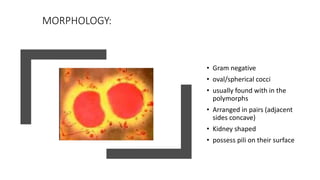
• Gram negative
• oval/spherical cocci
• usually found with in the
polymorphs
• Arranged in pairs (adjacent
sides concave)
• Kidney shaped
• possess pili on their surface
CULTURE & CULTURAL CHARACTERISTICS:
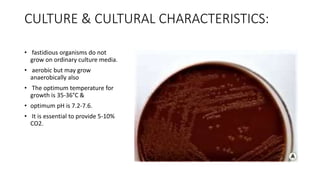
• fastidious organisms do not
grow on ordinary culture media.
• aerobic but may grow
anaerobically also
• The optimum temperature for
growth is 35-36°C &
• optimum pH is 7.2-7.6.
• It is essential to provide 5-10%
CO2.
Media used:
a) Non selective media:
• Chocolate agar,
• Mueller-Hinton agar
• Modified New York City medium
b) Selective media:
• Thayer Martin medium
• with antibiotics (Vancomycin, Colistin &
Nystatin)
Colony morphology
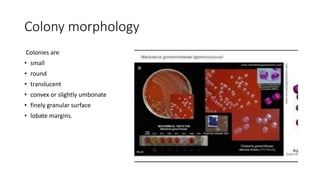
Colonies are
• small
• round
• translucent
• convex or slightly umbonate
• finely granular surface
• lobate margins.
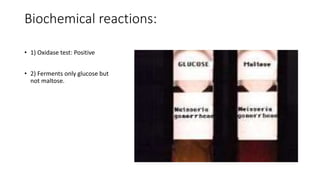
Biochemical reactions:
• 1) Oxidase test: Positive
• 2) Ferments only glucose but
not maltose.
PATHOGENICITY:
•Asymptomatic carriers
•Patients
Source of infection:
•Venereal infection (sexual
contact)
•Nonvenereal infection
Mode of infection:
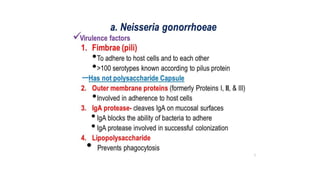
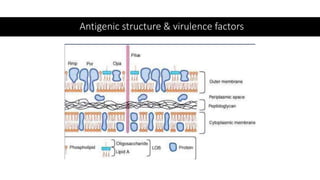
Antigenic structure & virulence factors:
1. Pili
2. Lipooligosaccharide: Endotoxic.
3. Outer membrane proteins: 3 types
• a) Protein I (por)- it is a porin & helps in adherence.
• b) Protein II (opa)- helps in adherence.
• c) Protein III (rmp)- it is associated with protein I.
4. IgA1 protease: Splits & inactivates IgA
Antigenic structure & virulence factors
Mechanism of pathogenesis:
1. Gonococci adhere to epithelial cells of urethra or other mucosal
surface through pili
2. penetrate through the intercellular space
3. reach the sub epithelial connective tissue &
4. causes inflammation
5. Leads to clinical manifestations
6. Incubation period: 2-8 days.
Disease In men:
• The disease starts as an acute urethritis with a muco-purulent
discharge
• extends to the prostate, seminal vesicles & epididymis
• In some it may become chronic urethritis
• The infection may spread to the peri-urethral tissues,
• causing abscesses & multiple discharging sinuses
Diseases In women:
• The initial infection is urethritis & cervicitis
• but vaginitis does not occur in adult female
• (vulvovaginitis can occur in prepubertal girls)
• The infection may extend to Bartholin’s glands,
• endometrium & fallopian tubes causing
• Pelvic Inflammatory Disease (PID)
• Rarely peritonitis may develop with perihepatic
In both the sexes:
• Proctitis,
• pharyngitis,
• conjunctivitis,
• bacteraemia which may lead to metastatic infection such as
• arthritis,
• endocarditis,
• meningitis,
• pyemia &
• skin rashes.
LABORATORY DIAGNOSIS:
• In men:
• a) Acute infection- Urethral discharge
• b) Chronic infection) Morning drop
• ii) Discharge collected after prostatic massage
• iii) Centrifuged deposit of urine
• B) In women:
• i) Urethral discharge
• ii) Cervical swabs
In both the
sexes:
Blood,
CSF, s
ynovial fluid,
throat swab,
rectal swab &
material from skin rashes
A) Direct microscopy:
• Gram staining:
Smear provides a
presumptive
evidence
of gonorrhea in men.
Gram negative
diplococci are found.
But it is unreliable
in women.
Immunofluorescence:
Serology:
Complement fixation test,
Precipitation,
Passive agglutination,
Immunofluorescence,
Radioimmunoassay.(uses whole-cell lysate,pilus
protein and lipopolysaccharide antigen)
TREATMENT:
• Previously Penicillin was drug of choice but
resistance developed rapidly.
• Penicillin resistant is due to production of
penicillinase enzyme & the strains are called
as penicillinase producing Neisseria
gonorrhoeae (PPNG).
• Now Ceftriaxone or Ciprofloxacin plus
Doxycycline or Erythromycin is useful.
EPIDEMIOLOGY:
• Gonorrhoea is an exclusively human disease.
• The only source of infection is a human
carrier or less often a patient.
• Asymptomatic carriage in women makes them
a reservoir to spread infection among their
male contact.
• Gonorrhoea is an venereal disease (STD)
PROPHYLAXIS:
Early detection of cases,
Tracing of contacts,
Health education,
General measures,
Vaccination has no role in prophylaxis.
COMMENSAL NEISSERIAE
• N. lactamica
• N.pharyngis
• N. polysaccreae
• N. cinerea
• N. flavescens
• N. mucosa
 Neiserria gonorrhoeae

Neiserria gonorrhoeae

  • 1.
  • 2.
    Neisseria gonorrhoeae (Gonococcus) •N. gonorrhoeae causes the sexually transmitted disease gonorrhoea. • first described by Neisser in 1879 in gonorrheal pus. • resembles meningococci very closely in many properties.
  • 3.
    MORPHOLOGY: • Gram negative •oval/spherical cocci • usually found with in the polymorphs • Arranged in pairs (adjacent sides concave) • Kidney shaped • possess pili on their surface
  • 4.
    CULTURE & CULTURALCHARACTERISTICS: • fastidious organisms do not grow on ordinary culture media. • aerobic but may grow anaerobically also • The optimum temperature for growth is 35-36°C & • optimum pH is 7.2-7.6. • It is essential to provide 5-10% CO2.
  • 5.
    Media used: a) Nonselective media: • Chocolate agar, • Mueller-Hinton agar • Modified New York City medium b) Selective media: • Thayer Martin medium • with antibiotics (Vancomycin, Colistin & Nystatin)
  • 6.
    Colony morphology Colonies are •small • round • translucent • convex or slightly umbonate • finely granular surface • lobate margins.
  • 7.
    Biochemical reactions: • 1)Oxidase test: Positive • 2) Ferments only glucose but not maltose.
  • 8.
    PATHOGENICITY: •Asymptomatic carriers •Patients Source ofinfection: •Venereal infection (sexual contact) •Nonvenereal infection Mode of infection:
  • 9.
    Antigenic structure &virulence factors: 1. Pili 2. Lipooligosaccharide: Endotoxic. 3. Outer membrane proteins: 3 types • a) Protein I (por)- it is a porin & helps in adherence. • b) Protein II (opa)- helps in adherence. • c) Protein III (rmp)- it is associated with protein I. 4. IgA1 protease: Splits & inactivates IgA
  • 11.
    Antigenic structure &virulence factors
  • 12.
    Mechanism of pathogenesis: 1.Gonococci adhere to epithelial cells of urethra or other mucosal surface through pili 2. penetrate through the intercellular space 3. reach the sub epithelial connective tissue & 4. causes inflammation 5. Leads to clinical manifestations 6. Incubation period: 2-8 days.
  • 13.
    Disease In men: •The disease starts as an acute urethritis with a muco-purulent discharge • extends to the prostate, seminal vesicles & epididymis • In some it may become chronic urethritis • The infection may spread to the peri-urethral tissues, • causing abscesses & multiple discharging sinuses
  • 14.
    Diseases In women: •The initial infection is urethritis & cervicitis • but vaginitis does not occur in adult female • (vulvovaginitis can occur in prepubertal girls) • The infection may extend to Bartholin’s glands, • endometrium & fallopian tubes causing • Pelvic Inflammatory Disease (PID) • Rarely peritonitis may develop with perihepatic
  • 15.
    In both thesexes: • Proctitis, • pharyngitis, • conjunctivitis, • bacteraemia which may lead to metastatic infection such as • arthritis, • endocarditis, • meningitis, • pyemia & • skin rashes.
  • 16.
    LABORATORY DIAGNOSIS: • Inmen: • a) Acute infection- Urethral discharge • b) Chronic infection) Morning drop • ii) Discharge collected after prostatic massage • iii) Centrifuged deposit of urine • B) In women: • i) Urethral discharge • ii) Cervical swabs
  • 17.
    In both the sexes: Blood, CSF,s ynovial fluid, throat swab, rectal swab & material from skin rashes
  • 18.
    A) Direct microscopy: •Gram staining: Smear provides a presumptive evidence of gonorrhea in men. Gram negative diplococci are found. But it is unreliable in women.
  • 19.
  • 20.
    Serology: Complement fixation test, Precipitation, Passiveagglutination, Immunofluorescence, Radioimmunoassay.(uses whole-cell lysate,pilus protein and lipopolysaccharide antigen)
  • 21.
    TREATMENT: • Previously Penicillinwas drug of choice but resistance developed rapidly. • Penicillin resistant is due to production of penicillinase enzyme & the strains are called as penicillinase producing Neisseria gonorrhoeae (PPNG). • Now Ceftriaxone or Ciprofloxacin plus Doxycycline or Erythromycin is useful.
  • 22.
    EPIDEMIOLOGY: • Gonorrhoea isan exclusively human disease. • The only source of infection is a human carrier or less often a patient. • Asymptomatic carriage in women makes them a reservoir to spread infection among their male contact. • Gonorrhoea is an venereal disease (STD)
  • 23.
    PROPHYLAXIS: Early detection ofcases, Tracing of contacts, Health education, General measures, Vaccination has no role in prophylaxis.
  • 24.
    COMMENSAL NEISSERIAE • N.lactamica • N.pharyngis • N. polysaccreae • N. cinerea • N. flavescens • N. mucosa