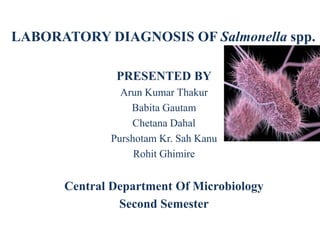

LABORATORY DIAGNOSIS OF Salmonella spp.
PRESENTED BY
Arun Kumar Thakur
Babita Gautam
Chetana Dahal
Purshotam Kr. Sah Kanu
Rohit Ghimire
Central Department Of Microbiology
Second Semester
Salmonella
• Salmonella named after an American bacteriologist,
D.E Salmon, who first isolated Salmonella
Choleraesuis from porcine intestine in 1884
• Salmonella spp gm (-ve), flagellated and facultative
anaerobic bacteria characterized by the presence of O,
H, and Vi antigen
• Salmonella ubiquitous human and animal pathogen
• Salmonella infection- one of three clinical syndrome
.i.e. gastroenteritis, enteric fever or focal disease
Human infections caused by some Salmonella spp
Salmonella Typhi-typhoid fever, bacterima
Salmonella Paratyphi A, B and C-paratyphoid
fever, bacterima
Salmonella Cholerasuis- bacterima
Salmonella Typhimurium- gastroenteritis
Salmonella Enterisitis, S. Hadar, S. Heidelberg,
S. Agona etc- gastroenteritis
Habitat
• Found in intestinal tract of human and animal including wild birds,
domestic pets and rodents.
• Under suitable environmental conditions, they may survive for
weeks in water and for years in soils.
• Majority are ubiquitous serotypes inhabiting a wide range of hosts.
• Members of subsps. enterica predominate among mammals and
others are found commonly in the intestinal tract of cold blooded
animals.
• Host adapted serotypes
• Some serotype are adopted to specific host eg.
 Abortusouis- confirmed to sheep
 Gallinarum- fowl
 Typhi-human
 Typhisuis -swine
Laboratory Diagnosis
Laboratory daignosis of Sallmonella spp is based on the following
methods:
1. Macroscopic examination of specimen along with microscopic
examination for morphological observation of bacteria
2. Isolation and identification of Sallmonella spp by culture and
biochemical test
3. Serodiagnosis by demonstration of Sallmonella spp antibodies and
antigens
4. Molecular diagnosis by DNA probes and PCR
 Specimens
i. Blood, blood clot, bone marrow and stool commonly used for
typhoid bacilli
ii. CSF, peritoneal fluid, mesentric lymph nodes, resected intestine,
phyranx, tonslis, abscess, bone and urine other specimen of choice
Morphology on Gram staining
Member of family enterobactericeae.
• Gram negative bacteria measuring 2-4 X 0.6 um
• Non-acid fast, non-sporing
• Motile with peritrichous flagella except Gallinarum pullorum
• Non capsulated but when gown on media with osmolarity, most
strains produce extracellular slime which is colanic acid.
Cont…
• Slime production is the rule among S. Paratyphi negative to D-
tartarate and is favoured by continued incubation at low
temperature.
• Most strains (80%) form type I (mannose sensitive,
haemagglutination) fimbriae composed of fimbrilin subunits
with a high proportion of hydrophobic amino acids.
• Gallinarum pullorum and a few strains in other serotypes
either form type 2 (non-haemagglutinating) fimbriae or are
non fimbricated.
Cultural characteristics
• Aerobic and faculatively anaerobic .
• Grows on simple lab media in temperature range (7- 48°)C ,optimally at 37°C
• pH 4-8 and water activity above 0.93.
• Many strains are proto trophic; i.e capable of growing on glucose-ammonium
minimal medium.
• Some strains are auxotrophic and require enrichment of the minimal medium
with one or more amino acids or vitamins eg. cysteine or nicotinamide.
• Most Typhi strain require tryptophan.
On NA
 Grey white, moist, circular, convex colonies with entire edge 2-3 mm in
diameter.
 Many paratyphi strains form large mucoid colonies, due to slime formation
when plates are left at room temp. for few days incubation at 37°C for 24
hrs.
NA XLD
• On MA
 NLF pale colored colonies.
• On DCA
 Small colonies with black centre
• On XLD
 Pink red colonies (H2S Producer)
 3-5 mm dia., with black centre those not producing H2S (paratyphi
A)
 Produce pink colonies without black centre
• On Peptone water and NB
 Most strains give abundant growth with uniform turbidity and a
thin surface pellicle forms on prolonged incubation.
 Rough variants which have a hydrophobic surface and tend to auto
aagglutinate produce agranular deposits and sometimes a thick
pellicle.
• Enrichment media
 Tetrathionate broth –enriches salmonallae but also permits growth
of proteus spp
 Kauffmann Muller Tetrathionate broth with a brilliant green,
inhibits proteus and so improves selectively.
 Selenite F Broth-excellent for typhi and Dublin but some eg
paratyphi A and Cholareusis may fail to multiply .
 Rappaport’s malachite green magnesium chloride broth –more
efficient for isolation of salmonellae from faeces water and
foodstuffs.
• Selective as well as Differential media
 Bismuth Sulfite Agar : selective as it inhibts most gm (+ve) and gm
(-ve) bacteria; differential as production of H2S, ferrous sulphate,
positive reactions appear as brown to black precipitate
 Brillant green agar: brillant green is inhibtory to most gm (+ve) and
gm (-ve) bacteria; differential lactose and sucrose fermentation
positive appears as yellow to green colonies with bright yellow to
green halos
Salmonella spp appear as white to pink or red colonies surrounded by a
bright halo
 Salmonellae Shigella Agar: selective as bile salts, sodium citrate and
brillant green inhibts most gm (+ve) and gm (-ve) bacteria;
differential due to presence of lactose, neutral red sodium thiosulfate
Salmonella spp appears colourless with black center
Biochemical Characteristics
1. Salmonellae shows following reactions:
2. Ferments gulcose, mannitol and maltose with acid and gas
production (exception S. Typhi sugar non fermenter)
3. Lactose, sucrose or salicin non fermenter
4. Indole non producer
5. Except S. Paratyphi A, S. choleraseuis and sime other species
produce H2S
6. Urea non hydrolyzer
7. MR positive
8. VP negative
9. Citrate positive (S. Typhi and S. ParaTyphi)
10. Decarboxylation of lysine, ornithine and arginine but not gultamic
acid ( exception S. Typhi and S. ParaTyphi A don’t decarboxylate
ornithine and lysine respectively)
11. Catalase positive
12. Oxidase negative
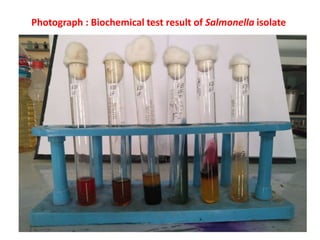
Photograph : Biochemical test result of Salmonella isolate
Salmonella presentation

Salmonella presentation

  • 1.
    LABORATORY DIAGNOSIS OFSalmonella spp. PRESENTED BY Arun Kumar Thakur Babita Gautam Chetana Dahal Purshotam Kr. Sah Kanu Rohit Ghimire Central Department Of Microbiology Second Semester
  • 2.
    Salmonella • Salmonella namedafter an American bacteriologist, D.E Salmon, who first isolated Salmonella Choleraesuis from porcine intestine in 1884 • Salmonella spp gm (-ve), flagellated and facultative anaerobic bacteria characterized by the presence of O, H, and Vi antigen • Salmonella ubiquitous human and animal pathogen • Salmonella infection- one of three clinical syndrome .i.e. gastroenteritis, enteric fever or focal disease
  • 3.
    Human infections causedby some Salmonella spp Salmonella Typhi-typhoid fever, bacterima Salmonella Paratyphi A, B and C-paratyphoid fever, bacterima Salmonella Cholerasuis- bacterima Salmonella Typhimurium- gastroenteritis Salmonella Enterisitis, S. Hadar, S. Heidelberg, S. Agona etc- gastroenteritis
  • 4.
    Habitat • Found inintestinal tract of human and animal including wild birds, domestic pets and rodents. • Under suitable environmental conditions, they may survive for weeks in water and for years in soils. • Majority are ubiquitous serotypes inhabiting a wide range of hosts. • Members of subsps. enterica predominate among mammals and others are found commonly in the intestinal tract of cold blooded animals. • Host adapted serotypes • Some serotype are adopted to specific host eg.  Abortusouis- confirmed to sheep  Gallinarum- fowl  Typhi-human  Typhisuis -swine
  • 5.
    Laboratory Diagnosis Laboratory daignosisof Sallmonella spp is based on the following methods: 1. Macroscopic examination of specimen along with microscopic examination for morphological observation of bacteria 2. Isolation and identification of Sallmonella spp by culture and biochemical test 3. Serodiagnosis by demonstration of Sallmonella spp antibodies and antigens 4. Molecular diagnosis by DNA probes and PCR  Specimens i. Blood, blood clot, bone marrow and stool commonly used for typhoid bacilli ii. CSF, peritoneal fluid, mesentric lymph nodes, resected intestine, phyranx, tonslis, abscess, bone and urine other specimen of choice
  • 6.
    Morphology on Gramstaining Member of family enterobactericeae. • Gram negative bacteria measuring 2-4 X 0.6 um • Non-acid fast, non-sporing • Motile with peritrichous flagella except Gallinarum pullorum • Non capsulated but when gown on media with osmolarity, most strains produce extracellular slime which is colanic acid.
  • 7.
    Cont… • Slime productionis the rule among S. Paratyphi negative to D- tartarate and is favoured by continued incubation at low temperature. • Most strains (80%) form type I (mannose sensitive, haemagglutination) fimbriae composed of fimbrilin subunits with a high proportion of hydrophobic amino acids. • Gallinarum pullorum and a few strains in other serotypes either form type 2 (non-haemagglutinating) fimbriae or are non fimbricated.
  • 8.
    Cultural characteristics • Aerobicand faculatively anaerobic . • Grows on simple lab media in temperature range (7- 48°)C ,optimally at 37°C • pH 4-8 and water activity above 0.93. • Many strains are proto trophic; i.e capable of growing on glucose-ammonium minimal medium. • Some strains are auxotrophic and require enrichment of the minimal medium with one or more amino acids or vitamins eg. cysteine or nicotinamide. • Most Typhi strain require tryptophan.
  • 9.
    On NA  Greywhite, moist, circular, convex colonies with entire edge 2-3 mm in diameter.  Many paratyphi strains form large mucoid colonies, due to slime formation when plates are left at room temp. for few days incubation at 37°C for 24 hrs. NA XLD
  • 10.
    • On MA NLF pale colored colonies. • On DCA  Small colonies with black centre • On XLD  Pink red colonies (H2S Producer)  3-5 mm dia., with black centre those not producing H2S (paratyphi A)  Produce pink colonies without black centre • On Peptone water and NB  Most strains give abundant growth with uniform turbidity and a thin surface pellicle forms on prolonged incubation.  Rough variants which have a hydrophobic surface and tend to auto aagglutinate produce agranular deposits and sometimes a thick pellicle.
  • 11.
    • Enrichment media Tetrathionate broth –enriches salmonallae but also permits growth of proteus spp  Kauffmann Muller Tetrathionate broth with a brilliant green, inhibits proteus and so improves selectively.  Selenite F Broth-excellent for typhi and Dublin but some eg paratyphi A and Cholareusis may fail to multiply .  Rappaport’s malachite green magnesium chloride broth –more efficient for isolation of salmonellae from faeces water and foodstuffs.
  • 12.
    • Selective aswell as Differential media  Bismuth Sulfite Agar : selective as it inhibts most gm (+ve) and gm (-ve) bacteria; differential as production of H2S, ferrous sulphate, positive reactions appear as brown to black precipitate  Brillant green agar: brillant green is inhibtory to most gm (+ve) and gm (-ve) bacteria; differential lactose and sucrose fermentation positive appears as yellow to green colonies with bright yellow to green halos Salmonella spp appear as white to pink or red colonies surrounded by a bright halo  Salmonellae Shigella Agar: selective as bile salts, sodium citrate and brillant green inhibts most gm (+ve) and gm (-ve) bacteria; differential due to presence of lactose, neutral red sodium thiosulfate Salmonella spp appears colourless with black center
  • 13.
    Biochemical Characteristics 1. Salmonellaeshows following reactions: 2. Ferments gulcose, mannitol and maltose with acid and gas production (exception S. Typhi sugar non fermenter) 3. Lactose, sucrose or salicin non fermenter 4. Indole non producer 5. Except S. Paratyphi A, S. choleraseuis and sime other species produce H2S 6. Urea non hydrolyzer 7. MR positive 8. VP negative 9. Citrate positive (S. Typhi and S. ParaTyphi) 10. Decarboxylation of lysine, ornithine and arginine but not gultamic acid ( exception S. Typhi and S. ParaTyphi A don’t decarboxylate ornithine and lysine respectively) 11. Catalase positive 12. Oxidase negative
  • 14.
    Photograph : Biochemicaltest result of Salmonella isolate