
Streptococci are classified on the basis of
 Colony morphology
 Hemolysis
 Biochemical Reactions
And most definitively by:
 Serologic specificity
 Spherical gram positive cocci
 Seen in chains & pairs
 Individually round-ovoid cocci
 0.6-1.0µm in diameter
 Facultative anaerobes
 Non-motile
 Non-spore forming
 Catalase negative (2H2O2 ---> O2 + 2H2O)
◦ Separation of streptococci from staphylococci
Lancefield grouping
Created by Rebecca Lancefield for Serological
diagnosis.
It is method of grouping bacteria based on
carbohydrate composition of bacterial antigens
found on their cell walls.
CHO antigen gives precipitin reaction and forms
basis of this serologic grouping
26 groups: A-H & K-U
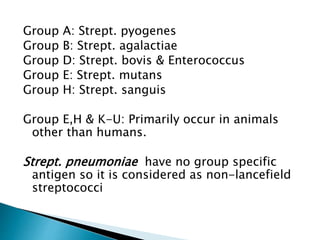
Group A: Strept. pyogenes
Group B: Strept. agalactiae
Group D: Strept. bovis & Enterococcus
Group E: Strept. mutans
Group H: Strept. sanguis
Group E,H & K-U: Primarily occur in animals
other than humans.
Strept. pneumoniae have no group specific
antigen so it is considered as non-lancefield
streptococci
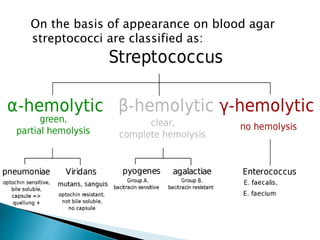
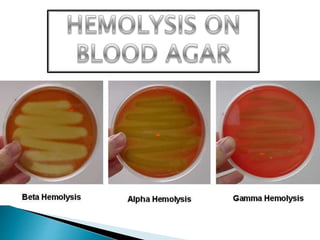
On the basis of appearance on blood agar
streptococci are classified as:
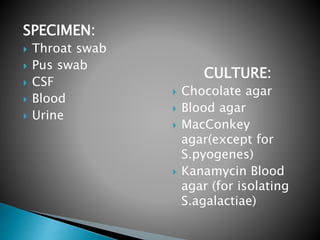
SPECIMEN:
 Throat swab
 Pus swab
 CSF
 Blood
 Urine
CULTURE:
 Chocolate agar
 Blood agar
 MacConkey
agar(except for
S.pyogenes)
 Kanamycin Blood
agar (for isolating
S.agalactiae)
 Lancefield group A
 ß hemolytic
 Cause tonsillitis, pharyngitis, otitis media,
cellulitis, impetigo, septicaemia, scarlet fever,
occasionally toxic shock syndrome.
Post –Streptococcal Infections:
Occur 1-4 weeks following group A streptococcal
infection.
Sequelae:
 Skin infection Glomerulonephritis
 Throat infection Rheumatic fever
 Blood agar: small(0.5-1mm) colourless, dry,
shiny or mucoid ß haemolytic colonies
 Crystal violet Blood agar
 MacCkonkey agar: doesn’t grow on it
BIOCHEMICAL TESTS
 Catalase negative
 PYR positive
 Bacitracin: Sensitive
 Benzylpencillin: Always sensitive
 Lancefield group B
 non-motile
 usually capsulated strains
 Causes septic abortion, gynaecological
sepsis, UTI, neonatal septicaemia and
meningitis.
 NORMAL FLORA: Female genital tract
 Sample: CSF, ear swab, blood for culture, HVS
in women
Culture:
 Blood agar: grey mucoid colonies of 2mm
ß hemolysis.
 MacCkonkey agar: most strains grow on this
medium
 Kanamycin blood agar: for isolating S.agalactiae
from urogenital specimens
Biochemical tests:
 Catalase negative
 CAMP test: Positive
 Hippurate Hydrolysis test: Positive
Antimicrobial Sensitive: Penicillin & Erythromycin
 Part of upper respiratory flora
 Leading cause of pneumonia at extreme ages
 Bronchitis, Meningitis, sinusitis, otitis media
 Systemic infections: bacteraemia &
endocarditis
 Non-motile & capsulated
 Fastidious organism Autolytic colonies
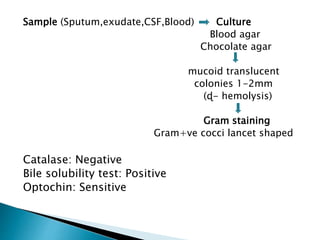
Sample (Sputum,exudate,CSF,Blood) Culture
Blood agar
Chocolate agar
mucoid translucent
colonies 1-2mm
(ɖ- hemolysis)
Gram staining
Gram+ve cocci lancet shaped
Catalase: Negative
Bile solubility test: Positive
Optochin: Sensitive
 Gram positive cocci
 Occur in short pairs or chains
 Non-capsulated & non-motile
 Enterococci possess Lancefield group D
antigen
 Cause infections in urinary tract, biliary tract,
ulcers, wounds (95% E.faecalis)
 NORMAL COMMENSAL: Vagina & Intestinal tract
Aerobic grows at wide temperature range10-45 ºC
 Blood agar: Mainly non-haemolytic (some ɖ/ß)
 MacCkonkey agar: Small dark red magenta colonies
ferments lactose
 CLED agar: small yellow colonies
BIOCHEMICAL TESTS
Catalase Negative
 Ferments Lactose
 Reduce litmus milk
 Hydrolyze aesculin producing Black colonies
 grow in presense of 6.5% NaCl & 40% Bile
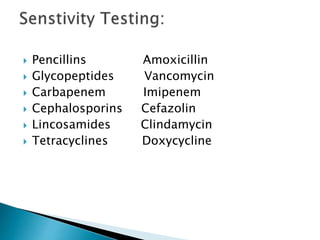
 Pencillins Amoxicillin
 Glycopeptides Vancomycin
 Carbapenem Imipenem
 Cephalosporins Cefazolin
 Lincosamides Clindamycin
 Tetracyclines Doxycycline

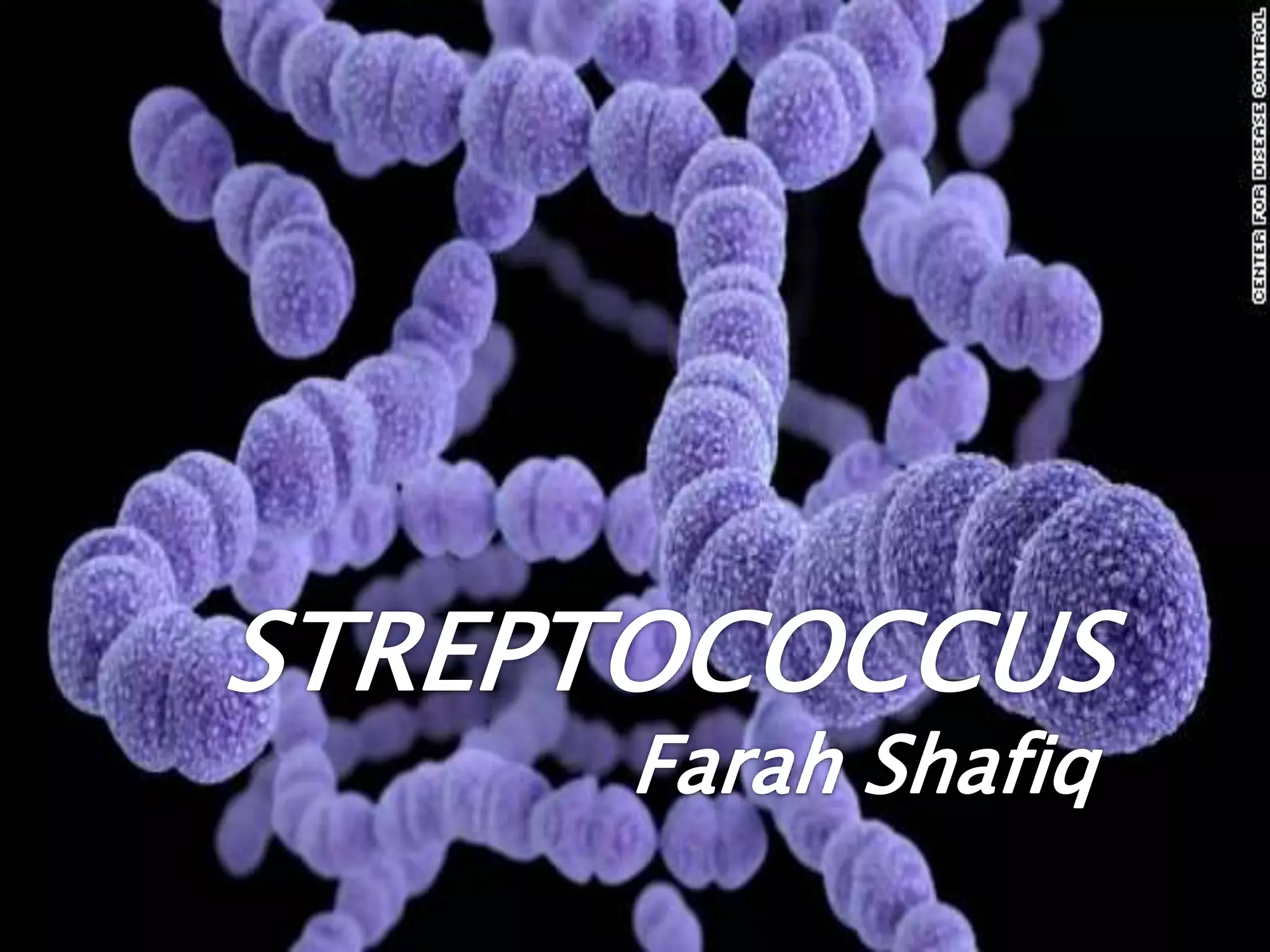
Streptococci

  • 2.
    Streptococci are classifiedon the basis of  Colony morphology  Hemolysis  Biochemical Reactions And most definitively by:  Serologic specificity
  • 3.
     Spherical grampositive cocci  Seen in chains & pairs  Individually round-ovoid cocci  0.6-1.0µm in diameter  Facultative anaerobes  Non-motile  Non-spore forming  Catalase negative (2H2O2 ---> O2 + 2H2O) ◦ Separation of streptococci from staphylococci
  • 4.
    Lancefield grouping Created byRebecca Lancefield for Serological diagnosis. It is method of grouping bacteria based on carbohydrate composition of bacterial antigens found on their cell walls. CHO antigen gives precipitin reaction and forms basis of this serologic grouping 26 groups: A-H & K-U
  • 5.
    Group A: Strept.pyogenes Group B: Strept. agalactiae Group D: Strept. bovis & Enterococcus Group E: Strept. mutans Group H: Strept. sanguis Group E,H & K-U: Primarily occur in animals other than humans. Strept. pneumoniae have no group specific antigen so it is considered as non-lancefield streptococci
  • 6.
    On the basisof appearance on blood agar streptococci are classified as:
  • 8.
    SPECIMEN:  Throat swab Pus swab  CSF  Blood  Urine CULTURE:  Chocolate agar  Blood agar  MacConkey agar(except for S.pyogenes)  Kanamycin Blood agar (for isolating S.agalactiae)
  • 9.
     Lancefield groupA  ß hemolytic  Cause tonsillitis, pharyngitis, otitis media, cellulitis, impetigo, septicaemia, scarlet fever, occasionally toxic shock syndrome. Post –Streptococcal Infections: Occur 1-4 weeks following group A streptococcal infection. Sequelae:  Skin infection Glomerulonephritis  Throat infection Rheumatic fever
  • 10.
     Blood agar:small(0.5-1mm) colourless, dry, shiny or mucoid ß haemolytic colonies  Crystal violet Blood agar  MacCkonkey agar: doesn’t grow on it BIOCHEMICAL TESTS  Catalase negative  PYR positive  Bacitracin: Sensitive  Benzylpencillin: Always sensitive
  • 11.
     Lancefield groupB  non-motile  usually capsulated strains  Causes septic abortion, gynaecological sepsis, UTI, neonatal septicaemia and meningitis.  NORMAL FLORA: Female genital tract  Sample: CSF, ear swab, blood for culture, HVS in women
  • 12.
    Culture:  Blood agar:grey mucoid colonies of 2mm ß hemolysis.  MacCkonkey agar: most strains grow on this medium  Kanamycin blood agar: for isolating S.agalactiae from urogenital specimens Biochemical tests:  Catalase negative  CAMP test: Positive  Hippurate Hydrolysis test: Positive Antimicrobial Sensitive: Penicillin & Erythromycin
  • 13.
     Part ofupper respiratory flora  Leading cause of pneumonia at extreme ages  Bronchitis, Meningitis, sinusitis, otitis media  Systemic infections: bacteraemia & endocarditis  Non-motile & capsulated  Fastidious organism Autolytic colonies
  • 14.
    Sample (Sputum,exudate,CSF,Blood) Culture Bloodagar Chocolate agar mucoid translucent colonies 1-2mm (ɖ- hemolysis) Gram staining Gram+ve cocci lancet shaped Catalase: Negative Bile solubility test: Positive Optochin: Sensitive
  • 15.
     Gram positivecocci  Occur in short pairs or chains  Non-capsulated & non-motile  Enterococci possess Lancefield group D antigen  Cause infections in urinary tract, biliary tract, ulcers, wounds (95% E.faecalis)  NORMAL COMMENSAL: Vagina & Intestinal tract
  • 16.
    Aerobic grows atwide temperature range10-45 ºC  Blood agar: Mainly non-haemolytic (some ɖ/ß)  MacCkonkey agar: Small dark red magenta colonies ferments lactose  CLED agar: small yellow colonies BIOCHEMICAL TESTS Catalase Negative  Ferments Lactose  Reduce litmus milk  Hydrolyze aesculin producing Black colonies  grow in presense of 6.5% NaCl & 40% Bile
  • 17.
     Pencillins Amoxicillin Glycopeptides Vancomycin  Carbapenem Imipenem  Cephalosporins Cefazolin  Lincosamides Clindamycin  Tetracyclines Doxycycline