IMMUNITY 
DR NILESH KATE 
MBBS,MD.
Objective 
 At the end of the class you shoud know 
 Architecture of immune system 
 Immunity 
 Antigens 
 Antibodies 
 Immune response development 
 Other immune mechanims
Defense Mechanism
Introduction 
 Definition 
 Types 
 Antigens 
 Antibodies 
 Immune system 
Immune response 
Immunomodulation 
Immunoenhancement 
Immunosuppression 
Immunotolerance. 
Autoimmunity 
Hypersensitivity
Architecture of immune system 
 Mononuclear Phagocytic system 
 Lymphoid components
Mononuclear Phagocytic system 
Formation 
Constituent 
cells 
Functions 
Tuesday, December 9, 2014
Lymphoid 
Components 
Primary lymphoid tissue 
 Thymus 
 Role 
 Effects of 
thymectomy. 
 Bursa equivalent
Peripheral 
lymphoid organs 
 lymph nodes 
 structure 
 function 
 spleen 
 structure 
 Function 
 MALT (Mucosa 
Associated 
Lymphoid Tissue)
Review 
Tuesday, December 9, 2014
IMMUNITY
Phagocytosis 
Tuesday, December 9, 2014
Antigen 
 Definition 
 Hapten 
 Immunogenicity 
 Antigen specificity 
 Species specificity 
 Isospecificity
Histocompatability Antigens 
 Major Histocompatability complex 
(Chromosome 6-short arm) HLA Ag 
 MHC Class I 
 MHC Class II 
 MHC Class III
CELL MEDIATED IMMUNITY 
 Role of cellular immunity 
 Intracellular bacteria– M.tuberculosis, M.leprae 
 Viruses 
 fungi 
 Allograft rejection & graft versus host 
reaction 
 Delayed hypersensitivity & autoimmune
Types of immune response 
 Primary 
 Secondary
Stages 
 Antigen processing and presentation
Recognition of antigen 
by lymphocytes 
Tuesday, December 9, 2014
T-lymphocytes differentiation 
(activation) 
CD8 types 
CD4 types 
TT co-operation 
Memory cells 
Tuesday, December 9, 2014
Attack phase 
 Role of cytotoxic T-cell 
 Lysis through cytotoxic 
substances 
 Induction of Apoptois 
 Perforin mediated killing
Helper T Cell
Memory cells 
Tuesday, December 9, 2014
Humoral mediated immunity 
 Role of humoral immunity 
 Extracellular bacterial pathogens. 
 Immediate hypersensitivity 
 Autoimmune diseases.
Types of immune response 
 Primary 
 Secondary
Stages 
 Antigen processing and 
presentation 
 Recognition of antigens by 
lymphocytes 
 Lymphocyte activation 
 Activation of T-lymphocytes. 
 Activation of B-lymphocytes. 
 Role of plasma cells 
 Role of memory cells
Review 
Tuesday, December 9, 2014
 Production of 
antibodies 
 Theories of antibody 
production 
 Clonal selection theory 
(Burne 1957) 
 Inactivation or attack 
phase 
 Direct attack 
 Complement system
Direct attack
Complement system 
 Classical pathway. 
 L 
 A 
 N 
 A 
 C 
 O 
 Alternate pathway.
Complement system 
Tuesday, December 9, 2014
Complement system 
Tuesday, December 9, 2014
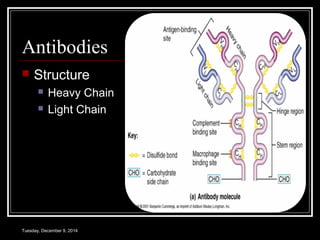
Antibodies 
 Structure 
 Heavy Chain 
 Light Chain 
Tuesday, December 9, 2014
Types 
 Immunoglobulins (Ig) 
 Ig G 
 Ig A 
 Ig M 
 Ig D 
 Ig E 
Tuesday, December 9, 2014
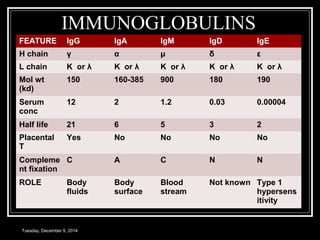
IMMUNOGLOBULINS 
FEATURE IgG IgA IgM IgD IgE 
H chain γ α μ δ ε 
L chain Κ or λ Κ or λ Κ or λ Κ or λ Κ or λ 
Mol wt 
150 160-385 900 180 190 
(kd) 
Serum 
conc 
12 2 1.2 0.03 0.00004 
Half life 21 6 5 3 2 
Placental 
T 
Yes No No No No 
Compleme 
nt fixation 
C A C N N 
ROLE Body 
fluids 
Body 
surface 
Blood 
stream 
Not known Type 1 
hypersens 
itivity 
Tuesday, December 9, 2014
Tuesday, December 9, 2014 
THANK YOU
Tuesday, December 9, 2014

Immune system

Editor's Notes

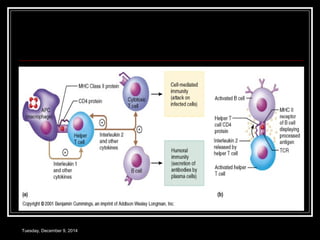
  • #21 The role of the helper T cells in both cellular and humoral immunity is illustrated on this slide. *The antigen-presenting cell will release interleukin I to stimulate the helper T cells. The helper T cell in turn will stimulate cytotoxic T cells and B cells. *It does this with interleukin II. The activated cytotoxic T cells provide cellular immunity. Cellular immunity is confirmed by cytotoxic T cells attacking infected or diseased body cells to destroy them. Humoral immunity is confirmed by antibodies that react with foreign invaders in ways that will be discussed later in this presentation.