DR NILESH KATE
MBBS,MD
PROFESSOR
ESIC MEDICAL COLLEGE, GULBARGA.
DEPT. OF PHYSIOLOGY
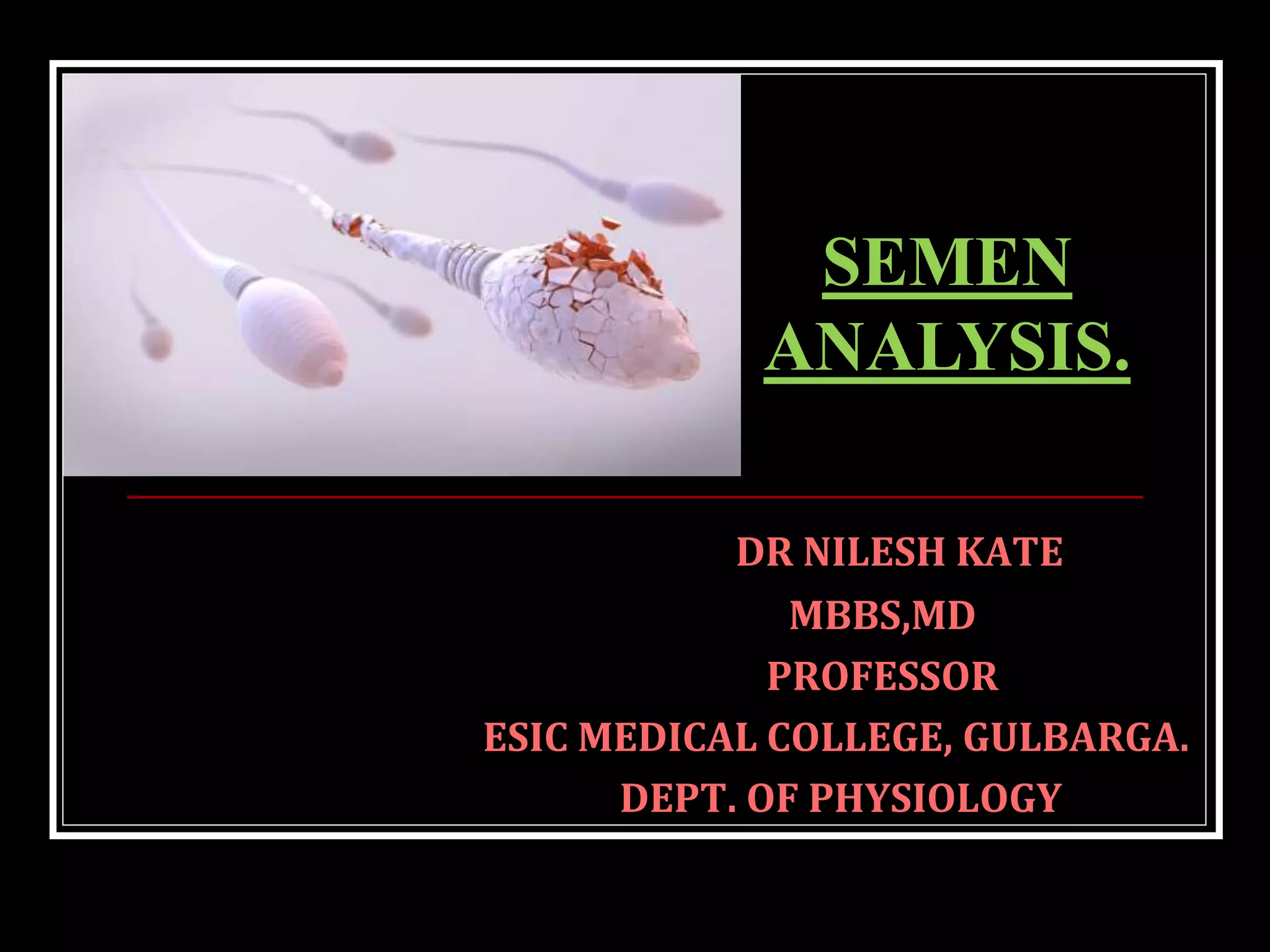
SEMEN
ANALYSIS.
OBJECTIVES
 Importance of semen analysis in clinical
practice
 Indications
 Composition of normal semen
 Morphology & motility of sperm
 Applied .
Friday, June 19, 2020
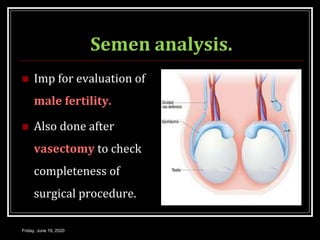
Semen analysis.
 Imp for evaluation of
male fertility.
 Also done after
vasectomy to check
completeness of
surgical procedure.
Friday, June 19, 2020
Semen – features.
 Volume – 2-5 ml per ejaculation.
 Motility - > 60% should be motile within 3
hrs.
 Count – 35-200 millions /ml
 Liquefaction – Liquify within 30 min.
Friday, June 19, 2020
Semen – features.
 pH – 7.2-7.7
 Fructose – normally present.
 Specific gravity – 1.028
Friday, June 19, 2020
Principle
 Analysis of freshly collected sample of semen
gives information about male fertility, which
is detected by examining the sample under
the microscope.
Friday, June 19, 2020
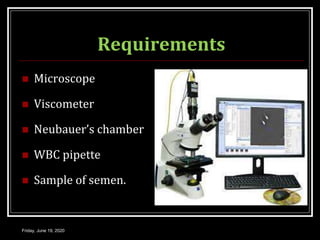
Requirements
 Microscope
 Viscometer
 Neubauer’s chamber
 WBC pipette
 Sample of semen.
Friday, June 19, 2020
Procedure
 After a period of sexual abstinence of 2 days.
 Sample is collected.
 Semen analysis done after 30 min.
Friday, June 19, 2020
Why after 30 min.
 Immediately after collection semen
coagulates & liquifies after 15-20 min.
 Semen contains fibrinogen which gets
converted to fibrin & coagulates the sample.
Friday, June 19, 2020
Measurement of other
parameters
 Measure the volume.
 Examine motility & morphology under low
power then high power.
Friday, June 19, 2020
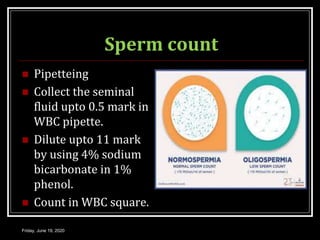
Sperm count
 Pipetteing
 Collect the seminal
fluid upto 0.5 mark in
WBC pipette.
 Dilute upto 11 mark
by using 4% sodium
bicarbonate in 1%
phenol.
 Count in WBC square.
Friday, June 19, 2020
Precautions
 Sample collection should be after 48 hrs of
abstinence.
 Sample should be analysed 30 min after
collection.
 Analysis should be done within 6 hrs of
collection.
Friday, June 19, 2020
Observations
 Volume
 Appearance
 Motility
 Count
 Liquefaction
 Morphology
 pH
 Fructose content.
Friday, June 19, 2020
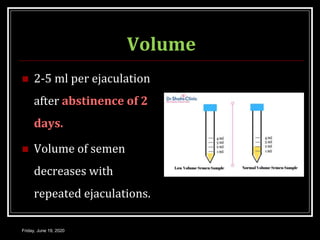
Volume
 2-5 ml per ejaculation
after abstinence of 2
days.
 Volume of semen
decreases with
repeated ejaculations.
Friday, June 19, 2020
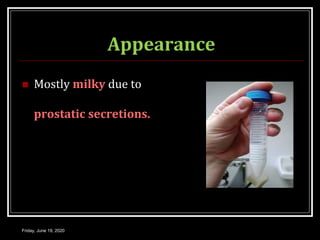
Appearance
 Mostly milky due to
prostatic secretions.
Friday, June 19, 2020
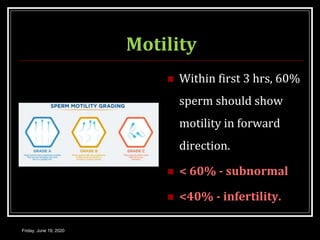
Motility
 Within first 3 hrs, 60%
sperm should show
motility in forward
direction.
 < 60% - subnormal
 <40% - infertility.
Friday, June 19, 2020
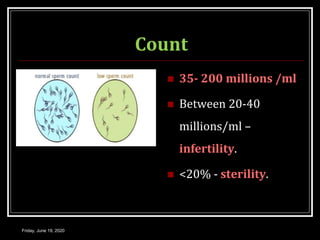
Count
 35- 200 millions /ml
 Between 20-40
millions/ml –
infertility.
 <20% - sterility.
Friday, June 19, 2020
Liquefaction
 Liquify within 30 min.
 Cause – Plasmin in prostatic fluid.
 Delayed for more than 2 hrs –
inflammation of accessory glands or enzyme
defect in secretory products of glands
Friday, June 19, 2020
Liquefaction.
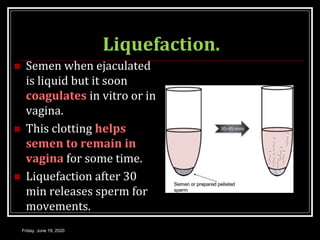
 Semen when ejaculated
is liquid but it soon
coagulates in vitro or in
vagina.
 This clotting helps
semen to remain in
vagina for some time.
 Liquefaction after 30
min releases sperm for
movements.
Friday, June 19, 2020
Morphology.
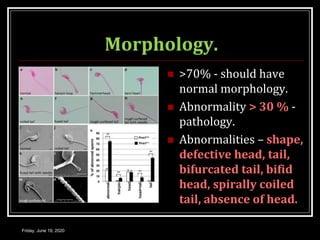
 >70% - should have
normal morphology.
 Abnormality > 30 % -
pathology.
 Abnormalities – shape,
defective head, tail,
bifurcated tail, bifid
head, spirally coiled
tail, absence of head.
Friday, June 19, 2020
pH
 Normal - 7.2-7.7
 The alkalinity is due to the prostatic secretions.
 Below 7 – semen contains prostatic fluid which
may be due to congenital absence of seminal
vesicle or excessive prostatic fluid.
Friday, June 19, 2020
Significance of alkaline pH.
 The alkaline semen brings the vaginal pH
from 3.5–4 to 6–6.5, the pH at which sperms
show optimum motility.
Friday, June 19, 2020
Fructose content.
 Normally present.
 Absent in –
 Absence or obstruction of ejaculatory ducts or
seminal vesicle.
Friday, June 19, 2020
Secretions of seminal vesicles
 The secretion from seminal vesicles is mucoid
and viscous fluid.
 It is neutral or slightly alkaline in nature.
 It contains fructose, phosphorylcholine,
ergothioneine, ascorbic acid, flavins and
prostaglandins.
Friday, June 19, 2020
Functions
 Nutrition to sperms
 Clotting of semen soon after ejaculation into
the female genital tract occurs due to
fibrinogen
 Fertilization of ovum may be enhanced by
the prostaglandins
Friday, June 19, 2020
Secretion of prostate gland
 Forms 10% of total semen.
 Functions –
 Maintenance of optimum pH for fertilization
(6–6.5)
 Clotting of semen by converting fibrinogen
(from seminal vesicles) into a coagulum is
caused by the clotting enzymes present in
the prostatic fluid.
Friday, June 19, 2020
Secretion of bulbourethral gland.
 Provide mucoid consistency to the semen
after puberty.
Friday, June 19, 2020
THANK YOU

Semen analysis

  • 1.
    DR NILESH KATE MBBS,MD PROFESSOR ESICMEDICAL COLLEGE, GULBARGA. DEPT. OF PHYSIOLOGY SEMEN ANALYSIS.
  • 2.
    OBJECTIVES  Importance ofsemen analysis in clinical practice  Indications  Composition of normal semen  Morphology & motility of sperm  Applied . Friday, June 19, 2020
  • 3.
    Semen analysis.  Impfor evaluation of male fertility.  Also done after vasectomy to check completeness of surgical procedure. Friday, June 19, 2020
  • 4.
    Semen – features. Volume – 2-5 ml per ejaculation.  Motility - > 60% should be motile within 3 hrs.  Count – 35-200 millions /ml  Liquefaction – Liquify within 30 min. Friday, June 19, 2020
  • 5.
    Semen – features. pH – 7.2-7.7  Fructose – normally present.  Specific gravity – 1.028 Friday, June 19, 2020
  • 6.
    Principle  Analysis offreshly collected sample of semen gives information about male fertility, which is detected by examining the sample under the microscope. Friday, June 19, 2020
  • 7.
    Requirements  Microscope  Viscometer Neubauer’s chamber  WBC pipette  Sample of semen. Friday, June 19, 2020
  • 8.
    Procedure  After aperiod of sexual abstinence of 2 days.  Sample is collected.  Semen analysis done after 30 min. Friday, June 19, 2020
  • 9.
    Why after 30min.  Immediately after collection semen coagulates & liquifies after 15-20 min.  Semen contains fibrinogen which gets converted to fibrin & coagulates the sample. Friday, June 19, 2020
  • 10.
    Measurement of other parameters Measure the volume.  Examine motility & morphology under low power then high power. Friday, June 19, 2020
  • 11.
    Sperm count  Pipetteing Collect the seminal fluid upto 0.5 mark in WBC pipette.  Dilute upto 11 mark by using 4% sodium bicarbonate in 1% phenol.  Count in WBC square. Friday, June 19, 2020
  • 12.
    Precautions  Sample collectionshould be after 48 hrs of abstinence.  Sample should be analysed 30 min after collection.  Analysis should be done within 6 hrs of collection. Friday, June 19, 2020
  • 13.
    Observations  Volume  Appearance Motility  Count  Liquefaction  Morphology  pH  Fructose content. Friday, June 19, 2020
  • 14.
    Volume  2-5 mlper ejaculation after abstinence of 2 days.  Volume of semen decreases with repeated ejaculations. Friday, June 19, 2020
  • 15.
    Appearance  Mostly milkydue to prostatic secretions. Friday, June 19, 2020
  • 16.
    Motility  Within first3 hrs, 60% sperm should show motility in forward direction.  < 60% - subnormal  <40% - infertility. Friday, June 19, 2020
  • 17.
    Count  35- 200millions /ml  Between 20-40 millions/ml – infertility.  <20% - sterility. Friday, June 19, 2020
  • 18.
    Liquefaction  Liquify within30 min.  Cause – Plasmin in prostatic fluid.  Delayed for more than 2 hrs – inflammation of accessory glands or enzyme defect in secretory products of glands Friday, June 19, 2020
  • 19.
    Liquefaction.  Semen whenejaculated is liquid but it soon coagulates in vitro or in vagina.  This clotting helps semen to remain in vagina for some time.  Liquefaction after 30 min releases sperm for movements. Friday, June 19, 2020
  • 20.
    Morphology.  >70% -should have normal morphology.  Abnormality > 30 % - pathology.  Abnormalities – shape, defective head, tail, bifurcated tail, bifid head, spirally coiled tail, absence of head. Friday, June 19, 2020
  • 21.
    pH  Normal -7.2-7.7  The alkalinity is due to the prostatic secretions.  Below 7 – semen contains prostatic fluid which may be due to congenital absence of seminal vesicle or excessive prostatic fluid. Friday, June 19, 2020
  • 22.
    Significance of alkalinepH.  The alkaline semen brings the vaginal pH from 3.5–4 to 6–6.5, the pH at which sperms show optimum motility. Friday, June 19, 2020
  • 23.
    Fructose content.  Normallypresent.  Absent in –  Absence or obstruction of ejaculatory ducts or seminal vesicle. Friday, June 19, 2020
  • 24.
    Secretions of seminalvesicles  The secretion from seminal vesicles is mucoid and viscous fluid.  It is neutral or slightly alkaline in nature.  It contains fructose, phosphorylcholine, ergothioneine, ascorbic acid, flavins and prostaglandins. Friday, June 19, 2020
  • 25.
    Functions  Nutrition tosperms  Clotting of semen soon after ejaculation into the female genital tract occurs due to fibrinogen  Fertilization of ovum may be enhanced by the prostaglandins Friday, June 19, 2020
  • 26.
    Secretion of prostategland  Forms 10% of total semen.  Functions –  Maintenance of optimum pH for fertilization (6–6.5)  Clotting of semen by converting fibrinogen (from seminal vesicles) into a coagulum is caused by the clotting enzymes present in the prostatic fluid. Friday, June 19, 2020
  • 27.
    Secretion of bulbourethralgland.  Provide mucoid consistency to the semen after puberty. Friday, June 19, 2020
  • 28.