Saddam Ansari
Tbilisi State Medical University
Immunology
What is immunology?
Immune (Latin- “immunus”)
To be free
People survived calamity of epidemic diseases when
faced with the same disease again
The study of physiological mechanisms that humans and
other animals use to defend their bodies from invading
organisms
Bacteria - Viruses
Fungi - Parasites - Toxins
Immunology Buzzword
Antigen
Any molecule that binds to immunoglobulin or T
cell receptor
Pathogen
Microorganism that can cause disease
Antibody (Ab)
Secreted immunoglobulin
Continued…
Immunoglobulin (Ig)
Antigen binding molecules of B cells
Vaccination
Deliberate induction of protective immunity
to a pathogen
Immunization
The ability to resist infection
Types of Immunity
Innate Immunity
 Host defense mechanisms that act from the
start of an infection but do not adapt to a
particular pathogen
Adaptive Immunity
Response of an antigen specific B and T
lymphocytes to an antigen
Immunological memory
Types of Immunity
Humoral immunity
Immunity that is mediated by antibodies
Can be transferred by to a non-immune
recipient by serum
Cell Mediated Immunity
Immune response in which antigen specific T
cells dominate
Immunology cell histology
Polymorphonuclear
Lobed nucleus
Mononuclear
Non-lobed nucleus
Granulocyte
Many granules seen in cytoplasm
Continued…
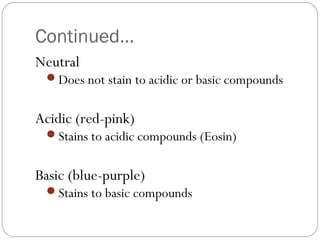
Neutral
Does not stain to acidic or basic compounds
Acidic (red-pink)
Stains to acidic compounds (Eosin)
Basic (blue-purple)
Stains to basic compounds
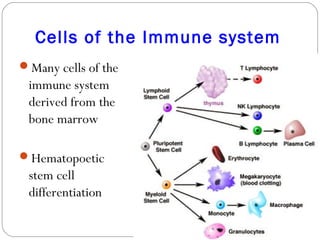
Cells of the Immune system
Many cells of the
immune system
derived from the
bone marrow
Hematopoetic
stem cell
differentiation
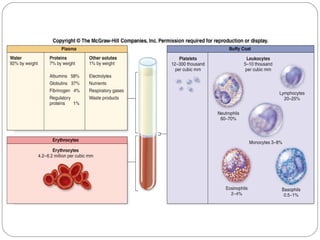
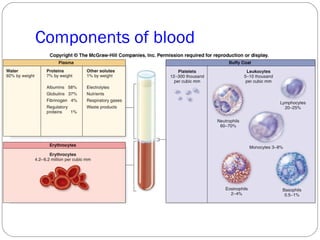
Components of blood
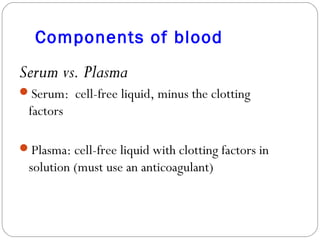
Serum vs. Plasma
Serum: cell-free liquid, minus the clotting
factors
Plasma: cell-free liquid with clotting factors in
solution (must use an anticoagulant)
Components of blood
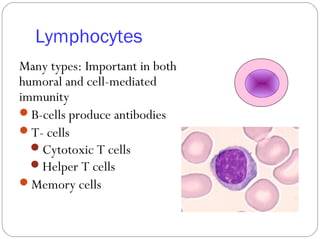
Lymphocytes
Many types: Important in both
humoral and cell-mediated
immunity
B-cells produce antibodies
T- cells
Cytotoxic T cells
Helper T cells
Memory cells
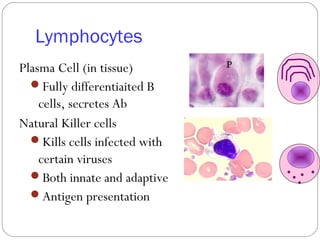
Lymphocytes
Plasma Cell (in tissue)
Fully differentiaited B
cells, secretes Ab
Natural Killer cells
Kills cells infected with
certain viruses
Both innate and adaptive
Antigen presentation
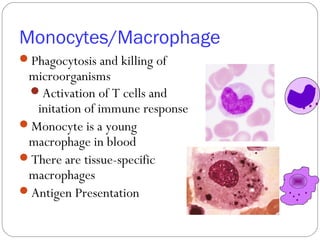
Monocytes/Macrophage
Phagocytosis and killing of
microorganisms
Activation of T cells and
initation of immune response
Monocyte is a young
macrophage in blood
There are tissue-specific
macrophages
Antigen Presentation
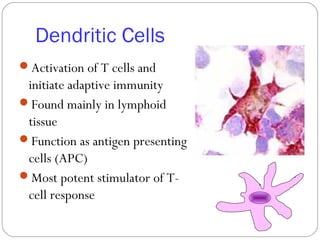
Dendritic Cells
Activation of T cells and
initiate adaptive immunity
Found mainly in lymphoid
tissue
Function as antigen presenting
cells (APC)
Most potent stimulator of T-
cell response
Mast Cells
Expulsion of parasites through
release of granules
Histamine, leukotrienes,
chemokines, cytokines
Also involved in allergic responses
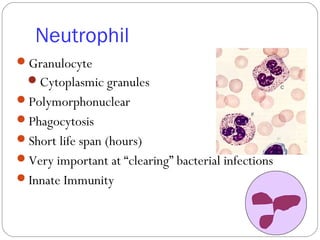
Neutrophil
Granulocyte
Cytoplasmic granules
Polymorphonuclear
Phagocytosis
Short life span (hours)
Very important at “clearing” bacterial infections
Innate Immunity
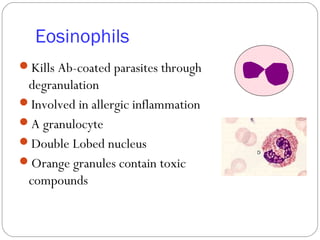
Eosinophils
Kills Ab-coated parasites through
degranulation
Involved in allergic inflammation
A granulocyte
Double Lobed nucleus
Orange granules contain toxic
compounds
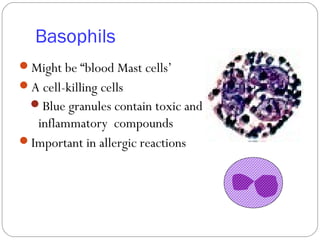
Basophils
Might be “blood Mast cells’
A cell-killing cells
Blue granules contain toxic and
inflammatory compounds
Important in allergic reactions
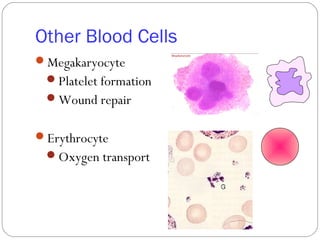
Other Blood Cells
Megakaryocyte
Platelet formation
Wound repair
Erythrocyte
Oxygen transport
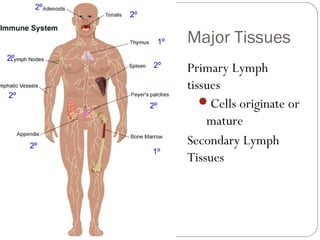
Major Tissues
Primary Lymph
tissues
Cells originate or
mature
Secondary Lymph
Tissues
2º
2º
1º
1º
2º
2º
2º
2º
2º
Introduction to immunology

Introduction to immunology