 When blood from two individuals is mixed,
sometimes
clumping (agglutination) of RBCs occurs.
This clumping is because of the
immunological reactions.
 Why clumping occurs in some cases and not
in other cases remained a mystery until the
discovery of blood groups by the Austrian
Scientist Karl Landsteiner, in 1901.
 Determination of ABO blood groups depends upon
the immunological reaction between antigen and
antibody.
 Landsteiner found two antigens on the surface of
RBCs and named them as A antigen and B antigen.
 These antigens are also called agglutinogens
because of their capacity to cause agglutination of
RBCs. He noticed the corresponding antibodies or
agglutinins in the plasma and named them anti-A
or α-antibody and anti-B or β-antibody.
 However, a particular agglutinogen and the
corresponding agglutinin cannot be present
together. If present, it causes clumping of the
blood.
 Based on this, Karl Landsteiner classified the
blood groups.
 Landsteiner law states that:
 1. If a particular agglutinogen (antigen) is
present in the RBCs, corresponding
agglutinin (antibody) must be absent in the
serum.
 2. If a particular agglutinogen is absent in
the RBCs, the corresponding agglutinin must
be present in the serum.
 Though the second part of Landsteiner law is
a fact, it is not applicable to Rh factor.
 „BLOOD GROUP SYSTEMS
 More than 20 genetically determined blood group
systems are known today. But, Landsteiner discovered
two blood group systems called the ABO system and the
Rh system.
 These two blood group systems are the most important
ones that are determined before blood
 ABO SYSTEM
 Based on the presence or absence of antigen A and
antigen B, blood is divided into four groups:
 1. ‘A’ group
 2. ‘B’ group
 3. ‘AB’ group
 4. ‘O’ group.
 Blood having antigen A belongs to ‘A’ group. This
blood has β-antibody in the serum.
 Blood with antigen B and α-antibody belongs to ‘B’
group.
 If both the antigens are present, blood group is
called ‘AB’ group and serum of this group does not
contain any antibody.
 If both antigens are absent, the blood group is
called ‘O’ group and both α and β antibodies are
present in the serum.
 ‘A’ group has two subgroups namely ‘A1’ and ‘A2’.
 Similarly ‘AB’ group has two subgroups namely
‘A1B’ and ‘A2B’.
 Determination of the ABO group is also called blood
grouping, blood typing or blood matching.
 Principle of Blood Typing – Agglutination
Blood typing is done on the basis of agglutination.
 Agglutination means the collection of separate
particles like RBCs into clumps or masses
Agglutination occurs if an antigen is mixed with its
corresponding antibody which is called
isoagglutinin.
 Agglutination occurs whenA antigen is mixed with
anti-A or when B antigen is mixed with anti-B.
 To determine the blood group of a person, a
suspension of his RBC and testing antisera
are required.
 Suspension of RBC is prepared by mixing
blood drops with isotonic saline (0.9%).
Test sera are:
 1. Antiserum A, containing anti-A or α-
antibody.
 2. Antiserum B, containing anti-B or β-
antibody
 Procedure
1. One drop of antiserum A is placed on one end of a
glass slide (or a tile) and one drop of antiserum B
on the other end.
2. One drop of RBC suspension is mixed with each
antiserum. The slide is slightly rocked for 2
minutes. The presence or absence of agglutination
is observed by naked eyes and if necessary, it is
confirmed by using microscope.
3. Presence of agglutination is confirmed by the
presence of thick masses (clumping) of RBCs
4. Absence of agglutination is confirmed by clear
mixture with dispersed RBCs
 Results
1. If agglutination occurs with antiserum A: The
antiserum A contains α-antibody. The agglutination
occurs if the RBC contains A antigen. So, the blood
group is A .
2. If agglutination occurs with antiserum B: The
antiserum B contains β-antibody. The agglutination
occurs if the RBC contains B antigen. So, the blood
group is B.
3. If agglutination occurs with both antisera A and B: The
RBC contains both A and B antigens to cause
agglutination. And, the blood group is AB.
4. If agglutination does not occur either with antiserum A
or antiserum B: The agglutination does not occur
because RBC does not contain any antigen. The blood
group is O.
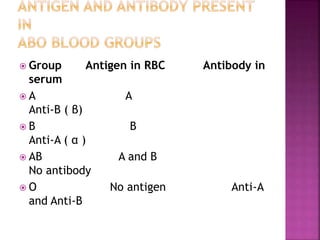
 Group Antigen in RBC Antibody in
serum
 A A
Anti-B ( β)
 B B
Anti-A ( α )
 AB A and B
No antibody
 O No antigen Anti-A
and Anti-B
 During blood transfusion, only compatible blood must be used. The
one who gives blood is called the ‘donor’ and the one who receives
the blood is called ‘recipient’.
 While transfusing the blood, antigen of the donor and the antibody
of the recipient are considered. The antibody of the donor and
antigen of the recipient are ignored mostly.
 Thus, RBC of ‘O’ group has no antigen and so agglutination does not
occur with any other group of blood. So, ‘O’ group blood can be
given to any blood group persons and the people with this blood
group are called ‘universal donors’.
 Plasma of AB group blood has no antibody. This does not cause
agglutination of RBC from any other group of blood. People with AB
group can receive blood from any blood group persons. So, people
with this blood group are called ‘universal recipients’.
 „
 Rh FACTOR
 Rh factor is an antigen present in RBC. This antigen was
discovered by Landsteiner and Wiener.
 It was first discovered in Rhesus monkey and hence the
name ‘Rh factor’. There are many Rh antigens but only the D
antigen is more antigenic in human.
 The persons having D antigen are called ‘Rh positive’ and
those without D antigen are called ‘Rh negative’.
 Among Indian population, 85% of people are Rh positive and
15% are Rh negative.
 Percentage of Rh positive people is more among black people.
 Rh group system is different from ABO group system because,
the antigen D does not have corresponding natural antibody
(anti-D). However, if Rh positive blood is transfused to a Rh
negative person anti-D is developed in that person.
 On the other hand, there is no risk of complications if the Rh
positive person receives Rh negative blood.
 HEMOLYTIC DISEASE OF FETUS AND NEWBORN –
ERYTHROBLASTOSIS FETALIS
 Hemolytic disease is the disease in fetus and newborn,
characterized by abnormal hemolysis of RBCs. It is due to Rh
incompatibility, i.e. the difference between the Rh blood
group of the mother and baby.
 Hemolytic disease leads to erythroblastosis fetalis.
 Erythroblastosis fetalis is a disorder in fetus, characterized by
the presence of erythroblasts in blood. When a mother is Rh
negative and fetus is Rh positive (the Rh factor being inherited
from the father), usually the first child escapes the
complications of Rh incompatibility.
 This is because the Rh antigen cannot pass from fetal blood
into the mother’s blood through the placental barrier.
 However, at the time of parturition (delivery of the child), the
Rh antigen from fetal blood may leak into mother’s blood
because of placental detachment.
 During postpartum period, i.e. within a
month after delivery, the mother develops Rh
antibody in her blood.
 When the mother conceives for the second
time and if the fetus happens to be Rh
positive again, the Rh antibody from
mother’s blood crosses placental barrier and
enters the fetal blood.
 Thus, the Rh antigen cannot cross the
placental barrier, whereas Rh antibody can
cross it.
 Rh antibody which enters the fetus causes
agglutination of fetal RBCs resulting in
hemolysis.
 Severe hemolysis in the fetus causes
jaundice.
 To compensate the hemolysis of more and
more number of RBCs, there is rapid
production of RBCs, not only from bone
marrow, but also from spleen and liver.
 Now, many large and immature cells in
proerythroblastic stage are released into
circulation. Because of this, the disease is
called erythroblastosis fetalis.

Blood groups

  • 2.
     When bloodfrom two individuals is mixed, sometimes clumping (agglutination) of RBCs occurs. This clumping is because of the immunological reactions.  Why clumping occurs in some cases and not in other cases remained a mystery until the discovery of blood groups by the Austrian Scientist Karl Landsteiner, in 1901.
  • 3.
     Determination ofABO blood groups depends upon the immunological reaction between antigen and antibody.  Landsteiner found two antigens on the surface of RBCs and named them as A antigen and B antigen.  These antigens are also called agglutinogens because of their capacity to cause agglutination of RBCs. He noticed the corresponding antibodies or agglutinins in the plasma and named them anti-A or α-antibody and anti-B or β-antibody.  However, a particular agglutinogen and the corresponding agglutinin cannot be present together. If present, it causes clumping of the blood.  Based on this, Karl Landsteiner classified the blood groups.
  • 4.
     Landsteiner lawstates that:  1. If a particular agglutinogen (antigen) is present in the RBCs, corresponding agglutinin (antibody) must be absent in the serum.  2. If a particular agglutinogen is absent in the RBCs, the corresponding agglutinin must be present in the serum.  Though the second part of Landsteiner law is a fact, it is not applicable to Rh factor.
  • 5.
     „BLOOD GROUPSYSTEMS  More than 20 genetically determined blood group systems are known today. But, Landsteiner discovered two blood group systems called the ABO system and the Rh system.  These two blood group systems are the most important ones that are determined before blood  ABO SYSTEM  Based on the presence or absence of antigen A and antigen B, blood is divided into four groups:  1. ‘A’ group  2. ‘B’ group  3. ‘AB’ group  4. ‘O’ group.
  • 6.
     Blood havingantigen A belongs to ‘A’ group. This blood has β-antibody in the serum.  Blood with antigen B and α-antibody belongs to ‘B’ group.  If both the antigens are present, blood group is called ‘AB’ group and serum of this group does not contain any antibody.  If both antigens are absent, the blood group is called ‘O’ group and both α and β antibodies are present in the serum.  ‘A’ group has two subgroups namely ‘A1’ and ‘A2’.  Similarly ‘AB’ group has two subgroups namely ‘A1B’ and ‘A2B’.
  • 7.
     Determination ofthe ABO group is also called blood grouping, blood typing or blood matching.  Principle of Blood Typing – Agglutination Blood typing is done on the basis of agglutination.  Agglutination means the collection of separate particles like RBCs into clumps or masses Agglutination occurs if an antigen is mixed with its corresponding antibody which is called isoagglutinin.  Agglutination occurs whenA antigen is mixed with anti-A or when B antigen is mixed with anti-B.
  • 8.
     To determinethe blood group of a person, a suspension of his RBC and testing antisera are required.  Suspension of RBC is prepared by mixing blood drops with isotonic saline (0.9%). Test sera are:  1. Antiserum A, containing anti-A or α- antibody.  2. Antiserum B, containing anti-B or β- antibody
  • 9.
     Procedure 1. Onedrop of antiserum A is placed on one end of a glass slide (or a tile) and one drop of antiserum B on the other end. 2. One drop of RBC suspension is mixed with each antiserum. The slide is slightly rocked for 2 minutes. The presence or absence of agglutination is observed by naked eyes and if necessary, it is confirmed by using microscope. 3. Presence of agglutination is confirmed by the presence of thick masses (clumping) of RBCs 4. Absence of agglutination is confirmed by clear mixture with dispersed RBCs
  • 10.
     Results 1. Ifagglutination occurs with antiserum A: The antiserum A contains α-antibody. The agglutination occurs if the RBC contains A antigen. So, the blood group is A . 2. If agglutination occurs with antiserum B: The antiserum B contains β-antibody. The agglutination occurs if the RBC contains B antigen. So, the blood group is B. 3. If agglutination occurs with both antisera A and B: The RBC contains both A and B antigens to cause agglutination. And, the blood group is AB. 4. If agglutination does not occur either with antiserum A or antiserum B: The agglutination does not occur because RBC does not contain any antigen. The blood group is O.
  • 11.
     Group Antigenin RBC Antibody in serum  A A Anti-B ( β)  B B Anti-A ( α )  AB A and B No antibody  O No antigen Anti-A and Anti-B
  • 13.
     During bloodtransfusion, only compatible blood must be used. The one who gives blood is called the ‘donor’ and the one who receives the blood is called ‘recipient’.  While transfusing the blood, antigen of the donor and the antibody of the recipient are considered. The antibody of the donor and antigen of the recipient are ignored mostly.  Thus, RBC of ‘O’ group has no antigen and so agglutination does not occur with any other group of blood. So, ‘O’ group blood can be given to any blood group persons and the people with this blood group are called ‘universal donors’.  Plasma of AB group blood has no antibody. This does not cause agglutination of RBC from any other group of blood. People with AB group can receive blood from any blood group persons. So, people with this blood group are called ‘universal recipients’.  „
  • 14.
     Rh FACTOR Rh factor is an antigen present in RBC. This antigen was discovered by Landsteiner and Wiener.  It was first discovered in Rhesus monkey and hence the name ‘Rh factor’. There are many Rh antigens but only the D antigen is more antigenic in human.  The persons having D antigen are called ‘Rh positive’ and those without D antigen are called ‘Rh negative’.  Among Indian population, 85% of people are Rh positive and 15% are Rh negative.  Percentage of Rh positive people is more among black people.  Rh group system is different from ABO group system because, the antigen D does not have corresponding natural antibody (anti-D). However, if Rh positive blood is transfused to a Rh negative person anti-D is developed in that person.  On the other hand, there is no risk of complications if the Rh positive person receives Rh negative blood.
  • 15.
     HEMOLYTIC DISEASEOF FETUS AND NEWBORN – ERYTHROBLASTOSIS FETALIS  Hemolytic disease is the disease in fetus and newborn, characterized by abnormal hemolysis of RBCs. It is due to Rh incompatibility, i.e. the difference between the Rh blood group of the mother and baby.  Hemolytic disease leads to erythroblastosis fetalis.  Erythroblastosis fetalis is a disorder in fetus, characterized by the presence of erythroblasts in blood. When a mother is Rh negative and fetus is Rh positive (the Rh factor being inherited from the father), usually the first child escapes the complications of Rh incompatibility.  This is because the Rh antigen cannot pass from fetal blood into the mother’s blood through the placental barrier.  However, at the time of parturition (delivery of the child), the Rh antigen from fetal blood may leak into mother’s blood because of placental detachment.
  • 16.
     During postpartumperiod, i.e. within a month after delivery, the mother develops Rh antibody in her blood.  When the mother conceives for the second time and if the fetus happens to be Rh positive again, the Rh antibody from mother’s blood crosses placental barrier and enters the fetal blood.  Thus, the Rh antigen cannot cross the placental barrier, whereas Rh antibody can cross it.
  • 17.
     Rh antibodywhich enters the fetus causes agglutination of fetal RBCs resulting in hemolysis.  Severe hemolysis in the fetus causes jaundice.  To compensate the hemolysis of more and more number of RBCs, there is rapid production of RBCs, not only from bone marrow, but also from spleen and liver.  Now, many large and immature cells in proerythroblastic stage are released into circulation. Because of this, the disease is called erythroblastosis fetalis.