DR NILESH KATE
MBBS,MD
ASSOCIATE PROF
DEPT. OF PHYSIOLOGY
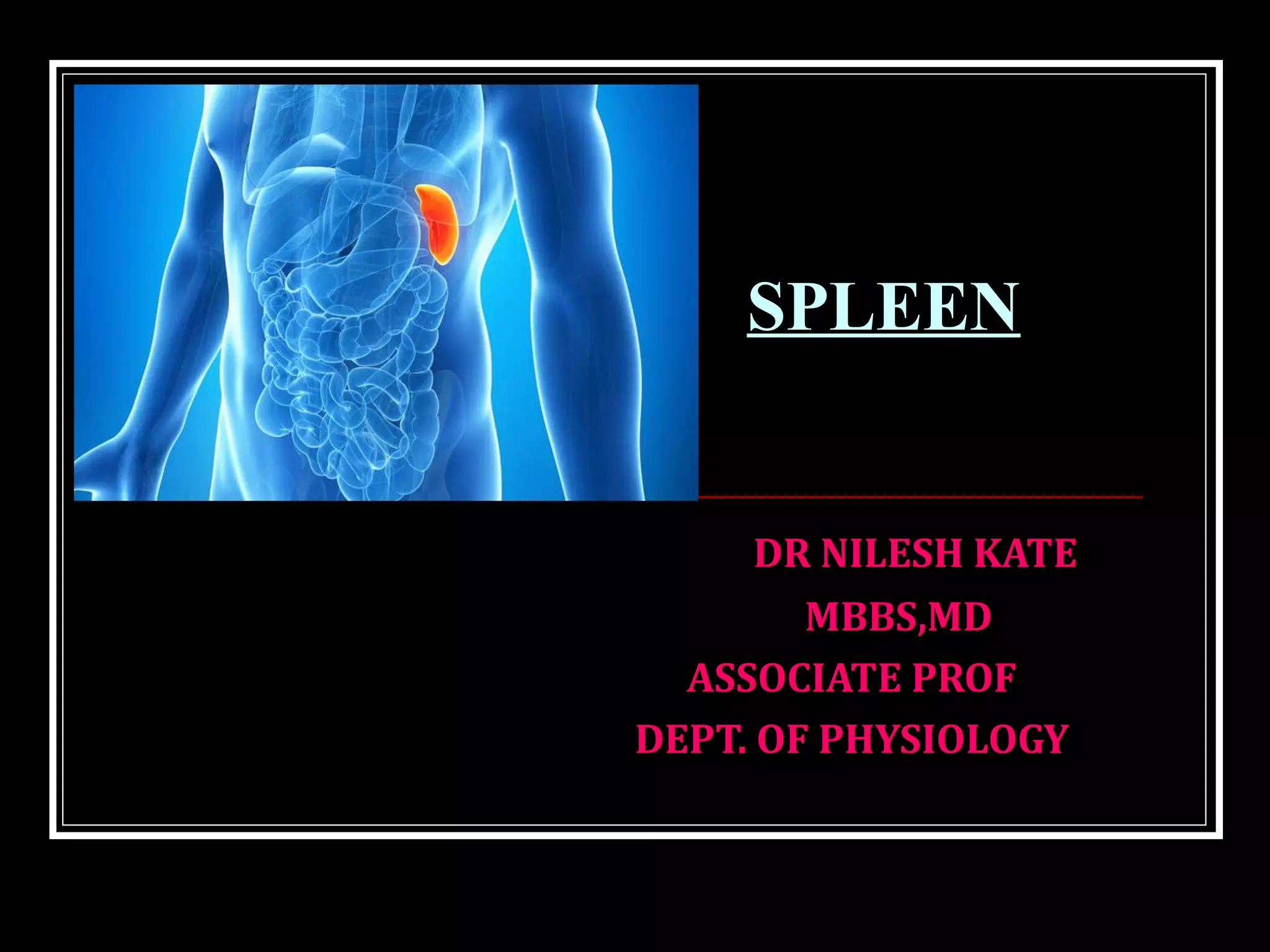
SPLEEN
OBJECTIVES
 At the end of the lecture you should know:
 The functional anatomy of the spleen.
 The histological structure of spleen (red & white
pulp)
 How to draw the schematic diagram of histological
structure.
 Functions of spleen.
 Definition & causes for splenomegaly &
hypersplenism.
 Definition, components & function of RES.
INTRODUCTION
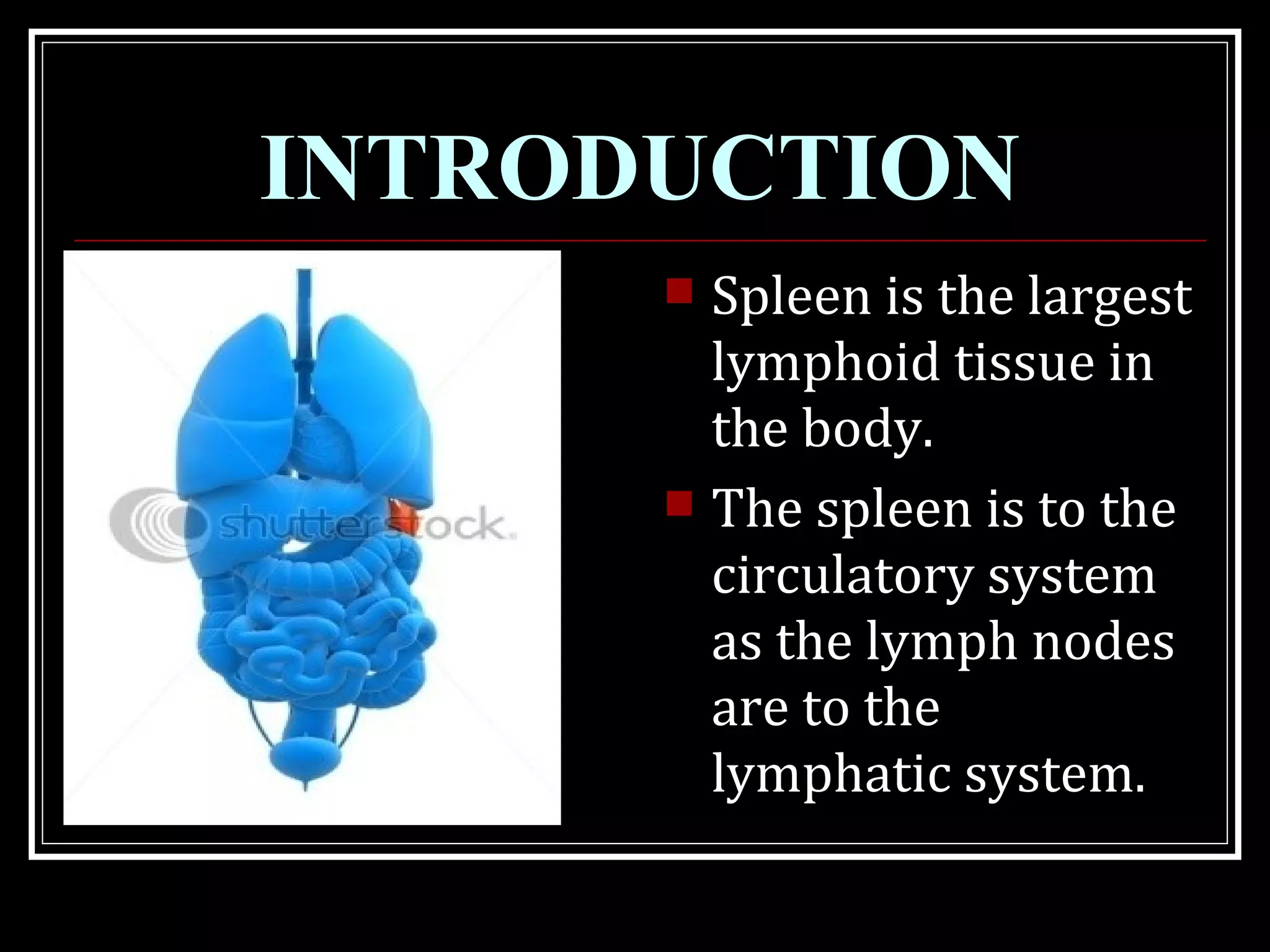
 Spleen is the largest
lymphoid tissue in
the body.
 The spleen is to the
circulatory system
as the lymph nodes
are to the
lymphatic system.
STRUCTURE
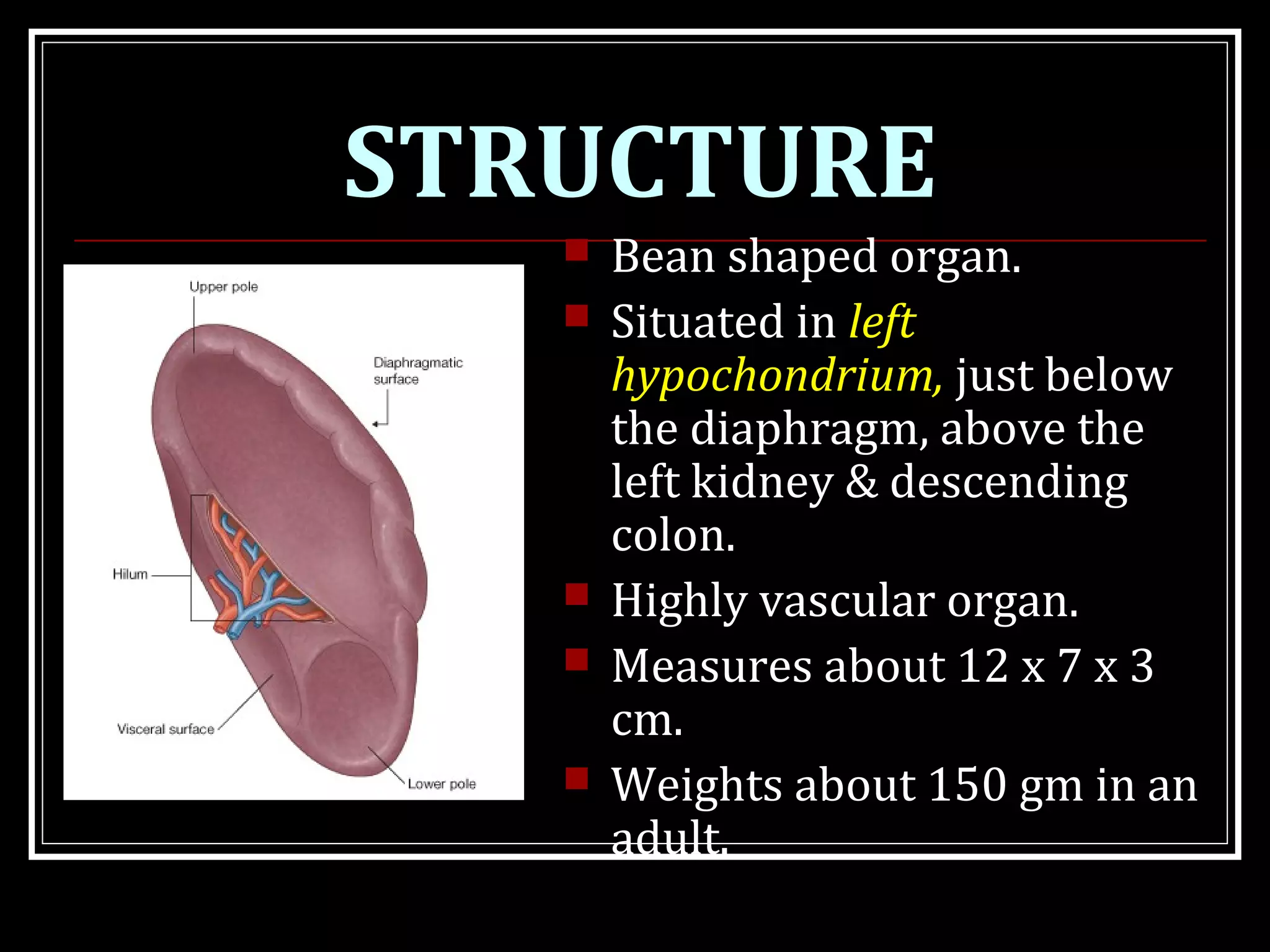
 Bean shaped organ.
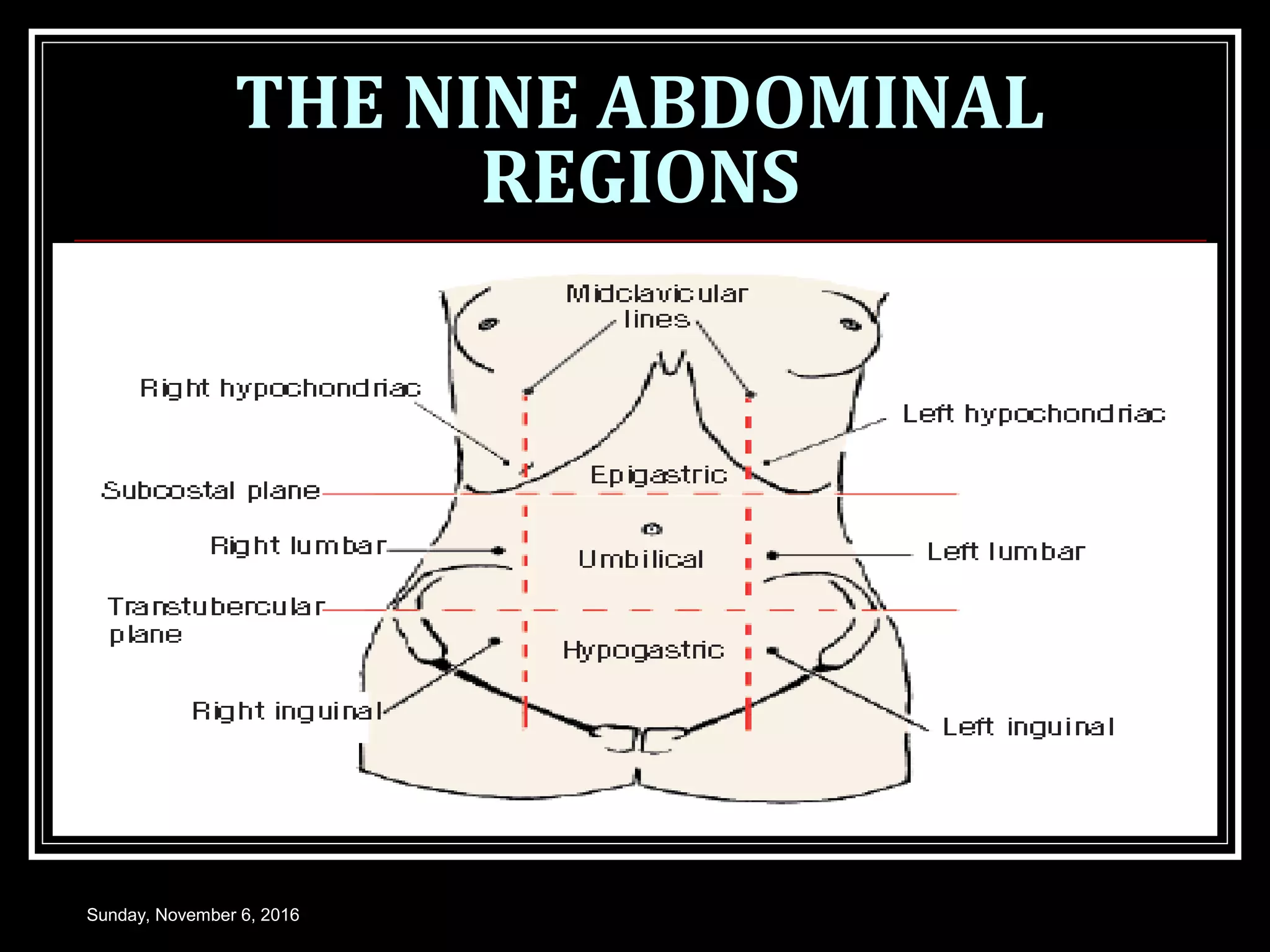
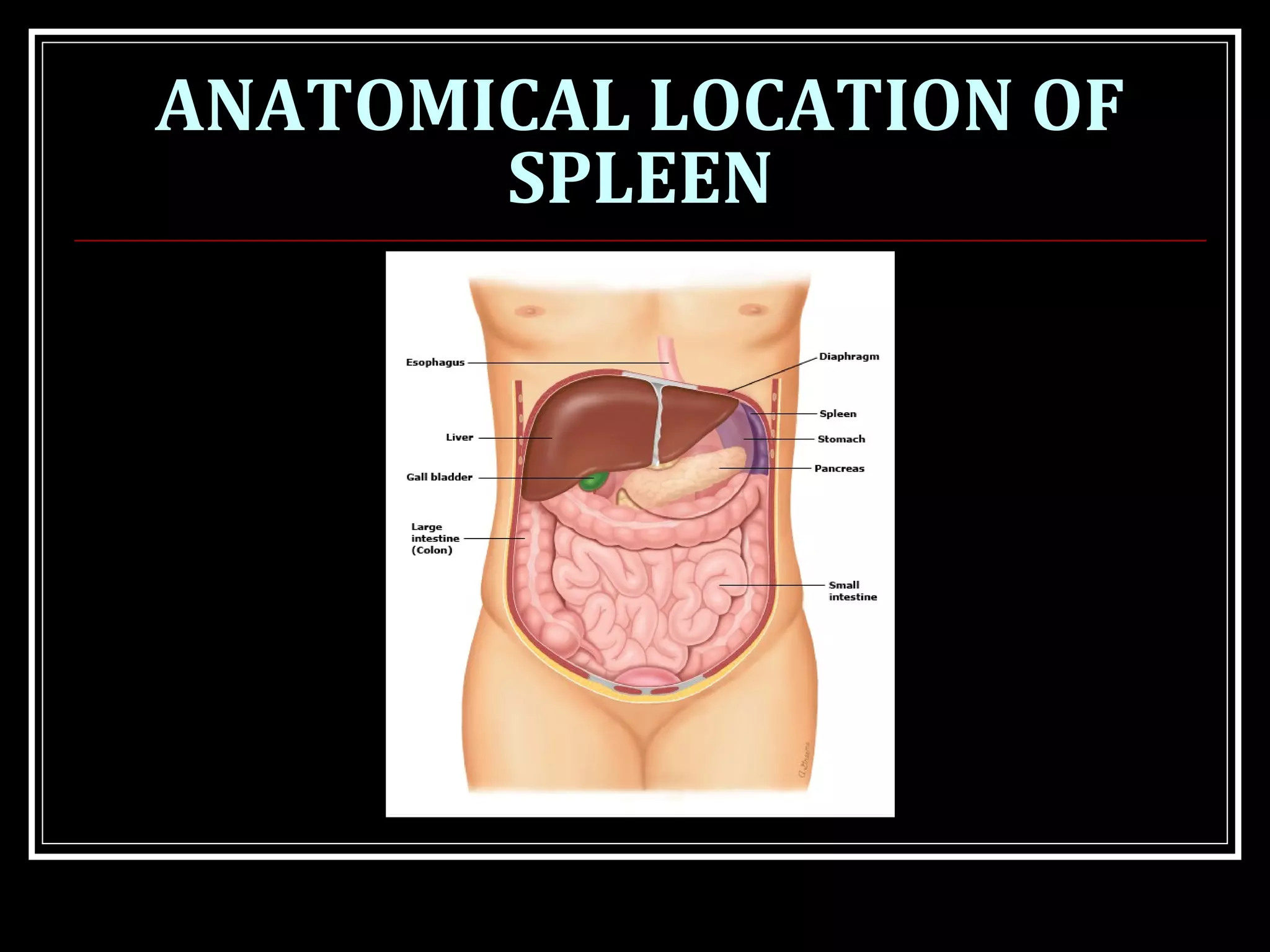
 Situated in left
hypochondrium, just below
the diaphragm, above the
left kidney & descending
colon.
 Highly vascular organ.
 Measures about 12 x 7 x 3
cm.
 Weights about 150 gm in an
adult.
THE NINE ABDOMINAL
REGIONS
Sunday, November 6, 2016
ANATOMICAL LOCATION OF
SPLEEN
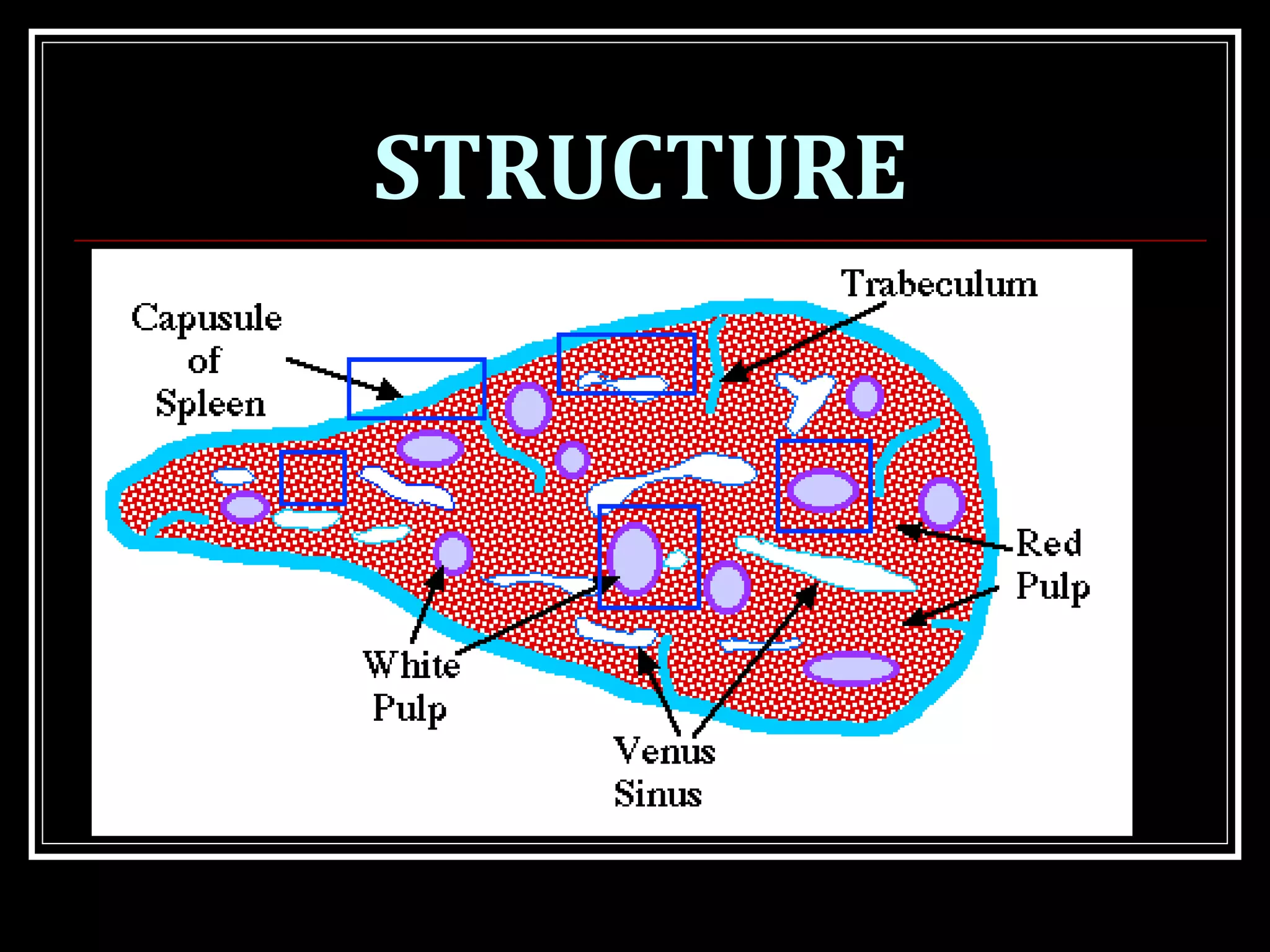
STRUCTURE
STRUCTURE
 The spleen is covered with a dense connective
tissue capsule.
 The fibrous tissue of the capsule extends into the
spleen to form a series of trabeculae between
which lies the splenic pulp (parenchyma).
 The parenchyma is divided into:
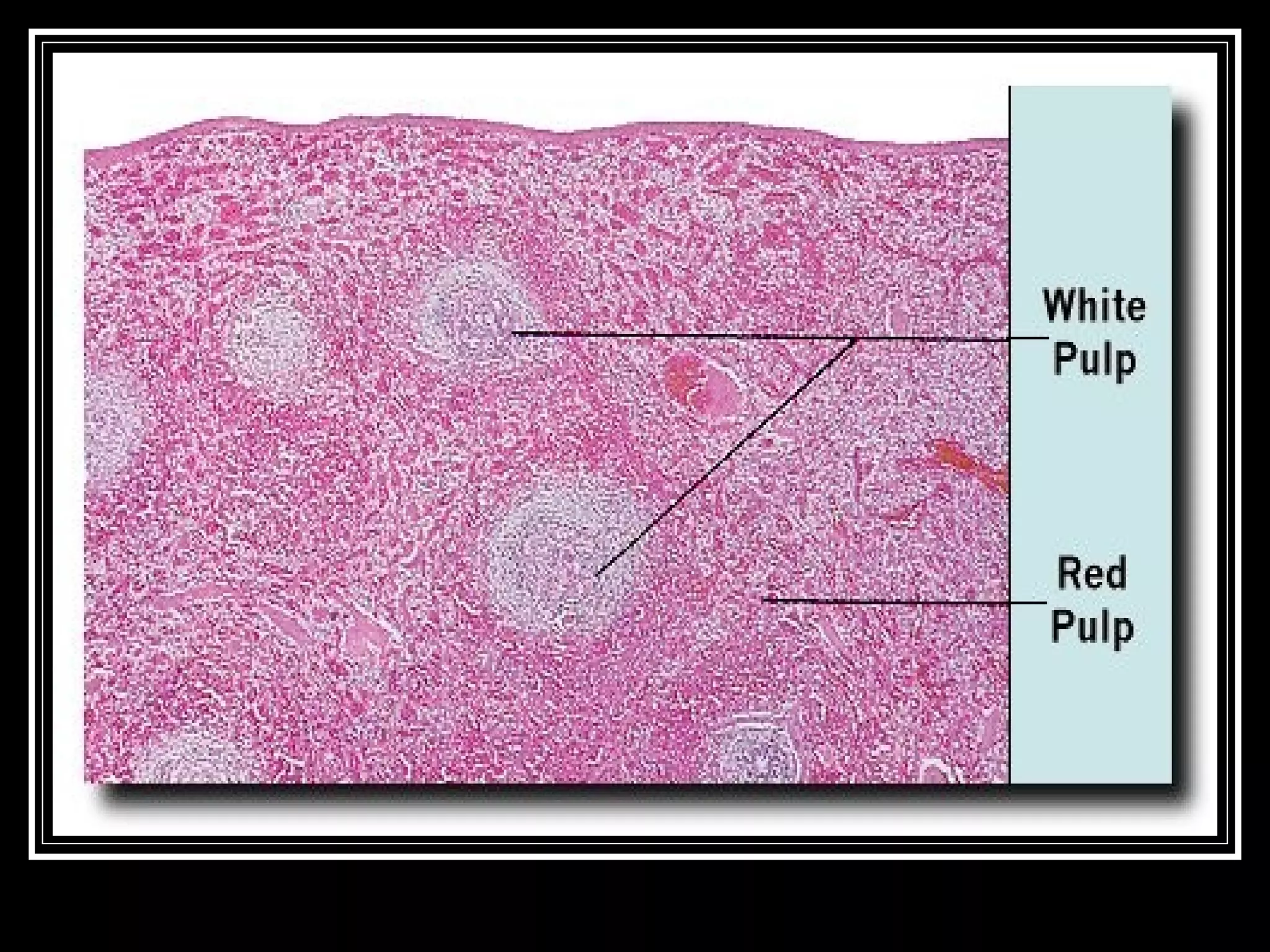
 White pulp
 Red pulp
WHITE PULP
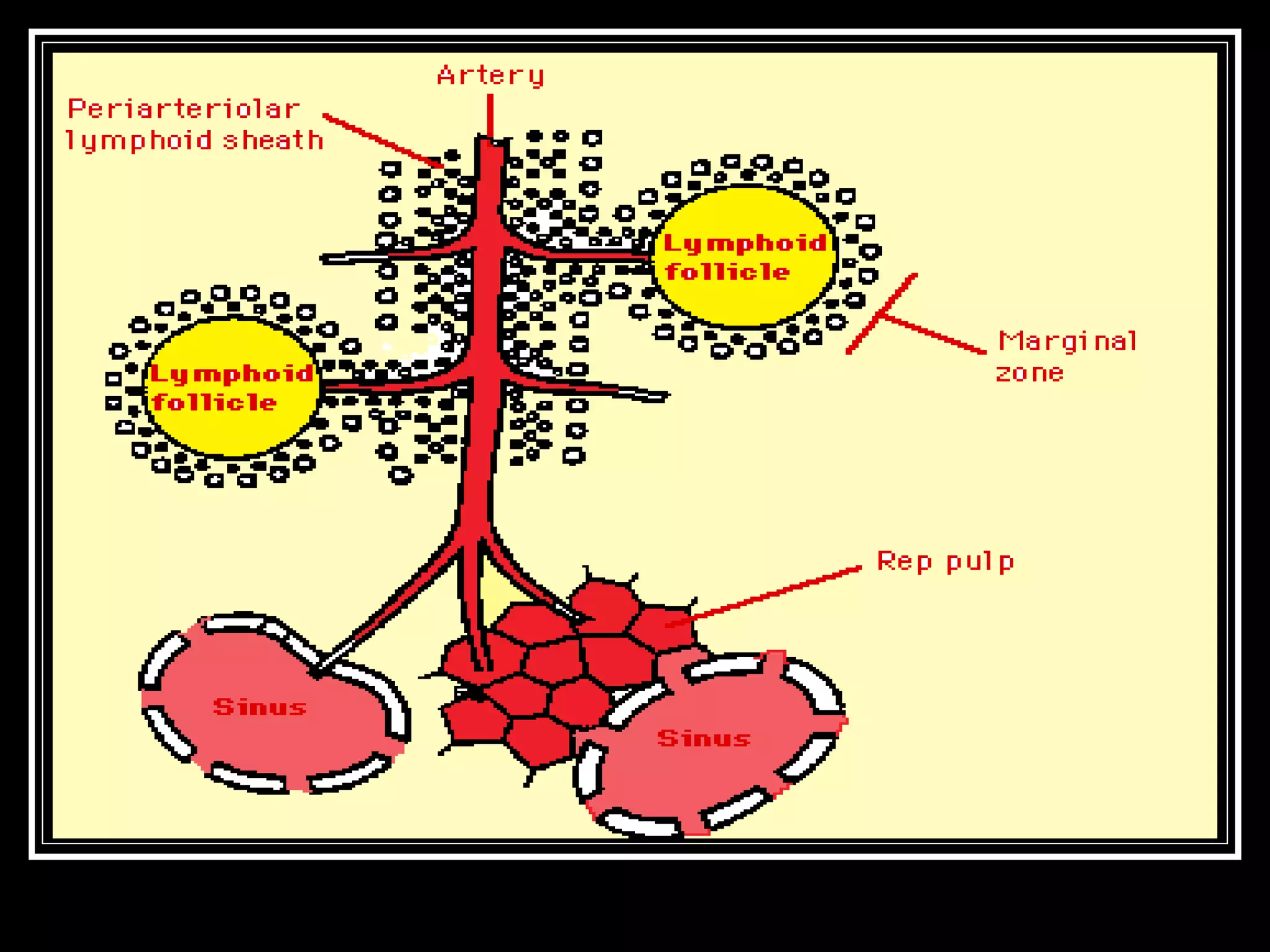
 Collection of lymphoid cells surrounding medium-
sized splenic arteries.
 The artery is surrounded by a collar of T
lymphocytes, k/a “periarteriolar lymphatic
sheath”.
 At intervals, this lymphatic sheath expands,
usually on one side of the artery, to form
‘lymphoid nodules’ composed principally of B
lymphocytes.
 On antigenic stimulation, typical ‘germinal
centers’ form within these B-cell areas.
RED PULP
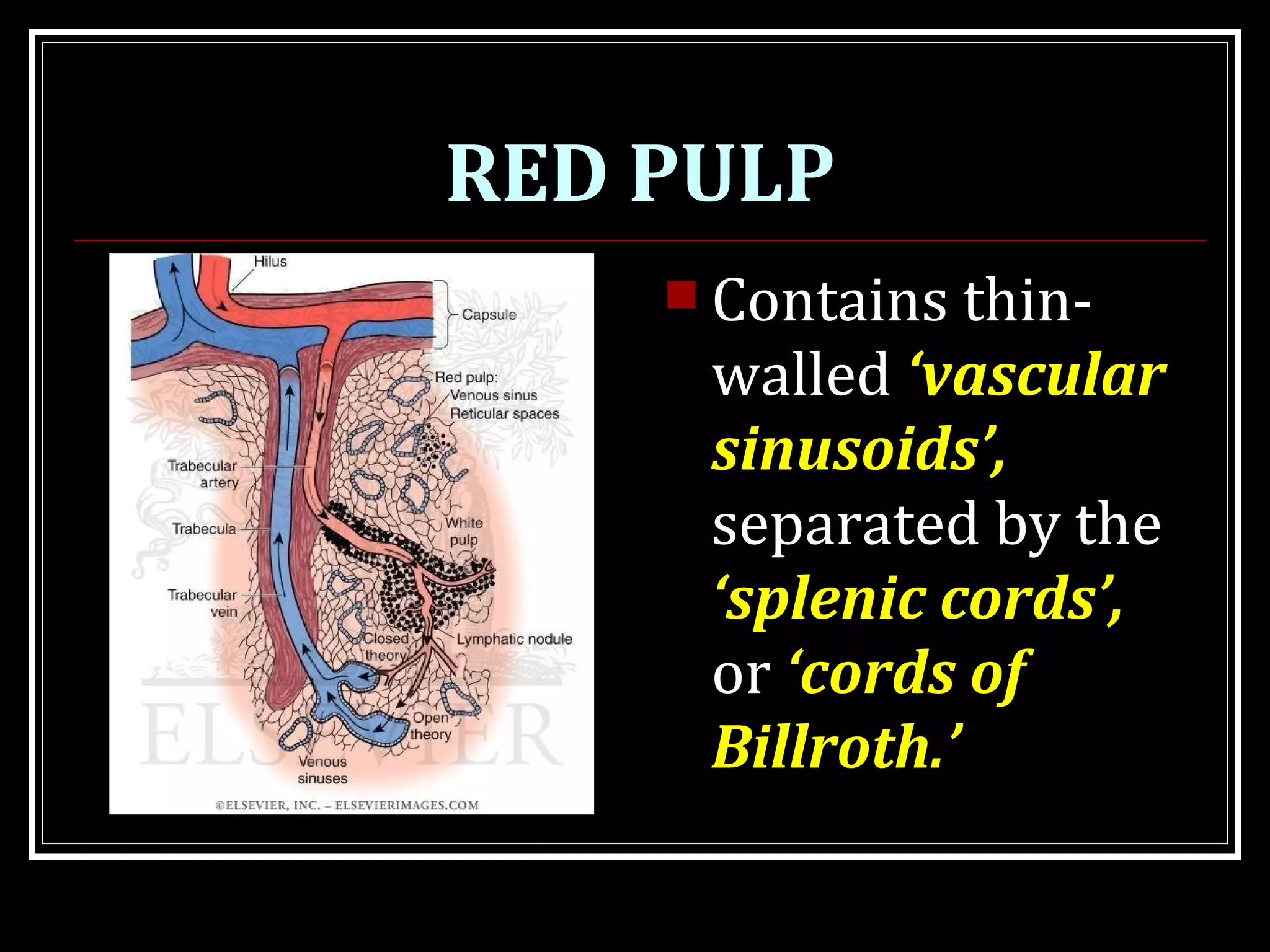
 Contains thin-
walled ‘vascular
sinusoids’,
separated by the
‘splenic cords’,
or ‘cords of
Billroth.’
RED PULP
 The endothelial lining
of the sinusoid is of
the open or
discontinuous type,
providing passage of
blood cells between
the sinusoids and
cords.
RED PULP
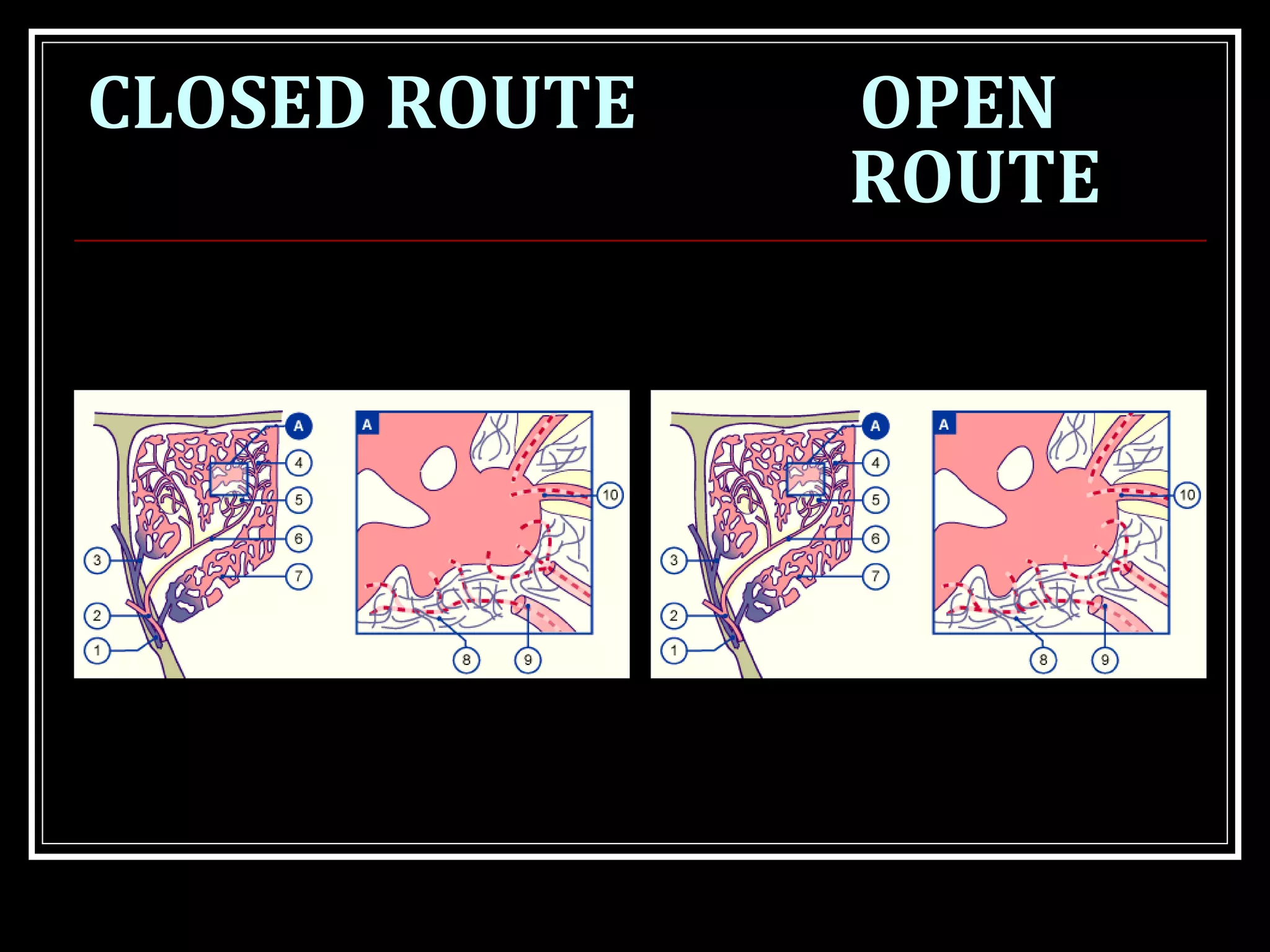
 Blood reaching the capillaries in red pulp may
take one of two routes:
 Open route: filters into the splenic cords.
 Closed route: passes directly into
sinusoides.
 The splenic cords are lined by macrophages
and function as seive through which blood in
red pulp filters into sinusoides.
CLOSED ROUTE OPEN
ROUTE
FUNCTIONS OF SPLEEN
 Formation of RBC
 Removal of unwanted elements from
the blood.
 Reservoir function
 Role in defense mechanism
 Storage and metabolism of iron
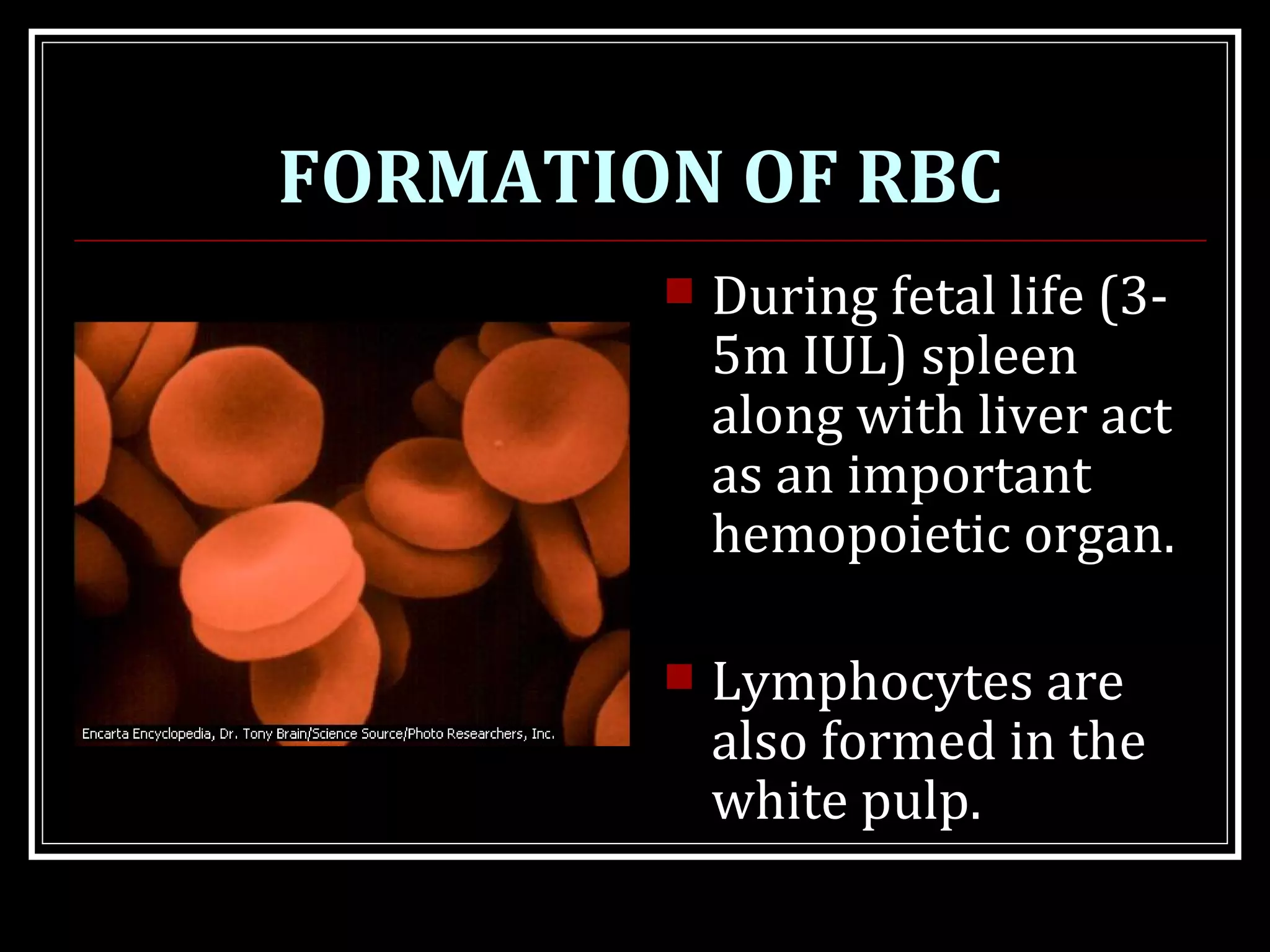
FORMATION OF RBC
 During fetal life (3-
5m IUL) spleen
along with liver act
as an important
hemopoietic organ.
 Lymphocytes are
also formed in the
white pulp.
REMOVAL OF UNWANTED
ELEMENTS FROM THE BLOOD.
 By splenic phagocytes in the cord.
 Removes:
 Old effaced RBCs
 Damaged RBCs & leucocytes
 Abnormal RBCs (e.g. Hereditary spherocytes)
 Bacteria, cell debris etc.
 RBCs undergo extreme deformation during
passage from the cords into the sinusoids.
 ↓ RBC elasticity  RBC entrapped in cords 
phagocytosed by cordal macrophages.
RESERVOIR FUNCTION
 More important in animals with contractile
spleen (e.g. Dog). Human spleen is non-
contractile.
 It contains about 30-40 ml of RBCs. Also
contains 30-40% of total platelet mass in the
body.
 Enlarged spleen can trap 80-90% of platelets
and can cause thrombocytopenia.
ROLE IN DEFENSE MECHANISM
 Macrophages of spleen
engulf bacteria and other
infectious agents.
 Lymphoid cells of the
spleen react against
infections by formation of
antibodies.
 Contains about 25% of T
& 15% of B lymphocytes
STORAGE AND METABOLISM OF
IRON
SPLENOMEGALY
(A CLINICALLY PALPABLE SPLEEN IS CALLED
SPLENOMEGALY).
 HEMATOLOGICAL
CAUSES:
 Haemolytic anaemias
 Haemoglobinopathies
 Leukemias
 Lymphomas
 INFLAMMATIONS:
 Rheumatoid Arthritis
 INFECTIONS:
 Acute: typhoid
 Chronic: tuberculosis
 Parasitic: malaria, kala
azar
 OTHERS:
 Portal hypertension
 Cancers
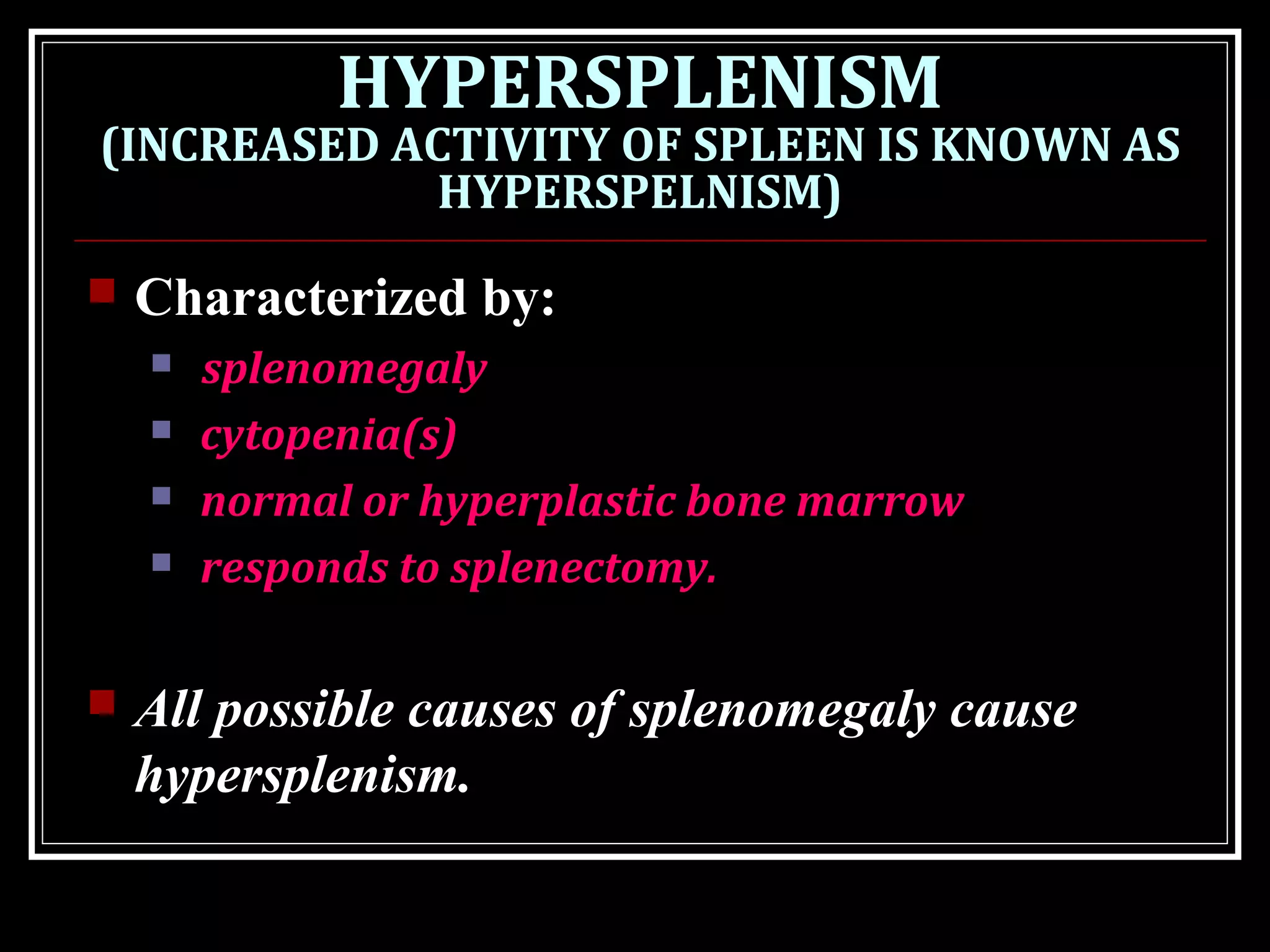
HYPERSPLENISM
(INCREASED ACTIVITY OF SPLEEN IS KNOWN AS
HYPERSPELNISM)
 Characterized by:
 splenomegaly
 cytopenia(s)
 normal or hyperplastic bone marrow
 responds to splenectomy.
 All possible causes of splenomegaly cause
hypersplenism.
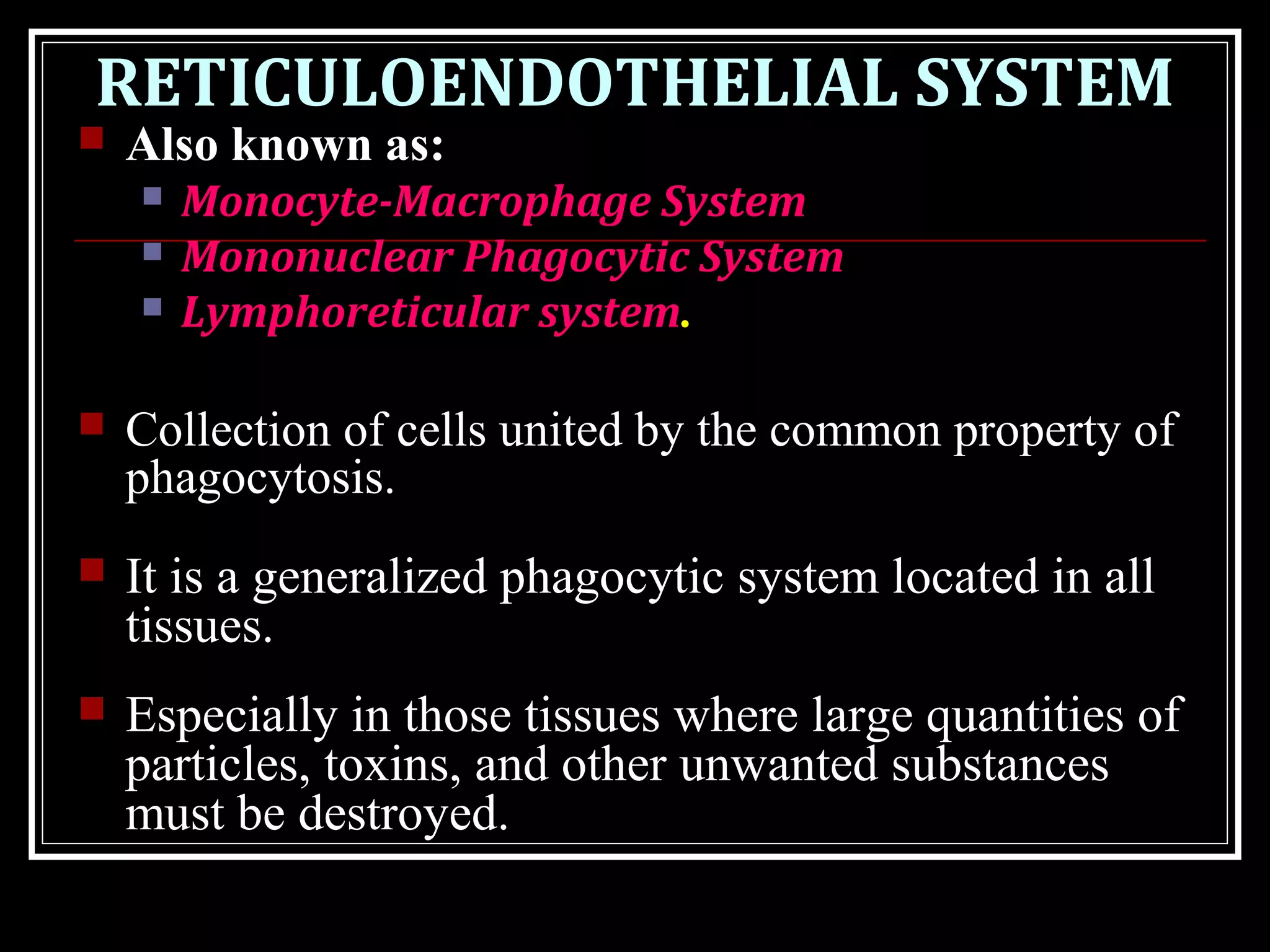
RETICULOENDOTHELIAL SYSTEM
 Also known as:
 Monocyte-Macrophage System
 Mononuclear Phagocytic System
 Lymphoreticular system.
 Collection of cells united by the common property of
phagocytosis.
 It is a generalized phagocytic system located in all
tissues.
 Especially in those tissues where large quantities of
particles, toxins, and other unwanted substances
must be destroyed.
RETICULOENDOTHELIAL
SYSTEM
 System of cells which have highly
phagocytic properties.
 RES consists of:
 Monocytes
 Mobile (wandering) tissue
macrophages
 Fixed tissue macrophages.
MONOCYTES
 Largest leucocytes.
 Immature cells present in blood,
with little ability to fight infectious
agent.
 After 72 hours they enter the tissues
to become ‘tissue macrophages’.
 In the tissue they swell to become
large in size and cytoplasm is filled
with lysosomes.
FUNCTIONS OF MONOCYTES
1. Enter tissue and form tissue macrophages – act as
scavengers.
2. Phagocyte several bacteria. (up to 100)
3. Engulf large particulate matter, dead tissue cells and
senile cells.
4. Along with macrophage involved in phagocytosis &
destruction of necrotic material.
5. Co-operate with B & T lymphocyte in both Humoral
& Cellular immunity.
WANDERING TISSUE MACROPHAGES
 Monocytes leaving the blood become
activated and differentiate into
macrophages.
 Those that have recently left the blood are
sometimes referred to as wandering
macrophages.
 Monocyte changes during maturation:
 A. Increase in cell size
 B. Number and complexity of intracellular
organelles increase, i.e., Golgi, mitochondria,
lysosomes
 C. Increase in intracellular digestive enzymes
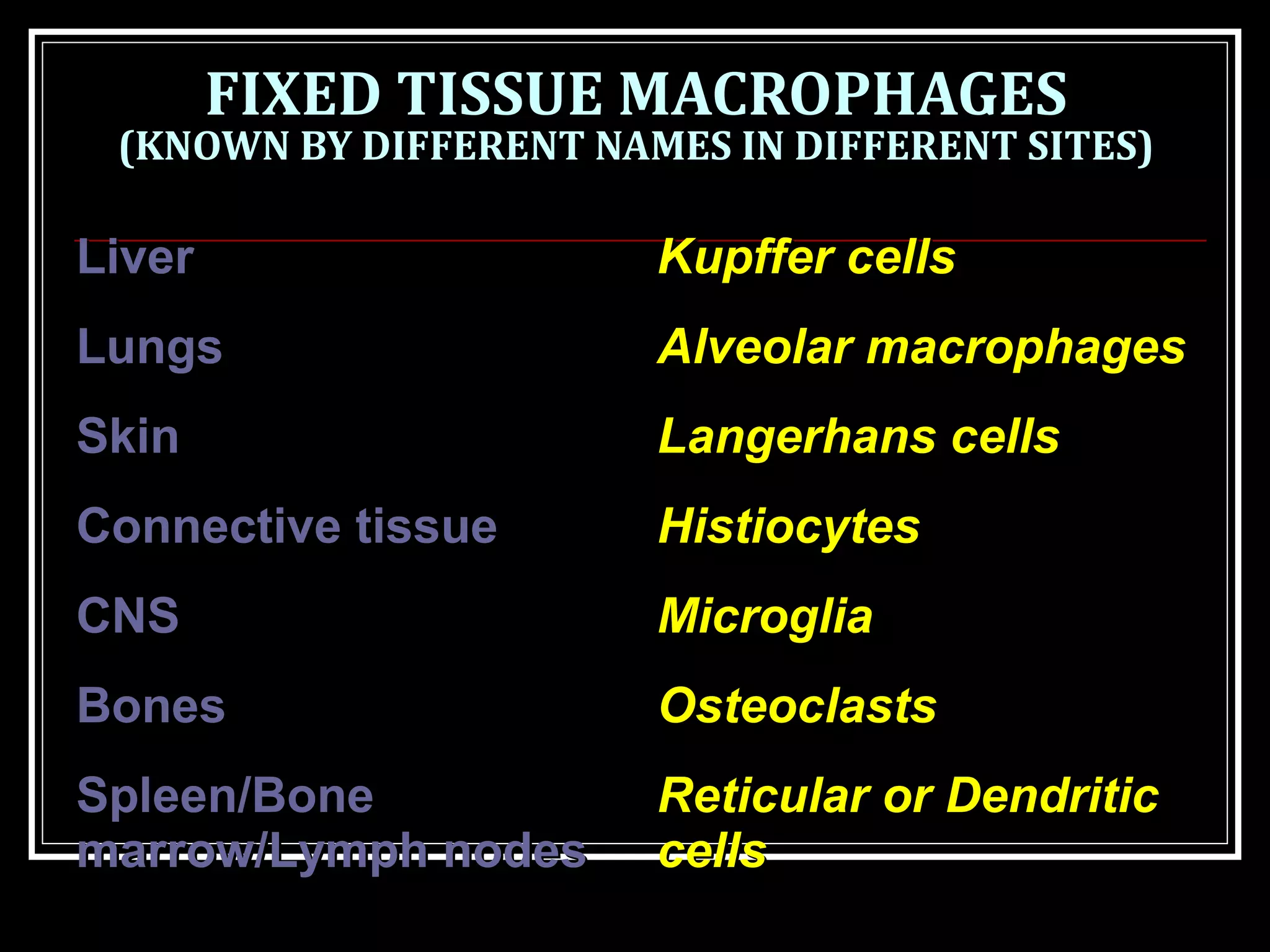
FIXED TISSUE MACROPHAGES
(KNOWN BY DIFFERENT NAMES IN DIFFERENT SITES)
LiverLiver Kupffer cellsKupffer cells
LungsLungs Alveolar macrophagesAlveolar macrophages
SkinSkin Langerhans cellsLangerhans cells
Connective tissueConnective tissue HistiocytesHistiocytes
CNSCNS MicrogliaMicroglia
BonesBones OsteoclastsOsteoclasts
Spleen/BoneSpleen/Bone
marrow/Lymph nodesmarrow/Lymph nodes
Reticular or DendriticReticular or Dendritic
cellscells
CNS
MICROGLIA
BONE
OSTEOCLAST
SKIN
LANGERTHAN
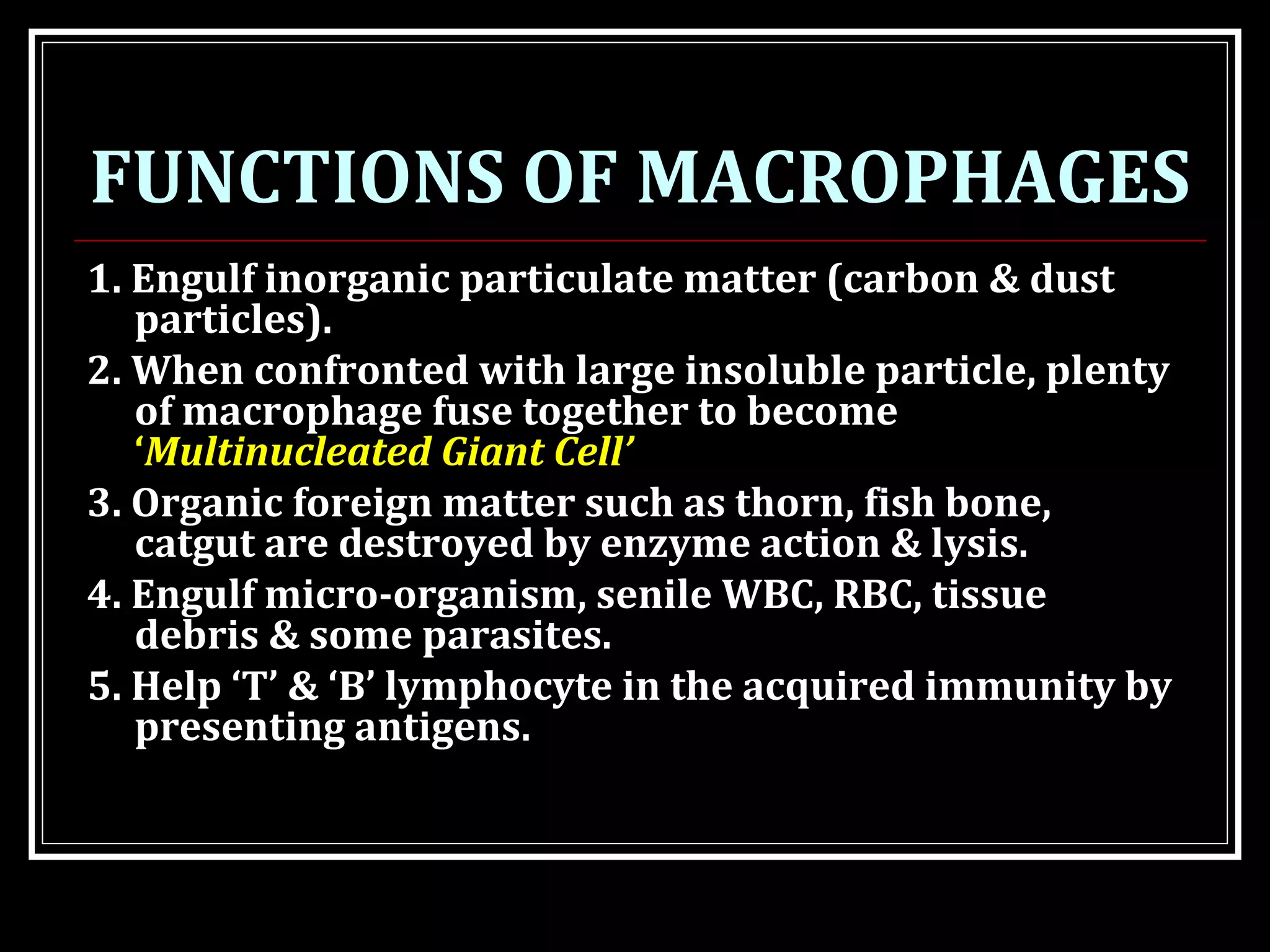
FUNCTIONS OF MACROPHAGES
1. Engulf inorganic particulate matter (carbon & dust
particles).
2. When confronted with large insoluble particle, plenty
of macrophage fuse together to become
‘Multinucleated Giant Cell’
3. Organic foreign matter such as thorn, fish bone,
catgut are destroyed by enzyme action & lysis.
4. Engulf micro-organism, senile WBC, RBC, tissue
debris & some parasites.
5. Help ‘T’ & ‘B’ lymphocyte in the acquired immunity by
presenting antigens.
FUNCTIONS OF THE RES
 Phagocytic Function:
 Bacteria, other foreign bodies and tissue debris are
engulfed and digested by the lysosomes of the
macrophages.
 Destruction of senile red cells.
 Storage and metabolism of iron.
 Formation of bile pigments.
SUMMARY
 In this lecture we have seen that:
 Spleen is divided into red & white pulp and
plays an important role in defense
mechanism.
 RES is an innate defense mechanism of the
body and is located in all the tissues of the
body.
Thank
You

SPLEEN AND RETICULOENDOTHELIAL SYSTEM

  • 1.
    DR NILESH KATE MBBS,MD ASSOCIATEPROF DEPT. OF PHYSIOLOGY SPLEEN
  • 2.
    OBJECTIVES  At theend of the lecture you should know:  The functional anatomy of the spleen.  The histological structure of spleen (red & white pulp)  How to draw the schematic diagram of histological structure.  Functions of spleen.  Definition & causes for splenomegaly & hypersplenism.  Definition, components & function of RES.
  • 3.
    INTRODUCTION  Spleen isthe largest lymphoid tissue in the body.  The spleen is to the circulatory system as the lymph nodes are to the lymphatic system.
  • 4.
    STRUCTURE  Bean shapedorgan.  Situated in left hypochondrium, just below the diaphragm, above the left kidney & descending colon.  Highly vascular organ.  Measures about 12 x 7 x 3 cm.  Weights about 150 gm in an adult.
  • 5.
  • 6.
  • 7.
  • 8.
    STRUCTURE  The spleenis covered with a dense connective tissue capsule.  The fibrous tissue of the capsule extends into the spleen to form a series of trabeculae between which lies the splenic pulp (parenchyma).  The parenchyma is divided into:  White pulp  Red pulp
  • 11.
    WHITE PULP  Collectionof lymphoid cells surrounding medium- sized splenic arteries.  The artery is surrounded by a collar of T lymphocytes, k/a “periarteriolar lymphatic sheath”.  At intervals, this lymphatic sheath expands, usually on one side of the artery, to form ‘lymphoid nodules’ composed principally of B lymphocytes.  On antigenic stimulation, typical ‘germinal centers’ form within these B-cell areas.
  • 13.
    RED PULP  Containsthin- walled ‘vascular sinusoids’, separated by the ‘splenic cords’, or ‘cords of Billroth.’
  • 14.
    RED PULP  Theendothelial lining of the sinusoid is of the open or discontinuous type, providing passage of blood cells between the sinusoids and cords.
  • 16.
    RED PULP  Bloodreaching the capillaries in red pulp may take one of two routes:  Open route: filters into the splenic cords.  Closed route: passes directly into sinusoides.  The splenic cords are lined by macrophages and function as seive through which blood in red pulp filters into sinusoides.
  • 17.
  • 19.
    FUNCTIONS OF SPLEEN Formation of RBC  Removal of unwanted elements from the blood.  Reservoir function  Role in defense mechanism  Storage and metabolism of iron
  • 20.
    FORMATION OF RBC During fetal life (3- 5m IUL) spleen along with liver act as an important hemopoietic organ.  Lymphocytes are also formed in the white pulp.
  • 21.
    REMOVAL OF UNWANTED ELEMENTSFROM THE BLOOD.  By splenic phagocytes in the cord.  Removes:  Old effaced RBCs  Damaged RBCs & leucocytes  Abnormal RBCs (e.g. Hereditary spherocytes)  Bacteria, cell debris etc.  RBCs undergo extreme deformation during passage from the cords into the sinusoids.  ↓ RBC elasticity  RBC entrapped in cords  phagocytosed by cordal macrophages.
  • 22.
    RESERVOIR FUNCTION  Moreimportant in animals with contractile spleen (e.g. Dog). Human spleen is non- contractile.  It contains about 30-40 ml of RBCs. Also contains 30-40% of total platelet mass in the body.  Enlarged spleen can trap 80-90% of platelets and can cause thrombocytopenia.
  • 23.
    ROLE IN DEFENSEMECHANISM  Macrophages of spleen engulf bacteria and other infectious agents.  Lymphoid cells of the spleen react against infections by formation of antibodies.  Contains about 25% of T & 15% of B lymphocytes
  • 24.
  • 25.
    SPLENOMEGALY (A CLINICALLY PALPABLESPLEEN IS CALLED SPLENOMEGALY).  HEMATOLOGICAL CAUSES:  Haemolytic anaemias  Haemoglobinopathies  Leukemias  Lymphomas  INFLAMMATIONS:  Rheumatoid Arthritis  INFECTIONS:  Acute: typhoid  Chronic: tuberculosis  Parasitic: malaria, kala azar  OTHERS:  Portal hypertension  Cancers
  • 26.
    HYPERSPLENISM (INCREASED ACTIVITY OFSPLEEN IS KNOWN AS HYPERSPELNISM)  Characterized by:  splenomegaly  cytopenia(s)  normal or hyperplastic bone marrow  responds to splenectomy.  All possible causes of splenomegaly cause hypersplenism.
  • 27.
    RETICULOENDOTHELIAL SYSTEM  Alsoknown as:  Monocyte-Macrophage System  Mononuclear Phagocytic System  Lymphoreticular system.  Collection of cells united by the common property of phagocytosis.  It is a generalized phagocytic system located in all tissues.  Especially in those tissues where large quantities of particles, toxins, and other unwanted substances must be destroyed.
  • 28.
    RETICULOENDOTHELIAL SYSTEM  System ofcells which have highly phagocytic properties.  RES consists of:  Monocytes  Mobile (wandering) tissue macrophages  Fixed tissue macrophages.
  • 29.
    MONOCYTES  Largest leucocytes. Immature cells present in blood, with little ability to fight infectious agent.  After 72 hours they enter the tissues to become ‘tissue macrophages’.  In the tissue they swell to become large in size and cytoplasm is filled with lysosomes.
  • 30.
    FUNCTIONS OF MONOCYTES 1.Enter tissue and form tissue macrophages – act as scavengers. 2. Phagocyte several bacteria. (up to 100) 3. Engulf large particulate matter, dead tissue cells and senile cells. 4. Along with macrophage involved in phagocytosis & destruction of necrotic material. 5. Co-operate with B & T lymphocyte in both Humoral & Cellular immunity.
  • 31.
    WANDERING TISSUE MACROPHAGES Monocytes leaving the blood become activated and differentiate into macrophages.  Those that have recently left the blood are sometimes referred to as wandering macrophages.  Monocyte changes during maturation:  A. Increase in cell size  B. Number and complexity of intracellular organelles increase, i.e., Golgi, mitochondria, lysosomes  C. Increase in intracellular digestive enzymes
  • 32.
    FIXED TISSUE MACROPHAGES (KNOWNBY DIFFERENT NAMES IN DIFFERENT SITES) LiverLiver Kupffer cellsKupffer cells LungsLungs Alveolar macrophagesAlveolar macrophages SkinSkin Langerhans cellsLangerhans cells Connective tissueConnective tissue HistiocytesHistiocytes CNSCNS MicrogliaMicroglia BonesBones OsteoclastsOsteoclasts Spleen/BoneSpleen/Bone marrow/Lymph nodesmarrow/Lymph nodes Reticular or DendriticReticular or Dendritic cellscells
  • 33.
  • 34.
    FUNCTIONS OF MACROPHAGES 1.Engulf inorganic particulate matter (carbon & dust particles). 2. When confronted with large insoluble particle, plenty of macrophage fuse together to become ‘Multinucleated Giant Cell’ 3. Organic foreign matter such as thorn, fish bone, catgut are destroyed by enzyme action & lysis. 4. Engulf micro-organism, senile WBC, RBC, tissue debris & some parasites. 5. Help ‘T’ & ‘B’ lymphocyte in the acquired immunity by presenting antigens.
  • 35.
    FUNCTIONS OF THERES  Phagocytic Function:  Bacteria, other foreign bodies and tissue debris are engulfed and digested by the lysosomes of the macrophages.  Destruction of senile red cells.  Storage and metabolism of iron.  Formation of bile pigments.
  • 36.
    SUMMARY  In thislecture we have seen that:  Spleen is divided into red & white pulp and plays an important role in defense mechanism.  RES is an innate defense mechanism of the body and is located in all the tissues of the body.
  • 37.