IMMUNITY
DR NILESH KATE
MBBS,MD.
DEPARTMENT OF
PHYSIOLOGY.
OBJECTIVE
 At the end of the class you shoud know
 Architecture of immune system
 Immunity
 Antigens
 Antibodies
 Immune response development
 Other immune mechanims
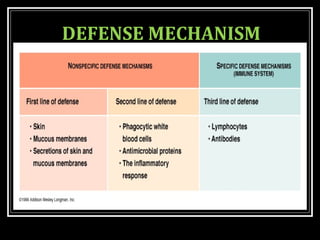
DEFENSE MECHANISM
INTRODUCTION
 Definition
 Types
 Antigens
 Antibodies
 Immune system
Immune response
Immunomodulation
Immunoenhancement
Immunosuppression
Immunotolerance.
Autoimmunity
Hypersensitivity
ARCHITECTURE OF IMMUNE
SYSTEM
 Mononuclear Phagocytic system – also
called as Tissue Macrophage system (1960)
previously called Reticulo endothelial sytem.
 Lymphoid components – consists of
network of lymphoid organs, nodes & cells.
MONONUCLEAR PHAGOCYTIC
SYSTEM
Formation
-Monocytes from bone
marrow circulates for 3
days & then enters
tissue & becomes tissue
Macrophages.
Saturday, June 16, 2018
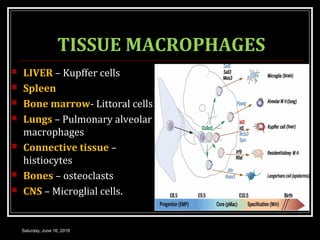
TISSUE MACROPHAGES
 LIVER – Kupffer cells
 Spleen
 Bone marrow- Littoral cells
 Lungs – Pulmonary alveolar
macrophages
 Connective tissue –
histiocytes
 Bones – osteoclasts
 CNS – Microglial cells.
Saturday, June 16, 2018
MONONUCLEAR PHAGOCYTIC
SYSTEM
 Constituent
cells
Precursor cells
of monocytes
Promonocytes
monocytes
Saturday, June 16, 2018
MONONUCLEAR PHAGOCYTIC
SYSTEM
Functions
1 Role in inflammation &
healing
2 Role in defence against
bacteria
3 Role in immune response
4 Role in removal of old RBC
5 Role in removal of old WBC
& platelets
6 Storage function.
Saturday, June 16, 2018
LYMPHOID
COMPONENTS
Primary lymphoid
tissue
 Thymus – contains
Thymocytes
containing
thymocin.
 Role – education
of lymphocytes to
become T
lymphocytes.
 Effects of
thymectomy –
marked infection.
LYMPHOID
COMPONENTS
Primary lymphoid
tissue
 Bursa equivalent –
bone marrow
 Lymphocyes from
bone marrow
become B
Lymphocytes
 Form plasma cells &
antibodies.
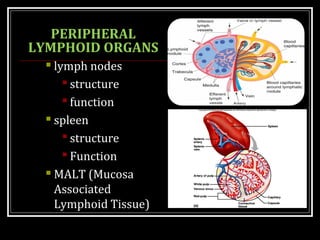
PERIPHERAL
LYMPHOID ORGANS
 lymph nodes
 structure
 function
 spleen
 structure
 Function
 MALT (Mucosa
Associated
Lymphoid Tissue)
REVIEW
Saturday, June 16, 2018
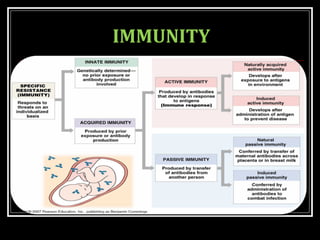
IMMUNITY
PHAGOCYTOSIS
Saturday, June 16, 2018
PHAGOCYTOSIS
Saturday, June 16, 2018
 Stages
 Margination
 Diapedesis
 Chemotaxis
 Peudopodia formation – engulfment
 Killing / degradation
ANTIGEN
 Definition
 Hapten
 Immunogenicity
 Antigen specificity
 Species specificity
 Isospecificity
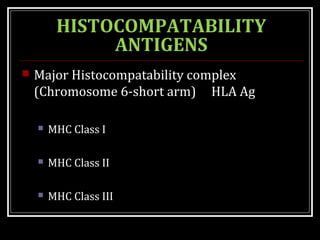
HISTOCOMPATABILITY
ANTIGENS
 Major Histocompatability complex
(Chromosome 6-short arm) HLA Ag
 MHC Class I
 MHC Class II
 MHC Class III
CELL MEDIATED IMMUNITY
 Role of cellular immunity
 Intracellular bacteria– M.tuberculosis, M.leprae
 Viruses
 fungi
 Allograft rejection & graft versus host
reaction
 Delayed hypersensitivity & autoimmune
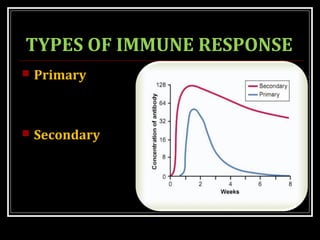
TYPES OF IMMUNE RESPONSE
 Primary
 Secondary
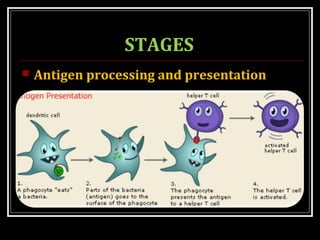
STAGES
 Antigen processing and presentation
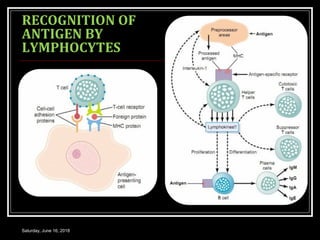
RECOGNITION OF
ANTIGEN BY
LYMPHOCYTES
Saturday, June 16, 2018
T-LYMPHOCYTES
DIFFERENTIATION (ACTIVATION)
Saturday, June 16, 2018
CD8 types
CD4 types
TT co-operation
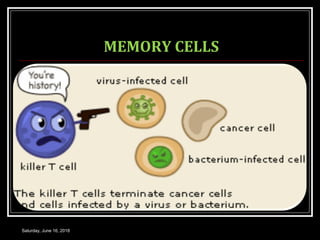
Memory cells
ATTACK PHASE
 Role of cytotoxic T-
cell
 Lysis through cytotoxic
substances
 Induction of Apoptois
 Perforin mediated killing
HELPER T CELL
MEMORY CELLS
Saturday, June 16, 2018
HUMORAL MEDIATED
IMMUNITY
 Role of humoral immunity
 Extracellular bacterial pathogens.
 Immediate hypersensitivity
 Autoimmune diseases.
TYPES OF IMMUNE RESPONSE
 Primary
 Secondary
STAGES
 Antigen processing and
presentation
 Recognition of antigens
by lymphocytes
 Lymphocyte activation
 Activation of T-lymphocytes.
 Activation of B-lymphocytes.
 Role of plasma cells
 Role of memory cells
REVIEW
Saturday, June 16, 2018
 PRODUCTION OF
ANTIBODIES
 Theories of antibody
production
 Clonal selection theory
(Burne 1957)
 Inactivation or attack
phase
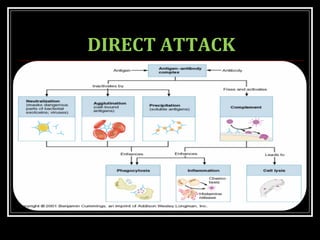
 Direct attack
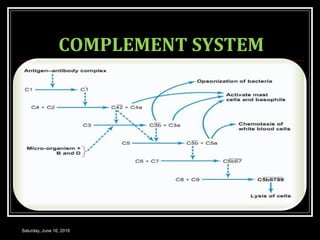
 Complement system
DIRECT ATTACK
COMPLEMENT SYSTEM
 Classical pathway.
 L - Lysis
 A - Agglutination
 N - Neutralization
 A – activation &
degranulation of
mast cells
 C - chemotaxis
 O- Opsoniozation.
 Alternate pathway.
COMPLEMENT SYSTEM
Saturday, June 16, 2018
COMPLEMENT SYSTEM
Saturday, June 16, 2018
ANTIBODIES
 Structure
 Heavy Chain
 Light Chain
Saturday, June 16, 2018
TYPES
 Immunoglobulins (Ig)
 Ig G
 Ig A
 Ig M
 Ig D
 Ig E
Saturday, June 16, 2018
IMMUNOGLOBULINS
FEATURE IgG IgA IgM IgD IgE
H chain γ α μ δ ε
L chain Κ or λ Κ or λ Κ or λ Κ or λ Κ or λ
Mol wt
(kd)
150 160-385 900 180 190
Serum
conc
12 2 1.2 0.03 0.00004
Half life 21 6 5 3 2
Placental
T
Yes No No No No
Compleme
nt fixation
C A C N N
ROLE Body
fluids
Body
surface
Blood
stream
Not known Type 1
hypersens
itivity
Saturday, June 16, 2018
OTHER IMMUNE MECHANISM
RELATED ASPECTS.
 Immune tolerance
 Immune modulation
 Autoimmunity
 Hypersensitivity
 Immunodeficiency diseases.
Saturday, June 16, 2018
IMMUNE TOLERANCE
 Def – State of
unresponsiveness to
an antigen.
 Types.
 Natural – Non-
responsiveness to self
antigen.
Saturday, June 16, 2018
IMMUNE TOLERANCE
 Acquired.
 General – Due to
impairment of
immune system.
 Specific – specific
antigen becomes
tolerogenic.
Saturday, June 16, 2018
MECHANISM OF TOLERANCE
 Clonal deletion – clones
are selectively deleted.
 Clonal synergy – cones of
cells might remain but not
activated.
 Clonal Suppression –
Inhibited through active
suppression.
Saturday, June 16, 2018
FACTORS INFLUENCING
INDUCTION OF TOLERANCE.
 Species –tolerance varies from species to species
 Immunological competency of the host.
 Antigen – Physical nature, Dose, Route of
administration.
 Age of the host.
Saturday, June 16, 2018
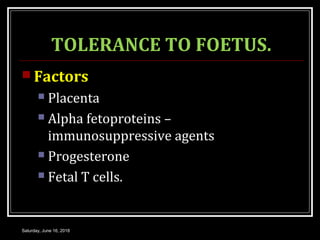
TOLERANCE TO FOETUS.
 Factors
 Placenta
 Alpha fetoproteins –
immunosuppressive agents
 Progesterone
 Fetal T cells.
Saturday, June 16, 2018
IMMUNE MODULATION
 Immune Enhancement – increase in response
in terms of Rate, Intensity, Duration
 Adjuvant – Non-specifically enhance immune
response to an antigen.
Saturday, June 16, 2018
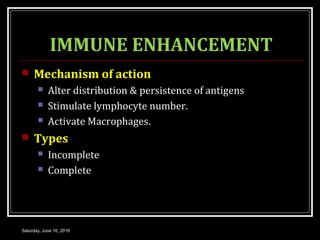
IMMUNE ENHANCEMENT
 Mechanism of action
 Alter distribution & persistence of antigens
 Stimulate lymphocyte number.
 Activate Macrophages.
 Types
 Incomplete
 Complete
Saturday, June 16, 2018
IMMUNE SUPPRESSION
 Immune suppression – Reduction in
immunological response.
 Specific
 Non-specific.
 Immunosuppressive agents.
 Physical
 Chemical
 Biological.
Saturday, June 16, 2018
PHYSICAL
 Irradiation
 Surgical
procedures.
 Thymectomy
 Splenectomy
 Thoracic duct
drainage.
Saturday, June 16, 2018
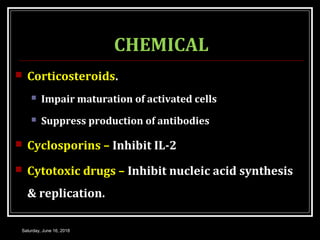
CHEMICAL
 Corticosteroids.
 Impair maturation of activated cells
 Suppress production of antibodies
 Cyclosporins – Inhibit IL-2
 Cytotoxic drugs – Inhibit nucleic acid synthesis
& replication.
Saturday, June 16, 2018
BIOLOGICAL.
 Antigen induced suppression – Desensitization
against allergen
 Antibody induced suppression – used in
pregnant mothers.
 Anti-lymphocytic serum.
Saturday, June 16, 2018
AUTOIMMUNITY
 Mechanism
 Forbidden clones.
 Hidden antigen or
sequestrated antigens
 Neo antigens or altered
antigens
 Cross reacting antigens
– molecular mimicry
 Mutations
 Unbalanced activity of
Helper & suppressor T
cells.
Saturday, June 16, 2018
AUTOIMMUNE DIEASES.
 Autoimmune anemia
 Thrombocytopenic purpura.
 Grave’s disease
 Hashimoto’s disease
 Insulin dependent diabetes mellitus.
 Rheumatoid arthritis.
 Rheumatic fever.
Saturday, June 16, 2018
HYPERSENSITIVITY
Abnormal response which produces
physiological or histopathological
damage in the host
Saturday, June 16, 2018
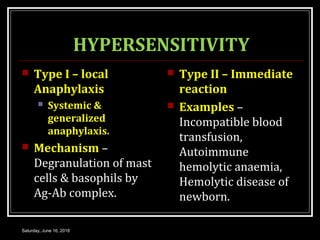
HYPERSENSITIVITY
 Type I – local
Anaphylaxis
 Systemic &
generalized
anaphylaxis.
 Mechanism –
Degranulation of mast
cells & basophils by
Ag-Ab complex.
 Type II – Immediate
reaction
 Examples –
Incompatible blood
transfusion,
Autoimmune
hemolytic anaemia,
Hemolytic disease of
newborn.
Saturday, June 16, 2018
HYPERSENSITIVITY
 Type III (Immune
complex mediated) –
damage of the
complex deposited in
tissue.
 Type IV – Delayed.
 Tuberculin tests
 Contact dermatitis
Saturday, June 16, 2018
IMMUNODEFICIENCY
DISEASES.
 Defect may be in the
 Lymphocyte & Natural killer cells
 Phagocytic cells
 Complement proteins.
 PRIMARY Immunodeficiency
 SECONDARY.
Saturday, June 16, 2018
PRIMARY IMMUNODEFICIENCY
DISEASE.
 Humoral immune deficiency
 Cellular immunodeficiency.
 Combined
 Complement immunodeficiency.
 Phagocytic disorders.
Saturday, June 16, 2018
SECONDARY
IMMUNODEFICIENCY DISEASE.
 AIDS – Acquired
immunodeficiency syndrome.
 Reduction in Helper T cells
 First detected in USA 1981
(India-1986)
 Spread of disease – sex
workers, drug addicts,
homosexual males &
unscreened blood transfusion.
Saturday, June 16, 2018
AIDS – ACQUIRED
IMMUNODEFICIENCY SYNDROME.
 Transmission – 3 routes
 Parenteral
 Sexual
 Transplacental.
 Structure of HIV –
Retrovirus.
 Core – 2 single strands of
genomic RNA, enzyme
reverse transcriptase &
protein P-15
Saturday, June 16, 2018
AIDS – ACQUIRED
IMMUNODEFICIENCY SYNDROME.
 Virus Multiplication
– virus comes in
contact with T4
antigen – passes into
cell – genomic RNA
synthesizes copy DNA
with help of reverse
transcriptase.
Saturday, June 16, 2018
AIDS – ACQUIRED
IMMUNODEFICIENCY SYNDROME.
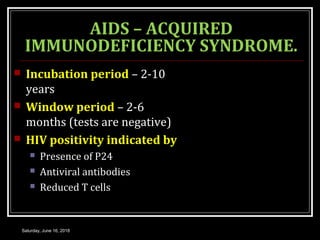
 Incubation period – 2-10
years
 Window period – 2-6
months (tests are negative)
 HIV positivity indicated by
 Presence of P24
 Antiviral antibodies
 Reduced T cells
Saturday, June 16, 2018
AIDS – ACQUIRED
IMMUNODEFICIENCY SYNDROME.
 Signs & symptoms –
mostly opportunistic
infections due to low
immunity
 HIV tests.
 screening tests - ELISA
 Supplement tests –
Wesrnblot essay
 Confirmatory tests – virus
isolation, p24 detection
Saturday, June 16, 2018
AIDS – ACQUIRED
IMMUNODEFICIENCY SYNDROME.
 Treatment – Triple
drug treatment.
 Protease inhibitor,
 Reverse transcriptase
inhibitor,
 Azidothymidines
 Interleukins
 Prevention
 Education
 Screening
 Ban on prostitution.
 Safer sex
 Use of disposable
instruments.
Saturday, June 16, 2018
OBJECTIVE ………
 At the end of the class you shoud know
 Architecture of immune system
 Immunity
 Antigens
 Antibodies
 Immune response development
 Other immune mechanims
Saturday, June 16, 2018
THANK YOU

Immunity

Editor's Notes

  • #26 The role of the helper T cells in both cellular and humoral immunity is illustrated on this slide. *The antigen-presenting cell will release interleukin I to stimulate the helper T cells. The helper T cell in turn will stimulate cytotoxic T cells and B cells. *It does this with interleukin II. The activated cytotoxic T cells provide cellular immunity. Cellular immunity is confirmed by cytotoxic T cells attacking infected or diseased body cells to destroy them. Humoral immunity is confirmed by antibodies that react with foreign invaders in ways that will be discussed later in this presentation.