Immunology  Immune system of organism. Antigens
Features of immune system  Situated in different parts of body Rapid regeneration  Circulation of immune cells in the organism  Possibility to “learn”  Possibility to form a lasting memory
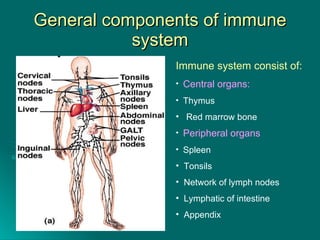
General components of immune system Immune system consist of: Central organs:  Thymus  Red marrow bone Peripheral organs   Spleen  Tonsils  Network of lymph nodes Lymphatic of intestine  Appendix
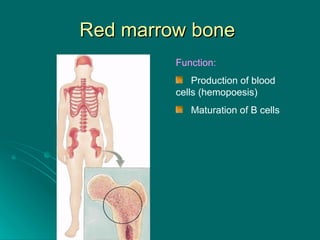
Red marrow bone  Function: Production of blood  cells (hemopoesis) Maturation of B cells
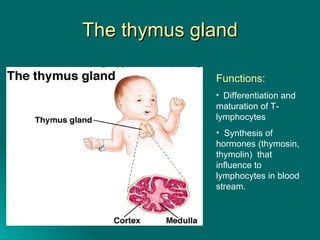
The thymus gland Functions: Differentiation and maturation of T-lymphocytes Synthesis of hormones (thymosin, thymolin)  that influence to lymphocytes in blood stream.
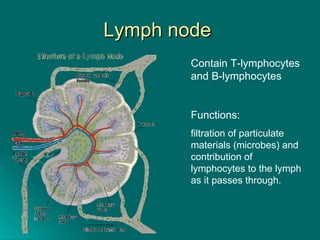
Lymph node  Contain T-lymphocytes and B-lymphocytes Functions:  filtration of particulate materials (microbes) and contribution of lymphocytes to the lymph as it passes through.
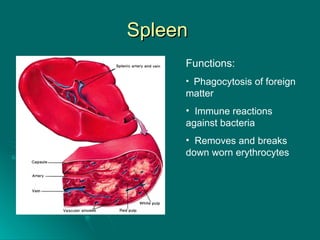
Spleen  Functions: Phagocytosis of foreign matter Immune reactions against bacteria Removes and breaks down worn erythrocytes
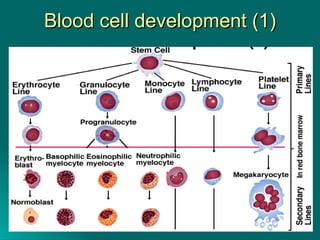
Blood cell development (1)
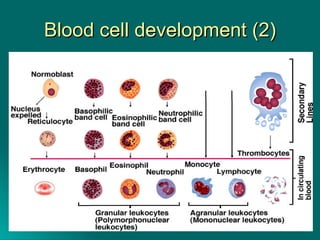
Blood cell development (2)
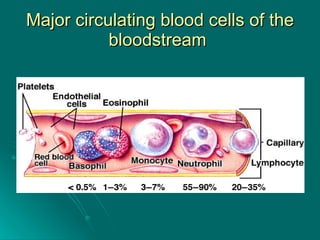
Major circulating blood cells of the bloodstream
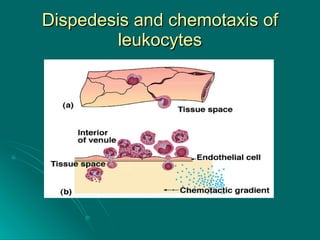
Dispedesis and chemotaxis of leukocytes
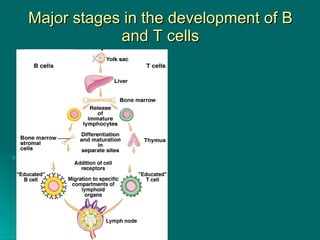
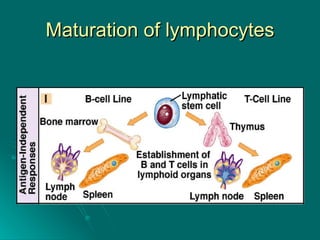
Major stages in the development of B and T cells
Maturation of lymphocytes
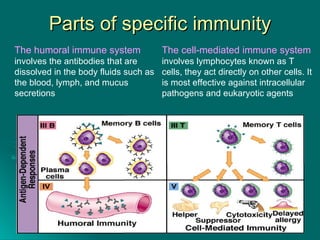
Parts of specific immunity The humoral immune system   involves the antibodies that are dissolved in the body fluids such as the blood, lymph, and mucus secretions The cell-mediated immune system  involves lymphocytes known as T cells, they act directly on other cells. It is most effective against intracellular pathogens and eukaryotic agents
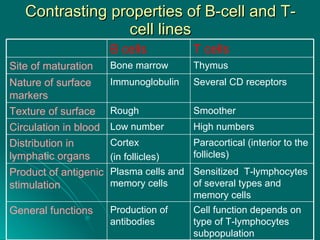
Contrasting properties of B-cell and T-cell lines Cell function depends on type of T-lymphocytes subpopulation Production of antibodies  General functions Sensitized  T-lymphocytes of several types and memory cells Plasma cells and memory cells Product of antigenic stimulation  Paracortical (interior to the follicles) Cortex  (in follicles) Distribution in lymphatic organs High numbers Low number Circulation in blood  Smoother  Rough  Texture of surface  Several CD receptors  Immunoglobulin  Nature of surface markers Thymus Bone marrow Site of maturation T cells B cells
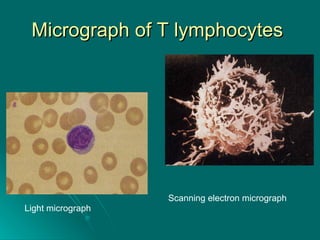
Micrograph of T lymphocytes  Light micrograph  Scanning electron micrograph
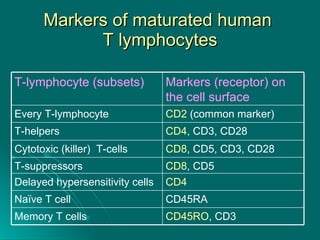
Markers of maturated human  T lymphocytes CD45RA Naïve T cell CD45RO , CD3 Memory T cells CD4 Delayed hypersensitivity cells CD8 , CD5 T-suppressors CD8 , CD5, CD3, CD28 Cytotoxic (killer)  T-cells CD4,  CD3, CD28 T-helpers CD2  (common marker) Every T-lymphocyte  Markers (receptor) on the cell surface  T-lymphocyte (subsets)
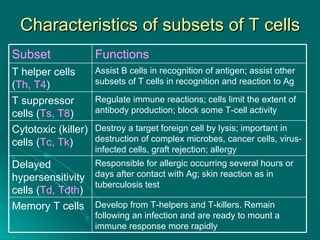
Characteristics of subsets of T cells Develop from T-helpers and T-killers. Remain following an infection and are ready to mount a immune response more rapidly Memory T cells Responsible for allergic occurring several hours or days after contact with Ag; skin reaction as in tuberculosis test Delayed hypersensitivity cells ( Td, Tdth ) Destroy a target foreign cell by lysis; important in destruction of complex microbes, cancer cells, virus-infected cells, graft rejection; allergy Cytotoxic (killer) cells ( Tc, Tk ) Regulate immune reactions; cells limit the extent of antibody production; block some T-cell activity T suppressor cells ( Ts, T8 ) Assist B cells in recognition of antigen; assist other subsets of T cells in recognition and reaction to Ag T helper cells ( Th, T4 ) Functions  Subset
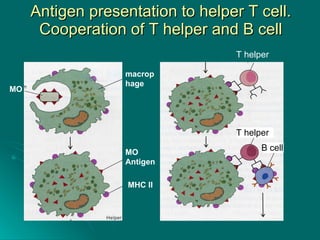
Antigen presentation to helper T cell. Cooperation of T helper and B cell T helper T helper B cell MO MO Antigen macrophage  MHC II
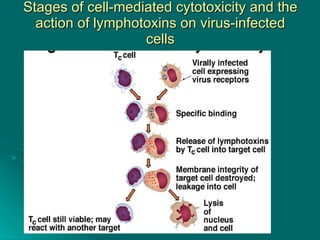
Stages of cell-mediated cytotoxicity and the action of lymphotoxins on virus-infected cells
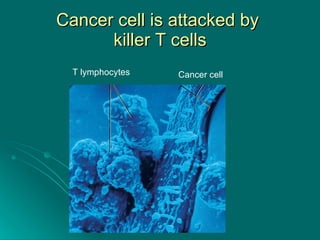
Cancer cell is attacked by  killer T cells T lymphocytes Cancer cell
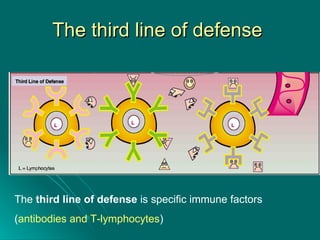
The third line of defense  The  third line of defense  is specific immune factors  ( antibodies and T-lymphocytes )
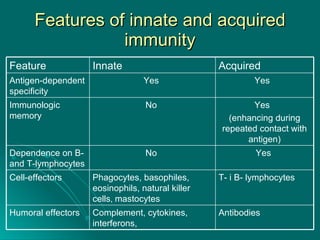
Features of innate and acquired immunity Antibodies  Complement, cytokines, interferons,  Humoral effectors  Т- і В-  lymphocytes  Phagocytes, basophiles, eosinophils, natural killer cells ,   mastocytes   Cell-effectors  Yes  No  Dependence on  В-  and  Т- lymphocytes  Yes  ( enhancing during repeated contact with antigen ) No  Immunologic memory  Yes  Yes  Antigen-dependent specificity  Acquired  Innate  Feature
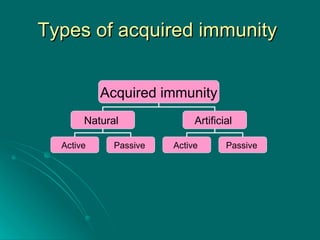
Types of acquired immunity  Acquired immunity Natural  Artificial  Active  Passive   Active   Passive
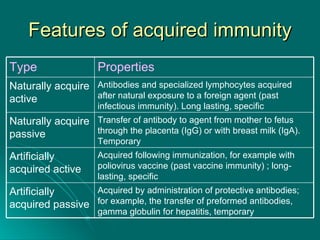
Features of acquired immunity Acquired by administration of protective antibodies; for example, the transfer of preformed antibodies, gamma globulin for hepatitis, temporary  Artificially acquired passive Acquired following immunization, for example with poliovirus vaccine (past vaccine immunity) ; long-lasting, specific Artificially acquired active Transfer of antibody to agent from mother to fetus through the placenta (IgG) or with breast milk (IgA). Temporary  Naturally acquire passive Antibodies and specialized lymphocytes acquired after natural exposure to a foreign agent (past infectious immunity). Long lasting, specific Naturally acquire active Properties   Type
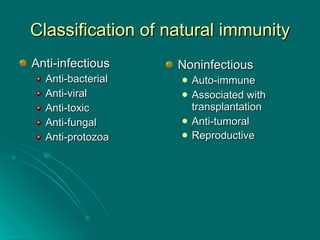
Classification of natural immunity Anti-infectious  Anti-bacterial Anti-viral Anti-toxic  Anti-fungal  Anti-protozoa  Noninfectious  Auto-immune  Associated with transplantation  Anti-tumoral  Reproductive
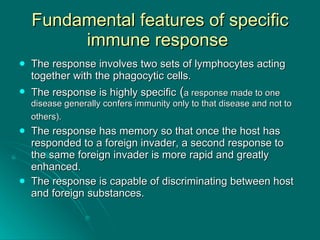
Fundamental features of specific immune response  The response involves two sets of lymphocytes acting together with the phagocytic cells. The response is highly specific  ( a response made to one disease generally confers immunity only to that disease and not to others).   The response has memory so that once the host has responded to a foreign invader, a second response to the same foreign invader is more rapid and greatly enhanced. The response is capable of discriminating between host and foreign substances.
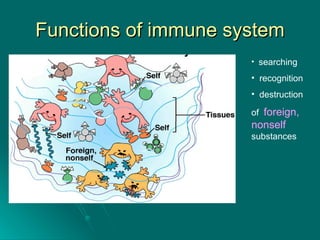
Functions of immune system searching recognition destruction of  foreign, nonself   substances
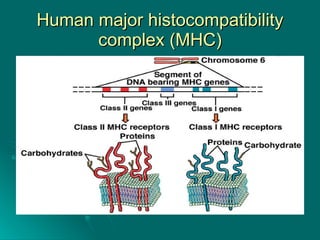
Human major histocompatibility complex (MHC)
Characteristic of MHC antigens MHC  –  M ajor  H istocompatibility  C omplex HLA  –  H uman  L eukocyte  A ntigen  This receptor complex plays a vital role in recognition of self by the immune system and in rejection of foreign tissue.  MHC I  antigen presents on the surface of every nucleus-contained cell and is marker of self. MHC I regulates acceptance or rejection of tissue grafts. MHC II  antigens located primarily  on macrophages and B cells and regulate immune response. It functions in cooperative immune responses to antigens mounted by these cells and T-cells.  MHC III  genes code for certain secreted complement components such as C2 and C4.
Antigens (Ag)  The word  antigen  is a combination of the words  anti body and  gen erator. Antigens  are substances that are genetically foreign and can trigger the development of specific immune reactions after penetration in organism
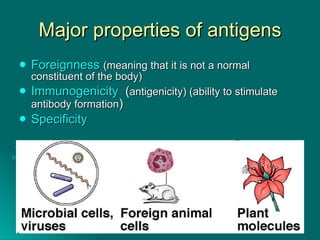
Major properties of antigens Foreignness   (meaning that it is not a normal constituent of the body) Immunogenicity   ( antigenicity) (ability to stimulate antibody formation ) Specificity
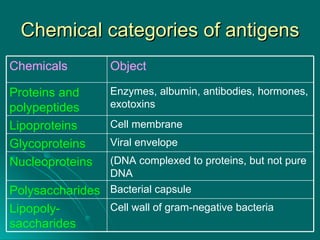
Chemical categories of antigens Cell wall of gram-negative bacteria  Lipopoly-saccharides  Bacterial capsule Polysaccharides  (DNA complexed to proteins, but not pure DNA Nucleoproteins  Viral envelope  Glycoproteins  Cell membrane Lipoproteins  Enzymes, albumin, antibodies, hormones, exotoxins Proteins and polypeptides  Object  Chemicals
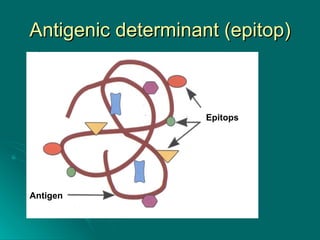
Antigenic determinant (epitop) Antigen  Epitops
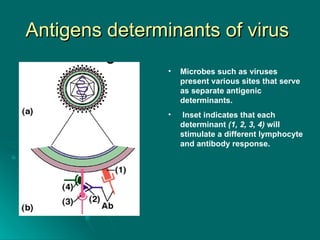
Antigens determinants of virus  Microbes such as viruses present various sites that serve as separate antigenic determinants.  Inset indicates that each determinant  (1, 2, 3, 4)  will stimulate a different lymphocyte and antibody response.
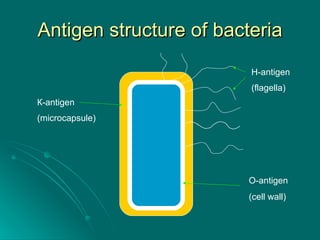
Antigen structure of bacteria О- antigen (cell wall) К- antigen (microcapsule)   Н- antigen (flagella)
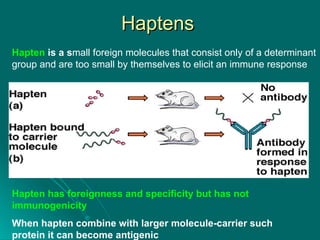
Haptens  Hapten  is a s mall foreign molecules that consist only of a determinant group and are too small by themselves to elicit an immune response   Hapten has foreignness and specificity but has not immunogenicity When hapten combine with larger molecule-carrier such protein it can become antigenic

Bohomolets Microbiology Lecture #10

  • 1.
    Immunology Immunesystem of organism. Antigens
  • 2.
    Features of immunesystem Situated in different parts of body Rapid regeneration Circulation of immune cells in the organism Possibility to “learn” Possibility to form a lasting memory
  • 3.
    General components ofimmune system Immune system consist of: Central organs: Thymus Red marrow bone Peripheral organs Spleen Tonsils Network of lymph nodes Lymphatic of intestine Appendix
  • 4.
    Red marrow bone Function: Production of blood cells (hemopoesis) Maturation of B cells
  • 5.
    The thymus glandFunctions: Differentiation and maturation of T-lymphocytes Synthesis of hormones (thymosin, thymolin) that influence to lymphocytes in blood stream.
  • 6.
    Lymph node Contain T-lymphocytes and B-lymphocytes Functions: filtration of particulate materials (microbes) and contribution of lymphocytes to the lymph as it passes through.
  • 7.
    Spleen Functions:Phagocytosis of foreign matter Immune reactions against bacteria Removes and breaks down worn erythrocytes
  • 8.
  • 9.
  • 10.
    Major circulating bloodcells of the bloodstream
  • 11.
  • 12.
    Major stages inthe development of B and T cells
  • 13.
  • 14.
    Parts of specificimmunity The humoral immune system involves the antibodies that are dissolved in the body fluids such as the blood, lymph, and mucus secretions The cell-mediated immune system involves lymphocytes known as T cells, they act directly on other cells. It is most effective against intracellular pathogens and eukaryotic agents
  • 15.
    Contrasting properties ofB-cell and T-cell lines Cell function depends on type of T-lymphocytes subpopulation Production of antibodies General functions Sensitized T-lymphocytes of several types and memory cells Plasma cells and memory cells Product of antigenic stimulation Paracortical (interior to the follicles) Cortex (in follicles) Distribution in lymphatic organs High numbers Low number Circulation in blood Smoother Rough Texture of surface Several CD receptors Immunoglobulin Nature of surface markers Thymus Bone marrow Site of maturation T cells B cells
  • 16.
    Micrograph of Tlymphocytes Light micrograph Scanning electron micrograph
  • 17.
    Markers of maturatedhuman T lymphocytes CD45RA Naïve T cell CD45RO , CD3 Memory T cells CD4 Delayed hypersensitivity cells CD8 , CD5 T-suppressors CD8 , CD5, CD3, CD28 Cytotoxic (killer) T-cells CD4, CD3, CD28 T-helpers CD2 (common marker) Every T-lymphocyte Markers (receptor) on the cell surface T-lymphocyte (subsets)
  • 18.
    Characteristics of subsetsof T cells Develop from T-helpers and T-killers. Remain following an infection and are ready to mount a immune response more rapidly Memory T cells Responsible for allergic occurring several hours or days after contact with Ag; skin reaction as in tuberculosis test Delayed hypersensitivity cells ( Td, Tdth ) Destroy a target foreign cell by lysis; important in destruction of complex microbes, cancer cells, virus-infected cells, graft rejection; allergy Cytotoxic (killer) cells ( Tc, Tk ) Regulate immune reactions; cells limit the extent of antibody production; block some T-cell activity T suppressor cells ( Ts, T8 ) Assist B cells in recognition of antigen; assist other subsets of T cells in recognition and reaction to Ag T helper cells ( Th, T4 ) Functions Subset
  • 19.
    Antigen presentation tohelper T cell. Cooperation of T helper and B cell T helper T helper B cell MO MO Antigen macrophage MHC II
  • 20.
    Stages of cell-mediatedcytotoxicity and the action of lymphotoxins on virus-infected cells
  • 21.
    Cancer cell isattacked by killer T cells T lymphocytes Cancer cell
  • 22.
    The third lineof defense The third line of defense is specific immune factors ( antibodies and T-lymphocytes )
  • 23.
    Features of innateand acquired immunity Antibodies Complement, cytokines, interferons, Humoral effectors Т- і В- lymphocytes Phagocytes, basophiles, eosinophils, natural killer cells , mastocytes Cell-effectors Yes No Dependence on В- and Т- lymphocytes Yes ( enhancing during repeated contact with antigen ) No Immunologic memory Yes Yes Antigen-dependent specificity Acquired Innate Feature
  • 24.
    Types of acquiredimmunity Acquired immunity Natural Artificial Active Passive Active Passive
  • 25.
    Features of acquiredimmunity Acquired by administration of protective antibodies; for example, the transfer of preformed antibodies, gamma globulin for hepatitis, temporary Artificially acquired passive Acquired following immunization, for example with poliovirus vaccine (past vaccine immunity) ; long-lasting, specific Artificially acquired active Transfer of antibody to agent from mother to fetus through the placenta (IgG) or with breast milk (IgA). Temporary Naturally acquire passive Antibodies and specialized lymphocytes acquired after natural exposure to a foreign agent (past infectious immunity). Long lasting, specific Naturally acquire active Properties Type
  • 26.
    Classification of naturalimmunity Anti-infectious Anti-bacterial Anti-viral Anti-toxic Anti-fungal Anti-protozoa Noninfectious Auto-immune Associated with transplantation Anti-tumoral Reproductive
  • 27.
    Fundamental features ofspecific immune response The response involves two sets of lymphocytes acting together with the phagocytic cells. The response is highly specific ( a response made to one disease generally confers immunity only to that disease and not to others). The response has memory so that once the host has responded to a foreign invader, a second response to the same foreign invader is more rapid and greatly enhanced. The response is capable of discriminating between host and foreign substances.
  • 28.
    Functions of immunesystem searching recognition destruction of foreign, nonself substances
  • 29.
  • 30.
    Characteristic of MHCantigens MHC – M ajor H istocompatibility C omplex HLA – H uman L eukocyte A ntigen This receptor complex plays a vital role in recognition of self by the immune system and in rejection of foreign tissue. MHC I antigen presents on the surface of every nucleus-contained cell and is marker of self. MHC I regulates acceptance or rejection of tissue grafts. MHC II antigens located primarily on macrophages and B cells and regulate immune response. It functions in cooperative immune responses to antigens mounted by these cells and T-cells. MHC III genes code for certain secreted complement components such as C2 and C4.
  • 31.
    Antigens (Ag) The word antigen is a combination of the words anti body and gen erator. Antigens are substances that are genetically foreign and can trigger the development of specific immune reactions after penetration in organism
  • 32.
    Major properties ofantigens Foreignness (meaning that it is not a normal constituent of the body) Immunogenicity ( antigenicity) (ability to stimulate antibody formation ) Specificity
  • 33.
    Chemical categories ofantigens Cell wall of gram-negative bacteria Lipopoly-saccharides Bacterial capsule Polysaccharides (DNA complexed to proteins, but not pure DNA Nucleoproteins Viral envelope Glycoproteins Cell membrane Lipoproteins Enzymes, albumin, antibodies, hormones, exotoxins Proteins and polypeptides Object Chemicals
  • 34.
  • 35.
    Antigens determinants ofvirus Microbes such as viruses present various sites that serve as separate antigenic determinants. Inset indicates that each determinant (1, 2, 3, 4) will stimulate a different lymphocyte and antibody response.
  • 36.
    Antigen structure ofbacteria О- antigen (cell wall) К- antigen (microcapsule) Н- antigen (flagella)
  • 37.
    Haptens Hapten is a s mall foreign molecules that consist only of a determinant group and are too small by themselves to elicit an immune response Hapten has foreignness and specificity but has not immunogenicity When hapten combine with larger molecule-carrier such protein it can become antigenic

Editor's Notes

  • #4 Central organs of immune system educate immune cells, peripheral organs directly realize immune response.
  • #5 The primary precursor of new blood cells is a pool of undifferentiated cells called pluripotential stem cells maintained in the marrow. During development, these stem cells proliferate and differentiate —meaning that immature or unspecialized cells develop the specialized form and function of mature cells. The primary lines of cells that arise from this process produce red blood cells (erythrocytes), white blood cells (leukocytes), and platelets (thrombocytes). The white blood cell lines are programmed to develop into several secondary lines of cells during the final process of differentiation.
  • #6 The size of the thymus is greatest proportionately at birth
  • #7 Lymph nodes are small, encapsulated, bean-shaped organs, usually in clusters, along lymphatic channels and large blood vessels. Both the location and architecture of these nodes clearly specialize them for filtering out materials that have entered the lymph and providing appropriate cells and niches for immune reactions. A view of a single sectioned lymph node reveals its filtering and cellular response systems. The central zone, or medulla* is the location of T cells, and the surrounding germinal centers in the cortex* are packed with B cells. This system of sinuses and discrete lymphocyte zones filters out particulate materials (microbes, for instance) and contributes lymphocytes to the lymph as it passes through. Many of the initial encounters between lymphocytes and microbes that result in specific immune responses occur in the lymph nodes
  • #8 The spleen is somewhat similar to a lymph node in its basic structure and function, except that the spleen circulates blood instead of lymph. The spleen serves as an important station for phagocytosis of foreign matter and immune reactions against bacteria and removes and breaks down worn erythrocytes.
  • #9 Each cell type in circulating blood (bottom row) is ultimately derived from an undifferentiated stem cell in the red marrow. During differentiation, the stem cell gives rise to several cell lines that become more and more specialized.
  • #10 Mature cells are released into the circulatory system.
  • #11 The picture shows the cell types and relative proportions of circulating white blood cells.
  • #20 In most immune reactions, the antigen must be further acted upon and formally presented to lymphocytes by special macrophages or other cells called antigen-processing cells (APCs). These large dendritic* cells engulf the antigen and modify is so that it will be more immunogenic and recognizable to lymphocytes. After processing is complete, the antigen is moved to the surface of the APC and bound to the MHC II receptor so that it will be readily accessible to the lymphocytes during presentation. The helper T cell that recognizes this antigen and MHC II can then interact with a B cell of the right recognition and activation.
  • #21 For a killer T cell to become activated, it must recognize foreign re­ceptors on a target cell and mount a direct attack upon it. After activation, the Tc cell delivers a dose of several cytokines that severely injures the target cell membrane (figure 15.21). This release of cytokines is followed by target cell death through a process called apoptosis
  • #23 The highly specific third line of defense is acquired on an individual basis as each foreign substance is encountered by white blood cells called lymphocytes. The reaction with each different microbe produces unique protective substances and cells that can come into play if that microbe is encountered again. The third line of defense provides long-term immunity.
  • #25 Acquired immunity occurs as the result of exposure to microorganisms or another foreign substance. Human acquires this immunity during ontogenesis. As a general rule, acquired immunity depends on a highly specific response against the invading agent. When natural im. – human acquired something (antibody or Ag in naturally pathway), when artificial – substance is entered in human organism artificially. When active immunity immune system works actively and produces Ab self-dependently, When passive im. organism receives preformed Antibodies.
  • #29 How immune cells discriminate self cells from foreign? On the picture self cells have white components. What is it?
  • #30 This gene complex gives rise to a series of glycoproteins (called MHC antigens) found on all cells except red blood cells. This receptor complex plays a vital role in recognition of self by the immune system and in rejection of foreign tissue. Genes that regulate and code for the MHC of humans are located on the sixth chromosome, clustered in a multigene complex of three subgroups called class I, class II, and class III
  • #31 Because these marks were first identified in humans on the surface of white blood cells, the MHC is also known as the human leukocyte antigen (HLA) system. If specialized immune cells have not find on the cells their own MHC I antigens, they perceive these cells as foreign.
  • #33 Whole microbes or their parts, cells, or substances that arise from other humans, animals, plants, and various molecules all possess this quality of foreignness and thus are potentially antigenic to the immune system of an individual
  • #35 A lymphocyte's capacity to discriminate differences in mo­lecular shape is so fine that it recognizes and responds to only a portion of the antigen molecule. This molecular fragment, called the antigenic determinant, is the primary signal that the molecule is foreign. The particular tertiary structure and shape of this determinant must conform like a key to the receptor "lock" of the lymphocyte, which then responds to it.
  • #38 are termed haptens. However, if such an incomplete antigen is linked to a larger carrier molecule, the combination develops immunogenicity