DR NILESH KATE
MBBS,MD
PROFESSOR
ESIC MEDICAL COLLEGE, GULBARGA.
DEPT. OF PHYSIOLOGY
Sexual Growth
and Development
OBJECTIVES
 PRE-PUBERTAL SEXUAL GROWTH AND
DEVELOPMENT
 Sex determination
 Sex differentiation
 Disorders of sexual development
Friday, June 19, 2020
SEX DETERMINATION
 Human chromosomes
 Human gametes
 Genetic sex determination
 Formation of Barr body
Friday, June 19, 2020
Sex determination
(Genetic differentiation)
 Genotype of the fetus,
whether male or
female.
 Determined by the
presence of sex
chromosomes,
 So also known as
chromosomal sex
differentiation
Friday, June 19, 2020
Human chromosomes
 Each cell in a normal adult male and female
possesses 46 chromosomes (44 autosomes +
2 sex chromosomes)
 Except ovum and sperm
Friday, June 19, 2020
Gametogenesis
Primitive
germ cells
oogonia
Meiosis
Reduction
division
Ova
22X
Friday, June 19, 2020
Primitive germ
cells
Spermatogonia
Meiosis
Reduction
division
Sperm
22Y
Genetic sex determination
 Occurs during
fertilization, i.e.
penetration of the
ovum by the sperm.
Friday, June 19, 2020
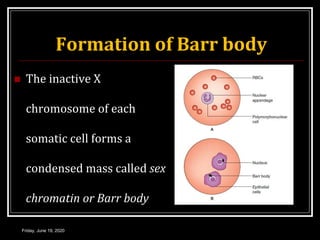
Formation of Barr body
 One of X chromosomes of
somatic cells in the female
embryo becomes inactive
while the other remains
active.
Friday, June 19, 2020
Formation of Barr body
 The inactive X
chromosome of each
somatic cell forms a
condensed mass called sex
chromatin or Barr body
Friday, June 19, 2020
Significance of Barr body
• By cytological tests.Identification
of sex
genotype
• In abnormal cells with 3
or more x chromosomes,
there are 2 or more barr
bodies.
Identification
of abnormal
genotype.
Friday, June 19, 2020
Sex differentiation
Friday, June 19, 2020
Gonadal Differentiation
 Gonadogenesis
 Formation of gonads, i.e. testes in males and
ovaries in females.
 Dependent on the genotype of the embryo.
Friday, June 19, 2020
Genital Ridge
 Condensation of
mesenchymal tissue
present on each side near
the adrenal glands.
 Proliferation of both
germinal and non-germinal
cells migrated to genital
ridge leads to formation of
bipotential gonads.
Friday, June 19, 2020
Bipotential Gonads
 Primordial or primitive or
indifferent or ambisexual
gonads.
 Up to 6 weeks of gestation
the bipotential gonads are
identical in both sexes
Friday, June 19, 2020
Structure.
 Consists of a medulla, a
cortex and primordial
germ cells.
 The germ cells are
embedded in the layer
of cortical epithelium
surrounding a core of
medullary
mesenchymal tissue
Friday, June 19, 2020
Testicular Differentiation
 At about 6th week
 At about eighth week
 At about ninth week
 At about the 35th week
Friday, June 19, 2020
At about 6th week
 Begins with the
appearance of primitive
seminiferous cords (sex
cords) from the
germinal epithelium
covering the medulla of
bipotential gonad
Friday, June 19, 2020
At about eighth week
 Leydig (interstitial) cells
appear in the interstitial
spaces of seminiferous
tubules and continue to
proliferate.
Friday, June 19, 2020
At about eighth week
 The membrane of Leydig cells has receptors
for human chorionic gonadotropins (HCG)
and for luteinizing hormone (LH).
Friday, June 19, 2020
At about ninth week
 The Leydig cells synthesize and secrete
testosterone in response to HCG secreted by
placenta.
Friday, June 19, 2020
At about the 35th week
 Occurs descent of testes through inguinal
canal into scrotum.
 Final stage of testicular differentiation.
Friday, June 19, 2020
Role of Y chromosome in
testicular differentiation
 Y chromosome contains
2 transcription genes,
 For Testicular
differentiation
 For the formation of
Mullerian duct inhibitory
substance (MIS)
Friday, June 19, 2020
Gene for testicular
differentiation
 Called SRY gene (Sex-determining region of
the Y chromosome)
 Encodes the testis-determining factor (TDF) -
triggers the testicular differentiation.
 The TDF gene product causes Sertoli cell
differentiation.
Friday, June 19, 2020
Ovarian Differentiation
 By 10th week occurs in the absence of TDF.
Friday, June 19, 2020
Genital Differentiation
 Differentiation of
internal genitalia
 Differentiation of
external genitalia
Friday, June 19, 2020
Differentiation Of Internal
Genitalia
 During 6th week - neutral sex anlagen develops
along with the development of bipotential gonad.
 The primordia consists of 2 ducts
 Paired set of Wolffian (male) ducts
 Paired set of Mullerian (female) ducts.
 By seventh week of gestation, the embryo has both
male and female primordial ducts
Friday, June 19, 2020
Differentiation Of Male
Internal Genitalia
 Leydig cells secrete
testosterone –stimulate
wolffian duct & forms
epididymis, vas
deferens & seminal
vesicles.
 The MIS causes
regression of the
Mullerian ducts by
apoptosis.
Friday, June 19, 2020
Differentiation Of Female
Internal Genitalia
 In the absence of MIS,
the female ducts
(Mullerian ducts)
proliferate and form
oviduct (uterine tubes),
uterus and upper two
thirds of vagina.
 In the absence of
testosterone, Wolffian
ducts degenerate.
Friday, June 19, 2020
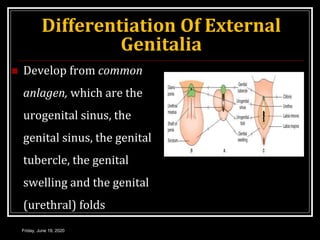
Differentiation Of External
Genitalia
 Develop from common
anlagen, which are the
urogenital sinus, the
genital sinus, the genital
tubercle, the genital
swelling and the genital
(urethral) folds
Friday, June 19, 2020
Differentiation Of External
Genitalia
 The external genitalia are bipotential till
eighth week of gestation,
 i.e. it can develop along either male or female
lines.
Friday, June 19, 2020
Psychological Differentiation
 It is determined by the effect of androgens
on the development of brain in the
embryonic stage.
Friday, June 19, 2020
Disorders Of Sexual
Development
 Chromosomal abnormalities.
 Hormonal abnormalities.
Friday, June 19, 2020
Chromosomal Abnormalities
 Trisomy
 Monosomy
Friday, June 19, 2020
Trisomy
 During gametogenesis
due to non-disjunction
of sex chromosomes.
 The presence of extra
X or Y chromosome
(Trisomy)
Friday, June 19, 2020
XXY pattern of chromosomes
 Klinefelter syndrome
 Characteristic features
 Poor development of testis
with hyalization of
seminiferous tubules, leading
to sterility. (seminiferous
dysgenesis.)
 Patient has normal male
internal and external
genitalia.
Friday, June 19, 2020
XXY Pattern Of Chromosomes
 Patients are usually tall
(due to growth of lower
body segment) and
obese.
 Gynaecomastia
(development of breast
in male).
 The secondary sex
characters are poorly
developed.
Friday, June 19, 2020
XXX (Genotype) Pattern Of
Chromosomes
 poor sexual development
(infantile), scanty
menstruation and mental
retardation.
 Low or normal plasma
testosterone level,
 High plasma level of
gonadotropins (LH and FSH),
 High plasma level of
oestradiol
 Positive sex chromatin test
Friday, June 19, 2020
Monosomy
 Turner’s syndrome.
 (karyotype) is 44 + XO
 ovarian dysgenesis because of XO karyotype.
 Puberty is delayed, scanty menstruation,
amenorrhoea (no menstruation), primary
infertility and amastia.
Friday, June 19, 2020
Turner Syndrome
 mental retardation
 Dwarfism.
 Webbed neck (folds of skin
on the side of the neck
 face is peculiar with low
hair line, ptosis (drooping
of eyelids),
 epicanthus (low set ears),
micrognathia (small jaw)
and co-arctation of aorta
Friday, June 19, 2020
Diagnosis Of Chromosomal
Abnormalities
 Amniocentesis - by inserting a needle into
the amniotic cavity through anterior
abdominal wall.
 Chorionic villus sampling - by a needle
biopsy of chorionic villi.
Friday, June 19, 2020
Hormonal Abnormalities
 Pseudohermaphroditism - individual
having genotype (gonads) of one sex (either
testes or ovaries) and genitalia of other sex.
 True hermaphroditism - gonads of both
sexes are present; its rare.
Friday, June 19, 2020
Pseudohermaphroditism
 Female – Genotypically
–female.
 Gonads and internal
genitalia are feminine
like (ovaries, oviduct
and uterus are present),
Friday, June 19, 2020
Pseudohermaphroditism
 But at pre-pubertal
age masculinization
occurs in the form of
diamond-shaped
pubic hair growth and
development of penis.
 Increased plasma
levels of testosterone
and androgens
Friday, June 19, 2020
Pseudohermaphroditism
 Male
 Androgen resistance – gynaecomastia
 Testicular feminising syndrome
 Defective testicular development.
 Congenital 17α hydroxylase deficiency –
deficient testosterone.
 Congenital blockade of pregnenolone
formation
Friday, June 19, 2020
THANK YOU

Sexual growth and development

  • 1.
    DR NILESH KATE MBBS,MD PROFESSOR ESICMEDICAL COLLEGE, GULBARGA. DEPT. OF PHYSIOLOGY Sexual Growth and Development
  • 2.
    OBJECTIVES  PRE-PUBERTAL SEXUALGROWTH AND DEVELOPMENT  Sex determination  Sex differentiation  Disorders of sexual development Friday, June 19, 2020
  • 3.
    SEX DETERMINATION  Humanchromosomes  Human gametes  Genetic sex determination  Formation of Barr body Friday, June 19, 2020
  • 4.
    Sex determination (Genetic differentiation) Genotype of the fetus, whether male or female.  Determined by the presence of sex chromosomes,  So also known as chromosomal sex differentiation Friday, June 19, 2020
  • 5.
    Human chromosomes  Eachcell in a normal adult male and female possesses 46 chromosomes (44 autosomes + 2 sex chromosomes)  Except ovum and sperm Friday, June 19, 2020
  • 6.
    Gametogenesis Primitive germ cells oogonia Meiosis Reduction division Ova 22X Friday, June19, 2020 Primitive germ cells Spermatogonia Meiosis Reduction division Sperm 22Y
  • 7.
    Genetic sex determination Occurs during fertilization, i.e. penetration of the ovum by the sperm. Friday, June 19, 2020
  • 8.
    Formation of Barrbody  One of X chromosomes of somatic cells in the female embryo becomes inactive while the other remains active. Friday, June 19, 2020
  • 9.
    Formation of Barrbody  The inactive X chromosome of each somatic cell forms a condensed mass called sex chromatin or Barr body Friday, June 19, 2020
  • 10.
    Significance of Barrbody • By cytological tests.Identification of sex genotype • In abnormal cells with 3 or more x chromosomes, there are 2 or more barr bodies. Identification of abnormal genotype. Friday, June 19, 2020
  • 11.
  • 12.
    Gonadal Differentiation  Gonadogenesis Formation of gonads, i.e. testes in males and ovaries in females.  Dependent on the genotype of the embryo. Friday, June 19, 2020
  • 13.
    Genital Ridge  Condensationof mesenchymal tissue present on each side near the adrenal glands.  Proliferation of both germinal and non-germinal cells migrated to genital ridge leads to formation of bipotential gonads. Friday, June 19, 2020
  • 14.
    Bipotential Gonads  Primordialor primitive or indifferent or ambisexual gonads.  Up to 6 weeks of gestation the bipotential gonads are identical in both sexes Friday, June 19, 2020
  • 15.
    Structure.  Consists ofa medulla, a cortex and primordial germ cells.  The germ cells are embedded in the layer of cortical epithelium surrounding a core of medullary mesenchymal tissue Friday, June 19, 2020
  • 16.
    Testicular Differentiation  Atabout 6th week  At about eighth week  At about ninth week  At about the 35th week Friday, June 19, 2020
  • 17.
    At about 6thweek  Begins with the appearance of primitive seminiferous cords (sex cords) from the germinal epithelium covering the medulla of bipotential gonad Friday, June 19, 2020
  • 18.
    At about eighthweek  Leydig (interstitial) cells appear in the interstitial spaces of seminiferous tubules and continue to proliferate. Friday, June 19, 2020
  • 19.
    At about eighthweek  The membrane of Leydig cells has receptors for human chorionic gonadotropins (HCG) and for luteinizing hormone (LH). Friday, June 19, 2020
  • 20.
    At about ninthweek  The Leydig cells synthesize and secrete testosterone in response to HCG secreted by placenta. Friday, June 19, 2020
  • 21.
    At about the35th week  Occurs descent of testes through inguinal canal into scrotum.  Final stage of testicular differentiation. Friday, June 19, 2020
  • 22.
    Role of Ychromosome in testicular differentiation  Y chromosome contains 2 transcription genes,  For Testicular differentiation  For the formation of Mullerian duct inhibitory substance (MIS) Friday, June 19, 2020
  • 23.
    Gene for testicular differentiation Called SRY gene (Sex-determining region of the Y chromosome)  Encodes the testis-determining factor (TDF) - triggers the testicular differentiation.  The TDF gene product causes Sertoli cell differentiation. Friday, June 19, 2020
  • 24.
    Ovarian Differentiation  By10th week occurs in the absence of TDF. Friday, June 19, 2020
  • 25.
    Genital Differentiation  Differentiationof internal genitalia  Differentiation of external genitalia Friday, June 19, 2020
  • 26.
    Differentiation Of Internal Genitalia During 6th week - neutral sex anlagen develops along with the development of bipotential gonad.  The primordia consists of 2 ducts  Paired set of Wolffian (male) ducts  Paired set of Mullerian (female) ducts.  By seventh week of gestation, the embryo has both male and female primordial ducts Friday, June 19, 2020
  • 27.
  • 28.
    Differentiation Of Male InternalGenitalia  Leydig cells secrete testosterone –stimulate wolffian duct & forms epididymis, vas deferens & seminal vesicles.  The MIS causes regression of the Mullerian ducts by apoptosis. Friday, June 19, 2020
  • 29.
    Differentiation Of Female InternalGenitalia  In the absence of MIS, the female ducts (Mullerian ducts) proliferate and form oviduct (uterine tubes), uterus and upper two thirds of vagina.  In the absence of testosterone, Wolffian ducts degenerate. Friday, June 19, 2020
  • 30.
    Differentiation Of External Genitalia Develop from common anlagen, which are the urogenital sinus, the genital sinus, the genital tubercle, the genital swelling and the genital (urethral) folds Friday, June 19, 2020
  • 31.
    Differentiation Of External Genitalia The external genitalia are bipotential till eighth week of gestation,  i.e. it can develop along either male or female lines. Friday, June 19, 2020
  • 32.
  • 33.
    Psychological Differentiation  Itis determined by the effect of androgens on the development of brain in the embryonic stage. Friday, June 19, 2020
  • 34.
    Disorders Of Sexual Development Chromosomal abnormalities.  Hormonal abnormalities. Friday, June 19, 2020
  • 35.
    Chromosomal Abnormalities  Trisomy Monosomy Friday, June 19, 2020
  • 36.
    Trisomy  During gametogenesis dueto non-disjunction of sex chromosomes.  The presence of extra X or Y chromosome (Trisomy) Friday, June 19, 2020
  • 37.
    XXY pattern ofchromosomes  Klinefelter syndrome  Characteristic features  Poor development of testis with hyalization of seminiferous tubules, leading to sterility. (seminiferous dysgenesis.)  Patient has normal male internal and external genitalia. Friday, June 19, 2020
  • 38.
    XXY Pattern OfChromosomes  Patients are usually tall (due to growth of lower body segment) and obese.  Gynaecomastia (development of breast in male).  The secondary sex characters are poorly developed. Friday, June 19, 2020
  • 39.
    XXX (Genotype) PatternOf Chromosomes  poor sexual development (infantile), scanty menstruation and mental retardation.  Low or normal plasma testosterone level,  High plasma level of gonadotropins (LH and FSH),  High plasma level of oestradiol  Positive sex chromatin test Friday, June 19, 2020
  • 40.
    Monosomy  Turner’s syndrome. (karyotype) is 44 + XO  ovarian dysgenesis because of XO karyotype.  Puberty is delayed, scanty menstruation, amenorrhoea (no menstruation), primary infertility and amastia. Friday, June 19, 2020
  • 41.
    Turner Syndrome  mentalretardation  Dwarfism.  Webbed neck (folds of skin on the side of the neck  face is peculiar with low hair line, ptosis (drooping of eyelids),  epicanthus (low set ears), micrognathia (small jaw) and co-arctation of aorta Friday, June 19, 2020
  • 42.
    Diagnosis Of Chromosomal Abnormalities Amniocentesis - by inserting a needle into the amniotic cavity through anterior abdominal wall.  Chorionic villus sampling - by a needle biopsy of chorionic villi. Friday, June 19, 2020
  • 43.
    Hormonal Abnormalities  Pseudohermaphroditism- individual having genotype (gonads) of one sex (either testes or ovaries) and genitalia of other sex.  True hermaphroditism - gonads of both sexes are present; its rare. Friday, June 19, 2020
  • 44.
    Pseudohermaphroditism  Female –Genotypically –female.  Gonads and internal genitalia are feminine like (ovaries, oviduct and uterus are present), Friday, June 19, 2020
  • 45.
    Pseudohermaphroditism  But atpre-pubertal age masculinization occurs in the form of diamond-shaped pubic hair growth and development of penis.  Increased plasma levels of testosterone and androgens Friday, June 19, 2020
  • 46.
    Pseudohermaphroditism  Male  Androgenresistance – gynaecomastia  Testicular feminising syndrome  Defective testicular development.  Congenital 17α hydroxylase deficiency – deficient testosterone.  Congenital blockade of pregnenolone formation Friday, June 19, 2020
  • 47.