SMALL
INTESTINE
LARGE
INTESTINE
MOTILITY
DR.NILESH KATE.
M.D.
ASSOCIATE PROFESSOR,
DEPARTMENT OF PHYSIOLOGY,
ESIC MEDICAL COLLEGE & HOSPITAL,
GULBARGA.
GENERAL PRINCIPLES OF
GASTROINTESTINAL FUNCTIONS
 Motility. -- characteristics
 Functional syncytium.
 3layers of smooth muscles
of intestine.
 Functional types of
gastrointestinal
movements
GENERAL PRINCIPLES OF
GASTROINTESTINAL FUNCTIONS
 Propulsive
 Contraction ring
 Receptive relaxation.
 Mixing
 Peristaltic contractions
 Local constrictive contractions.
SMALL INTESTINE MOTILITY
 DURING INTERDIGESTIVE PERIOD
 DURING DIGESTIVE PERIOD
 MOTILITY REFLEXES.
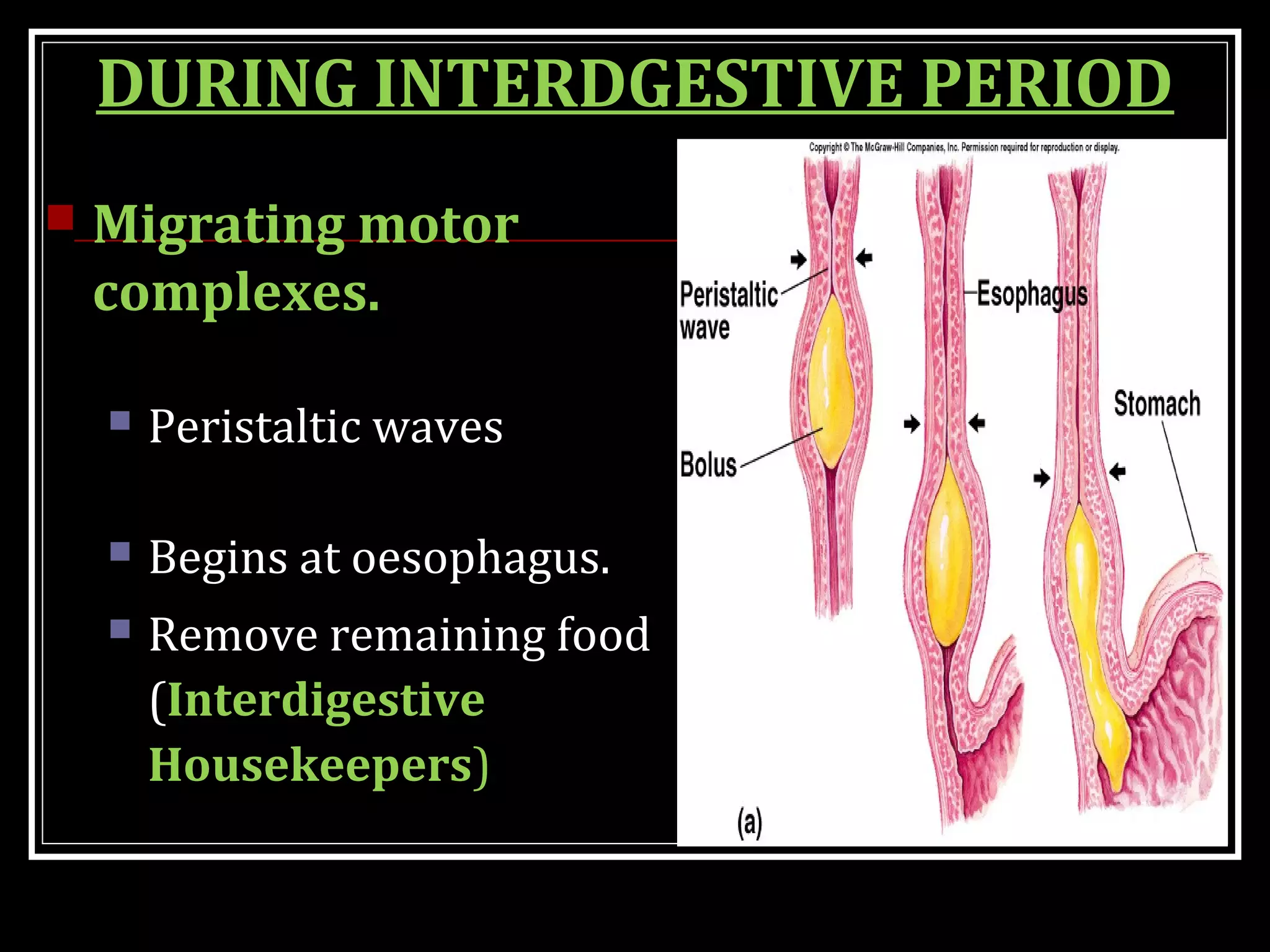
DURING INTERDGESTIVE PERIOD
 Migrating motor
complexes.
 Peristaltic waves
 Begins at oesophagus.
 Remove remaining food
(Interdigestive
Housekeepers)
Migrating Motor Complexes.
 RATE- Regular 5 cm/min every 60-90 min.
 Close correlation between BER & MMC.
 Associated with increase in gastric secretion, bile
flow & pancreatic secretion.
 Abolished immediately with entry of food.
DURING DIGESTIVE PERIOD
 Mixing movements
 Propulsive movements
 Movements of villi.
Mixing movements
 Responsible for mixing of chyme with digestive
juices ( intestine, bile, Pancreatic)
 Includes
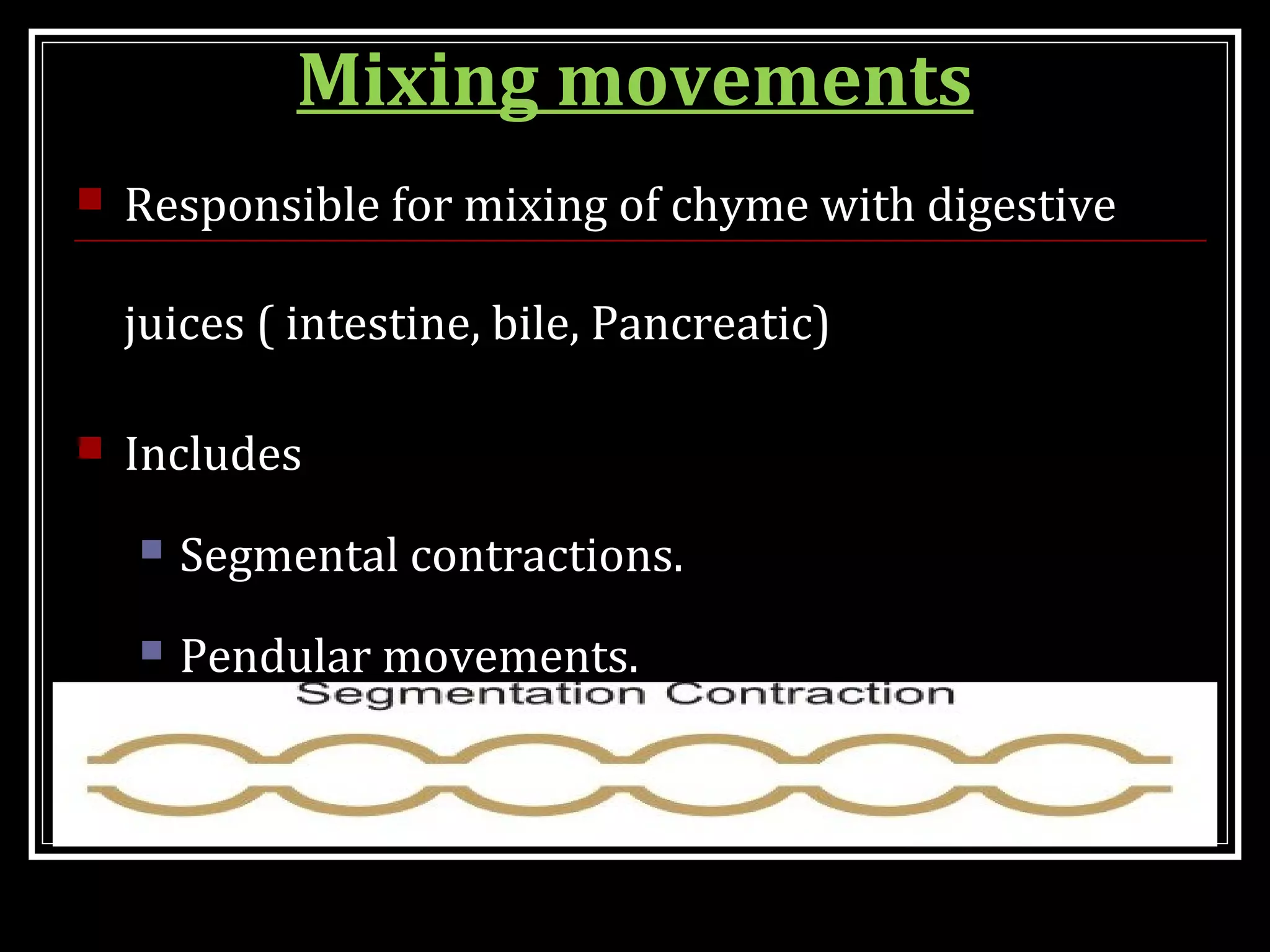
 Segmental contractions.
 Pendular movements.
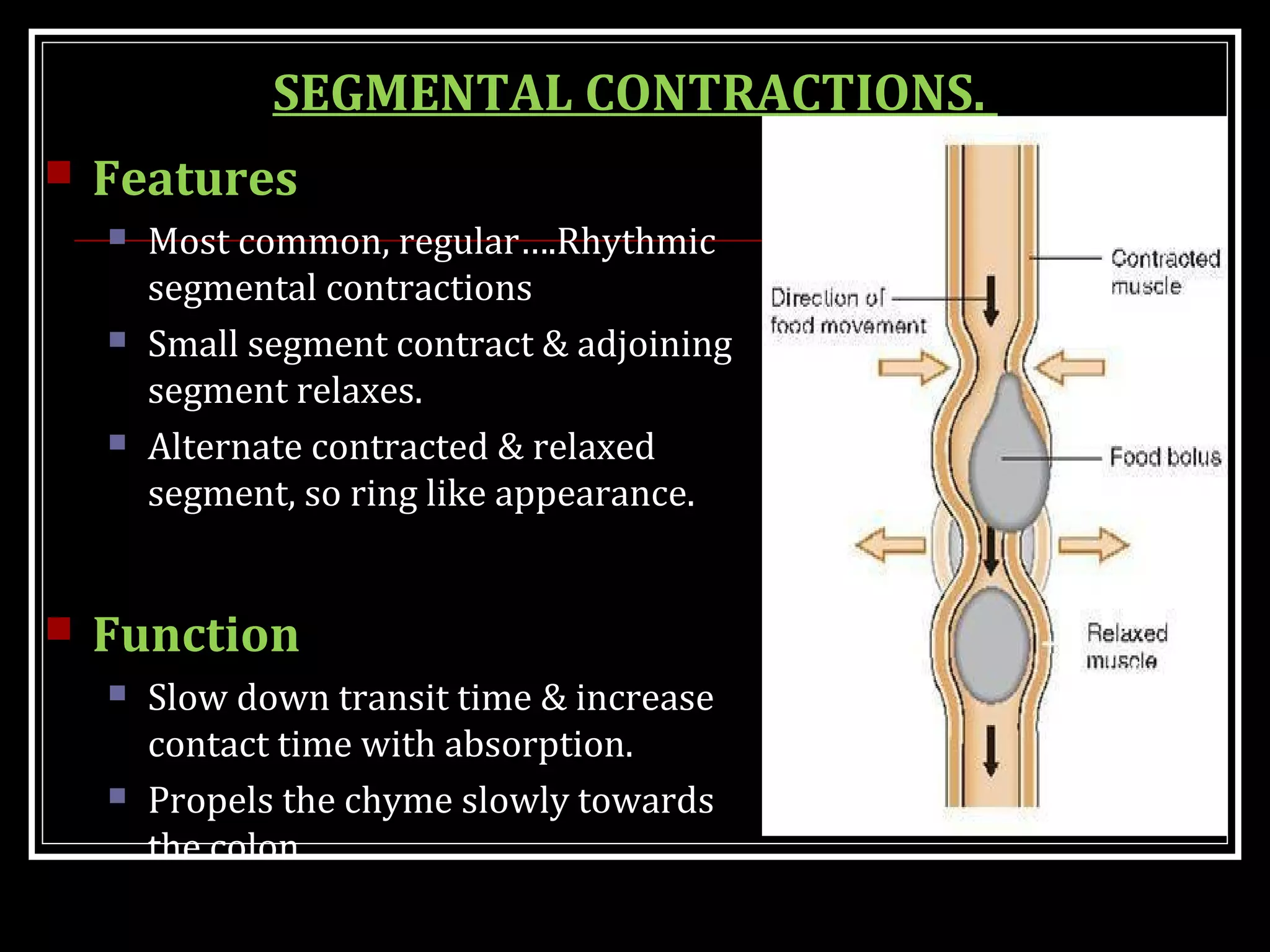
SEGMENTAL CONTRACTIONS.
 Features
 Most common, regular….Rhythmic
segmental contractions
 Small segment contract & adjoining
segment relaxes.
 Alternate contracted & relaxed
segment, so ring like appearance.
 Function
 Slow down transit time & increase
contact time with absorption.
 Propels the chyme slowly towards
the colon.
SEGMENTAL CONTRACTIONS. (cont…)
 Rate & duration.
 12 times/ min ( duodenum)
 8 times / min (ileum)
 Types (2 types)
 Eccentric ( lesser than 2 cm in length)
 Concentric (longer than 2cm in length)
 Control
 Initiation
 Occur only when slow waves (BER) produces spikes or action
potential.
 Frequency
 Directly related to frequency of slow waves & controlled by
pacemaker cells.
 Strength
 Proportional to frequency of spikes generated by slow waves.
PENDULAR MOVEMENTS.
 Small constrictive waves sweep forward &
backward or upward & downward in
pendular fashion.
Propulsive movements
 Involved in pushing the
chyme towards the aboral
end.
 These include
 Peristaltic contractions
 Peristaltic rush.
PERISTALTIC CONTRACTIONS
 Features.
 Wave of contraction
preceded by wave of
relaxation.
 Highly coordinated,
involve contraction of
segment behind bolus &
relaxation in front.
 Consists of deep circular
ring @ 0.5 to 2 cm/sec.
 Chyme move @ 1cm/min.
so 3-4 hrs from pylorus to
iliocecal valve.
Law of intestine.
 Starling (1901)
 Polarity of intestine, Polar conduction of intestine,
Electrical activity of intestine, Law of gut, Theory
of receptive relaxation.
 “Peristaltic contraction travels from point of
stimulation in both direction but contraction
in oral direction disappears & persists in
aboral direction.”
PERISTALTIC CONTRACTIONS
 Functions
 Propel food.
 Digestion & absorption.
 Control
 Initiation
 Stimulus – distention.
(myentric reflex).
 Rate – 2-2.5 cm/sec.
Local stretch
Releases SEROTONIN
Activate sensory neurons
Stimulate myentric plexus
Activity travels in either
direction to release
Ach & sub P —Circular
constriction.
NO & VIP, ATP – Receptive
relaxation.
PERISTALTIC CONTRACTIONS
PERISTALTIC RUSH.
 Very powerful peristaltic contractions
 When intestinal mucosa irritated
 Partly initiated by extrinsic nervous system & partly by
myentric reflex.
 Begins in duodenum through entire length up to iliocecal
valve.
 Relieve small intestine irritant or extensive distention.
 E.g. ---Diarrhoea.
Movements of villi.
 Features
 Consists of alternate shortening & elongation of
villi by contraction & relaxation of muscles.
 Initiation.
 Local nervous reflexes.
 Villikinin.– hormone from small intestine mucosa.
Movements of villi.
 Functions
 Help in emptying
lymph from central
lacteal into the
lymphatic system.
 Increases surface area
so absorption
MOTILITY REFLEXES.
 Gastroileal reflex.
 Distention of stomach by food.
 Reflex stimulation of vagus.
 Relaxation of iliocecal sphincter
 Intestinointesinal reflex.
 Over distention of one segment
 Relaxation of smooth muscle of rest of
intestine.
APPLIED
 PARALYTIC ILEUS.
 INTESTINAL
OBSTRUCTION.
PARALYTIC ILEUS.
 Adynamic ileus.
 Pathophysiology –
intestinal motility
markedly decreased
leads to retention of
contents
 Irregular distension of
small intestine by
pockets of gas & fluids.
 Causes ---
 Direct inhibition of
smooth muscle of small
intestine due to handling
of intestine. e.g.
Intraabdominal
operations & trauma.
 Reflex inhibition due to
increased discharge of
noradrenergic fibres in
splanchnic nerves.
Wednesday, April 22, 2015
INTESTINAL OBSTRUCTION.
 Causes –
 Due to tumors,
strictures and fibrotic
bands in abdomen.
 Features –
 Intestinal colic – severe
pain due to peristaltic rush.
 Distension of small
intestine due to increased
intraluminal pressure.
 Local ischemia.
 Sweating , hypotension &
severe vomiting due to
stimulation of visceral afferent
nerves.
 When obstruction in upper
part of small intestine—
antiperistaltic reflux causes
intestinal juices to flow into
stomach.
 When obstruction in upper
part of small intestine— vomit
become more basic than
acidic.
Wednesday, April 22, 2015
LARGE INTESTINE MOTILITY.
 Slow wave activity.
 Coordinated by BER Or Slow wave
activity (SWA)
 Frequency of SWA gradually increase
down the LI.
 9/min – iliocecal valve to 16/min at
sigmoid colon.
LARGE INTESTINE MOVEMENTS.
 Functions
 Absorption of water & electrolyte from chyme
(Proximal)
 Storage of faecal matter.(Distal)
 Contractile activity serves 2 main functions
 Increase efficacy for absorption
 Promotes excretion of faecal matter.
TYPES
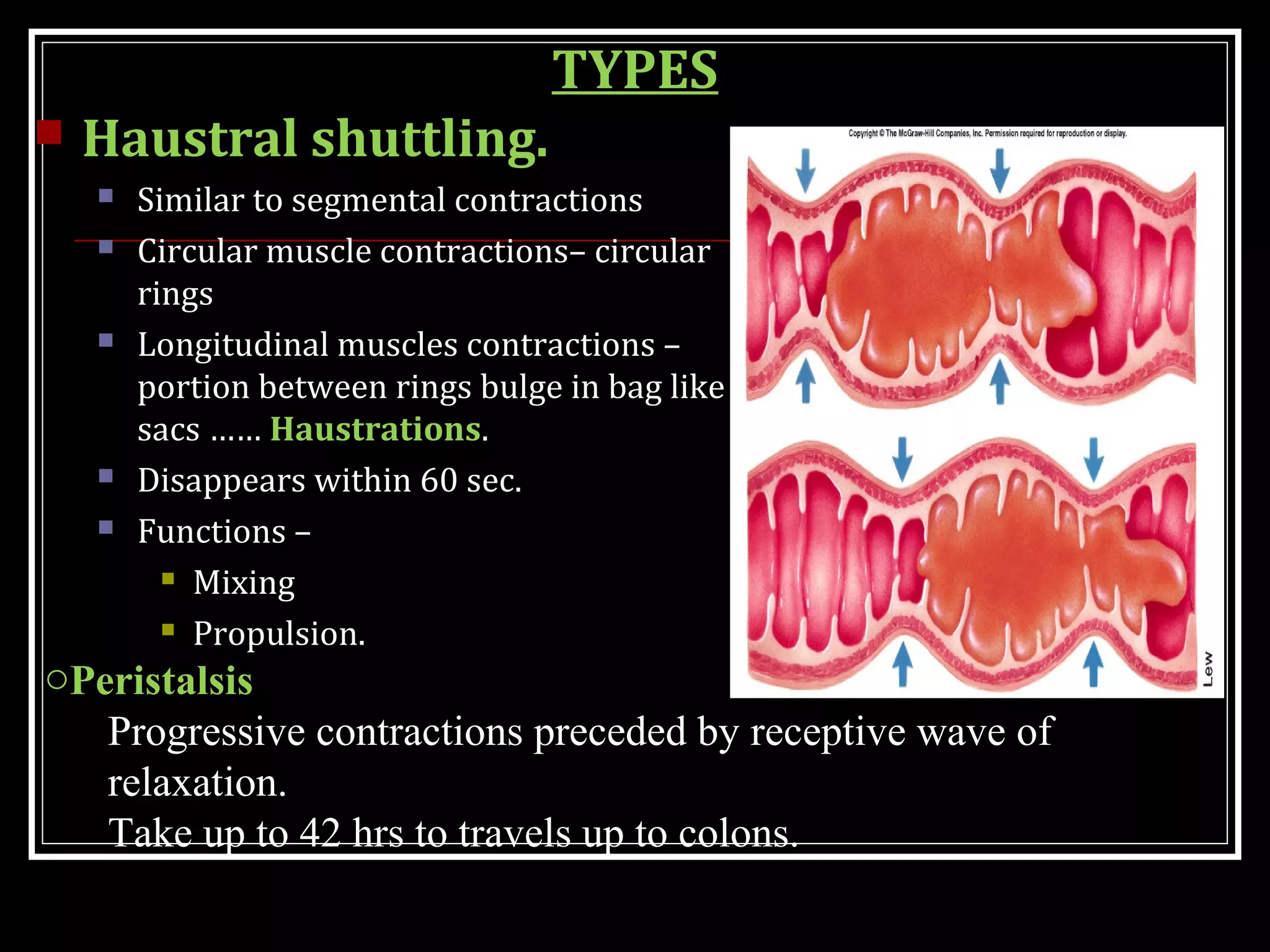
 Haustral shuttling.
 Similar to segmental contractions
 Circular muscle contractions– circular
rings
 Longitudinal muscles contractions –
portion between rings bulge in bag like
sacs …… Haustrations.
 Disappears within 60 sec.
 Functions –
 Mixing
 Propulsion.
oPeristalsis
Progressive contractions preceded by receptive wave of
relaxation.
Take up to 42 hrs to travels up to colons.
TYPES
 Mass movements.
 Special types of peristaltic contractions in colon only.
 3-4 times a day after a meals.
 Contraction of the smooth muscle over a large area distal to the
constriction.
 Force faecal matter into rectum initiate defecation reflex.
 Can be initiated by
 Gastro colic reflex
 Intense stimulation of parasympathetic nerves.
 Over distention of segment of colon.
DEFAECATION REFLEX.
 Functional anatomy.
 Internal anal sphincter
(involuntary) circular
smooth muscle of
pelvirectal flexure.
 Parasymp– inhibitory
 Symp – excitatory.
 External anal sphincter.
Somatic skeletal muscles
supplied by pudendal
nerves.
DEFAECATION REFLEX.
 Act of defaecation
 Involves both – voluntary & reflex activity.
 Reflex contraction of distal colon & rectum –
propel faecal matter in anal canal.
 Reflex relaxation of internal anal sphincter.
 Reflex relaxation with voluntary control of Ext
anal sphincter & voluntary contraction of
abdominal muscles.
EVENTS ASSOCIATED
 Distention of rectum.—
 Usually rectum is empty as
frequency of contractions is
greater in rectum than in
sigmoid colon leads to
retrograde movements of
fecal materials.
 Gastrocolic reflex pushes
faeces into rectum
increases intrarectal
pressure passively.
Defaecation reflexes.
Intrinsic reflex.
Mediated by intrinsic nerve
plexus.
Distension of rectum
initiate afferents through
myentric plexus. ---
Initiate peristalsis in
descending colon,
sigmoid colon, rectum –--
Increase intra-rectal
pressure. --- Relaxation of
internal anal sphincter.
 Spinal cord reflex.
 Distension of rectum by
faeces – afferent through
pelvic nerves to sacral
part of spinal cord –--
reflex parasympathetic
discharge & pelvic
splanchnic nerves to cause
--- intense peristaltic
contractions --- rectal
pressure above 55 mm Hg.
 Relaxation of internal &
external anal sphincter.
Wednesday, April 22, 2015
EVENTS ASSOCIATED
 Role of voluntary control on defaecation.
 When defeacation is Not allowed --- voluntary control
maintains contraction of external anal sphincter by
pudendal nerves – internal sphincter also closes ---
rectum relaxes to accommodate more faecal matter.
 When defeacation is allowed. --- external sphincter
relaxed voluntarily --- intra abdominal pressure raised by
Valsalva manoeuvre. --- smooth muscle of distal colon &
rectum contract forcefully & propel faecal matter outside.
 Voluntary initiation of defaecation. --- before pressure
reached that relaxes both sphincters (less than 55mmhg
& more than 18mm Hg) ---by voluntary relaxing external
sphincter & contracting abdominal muscles.
APPLIED
 Defaecation in Infants. – automatic emptying
of lower bowel without voluntary control.
 Individuals with spinal cord transactions.
--- initially retention of faeces occurs --- later
reflex returns quickly --- as rectal pressure
reaches 55 mm Hg reflex evacuation occurs
automatically.
 Role of dietary fibres. – increases bulk of
faeces & play a role in distending rectum.
APPLIED
 Hirschsprung’s disease –
Aganglionic mega colon
--- congenital absence of
Auerbach’s plexus in wall of
rectosigmoid region.
 Blockage of peristalsis &mass
contractions
 Leads to dilatation of colon.
 Treatment --- cutting
Aganglionic portion of pelvic-
rectal junction & anastomosing
cut ends.
 Constipation.---
 Failure of voiding of
faeces --- due to
infrequent mass
movements in colon –
faeces remain in colon for
longer time – becomes
hard & dry due to fluid
absorption.
 Due to irregular bowel
habits.
Wednesday, April 22, 2015
THANK YOU.

INTESTINE MOTILITY

  • 1.
  • 2.
    GENERAL PRINCIPLES OF GASTROINTESTINALFUNCTIONS  Motility. -- characteristics  Functional syncytium.  3layers of smooth muscles of intestine.  Functional types of gastrointestinal movements
  • 3.
    GENERAL PRINCIPLES OF GASTROINTESTINALFUNCTIONS  Propulsive  Contraction ring  Receptive relaxation.  Mixing  Peristaltic contractions  Local constrictive contractions.
  • 4.
    SMALL INTESTINE MOTILITY DURING INTERDIGESTIVE PERIOD  DURING DIGESTIVE PERIOD  MOTILITY REFLEXES.
  • 5.
    DURING INTERDGESTIVE PERIOD Migrating motor complexes.  Peristaltic waves  Begins at oesophagus.  Remove remaining food (Interdigestive Housekeepers)
  • 6.
    Migrating Motor Complexes. RATE- Regular 5 cm/min every 60-90 min.  Close correlation between BER & MMC.  Associated with increase in gastric secretion, bile flow & pancreatic secretion.  Abolished immediately with entry of food.
  • 7.
    DURING DIGESTIVE PERIOD Mixing movements  Propulsive movements  Movements of villi.
  • 8.
    Mixing movements  Responsiblefor mixing of chyme with digestive juices ( intestine, bile, Pancreatic)  Includes  Segmental contractions.  Pendular movements.
  • 9.
    SEGMENTAL CONTRACTIONS.  Features Most common, regular….Rhythmic segmental contractions  Small segment contract & adjoining segment relaxes.  Alternate contracted & relaxed segment, so ring like appearance.  Function  Slow down transit time & increase contact time with absorption.  Propels the chyme slowly towards the colon.
  • 10.
    SEGMENTAL CONTRACTIONS. (cont…) Rate & duration.  12 times/ min ( duodenum)  8 times / min (ileum)  Types (2 types)  Eccentric ( lesser than 2 cm in length)  Concentric (longer than 2cm in length)  Control  Initiation  Occur only when slow waves (BER) produces spikes or action potential.  Frequency  Directly related to frequency of slow waves & controlled by pacemaker cells.  Strength  Proportional to frequency of spikes generated by slow waves.
  • 11.
    PENDULAR MOVEMENTS.  Smallconstrictive waves sweep forward & backward or upward & downward in pendular fashion.
  • 12.
    Propulsive movements  Involvedin pushing the chyme towards the aboral end.  These include  Peristaltic contractions  Peristaltic rush.
  • 13.
    PERISTALTIC CONTRACTIONS  Features. Wave of contraction preceded by wave of relaxation.  Highly coordinated, involve contraction of segment behind bolus & relaxation in front.  Consists of deep circular ring @ 0.5 to 2 cm/sec.  Chyme move @ 1cm/min. so 3-4 hrs from pylorus to iliocecal valve.
  • 14.
    Law of intestine. Starling (1901)  Polarity of intestine, Polar conduction of intestine, Electrical activity of intestine, Law of gut, Theory of receptive relaxation.  “Peristaltic contraction travels from point of stimulation in both direction but contraction in oral direction disappears & persists in aboral direction.”
  • 15.
    PERISTALTIC CONTRACTIONS  Functions Propel food.  Digestion & absorption.  Control  Initiation  Stimulus – distention. (myentric reflex).  Rate – 2-2.5 cm/sec. Local stretch Releases SEROTONIN Activate sensory neurons Stimulate myentric plexus Activity travels in either direction to release Ach & sub P —Circular constriction. NO & VIP, ATP – Receptive relaxation.
  • 16.
  • 17.
    PERISTALTIC RUSH.  Verypowerful peristaltic contractions  When intestinal mucosa irritated  Partly initiated by extrinsic nervous system & partly by myentric reflex.  Begins in duodenum through entire length up to iliocecal valve.  Relieve small intestine irritant or extensive distention.  E.g. ---Diarrhoea.
  • 18.
    Movements of villi. Features  Consists of alternate shortening & elongation of villi by contraction & relaxation of muscles.  Initiation.  Local nervous reflexes.  Villikinin.– hormone from small intestine mucosa.
  • 19.
    Movements of villi. Functions  Help in emptying lymph from central lacteal into the lymphatic system.  Increases surface area so absorption
  • 20.
    MOTILITY REFLEXES.  Gastroilealreflex.  Distention of stomach by food.  Reflex stimulation of vagus.  Relaxation of iliocecal sphincter  Intestinointesinal reflex.  Over distention of one segment  Relaxation of smooth muscle of rest of intestine.
  • 21.
    APPLIED  PARALYTIC ILEUS. INTESTINAL OBSTRUCTION.
  • 22.
    PARALYTIC ILEUS.  Adynamicileus.  Pathophysiology – intestinal motility markedly decreased leads to retention of contents  Irregular distension of small intestine by pockets of gas & fluids.  Causes ---  Direct inhibition of smooth muscle of small intestine due to handling of intestine. e.g. Intraabdominal operations & trauma.  Reflex inhibition due to increased discharge of noradrenergic fibres in splanchnic nerves. Wednesday, April 22, 2015
  • 23.
    INTESTINAL OBSTRUCTION.  Causes–  Due to tumors, strictures and fibrotic bands in abdomen.  Features –  Intestinal colic – severe pain due to peristaltic rush.  Distension of small intestine due to increased intraluminal pressure.  Local ischemia.  Sweating , hypotension & severe vomiting due to stimulation of visceral afferent nerves.  When obstruction in upper part of small intestine— antiperistaltic reflux causes intestinal juices to flow into stomach.  When obstruction in upper part of small intestine— vomit become more basic than acidic. Wednesday, April 22, 2015
  • 24.
    LARGE INTESTINE MOTILITY. Slow wave activity.  Coordinated by BER Or Slow wave activity (SWA)  Frequency of SWA gradually increase down the LI.  9/min – iliocecal valve to 16/min at sigmoid colon.
  • 25.
    LARGE INTESTINE MOVEMENTS. Functions  Absorption of water & electrolyte from chyme (Proximal)  Storage of faecal matter.(Distal)  Contractile activity serves 2 main functions  Increase efficacy for absorption  Promotes excretion of faecal matter.
  • 26.
    TYPES  Haustral shuttling. Similar to segmental contractions  Circular muscle contractions– circular rings  Longitudinal muscles contractions – portion between rings bulge in bag like sacs …… Haustrations.  Disappears within 60 sec.  Functions –  Mixing  Propulsion. oPeristalsis Progressive contractions preceded by receptive wave of relaxation. Take up to 42 hrs to travels up to colons.
  • 27.
    TYPES  Mass movements. Special types of peristaltic contractions in colon only.  3-4 times a day after a meals.  Contraction of the smooth muscle over a large area distal to the constriction.  Force faecal matter into rectum initiate defecation reflex.  Can be initiated by  Gastro colic reflex  Intense stimulation of parasympathetic nerves.  Over distention of segment of colon.
  • 28.
    DEFAECATION REFLEX.  Functionalanatomy.  Internal anal sphincter (involuntary) circular smooth muscle of pelvirectal flexure.  Parasymp– inhibitory  Symp – excitatory.  External anal sphincter. Somatic skeletal muscles supplied by pudendal nerves.
  • 29.
    DEFAECATION REFLEX.  Actof defaecation  Involves both – voluntary & reflex activity.  Reflex contraction of distal colon & rectum – propel faecal matter in anal canal.  Reflex relaxation of internal anal sphincter.  Reflex relaxation with voluntary control of Ext anal sphincter & voluntary contraction of abdominal muscles.
  • 30.
    EVENTS ASSOCIATED  Distentionof rectum.—  Usually rectum is empty as frequency of contractions is greater in rectum than in sigmoid colon leads to retrograde movements of fecal materials.  Gastrocolic reflex pushes faeces into rectum increases intrarectal pressure passively.
  • 31.
    Defaecation reflexes. Intrinsic reflex. Mediatedby intrinsic nerve plexus. Distension of rectum initiate afferents through myentric plexus. --- Initiate peristalsis in descending colon, sigmoid colon, rectum –-- Increase intra-rectal pressure. --- Relaxation of internal anal sphincter.  Spinal cord reflex.  Distension of rectum by faeces – afferent through pelvic nerves to sacral part of spinal cord –-- reflex parasympathetic discharge & pelvic splanchnic nerves to cause --- intense peristaltic contractions --- rectal pressure above 55 mm Hg.  Relaxation of internal & external anal sphincter. Wednesday, April 22, 2015
  • 32.
    EVENTS ASSOCIATED  Roleof voluntary control on defaecation.  When defeacation is Not allowed --- voluntary control maintains contraction of external anal sphincter by pudendal nerves – internal sphincter also closes --- rectum relaxes to accommodate more faecal matter.  When defeacation is allowed. --- external sphincter relaxed voluntarily --- intra abdominal pressure raised by Valsalva manoeuvre. --- smooth muscle of distal colon & rectum contract forcefully & propel faecal matter outside.  Voluntary initiation of defaecation. --- before pressure reached that relaxes both sphincters (less than 55mmhg & more than 18mm Hg) ---by voluntary relaxing external sphincter & contracting abdominal muscles.
  • 33.
    APPLIED  Defaecation inInfants. – automatic emptying of lower bowel without voluntary control.  Individuals with spinal cord transactions. --- initially retention of faeces occurs --- later reflex returns quickly --- as rectal pressure reaches 55 mm Hg reflex evacuation occurs automatically.  Role of dietary fibres. – increases bulk of faeces & play a role in distending rectum.
  • 34.
    APPLIED  Hirschsprung’s disease– Aganglionic mega colon --- congenital absence of Auerbach’s plexus in wall of rectosigmoid region.  Blockage of peristalsis &mass contractions  Leads to dilatation of colon.  Treatment --- cutting Aganglionic portion of pelvic- rectal junction & anastomosing cut ends.  Constipation.---  Failure of voiding of faeces --- due to infrequent mass movements in colon – faeces remain in colon for longer time – becomes hard & dry due to fluid absorption.  Due to irregular bowel habits. Wednesday, April 22, 2015
  • 35.