DR NILESH KATE
MBBS,MD
PROFESSOR
ESIC MEDICAL COLLEGE, GULBARGA.
DEPT. OF PHYSIOLOGY
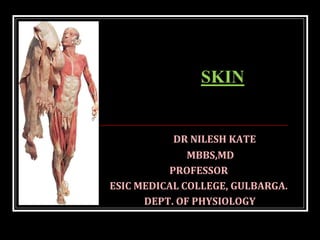
SKIN
OBJECTIVES.
 Introduction
 Functions
 Layers
 Colours
 Appendages
 Glands
 Disorders
 Tumors & its role in temperature regulation.
The Integumentary System
 Integument is skin
 Skin and its appendages make up the
Integumentary system
 A fatty layer (hypodermis) lies deep to it
 Two distinct regions
 Epidermis
 Dermis
Functions of skin
 Protection
 Cushions and insulates and is waterproof
 Protects from chemicals, heat, cold, bacteria
 Screens UV
 Synthesizes vitamin D with UV
 Regulates body heat
 Prevents unnecessary water loss
 Sensory reception (nerve endings)
Epidermis
 Keratinized stratified squamous epithelium
 Four types of cells
 Keratinocytes – deepest, produce keratin
(tough fibrous protein)
 Melanocytes - make dark skin pigment melanin
 Merkel cells – associated with sensory nerve
endings
 Langerhans cells – Macrophage-like dendritic
cells
(see figure on next slide)
Epidermis
 Layers (from deep to superficial)
 Stratum basale or germinativum – single row of cells
attached to dermis; youngest cells
 Stratum spinosum – spinyness is artifactual;
tonofilaments (bundles of protein) resist tension
 Stratum granulosum – layers of flattened
keratinocytes producing keratin (hair and nails made
of it also)
 Stratum lucidum (only on palms and soles)
 Stratum corneum – horny layer (cells dead, many
layers thick)
Friday, June 19, 2020
Epithelium: layers (on left) and cell types (on
right)
Remember…
 Four basic types of tissue
 Epithelium – epidermis just discussed
 Connective tissue - dermis
 Muscle tissue
 Nervous tissue
Dermis
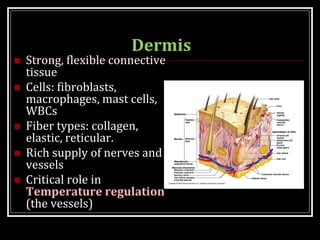
 Strong, flexible connective
tissue
 Cells: fibroblasts,
macrophages, mast cells,
WBCs
 Fiber types: collagen,
elastic, reticular.
 Rich supply of nerves and
vessels
 Critical role in
Temperature regulation
(the vessels)
Dermis
 Two layers
 Papillary – areolar
connective tissue;
includes dermal papillae
 Reticular – “reticulum”
(network) of collagen
and reticular fibers
Friday, June 19, 2020
Fingerprints, palmprints, footprints
 Dermal papillae lie atop dermal ridges
 Elevate the overlying epidermis into
epidermal ridges
 Are “sweat films” because of sweat
pores
 Genetically determined
The dermis is the receptive site
for the pigment of tattoos
Fingerprints, palmprints,
footprints
Flexion creases
 Deep dermis, from continual folding
Fibers
 Collagen: strength and resilience
 Elastic fibers: stretch-recoil
 Striae: stretch marks
 Tension lines
 The direction the bundles of fibers are directed
Friday, June 19, 2020
Hypodermis
 “Hypodermis” (Gk) = below the skin
 “Subcutaneous” (Latin) = below the skin
 Also called “superficial fascia”
“fascia” (Latin) =band; in anatomy: sheet of connective
tissue
 Fatty tissue which stores fat and anchors skin
(areolar tissue and adipose cells)
 Different patterns of accumulation
(male/female)
Skin color
 Three skin pigments
 Melanin: the most important
 Carotene: from carrots and yellow vegies
 Hemoglobin: the pink of light skin
 Melanin in granules passes from melanocytes
(same number in all races) to keratinocytes
in stratum basale
 Digested by lysosomes
 Variations in color
 Protection from UV light vs vitamin D?
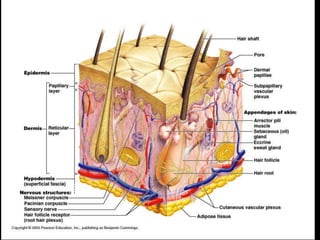
Skin appendages
 Derived from epidermis but extend into
dermis
 Include
 Hair and hair follicles
 Sebaceous (oil) glands
 Sweat (sudoiferous) glands
 Nails
Nails
 Of hard keratin
 Corresponds to hooves and claws
 Grows from nail matrix
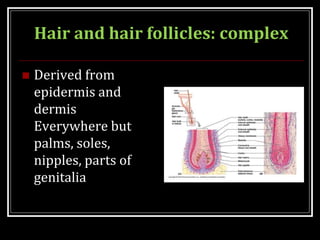
Hair and hair follicles: complex
 Derived from
epidermis and
dermis
Everywhere but
palms, soles,
nipples, parts of
genitalia
Hair and hair follicles:
complex
 Functions of hair
 Warmth – less in man than other mammals
 Sense light touch of the skin
 Protection - scalp
 Parts
 Root imbedded in skin
 Shaft projecting above skin surface
Hair and hair follicles:
complex
 Make up of hair – hard keratin
 Three concentric layers
 Medulla (core)
 Cortex (surrounds medulla)
 Cuticle (single layers, overlapping)
Friday, June 19, 2020
Hair and hair follicles:
complex
 Types of hair
 Vellus: fine, short hairs
 Intermediate hairs
 Terminal: longer, courser hair
 Hair growth: averages 2 mm/week
 Active: growing
 Resting phase then shed
Hair and hair follicles:
complex
 Hair loss
 Thinning – age related
 Male pattern baldness
 Hair color
 Amount of melanin for black or brown; distinct
form of melanin for red
 White: decreased melanin and air bubbles in
the medulla
 Genetically determined though influenced by
hormones and environment.
Friday, June 19, 2020
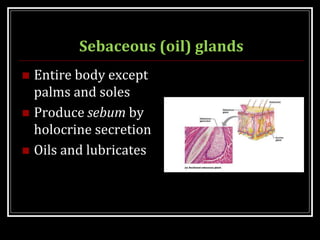
Sebaceous (oil) glands
 Entire body except
palms and soles
 Produce sebum by
holocrine secretion
 Oils and lubricates
Sweat glands
 Entire skin
surface except
nipples and part
of external
genitalia
 Prevent
overheating
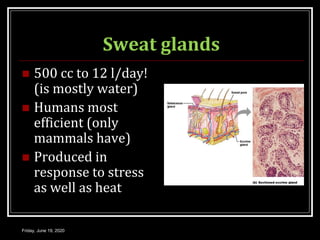
Sweat glands
 500 cc to 12 l/day!
(is mostly water)
 Humans most
efficient (only
mammals have)
 Produced in
response to stress
as well as heat
Friday, June 19, 2020
Types of sweat glands
 Eccrine or merocrine
 Most numerous
 True sweat: 99% water, some salts,
traces of waste
 Open through pores
Types of sweat glands
 Apocrine
 Axillary, anal and genital areas only
 Ducts open into hair follices
 The organic molecules in it decompose with time -
odor
 Modified apocrine glands
 Ceruminous – secrete earwax
 Mammary – secrete milk
Disorders of the integumentary
system
 Burns
 Threat to life
 Catastrophic loss of body fluids
 Dehydration and fatal circulatory shock
 Infection
 Types
 First degree – epidermis: redness (e.g. sunburn)
 Second degree – epidermis and upper dermis: blister
 Third degree - full thickness
 Infections
 Skin cancer
Burns
First-degree
(epidermis only; redness)
Second-degree
(epidermis and dermis,
with blistering)
Third-degree
(full thickness, destroying
epidermis, dermis, often
part of hypodermis)
Critical burns.
 Over 10% of the body
has third-degree
burns
 25 % of the body has
second-degree burns
 Third-degree burns on
face, hands, or feet
Estimate by “rule of 9’s”
Tumors of the skin
 Benign, e.g. warts
 Cancer – associated with UV exposure (also skin
aging)
 Aktinic keratosis - premalignant
 Basal cell - cells of stratum basale
 Squamous cell - keratinocytes
 Melanoma – melanocytes: most dangerous; recognition:
 A - Asymmetry
 B - Border irregularity
 C - Colors
 D - Diameter larger than 6 mm
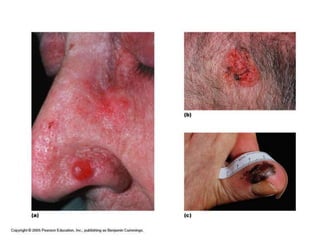
Basal cell carcinoma
Sqaumous cell carcinoma
Melanoma
Skin Cancer
Why?
• All organisms are limited by their ability to
survive in different temperatures
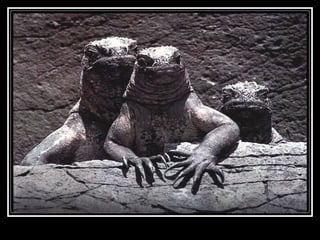
• Some, like reptiles and amphibia are
poikilothermic
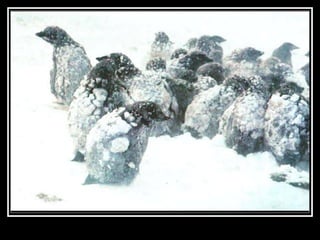
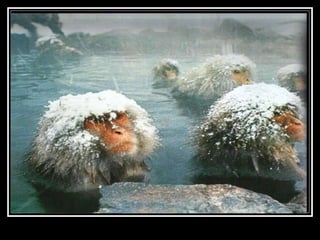
• Others like humans are homeothermic
How?
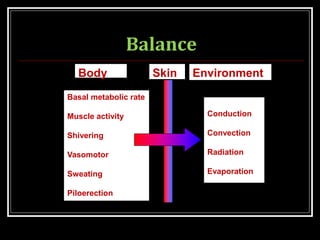
• The actual body temperature is a consequence of
the balance between the amount of heat produced
and the amount of heat lost. The balance may be
altered
• physiologically or
• behaviourally
Basal metabolic rate
Muscle activity
Shivering
Vasomotor
Sweating
Piloerection
Conduction
Convection
Radiation
Evaporation
Body Skin Environment
Balance
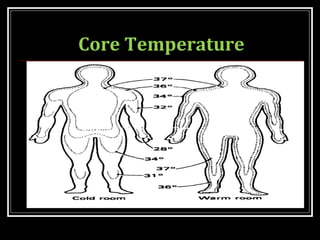
Core Temperature
Reference
Response
Controlled
system
Feedback
Set-point
hypothesis
So how is it regulated?
Response
Controlled
system
Feedback
Balance hypothesis
Feedback
warmcool
Inputs Outputs
Hypothalamus
Central
thermosensors
warm cool
Peripheral
thermosensors
warm cool
Neural
sweating
shivering
vasoconstriction
vasodilation
Hormonal
adrenaline
TRH
Babies
• Babies (and hamsters) have an extra
mechanism
• Brown fat.
• Suprascapular deposits
• Rich in mitochondria
Normal body temperature
• Depends where and when you
measure it
• tympanic> oral > axillary by 0.5oC
• can be affected by
• exercise
• emotion
• time of day
Rectal
temp
OC
37.4
36.8
36.2
12 18 624 12
Time
Postovulatory
Preovulatory
And the menstrual cycle (o- p+)
Fever
• Monocytes and phagocytes release endogenous
pyrogen (Interleukin-1, IL-1).
• The anterior hypothalamus is sensitive to IL-1
• Hypothalamic sensitivity to temperature is
altered.
So…
• The body temperature then becomes
regulated at a new, higher level.
• There is some evidence that the raised body
temperature enables the fight against the
infection.
But...
• Every 1OC rise in temperature increases
basal metabolic rate and oxygen
consumption by about 13%,
• In acute infection, the ability to mobilise fat
stores is inhibited.
Consequently
• Skeletal muscle is broken down and the amino
acids are used in gluconeogenesis.
• This can be debilitating.
And even worse
• In addition to the increased demand for
energy
• Temperatures (above 42OC) damage nerve
cells
• impair thermoregulation
• have more serious consequences.
THANK YOU

Skin

  • 1.
    DR NILESH KATE MBBS,MD PROFESSOR ESICMEDICAL COLLEGE, GULBARGA. DEPT. OF PHYSIOLOGY SKIN
  • 2.
    OBJECTIVES.  Introduction  Functions Layers  Colours  Appendages  Glands  Disorders  Tumors & its role in temperature regulation.
  • 3.
    The Integumentary System Integument is skin  Skin and its appendages make up the Integumentary system  A fatty layer (hypodermis) lies deep to it  Two distinct regions  Epidermis  Dermis
  • 4.
    Functions of skin Protection  Cushions and insulates and is waterproof  Protects from chemicals, heat, cold, bacteria  Screens UV  Synthesizes vitamin D with UV  Regulates body heat  Prevents unnecessary water loss  Sensory reception (nerve endings)
  • 5.
    Epidermis  Keratinized stratifiedsquamous epithelium  Four types of cells  Keratinocytes – deepest, produce keratin (tough fibrous protein)  Melanocytes - make dark skin pigment melanin  Merkel cells – associated with sensory nerve endings  Langerhans cells – Macrophage-like dendritic cells (see figure on next slide)
  • 6.
    Epidermis  Layers (fromdeep to superficial)  Stratum basale or germinativum – single row of cells attached to dermis; youngest cells  Stratum spinosum – spinyness is artifactual; tonofilaments (bundles of protein) resist tension  Stratum granulosum – layers of flattened keratinocytes producing keratin (hair and nails made of it also)  Stratum lucidum (only on palms and soles)  Stratum corneum – horny layer (cells dead, many layers thick) Friday, June 19, 2020
  • 7.
    Epithelium: layers (onleft) and cell types (on right)
  • 8.
    Remember…  Four basictypes of tissue  Epithelium – epidermis just discussed  Connective tissue - dermis  Muscle tissue  Nervous tissue
  • 9.
    Dermis  Strong, flexibleconnective tissue  Cells: fibroblasts, macrophages, mast cells, WBCs  Fiber types: collagen, elastic, reticular.  Rich supply of nerves and vessels  Critical role in Temperature regulation (the vessels)
  • 10.
    Dermis  Two layers Papillary – areolar connective tissue; includes dermal papillae  Reticular – “reticulum” (network) of collagen and reticular fibers Friday, June 19, 2020
  • 11.
    Fingerprints, palmprints, footprints Dermal papillae lie atop dermal ridges  Elevate the overlying epidermis into epidermal ridges  Are “sweat films” because of sweat pores  Genetically determined The dermis is the receptive site for the pigment of tattoos
  • 12.
    Fingerprints, palmprints, footprints Flexion creases Deep dermis, from continual folding Fibers  Collagen: strength and resilience  Elastic fibers: stretch-recoil  Striae: stretch marks  Tension lines  The direction the bundles of fibers are directed Friday, June 19, 2020
  • 13.
    Hypodermis  “Hypodermis” (Gk)= below the skin  “Subcutaneous” (Latin) = below the skin  Also called “superficial fascia” “fascia” (Latin) =band; in anatomy: sheet of connective tissue  Fatty tissue which stores fat and anchors skin (areolar tissue and adipose cells)  Different patterns of accumulation (male/female)
  • 14.
    Skin color  Threeskin pigments  Melanin: the most important  Carotene: from carrots and yellow vegies  Hemoglobin: the pink of light skin  Melanin in granules passes from melanocytes (same number in all races) to keratinocytes in stratum basale  Digested by lysosomes  Variations in color  Protection from UV light vs vitamin D?
  • 15.
    Skin appendages  Derivedfrom epidermis but extend into dermis  Include  Hair and hair follicles  Sebaceous (oil) glands  Sweat (sudoiferous) glands  Nails
  • 17.
    Nails  Of hardkeratin  Corresponds to hooves and claws  Grows from nail matrix
  • 18.
    Hair and hairfollicles: complex  Derived from epidermis and dermis Everywhere but palms, soles, nipples, parts of genitalia
  • 19.
    Hair and hairfollicles: complex  Functions of hair  Warmth – less in man than other mammals  Sense light touch of the skin  Protection - scalp  Parts  Root imbedded in skin  Shaft projecting above skin surface
  • 20.
    Hair and hairfollicles: complex  Make up of hair – hard keratin  Three concentric layers  Medulla (core)  Cortex (surrounds medulla)  Cuticle (single layers, overlapping) Friday, June 19, 2020
  • 21.
    Hair and hairfollicles: complex  Types of hair  Vellus: fine, short hairs  Intermediate hairs  Terminal: longer, courser hair  Hair growth: averages 2 mm/week  Active: growing  Resting phase then shed
  • 22.
    Hair and hairfollicles: complex  Hair loss  Thinning – age related  Male pattern baldness  Hair color  Amount of melanin for black or brown; distinct form of melanin for red  White: decreased melanin and air bubbles in the medulla  Genetically determined though influenced by hormones and environment. Friday, June 19, 2020
  • 23.
    Sebaceous (oil) glands Entire body except palms and soles  Produce sebum by holocrine secretion  Oils and lubricates
  • 24.
    Sweat glands  Entireskin surface except nipples and part of external genitalia  Prevent overheating
  • 25.
    Sweat glands  500cc to 12 l/day! (is mostly water)  Humans most efficient (only mammals have)  Produced in response to stress as well as heat Friday, June 19, 2020
  • 26.
    Types of sweatglands  Eccrine or merocrine  Most numerous  True sweat: 99% water, some salts, traces of waste  Open through pores
  • 27.
    Types of sweatglands  Apocrine  Axillary, anal and genital areas only  Ducts open into hair follices  The organic molecules in it decompose with time - odor  Modified apocrine glands  Ceruminous – secrete earwax  Mammary – secrete milk
  • 28.
    Disorders of theintegumentary system  Burns  Threat to life  Catastrophic loss of body fluids  Dehydration and fatal circulatory shock  Infection  Types  First degree – epidermis: redness (e.g. sunburn)  Second degree – epidermis and upper dermis: blister  Third degree - full thickness  Infections  Skin cancer
  • 29.
    Burns First-degree (epidermis only; redness) Second-degree (epidermisand dermis, with blistering) Third-degree (full thickness, destroying epidermis, dermis, often part of hypodermis)
  • 30.
    Critical burns.  Over10% of the body has third-degree burns  25 % of the body has second-degree burns  Third-degree burns on face, hands, or feet Estimate by “rule of 9’s”
  • 31.
    Tumors of theskin  Benign, e.g. warts  Cancer – associated with UV exposure (also skin aging)  Aktinic keratosis - premalignant  Basal cell - cells of stratum basale  Squamous cell - keratinocytes  Melanoma – melanocytes: most dangerous; recognition:  A - Asymmetry  B - Border irregularity  C - Colors  D - Diameter larger than 6 mm
  • 32.
    Basal cell carcinoma Sqaumouscell carcinoma Melanoma Skin Cancer
  • 38.
    Why? • All organismsare limited by their ability to survive in different temperatures • Some, like reptiles and amphibia are poikilothermic • Others like humans are homeothermic
  • 39.
    How? • The actualbody temperature is a consequence of the balance between the amount of heat produced and the amount of heat lost. The balance may be altered • physiologically or • behaviourally
  • 40.
    Basal metabolic rate Muscleactivity Shivering Vasomotor Sweating Piloerection Conduction Convection Radiation Evaporation Body Skin Environment Balance
  • 41.
  • 42.
  • 43.
  • 44.
    Inputs Outputs Hypothalamus Central thermosensors warm cool Peripheral thermosensors warmcool Neural sweating shivering vasoconstriction vasodilation Hormonal adrenaline TRH
  • 45.
    Babies • Babies (andhamsters) have an extra mechanism • Brown fat. • Suprascapular deposits • Rich in mitochondria
  • 46.
    Normal body temperature •Depends where and when you measure it • tympanic> oral > axillary by 0.5oC • can be affected by • exercise • emotion • time of day
  • 47.
    Rectal temp OC 37.4 36.8 36.2 12 18 62412 Time Postovulatory Preovulatory And the menstrual cycle (o- p+)
  • 48.
    Fever • Monocytes andphagocytes release endogenous pyrogen (Interleukin-1, IL-1). • The anterior hypothalamus is sensitive to IL-1 • Hypothalamic sensitivity to temperature is altered.
  • 49.
    So… • The bodytemperature then becomes regulated at a new, higher level. • There is some evidence that the raised body temperature enables the fight against the infection.
  • 50.
    But... • Every 1OCrise in temperature increases basal metabolic rate and oxygen consumption by about 13%, • In acute infection, the ability to mobilise fat stores is inhibited.
  • 51.
    Consequently • Skeletal muscleis broken down and the amino acids are used in gluconeogenesis. • This can be debilitating.
  • 52.
    And even worse •In addition to the increased demand for energy • Temperatures (above 42OC) damage nerve cells • impair thermoregulation • have more serious consequences.
  • 53.