Classification,
Lab diagnosis
and
Important diseases caused
by
Fungi
2/13/2015 1
Mohammad Mukhit Kazi, Lecturer SDCH
Pune
Objectives
To know about important characteristics of fungi
To know various classification systems
To know medically important fungi
To know the lab diagnosis of fungi
To know treatment of fungal diseases
2/13/2015 2
Mohammad Mukhit Kazi, Lecturer SDCH
Pune
Mycology
• Study of fungi – mycology
• Mykos – mushroom
• All fungi are eukaryotic
• Natural habitat- soil, water and decaying organic debris
• Obligate or facultative aerobe
• Chemotrophic organisms
2/13/2015 3
Mohammad Mukhit Kazi, Lecturer SDCH
Pune
• Differences from bacteria
– Posses rigid cell wall
– Contain chitin, mannan and polysacharide
– Cytopalsmic membrane contain sterols
– True nuclei with Nuclear membrane, mitochondria and endopalsmic
reticulum
– Unicellular or multicellular
– Divide by asexually, sexually or by both
2/13/2015 4
Mohammad Mukhit Kazi, Lecturer SDCH
Pune
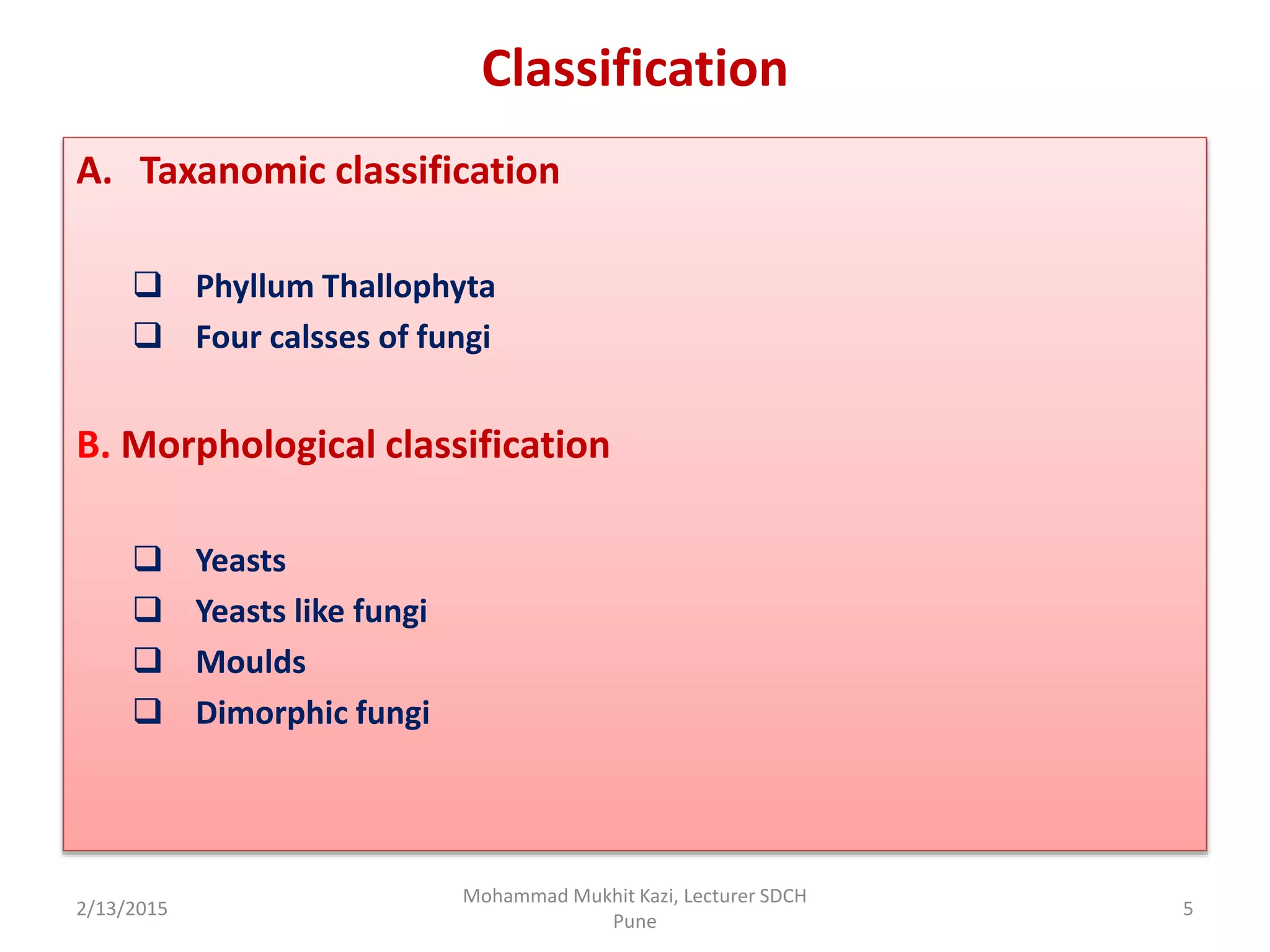
Classification
A. Taxanomic classification
 Phyllum Thallophyta
 Four calsses of fungi
B. Morphological classification
 Yeasts
 Yeasts like fungi
 Moulds
 Dimorphic fungi
2/13/2015 5
Mohammad Mukhit Kazi, Lecturer SDCH
Pune
Thallophyta
Thallophyta
Irregular plant masses lacking definite root, stem and leaf structures
Fungi Algae
(No chlorophyll) (Chlorophyll)
4 classes
Zygomycetes Ascomycetes Basidiomycetes Deuteromycetes or
fungi imperfecti
• Lower fungi having
non-septate hyphae
• Forms asexual
spores
sporangiospores
• Sexual spores
zygospores and
oospres
• Septate hyphae
• Sexual spores
(ascospores) are
present within the
sac or ascus
• Septate hyphae
•Sexual spores are
basidiospores on a
basidium
• Septate hyphae
•Lack a known sexual state.
Most fungi medically
important fungi belongs to
this class
2/13/2015 6
Mohammad Mukhit Kazi, Lecturer SDCH
Pune
Yeasts
i. Round to oval unicelluar
ii. Reproduce by budding
iii. Creamy mucoid colonies
iv. E.g. Cryptococcus neoformans
2/13/2015 7
Mohammad Mukhit Kazi, Lecturer SDCH
Pune
Yeasts like fungi
• Partly as yeasts and partly as elongated
budding cells
• Germ tube to demonstrate pseudohyphae
2/13/2015 8
Mohammad Mukhit Kazi, Lecturer SDCH
Pune
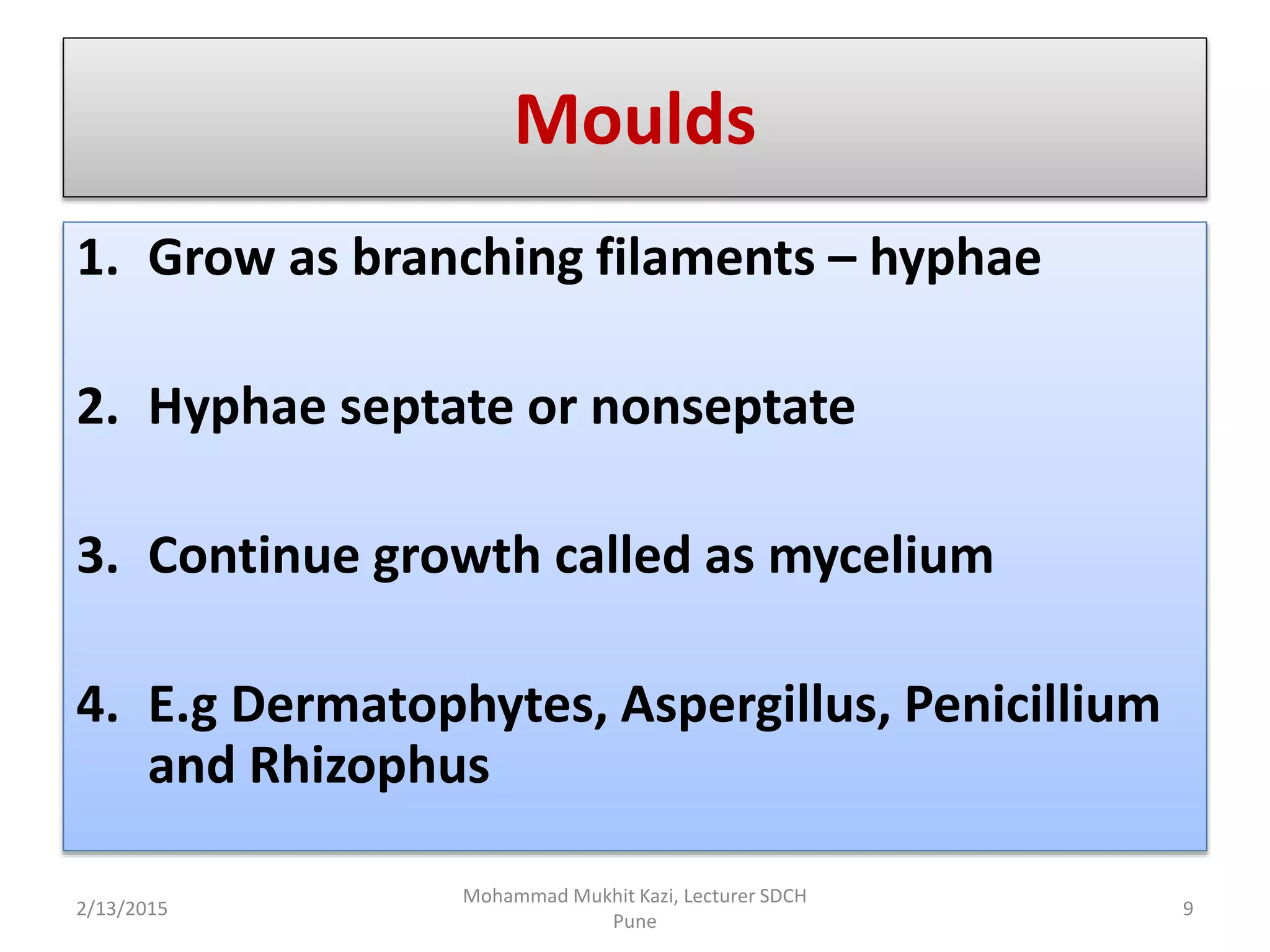
Moulds
1. Grow as branching filaments – hyphae
2. Hyphae septate or nonseptate
3. Continue growth called as mycelium
4. E.g Dermatophytes, Aspergillus, Penicillium
and Rhizophus
2/13/2015 9
Mohammad Mukhit Kazi, Lecturer SDCH
Pune
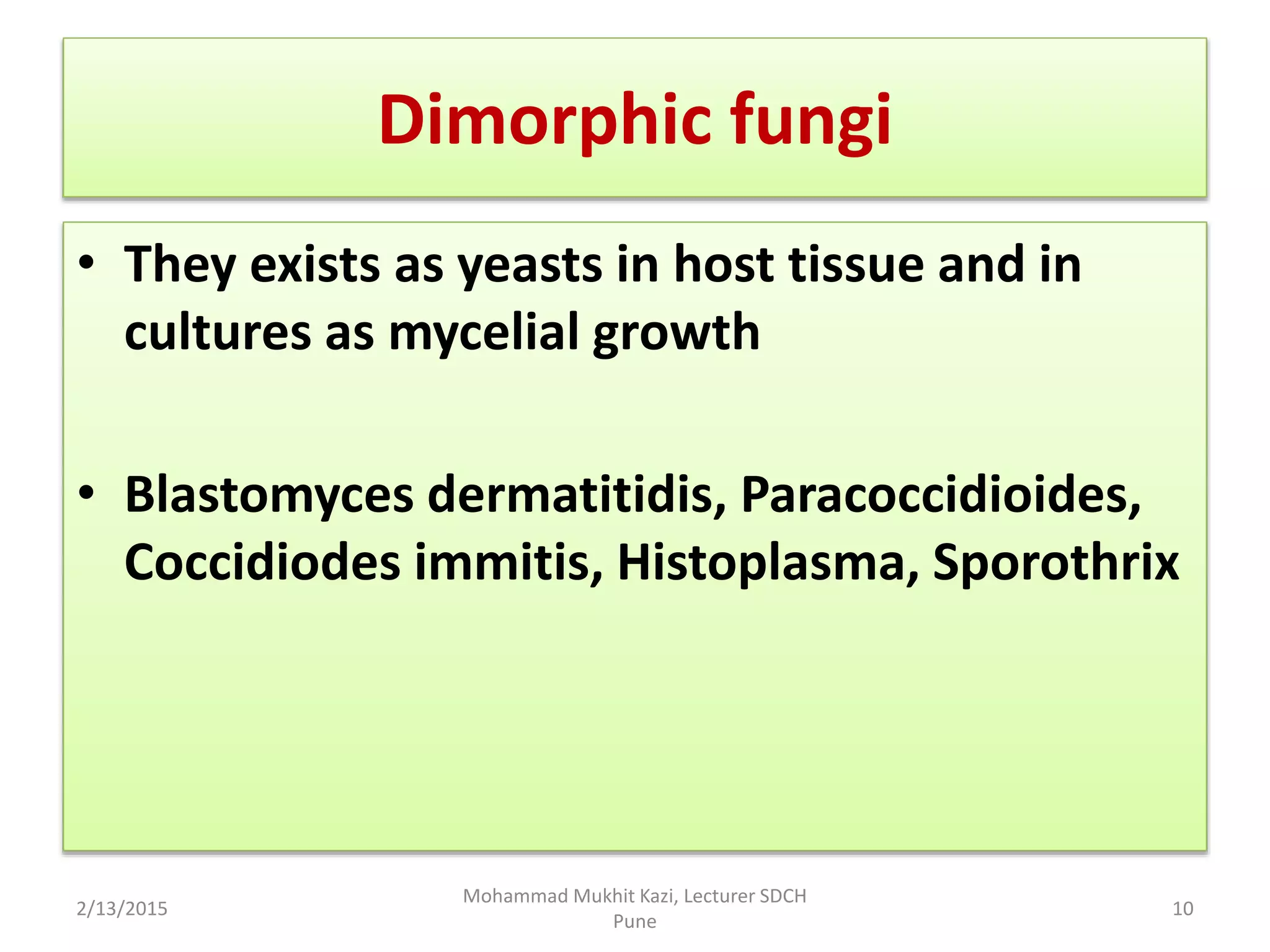
Dimorphic fungi
• They exists as yeasts in host tissue and in
cultures as mycelial growth
• Blastomyces dermatitidis, Paracoccidioides,
Coccidiodes immitis, Histoplasma, Sporothrix
2/13/2015 10
Mohammad Mukhit Kazi, Lecturer SDCH
Pune
Reproduction and sporulation
• Sexual spores – oospres, ascospores,
zygospores and basidiospores
• Vegetative spores –
– Blastospores:formed by budding from parent cell
– Arthrospores: cross septa into hyphae
• Aerial spores: Conidiospores, Microconidia,
Macroconidia, Sporangiospores
2/13/2015 11
Mohammad Mukhit Kazi, Lecturer SDCH
Pune
Laboratory Diagnosis
A. Direct microscopy
– KOH preparation
– Gram staining
– India ink preparation
B. Culture
- SDA
C. Slide culture test
2/13/2015 12
Mohammad Mukhit Kazi, Lecturer SDCH
Pune
Classification of fungal diseases
A. Superficial mycoses- skin nails hair
B. Subcutaneous mycoses – myetoma
C. Systemic mycoses - aspergillosis
2/13/2015 13
Mohammad Mukhit Kazi, Lecturer SDCH
Pune
Dermatophytes
• They infect superficial keratinized tissue (skin,
nail and hair) without involving tissue
• They break down and utilizes keratin
• Incapabale of penetrating subcutaneous tissue
• Cause dermatomycoses also known as
ringworm
2/13/2015 14
Mohammad Mukhit Kazi, Lecturer SDCH
Pune
Cylindrical
macroconidia
Fusiform
macroconidia
Club shaped
macroconidia
2/13/2015 15
Mohammad Mukhit Kazi, Lecturer SDCH
Pune
2/13/2015 16
Mohammad Mukhit Kazi, Lecturer SDCH
Pune
Classification
– Trichophyton - hair, skin and nail
– Microsporum – hair , skin
– Epidermophyton – skin and nail
 Lab diagnosis:
 Specimen: skin, hair or nail
 Direct microscopy – LPCB mount
 Culture
 Treatment
2/13/2015 17
Mohammad Mukhit Kazi, Lecturer SDCH
Pune
Subcutaneous Mycoses
• Mycetoma : crhonic granulomatous infection of
subcutaneous tissue usually affects foot
• Also known as Madura foot
• Mainly in tropical countirs
• Common in Tamilnadu
• Caused by Actinomycetes and filamentous fungi
• Enter through minor trauma
• Diagnosis made by observing granules
• Treatment- sulphonamides sometime amputation
2/13/2015 18
Mohammad Mukhit Kazi, Lecturer SDCH
Pune
Sporotrichosis
• Is nodular, ulcerating disease of skin and subcutaneous
tissue
• Acces through thorn pricks or injuries
• Spread through lymphatics upto regional lymph nodes
• Sporothrix schenckii – dimorphic fungi
• Lab diagnosis by culture
2/13/2015 19
Mohammad Mukhit Kazi, Lecturer SDCH
Pune
Rhinosporidiosis
• Is a chronic granulomatous disease characterized by
formation of friable polyps, usually confined to nose, mouth
or eye
• Causative agent Rhinosporidium seeberi
• Reported from Srilanka and India
• Mode of infection is not known
• Lab diagnosis done by demonstration of sporangia
2/13/2015 20
Mohammad Mukhit Kazi, Lecturer SDCH
Pune
Rhinosporidiosis
2/13/2015 21
Mohammad Mukhit Kazi, Lecturer SDCH
Pune
Systemic mycoses
1. Histoplasmosis
– Histoplasma capsulatum
– Reticuloendothelial system
– Source – soil with excreta of birds
– Asymptomatic
– Sputum, bone marrow, blood, scrapings,
biopsies
– Geimsa stain or Wright stain
– Culture- SDA
– Amphotericin B
2/13/2015 22
Mohammad Mukhit Kazi, Lecturer SDCH
Pune
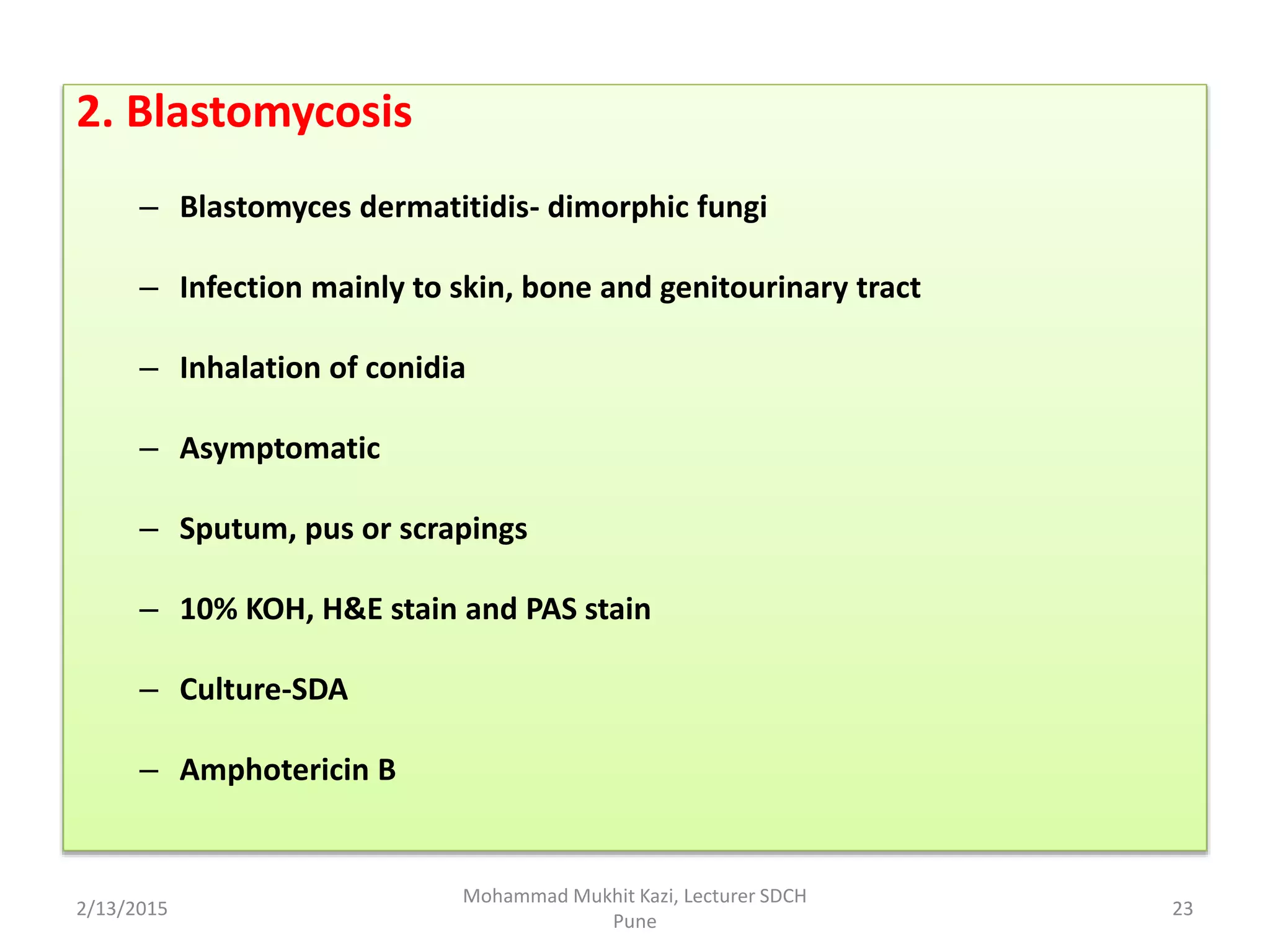
2. Blastomycosis
– Blastomyces dermatitidis- dimorphic fungi
– Infection mainly to skin, bone and genitourinary tract
– Inhalation of conidia
– Asymptomatic
– Sputum, pus or scrapings
– 10% KOH, H&E stain and PAS stain
– Culture-SDA
– Amphotericin B
2/13/2015 23
Mohammad Mukhit Kazi, Lecturer SDCH
Pune
3. Paracoccidiomycosis
– Paracoccidioides brasilensis- dimorphic fungi
– Inhalation of spores
– Same
4. Coccidiodomycosis
5. Crptococcosis
- Crptococcus neoformans
- Inhalation of dust
- Seen in immunocompromised
- demosntration of capsule by india ink
6. Opportunistic mycoses- candiasis, aspergillosis, zygomycoses
2/13/2015 24
Mohammad Mukhit Kazi, Lecturer SDCH
Pune
Aspergillus fumigatus
2/13/2015 25
Mohammad Mukhit Kazi, Lecturer SDCH
Pune
Aspergillus terreus
2/13/2015 26
Mohammad Mukhit Kazi, Lecturer SDCH
Pune
Aspergillus fumigatus
2/13/2015 27
Mohammad Mukhit Kazi, Lecturer SDCH
Pune
ASpergillus niger
2/13/2015 28
Mohammad Mukhit Kazi, Lecturer SDCH
Pune
Typical growth of Aspergillus spp
2/13/2015 29
Mohammad Mukhit Kazi, Lecturer SDCH
Pune
ASpergillus flavus
2/13/2015 30
Mohammad Mukhit Kazi, Lecturer SDCH
Pune
Mucor
2/13/2015 31
Mohammad Mukhit Kazi, Lecturer SDCH
Pune
Take home message
• Fungi are eukaryotes
• Medically important fungi belongs to Fungi imperfecti or
Deuteromycetes
• Sabourauds dextrose agar is used to culture
• Slide culture to demonstrate better morphological characters
• KOH mount or LPCB mount for demonstration
• Mainly opportunistic infections
• E.g. Candidiasis, Cryptococcosis, Aspergillosis
2/13/2015 32
Mohammad Mukhit Kazi, Lecturer SDCH
Pune

Medical mycology

  • 1.
    Classification, Lab diagnosis and Important diseasescaused by Fungi 2/13/2015 1 Mohammad Mukhit Kazi, Lecturer SDCH Pune
  • 2.
    Objectives To know aboutimportant characteristics of fungi To know various classification systems To know medically important fungi To know the lab diagnosis of fungi To know treatment of fungal diseases 2/13/2015 2 Mohammad Mukhit Kazi, Lecturer SDCH Pune
  • 3.
    Mycology • Study offungi – mycology • Mykos – mushroom • All fungi are eukaryotic • Natural habitat- soil, water and decaying organic debris • Obligate or facultative aerobe • Chemotrophic organisms 2/13/2015 3 Mohammad Mukhit Kazi, Lecturer SDCH Pune
  • 4.
    • Differences frombacteria – Posses rigid cell wall – Contain chitin, mannan and polysacharide – Cytopalsmic membrane contain sterols – True nuclei with Nuclear membrane, mitochondria and endopalsmic reticulum – Unicellular or multicellular – Divide by asexually, sexually or by both 2/13/2015 4 Mohammad Mukhit Kazi, Lecturer SDCH Pune
  • 5.
    Classification A. Taxanomic classification Phyllum Thallophyta  Four calsses of fungi B. Morphological classification  Yeasts  Yeasts like fungi  Moulds  Dimorphic fungi 2/13/2015 5 Mohammad Mukhit Kazi, Lecturer SDCH Pune
  • 6.
    Thallophyta Thallophyta Irregular plant masseslacking definite root, stem and leaf structures Fungi Algae (No chlorophyll) (Chlorophyll) 4 classes Zygomycetes Ascomycetes Basidiomycetes Deuteromycetes or fungi imperfecti • Lower fungi having non-septate hyphae • Forms asexual spores sporangiospores • Sexual spores zygospores and oospres • Septate hyphae • Sexual spores (ascospores) are present within the sac or ascus • Septate hyphae •Sexual spores are basidiospores on a basidium • Septate hyphae •Lack a known sexual state. Most fungi medically important fungi belongs to this class 2/13/2015 6 Mohammad Mukhit Kazi, Lecturer SDCH Pune
  • 7.
    Yeasts i. Round tooval unicelluar ii. Reproduce by budding iii. Creamy mucoid colonies iv. E.g. Cryptococcus neoformans 2/13/2015 7 Mohammad Mukhit Kazi, Lecturer SDCH Pune
  • 8.
    Yeasts like fungi •Partly as yeasts and partly as elongated budding cells • Germ tube to demonstrate pseudohyphae 2/13/2015 8 Mohammad Mukhit Kazi, Lecturer SDCH Pune
  • 9.
    Moulds 1. Grow asbranching filaments – hyphae 2. Hyphae septate or nonseptate 3. Continue growth called as mycelium 4. E.g Dermatophytes, Aspergillus, Penicillium and Rhizophus 2/13/2015 9 Mohammad Mukhit Kazi, Lecturer SDCH Pune
  • 10.
    Dimorphic fungi • Theyexists as yeasts in host tissue and in cultures as mycelial growth • Blastomyces dermatitidis, Paracoccidioides, Coccidiodes immitis, Histoplasma, Sporothrix 2/13/2015 10 Mohammad Mukhit Kazi, Lecturer SDCH Pune
  • 11.
    Reproduction and sporulation •Sexual spores – oospres, ascospores, zygospores and basidiospores • Vegetative spores – – Blastospores:formed by budding from parent cell – Arthrospores: cross septa into hyphae • Aerial spores: Conidiospores, Microconidia, Macroconidia, Sporangiospores 2/13/2015 11 Mohammad Mukhit Kazi, Lecturer SDCH Pune
  • 12.
    Laboratory Diagnosis A. Directmicroscopy – KOH preparation – Gram staining – India ink preparation B. Culture - SDA C. Slide culture test 2/13/2015 12 Mohammad Mukhit Kazi, Lecturer SDCH Pune
  • 13.
    Classification of fungaldiseases A. Superficial mycoses- skin nails hair B. Subcutaneous mycoses – myetoma C. Systemic mycoses - aspergillosis 2/13/2015 13 Mohammad Mukhit Kazi, Lecturer SDCH Pune
  • 14.
    Dermatophytes • They infectsuperficial keratinized tissue (skin, nail and hair) without involving tissue • They break down and utilizes keratin • Incapabale of penetrating subcutaneous tissue • Cause dermatomycoses also known as ringworm 2/13/2015 14 Mohammad Mukhit Kazi, Lecturer SDCH Pune
  • 15.
  • 16.
    2/13/2015 16 Mohammad MukhitKazi, Lecturer SDCH Pune
  • 17.
    Classification – Trichophyton -hair, skin and nail – Microsporum – hair , skin – Epidermophyton – skin and nail  Lab diagnosis:  Specimen: skin, hair or nail  Direct microscopy – LPCB mount  Culture  Treatment 2/13/2015 17 Mohammad Mukhit Kazi, Lecturer SDCH Pune
  • 18.
    Subcutaneous Mycoses • Mycetoma: crhonic granulomatous infection of subcutaneous tissue usually affects foot • Also known as Madura foot • Mainly in tropical countirs • Common in Tamilnadu • Caused by Actinomycetes and filamentous fungi • Enter through minor trauma • Diagnosis made by observing granules • Treatment- sulphonamides sometime amputation 2/13/2015 18 Mohammad Mukhit Kazi, Lecturer SDCH Pune
  • 19.
    Sporotrichosis • Is nodular,ulcerating disease of skin and subcutaneous tissue • Acces through thorn pricks or injuries • Spread through lymphatics upto regional lymph nodes • Sporothrix schenckii – dimorphic fungi • Lab diagnosis by culture 2/13/2015 19 Mohammad Mukhit Kazi, Lecturer SDCH Pune
  • 20.
    Rhinosporidiosis • Is achronic granulomatous disease characterized by formation of friable polyps, usually confined to nose, mouth or eye • Causative agent Rhinosporidium seeberi • Reported from Srilanka and India • Mode of infection is not known • Lab diagnosis done by demonstration of sporangia 2/13/2015 20 Mohammad Mukhit Kazi, Lecturer SDCH Pune
  • 21.
  • 22.
    Systemic mycoses 1. Histoplasmosis –Histoplasma capsulatum – Reticuloendothelial system – Source – soil with excreta of birds – Asymptomatic – Sputum, bone marrow, blood, scrapings, biopsies – Geimsa stain or Wright stain – Culture- SDA – Amphotericin B 2/13/2015 22 Mohammad Mukhit Kazi, Lecturer SDCH Pune
  • 23.
    2. Blastomycosis – Blastomycesdermatitidis- dimorphic fungi – Infection mainly to skin, bone and genitourinary tract – Inhalation of conidia – Asymptomatic – Sputum, pus or scrapings – 10% KOH, H&E stain and PAS stain – Culture-SDA – Amphotericin B 2/13/2015 23 Mohammad Mukhit Kazi, Lecturer SDCH Pune
  • 24.
    3. Paracoccidiomycosis – Paracoccidioidesbrasilensis- dimorphic fungi – Inhalation of spores – Same 4. Coccidiodomycosis 5. Crptococcosis - Crptococcus neoformans - Inhalation of dust - Seen in immunocompromised - demosntration of capsule by india ink 6. Opportunistic mycoses- candiasis, aspergillosis, zygomycoses 2/13/2015 24 Mohammad Mukhit Kazi, Lecturer SDCH Pune
  • 25.
    Aspergillus fumigatus 2/13/2015 25 MohammadMukhit Kazi, Lecturer SDCH Pune
  • 26.
    Aspergillus terreus 2/13/2015 26 MohammadMukhit Kazi, Lecturer SDCH Pune
  • 27.
    Aspergillus fumigatus 2/13/2015 27 MohammadMukhit Kazi, Lecturer SDCH Pune
  • 28.
    ASpergillus niger 2/13/2015 28 MohammadMukhit Kazi, Lecturer SDCH Pune
  • 29.
    Typical growth ofAspergillus spp 2/13/2015 29 Mohammad Mukhit Kazi, Lecturer SDCH Pune
  • 30.
    ASpergillus flavus 2/13/2015 30 MohammadMukhit Kazi, Lecturer SDCH Pune
  • 31.
    Mucor 2/13/2015 31 Mohammad MukhitKazi, Lecturer SDCH Pune
  • 32.
    Take home message •Fungi are eukaryotes • Medically important fungi belongs to Fungi imperfecti or Deuteromycetes • Sabourauds dextrose agar is used to culture • Slide culture to demonstrate better morphological characters • KOH mount or LPCB mount for demonstration • Mainly opportunistic infections • E.g. Candidiasis, Cryptococcosis, Aspergillosis 2/13/2015 32 Mohammad Mukhit Kazi, Lecturer SDCH Pune