DR NILESH KATE
MBBS,MD
ASSOCIATE PROFESSOR
DEPT. OF PHYSIOLOGY
SKELETAL
MUSCLE
CONTRACTION.
OBJECTIVES
 Process of Muscle Excitation.
 Process of Excitation-Contraction Coupling.
 Process of Muscle Contraction.
 Sequence of events during muscle contraction
& relaxation when stimulated by nerve.
 Types of Muscle Contraction
 Isotonic & Isometric.
Thursday, February 11, 2016
PROCESS OF MUSCLE
EXCITATION.
 Muscle – excitable
tissue.
 When stimulated
shows response
 Electrical Response –
production of action
potential.
 Mechanical Response
– contraction.
Thursday, February 11, 2016
PROCESS OF MUSCLE
EXCITATION.
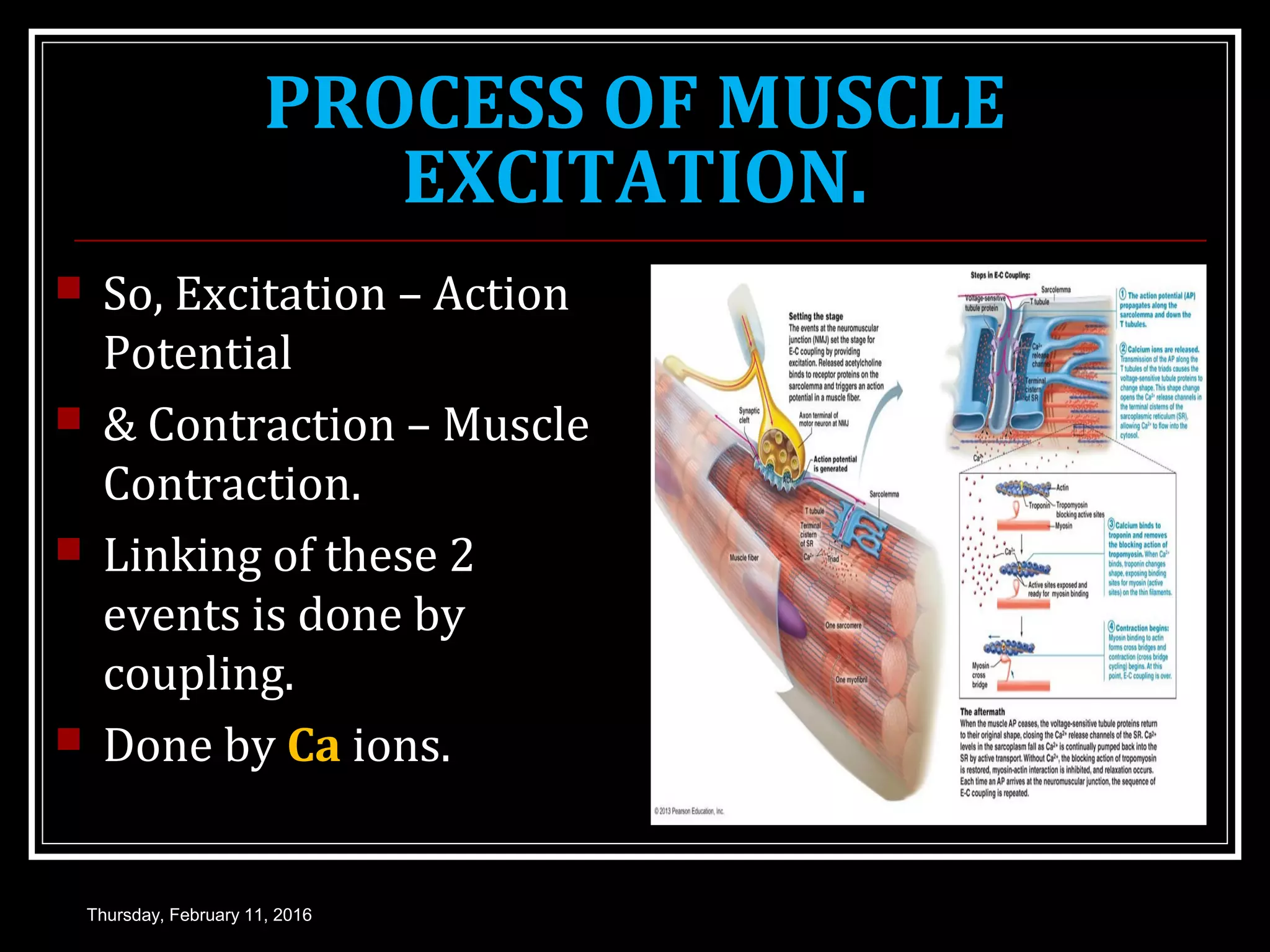
 So, Excitation – Action
Potential
 & Contraction – Muscle
Contraction.
 Linking of these 2
events is done by
coupling.
 Done by Ca ions.
Thursday, February 11, 2016
PROCESS OF EXCITATION-
CONTRACTION COUPLING.
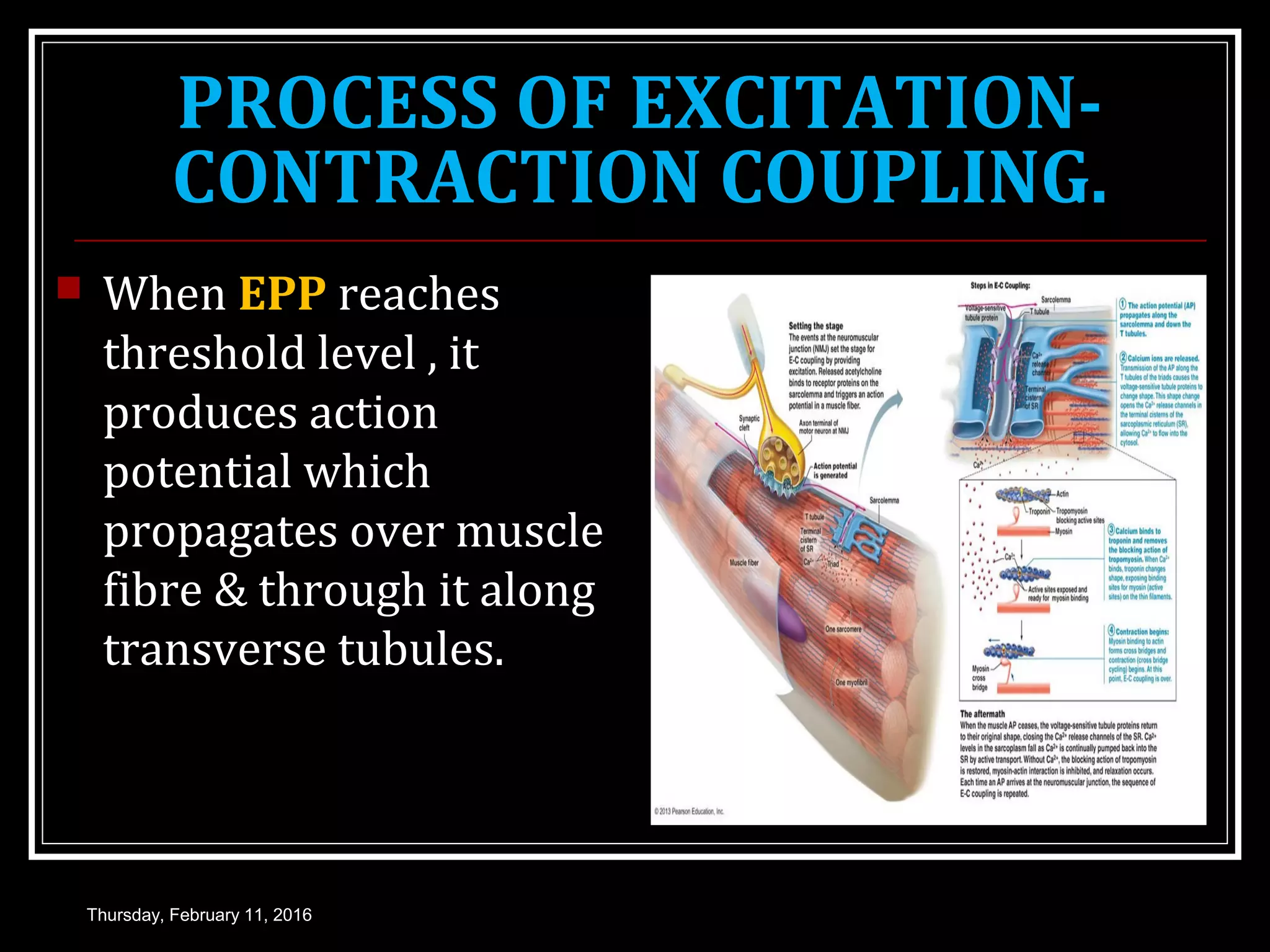
 When EPP reaches
threshold level , it
produces action
potential which
propagates over muscle
fibre & through it along
transverse tubules.
Thursday, February 11, 2016
DIFFERENCE BETWEEN EXCITATION
OF NERVE & MUSCLE.
FEATURES NERVE SKELETAL MUSCLE
RMP (mv) -70 -90
THRESHOLD LEVEL
(mv)
15 30-40
AP Magnitude (mv) 100-105 120-130
SPIKE POENTIAL
DURATION (ms)
0.4-2 2-4
ABSOLUTE
REFRACTORY PERIOD
0.4-2 1-3
EXCITABILITY MORE LESS
CONDUCTION
VELOCITY
VARIABLE LOW
Thursday, February 11, 2016
PROCESS OF MUSCLE
CONTRACTION.
 AP initiated in plasma
membrane spread to
surface & into muscle
fibre through T tubules.
 When reaches tip of T
Tubule activate voltage
gated DHP
(Dihydropyridine
Receptors)
Thursday, February 11, 2016
PROCESS OF MUSCLE
CONTRACTION.
 Activated DHP
receptors
triggers
opening of Ca release
channels on terminal
cisterns i.e. Ryanodine
Receptors
Ca diffuses into cytoplasm
& ICF Ca increases
(2000 times)
Thursday, February 11, 2016
PROCESS OF MUSCLE
CONTRACTION.
 Ca ion get attached to
Troponin-C & starts
chain of events
 So Ca acts as linkage
between excitation &
contraction process.
Thursday, February 11, 2016
PROCESS OF MUSCLE
CONTRACTION.
 Molecular basis of
Muscle Contraction.
 A.F.Huxley &
H.E.Huxley put forward
Sliding Filament
theory / Rachet
theory / Walk-along
theory / Modern
theory of Muscular
Contraction.
Thursday, February 11, 2016
STEPS OF CROSS BRIDGE
CYCLING.
 Initiation of cross bridge
cycling.
 Formation of Actin-myosin
complex
 Power stroke.
 Detachment of myosin head of
cross bridge from the active
site of an Actin filament.
 Reactivation of Myosin Head.
Thursday, February 11, 2016
INITIATION OF CROSS BRIDGE
CYCLING.
 At Rest –
 Troponin I is lightly bound to
actin
 & Myosin binding sites on
actin is covered by
tropomyosin which lies in a
groove between actin strands.
 Troponin T attached to
tropomyosin to form
troponin-tropomyosin
complex.
Thursday, February 11, 2016
INITIATION OF CROSS BRIDGE
CYCLING.
 After Excitation – Ca
released in cytosol is
attached to Troponin C.
 Causes conformational
change & Tropomyosin
to move laterally
 Uncover active binding
sites on Actin.
Thursday, February 11, 2016
FORMATION OF ACTIN-
MYOSIN COMPLEX
 Head of myosin binds
with ATP
 ATPase activity of head
of myosin breaks ATP
into ADP + Pi cleavage
products.
 Head gets energy move
perpendicular toward
Actin & gets attached
Thursday, February 11, 2016
POWER STROKE.
 Actin-Myosin-ADP-Pi
complex triggers
 Release of Pi & ADP
 Conformational change
in myosin & myosin head
flex toward arm.
 This movements
generate mechanical
force – POWER
STROKE.
Thursday, February 11, 2016
EFFECTS OF POWER STROKE
 If load on muscle is
Small – Actin slides
over myosin & muscle
shortening.
 If load is Large –
flexion of myosin head-
stretching of elastic
neck & no sliding.
Thursday, February 11, 2016
DETACHMENT OF MYOSIN HEAD OF CROSS
BRIDGE FROM THE ACTIVE SITE OF AN
ACTIN FILAMENT.
 Release of ADP & Pi
make new ATP to
attach to myosin head.
 This new ATP with
myosin head has low
affinity for Actin so
Dissociation of
myosin head with
Actin occurs.
Thursday, February 11, 2016
REACTIVATION OF MYOSIN
HEAD.
 This bound ATP splits
again into ADP & Pi
 Which again give energy
to myosin head &
reactivate it.
 Again energized head
move towards Actin
filaments & gets
attached to it.
Thursday, February 11, 2016
CHANGES AT SARCOMERE LEVEL
DURING MUSCLE CONTRACTION.
 Width of A band
remains constant.
 H zone Disappears.
 I band width
decreases.
 Z line move closer.
 The Sarcomere
shortens.
Thursday, February 11, 2016
STEPS IN MUSCLE RELAXATION.
 After a few ms Ca pump
transport Ca from
Sarcoplasm
 Sarcoplasmic
Reticulum
discharge to
Terminal Cisterns.
Thursday, February 11, 2016
STEPS IN MUSCLE RELAXATION.
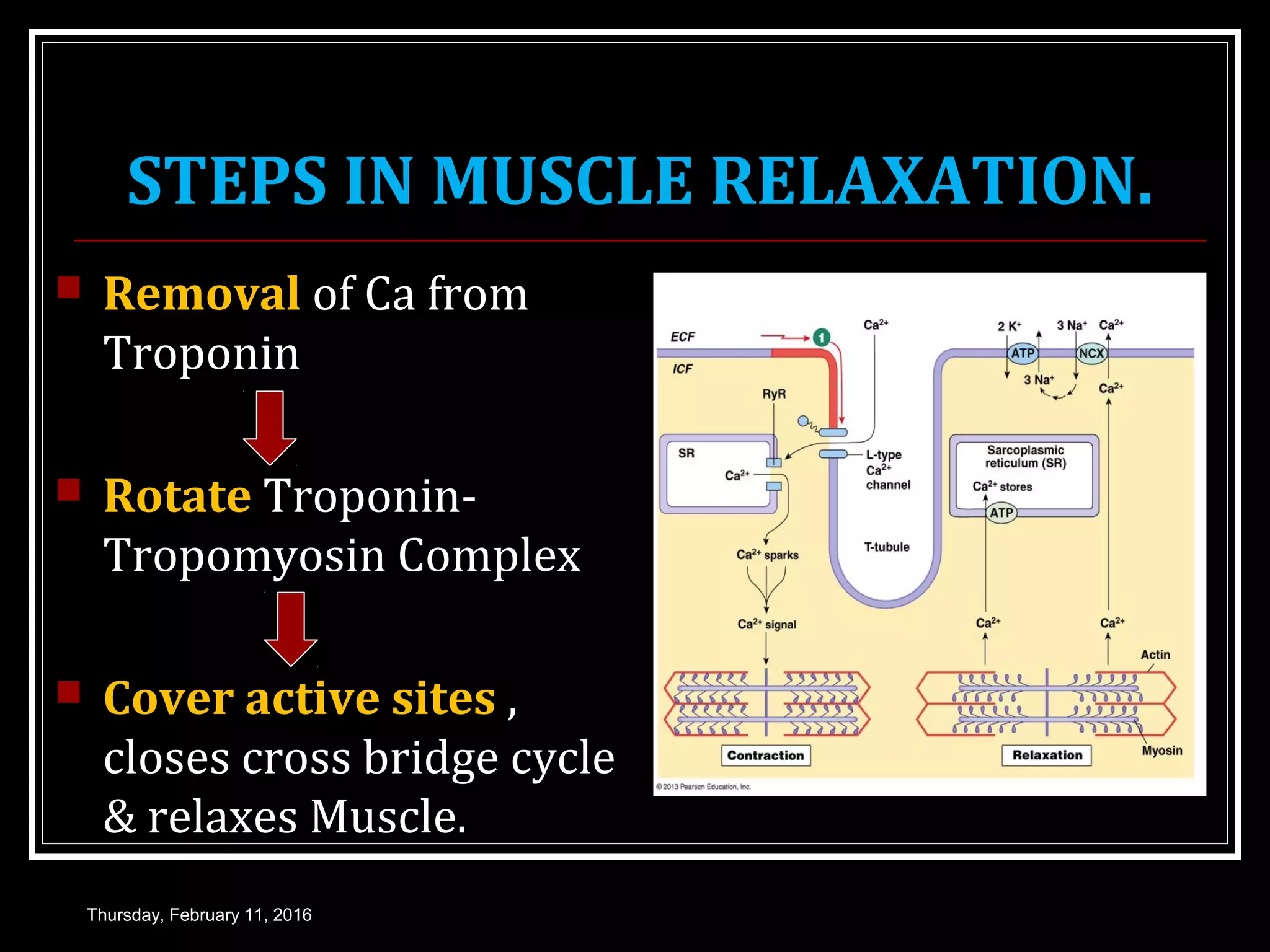
 Removal of Ca from
Troponin
 Rotate Troponin-
Tropomyosin Complex
 Cover active sites ,
closes cross bridge cycle
& relaxes Muscle.
Thursday, February 11, 2016
ROLE OF ATP IN MUSCLE
CONTRATION & RELAXATION.
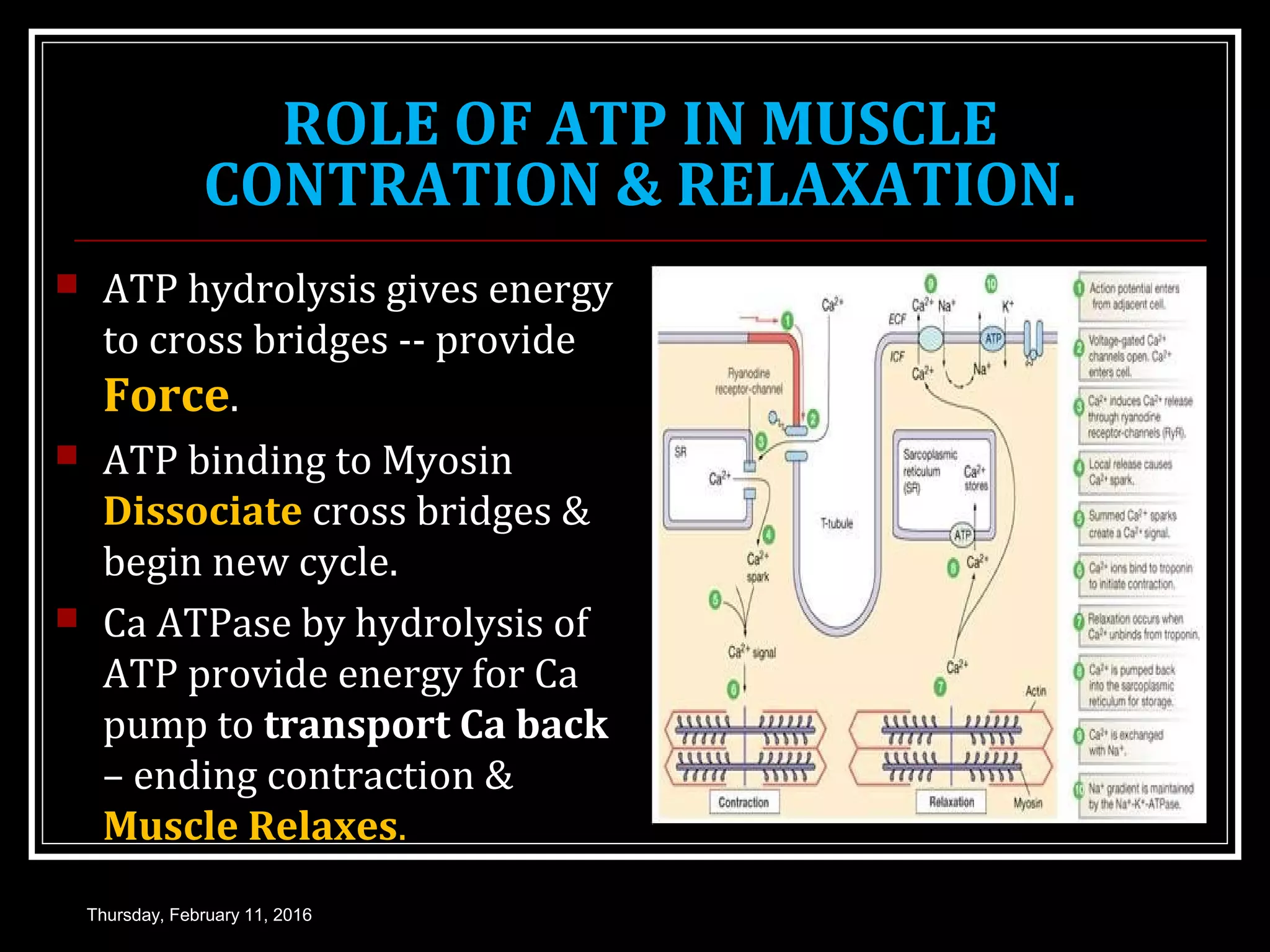
 ATP hydrolysis gives energy
to cross bridges -- provide
Force.
 ATP binding to Myosin
Dissociate cross bridges &
begin new cycle.
 Ca ATPase by hydrolysis of
ATP provide energy for Ca
pump to transport Ca back
– ending contraction &
Muscle Relaxes.
Thursday, February 11, 2016
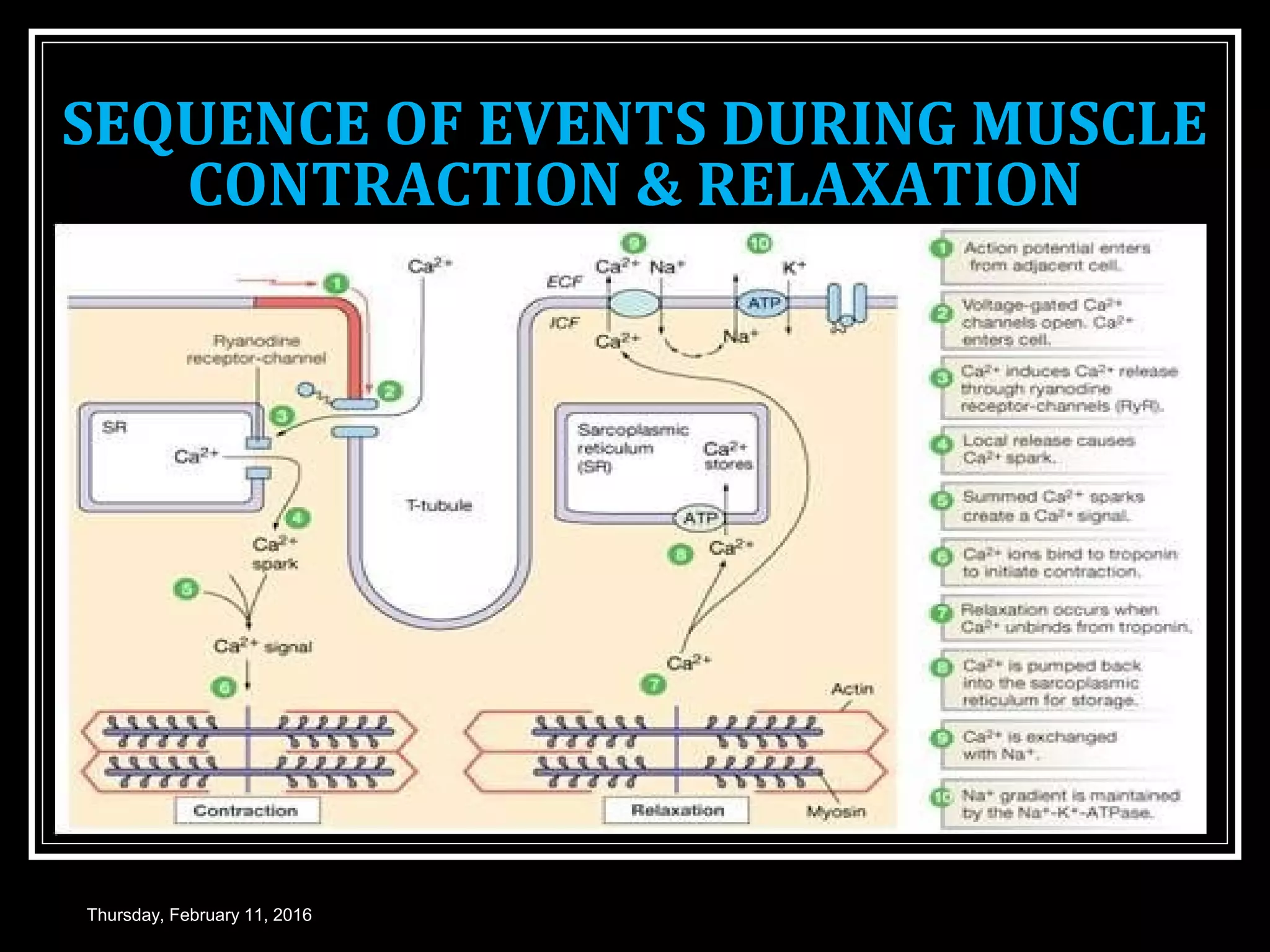
SEQUENCE OF EVENTS DURING MUSCLE
CONTRACTION & RELAXATION
Thursday, February 11, 2016
CONTRACTILE RESPONSE.
 Muscle stimulated
 Excited
 Response – Contraction
 Manifested by
 Shortening (Iso-Tonic)
 Developing Tension
(Iso-Metric)
 Both
Thursday, February 11, 2016
TYPES OF MUSCLE CONTRACTION
ISOTONIC & ISOMETRIC.
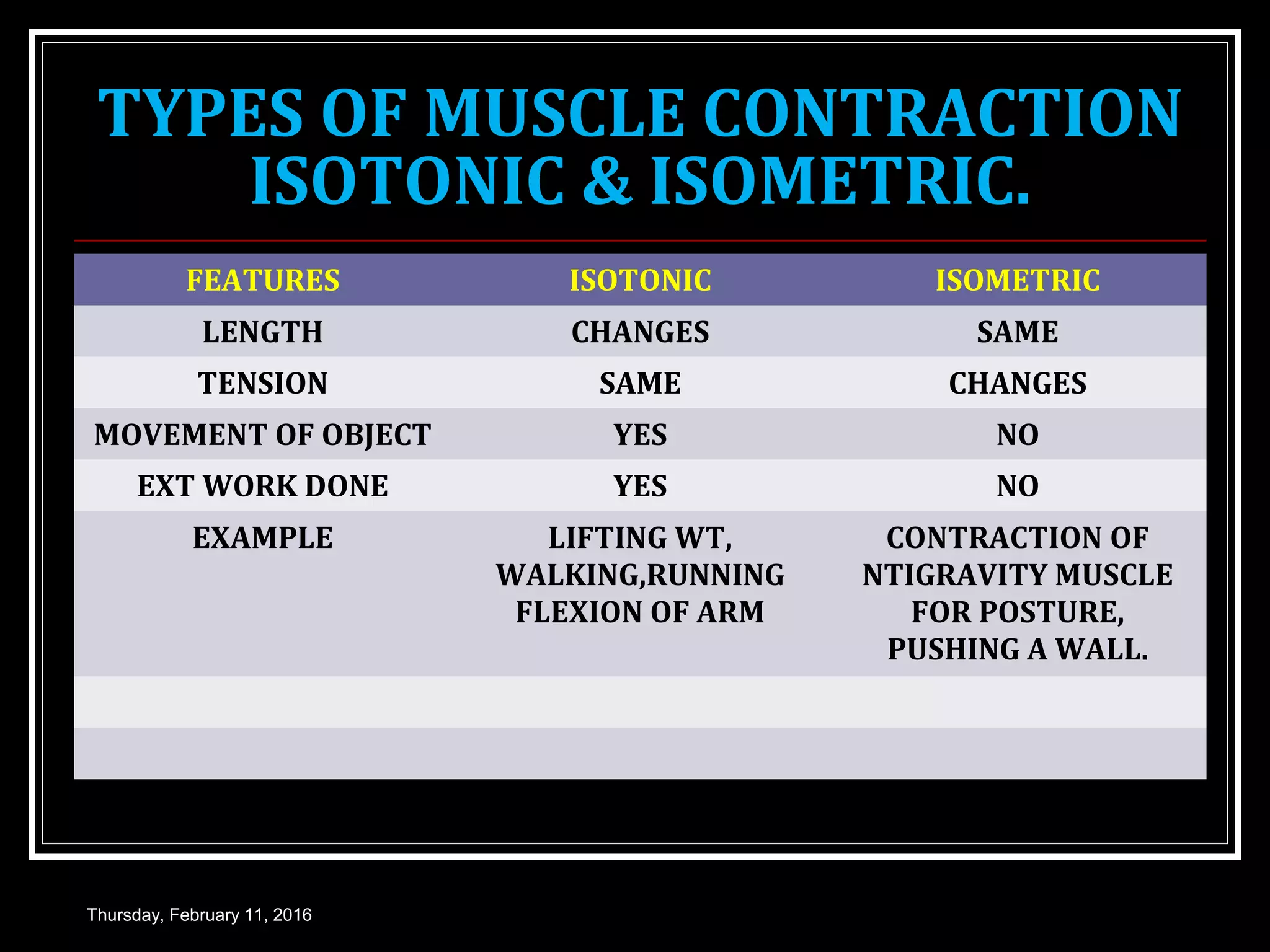
FEATURES ISOTONIC ISOMETRIC
LENGTH CHANGES SAME
TENSION SAME CHANGES
MOVEMENT OF OBJECT YES NO
EXT WORK DONE YES NO
EXAMPLE LIFTING WT,
WALKING,RUNNING
FLEXION OF ARM
CONTRACTION OF
NTIGRAVITY MUSCLE
FOR POSTURE,
PUSHING A WALL.
Thursday, February 11, 2016
TYPES OF MUSCLE CONTRACTION
ISOTONIC & ISOMETRIC.
Thursday, February 11, 2016
OBJECTIVES WE HAVE SEEN
 Process of Muscle Excitation.
 Process of Excitation-Contraction Coupling.
 Process of Muscle Contraction.
 Sequence of events during muscle
contraction & relaxation when stimulated by
nerve.
 Types of Muscle Contraction
 Isotonic & Isometric.
Thursday, February 11, 2016
Thank
You

Skeletal muscle contraction

  • 1.
    DR NILESH KATE MBBS,MD ASSOCIATEPROFESSOR DEPT. OF PHYSIOLOGY SKELETAL MUSCLE CONTRACTION.
  • 2.
    OBJECTIVES  Process ofMuscle Excitation.  Process of Excitation-Contraction Coupling.  Process of Muscle Contraction.  Sequence of events during muscle contraction & relaxation when stimulated by nerve.  Types of Muscle Contraction  Isotonic & Isometric. Thursday, February 11, 2016
  • 3.
    PROCESS OF MUSCLE EXCITATION. Muscle – excitable tissue.  When stimulated shows response  Electrical Response – production of action potential.  Mechanical Response – contraction. Thursday, February 11, 2016
  • 4.
    PROCESS OF MUSCLE EXCITATION. So, Excitation – Action Potential  & Contraction – Muscle Contraction.  Linking of these 2 events is done by coupling.  Done by Ca ions. Thursday, February 11, 2016
  • 5.
    PROCESS OF EXCITATION- CONTRACTIONCOUPLING.  When EPP reaches threshold level , it produces action potential which propagates over muscle fibre & through it along transverse tubules. Thursday, February 11, 2016
  • 6.
    DIFFERENCE BETWEEN EXCITATION OFNERVE & MUSCLE. FEATURES NERVE SKELETAL MUSCLE RMP (mv) -70 -90 THRESHOLD LEVEL (mv) 15 30-40 AP Magnitude (mv) 100-105 120-130 SPIKE POENTIAL DURATION (ms) 0.4-2 2-4 ABSOLUTE REFRACTORY PERIOD 0.4-2 1-3 EXCITABILITY MORE LESS CONDUCTION VELOCITY VARIABLE LOW Thursday, February 11, 2016
  • 7.
    PROCESS OF MUSCLE CONTRACTION. AP initiated in plasma membrane spread to surface & into muscle fibre through T tubules.  When reaches tip of T Tubule activate voltage gated DHP (Dihydropyridine Receptors) Thursday, February 11, 2016
  • 8.
    PROCESS OF MUSCLE CONTRACTION. Activated DHP receptors triggers opening of Ca release channels on terminal cisterns i.e. Ryanodine Receptors Ca diffuses into cytoplasm & ICF Ca increases (2000 times) Thursday, February 11, 2016
  • 9.
    PROCESS OF MUSCLE CONTRACTION. Ca ion get attached to Troponin-C & starts chain of events  So Ca acts as linkage between excitation & contraction process. Thursday, February 11, 2016
  • 10.
    PROCESS OF MUSCLE CONTRACTION. Molecular basis of Muscle Contraction.  A.F.Huxley & H.E.Huxley put forward Sliding Filament theory / Rachet theory / Walk-along theory / Modern theory of Muscular Contraction. Thursday, February 11, 2016
  • 11.
    STEPS OF CROSSBRIDGE CYCLING.  Initiation of cross bridge cycling.  Formation of Actin-myosin complex  Power stroke.  Detachment of myosin head of cross bridge from the active site of an Actin filament.  Reactivation of Myosin Head. Thursday, February 11, 2016
  • 12.
    INITIATION OF CROSSBRIDGE CYCLING.  At Rest –  Troponin I is lightly bound to actin  & Myosin binding sites on actin is covered by tropomyosin which lies in a groove between actin strands.  Troponin T attached to tropomyosin to form troponin-tropomyosin complex. Thursday, February 11, 2016
  • 13.
    INITIATION OF CROSSBRIDGE CYCLING.  After Excitation – Ca released in cytosol is attached to Troponin C.  Causes conformational change & Tropomyosin to move laterally  Uncover active binding sites on Actin. Thursday, February 11, 2016
  • 14.
    FORMATION OF ACTIN- MYOSINCOMPLEX  Head of myosin binds with ATP  ATPase activity of head of myosin breaks ATP into ADP + Pi cleavage products.  Head gets energy move perpendicular toward Actin & gets attached Thursday, February 11, 2016
  • 15.
    POWER STROKE.  Actin-Myosin-ADP-Pi complextriggers  Release of Pi & ADP  Conformational change in myosin & myosin head flex toward arm.  This movements generate mechanical force – POWER STROKE. Thursday, February 11, 2016
  • 16.
    EFFECTS OF POWERSTROKE  If load on muscle is Small – Actin slides over myosin & muscle shortening.  If load is Large – flexion of myosin head- stretching of elastic neck & no sliding. Thursday, February 11, 2016
  • 17.
    DETACHMENT OF MYOSINHEAD OF CROSS BRIDGE FROM THE ACTIVE SITE OF AN ACTIN FILAMENT.  Release of ADP & Pi make new ATP to attach to myosin head.  This new ATP with myosin head has low affinity for Actin so Dissociation of myosin head with Actin occurs. Thursday, February 11, 2016
  • 18.
    REACTIVATION OF MYOSIN HEAD. This bound ATP splits again into ADP & Pi  Which again give energy to myosin head & reactivate it.  Again energized head move towards Actin filaments & gets attached to it. Thursday, February 11, 2016
  • 19.
    CHANGES AT SARCOMERELEVEL DURING MUSCLE CONTRACTION.  Width of A band remains constant.  H zone Disappears.  I band width decreases.  Z line move closer.  The Sarcomere shortens. Thursday, February 11, 2016
  • 20.
    STEPS IN MUSCLERELAXATION.  After a few ms Ca pump transport Ca from Sarcoplasm  Sarcoplasmic Reticulum discharge to Terminal Cisterns. Thursday, February 11, 2016
  • 21.
    STEPS IN MUSCLERELAXATION.  Removal of Ca from Troponin  Rotate Troponin- Tropomyosin Complex  Cover active sites , closes cross bridge cycle & relaxes Muscle. Thursday, February 11, 2016
  • 22.
    ROLE OF ATPIN MUSCLE CONTRATION & RELAXATION.  ATP hydrolysis gives energy to cross bridges -- provide Force.  ATP binding to Myosin Dissociate cross bridges & begin new cycle.  Ca ATPase by hydrolysis of ATP provide energy for Ca pump to transport Ca back – ending contraction & Muscle Relaxes. Thursday, February 11, 2016
  • 23.
    SEQUENCE OF EVENTSDURING MUSCLE CONTRACTION & RELAXATION Thursday, February 11, 2016
  • 24.
    CONTRACTILE RESPONSE.  Musclestimulated  Excited  Response – Contraction  Manifested by  Shortening (Iso-Tonic)  Developing Tension (Iso-Metric)  Both Thursday, February 11, 2016
  • 25.
    TYPES OF MUSCLECONTRACTION ISOTONIC & ISOMETRIC. FEATURES ISOTONIC ISOMETRIC LENGTH CHANGES SAME TENSION SAME CHANGES MOVEMENT OF OBJECT YES NO EXT WORK DONE YES NO EXAMPLE LIFTING WT, WALKING,RUNNING FLEXION OF ARM CONTRACTION OF NTIGRAVITY MUSCLE FOR POSTURE, PUSHING A WALL. Thursday, February 11, 2016
  • 26.
    TYPES OF MUSCLECONTRACTION ISOTONIC & ISOMETRIC. Thursday, February 11, 2016
  • 27.
    OBJECTIVES WE HAVESEEN  Process of Muscle Excitation.  Process of Excitation-Contraction Coupling.  Process of Muscle Contraction.  Sequence of events during muscle contraction & relaxation when stimulated by nerve.  Types of Muscle Contraction  Isotonic & Isometric. Thursday, February 11, 2016
  • 28.