Hybrid Distributed Generation
Systems
Presented by:
Satabdy Jena
Roll No.T14EE003
M.Tech (Power & Energy Systems)
Department of Electrical and Electronics Engineering
NATIONAL INSTITUTE OF TECHNOLOGY, MEGHALAYA
Outline
1.Introduction
2.Hybrid Distributed Generation Systems (HDGS)
3.HDGS Requirements and system configurations
4.HDGS Schemes
5.Application of HDGS
6.Benefits of HDGS
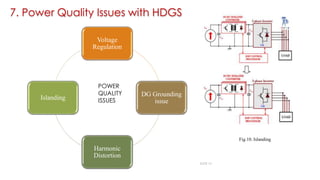
7.Power Quality Issues with HDGS
8.Distributed Power Generation Scenario in India
9.Successful HDGS ventures
10. Future research directions in HDGS
11.Conclusion
12.References
2
1.Introduction
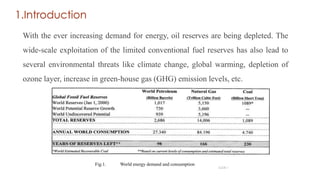
With the ever increasing demand for energy, oil reserves are being depleted. The
wide-scale exploitation of the limited conventional fuel reserves has also lead to
several environmental threats like climate change, global warming, depletion of
ozone layer, increase in green-house gas (GHG) emission levels, etc.
3
SLIDE 1
Fig.1. World energy demand and consumption
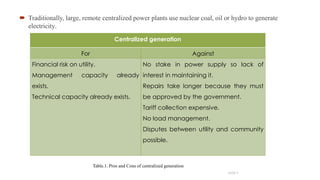
 Traditionally, large, remote centralized power plants use nuclear coal, oil or hydro to generate
electricity.
Centralized generation
For Against
Financial risk on utility.
Management capacity already
exists.
Technical capacity already exists.
No stake in power supply so lack of
interest in maintaining it.
Repairs take longer because they must
be approved by the government.
Tariff collection expensive.
No load management.
Disputes between utility and community
possible.
4
SLIDE 2
Table.1. Pros and Cons of centralized generation
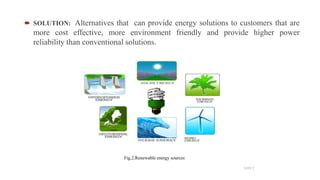
 SOLUTION: Alternatives that can provide energy solutions to customers that are
more cost effective, more environment friendly and provide higher power
reliability than conventional solutions.
5
SLIDE 3
Fig.2.Renewable energy sources
2.Hybrid Distributed Generation
Definition:
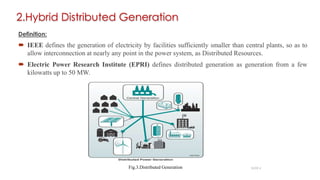
 IEEE defines the generation of electricity by facilities sufficiently smaller than central plants, so as to
allow interconnection at nearly any point in the power system, as Distributed Resources.
 Electric Power Research Institute (EPRI) defines distributed generation as generation from a few
kilowatts up to 50 MW.
6
SLIDE 4Fig.3.Distributed Generation
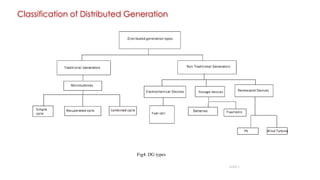
Classification of Distributed Generation
7
SLIDE 5
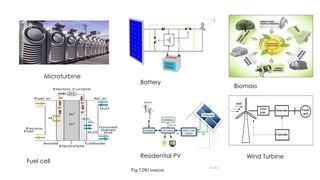
Fig4. DG types
8
SLIDE 6
Fig.5.DG sources
Microturbine
Battery
Biomass
Fuel cell
Residential PV Wind Turbine
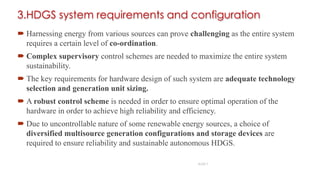
3.HDGS system requirements and configuration
 Harnessing energy from various sources can prove challenging as the entire system
requires a certain level of co-ordination.
 Complex supervisory control schemes are needed to maximize the entire system
sustainability.
 The key requirements for hardware design of such system are adequate technology
selection and generation unit sizing.
 A robust control scheme is needed in order to ensure optimal operation of the
hardware in order to achieve high reliability and efficiency.
 Due to uncontrollable nature of some renewable energy sources, a choice of
diversified multisource generation configurations and storage devices are
required to ensure reliability and sustainable autonomous HDGS.
9
SLIDE 7
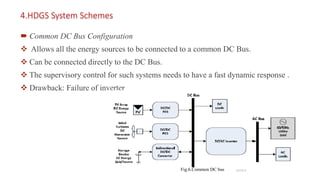
 Common DC Bus Configuration
 Allows all the energy sources to be connected to a common DC Bus.
 Can be connected directly to the DC Bus.
 The supervisory control for such systems needs to have a fast dynamic response .
 Drawback: Failure of inverter
4.HDGS System Schemes
10
SLIDE 8Fig.6.Common DC bus
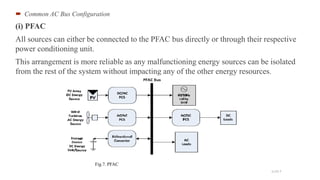
 Common AC Bus Configuration
(i) PFAC
All sources can either be connected to the PFAC bus directly or through their respective
power conditioning unit.
This arrangement is more reliable as any malfunctioning energy sources can be isolated
from the rest of the system without impacting any of the other energy resources.
11
SLIDE 9
Fig.7. PFAC
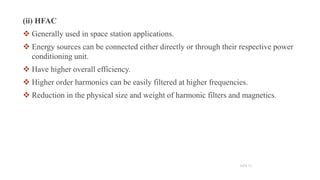
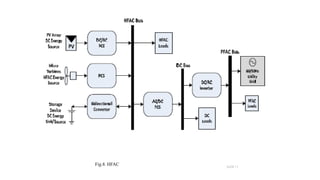
(ii) HFAC
 Generally used in space station applications.
 Energy sources can be connected either directly or through their respective power
conditioning unit.
 Have higher overall efficiency.
 Higher order harmonics can be easily filtered at higher frequencies.
 Reduction in the physical size and weight of harmonic filters and magnetics.
12
SLIDE 10
13
SLIDE 11
Fig.8. HFAC
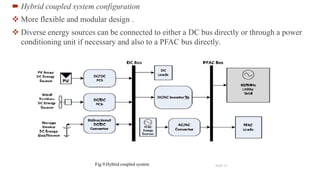
 Hybrid coupled system configuration
 More flexible and modular design .
 Diverse energy sources can be connected to either a DC bus directly or through a power
conditioning unit if necessary and also to a PFAC bus directly.
14
SLIDE 12Fig.9.Hybrid coupled system
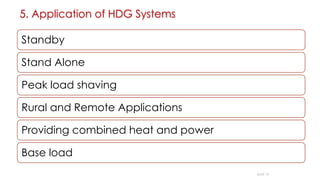
5. Application of HDG Systems
Standby
Stand Alone
Peak load shaving
Rural and Remote Applications
Providing combined heat and power
Base load
15
SLIDE 13
6. Benefits of HDGS
• Provide the required local load increase.
• Assembled easily anywhere as modules.
• Location flexibility.
• Reduce the wholesale power price.
(a) From the economical point of view:
• reduce the distribution power network losses, distribution load demands.
• system continuity and reliability .
• transmission capacity release.
• reduce output process emission.
(b) From operational point of view:
16
SLIDE 14
7. Power Quality Issues with HDGS
Voltage
Regulation
DG Grounding
issue
Harmonic
Distortion
Islanding
17
SLIDE 15
POWER
QUALITY
ISSUES
Fig.10. Islanding
 Inherent intermittent nature of renewable energy sources leading to relatively
lower capacity utilization factors.
 Relatively high capital costs when compared to conventional power systems
which in turn require incentives and financial arrangement for capacity building,
promotion and development of energy.
 Requirement of servicing companies for local program implementation.
 Need for adequate mobilization for payment of user charges involving perhaps
Non-Government Organizations and local bodies.
 Lack of operation and maintenance services providers is an issue that needs
attention.
 Need for developing sustainable revenue / business models.
 Assistance for project preparation.
18
SLIDE 16
8. Challenges with HDGS
9. Distributed Energy Scenario in India
 India was the first country in the world to set up a ministry of non-conventional
energy resources in early 1980s.
 India’s cumulative grid interactive or grid tied renewable energy capacity has
reached 29.9 GW.
 The Electricity Act, 2003 specifies distributed generation and supply through
stand-alone conventional and renewable energy systems.
 The National Electricity Policy notified on 12 February 2005 recommends to
provide a reliable rural electrification system, wherever conventional grid is not
feasible, decentralized distributed generation facilities (using conventional or non-
conventional sources of energy) together with local distribution network be
provided.
 The Rajiv Gandhi Grameen Vidyutikaran Yojna and the Remote Village
Electrification Scheme, will provide up to 90% capital subsidy for rural
electrification projects using decentralized distributed generation options based on
conventional and non-conventional fuels.
19
SLIDE 17
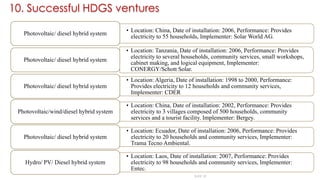
10. Successful HDGS ventures
• Location: China, Date of installation: 2006, Performance: Provides
electricity to 55 households, Implementer: Solar World AG.
Photovoltaic/ diesel hybrid system
• Location: Tanzania, Date of installation: 2006, Performance: Provides
electricity to several households, community services, small workshops,
cabinet making, and logical equipment, Implementer:
CONERGY/Schott Solar.
Photovoltaic/ diesel hybrid system
• Location: Algeria, Date of installation: 1998 to 2000, Performance:
Provides electricity to 12 households and community services,
Implementer: CDER
Photovoltaic/ diesel hybrid system
• Location: China, Date of installation: 2002, Performance: Provides
electricity to 3 villages composed of 500 households, community
services and a tourist facility. Implementer: Bergey.
Photovoltaic/wind/diesel hybrid system
• Location: Ecuador, Date of installation: 2006, Performance: Provides
electricity to 20 households and community services, Implementer:
Trama Tecno Ambiental.
Photovoltaic/ diesel hybrid system
• Location: Laos, Date of installation: 2007, Performance: Provides
electricity to 98 households and community services, Implementer:
Entec.
Hydro/ PV/ Diesel hybrid system
20
SLIDE 18
SLIDE 19
21
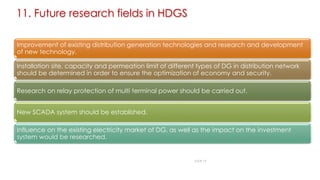
11. Future research fields in HDGS
Improvement of existing distribution generation technologies and research and development
of new technology.
Installation site, capacity and permeation limit of different types of DG in distribution network
should be determined in order to ensure the optimization of economy and security.
Research on relay protection of multi terminal power should be carried out.
New SCADA system should be established.
Influence on the existing electricity market of DG, as well as the impact on the investment
system would be researched.
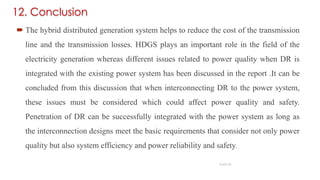
 The hybrid distributed generation system helps to reduce the cost of the transmission
line and the transmission losses. HDGS plays an important role in the field of the
electricity generation whereas different issues related to power quality when DR is
integrated with the existing power system has been discussed in the report .It can be
concluded from this discussion that when interconnecting DR to the power system,
these issues must be considered which could affect power quality and safety.
Penetration of DR can be successfully integrated with the power system as long as
the interconnection designs meet the basic requirements that consider not only power
quality but also system efficiency and power reliability and safety.
SLIDE 20
12. Conclusion
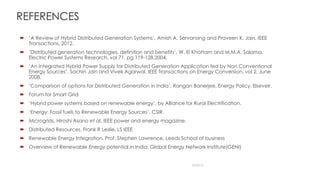
REFERENCES
 ‘A Review of Hybrid Distributed Generation Systems’, Amish A. Servansing and Praveen K. Jain, IEEE
Transactions, 2012.
 ‘Distributed generation technologies, definition and benefits’, W. El Khattam and M.M.A. Salama,
Electric Power Systems Research, vol 71, pg 119-128,2004.
 ‘An Integrated Hybrid Power Supply for Distributed Generation Application fed by Non Conventional
Energy Sources’, Sachin Jain and Vivek Agarwal, IEEE Transactions on Energy Conversion, vol 2, June
2008.
 ‘Comparison of options for Distributed Generation in India’, Rangan Banerjee, Energy Policy, Elseveir.
 Forum for Smart Grid
 ‘Hybrid power systems based on renewable energy’, by Alliance for Rural Electrification.
 ‘Energy: Fossil fuels to Renewable Energy Sources’, CSIR.
 Microgrids, Hiroshi Asano et al, IEEE power and energy magazine.
 Distributed Resources, Frank R Leslie, LS IEEE
 Renewable Energy Integration, Prof. Stephen Lawrence, Leeds School of business
 Overview of Renewable Energy potential in India, Global Energy Network Institute(GENI)
23
SLIDE 21

Hybrid distributed generation

  • 1.
    Hybrid Distributed Generation Systems Presentedby: Satabdy Jena Roll No.T14EE003 M.Tech (Power & Energy Systems) Department of Electrical and Electronics Engineering NATIONAL INSTITUTE OF TECHNOLOGY, MEGHALAYA
  • 2.
    Outline 1.Introduction 2.Hybrid Distributed GenerationSystems (HDGS) 3.HDGS Requirements and system configurations 4.HDGS Schemes 5.Application of HDGS 6.Benefits of HDGS 7.Power Quality Issues with HDGS 8.Distributed Power Generation Scenario in India 9.Successful HDGS ventures 10. Future research directions in HDGS 11.Conclusion 12.References 2
  • 3.
    1.Introduction With the everincreasing demand for energy, oil reserves are being depleted. The wide-scale exploitation of the limited conventional fuel reserves has also lead to several environmental threats like climate change, global warming, depletion of ozone layer, increase in green-house gas (GHG) emission levels, etc. 3 SLIDE 1 Fig.1. World energy demand and consumption
  • 4.
     Traditionally, large,remote centralized power plants use nuclear coal, oil or hydro to generate electricity. Centralized generation For Against Financial risk on utility. Management capacity already exists. Technical capacity already exists. No stake in power supply so lack of interest in maintaining it. Repairs take longer because they must be approved by the government. Tariff collection expensive. No load management. Disputes between utility and community possible. 4 SLIDE 2 Table.1. Pros and Cons of centralized generation
  • 5.
     SOLUTION: Alternativesthat can provide energy solutions to customers that are more cost effective, more environment friendly and provide higher power reliability than conventional solutions. 5 SLIDE 3 Fig.2.Renewable energy sources
  • 6.
    2.Hybrid Distributed Generation Definition: IEEE defines the generation of electricity by facilities sufficiently smaller than central plants, so as to allow interconnection at nearly any point in the power system, as Distributed Resources.  Electric Power Research Institute (EPRI) defines distributed generation as generation from a few kilowatts up to 50 MW. 6 SLIDE 4Fig.3.Distributed Generation
  • 7.
    Classification of DistributedGeneration 7 SLIDE 5 Fig4. DG types
  • 8.
  • 9.
    3.HDGS system requirementsand configuration  Harnessing energy from various sources can prove challenging as the entire system requires a certain level of co-ordination.  Complex supervisory control schemes are needed to maximize the entire system sustainability.  The key requirements for hardware design of such system are adequate technology selection and generation unit sizing.  A robust control scheme is needed in order to ensure optimal operation of the hardware in order to achieve high reliability and efficiency.  Due to uncontrollable nature of some renewable energy sources, a choice of diversified multisource generation configurations and storage devices are required to ensure reliability and sustainable autonomous HDGS. 9 SLIDE 7
  • 10.
     Common DCBus Configuration  Allows all the energy sources to be connected to a common DC Bus.  Can be connected directly to the DC Bus.  The supervisory control for such systems needs to have a fast dynamic response .  Drawback: Failure of inverter 4.HDGS System Schemes 10 SLIDE 8Fig.6.Common DC bus
  • 11.
     Common ACBus Configuration (i) PFAC All sources can either be connected to the PFAC bus directly or through their respective power conditioning unit. This arrangement is more reliable as any malfunctioning energy sources can be isolated from the rest of the system without impacting any of the other energy resources. 11 SLIDE 9 Fig.7. PFAC
  • 12.
    (ii) HFAC  Generallyused in space station applications.  Energy sources can be connected either directly or through their respective power conditioning unit.  Have higher overall efficiency.  Higher order harmonics can be easily filtered at higher frequencies.  Reduction in the physical size and weight of harmonic filters and magnetics. 12 SLIDE 10
  • 13.
  • 14.
     Hybrid coupledsystem configuration  More flexible and modular design .  Diverse energy sources can be connected to either a DC bus directly or through a power conditioning unit if necessary and also to a PFAC bus directly. 14 SLIDE 12Fig.9.Hybrid coupled system
  • 15.
    5. Application ofHDG Systems Standby Stand Alone Peak load shaving Rural and Remote Applications Providing combined heat and power Base load 15 SLIDE 13
  • 16.
    6. Benefits ofHDGS • Provide the required local load increase. • Assembled easily anywhere as modules. • Location flexibility. • Reduce the wholesale power price. (a) From the economical point of view: • reduce the distribution power network losses, distribution load demands. • system continuity and reliability . • transmission capacity release. • reduce output process emission. (b) From operational point of view: 16 SLIDE 14
  • 17.
    7. Power QualityIssues with HDGS Voltage Regulation DG Grounding issue Harmonic Distortion Islanding 17 SLIDE 15 POWER QUALITY ISSUES Fig.10. Islanding
  • 18.
     Inherent intermittentnature of renewable energy sources leading to relatively lower capacity utilization factors.  Relatively high capital costs when compared to conventional power systems which in turn require incentives and financial arrangement for capacity building, promotion and development of energy.  Requirement of servicing companies for local program implementation.  Need for adequate mobilization for payment of user charges involving perhaps Non-Government Organizations and local bodies.  Lack of operation and maintenance services providers is an issue that needs attention.  Need for developing sustainable revenue / business models.  Assistance for project preparation. 18 SLIDE 16 8. Challenges with HDGS
  • 19.
    9. Distributed EnergyScenario in India  India was the first country in the world to set up a ministry of non-conventional energy resources in early 1980s.  India’s cumulative grid interactive or grid tied renewable energy capacity has reached 29.9 GW.  The Electricity Act, 2003 specifies distributed generation and supply through stand-alone conventional and renewable energy systems.  The National Electricity Policy notified on 12 February 2005 recommends to provide a reliable rural electrification system, wherever conventional grid is not feasible, decentralized distributed generation facilities (using conventional or non- conventional sources of energy) together with local distribution network be provided.  The Rajiv Gandhi Grameen Vidyutikaran Yojna and the Remote Village Electrification Scheme, will provide up to 90% capital subsidy for rural electrification projects using decentralized distributed generation options based on conventional and non-conventional fuels. 19 SLIDE 17
  • 20.
    10. Successful HDGSventures • Location: China, Date of installation: 2006, Performance: Provides electricity to 55 households, Implementer: Solar World AG. Photovoltaic/ diesel hybrid system • Location: Tanzania, Date of installation: 2006, Performance: Provides electricity to several households, community services, small workshops, cabinet making, and logical equipment, Implementer: CONERGY/Schott Solar. Photovoltaic/ diesel hybrid system • Location: Algeria, Date of installation: 1998 to 2000, Performance: Provides electricity to 12 households and community services, Implementer: CDER Photovoltaic/ diesel hybrid system • Location: China, Date of installation: 2002, Performance: Provides electricity to 3 villages composed of 500 households, community services and a tourist facility. Implementer: Bergey. Photovoltaic/wind/diesel hybrid system • Location: Ecuador, Date of installation: 2006, Performance: Provides electricity to 20 households and community services, Implementer: Trama Tecno Ambiental. Photovoltaic/ diesel hybrid system • Location: Laos, Date of installation: 2007, Performance: Provides electricity to 98 households and community services, Implementer: Entec. Hydro/ PV/ Diesel hybrid system 20 SLIDE 18
  • 21.
    SLIDE 19 21 11. Futureresearch fields in HDGS Improvement of existing distribution generation technologies and research and development of new technology. Installation site, capacity and permeation limit of different types of DG in distribution network should be determined in order to ensure the optimization of economy and security. Research on relay protection of multi terminal power should be carried out. New SCADA system should be established. Influence on the existing electricity market of DG, as well as the impact on the investment system would be researched.
  • 22.
     The hybriddistributed generation system helps to reduce the cost of the transmission line and the transmission losses. HDGS plays an important role in the field of the electricity generation whereas different issues related to power quality when DR is integrated with the existing power system has been discussed in the report .It can be concluded from this discussion that when interconnecting DR to the power system, these issues must be considered which could affect power quality and safety. Penetration of DR can be successfully integrated with the power system as long as the interconnection designs meet the basic requirements that consider not only power quality but also system efficiency and power reliability and safety. SLIDE 20 12. Conclusion
  • 23.
    REFERENCES  ‘A Reviewof Hybrid Distributed Generation Systems’, Amish A. Servansing and Praveen K. Jain, IEEE Transactions, 2012.  ‘Distributed generation technologies, definition and benefits’, W. El Khattam and M.M.A. Salama, Electric Power Systems Research, vol 71, pg 119-128,2004.  ‘An Integrated Hybrid Power Supply for Distributed Generation Application fed by Non Conventional Energy Sources’, Sachin Jain and Vivek Agarwal, IEEE Transactions on Energy Conversion, vol 2, June 2008.  ‘Comparison of options for Distributed Generation in India’, Rangan Banerjee, Energy Policy, Elseveir.  Forum for Smart Grid  ‘Hybrid power systems based on renewable energy’, by Alliance for Rural Electrification.  ‘Energy: Fossil fuels to Renewable Energy Sources’, CSIR.  Microgrids, Hiroshi Asano et al, IEEE power and energy magazine.  Distributed Resources, Frank R Leslie, LS IEEE  Renewable Energy Integration, Prof. Stephen Lawrence, Leeds School of business  Overview of Renewable Energy potential in India, Global Energy Network Institute(GENI) 23 SLIDE 21