Distributed Generation
Development of the Electrical Power
System
• In the early days of electricity supply, each town or
city would have its own small generating station
supplying local loads.
Development of the Electrical Power
System
• But, now in classical power systems, which have
been developed, over the past 70 years, large
power generation plants are located at adequate
geographical places to produce most of the
power, which is then transferred towards large
consumption centers over long distance
transmission lines.
• This model gave way to the present centralized
system largely because of economies of scale.
Development of the Electrical Power
System
• Also, there was the desire to sequester
electricity generation facilities away from
population centers for environmental
reasons and to locate them closer to the
source of fuel and water.
Conventional Power System Network
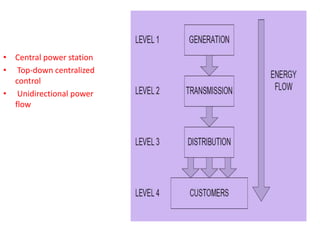
• Central power station
• Top-down centralized
control
• Unidirectional power
flow
Conventional Power System Network
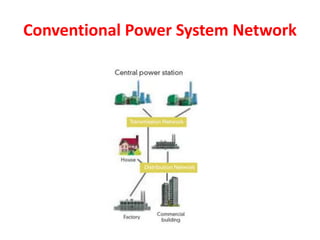
• For more than 7 decades, the norm for the
electric power industry in developed nations has
been to generate power in large, centralized
generating stations and to distribute the power
to end users through transformers, transmission
lines, and distribution lines.
• This is often collectively referred to as the
“wires” system in DG literature.
• Let us see what can go wrong with delivery of
power by wires.
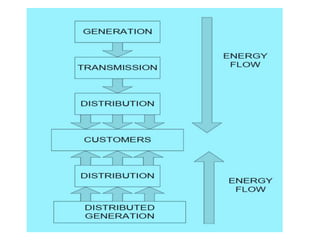
Distributed Generation
• Energy source integrated at distribution level is
termed as distributed generation (DG).
• They are distributed throughout the power
system closer to the loads.
• Distributed generation may be connected at a
number of voltage levels from 120/230 V to 150
KV.
• Generators larger than 10 MW are
Interconnected at transmission voltages.
Distributed Generation
• The normal distribution system delivers
electric energy through wires from a single
source of power to a multitude of loads.
• Thus, several power quality issues arise when
there are multiple sources.
• Will DG improve the power quality or will it
degrade the service end users have come to
expect?
Resurgence of DG
• To foster energy independence:
• Tax credits were given, and power was purchased at
avoided cost rates to spur development of renewable
and energy-efficient, low-emissions technologies.
• This led to a spurt in the development of wind, solar,
and geothermal generation as well as gas-fired
cogeneration (combined heat and power) facilities.
• In the mid-1990s, interest in DG once again peaked
with the development of improved DG technologies
and the deregulation of the power industry allowing
more power producers to participate in the market.
Resurgence of DG
• Also, the appearance of critical high-
technology loads requiring much greater
reliability than can be achieved by wire
delivery alone has created a demand for local
generation and storage to fill the gap.
• Some futurists see a return to a high-tech
version of the original power system model.
Resurgence of DG
• New technologies would allow the generation to
be as widely dispersed as the load and
interconnected power grids could be small (i.e.,
microgrids).
• The generation would be powered by renewable
resources or clean-burning, high-efficiency
technologies.
• Energy distribution will be shifted from wires to
pipes containing some type of fuel, which many
think will ultimately be hydrogen.
DG benefits
• End-user perspective
• Distribution utility perspective.
• Commercial power producer perspective.
End-user perspective
• This is where most of the value for DG is found
today.
• End users who place a high value on electric
power can generally benefit greatly by having
backup generation to provide improved
reliability.
• End users may also be able to receive
compensation for making their generation
capacity available to the power system in areas
where there are potential power shortages.
End-user perspective
• Benefit in high-efficiency applications such as
combined heat and power, where the total
energy bill is reduced.
Combined Heat and Power (CHP)
• Combined Heat and Power (CHP) - Also referred
to as Cooling, Heating, and Power or
cogeneration.
• This DG technology is operated at least 6,000
hours per year to allow a facility to generate
some or all of its power.
• A portion of the DG waste heat is used for water
heating, space heating, steam generation or
other thermal needs.
• In some instances this thermal energy can also
be used to operate special cooling equipment.
Combined Heat and Power (CHP)
• Important DG characteristics for combined heat and
power include: · High useable thermal output (leading
to high overall efficiency), · Low variable maintenance
costs, and · Low emissions.
• CHP characteristics are similar to those of Continuous
Power, and thus the two applications have almost
identical customer profiles, though the high thermal
demand necessary here is not a requisite for
Continuous Power applications.
• As with Continuous Power, CHP is most commonly
used by industry clients, with a small portion of
overall installations in the commercial sector
Distribution utility perspective
• The distribution utility is interested in selling
power to end users through its existing network
of lines and substations.
• DG can be used for transmission and distribution
(T&D) capacity relief.
• In most cases, this application has a limited life
until the load grows sufficiently to justify
building new T&D facilities.
• Thus, DG serves as a hedge against uncertain
load growth. It also can serve as a hedge against
high price spikes on the power market (if
permitted by regulatory agencies).
Commercial power producer
perspective
• Those looking at DG from this perspective are mainly
interested in selling power or ancillary services into
the area power market.
• In the sense that DG is discussed here, most units are
too small to bid individually in the power markets.
• Commercial aggregators will bid the capacities of
several units.
• The DG may be directly interconnected into the grid
or simply serve the load off-grid.
• The latter avoids many of the problems associated
with interconnection but does not allow the full
capacity of the DG to be utilized.
Disadvantages of DG.
• Utilities are concerned with power quality issues.
• End users should be mainly concerned about costs
and maintenance.
• Do end users really want to operate generators?
• Will electricity actually cost less and be more reliable?
• Will power markets continue to be favorable toward
DG?
• There are many unanswered questions.
• However, it seems likely that the amount of DG
interconnected with the utility system will continue to
increase for the foreseeable future.
DG Technologies
• Reciprocating engine genset
• Combustion (gas) turbines
• Fuel cells
• Wind turbines
• Photovoltaic systems

Distributed generation.pptx

  • 1.
  • 2.
    Development of theElectrical Power System • In the early days of electricity supply, each town or city would have its own small generating station supplying local loads.
  • 3.
    Development of theElectrical Power System • But, now in classical power systems, which have been developed, over the past 70 years, large power generation plants are located at adequate geographical places to produce most of the power, which is then transferred towards large consumption centers over long distance transmission lines. • This model gave way to the present centralized system largely because of economies of scale.
  • 4.
    Development of theElectrical Power System • Also, there was the desire to sequester electricity generation facilities away from population centers for environmental reasons and to locate them closer to the source of fuel and water.
  • 5.
  • 6.
    • Central powerstation • Top-down centralized control • Unidirectional power flow
  • 7.
    Conventional Power SystemNetwork • For more than 7 decades, the norm for the electric power industry in developed nations has been to generate power in large, centralized generating stations and to distribute the power to end users through transformers, transmission lines, and distribution lines. • This is often collectively referred to as the “wires” system in DG literature. • Let us see what can go wrong with delivery of power by wires.
  • 8.
    Distributed Generation • Energysource integrated at distribution level is termed as distributed generation (DG). • They are distributed throughout the power system closer to the loads. • Distributed generation may be connected at a number of voltage levels from 120/230 V to 150 KV. • Generators larger than 10 MW are Interconnected at transmission voltages.
  • 10.
    Distributed Generation • Thenormal distribution system delivers electric energy through wires from a single source of power to a multitude of loads. • Thus, several power quality issues arise when there are multiple sources. • Will DG improve the power quality or will it degrade the service end users have come to expect?
  • 11.
    Resurgence of DG •To foster energy independence: • Tax credits were given, and power was purchased at avoided cost rates to spur development of renewable and energy-efficient, low-emissions technologies. • This led to a spurt in the development of wind, solar, and geothermal generation as well as gas-fired cogeneration (combined heat and power) facilities. • In the mid-1990s, interest in DG once again peaked with the development of improved DG technologies and the deregulation of the power industry allowing more power producers to participate in the market.
  • 12.
    Resurgence of DG •Also, the appearance of critical high- technology loads requiring much greater reliability than can be achieved by wire delivery alone has created a demand for local generation and storage to fill the gap. • Some futurists see a return to a high-tech version of the original power system model.
  • 13.
    Resurgence of DG •New technologies would allow the generation to be as widely dispersed as the load and interconnected power grids could be small (i.e., microgrids). • The generation would be powered by renewable resources or clean-burning, high-efficiency technologies. • Energy distribution will be shifted from wires to pipes containing some type of fuel, which many think will ultimately be hydrogen.
  • 14.
    DG benefits • End-userperspective • Distribution utility perspective. • Commercial power producer perspective.
  • 15.
    End-user perspective • Thisis where most of the value for DG is found today. • End users who place a high value on electric power can generally benefit greatly by having backup generation to provide improved reliability. • End users may also be able to receive compensation for making their generation capacity available to the power system in areas where there are potential power shortages.
  • 16.
    End-user perspective • Benefitin high-efficiency applications such as combined heat and power, where the total energy bill is reduced.
  • 17.
    Combined Heat andPower (CHP) • Combined Heat and Power (CHP) - Also referred to as Cooling, Heating, and Power or cogeneration. • This DG technology is operated at least 6,000 hours per year to allow a facility to generate some or all of its power. • A portion of the DG waste heat is used for water heating, space heating, steam generation or other thermal needs. • In some instances this thermal energy can also be used to operate special cooling equipment.
  • 18.
    Combined Heat andPower (CHP) • Important DG characteristics for combined heat and power include: · High useable thermal output (leading to high overall efficiency), · Low variable maintenance costs, and · Low emissions. • CHP characteristics are similar to those of Continuous Power, and thus the two applications have almost identical customer profiles, though the high thermal demand necessary here is not a requisite for Continuous Power applications. • As with Continuous Power, CHP is most commonly used by industry clients, with a small portion of overall installations in the commercial sector
  • 19.
    Distribution utility perspective •The distribution utility is interested in selling power to end users through its existing network of lines and substations. • DG can be used for transmission and distribution (T&D) capacity relief. • In most cases, this application has a limited life until the load grows sufficiently to justify building new T&D facilities. • Thus, DG serves as a hedge against uncertain load growth. It also can serve as a hedge against high price spikes on the power market (if permitted by regulatory agencies).
  • 20.
    Commercial power producer perspective •Those looking at DG from this perspective are mainly interested in selling power or ancillary services into the area power market. • In the sense that DG is discussed here, most units are too small to bid individually in the power markets. • Commercial aggregators will bid the capacities of several units. • The DG may be directly interconnected into the grid or simply serve the load off-grid. • The latter avoids many of the problems associated with interconnection but does not allow the full capacity of the DG to be utilized.
  • 21.
    Disadvantages of DG. •Utilities are concerned with power quality issues. • End users should be mainly concerned about costs and maintenance. • Do end users really want to operate generators? • Will electricity actually cost less and be more reliable? • Will power markets continue to be favorable toward DG? • There are many unanswered questions. • However, it seems likely that the amount of DG interconnected with the utility system will continue to increase for the foreseeable future.
  • 22.
    DG Technologies • Reciprocatingengine genset • Combustion (gas) turbines • Fuel cells • Wind turbines • Photovoltaic systems